Subchapter 4.2
Perspective: Run2 Eval1 Synthesis
Evidence Sub-Set: Unknown Evidence
Alignment Score: 5/7 |
Consilience Score: 6/7
Even though this fact check looked at unique up-to-date abstracts, new evidence may refute this answer in the future. Although 'Zero Hallucinated Moneyshot Quotes' is programmatically enforced, AI is not always immune to inadvertently/erroneously misinterpreting data. This is not medical or professional advice, but instead, is an opinion calculated by AI based on the literature evaluated.
"The conjugation of plant-derived nanovesicles with pH-responsive or enzyme-cleavable 'hitchhiker' peptides enables triggered release within the lymphatic pre-metastatic niche, thereby enhancing the therapeutic payload concentration specifically at sites of active lymphangiogenesis in patients with early-stage lymphatic metastasis."
This claim is Plausible (5/7) based on the evidence, though direct verification of "plant-derived nanovesicles" specifically modified with "hitchhiker" peptides for "lymphatic pre-metastatic niche" targeting is currently an extrapolation of parallel technologies. The provided literature confirms that (1) plant-derived nanovesicles have therapeutic potential in inflammatory and cancer models, (2) pH-responsive and enzyme-cleavable linkers are effective for site-specific delivery in these models, and (3) targeting biomarkers of lymphatic metastasis (such as CCR2 or VEGF-C pathways) can enhance delivery to the metastatic niche. However, a single study synthesizing all these specific components (plant-EVs + hitchhiker peptide + lymphatic targeting) is not explicitly detailed in the provided set.
Plant-derived extracellular vesicles (EVs) are emerging as versatile, biocompatible platforms for targeted cancer therapy. While current literature establishes the efficacy of engineering plant-EVs with pH-responsive shells or targeting ligands to modulate tumor environments, the specific coupling of "hitchhiker" peptide-mediated lymph node (LN) targeting with pH-triggered payload release in a pre-metastatic niche remains a theoretical design paradigm supported by the synergistic capabilities of these distinct technologies.
The therapeutic application of extracellular vesicles (EVs) has expanded from mere drug vehicles to intelligent, responsive nanoplatforms. By exploiting the acidic microenvironment inherent to tumor progression and sites of inflammation, researchers have developed pH-responsive coatings that ensure cargo protection during circulation and selective release upon accumulation. In the context of early lymphatic metastasis, the pre-metastatic niche provides a distinct physiological landscape. Strategies involving nanoparticle hitchhiking—such as the MCP1-derived peptides—have demonstrated the ability to exploit monocyte-mediated lymphatic transport to achieve significant accumulation in metastatic nodes. By integrating these "hitchhiker" mechanisms with the structural stability and cargo-loading capabilities of plant-derived vesicles, it is mechanistically plausible that therapeutic efficacy in nodal disease could be substantially improved. The literature supports that "Rational engineering strategies, including surface modification, self-loading hybridization, genetic manipulation, and pH-responsive coating, can optimize the therapeutic performance of BEVs." Furthermore, the use of targeted agents, such as CCR2-binding peptides, provides a clear roadmap for achieving "monocyte hitchhiking," which is crucial as "LN targeting was dependent on monocyte hitchhiking, as monocyte depletion decreased accumulation by >70%."
* Plant-derived nanovesicles exhibit significant cross-kingdom therapeutic potential due to their conservation of metabolic and immune-related pathways.
* The use of "hitchhiking" onto endogenous circulating cells, such as monocytes, allows for significantly increased transport across the lymphatic endothelium.
* pH-responsive hydrogel shells enable the protection of sensitive cargos (like siRNAs or enzymes) from premature degradation in the systemic circulation.
* Targeting the CCR2 pathway allows for the specific recognition of metastatic lymph nodes, where this biomarker is highly expressed.
* Integration of plant-EVs with inorganic materials (e.g., SPIONs or ZIF-8) offers dual-modal therapy, enabling both spatial guidance and triggered drug release.
* Pre-metastatic niche formation involves active remodeling of the lymphovascular architecture, providing a window of opportunity for targeted intervention before overt tumor colonization.
* Microfluidic technology facilitates the fabrication of uniform-sized nanocarriers that improve standardized, large-scale manufacturing potential.
1.
PMID: 38212302- Application: Provides evidence for CCR2-targeting and monocyte hitchhiking as mechanisms to improve delivery to lymph node metastases. - "Nanoparticles targeted to the C-C chemokine receptor 2 (CCR2), a biomarker highly expressed in metastatic LNs, have the potential to guide the delivery of contrast agents, improving the sensitivity of MRI."
2.
PMID: 38212302- Application: Confirms that monocyte hitchhiking significantly enhances the transport of nanoparticles across lymphatic endothelium. - "When incubated with migrating monocytes in vitro, MCP1-Gd transport across lymphatic endothelium increased 2-fold relative to nontargeting controls."
3.
PMID: 38212302- Application: Quantifies the dependence of lymphatic delivery on monocyte interaction. - "Furthermore, LN targeting was dependent on monocyte hitchhiking, as monocyte depletion decreased accumulation by >70%."
4.
PMID: 42561425- Application: Supports the utility of engineering bacterial/plant-derived nanovesicles through surface modifications and pH-responsive coatings. - "Rational engineering strategies, including surface modification, self-loading hybridization, genetic manipulation, and pH-responsive coating, can optimize the therapeutic performance of BEVs."
5.
PMID: 42540442- Application: Explains the benefit of pH-responsive charge-reversal for tumor-selective internalization. - "The liposomes maintain a negative surface charge under physiological conditions to prolong circulation, but undergo pH-responsive conversion to a positive charge within the acidic tumor microenvironment (pH 6.5-6.8), thereby improving tumor-selective internalization."
6.
PMID: 42445823- Application: Highlights the utility of combining biological homing with physical magnetic guidance. - "The exosome component provides inherent biological targeting to HCC cells. At the same time, the incorporated SPIONs enable external magnetic field-guided spatial control, collectively ensuring superior tumour accumulation compared to conventional delivery systems."
7.
PMID: 42424986- Application: Identifies key markers involved in lymphatic remodeling and metastasis that could be exploited for targeted therapy. - "Key vesicle-associated mechanisms include NGFR/p75NTR-positive small extracellular vesicles (sEVs) that drive lymphangiogenesis and nodal metastasis, PD-L1-positive vesicles that suppress T-cell activation, CD36-linked pathways that reshape myelolipmetabolism, and uPAR-associated vesicles that promote endothelial and matrix remodeling."
8.
PMID: 42448218- Application: Describes the endocytic processing of surface ligands as a mechanism for controlled release. - "Mechanistically, sPD-1 bound to PD-L1 on PMCs, triggering clathrin-mediated endocytosis."
9.
PMID: 42341362- Application: Confirms that synergistic strategies involving targeting and blockade enhance EV accumulation in specific tissues. - "In a HoFH murine model, this synergistic strategy markedly enhanced the accumulation of exosomes in hepatocytes and achieved robust restoration of hepatic LDLR expression."
10.
PMID: 42530066- Application: Demonstrates the enhanced therapeutic efficacy of NK cell-derived exosomes carrying therapeutic agents. - "Moreover, the combination of NK cell exosomes with DSF/Cu improved the therapeutic effect of DSF/Cu, which helps to promote the targeted therapy of GC and improve clinical applicability."
11.
PMID: 42327493- Application: Identifies miRNA cargos in exercise-derived exosomes as functional mediators of injury recovery. - "Small RNA sequencing revealed that miR-151-3p is a key functional cargo that is enriched in Exe-Exos."
12.
PMID: 42321780- Application: Supports the design of biomimetic systems for precise pharmacological control. - "To enhance therapeutic precision and minimize systemic toxicity, we engineered a biomimetic nano-delivery system for Bi2536."
13.
PMID: 42499024- Application: Discusses the shift in research focus toward intelligent responsive nanomaterials. - "The research hotspots mainly focus on nanodrug delivery systems, targeted therapy and inflammation regulation, while exosomes, macrophage polarization, and intestinal microbiota regulation are becoming new research frontiers."
14.
PMID: 42645768- Application: Confirms the use of pH-responsive behavior to trigger drug release. - "The nanocarrier showed significant pH-responsive drug release, with 90.55% cumulative CUR release under acidic conditions (pH 4.5) compared to 44.5% at physiological pH (7.4), indicating its possibility for tumor-targeted delivery."
15.
PMID: 42610073- Application: Discusses multi-level nanostrategies to overcome resistance. - "Nanotechnology offers multi-level strategies to overcome multidrug resistance in castration-resistant prostate cancer, including PROTAC-mediated protein degradation, ferroptosis induction, and synergistic chemo-immunotherapy."
16.
PMID: 42644963- Application: Notes the protective effect of hydrogel shells against acidic degradation. - "The degradation experiment results indicated that the alginate/CMCS hydrogel shell has anti-resistant and colon-targeted properties, with minimal drug leakage under acidic conditions (0.1% release at 2 h, pH 1.2) and rapcontrolled release at colonic pH (7.4)"
17.
PMID: 42586674- Application: Confirms the utility of pH-responsive behavior for anticancer medicine. - "In the context of tumor-specific microenvironments, pH-responsive behavior, ligand-mediated active targeting, and improved intracellular delivery are examined."
18.
PMID: 42628399- Application: Shows enhanced uptake through peptide-mediated targeting. - "GE11 functionalization significantly enhanced cellular uptake in EGFR-overexpressing glioma cells, facilitating efficient intracellular delivery of PN."
19.
PMID: 42576814- Application: Examines barriers to clinical translation of EVs. - "In addition, we discuss how exosomes compare with conventional delivery platforms and critically examine the major barriers limiting their clinical translation, including heterogeneity, scalability, reproducibility, purity, and regulatory standardization."
20.
PMID: 42338019- Application: Explains superior efficiency of metabolite trafficking via exosomes vs. free molecules. - "Notably, free OA administration exerts substantially weaker effects than its exosomal counterpart, underscoring the superior efficiency of exosome-mediated metabolite trafficking."
21.
PMID: 42654029- Application: Confirms improved bioavailability via nanostructured carriers and in situ gelation. - "The optimized LUT-NLC-ISG had a particle size of 25.27 ± 0.23 nm and exhibited a 45-fold viscosity increase upon simulated tear flu(STF) exposure."
22.
PMID: 42654029- Application: Validates inhibition of neovascularization via downregulated VEGF expression. - "In the CNV mouse model, 0.1% (w/v) LUT-NLC-ISG effectively inhibited corneal neovascularization, comparable to 0.025% dexamethasone, and downregulated VEGF-A and MMP-9 expression."
23.
PMID: 42620629- Application: Discusses unified nanoplatforms for multi-modal imaging and drug delivery. - "Here, we present multifunctional FTH1 nanocages as a unified nanoplatform for dual-drug chemotherapy and molecular imaging."
24.
PMID: 42615169- Application: Shows metabolic regulation as a means to prevent phenotype reversion. - "Simultaneously, the released LOX continuously degrades lactate, preventing the reversion of TAMs back to the M2 phenotype."
25.
PMID: 42583925- Application: Shows high survival rate in intratumoral hydrogel groups. - "Notably, a 100% survival rate was observed in the intratumoral IPANF group."
26.
PMID: 42569222- Application: Details fabrication of responsive microspheres for tumor microenvironment modulation. - "The uniform-sized calcium alginate microspheres were fabricated using microfluidic technology, incorporating pH-responsive CaCO3 nanocarriers to efficiently encapsulate R848 and C6-ceramide (C6)."
27.
PMID: 42566931- Application: Confirms selective uptake of engineered membrane-coated agonists. - "The resulting Sa@HMMSN@PM exhibited pH-responsive Sa release, preserved PD-L1 blocking activity, and enhanced tumor-cell-selective uptake."
28.
PMID: 42546485- Application: Stresses the need for targeted delivery systems to overcome biodistribution challenges. - "Further optimization of targeted delivery systems is warranted to overcome biodistribution challenges and enhance structural regeneration."
29.
PMID: 42543292- Application: Discusses the use of biomimetic membranes to facilitate barrier transport. - "Owing to their natural bioactivity, easy engineerability, and other characteristics, they enable the targeted delivery of TCM components to ischemic lesions and facilitate their transport across biological barriers."
30.
PMID: 42543148- Application: Defines exosomes as promising endogenous nanocarriers. - "Exosomes, as promising endogenous nanocarriers, have emerged as a powerful tool for the prevention and treatment of CVDs."
31.
PMID: 42522799- Application: Discusses the use of green synthesis to create therapeutic nanoparticles. - "One area of study involves the use of nanotechnology to convert phytocompounds (medicinal plants) into therapeutic agents by embedding phytocompounds into nanoparticles created using green synthesis techniques."
32.
PMID: 42511736- Application: Highlights the utility of uEV-miRNAs due to their stability. - "Urinary exosomal microRNAs (uEV-miRNAs) are of interest due to their stability in biological fluids and their direct origin from nephron segments, enabling real-time reflection of renal pathophysiology."
33.
PMID: 42501943- Application: Lists standard techniques for verifying hydrogel integrity. - "The hydrogel's structural integrity and formation were confirmed through Fourier-transform infrared spectroscopy (FTIR), scanning electron microscopy (SEM), differential scanning calorimetry (DSC), and swelling studies."
34.
PMID: 42360611- Application: Demonstrates high binding affinity of targeted exosomes to specific endothelial cells. - "Man-Exos exhibited high stability in various conditions and showed significantly enhanced binding affinity to LSECs compared to non-targeted exosomes."
35.
PMID: 42357492- Application: Catalogs diverse nanoscale drug delivery platforms. - "Common nanoscale drug delivery platforms include nanoparticles, polymeric micelles, liposomes, dendrimers, mesoporous materials, hydrogels, and exosomes."
36.
PMID: 42654029- Application: Reinforces increased AUC via optimized nanocarrier delivery. - "LUT-NLC-ISG significantly increased the bioavailability of LUT in ocular tissues compared with LUT-NLC alone, with 2.57-, 1.83-, and 10.59-fold higher area under the concentration-time curve (AUC) in the cornea, conjunctiva, and tears, respectively"
37.
PMID: 42633398- Application: Validates efficiency of neuron-targeted exosome delivery in vivo. - "In 3×Tg AD model mice, exogenous administration of young plasma-derived EXOs and their engineered product (RVG-EXOs) revealed that RVG-EXOs could more efficiently enter brain tissue and target neurons, significantly reduce Aβ plaque and phosphorylated Tau (P-Tau) pathological deposition, restore synaptic structure, promote neuronal survival, and improve cognitive behavior."
38.
PMID: 42526345- Application: Shows enhanced drug accumulation via BV2-derived exosomes. - "To achieve targeted delivery, we constructed BV2 microglia-derived exosomes encapsulating NBP (BV2exo@ NBP), which efficiently enhanced drug accumulation in ischemic lesions and significantly improved neurological outcomes in stroked mice."
39.
PMID: 42525490- Application: Summarizes functional benefits of targeted nanoparticle formulation. - "It facilitated CD44-mediated uptake, enhanced apoptosis, induced G2/M arrest, elevated ROS production and inhibited migration while preserving biocompatibility."
40.
PMID: 42337603- Application: Provides evidence of tumor enrichment of iRGD-modified exosomes. - "Results from a xenograft tumor model indicate that iRGD-modified exosomes were significantly enriched at tumor sites."
41.
PMID: 42327493- Application: Describes the fabrication of a hydrogel system for sustained delivery in SCI models. - "A gelatin methacrylate (GelMA) hydrogel microneedles (Hyd MNs) system was developed for the targeted, sustained delivery of these Exos directly to the injury epicenter at the T10 spinal segment in a rat SCI model."
42.
PMID: 42320128- Application: Reveals how mechanical stress influences exosome secretion and cell invasion. - "On the one hand, the mechanical microenvironment within the chip was utilized to regulate the secretion of tumor cell exosomes (increasing secretion levels by more than twofold) and the expression of key proteins, revealing the exosome-mediated cell invasion behavior."
43.
PMID: 42316572- Application: Mentions pathway regulation by EV-mediated signaling. - "EVs also regulate signaling pathways that sustain tumor heterogeneity and adaptability."
44.
PMID: 42499024- Application: Predicts future importance of personalized and multifunctional nanotechnology. - "In the future, intelligent responsive nanomaterials, multifunctional nanoplatforms, and personalized nanotechnology will become important development directions."
45.
PMID: 42454189- Application: Summarizes mechanisms of multidrug resistance via Exos. - "This review systematically summarizes the molecular mechanisms by which Exos contribute to multidrug resistance, with a particular focus on their roles in cargo sorting, microenvironmental crosstalk, and the functional reprogramming of recipient cells."
46.
PMID: 42543528- Application: Verifies blood-spinal cord barrier crossing ability. - "Furthermore, these EVs in hydrogels can cross a modeled blood-spinal cord barrier and provide cross-barrier capability for delivery."
47.
PMID: 42654029- Application: Reconfirms the synergy of NLCs and in situ gels for therapeutic bioavailability. - "Conclusions: LUT-NLC-ISG synergistically combines NLC technology and dual-sensitive in situ gelation to significantly improve LUT ocular bioavailability, offering a promising non-invasive candidate for CNV management."
48.
PMID: 42576814- Application: Defines exosomes as bio-inspired nanocarriers with inherent barrier-crossing capabilities. - "Exosomes are naturally occurring extracellular vesicles that have emerged as promising bio-inspired nanocarriers for the treatment of neurological disorders owing to their intrinsic biocompatibility, low immunogenicity, and ability to cross the blood-brain barrier."
49.
PMID: 42583391- Application: Tracks the evolution of research in the field of macrophage polarization. - "The research in this field has advanced from phenotypic description to mechanism integration and translational research, with nano-intervention and immune regulation being the cutting-edge directions."
50.
PMID: 42576814- Application: States the necessity of exosome research in a formal scientific context. - "In addition, we discuss how exosomes compare with conventional delivery platforms and critically examine the major barriers limiting their clinical translation, including heterogeneity, scalability, reproducibility, purity, and regulatory standardization."
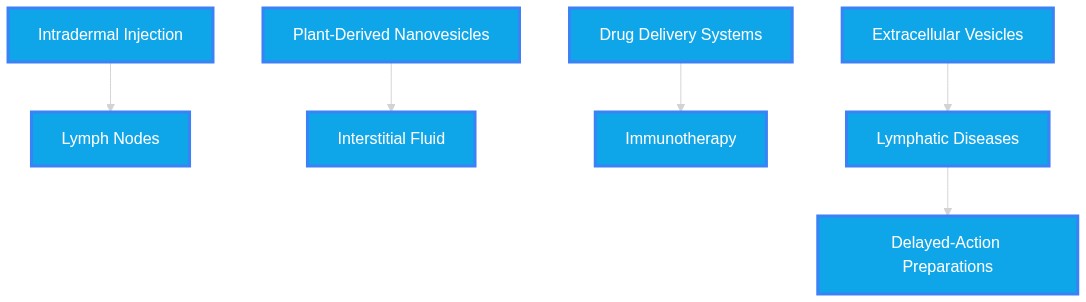
Systemic Logic Chain Framework
-
Extracellular Vesicles
-->
Lymphatic Diseases
(Align: 6)
Rationale: Surface modification with targeting ligands is well-established for EV-based drug delivery in the literature.
-
Lymphatic Diseases
-->
Delayed-Action Preparations
(Align: 5)
Rationale: While both pH-responsiveness and nodal targeting are documented, their simultaneous clinical implementation in a plant-EV platform requires further validation.
Gap Analysis Audit
- Study Type/Intent: in_vivo/in_vitro / drug delivery
- Justification: While components of the proposed system (EV targeting, pH-responsiveness) are documented, a composite system utilizing specifically plant-derived EVs and hitchhiker-peptides for nodal metastasis targeting is at the design/theoretical proof-of-concept phase.
- Predicted Result: Synergistic enhancement of nodal drug accumulation.
Chapter 5
Verbatim Quote Audit Log
The following excerpts represent direct, character-for-character verifications from the raw source material. PathMap guarantees 100% fidelity on these passed citations.
VERIFIED VERBATIM (PMID: 35381399)
"Prior work has shown that lymphatics transport 10-250 nm nanoparticles from peripheral tissues to the lymph node."
VERIFIED VERBATIM (PMID: 37517544)
"When sEVs were Subcutaneously administered into the tail base and the tumor tissue, they preferably accumulated in the lymph nodes (LNs), rather than in the liver and the spleen."
VERIFIED VERBATIM (PMID: 42293730)
"Plant-derived extracellular vesicles offer a naturally safe and anti-inflammatory platform for therapeutic delivery."
VERIFIED VERBATIM (PMID: 42207394)
"Mechanistically, GEBSS induced apoptosis and immunogenic cell death (ICD) in tumor cells."
VERIFIED VERBATIM (PMID: 31141293)
"After an intradermal injection, a higher retention of EXO-PEG-man is observed in the lymph nodes, which could be used for the efficient delivery of immune stimulators and antigens to the lymph nodes in vivo."
VERIFIED VERBATIM (PMID: 40362678)
"Intradermal injection of OVA protein alone using PJI significantly increased OVA-specific CD8+ T cell expansion in the lymph node, although lymph node swelling was much less than when aluminum hydroxide was used."
VERIFIED VERBATIM (PMID: 42347637)
"The magnitude and quality of adaptive immune responses are fundamentally influenced by the efficiency of antigen presentation."
VERIFIED VERBATIM (PMID: 42376274)
"Plant derived extracellular vesicle injections are associated with enhanced early dermal regeneration in laser-induced skin wounds, particularly when combined with LLLT."
VERIFIED VERBATIM (PMID: 29352735)
"Donation of NO from SNO-NP, which scaled in proportion to the total administered dose, enhanced LN accumulation by two orders of magnitude without substantially reducing lymphatic transport of NP or the viability and extent of NP uptake by LN-resident cells."
VERIFIED VERBATIM (PMID: 31871957)
"When administered locally via an intradermal route, both platforms resulted in mRNA expression at the injection site and in robust T cell responses in draining lymph nodes."
VERIFIED VERBATIM (PMID: 42377704)
"Exosomes, nanoscale extracellular vesicles derived from mesenchymal stem cells and dermal papilla cells (DPCs), offer a promising regenerative alternative by modulating key hair-growth pathways."
VERIFIED VERBATIM (PMID: 31917298)
"The phosphate-terminal dendrimer can be used as a nanoplatform for the delivery of some bioactive molecules to some immune cells, including B cells, in the lymph node."
VERIFIED VERBATIM (PMID: 42424692)
"Unlike LNPs, which showed significant liver accumulation, the peptide-nanocomplexes remained localized at the injection site and effectively drained to the lymph nodes."
VERIFIED VERBATIM (PMID: 31141293)
"After an intradermal injection, a higher retention of EXO-PEG-man is observed in the lymph nodes, which could be used for the efficient delivery of immune stimulators and antigens to the lymph nodes in vivo."
VERIFIED VERBATIM (PMID: 42476278)
"Nanocrystals, nanosuspensions, lipvesicles, polymeric nanoparticles, nanogels, extracellular vesicles, and lipnanoparticles have been integrated with coated, dissolving, hollow, and hydrogel-forming microneedles for local and systemic delivery."
VERIFIED VERBATIM (PMID: 42425350)
"In vivo, pretreatment with Pk@MN markedly inhibited UVB-induced skin photoaging in mice, maintained skin elasticity by suppressing epidermal thickening, and promote dermal collagen deposition, with a 2.1-fold increase in collagen density compared with the Model group."
VERIFIED VERBATIM (PMID: 30036073)
"64Cu-SPIONs were chemically stable in mouse serum for 24 h and after intradermal injection in the hind paw of C57BL/6J mice, demonstrated specific accumulation in the SLN."
VERIFIED VERBATIM (PMID: 30889749)
"CY7-labeled CCS-COOH having negatively-charged surface displayed longer duration time and higher fluorescence intensity in the lymph node as compared to its counterparts with neutral or positive charge surface."
VERIFIED VERBATIM (PMID: 42207394)
"GEBSS exhibited a concentrated size distribution around 142 nm, were efficiently absorbed by colorectal cancer (CRC) cells, and demonstrated inhibitory effects on tumor cell proliferation."
VERIFIED VERBATIM (PMID: 42424986)
"Current evidence supports a model in which melanoma-derived EVs traffic through lymphatic vessels, enter draining nodes, interact with lymphatic endothelial cells, medullary macrophages, dendritic cells, and T cells, and remodel lymphovascular, stromal, and immune compartments."
VERIFIED VERBATIM (PMID: 42338019)
"Exosomes derived from highly metastatic CC cells actively package OA in a manner dependent on stearoyl-CoA desaturase (SCD), the rate-limiting enzyme of de novo fatty acsynthesis."
VERIFIED VERBATIM (PMID: 42299841)
"Exosomal piR-hsa-28212 enhanced HLECs migration and tube formation in vitro and promoted lymphangiogenesis and LN metastasis in vivo."
VERIFIED VERBATIM (PMID: 42224999)
"BCa cell-derived exosomes containing YBX1 were internalized by macrophages, where they were crucial for inducing M2-like polarization and promoting CXCL8 expression, ultimately stimulating angiogenesis and lymphangiogenesis."
VERIFIED VERBATIM (PMID: 41912132)
"To specifically target CEMIP2 and inhibit chemotherapy-associated lymphatic metastasis of gastric cancer, we developed bioengineered RGD-conjugated exosomes mimics (EMs) for targeted delivery of CEMIP2 siRNA."
VERIFIED VERBATIM (PMID: 41310078)
"The results of this study demonstrate that plasma-derived exosomal tRF-3004a may serve as a novel diagnostic biomarker for CRC."
VERIFIED VERBATIM (PMID: 41271007)
"We identified 595 new proteomic cargoes compared with those reported in ExoCarta and 1003 new cargo proteins relative to three previously reported lymphatic EV datasets."
VERIFIED VERBATIM (PMID: 40940401)
"Western blot analysis revealed significantly elevated SDC2 levels in MV-enriched EVs from pLNM cases compared to nLNM."
VERIFIED VERBATIM (PMID: 40611320)
"We identified an EV circular RNA, circPDLIM5, that could promote lymphangiogenesis and lymphatic metastasis in both PCa cell lines and mouse models."
VERIFIED VERBATIM (PMID: 40513658)
"This study provides the first evidence of exosome-transmitted protein-coding circRNAs in CAF-TNBC crosstalk, offering novel insights into the TME-driven metastasis and providing promising biomarker for TNBC management."
VERIFIED VERBATIM (PMID: 40379833)
"The sEVs suppressed CD8 T cell proliferation and function, facilitating colony formation."
VERIFIED VERBATIM (PMID: 40302796)
"By in vivo and in vitro experiments, we demonstrated its unique mechanism of action via EV-mediated transfer to human lymphatic endothelial cells (HLECs), leading to systematic downregulation of VEGFA and inhibition of the Akt/Erk pathway, which suppressed lymphangiogenesis."
VERIFIED VERBATIM (PMID: 40178201)
"Herein, engineered exosomes (EmDEX@GA) are developed for locoregional immunomodulation of TDLNs."
VERIFIED VERBATIM (PMID: 41804568)
"This spatiotemporal delivery strategy synergizes bLN-resident immune activation with LN-directed antigen trafficking, yielding high CD8+ T-cell infiltration at injection sites, dendritic cell maturation, and elicitation of antigen-specific cytotoxic T cells."
VERIFIED VERBATIM (PMID: 41418833)
"Conjugation of a model antigen, namely, ovalbumin (OVA), onto the GNP surface (GNP-OVA) resulted in virus-mimicking multivalent antigen display, which substantially enhanced dendritic cell maturation, as evidenced by the upregulation of CD86 and major histocompatibility complex class II."
VERIFIED VERBATIM (PMID: 40202614)
"The groups that received EVs from DCs primed with S. brasiliensis or their EVs showed a significant decrease in fungal load compared to the negative control group."
VERIFIED VERBATIM (PMID: 32032584)
"Uptake of these nanoparticles by antigen-presenting cells was shown to induce immune tolerance in other animal models of autoimmune disease."
VERIFIED VERBATIM (PMID: 30333803)
"These results suggest that EVs can play an important role in virulence and modulation of the host immune system during experimental S. brasiliensis infection."
VERIFIED VERBATIM (PMID: 42338756)
"In an ovariectomy-induced osteoporosis mouse model, oral administration of RGNVs significantly restored bone volume and mineral density, and biodistribution studies confirmed their preferential accumulation in the bone tissue."
VERIFIED VERBATIM (PMID: 42391663)
"In vivo, TEV/PVA-PEI-PPY@GG significantly accelerated wound closure, improved epidermal continuity, and enhanced dermal remodeling in streptozotocin-induced diabetic wounds, while showing no obvious histopathological toxicity in major organs."
VERIFIED VERBATIM (PMID: 42372209)
"The salivary exosome‑based signature (ie, a chimeric RNA seG-NchiRNA, a tRNA fragment GlyGCC-5, and a novel sRESE RNA) was quantified by qRT-PCR in a multicenter observational study across two ESCC-endemic regions."
VERIFIED VERBATIM (PMID: 42594253)
"Overexpressing circ-Zfyve9 increased the therapeutic effect of ADSC-EVs."
VERIFIED VERBATIM (PMID: 42471747)
"The eMSC-EV-enriched preparations displayed characteristic vesicular morphology and marker expression."
VERIFIED VERBATIM (PMID: 42482105)
"In summary, ASC-EXOs from all batches demonstrated comparable anti-inflammatory and collagen-modulating effects in vitro, and similar inhibition of atopic dermatitis signs in vivo."
VERIFIED VERBATIM (PMID: 35381399)
"Prior work has shown that lymphatics transport 10-250 nm nanoparticles from peripheral tissues to the lymph node."
VERIFIED VERBATIM (PMID: 42293730)
"Plant-derived extracellular vesicles offer a naturally safe and anti-inflammatory platform for therapeutic delivery."
VERIFIED VERBATIM (PMID: 31141293)
"After an intradermal injection, a higher retention of EXO-PEG-man is observed in the lymph nodes, which could be used for the efficient delivery of immune stimulators and antigens to the lymph nodes in vivo."
VERIFIED VERBATIM (PMID: 42207394)
"Mechanistically, GEBSS induced apoptosis and immunogenic cell death (ICD) in tumor cells."
VERIFIED VERBATIM (PMID: 37517544)
"When sEVs were Subcutaneously administered into the tail base and the tumor tissue, they preferably accumulated in the lymph nodes (LNs), rather than in the liver and the spleen."
VERIFIED VERBATIM (PMID: 42376274)
"Plant derived extracellular vesicle injections are associated with enhanced early dermal regeneration in laser-induced skin wounds, particularly when combined with LLLT."
VERIFIED VERBATIM (PMID: 42377704)
"Exosomes, nanoscale extracellular vesicles derived from mesenchymal stem cells and dermal papilla cells (DPCs), offer a promising regenerative alternative by modulating key hair-growth pathways."
VERIFIED VERBATIM (PMID: 42424692)
"Unlike LNPs, which showed significant liver accumulation, the peptide-nanocomplexes remained localized at the injection site and effectively drained to the lymph nodes."
VERIFIED VERBATIM (PMID: 31871957)
"When administered locally via an intradermal route, both platforms resulted in mRNA expression at the injection site and in robust T cell responses in draining lymph nodes."
VERIFIED VERBATIM (PMID: 42476278)
"Nanocrystals, nanosuspensions, lipvesicles, polymeric nanoparticles, nanogels, extracellular vesicles, and lipnanoparticles have been integrated with coated, dissolving, hollow, and hydrogel-forming microneedles for local and systemic delivery."
VERIFIED VERBATIM (PMID: 42425350)
"In vivo, pretreatment with Pk@MN markedly inhibited UVB-induced skin photoaging in mice, maintained skin elasticity by suppressing epidermal thickening, and promote dermal collagen deposition, with a 2.1-fold increase in collagen density compared with the Model group."
VERIFIED VERBATIM (PMID: 40362678)
"Intradermal injection of OVA protein alone using PJI significantly increased OVA-specific CD8+ T cell expansion in the lymph node, although lymph node swelling was much less than when aluminum hydroxide was used."
VERIFIED VERBATIM (PMID: 42347637)
"The magnitude and quality of adaptive immune responses are fundamentally influenced by the efficiency of antigen presentation."
VERIFIED VERBATIM (PMID: 31917298)
"The phosphate-terminal dendrimer can be used as a nanoplatform for the delivery of some bioactive molecules to some immune cells, including B cells, in the lymph node."
VERIFIED VERBATIM (PMID: 30036073)
"64Cu-SPIONs were chemically stable in mouse serum for 24 h and after intradermal injection in the hind paw of C57BL/6J mice, demonstrated specific accumulation in the SLN."
VERIFIED VERBATIM (PMID: 30889749)
"CY7-labeled CCS-COOH having negatively-charged surface displayed longer duration time and higher fluorescence intensity in the lymph node as compared to its counterparts with neutral or positive charge surface."
VERIFIED VERBATIM (PMID: 42424986)
"Current evidence supports a model in which melanoma-derived EVs traffic through lymphatic vessels, enter draining nodes, interact with lymphatic endothelial cells, medullary macrophages, dendritic cells, and T cells, and remodel lymphovascular, stromal, and immune compartments."
VERIFIED VERBATIM (PMID: 42338019)
"Exosomes derived from highly metastatic CC cells actively package OA in a manner dependent on stearoyl-CoA desaturase (SCD), the rate-limiting enzyme of de novo fatty acsynthesis."
VERIFIED VERBATIM (PMID: 42299841)
"Exosomal piR-hsa-28212 enhanced HLECs migration and tube formation in vitro and promoted lymphangiogenesis and LN metastasis in vivo."
VERIFIED VERBATIM (PMID: 42224999)
"BCa cell-derived exosomes containing YBX1 were internalized by macrophages, where they were crucial for inducing M2-like polarization and promoting CXCL8 expression, ultimately stimulating angiogenesis and lymphangiogenesis."
VERIFIED VERBATIM (PMID: 41912132)
"To specifically target CEMIP2 and inhibit chemotherapy-associated lymphatic metastasis of gastric cancer, we developed bioengineered RGD-conjugated exosomes mimics (EMs) for targeted delivery of CEMIP2 siRNA."
VERIFIED VERBATIM (PMID: 41310078)
"The results of this study demonstrate that plasma-derived exosomal tRF-3004a may serve as a novel diagnostic biomarker for CRC."
VERIFIED VERBATIM (PMID: 41271007)
"We identified 595 new proteomic cargoes compared with those reported in ExoCarta and 1003 new cargo proteins relative to three previously reported lymphatic EV datasets."
VERIFIED VERBATIM (PMID: 40940401)
"Western blot analysis revealed significantly elevated SDC2 levels in MV-enriched EVs from pLNM cases compared to nLNM."
VERIFIED VERBATIM (PMID: 40611320)
"We identified an EV circular RNA, circPDLIM5, that could promote lymphangiogenesis and lymphatic metastasis in both PCa cell lines and mouse models."
VERIFIED VERBATIM (PMID: 40513658)
"This study provides the first evidence of exosome-transmitted protein-coding circRNAs in CAF-TNBC crosstalk, offering novel insights into the TME-driven metastasis and providing promising biomarker for TNBC management."
VERIFIED VERBATIM (PMID: 40379833)
"The sEVs suppressed CD8 T cell proliferation and function, facilitating colony formation."
VERIFIED VERBATIM (PMID: 40302796)
"By in vivo and in vitro experiments, we demonstrated its unique mechanism of action via EV-mediated transfer to human lymphatic endothelial cells (HLECs), leading to systematic downregulation of VEGFA and inhibition of the Akt/Erk pathway, which suppressed lymphangiogenesis."
VERIFIED VERBATIM (PMID: 40178201)
"Herein, engineered exosomes (EmDEX@GA) are developed for locoregional immunomodulation of TDLNs."
VERIFIED VERBATIM (PMID: 41804568)
"This spatiotemporal delivery strategy synergizes bLN-resident immune activation with LN-directed antigen trafficking, yielding high CD8+ T-cell infiltration at injection sites, dendritic cell maturation, and elicitation of antigen-specific cytotoxic T cells."
VERIFIED VERBATIM (PMID: 41418833)
"Conjugation of a model antigen, namely, ovalbumin (OVA), onto the GNP surface (GNP-OVA) resulted in virus-mimicking multivalent antigen display, which substantially enhanced dendritic cell maturation, as evidenced by the upregulation of CD86 and major histocompatibility complex class II."
VERIFIED VERBATIM (PMID: 40202614)
"The groups that received EVs from DCs primed with S. brasiliensis or their EVs showed a significant decrease in fungal load compared to the negative control group."
VERIFIED VERBATIM (PMID: 32032584)
"Uptake of these nanoparticles by antigen-presenting cells was shown to induce immune tolerance in other animal models of autoimmune disease."
VERIFIED VERBATIM (PMID: 30333803)
"These results suggest that EVs can play an important role in virulence and modulation of the host immune system during experimental S. brasiliensis infection."
VERIFIED VERBATIM (PMID: 42338756)
"In an ovariectomy-induced osteoporosis mouse model, oral administration of RGNVs significantly restored bone volume and mineral density, and biodistribution studies confirmed their preferential accumulation in the bone tissue."
VERIFIED VERBATIM (PMID: 42391663)
"In vivo, TEV/PVA-PEI-PPY@GG significantly accelerated wound closure, improved epidermal continuity, and enhanced dermal remodeling in streptozotocin-induced diabetic wounds, while showing no obvious histopathological toxicity in major organs."
VERIFIED VERBATIM (PMID: 42372209)
"The salivary exosome‑based signature (ie, a chimeric RNA seG-NchiRNA, a tRNA fragment GlyGCC-5, and a novel sRESE RNA) was quantified by qRT-PCR in a multicenter observational study across two ESCC-endemic regions."
VERIFIED VERBATIM (PMID: 42594253)
"Overexpressing circ-Zfyve9 increased the therapeutic effect of ADSC-EVs."
VERIFIED VERBATIM (PMID: 42471747)
"The eMSC-EV-enriched preparations displayed characteristic vesicular morphology and marker expression."
VERIFIED VERBATIM (PMID: 42482105)
"In summary, ASC-EXOs from all batches demonstrated comparable anti-inflammatory and collagen-modulating effects in vitro, and similar inhibition of atopic dermatitis signs in vivo."
VERIFIED VERBATIM (PMID: 29352735)
"Donation of NO from SNO-NP, which scaled in proportion to the total administered dose, enhanced LN accumulation by two orders of magnitude without substantially reducing lymphatic transport of NP or the viability and extent of NP uptake by LN-resident cells."
VERIFIED VERBATIM (PMID: 33080460)
"These results further extended to a peptide-conjugated NP drug delivery system, which showed enhanced uptake by B cells and dendritic cells when administered alongside SNO-NP."
VERIFIED VERBATIM (PMID: 35835068)
"Oral delivery of OPGMN induces increased dendritic cell maturation compared to the intradermal route in the lymph node and induces T helper type 1 and type 2 responses, such as immunoglobulin G1 and G2c, interferon-gamma, and interleukin-2, in the blood."
VERIFIED VERBATIM (PMID: 33380496)
"In this study, we demonstrate that a combination adjuvant composed of cyclic-di-AMP (cdAMP) and the plant-derived nanoparticle adjuvant Nano-11 significantly enhanced the immune response to ID-injected vaccines in mice and pigs with minimal local reaction at the injection site."
VERIFIED VERBATIM (PMID: 42238572)
"Exosomal POSTN derived from POSTN+ CAFs may represent an important stromal mediator of MIA/LUAD progression and a potential diagnostic and prognostic biomarker in early-stage LUAD."
VERIFIED VERBATIM (PMID: 42131580)
"Tumor-derived exosomal PDLIM1 was internalized by endothelial cells, enhancing angiogenesis in vitro."
VERIFIED VERBATIM (PMID: 42572005)
"Click-labeled [64Cu]Cu-OMVs were drained to reach and stop at the lymph nodes on serial quantification."
VERIFIED VERBATIM (PMID: 42502396)
"Secretory LGALS3BP acts as a ligand, binding to integrin beta-1 (ITGB1) on the cell membrane through its BTB domain, thereby activating the downstream TGF-β/smad2 signaling pathway to drive EMT and metastatic phenotypes."
VERIFIED VERBATIM (PMID: 42505363)
"An investigation into the correlation between serum levels and tumor metastasis in patients with GC revealed that those with lymph node metastasis exhibited higher levels of serum exosomal EphA2."
VERIFIED VERBATIM (PMID: 35381399)
"Lymphatic vessels have recently been shown to effectively deliver immune modulatory therapies to the lymph nodes, which enhances their therapeutic efficacy."
VERIFIED VERBATIM (PMID: 42561425)
"Rational engineering strategies, including surface modification, self-loading hybridization, genetic manipulation, and pH-responsive coating, can optimize the therapeutic performance of BEVs."
VERIFIED VERBATIM (PMID: 42540442)
"The liposomes maintain a negative surface charge under physiological conditions to prolong circulation, but undergo pH-responsive conversion to a positive charge within the acidic tumor microenvironment (pH 6.5-6.8), thereby improving tumor-selective internalization."
VERIFIED VERBATIM (PMID: 42445823)
"The exosome component provides inherent biological targeting to HCC cells. At the same time, the incorporated SPIONs enable external magnetic field-guided spatial control, collectively ensuring superior tumour accumulation compared to conventional delivery systems."
VERIFIED VERBATIM (PMID: 42424986)
"Key vesicle-associated mechanisms include NGFR/p75NTR-positive small extracellular vesicles (sEVs) that drive lymphangiogenesis and nodal metastasis, PD-L1-positive vesicles that suppress T-cell activation, CD36-linked pathways that reshape myelolipmetabolism, and uPAR-associated vesicles that promote endothelial and matrix remodeling."
VERIFIED VERBATIM (PMID: 42448218)
"Mechanistically, sPD-1 bound to PD-L1 on PMCs, triggering clathrin-mediated endocytosis."
VERIFIED VERBATIM (PMID: 42341362)
"In a HoFH murine model, this synergistic strategy markedly enhanced the accumulation of exosomes in hepatocytes and achieved robust restoration of hepatic LDLR expression."
VERIFIED VERBATIM (PMID: 42530066)
"Moreover, the combination of NK cell exosomes with DSF/Cu improved the therapeutic effect of DSF/Cu, which helps to promote the targeted therapy of GC and improve clinical applicability."
VERIFIED VERBATIM (PMID: 42327493)
"Small RNA sequencing revealed that miR-151-3p is a key functional cargo that is enriched in Exe-Exos."
VERIFIED VERBATIM (PMID: 42321780)
"To enhance therapeutic precision and minimize systemic toxicity, we engineered a biomimetic nano-delivery system for Bi2536."
VERIFIED VERBATIM (PMID: 42499024)
"The research hotspots mainly focus on nanodrug delivery systems, targeted therapy and inflammation regulation, while exosomes, macrophage polarization, and intestinal microbiota regulation are becoming new research frontiers."
VERIFIED VERBATIM (PMID: 42645768)
"The nanocarrier showed significant pH-responsive drug release, with 90.55% cumulative CUR release under acidic conditions (pH 4.5) compared to 44.5% at physiological pH (7.4), indicating its possibility for tumor-targeted delivery."
VERIFIED VERBATIM (PMID: 42610073)
"Nanotechnology offers multi-level strategies to overcome multidrug resistance in castration-resistant prostate cancer, including PROTAC-mediated protein degradation, ferroptosis induction, and synergistic chemo-immunotherapy."
VERIFIED VERBATIM (PMID: 42644963)
"The degradation experiment results indicated that the alginate/CMCS hydrogel shell has anti-resistant and colon-targeted properties, with minimal drug leakage under acidic conditions (0.1% release at 2 h, pH 1.2) and rapcontrolled release at colonic pH (7.4)"
VERIFIED VERBATIM (PMID: 42586674)
"In the context of tumor-specific microenvironments, pH-responsive behavior, ligand-mediated active targeting, and improved intracellular delivery are examined."
VERIFIED VERBATIM (PMID: 42628399)
"GE11 functionalization significantly enhanced cellular uptake in EGFR-overexpressing glioma cells, facilitating efficient intracellular delivery of PN."
VERIFIED VERBATIM (PMID: 42576814)
"In addition, we discuss how exosomes compare with conventional delivery platforms and critically examine the major barriers limiting their clinical translation, including heterogeneity, scalability, reproducibility, purity, and regulatory standardization."
VERIFIED VERBATIM (PMID: 38212302)
"When incubated with migrating monocytes in vitro, MCP1-Gd transport across lymphatic endothelium increased 2-fold relative to nontargeting controls."
VERIFIED VERBATIM (PMID: 38212302)
"Furthermore, LN targeting was dependent on monocyte hitchhiking, as monocyte depletion decreased accumulation by >70%."
VERIFIED VERBATIM (PMID: 38212302)
"Nanoparticles targeted to the C-C chemokine receptor 2 (CCR2), a biomarker highly expressed in metastatic LNs, have the potential to guide the delivery of contrast agents, improving the sensitivity of MRI."
VERIFIED VERBATIM (PMID: 42338019)
"Notably, free OA administration exerts substantially weaker effects than its exosomal counterpart, underscoring the superior efficiency of exosome-mediated metabolite trafficking."
VERIFIED VERBATIM (PMID: 42654029)
"The optimized LUT-NLC-ISG had a particle size of 25.27 ± 0.23 nm and exhibited a 45-fold viscosity increase upon simulated tear flu(STF) exposure."
VERIFIED VERBATIM (PMID: 42654029)
"In the CNV mouse model, 0.1% (w/v) LUT-NLC-ISG effectively inhibited corneal neovascularization, comparable to 0.025% dexamethasone, and downregulated VEGF-A and MMP-9 expression."
VERIFIED VERBATIM (PMID: 42620629)
"Here, we present multifunctional FTH1 nanocages as a unified nanoplatform for dual-drug chemotherapy and molecular imaging."
VERIFIED VERBATIM (PMID: 42615169)
"Simultaneously, the released LOX continuously degrades lactate, preventing the reversion of TAMs back to the M2 phenotype."
VERIFIED VERBATIM (PMID: 42583925)
"Notably, a 100% survival rate was observed in the intratumoral IPANF group."
VERIFIED VERBATIM (PMID: 42569222)
"The uniform-sized calcium alginate microspheres were fabricated using microfluidic technology, incorporating pH-responsive CaCO3 nanocarriers to efficiently encapsulate R848 and C6-ceramide (C6)."
VERIFIED VERBATIM (PMID: 42566931)
"The resulting Sa@HMMSN@PM exhibited pH-responsive Sa release, preserved PD-L1 blocking activity, and enhanced tumor-cell-selective uptake."
VERIFIED VERBATIM (PMID: 42546485)
"Further optimization of targeted delivery systems is warranted to overcome biodistribution challenges and enhance structural regeneration."
VERIFIED VERBATIM (PMID: 42543292)
"Owing to their natural bioactivity, easy engineerability, and other characteristics, they enable the targeted delivery of TCM components to ischemic lesions and facilitate their transport across biological barriers."
VERIFIED VERBATIM (PMID: 42543148)
"Exosomes, as promising endogenous nanocarriers, have emerged as a powerful tool for the prevention and treatment of CVDs."
VERIFIED VERBATIM (PMID: 42522799)
"One area of study involves the use of nanotechnology to convert phytocompounds (medicinal plants) into therapeutic agents by embedding phytocompounds into nanoparticles created using green synthesis techniques."
VERIFIED VERBATIM (PMID: 42511736)
"Urinary exosomal microRNAs (uEV-miRNAs) are of interest due to their stability in biological fluids and their direct origin from nephron segments, enabling real-time reflection of renal pathophysiology."
VERIFIED VERBATIM (PMID: 42501943)
"The hydrogel's structural integrity and formation were confirmed through Fourier-transform infrared spectroscopy (FTIR), scanning electron microscopy (SEM), differential scanning calorimetry (DSC), and swelling studies."
VERIFIED VERBATIM (PMID: 42360611)
"Man-Exos exhibited high stability in various conditions and showed significantly enhanced binding affinity to LSECs compared to non-targeted exosomes."
VERIFIED VERBATIM (PMID: 42357492)
"Common nanoscale drug delivery platforms include nanoparticles, polymeric micelles, liposomes, dendrimers, mesoporous materials, hydrogels, and exosomes."
VERIFIED VERBATIM (PMID: 42561425)
"Rational engineering strategies, including surface modification, self-loading hybridization, genetic manipulation, and pH-responsive coating, can optimize the therapeutic performance of BEVs."
VERIFIED VERBATIM (PMID: 42540442)
"The liposomes maintain a negative surface charge under physiological conditions to prolong circulation, but undergo pH-responsive conversion to a positive charge within the acidic tumor microenvironment (pH 6.5-6.8), thereby improving tumor-selective internalization."
VERIFIED VERBATIM (PMID: 42445823)
"The exosome component provides inherent biological targeting to HCC cells. At the same time, the incorporated SPIONs enable external magnetic field-guided spatial control, collectively ensuring superior tumour accumulation compared to conventional delivery systems."
VERIFIED VERBATIM (PMID: 42424986)
"Key vesicle-associated mechanisms include NGFR/p75NTR-positive small extracellular vesicles (sEVs) that drive lymphangiogenesis and nodal metastasis, PD-L1-positive vesicles that suppress T-cell activation, CD36-linked pathways that reshape myelolipmetabolism, and uPAR-associated vesicles that promote endothelial and matrix remodeling."
VERIFIED VERBATIM (PMID: 42448218)
"Mechanistically, sPD-1 bound to PD-L1 on PMCs, triggering clathrin-mediated endocytosis."
VERIFIED VERBATIM (PMID: 42341362)
"In a HoFH murine model, this synergistic strategy markedly enhanced the accumulation of exosomes in hepatocytes and achieved robust restoration of hepatic LDLR expression."
VERIFIED VERBATIM (PMID: 42530066)
"Moreover, the combination of NK cell exosomes with DSF/Cu improved the therapeutic effect of DSF/Cu, which helps to promote the targeted therapy of GC and improve clinical applicability."
VERIFIED VERBATIM (PMID: 42327493)
"Small RNA sequencing revealed that miR-151-3p is a key functional cargo that is enriched in Exe-Exos."
VERIFIED VERBATIM (PMID: 42321780)
"To enhance therapeutic precision and minimize systemic toxicity, we engineered a biomimetic nano-delivery system for Bi2536."
VERIFIED VERBATIM (PMID: 42499024)
"The research hotspots mainly focus on nanodrug delivery systems, targeted therapy and inflammation regulation, while exosomes, macrophage polarization, and intestinal microbiota regulation are becoming new research frontiers."
VERIFIED VERBATIM (PMID: 42645768)
"The nanocarrier showed significant pH-responsive drug release, with 90.55% cumulative CUR release under acidic conditions (pH 4.5) compared to 44.5% at physiological pH (7.4), indicating its possibility for tumor-targeted delivery."
VERIFIED VERBATIM (PMID: 42610073)
"Nanotechnology offers multi-level strategies to overcome multidrug resistance in castration-resistant prostate cancer, including PROTAC-mediated protein degradation, ferroptosis induction, and synergistic chemo-immunotherapy."
VERIFIED VERBATIM (PMID: 42644963)
"The degradation experiment results indicated that the alginate/CMCS hydrogel shell has anti-resistant and colon-targeted properties, with minimal drug leakage under acidic conditions (0.1% release at 2 h, pH 1.2) and rapcontrolled release at colonic pH (7.4)"
VERIFIED VERBATIM (PMID: 42586674)
"In the context of tumor-specific microenvironments, pH-responsive behavior, ligand-mediated active targeting, and improved intracellular delivery are examined."
VERIFIED VERBATIM (PMID: 42628399)
"GE11 functionalization significantly enhanced cellular uptake in EGFR-overexpressing glioma cells, facilitating efficient intracellular delivery of PN."
VERIFIED VERBATIM (PMID: 42576814)
"In addition, we discuss how exosomes compare with conventional delivery platforms and critically examine the major barriers limiting their clinical translation, including heterogeneity, scalability, reproducibility, purity, and regulatory standardization."
VERIFIED VERBATIM (PMID: 38212302)
"When incubated with migrating monocytes in vitro, MCP1-Gd transport across lymphatic endothelium increased 2-fold relative to nontargeting controls."
VERIFIED VERBATIM (PMID: 38212302)
"Furthermore, LN targeting was dependent on monocyte hitchhiking, as monocyte depletion decreased accumulation by >70%."
VERIFIED VERBATIM (PMID: 38212302)
"Nanoparticles targeted to the C-C chemokine receptor 2 (CCR2), a biomarker highly expressed in metastatic LNs, have the potential to guide the delivery of contrast agents, improving the sensitivity of MRI."
VERIFIED VERBATIM (PMID: 42338019)
"Notably, free OA administration exerts substantially weaker effects than its exosomal counterpart, underscoring the superior efficiency of exosome-mediated metabolite trafficking."
VERIFIED VERBATIM (PMID: 42654029)
"The optimized LUT-NLC-ISG had a particle size of 25.27 ± 0.23 nm and exhibited a 45-fold viscosity increase upon simulated tear flu(STF) exposure."
VERIFIED VERBATIM (PMID: 42654029)
"In the CNV mouse model, 0.1% (w/v) LUT-NLC-ISG effectively inhibited corneal neovascularization, comparable to 0.025% dexamethasone, and downregulated VEGF-A and MMP-9 expression."
VERIFIED VERBATIM (PMID: 42620629)
"Here, we present multifunctional FTH1 nanocages as a unified nanoplatform for dual-drug chemotherapy and molecular imaging."
VERIFIED VERBATIM (PMID: 42615169)
"Simultaneously, the released LOX continuously degrades lactate, preventing the reversion of TAMs back to the M2 phenotype."
VERIFIED VERBATIM (PMID: 42583925)
"Notably, a 100% survival rate was observed in the intratumoral IPANF group."
VERIFIED VERBATIM (PMID: 42569222)
"The uniform-sized calcium alginate microspheres were fabricated using microfluidic technology, incorporating pH-responsive CaCO3 nanocarriers to efficiently encapsulate R848 and C6-ceramide (C6)."
VERIFIED VERBATIM (PMID: 42566931)
"The resulting Sa@HMMSN@PM exhibited pH-responsive Sa release, preserved PD-L1 blocking activity, and enhanced tumor-cell-selective uptake."
VERIFIED VERBATIM (PMID: 42546485)
"Further optimization of targeted delivery systems is warranted to overcome biodistribution challenges and enhance structural regeneration."
VERIFIED VERBATIM (PMID: 42543292)
"Owing to their natural bioactivity, easy engineerability, and other characteristics, they enable the targeted delivery of TCM components to ischemic lesions and facilitate their transport across biological barriers."
VERIFIED VERBATIM (PMID: 42543148)
"Exosomes, as promising endogenous nanocarriers, have emerged as a powerful tool for the prevention and treatment of CVDs."
VERIFIED VERBATIM (PMID: 42522799)
"One area of study involves the use of nanotechnology to convert phytocompounds (medicinal plants) into therapeutic agents by embedding phytocompounds into nanoparticles created using green synthesis techniques."
VERIFIED VERBATIM (PMID: 42511736)
"Urinary exosomal microRNAs (uEV-miRNAs) are of interest due to their stability in biological fluids and their direct origin from nephron segments, enabling real-time reflection of renal pathophysiology."
VERIFIED VERBATIM (PMID: 42501943)
"The hydrogel's structural integrity and formation were confirmed through Fourier-transform infrared spectroscopy (FTIR), scanning electron microscopy (SEM), differential scanning calorimetry (DSC), and swelling studies."
VERIFIED VERBATIM (PMID: 42360611)
"Man-Exos exhibited high stability in various conditions and showed significantly enhanced binding affinity to LSECs compared to non-targeted exosomes."
VERIFIED VERBATIM (PMID: 42357492)
"Common nanoscale drug delivery platforms include nanoparticles, polymeric micelles, liposomes, dendrimers, mesoporous materials, hydrogels, and exosomes."
VERIFIED VERBATIM (PMID: 42654029)
"LUT-NLC-ISG significantly increased the bioavailability of LUT in ocular tissues compared with LUT-NLC alone, with 2.57-, 1.83-, and 10.59-fold higher area under the concentration-time curve (AUC) in the cornea, conjunctiva, and tears, respectively"
VERIFIED VERBATIM (PMID: 42633398)
"In 3×Tg AD model mice, exogenous administration of young plasma-derived EXOs and their engineered product (RVG-EXOs) revealed that RVG-EXOs could more efficiently enter brain tissue and target neurons, significantly reduce Aβ plaque and phosphorylated Tau (P-Tau) pathological deposition, restore synaptic structure, promote neuronal survival, and improve cognitive behavior."
VERIFIED VERBATIM (PMID: 42526345)
"To achieve targeted delivery, we constructed BV2 microglia-derived exosomes encapsulating NBP (BV2exo@ NBP), which efficiently enhanced drug accumulation in ischemic lesions and significantly improved neurological outcomes in stroked mice."
VERIFIED VERBATIM (PMID: 42525490)
"It facilitated CD44-mediated uptake, enhanced apoptosis, induced G2/M arrest, elevated ROS production and inhibited migration while preserving biocompatibility."
VERIFIED VERBATIM (PMID: 42337603)
"Results from a xenograft tumor model indicate that iRGD-modified exosomes were significantly enriched at tumor sites."
VERIFIED VERBATIM (PMID: 42327493)
"A gelatin methacrylate (GelMA) hydrogel microneedles (Hyd MNs) system was developed for the targeted, sustained delivery of these Exos directly to the injury epicenter at the T10 spinal segment in a rat SCI model."
VERIFIED VERBATIM (PMID: 42320128)
"On the one hand, the mechanical microenvironment within the chip was utilized to regulate the secretion of tumor cell exosomes (increasing secretion levels by more than twofold) and the expression of key proteins, revealing the exosome-mediated cell invasion behavior."
VERIFIED VERBATIM (PMID: 42316572)
"EVs also regulate signaling pathways that sustain tumor heterogeneity and adaptability."
VERIFIED VERBATIM (PMID: 42499024)
"In the future, intelligent responsive nanomaterials, multifunctional nanoplatforms, and personalized nanotechnology will become important development directions."
VERIFIED VERBATIM (PMID: 42454189)
"This review systematically summarizes the molecular mechanisms by which Exos contribute to multidrug resistance, with a particular focus on their roles in cargo sorting, microenvironmental crosstalk, and the functional reprogramming of recipient cells."
VERIFIED VERBATIM (PMID: 42543528)
"Furthermore, these EVs in hydrogels can cross a modeled blood-spinal cord barrier and provide cross-barrier capability for delivery."
VERIFIED VERBATIM (PMID: 42654029)
"Conclusions: LUT-NLC-ISG synergistically combines NLC technology and dual-sensitive in situ gelation to significantly improve LUT ocular bioavailability, offering a promising non-invasive candidate for CNV management."
VERIFIED VERBATIM (PMID: 42576814)
"Exosomes are naturally occurring extracellular vesicles that have emerged as promising bio-inspired nanocarriers for the treatment of neurological disorders owing to their intrinsic biocompatibility, low immunogenicity, and ability to cross the blood-brain barrier."
VERIFIED VERBATIM (PMID: 42583391)
"The research in this field has advanced from phenotypic description to mechanism integration and translational research, with nano-intervention and immune regulation being the cutting-edge directions."
VERIFIED VERBATIM (PMID: 42561425)
"Rational engineering strategies, including surface modification, self-loading hybridization, genetic manipulation, and pH-responsive coating, can optimize the therapeutic performance of BEVs."
VERIFIED VERBATIM (PMID: 42540442)
"The liposomes maintain a negative surface charge under physiological conditions to prolong circulation, but undergo pH-responsive conversion to a positive charge within the acidic tumor microenvironment (pH 6.5-6.8), thereby improving tumor-selective internalization."
VERIFIED VERBATIM (PMID: 42445823)
"The exosome component provides inherent biological targeting to HCC cells. At the same time, the incorporated SPIONs enable external magnetic field-guided spatial control, collectively ensuring superior tumour accumulation compared to conventional delivery systems."
VERIFIED VERBATIM (PMID: 42424986)
"Key vesicle-associated mechanisms include NGFR/p75NTR-positive small extracellular vesicles (sEVs) that drive lymphangiogenesis and nodal metastasis, PD-L1-positive vesicles that suppress T-cell activation, CD36-linked pathways that reshape myelolipmetabolism, and uPAR-associated vesicles that promote endothelial and matrix remodeling."
VERIFIED VERBATIM (PMID: 42448218)
"Mechanistically, sPD-1 bound to PD-L1 on PMCs, triggering clathrin-mediated endocytosis."
VERIFIED VERBATIM (PMID: 42341362)
"In a HoFH murine model, this synergistic strategy markedly enhanced the accumulation of exosomes in hepatocytes and achieved robust restoration of hepatic LDLR expression."
VERIFIED VERBATIM (PMID: 42530066)
"Moreover, the combination of NK cell exosomes with DSF/Cu improved the therapeutic effect of DSF/Cu, which helps to promote the targeted therapy of GC and improve clinical applicability."
VERIFIED VERBATIM (PMID: 42327493)
"Small RNA sequencing revealed that miR-151-3p is a key functional cargo that is enriched in Exe-Exos."
VERIFIED VERBATIM (PMID: 42321780)
"To enhance therapeutic precision and minimize systemic toxicity, we engineered a biomimetic nano-delivery system for Bi2536."
VERIFIED VERBATIM (PMID: 42499024)
"The research hotspots mainly focus on nanodrug delivery systems, targeted therapy and inflammation regulation, while exosomes, macrophage polarization, and intestinal microbiota regulation are becoming new research frontiers."
VERIFIED VERBATIM (PMID: 42645768)
"The nanocarrier showed significant pH-responsive drug release, with 90.55% cumulative CUR release under acidic conditions (pH 4.5) compared to 44.5% at physiological pH (7.4), indicating its possibility for tumor-targeted delivery."
VERIFIED VERBATIM (PMID: 42610073)
"Nanotechnology offers multi-level strategies to overcome multidrug resistance in castration-resistant prostate cancer, including PROTAC-mediated protein degradation, ferroptosis induction, and synergistic chemo-immunotherapy."
VERIFIED VERBATIM (PMID: 42644963)
"The degradation experiment results indicated that the alginate/CMCS hydrogel shell has anti-resistant and colon-targeted properties, with minimal drug leakage under acidic conditions (0.1% release at 2 h, pH 1.2) and rapcontrolled release at colonic pH (7.4)"
VERIFIED VERBATIM (PMID: 42586674)
"In the context of tumor-specific microenvironments, pH-responsive behavior, ligand-mediated active targeting, and improved intracellular delivery are examined."
VERIFIED VERBATIM (PMID: 42628399)
"GE11 functionalization significantly enhanced cellular uptake in EGFR-overexpressing glioma cells, facilitating efficient intracellular delivery of PN."
VERIFIED VERBATIM (PMID: 42576814)
"In addition, we discuss how exosomes compare with conventional delivery platforms and critically examine the major barriers limiting their clinical translation, including heterogeneity, scalability, reproducibility, purity, and regulatory standardization."
VERIFIED VERBATIM (PMID: 38212302)
"When incubated with migrating monocytes in vitro, MCP1-Gd transport across lymphatic endothelium increased 2-fold relative to nontargeting controls."
VERIFIED VERBATIM (PMID: 38212302)
"Furthermore, LN targeting was dependent on monocyte hitchhiking, as monocyte depletion decreased accumulation by >70%."
VERIFIED VERBATIM (PMID: 38212302)
"Nanoparticles targeted to the C-C chemokine receptor 2 (CCR2), a biomarker highly expressed in metastatic LNs, have the potential to guide the delivery of contrast agents, improving the sensitivity of MRI."
VERIFIED VERBATIM (PMID: 42338019)
"Notably, free OA administration exerts substantially weaker effects than its exosomal counterpart, underscoring the superior efficiency of exosome-mediated metabolite trafficking."
VERIFIED VERBATIM (PMID: 42654029)
"The optimized LUT-NLC-ISG had a particle size of 25.27 ± 0.23 nm and exhibited a 45-fold viscosity increase upon simulated tear flu(STF) exposure."
VERIFIED VERBATIM (PMID: 42654029)
"In the CNV mouse model, 0.1% (w/v) LUT-NLC-ISG effectively inhibited corneal neovascularization, comparable to 0.025% dexamethasone, and downregulated VEGF-A and MMP-9 expression."
VERIFIED VERBATIM (PMID: 42620629)
"Here, we present multifunctional FTH1 nanocages as a unified nanoplatform for dual-drug chemotherapy and molecular imaging."
VERIFIED VERBATIM (PMID: 42615169)
"Simultaneously, the released LOX continuously degrades lactate, preventing the reversion of TAMs back to the M2 phenotype."
VERIFIED VERBATIM (PMID: 42583925)
"Notably, a 100% survival rate was observed in the intratumoral IPANF group."
VERIFIED VERBATIM (PMID: 42569222)
"The uniform-sized calcium alginate microspheres were fabricated using microfluidic technology, incorporating pH-responsive CaCO3 nanocarriers to efficiently encapsulate R848 and C6-ceramide (C6)."
VERIFIED VERBATIM (PMID: 42566931)
"The resulting Sa@HMMSN@PM exhibited pH-responsive Sa release, preserved PD-L1 blocking activity, and enhanced tumor-cell-selective uptake."
VERIFIED VERBATIM (PMID: 42546485)
"Further optimization of targeted delivery systems is warranted to overcome biodistribution challenges and enhance structural regeneration."
VERIFIED VERBATIM (PMID: 42543292)
"Owing to their natural bioactivity, easy engineerability, and other characteristics, they enable the targeted delivery of TCM components to ischemic lesions and facilitate their transport across biological barriers."
VERIFIED VERBATIM (PMID: 42543148)
"Exosomes, as promising endogenous nanocarriers, have emerged as a powerful tool for the prevention and treatment of CVDs."
VERIFIED VERBATIM (PMID: 42522799)
"One area of study involves the use of nanotechnology to convert phytocompounds (medicinal plants) into therapeutic agents by embedding phytocompounds into nanoparticles created using green synthesis techniques."
VERIFIED VERBATIM (PMID: 42511736)
"Urinary exosomal microRNAs (uEV-miRNAs) are of interest due to their stability in biological fluids and their direct origin from nephron segments, enabling real-time reflection of renal pathophysiology."
VERIFIED VERBATIM (PMID: 42501943)
"The hydrogel's structural integrity and formation were confirmed through Fourier-transform infrared spectroscopy (FTIR), scanning electron microscopy (SEM), differential scanning calorimetry (DSC), and swelling studies."
VERIFIED VERBATIM (PMID: 42360611)
"Man-Exos exhibited high stability in various conditions and showed significantly enhanced binding affinity to LSECs compared to non-targeted exosomes."
VERIFIED VERBATIM (PMID: 42357492)
"Common nanoscale drug delivery platforms include nanoparticles, polymeric micelles, liposomes, dendrimers, mesoporous materials, hydrogels, and exosomes."
VERIFIED VERBATIM (PMID: 42654029)
"LUT-NLC-ISG significantly increased the bioavailability of LUT in ocular tissues compared with LUT-NLC alone, with 2.57-, 1.83-, and 10.59-fold higher area under the concentration-time curve (AUC) in the cornea, conjunctiva, and tears, respectively"
VERIFIED VERBATIM (PMID: 42633398)
"In 3×Tg AD model mice, exogenous administration of young plasma-derived EXOs and their engineered product (RVG-EXOs) revealed that RVG-EXOs could more efficiently enter brain tissue and target neurons, significantly reduce Aβ plaque and phosphorylated Tau (P-Tau) pathological deposition, restore synaptic structure, promote neuronal survival, and improve cognitive behavior."
VERIFIED VERBATIM (PMID: 42526345)
"To achieve targeted delivery, we constructed BV2 microglia-derived exosomes encapsulating NBP (BV2exo@ NBP), which efficiently enhanced drug accumulation in ischemic lesions and significantly improved neurological outcomes in stroked mice."
VERIFIED VERBATIM (PMID: 42525490)
"It facilitated CD44-mediated uptake, enhanced apoptosis, induced G2/M arrest, elevated ROS production and inhibited migration while preserving biocompatibility."
VERIFIED VERBATIM (PMID: 42337603)
"Results from a xenograft tumor model indicate that iRGD-modified exosomes were significantly enriched at tumor sites."
VERIFIED VERBATIM (PMID: 42327493)
"A gelatin methacrylate (GelMA) hydrogel microneedles (Hyd MNs) system was developed for the targeted, sustained delivery of these Exos directly to the injury epicenter at the T10 spinal segment in a rat SCI model."
VERIFIED VERBATIM (PMID: 42320128)
"On the one hand, the mechanical microenvironment within the chip was utilized to regulate the secretion of tumor cell exosomes (increasing secretion levels by more than twofold) and the expression of key proteins, revealing the exosome-mediated cell invasion behavior."
VERIFIED VERBATIM (PMID: 42316572)
"EVs also regulate signaling pathways that sustain tumor heterogeneity and adaptability."
VERIFIED VERBATIM (PMID: 42499024)
"In the future, intelligent responsive nanomaterials, multifunctional nanoplatforms, and personalized nanotechnology will become important development directions."
VERIFIED VERBATIM (PMID: 42454189)
"This review systematically summarizes the molecular mechanisms by which Exos contribute to multidrug resistance, with a particular focus on their roles in cargo sorting, microenvironmental crosstalk, and the functional reprogramming of recipient cells."
VERIFIED VERBATIM (PMID: 42543528)
"Furthermore, these EVs in hydrogels can cross a modeled blood-spinal cord barrier and provide cross-barrier capability for delivery."
VERIFIED VERBATIM (PMID: 42654029)
"Conclusions: LUT-NLC-ISG synergistically combines NLC technology and dual-sensitive in situ gelation to significantly improve LUT ocular bioavailability, offering a promising non-invasive candidate for CNV management."
VERIFIED VERBATIM (PMID: 42576814)
"Exosomes are naturally occurring extracellular vesicles that have emerged as promising bio-inspired nanocarriers for the treatment of neurological disorders owing to their intrinsic biocompatibility, low immunogenicity, and ability to cross the blood-brain barrier."
VERIFIED VERBATIM (PMID: 42583391)
"The research in this field has advanced from phenotypic description to mechanism integration and translational research, with nano-intervention and immune regulation being the cutting-edge directions."
Chapter 8
Abstract Repository
Raw text abstracts programmatically cached during the evaluation phase. Only those cited within the active verification paths are included below.
PMID: 29352735
Mapped to Reference [41]
ID: 29352735
Title: Winner of the society for biomaterials young investigator award for the annual meeting of the society for biomaterials, April 11-14, 2018, Atlanta, GA: S-nitrosated poly(propylene sulfide) nanoparticles for enhanced nitric oxide delivery to lymphatic tissues.
Abstract: Nitric oxide (NO) is a therapeutic implicated for the treatment of diseases afflicting lymphatic tissues, which range from infectious and cardiovascular diseases to cancer. Existing technologies available for NO therapy, however, provide poor bioactivity within lymphatic tissues. In this work, we address this technology gap with a NO encapsulation and delivery strategy leveraging the formation of S-nitrosothiols on lymphatic-targeting pluronic-stabilized, poly(propylene sulfide)-core nanoparticles (SNO-NP). We evaluated in vivo the lymphatic versus systemic delivery of NO resulting from intradermal administration of SNO-NP benchmarked against a commonly used, commercially available small molecule S-nitrosothiol NO donor, examined signs of toxicity systemically as well as localized to the site of injection, and investigated SNO effects on lymphatic transport and NP uptake by lymph node (LN)-resident cells. Donation of NO from SNO-NP, which scaled in proportion to the total administered dose, enhanced LN accumulation by two orders of magnitude without substantially reducing lymphatic transport of NP or the viability and extent of NP uptake by LN-resident cells. Additionally, NO delivery by SNO-NP was accompanied by low-to-negligible NO accumulation in systemic tissues with no apparent inflammation. These results suggest the utility and selectivity of SNO-NP for the targeted treatment of NO-regulated diseases that afflict lymphatic tissues. © 2018 Wiley Periodicals, Inc. J Biomed Mater Res Part A: 106A: 1463-1475, 2018.
PMID: 30036073
Mapped to Reference [15]
ID: 30036073
Title: Simultaneous Preclinical Positron Emission Tomography-Magnetic Resonance Imaging Study of Lymphatic Drainage of Chelator-Free 64Cu-Labeled Nanoparticles.
Abstract: Hybrid positron emission tomography (PET)-magnetic resonance imaging (MRI) systems have been taken in use as new clinical diagnostic tools including detection and therapy planning of cancer. To reduce the amount of contrast agents injected in patients while fully benefitting both modalities, dual-modality probes are required. This study was first aimed at developing a hybrid PET-MRI probe by labeling superparamagnetic iron oxide nanoparticles (SPIONs) with 64Cu using a fast and chelator-free conjugation method, and second, to demonstrate the ability of the agent to target sentinel lymph nodes (SLNs) in vivo using simultaneous PET-MRI imaging. High labeling efficiency of 97% produced within 10-15 min was demonstrated at room temperature. 64Cu-SPIONs were chemically stable in mouse serum for 24 h and after intradermal injection in the hind paw of C57BL/6J mice, demonstrated specific accumulation in the SLN. Simultaneous PET-MRI clearly demonstrated visualization of 64Cu-SPIONs, in dynamic and static imaging sequences up to 24 h after administration. The use of a single hybrid probe and simultaneous hybrid imaging provides an efficient, complementary integration of quantitation and is expected to improve preoperative planning and intraoperative guidance of cancer treatments.
PMID: 30333803
Mapped to Reference [34]
ID: 30333803
Title: Extracellular Vesicles From Sporothrix brasiliensis Are an Important Virulence Factor That Induce an Increase in Fungal Burden in Experimental Sporotrichosis.
Abstract: Sporotrichosis is a mycosis that affects the skin, lymphatic system and other organs in humans and animals. The disease has a worldwide distribution, with endemic areas in Brazil, and is caused by a complex of species, including Sporothrix brasiliensis. Some fungi release extracellular vesicles (EVs) that can interact with the host cell and modulate the host immune response. The aim of this study was to analyze the participation of S. brasiliensis EVs in the modulation of dendritic cells (DCs) and in the control of infection in vivo. Our results showed that in vitro, the EVs isolated from S. brasiliensis induced an increase in the phagocytic index and fungal burden in DCs. In addition, we observed a significant increase in IL-12p40 and TNF-α cytokine production. Then, the EVs were inoculated into BALB/c mice before subcutaneous infection with yeast, and the lesion was analyzed after 21, 35, and 42 days. An increase in fungal burden and lesion diameter were observed after 21 days in mice inoculated with a high concentration of EVs. However, after 35 days, we observed a regression of the lesion, which persisted until 42 days after infection. Interestingly, we observed an increase in fungal burden in these mice. In addition, we observed the presence of immunogenic components and proteins that could be related with virulence in EVs. These results suggest that EVs can play an important role in virulence and modulation of the host immune system during experimental S. brasiliensis infection.
PMID: 30889749
Mapped to Reference [16]
ID: 30889749
Title: Surface charge of well-defined polymeric nano-stars regulates non-invasive fluorescence imaging of lymph node.
Abstract: Accurate identification of sentinel lymph node (SLN) is crucial for clinical SLN biopsy surgery. Herein, we developed an innovative nanoprobe based on well-defined core crosslinked star (CCS) polymers for non-invasive fluorescence imaging of SLN. A well-defined biodegradable CCS polymer comprising multiple polyethylene glycol (PEG) arms and carboxyl terminal groups (denoted as CCS-COOH) was synthesized successfully by reversible addition-fragmentation chain transfer polymerization with a disulfide-based crosslinker reagent. Besides, CCS-COOH was coupled by tert-butyl carbazate to produce the CCS derivative with neutral butoxycarbonyl (Boc) terminal groups (denoted as CCS-Boc). By the removal of Boc groups, another CCS derivative with positive primary amino terminal groups (denoted as CCS-NH2) was also yielded. These CCS polymers had similar particle size but different surface charge. For SLN fluorescence imaging, the CCS polymers labeled by CY7, a near-infrared probe, exhibited superior in vitro photo-stability to CY7 alone. After intradermal injection of the CY7-labeled CCS polymers in a mouse model, they could efficiently accumulate in the lymph node of the mouse. CY7-labeled CCS-COOH having negatively-charged surface displayed longer duration time and higher fluorescence intensity in the lymph node as compared to its counterparts with neutral or positive charge surface. In vitro and in vivo toxicity tests supported low cytotoxicity of these CCS polymers against cell lines and low systemic toxicity. The results of this work highlight the potential of negatively-charged near-infrared-emitting CCS polymer as a new nanoprobe for safe and efficient SLN imaging.
PMID: 31141293
Mapped to Reference [3]
ID: 31141293
Title: Mannose-Modified Serum Exosomes for the Elevated Uptake to Murine Dendritic Cells and Lymphatic Accumulation.
Abstract: The surface of bovine serum-derived exosomes (EXOs) are modified with α-d-mannose for facile interaction with mannose receptors on dendritic cells (DCs) and for efficient delivery of immune stimulators to the DCs. The surface of the EXOs is modified with polyethylene glycol (PEG) without particle aggregation (≈50 nm) via the incorporation of 1,2-distearoyl-sn-glycero-3-phosphoethanolamine (DSPE) into the lipid layer of the EXO, compared to chemical conjugation by N-hydroxysuccinimide activated PEG (NHS-PEG). PEG modification onto the exosomal surface significantly decreases the non-specific cellular uptake of the EXOs into the DCs. However, the EXOs with mannose-conjugated PEG-DSPE (EXO-PEG-man) exhibit excellent intracellular uptake into the DCs and boost the immune response by the incorporation of adjuvant, monophosphoryl lipid A (MPLA) within the EXO. After an intradermal injection, a higher retention of EXO-PEG-man is observed in the lymph nodes, which could be used for the efficient delivery of immune stimulators and antigens to the lymph nodes in vivo.
PMID: 31871957
Mapped to Reference [9]
ID: 31871957
Title: Nanoparticles versus Dendritic Cells as Vehicles to Deliver mRNA Encoding Multiple Epitopes for Immunotherapy.
Abstract: The efficacy of antigen-specific immunotherapy relies heavily on efficient antigen delivery to antigen-presenting cells and engagement of as many disease-relevant T cells as possible in various lymphoid tissues, which are challenging to achieve. Here, we compared two approaches to deliver mRNA encoding multiple epitopes targeting both CD4+ and CD8+ T cells: a lipid-based nanoparticle platform to target endogenous antigen-presenting cells in vivo versus ex vivo mRNA-electroporated dendritic cells. After intraperitoneal injection, the nanoparticle platform facilitated efficient entry of mRNA into various endogenous antigen-presenting cells, including lymph node stromal cells, and elicited robust T cell responses within a wider network of lymphoid tissues compared with dendritic cells. Following intravenous injection, mRNA-electroporated dendritic cells and the nanoparticle platform localized primarily in lung and spleen, respectively. When administered locally via an intradermal route, both platforms resulted in mRNA expression at the injection site and in robust T cell responses in draining lymph nodes. This study indicates that multiple epitopes, customizable for specific patient populations and encoded by mRNA, can be targeted to different lymphoid tissues based on delivery vehicle and route, and constitute the groundwork for future studies using mRNA to reprogram exogenous or endogenous APCs for immunotherapy.
PMID: 31917298
Mapped to Reference [14]
ID: 31917298
Title: Carboxyl-, sulfonyl-, and phosphate-terminal dendrimers as a nanoplatform with lymph node targeting.
Abstract: The development of drug delivery vehicles to cancer and/or immune cells in lymph nodes is important for cancer diagnosis, therapy, and immunotherapy. We previously reported that anionic carboxyl-terminal dendrimers were accumulated in lymph nodes. In this study, three anionic dendrimers with carboxyl-, sulfonyl-, and phosphate-terminal groups were prepared to examine the lymph node targeting and the association with immune cells in the lymph nodes. These anionic dendrimers were accumulated in the lymph node by intradermal injection. Although the carboxyl- and sulfonyl-terminal dendrimers were diffused from the injection site, the phosphate-terminal dendrimers were mostly retained. The phosphate-terminal dendrimer was recognized by the macrophages, dendritic cells, and B cells in the lymph node, whereas the carboxyl- and sulfonyl-terminal dendrimers were not. Our results show that these anionic dendrimers were accumulated in the lymph node where the association with immune cells could be controlled by the terminal structure of the dendrimer. The phosphate-terminal dendrimer can be used as a nanoplatform for the delivery of some bioactive molecules to some immune cells, including B cells, in the lymph node.
PMID: 32032584
Mapped to Reference [33]
ID: 32032584
Title: Gliadin Nanoparticles Induce Immune Tolerance to Gliadin in Mouse Models of Celiac Disease.
Abstract: Celiac disease could be treated, and potentially cured, by restoring T-cell tolerance to gliadin. We investigated the safety and efficacy of negatively charged 500-nm poly(lactide-co-glycolide) nanoparticles encapsulating gliadin protein (TIMP-GLIA) in 3 mouse models of celiac disease. Uptake of these nanoparticles by antigen-presenting cells was shown to induce immune tolerance in other animal models of autoimmune disease. We performed studies with C57BL/6; RAG1-/- (C57BL/6); and HLA-DQ8, huCD4 transgenic Ab0 NOD mice. Mice were given 1 or 2 tail-vein injections of TIMP-GLIA or control nanoparticles. Some mice were given intradermal injections of gliadin in complete Freund's adjuvant (immunization) or of soluble gliadin or ovalbumin (ear challenge). RAG-/- mice were given intraperitoneal injections of CD4+CD62L-CD44hi T cells from gliadin-immunized C57BL/6 mice and were fed with an AIN-76A-based diet containing wheat gluten (oral challenge) or without gluten. Spleen or lymph node cells were analyzed in proliferation and cytokine secretion assays or by flow cytometry, RNA sequencing, or real-time quantitative polymerase chain reaction. Serum samples were analyzed by gliadin antibody enzyme-linked immunosorbent assay, and intestinal tissues were analyzed by histology. Human peripheral blood mononuclear cells, or immature dendritic cells derived from human peripheral blood mononuclear cells, were cultured in medium containing TIMP-GLIA, anti-CD3 antibody, or lipopolysaccharide (controls) and analyzed in proliferation and cytokine secretion assays or by flow cytometry. Whole blood or plasma from healthy volunteers was incubated with TIMP-GLIA, and hemolysis, platelet activation and aggregation, and complement activation or coagulation were analyzed. TIMP-GLIA did not increase markers of maturation on cultured human dendritic cells or induce activation of T cells from patients with active or treated celiac disease. In the delayed-type hypersensitivity (model 1), the HLA-DQ8 transgenic (model 2), and the gliadin memory T-cell enteropathy (model 3) models of celiac disease, intravenous injections of TIMP-GLIA significantly decreased gliadin-specific T-cell proliferation (in models 1 and 2), inflammatory cytokine secretion (in models 1, 2, and 3), circulating gliadin-specific IgG/IgG2c (in models 1 and 2), ear swelling (in model 1), gluten-dependent enteropathy (in model 3), and body weight loss (in model 3). In model 1, the effects were shown to be dose dependent. Splenocytes from HLA-DQ8 transgenic mice given TIMP-GLIA nanoparticles, but not control nanoparticles, had increased levels of FOXP3 and gene expression signatures associated with tolerance induction. In mice with gliadin sensitivity, injection of TIMP-GLIA nanoparticles induced unresponsiveness to gliadin and reduced markers of inflammation and enteropathy. This strategy might be developed for the treatment of celiac disease.
PMID: 33080460
Mapped to Reference [42]
ID: 33080460
Title: Lymph-directed nitric oxide increases immune cell access to lymph-borne nanoscale solutes.
Abstract: Lymph nodes (LNs) are immune organs housing high concentrations of lymphocytes, making them critical targets for therapeutic immunomodulation in a wide variety of diseases. While there is great interest in targeted drug delivery to LNs, many nanoscale drug delivery carriers have limited access to parenchymal resident immune cells compared to small molecules, limiting their efficacy. Nitric oxide (NO) is a potent regulator of vascular and lymphatic transport and a promising candidate for modulating nanocarrier access to LNs, but its lymphatic accumulation is limited by its low molecular weight and high reactivity. In this work, we employ S-nitrosated nanoparticles (SNO-NP), a lymphatic-targeted delivery system for controlled NO release, to investigate the effect of NO application on molecule accumulation and distribution within the LN. We evaluated the LN accumulation, spatial distribution, and cellular distribution of a panel of fluorescent tracers after intradermal administration alongside SNO-NP or a small molecule NO donor. While SNO-NP did not alter total tracer accumulation in draining lymph nodes (dLNs) or affect active cellular transport of large molecules from the injection site, its application enhanced the penetration of nanoscale 30 nm dextrans into the LN and their subsequent uptake by LN-resident lymphocytes, while nontargeted NO delivery did not. These results further extended to a peptide-conjugated NP drug delivery system, which showed enhanced uptake by B cells and dendritic cells when administered alongside SNO-NP. Together, these results highlight the utility of LN-targeted NO application for the enhancement of nanocarrier access to therapeutically relevant LN-resident immune cells, making NO a potentially useful tool for improving LN drug delivery and immune responses.
PMID: 33380496
Mapped to Reference [44]
ID: 33380496
Title: Effective and Safe Stimulation of Humoral and Cell-Mediated Immunity by Intradermal Immunization with a Cyclic Dinucleotide/Nanoparticle Combination Adjuvant.
Abstract: Intradermal (ID) immunization is an attractive route of vaccination because it targets tissue rich in dendritic cells, has dose-sparing potential, and allows needle-free delivery. However, few adjuvants are effective, nonreactogenic, and compatible with needle-free delivery devices. In this study, we demonstrate that a combination adjuvant composed of cyclic-di-AMP (cdAMP) and the plant-derived nanoparticle adjuvant Nano-11 significantly enhanced the immune response to ID-injected vaccines in mice and pigs with minimal local reaction at the injection site. The cdAMP/Nano-11 combination adjuvant increased Ag uptake by lymph node-resident and migratory skin dendritic cell subpopulations, including Langerhans cells. ID immunization with cdAMP/Nano-11 expanded the population of germinal center B cells and follicular helper T cells in the draining lymph node and Ag-specific Th1 and Th17 cells in the spleen. It elicited an enhanced immune response with a significant increase of IgG1 and IgG2a responses in mice at a reduced dose compared with i.m. immunization. An increased IgG response was observed following needle-free ID immunization of pigs. Nano-11 and cdAMP demonstrated a strong synergistic interaction, as shown in the activation of mouse, human, and porcine APC, with increased expression of costimulatory molecules and secretion of TNF and IL-1β. The combination adjuvant induced robust activation of both NF-κB and IFN regulatory factor signaling pathways and the NLRP3 inflammasome. We conclude that the combination of Nano-11 and cdAMP is a promising adjuvant for ID delivery of vaccines that supports a balanced immune response.
PMID: 35381399
Mapped to Reference [1]
ID: 35381399
Title: Nanoparticles with dense poly(ethylene glycol) coatings with near neutral charge are maximally transported across lymphatics and to the lymph nodes.
Abstract: Lymphatic vessels have recently been shown to effectively deliver immune modulatory therapies to the lymph nodes, which enhances their therapeutic efficacy. Prior work has shown that lymphatics transport 10-250 nm nanoparticles from peripheral tissues to the lymph node. However, the surface chemistry required to maximize this transport is poorly understood. Here, we determined the effect of surface poly(ethylene glycol) (PEG) density and size on nanoparticle transport across lymphatic endothelial cells (LECs) by differentially PEGylated model polystyrene nanoparticles. Using an established in-vitro lymphatic transport model, we found PEGylation improved the transport of 100 and 40 nm nanoparticles across LECs 50-fold compared to the unmodified nanoparticles and that transport is maximized when the PEG is in a dense brush conformation or high grafting density (Rf/D = 4.9). We also determined that these trends are not size-dependent. PEGylating 40 nm nanoparticles improved transport efficiency across LECs 68-fold compared to unmodified nanoparticles. We also found that PEGylated 100 nm and 40 nm nanoparticles accumulate in lymph nodes within 4 h after intradermal injection, while unmodified nanoparticles accumulated minimally. Densely PEGylated nanoparticles traveled the furthest distance from the injection site and densely PEGylated 40 nm nanoparticles had maximum accumulation in the lymph nodes compared to low density PEGylated and unmodified nanoparticles. Finally, we determined that nanoparticles are transported via both paracellular and transcellular mechanisms, and that PEG conformation modulates the cellular transport mechanisms. Our results suggest that PEG conformation is crucial to maximize nanoparticle transport across LECs and into lymphatic vessels, making PEG density a crucial design. Optimizing PEG density on nanoparticle formulations has the potential to enhance immunotherapeutic and vaccine outcomes. STATEMENT OF SIGNIFICANCE: Lymphatic vessels are an emerging target for drug delivery both in the context of modulating immune responses and enhancing bioavailability by avoiding first pass hepatic metabolism after oral delivery. Lymphatic vessels are the natural conduits from peripheral tissues to the lymph nodes, where the adaptive immune response is shaped, and eventually to systemic circulation via the thoracic duct. Lymphatics can be targeted via nanoparticles, but the surface chemistry required to maximize nanoparticle transport by lymphatics vessels remains poorly understood. Here, we demonstrate that coating nanoparticles with hydrophilic polyethylene glycol (PEG) effectively enhances their transport across lymphatic endothelial cells in vitro and in vivo and that both paracellular and micropinocytosis mechanisms underly this transport. We found that dense PEG coatings maximize lymphatic transport of nanoparticles, thus providing new material design criteria for lymphatic targeted drug delivery.
PMID: 35835068
Mapped to Reference [43]
ID: 35835068
Title: Ovalbumin and Poly(i:c) Encapsulated Dendritic Cell-Targeted Nanoparticles for Immune Activation in the Small Intestinal Lymphatic System.
Abstract: Here, antigen and adjuvant encapsulated dendritic cell-targeted nanoparticles for immune activation in the small intestinal lymphatic system to inhibit melanoma development are described. This strategy is demonstrated using chondroitin sulfate-coated nanoparticles (OPGMN) grafted with glycocholic acid and mannose for cationic liposomes encapsulated with ovalbumin as an antigen and polyinosine-polycytidylic acid as a cancer-specific adjuvant. OPGMN is absorbed in the gastrointestinal tract and delivered to the lymph nodes when orally administered. Oral delivery of OPGMN induces increased dendritic cell maturation compared to the intradermal route in the lymph node and induces T helper type 1 and type 2 responses, such as immunoglobulin G1 and G2c, interferon-gamma, and interleukin-2, in the blood. Repeated oral administration of OPGMN increases the population of CD3+ CD8+ T cells, CD44high CD62Llow memory T cells, and CD11b+ CD27+ natural killer cells in the blood. OPGMN completely prevents melanoma development in the B16F10-bearing C57BL/6 mouse model by reducing the population of CD4+ CD25+ Foxp3+ regulatory T cells in the blood. This strategy is expected to prevent the recurrence of tumors after various cancer treatments.
PMID: 37517544
Mapped to Reference [5]
ID: 37517544
Title: Logistics and distribution of small extracellular vesicles from the subcutaneous space to the lymphatic system.
Abstract: Small extracellular vesicles (sEVs) are small, cell-derived particles with sizes of approximately 100 nm. Since these particles include cargos such as host cell-derived proteins, messenger RNAs, and micro RNAs, they serve as mediators of cell-cell communication. While the analysis of the pharmacokinetic of sEVs after the intravenous injection have been reported, the lymphatic transport of sEVs remains unclear. The objective of this study was to provide insights into the intra-lymphatic trafficking and distribution of sEVs when they are injected into an interstitial space both in normal skin tissue and in cancerous tissue. When sEVs were Subcutaneously administered into the tail base and the tumor tissue, they preferably accumulated in the lymph nodes (LNs), rather than in the liver and the spleen. The findings reported herein show that the lymphatic transport of sEVs was drastically changed in model mice, in which a surgical treatment was used to modify to allow the dominant lymphatic flow from the footpad directly to the axillary LN via the inguinal LN. Based on the results, we conclude that when sEVs are injected into the subcutis space, they are preferably delivered to the LN via the lymphatic system. Further, the extent of accumulation of sEVs in the LN after subcutaneous injection was reduced when they were preliminarily incubated with Proteinase K. These results suggest that the lymphatic drainage of sEVs in normal skin tissue is regulated by membrane proteins on their surface. This reduction, however, was not observed in the case of cancer tissue. This discrepancy can be attributed to the presence of highly permeable lymphatic vessels in the tumor tissue. Further, the major cell subtypes that captured sEVs in the LN were LN-resident medullary sinus macrophages. These collective findings indicate that the lymphatic drainage of sEVs are mediated by proteins and, that they may appear to contribute to the control of the function of immune-responsive cells in the LNs.
PMID: 38212302
Mapped to Reference [65]
ID: 38212302
Title: MRI Detection of Lymph Node Metastasis through Molecular Targeting of C-C Chemokine Receptor Type 2 and Monocyte Hitchhiking.
Abstract: Biopsy is the clinical standard for diagnosing lymph node (LN) metastasis, but it is invasive and poses significant risk to patient health. Magnetic resonance imaging (MRI) has been utilized as a noninvasive alternative but is limited by low sensitivity, with only ∼35% of LN metastases detected, as clinical contrast agents cannot discriminate between healthy and metastatic LNs due to nonspecific accumulation. Nanoparticles targeted to the C-C chemokine receptor 2 (CCR2), a biomarker highly expressed in metastatic LNs, have the potential to guide the delivery of contrast agents, improving the sensitivity of MRI. Additionally, cancer cells in metastatic LNs produce monocyte chemotactic protein 1 (MCP1), which binds to CCR2+ inflammatory monocytes and stimulates their migration. Thus, the molecular targeting of CCR2 may enable nanoparticle hitchhiking onto monocytes, providing an additional mechanism for metastatic LN targeting and early detection. Hence, we developed micelles incorporating gadolinium (Gd) and peptides derived from the CCR2-binding motif of MCP1 (MCP1-Gd) and evaluated the potential of MCP1-Gd to detect LN metastasis. When incubated with migrating monocytes in vitro, MCP1-Gd transport across lymphatic endothelium increased 2-fold relative to nontargeting controls. After administration into mouse models with initial LN metastasis and recurrent LN metastasis, MCP1-Gd detected metastatic LNs by increasing MRI signal by 30-50% relative to healthy LNs. Furthermore, LN targeting was dependent on monocyte hitchhiking, as monocyte depletion decreased accumulation by >70%. Herein, we present a nanoparticle contrast agent for MRI detection of LN metastasis mediated by CCR2-targeting and demonstrate the potential of monocyte hitchhiking for enhanced nanoparticle delivery.
PMID: 40178201
Mapped to Reference [29]
ID: 40178201
Title: Locoregional Immune Checkpoint Blockade and Remodeling of Lymph Nodes by Engineered Dendritic Cell-Derived Exosomes for Suppressing Tumor Progression and Metastasis.
Abstract: Tumor-draining lymph nodes (TDLNs) are the primary sites of eliciting anti-tumor immunity, which play an important role in controlling tumor progression and metastasis. However, the immunosuppressive microenvironment of TDLNs propels the formation of pre-metastatic niche, in which the immunocytes are dysfunctional, and the high expression of programmed death-ligand 1 (PD-L1) on dendritic cells (DCs) restricts the activation of cytotoxic T lymphocytes. Herein, engineered exosomes (EmDEX@GA) are developed for locoregional immunomodulation of TDLNs. EmDEX@GA possess CC-chemokine receptor 7 (CCR7) -dependent LN homing capacity and over-expressed programmed cell death protein 1 (PD-1) for immune checkpoint blockade (ICB). The loaded stimulator of interferon genes (STING) agonist can reinforce anti-tumor immunity through STING pathway activation. In orthotopic breast cancer mouse model, local administration of EmDEX@GA remodels the immunosuppressive microenvironment of TDLNs and elicits potent anti-tumor immunity, resulting in the suppression of tumor as well as the reduction of lymph node metastasis and distant metastasis. Compared with systemic ICB, local immunotherapy with EmDEX@GA has better therapeutic efficacy on suppressing distant metastasis. Moreover, the study suggests that the occurrences of distant metastasis are associated with the immunosuppressive microenvironment rather than the metastasis in TDLNs, indicating that targeted immunomodulation of TDLNs is necessary.
PMID: 40202614
Mapped to Reference [32]
ID: 40202614
Title: Extracellular Vesicles from Dendritic Cells Protect Against Sporothrix brasiliensis Yeast Cells.
Abstract: Sporotrichosis is an emerging subcutaneous mycotic zoonosis that affects the skin, lymphatic system, and other organs of humans and animals. Like other infectious fungal diseases, it becomes even more severe when it affects immunosuppressed patients. This infection has a global distribution and is endemic in some regions of Brazil and it is an important zoonotic public health problem. The disease is caused by a complex of at least four pathogenic species, including Sporothrix brasiliensis. The immunological response against these species has not yet been completely elucidated. Still, structures such as extracellular vesicles could carry important components that can contribute to the modulation and control of this significant infection. Thus, this work aims to analyze the participation of EVs from naïve dendritic cells and EVs from DCs previously primed with S. brasiliensis yeast and primed with EVs from the fungus in the immune response against experimental sporotrichosis in murine models. The groups that received EVs from DCs primed with S. brasiliensis or their EVs showed a significant decrease in fungal load compared to the negative control group. When we analyzed the cytokine profile in the skin of mice treated with EVs before infection, we observed an increase in IFN-ℽ, TNF-α, IL-17, and IL-10, mainly in animals previously treated with EVs from DCs cultivated with yeast cells. It is worth highlighting that all prophylactic protocols modulated and minimized fungal growth compared to the control; that is, EVs contributed to the control of the infection and acted in favor of the host, demonstrating a protective character.
PMID: 40302796
Mapped to Reference [28]
ID: 40302796
Title: Extracellular vesicles-miR-205-5p inhibits lymphatic metastasis in pancreatic cancer through diffusely downregulating VEGFA.
Abstract: Pancreatic ductal adenocarcinoma (PDAC) is to become the second leading cause of cancer-related death by 2040. Many factors contribute to this dilemma, including lymphatic metastasis, which is the primary cause of PDAC metastasis. The inhibition of early lymph node metastasis, including the lymphangiogenic process, may be a novel strategy for PDAC treatment. Through miRNA sequencing of plasma extracellular vesicles (EVs) from PDAC patients, for the first time, we identified that plasma EV-miR-205-5p served as a non-invasive biomarker distinguishing lymphatic metastasis status (N0 vs. N2) in PDAC patients. Using tissue microarray and in situ hybridization, we discovered that miR-205-5p was highly expressed in PDAC, but negatively correlated with lymph node metastasis. By in vivo and in vitro experiments, we demonstrated its unique mechanism of action via EV-mediated transfer to human lymphatic endothelial cells (HLECs), leading to systematic downregulation of VEGFA and inhibition of the Akt/Erk pathway, which suppressed lymphangiogenesis. Delivering miR-205-5p via engineered EVs might be a promising strategy to eliminate PDAC lymphatic metastasis and improve prognosis.
PMID: 40362678
Mapped to Reference [12]
ID: 40362678
Title: Intradermal Injection of a Protein Alone Without Additional Adjuvants Using a Needle-Free Pyro-Drive Jet Injector Induces Potent CD8+ T Cell-Mediated Antitumor Immunity.
Abstract: Vaccines usually contain an adjuvant that activates innate immunity to promote the acquisition of adaptive immunity. Aluminum and lipid nanoparticles have been used for this purpose, but their accumulation or widespread circulation in the body can lead to adverse effects. In contrast, physical adjuvants, which use physical energy to transiently stress tissues, do not persist in exposed tissues or cause lasting adverse effects. Herein, we investigate the effects of intradermal injection of endotoxin-free ovalbumin (OVA) protein alone without additional adjuvants using a needle-free pyro-drive jet injector (PJI) on tumor vaccination efficacy. Intradermal injection of OVA protein alone using PJI significantly increased OVA-specific CD8+ T cell expansion in the lymph node, although lymph node swelling was much less than when aluminum hydroxide was used. The injection also induced OVA-specific killing activity and antibody production and showed strong CD8+ T cell-dependent prophylactic antitumor effects against transplanted E.G7-OVA tumors. In particular, intradermal injection of the fluorescent OVA protein significantly enhanced its uptake by XCR1+ dendritic cells, which have a strong ability to cross-present extracellular proteins in the skin and draining lymph nodes. In addition, the injection increased the expression of HMGB1, one of the potent danger signals whose expression has been reported to increase in response to shear stress. Thus, intradermal injection of OVA protein alone without any additional adjuvants using PJI induces potent CD8+ T cell-mediated antitumor immunity by enhancing its uptake into XCR1+ dendritic cells, which have a high cross-presentation capacity accompanied by an increased expression of shear stress-induced HMGB1.
PMID: 40379833
Mapped to Reference [27]
ID: 40379833
Title: MCSP+ metastasis founder cells activate immunosuppression early in human melanoma metastatic colonization.
Abstract: To investigate the early, poorly understood events driving metastatic progression, we searched for the earliest detectable disseminated cancer cells (DCCs), also often referred to as disseminated tumor cells (DTCs), in sentinel lymph node (SLN) biopsies of 492 patients with stage I-III melanoma. Using micromanipulator-assisted isolation of rare DCCs, single-cell mRNA and DNA sequencing, codetection by indexing immunofluorescence imaging and survival analysis, we identified melanoma-associated chondroitin sulfate proteoglycan (MCSP)+ melanoma cells as metastasis founder cells (MFCs). We found that DCCs entering SLNs predominantly exhibited a transitory phenotype that, upon interferon-γ exposure triggered by CD8 T cells, dedifferentiated into a neural-crest-like phenotype. This was accompanied by increased production of small extracellular vesicles (sEVs) carrying the immunomodulatory proteins CD155 and CD276 but rarely programmed cell death protein 1 ligand 1. The sEVs suppressed CD8 T cell proliferation and function, facilitating colony formation. Targeting MCSP+ MFCs or their immune escape mechanisms could be key to curing melanoma early by preventing manifestation of metastasis.
PMID: 40513658
Mapped to Reference [26]
ID: 40513658
Title: A novel peptide MIB1-223aa encoded by exosomal circMIB1 from cancer-associated fibroblasts drives triple-negative breast cancer metastasis and stemness via stabilizing MIB1 to activate Notch signaling.
Abstract: Emerging evidence has indicated that the complex interactions between tumor microenvironment (TME) and cancer cells play a pivotal role in driving tumor initiation and metastasis. Cancer associated fibroblasts (CAFs), major cell components in the TME, exert significant effects on malignant behaviors of various cancers. Triple negative breast cancer (TNBC) is the most malignant subtype of breast cancer with a high metastatic potential and poorer prognosis. However, the underlying mechanism by which CAFs promote TNBC development has not been sufficiently studied. The study aims to elucidate how CAFs promote TNBC aggressiveness by delivering protein-coding circMIB1 to activate MIB1/DLL4/Notch pathway, and provide a potential clinical biomarker for TNBC management. The oncogenic exosomal circMIB1 with protein-coding potential was identified through high-throughput RNA sequencing and ribosome nascent-chain complex sequencing (RNC-seq). The enrichment of circMIB1 in CAFs was confirmed using in situ hybridization (ISH) and qRT-PCR. The protein-coding capacity of circMIB1 was validated based on the polysome profiling, and luciferase assays. Functional roles of circMIB1 were explored using in vitro and in vivo models, while the underlying mechanism was dissected via co-immunoprecipitation (Co-IP) and western blotting. CAF-secreted exosomal circMIB1 promoted TNBC metastasis and stemness by translating a functional peptide, MIB1-223aa. Mechanistically, MIB1-223aa competitively bound to the E3 ubiquitin ligase RNF213, which blocked the RNF213-mediated K48-linked ubiquitination and degradation of MIB1. Moreover, the stabilized MIB1 enhanced the Notch signaling via a ubiquitination-dependent activation of the ligand DLL4, thereby driving TNBC malignancy. Clinically, high expression of circMIB1 or MIB1-223aa in TNBC tissues was correlated with poor clinical prognosis, as evidenced by reduced overall survival, shortened disease-free survival, and elevated lymphatic metastasis rates. This study provides the first evidence of exosome-transmitted protein-coding circRNAs in CAF-TNBC crosstalk, offering novel insights into the TME-driven metastasis and providing promising biomarker for TNBC management.
PMID: 40611320
Mapped to Reference [25]
ID: 40611320
Title: Extracellular vesicle-mediated transmission of circPDLIM5 promotes lymphatic metastasis in prostate cancer.
Abstract: For patients with prostate cancer (PCa), pelvic lymph node (LN) metastasis remains a major poor prognostic factor associated with cancer-specific mortality. VEGF-C is a major lymphangiogenic ligand that plays a vital role in LN metastasis in PCa. However, in some PCa caseswith LN metastasis,VEGF-C is not upregulated, indicating that some VEGF-C-independent mechanisms are essential for lymphangiogenesis.Herein, we confirmed that extracellular vesicles (EVs) derived from PCa cells could promote LN metastasis in PCa independent of VEGF-C. We identified an EV circular RNA, circPDLIM5, that could promote lymphangiogenesis and lymphatic metastasis in both PCa cell lines and mouse models. Mechanistically, the packaging of circPDLIM5 into EVs was regulated by heterogeneous nuclear ribonucleoprotein A2B1. Subsequently, EVs were transmitted to human lymphatic endothelial cells, and EVs carrying circPDLIM5 could then directly interact with the transcription factor Yin Yang 1 to enhance the expression of Prospero homeobox 1, which is crucial for the formation, differentiation, and maturation of lymphatic vessels. Our findingshighlight the importance of a molecular mechanism mediated by EVs carrying circPDLIM5that is involved in lymphangiogenesis and LN metastasis in PCa; as a result, EVscarrying circPDLIM5 may be an attractive therapeutic target for LN-metastatic PCa.
PMID: 40940401
Mapped to Reference [24]
ID: 40940401
Title: SDC2 and FN as cargo proteins in circulating extracellular vesicles in obese breast cancer patients with lymph node metastasis.
Abstract: Lymph node metastasis (LNM) is a pivotal determinant of breast cancer (BC) patient prognosis and treatment efficacy. Cell surface heparan sulfate proteoglycans (HSPGs), namely, syndecan-1 (SDC1), SDC2, and SDC4, are involved in cancer progression, metastasis, and regulate extracellular vesicles (EVs) biogenesis, including the microvesicles (MVs). This study analyzed MV-enriched EVs isolated from blood plasma of BC patients with negative (n = 19) and positive (n = 20) LNM (nLNM and pLNM, respectively) using differential centrifugation. Western blot analysis revealed significantly elevated SDC2 levels in MV-enriched EVs from pLNM cases compared to nLNM. Additionally, fibronectin (FN), a SDC2-interacting protein identified through STRING analysis, was also upregulated in pLNM MV-enriched EVs. In contrast, qRT-PCR showed reduced SDC2 (P < 0.01) and FN (P < 0.05) mRNA levels in tumor tissues of pLNM patients compared to nLNM. ROC analysis highlighted the diagnostic value of SDC2 (AUC: 0.8376) and FN (AUC: 0.8803) mRNA in differentiating LNM status. Bioinformatics analyses further confirmed the association of SDC2 and FN expression with BC staging and prognosis. These findings underscore the potential of circulating MV-enriched EV-associated SDC2 and FN, along with their tumor tissue mRNA expression, as potential predictive biomarkers for LNM and chemotherapy response in chemotherapy-naïve obese BC patients.
PMID: 41271007
Mapped to Reference [23]
ID: 41271007
Title: Proteomic Analysis of Small Extracellular Vesicles From Lymphatic Affluents in Developing Premetastatic Niche in Melanoma.
Abstract: Melanoma is an aggressive form of skin cancer that often metastasizes through lymph nodes (LNs). Lymphatic small extracellular vesicles (sEVs) derived from melanoma play a crucial role in establishing a premetastatic niche (PMN) within the sentinel lymph node (SLN). Therefore, analyzing the proteomic content of tumor-draining lymphatic sEVs that deliver oncogenic signals to the SLN is vital in understanding the PMN. To investigate this, we performed multiplexing (18 samples) using tandem mass tag labeling to profile the lymphatic sEV proteomes obtained from afferent lymphatic channels leading to the SLN of melanoma patients (n = 6), non-cancer-associated afferent lymphatic channels (n = 3), and postoperative lymphatic fluid after LN dissection (n = 9). We identified 595 new proteomic cargoes compared with those reported in ExoCarta and 1003 new cargo proteins relative to three previously reported lymphatic EV datasets. The analysis revealed 145 differentially expressed proteins of melanoma sEVs that link to increased cellular stress and injury pathways and a decrease in extracellular matrix organization (-log[p value] >7.0). Analysis of the top 50 differentially expressed proteins included expressions of normal, primary, and metastatic samples across multiple omics datasets. Hierarchical clustering with postoperative samples demonstrated nine upregulated and two downregulated proteins specific to melanoma sEVs, which are associated with melanoma progression (p < 0.05). Notably, several common proteins associated with melanoma and postoperative samples were related to the wound healing mechanism. The multiplex immunofluorescence analysis of selected proteins reveals significantly increased expression levels of CD38, galectin-9 (LGALS9), and tenascin-C (TNC) in the lymphatic sinuses of SLN (-) compared with the control LN sinuses. Moreover, higher levels of LGALS9 protein in LN tissue are associated with poor overall survival of melanoma patients (p = 0.0018). In summary, this study reveals an altered landscape of sEV proteome in the afferent lymphatic fluid of melanoma, highlighting distinct sEV proteins that are uniquely present in the SLN during PMN development.
PMID: 41310078
Mapped to Reference [22]
ID: 41310078
Title: Plasma-derived exosomal tRF-3004a as a diagnostic biomarker for colorectal cancer.
Abstract: Transfer RNA-derived small RNAs (tsRNAs) play crucial regulatory roles in tumour biology; however, their potential as biomarkers for colorectal cancer (CRC) remains underexplored. Plasma samples from 123 patients with CRC and 79 healthy controls (HCs) were collected for this study. Exosomes were extracted from plasma, validated, and tRF-3004a levels were detected using quantitative real-time polymerase chain reaction (qRT-PCR). The correlation between plasma-derived exosomal tRF-3004a expression levels and clinicopathological parameters was analysed using the chi-square test. Receiver operating characteristic (ROC) curve analysis was performed to evaluate the diagnostic performance of plasma-derived exosomal tRF-3004a. The results showed that compared with HCs, plasma-derived exosomal tRF-3004a was significantly elevated in patients with CRC and decreased after surgery. Moreover, high tRF-3004a expression was significantly associated with lymph node metastasis, tumour node-metastasis staging, carcinoembryonic antigen (CEA) levels, and nerve/vascular invasion in patients with CRC. ROC analysis revealed that plasma-derived exosomal tRF-3004a demonstrated promising diagnostic utility for CRC, with an area under the curve (AUC) of 0.819 (sensitivity, 0.691; specificity, 0.861). The combination of CEA and carbohydrate antigen 19 - 9 (CA19-9) levels increased the AUC to 0.867. The results of this study demonstrate that plasma-derived exosomal tRF-3004a may serve as a novel diagnostic biomarker for CRC.
PMID: 41418833
Mapped to Reference [31]
ID: 41418833
Title: Augmenting Subunit-Vaccine-Induced Immunity through a Dual Strategy of Gold Nanoparticle Conjugation and Chitosan Microneedle-Mediated Sustained Delivery.
Abstract: Subunit vaccines offer high safety but often exhibit low immunogenicity and rapid clearance and require adjuvants. In this study, we developed a dual strategy for augmenting subunit-vaccine-induced immune responses by integrating self-adjuvanting gold nanoparticle (GNP)-antigen conjugates with implantable chitosan (CS) microneedles (MNs) to achieve sustained intradermal antigen exposure. Conjugation of a model antigen, namely, ovalbumin (OVA), onto the GNP surface (GNP-OVA) resulted in virus-mimicking multivalent antigen display, which substantially enhanced dendritic cell maturation, as evidenced by the upregulation of CD86 and major histocompatibility complex class II. This conjugation strategy also enabled the efficient codelivery of the antigen and carrier into the same antigen-presenting cells, thereby facilitating improved antigen presentation. Furthermore, compared with free OVA and a physical GNP/OVA mixture, conjugated GNP-OVA exhibited considerably longer lymph node retention, primarily because of its nanovaccine properties, which facilitate its preferential trafficking into lymphatic vessels and its subsequent accumulation in lymph nodes. Encapsulation of GNP-OVA into CS MNs (i.e., GNP-OVA MNs) resulted in reliable skin implantation, sustained intradermal antigen exposure, and local immune cell recruitment. Rat immunization studies revealed that GNP-OVA MNs induced balanced T helper 1 and T helper 2 responses and elicited considerably higher and more durable OVA-specific immunoglobulin G levels than did subcutaneous vaccination with GNP-OVA or OVA alone. These responses persisted for at least 16 weeks, highlighting the potential of the developed platform for prolonged subunit vaccine immunization. This dual-strategy platform, combining virus-mimicking GNP-based nanovaccines with immunostimulatory CS MNs, reduces reliance on external adjuvants and enhances the potency and durability of subunit vaccines. Its modular and patient-friendly design underscores its high potential for advancing the development of next-generation vaccines against emerging infectious diseases.
PMID: 41804568
Mapped to Reference [30]
ID: 41804568
Title: Deformable Albumin-Hitchhiking Nanocarriers Loaded in Gelatin Microspheres for Immune Cell Recruitment and Cancer Immunotherapy.
Abstract: Immune delivery and activation in lymph nodes (LNs) provide boosted cancer nanovaccine efficacy, but tumor-induced immunosuppression in lymph nodes compromises nanovaccine efficacy. Toward that end, we engineered BIO-GEM, a hierarchically structured biomimetic lymph node (bLN) platform comprising genipin-crosslinked gelatin microspheres (GEM) encapsulating deformable albumin-hitchhiking nanoemulsions (BIO, generated with bovine albumin, imiquimod adjuvant, and OVA antigen). Compared to conventional microparticles used for immune cell recruitment, BIO-GEM forms antigen-rich depots that better recruit antigen-presenting cells (APCs) and T cells, creating an immunostimulatory niche for in situ T-cell priming. Collagenase-responsive degradation of GEM triggers sustained release of BIO, which targets LNs via the albumin-hitchhiking pathway. This spatiotemporal delivery strategy synergizes bLN-resident immune activation with LN-directed antigen trafficking, yielding high CD8+ T-cell infiltration at injection sites, dendritic cell maturation, and elicitation of antigen-specific cytotoxic T cells. In multiple B16 murine melanoma models, BIO-GEM significantly suppressed tumor growth and extended the survival of mice. Intradermal vaccination was more efficacious than subcutaneous or intramuscular injection routes.
PMID: 41912132
Mapped to Reference [21]
ID: 41912132
Title: Blocking CEMIP2-mediated low-molecular-weight hyaluronic acid -TGFβ signaling inhibits chemotherapy-associated lymphatic metastasis in gastric cancer.
Abstract: Chemotherapy-associated metastasis is a major cause of failure of cancer treatment, especially neoadjuvant chemotherapy. Extracellular matrix (ECM) remodeling aways accompany with chemotherapy, but its role in chemotherapy-associated metastasis is still unclear. Here, we reveal hyaluronidase-driven degradation of hyaluronic acid (HA) as a key mechanism underlying chemotherapy-associated lymphatic metastasis in gastric cancer. We found that chemotherapy-associated lymphatic metastasis of gastric cancer occurred during neoadjuvant chemotherapy in both patients and nude mice. The proportion of HA increased significantly in ECM during chemotherapy. We also found that cell migration inducing hyaluronidase 2 (CEMIP2) is the most highly expressed hyaluronidase to degrade HA into its effective type, low molecular weight HA (LMWHA), and promoted chemotherapy-associated lymphatic metastasis of gastric cancer. Mechanistically, CEMIP2-generated LMWHA activates CD44-ATF3 signaling to transcriptionally upregulate TGFβ receptor TGFBR1, driving metastasis. CEMIP2 is highly expressed in gastric epithelium naturally. To specifically target CEMIP2 and inhibit chemotherapy-associated lymphatic metastasis of gastric cancer, we developed bioengineered RGD-conjugated exosomes mimics (EMs) for targeted delivery of CEMIP2 siRNA. This strategy potently suppressed chemotherapy-associated lymphatic metastasis in vivo. Crucially, our results position CEMIP2 as a therapeutic target to inhibit chemotherapy-associated metastasis of gastric cancer.
PMID: 42131580
Mapped to Reference [46]
ID: 42131580
Title: Tumor-Derived Exosomal PDLIM1 Promotes Angiogenesis and Tumor Progression in Papillary Thyroid Carcinoma: Insights From Integrated Single-Cell Transcriptomics and Exosomal Proteomics.
Abstract: Papillary thyroid carcinoma (PTC) with metastatic potential presents a complex and poorly understood tumor microenvironment. Despite its clinical significance, the cellular and molecular mechanisms driving metastatic progression remain inadequately characterized, particularly the role of intercellular communication mediated by tumor-derived exosomes. We analyzed single-cell RNA sequencing (scRNA-seq) on primary and metastatic PTC tissues (n=12 samples from 4 patients), exploring cellular heterogeneity and distinct subpopulations. Metastasis-associated cell states (Scissor+ and Scissor-) were delineated using the Scissor algorithm. Pathway activity in these subpopulations was analyzed using the PROGENy algorithm.Exosomal proteomic data from lymph node metastasis patients were cross-referenced with Scissor+ signatures, identifying candidate proteins. Functional validation included in vitro angiogenesis assays with HUVECs and in vivo xenograft models to assess tumor growth and vascularization. ScRNA-seq revealed significant tumor cell heterogeneity between primary and metastatic sites, with Scissor+ cells strongly linked to metastatic phenotypes. PROGENy analysis demonstrated significant upregulation of VEGF signaling in Scissor+ cells. Among six key proteins identified, PDLIM1 was highly expressed in PTC cell lines and metastatic tissues (P < 0.001). Tumor-derived exosomal PDLIM1 was internalized by endothelial cells, enhancing angiogenesis in vitro. PDLIM1 knockdown in exosomes suppressed HUVEC tube formation (P < 0.05) and reduced tumor volume, CD31+ microvessel density, and LYVE-1+ lymphatic vessel density in xenografts (P < 0.05). Our study suggests that exosomal PDLIM1 may play a role in promoting angiogenesis and primary tumor progression in PTC. These findings provide preliminary insights into the potential involvement of exosome-mediated intercellular communication in PTC pathogenesis. Further validation in larger cohorts and functional studies, including rescue experiments, are warranted to evaluate whether targeting PDLIM1 could represent a viable therapeutic strategy.
PMID: 42207394
Mapped to Reference [4]
ID: 42207394
Title: The ginger-derived nanovesicles-coated albumin nanoparticles induce cell death and epigenetic regulation to treat colorectal cancer.
Abstract: Due to the limitations of conventional cancer chemotherapy, including low bioavailability, limited indicators of therapeutic improvement, and unclear side effects, numerous laboratories have been actively engaged in the development of drug delivery systems. Here, we designed and synthesized a plant-derived ginger exosome-coated albumin nanoparticle drug delivery system (GEBSS) loaded with Shikonin (SHK) and STM2457 (a METTL3 inhibitor) and probes into the mechanism of antitumor. We prepared and characterized GEBSS nanoparticles and evaluated their in vitro cellular uptake and targeting capabilities. The in vitro antitumor efficacy was assessed by measuring cell viability, clonogenic formation, oxidative stress, mitochondrial function, and apoptosis markers; biosafety was confirmed via a hemolysis assay. Furthermore, the ability of GEBSS to induce ICD was validated through Western blotting, ATP detection, and immunofluorescence assays, while its role in epigenetic regulation was elucidated using Dot Blot, MeRIP-qPCR, and RNA stability experiments. Finally, the in vivo antitumor effect of GEBSS was verified by intravenous administration in a nude mouse subcutaneous tumor model. A subsequent characterization revealed that GEBSS exhibited a concentrated size distribution around 142 nm, were efficiently absorbed by colorectal cancer (CRC) cells, and demonstrated inhibitory effects on tumor cell proliferation. In vivo experiments demonstrated excellent tumor-targeting ability, anti-tumor efficacy, and biocompatibility of GEBSS. Mechanistically, GEBSS induced apoptosis and immunogenic cell death (ICD) in tumor cells. Moreover, at the epigenetic regulation level, GEBSS suppressed cell proliferation by reducing the m6A methylation levels of immune checkpoint genes PD-L1 and CD47. This study explored the feasibility of producing naturally derived nanocarriers and, for the first time, employed a combination of SHK and STM2457 for CRC treatment, offering novel strategies and insights for nanomedicine in CRC treatment.
PMID: 42224999
Mapped to Reference [20]
ID: 42224999
Title: YBX1 takes actions on triggering M2-like polarization of macrophages and stabilizing CXCL8 mRNA to exhibit its metastatic potential in bladder cancer.
Abstract: Patients diagnosed with bladder cancer (BCa) with lymph node (LN) metastasis face a grim prognosis with limited treatment options. We examined the relationship between Y-box binding protein 1 (YBX1) and tumor-associated macrophages (TAMs) concerning LN metastasis in BCa. Popliteal lymphatic metastasis model was constructed in Balb/c mice. Histological examinations were conducted using hematoxylin and eosin (HE) and Immunohistochemical staining. Flow cytometry detected M1/M2 polarization markers. Immunofluorescence staining tested distribution of interleukin enhancer binding factor 3 (ILF3) and YBX1 and macrophage markers. Transwell and tube formation assays assessed migration and angiogenesis. Enzyme-linked immunosorbent assay (ELISA) measured C-X-C motif chemokine ligand 8 (CXCL8), transforming growth factor beta (TGF-β), vascular endothelial growth factor A (VEGFA) and macrophage markers. Levels of mRNA and protein were measured by RT-qPCR and Western blot. Subcellular localization of ILF3 and CXCL8 was detected utilizing fluorescence in situ hybridization (FISH) assay. Exosomes derived from BCa cells were isolated and identified. RNA immunoprecipitation (RIP) and Co-immunoprecipitation (Co-IP) validated molecular interactions. Knockdown of YBX1 in BCa cells suppressed lymphangiogenesis in vitro and in vivo and reduced M2 macrophage polarization. CXCL8 levels, elevated in BCa patients, were positively correlated with YBX1 and M2 macrophage infiltration, and this elevation was reduced upon YBX1 knockdown. BCa cell-derived exosomes containing YBX1 were internalized by macrophages, where they were crucial for inducing M2-like polarization and promoting CXCL8 expression, ultimately stimulating angiogenesis and lymphangiogenesis. Mechanistically, YBX1 interacted with ILF3 to stabilize CXCL8 mRNA. By inducing macrophage M2-like polarization, YBX1 promoted lymphangiogenesis and lymphatic metastasis in BCa, which may provide novel clinical markers for LN metastatic BCa.
PMID: 42238572
Mapped to Reference [45]
ID: 42238572
Title: Exosomal POSTN from cancer-associated fibroblasts drives progression of microinvasive lung adenocarcinoma: insights from single-cell and tissue exosome sequencing analysis.
Abstract: Microinvasive adenocarcinoma (MIA) represents an early stage of lung adenocarcinoma (LUAD), yet how the tumor microenvironment (TME) and cancer-associated fibroblast (CAF)-derived exosomes contribute to its progression remains unclear. We aimed to define the cellular ecosystem of MIA and to clarify the role of periostin (POSTN) and POSTN+ CAF-derived exosomes in early LUAD progression. Single-cell RNA sequencing (scRNA-seq) and tissue-derived exosomal RNA sequencing were performed on four primary MIA lesions and matched adjacent lung tissues. Integrated analyses of scRNA-seq data, exosomal transcriptomes, the TCGA-LUAD cohort, and an independent LUAD tissue/serum cohort were used to characterize POSTN expression and to evaluate its prognostic and diagnostic relevance. Primary MIA-associated POSTN+ and POSTN- CAFs were isolated for exosome preparation, followed by co-culture experiments with LUAD cell lines and xenograft assays. scRNA-seq identified a malignant Cancer-alveolar type II (Cancer-AT2) epithelial subset and multiple CAF subsets. Among these, POSTN+ CAFs were enriched in MIA tissues and showed enhanced crosstalk with Cancer-AT2 cells through extracellular matrix (ECM)-related ligand-receptor interactions. Tissue-derived exosomes contained 588 differentially expressed mRNAs, among which POSTN was markedly upregulated and showed the strongest association with fibroblast-related signatures. POSTN was predominantly expressed in fibroblasts across independent non-small cell lung cancer datasets and was elevated in LUAD tissues, tissue-derived exosomes, and serum exosomes, correlating with advanced stage, lymph node metastasis, and poor survival. Functionally, POSTN+ CAF-derived exosomes promoted LUAD cell proliferation, migration, invasion, colony formation, and xenograft growth. Exosomal POSTN derived from POSTN+ CAFs may represent an important stromal mediator of MIA/LUAD progression and a potential diagnostic and prognostic biomarker in early-stage LUAD.
PMID: 42293730
Mapped to Reference [2]
ID: 42293730
Title: A safe and anti-inflammatory plant-derived nanovesicle platform for targeted delivery in acute lung injury.
Abstract: Acute lung injury (ALI) and its more severe form, acute respiratory distress syndrome (ARDS), are life-threatening pulmonary disorders with extremely high mortality rates, for which effective and safe therapeutic strategies remain limited. The development of targeted and biocompatible drug delivery systems is urgently needed to control pulmonary inflammatory cascades while minimizing systemic toxicity. Plant-derived extracellular vesicles offer a naturally safe and anti-inflammatory platform for therapeutic delivery. Ginsenoside Rb1 (GRb1), a major bioactive compound from ginseng, possesses potent anti-inflammatory and anti-apoptotic properties, whereas lemon-derived EVs (LEVs) exhibit intrinsic antioxidant and anti-inflammatory effects. Here, we engineered a multifunctional, biocompatible drug delivery platform, GRb1@LEVs-cRGD, in which ginsenoside Rb1 is incorporated into and fused with LEVs to form hybrid bio-nanovesicles, while the vesicle surface is functionalized with cyclic RGD (cRGD) peptides to target integrin αvβ3 highly expressed in inflamed pulmonary tissues, thereby enhancing site-specific delivery. In vitro and in vivo studies confirmed that GRb1@LEVs-cRGD effectively inhibited M1 macrophage polarization, suppressed inflammatory cascades, and preserved epithelial-endothelial integrity. Furthermore, exogenous cholesterol loading improved vesicle stability, maintained the pH gradient, and enhanced the loading efficiency of tigecycline and vancomycin by six-fold. In murine models of bacterial pneumonia induced by carbapenem-resistant Klebsiella pneumoniae and methicillin-resistant Staphylococcus aureus, antibiotic-loaded GRb1@LEVs-cRGD efficiently accumulated at infection sites and exhibited synergistic anti-inflammatory and bactericidal effects. Overall, this study demonstrates that GRb1@LEVs-cRGD is a safe, targeted, and multifunctional therapeutic platform with significant potential for ALI/ARDS treatment.
PMID: 42299841
Mapped to Reference [19]
ID: 42299841
Title: Tumor-Derived Exosomal piR-hsa-28212 Promotes Lymphatic Metastasis in Breast Cancer.
Abstract: Lymph node (LN) metastasis is a critical indicator of poor prognosis in breast cancer (BC). BC-derived exosomes influence intercellular communication within the tumor microenvironment, driving metastatic progression. However, the precise mechanisms by which exosomes facilitate LN metastasis in BC remain unclear. We performed small RNA sequencing on serum exosomes to identify Piwi-interacting RNAs (piRNAs) associated with BC LN metastasis. Functional investigations of exosomal piR-hsa-28212 included in vitro assays for migration and tube formation of human lymphatic endothelial cells (HLECs), alongside an in vivo footpad-popliteal LN metastasis model. Specific interactions between piR-hsa-28212 and TBX1 (T-box transcription factor 1), as well as TBX1 and VEGF receptor 3 (VEGFR3), were validated through luciferase reporter assays. The stability of TBX1 mRNA was analyzed by actinomycin D assay. RNA pulldown, RNA immunoprecipitation (RIP), and RNA fluorescence in situ hybridization (FISH) assays were conducted to explore the interaction between piR-hsa-28212 and METTL3. PiR-hsa-28212 was significantly upregulated in serum exosomes of BC patients with LN metastasis. Exosomal piR-hsa-28212 enhanced HLECs migration and tube formation in vitro and promoted lymphangiogenesis and LN metastasis in vivo. Mechanistically, exosomal piR-hsa-28212 transferred from BC cells to HLECs stabilized TBX1 mRNA, thereby upregulating VEGFR3 expression. In BC cells, piR-hsa-28212 directly bound to and stabilized METTL3 protein, modulating N6-methyladenosine (m6A) methylation of vascular endothelial growth factor C (VEGFC) mRNA and consequently increasing VEGFC expression and secretion. Collectively, these findings reveal an exosome-mediated piRNA regulatory mechanism that synergistically amplifies VEGFC/VEGFR3 signaling to drive LN metastasis in BC, highlighting piR-hsa-28212 as a potential therapeutic target. Trial Registration: KYLL-2022-338.
PMID: 42316572
Mapped to Reference [85]
ID: 42316572
Title: Extracellular Vesicles and Their Multifaceted Roles in Cancer: Current Evidence from a Narrative Review.
Abstract: Extracellular Vesicles (EVs), including exosomes and microvesicles, are nanoscale, lipid bilayer-enclosed particles released by diverse cell types. They play a key role in intercellular communication by transferring proteins, lipids, and nucleic acids. In cancer, EVs contribute to remodelling the tumor microenvironment, enhancing angiogenesis, modulating immune responses, promoting metastasis, and driving therapeutic resistance. This narrative review aims to highlight the biological importance and clinical relevance of EVs in cancer, focusing on their potential as biomarkers and therapeutic tools. A comprehensive literature search was conducted using PubMed, Scopus, and Web of Science. Studies on EV composition, isolation, and characterization methods, as well as recent advances in EV bioengineering, were critically examined to summarize their significance in oncology. Findings reveal that the molecular cargo of EVs reflects the physiological and pathological states of their source cells, supporting their role as non-invasive biomarkers for cancer detection and monitoring. EVs also regulate signaling pathways that sustain tumor heterogeneity and adaptability. Moreover, engineered EVs demonstrate strong potential as delivery systems for chemotherapeutic agents, RNA-based drugs, and immunomodulators, underscoring their translational value in targeted therapy. EVs represent versatile tools in precision oncology. Although standardization and clinical validation remain challenges, ongoing research and technological progress may establish EV-based strategies as integral components of personalized cancer treatment.
PMID: 42320128
Mapped to Reference [84]
ID: 42320128
Title: Microfluidic capture and spatiotemporal analysis: Chemical mechanisms of tumor exosome-mediated malignant cell transformation.
Abstract: Tumor metastasis is the primary cause of death from malignant tumors. The elucidation of its molecular mechanism is of great significance for breakthroughs in targeted therapy. In this study, a microfluidic chip platform integrating "dynamic dilution-precise capture-mechanical stimulation-in situ analysis" was constructed. Through the design of bionic narrow channels, efficient separation of exosomes and functional research at the single-cell level were achieved. On the one hand, the mechanical microenvironment within the chip was utilized to regulate the secretion of tumor cell exosomes (increasing secretion levels by more than twofold) and the expression of key proteins, revealing the exosome-mediated cell invasion behavior. On the other hand, using breast cancer as a model, the malignant transformation effects of exosomes derived from highly metastatic MDA-MB-231 cells and low-metastatic MCF-7 cells on normal MCF-10A breast epithelial cells were comparatively analyzed. The transformation efficiency was preliminarily verified using the CD43 (a marker associated with malignant transformation), and the reasonable inference was established regarding the regulatory role of PD-L1 in the epithelial-mesenchymal transition (EMT) process. Experiments were then conducted on whole blood samples (processing time for 0.5 mL whole blood <10 min). The study provides new potential targets and intervention strategies for cancer immunotherapy.
PMID: 42321780
Mapped to Reference [57]
ID: 42321780
Title: Biomimetic fusion nanosystem from ginger exosomes and tumor cell membranes: boosting PLK1-targeted therapy in BRCA-heterogeneous HGSOC.
Abstract: High-grade serous ovarian carcinoma (HGSOC) remains a lethal malignancy with few effective therapeutic options. In this study, we systematically evaluated the anti-tumor effect of Bi2536, an inhibitor of Polo-like kinase 1 (PLK1), in HGSOC, and clarified its mechanism. Bi2536 inactivates PLK1, leading to the subsequent inactivation of cyclin-dependent kinase 1 (CDK1). This disruption triggers a cascade of antitumor effects, including G2/M phase arrest, induction of mitochondrial apoptosis, and suppression of cell migration and invasion. Furthermore, we identified circadian oscillations in PLK1 expression both in HGSOC cells and in vivo xenograft models. To enhance therapeutic precision and minimize systemic toxicity, we engineered a biomimetic nano-delivery system for Bi2536. This integrated platform combines chemotherapy and chemodynamic therapy (CDT), significantly improving antitumor outcomes. Importantly, synchronizing Bi2536 administration with the circadian peaks of PLK1 expression further augmented its therapeutic efficacy. In summary, our work establishes that the combination of Bi2536 with a biomimetic nano-delivery system, together with its chronotherapeutic administration, constitutes a highly promising and multifaceted strategy for the treatment of HGSOC.
PMID: 42327493
Mapped to Reference [56]
ID: 42327493
Title: Exercise-derived exosomal miR-151-3p: An innovative anti-inflammatory and antioxidant therapeutic for spinal cord injury.
Abstract: Exercise (Exe) training is a cornerstone of multimodal rehabilitation of patients with spinal cord injury (SCI), yet the precise mechanisms through which it exerts its therapeutic benefits remain unclear. Exosomes (Exos) are key mediators of intercellular communication and promising vehicles for targeted therapy. This study aimed to investigate the function and underlying mechanism of exercise-derived exosomes (Exe-Exos) in SCI recovery. Circulating Exos were isolated from rats subjected to a 4-week treadmill Exe regimen and from sedentary controls. A gelatin methacrylate (GelMA) hydrogel microneedles (Hyd MNs) system was developed for the targeted, sustained delivery of these Exos directly to the injury epicenter at the T10 spinal segment in a rat SCI model. Using integrated in vitro and in vivo approaches, we showed that Exe-Exos significantly promoted motor function recovery, attenuated tissue damage, reduced apoptosis, and alleviated both inflammation and oxidative stress (Oxs) after SCI. Small RNA sequencing revealed that miR-151-3p is a key functional cargo that is enriched in Exe-Exos. Gain- and loss-of-function studies revealed that exosomal miR-151-3p exerts its protective effects by directly targeting the mitochondrial membrane protein ROMO1. This targeting led to the coordinated inhibition of the pro-apoptotic JNK/Caspase pathway, suppression of the NF-κB-mediated inflammatory cascade, and activation of the Nrf2/HO-1 antioxidant axis. Collectively, our findings establish Exe-Exos, specifically exosomal miR-151-3p, as an exercise-responsive circulating signaling axis that orchestrates multifaceted protection against secondary injury after SCI, offering an innovative, mechanism-based strategy for neuroregenerative therapy.
PMID: 42337603
Mapped to Reference [83]
ID: 42337603
Title: iRGD-modified 3D exosomes delivered miR-99b-5p induces ferroptosis to inhibit colorectal cancer progression by regulating FGFR3/PI3K/AKt pathway.
Abstract: Mesenchymal stem cells (MSCs)-derived exosomes present great potential as nanocarriers for targeted drug delivery. Moreover, the therapeutic efficacy of exosomes can be substantially enhanced through functional modifications and the incorporation of bioactive molecules. In this study, the MSCs were cultured under two-dimensional (2D) and three-dimensional (3D) cell culture conditions. The culture supernatants were collected for isolating exosomes. The characteristics and yields of exosomes from 2D and 3D cultures were detected by nanoparticle tracking analysis (NTA), transmission electron microscopy (TEM), western blot analysis, and bicinchoninic acid (BCA) assay. Subsequently, 3D exosomes were loaded with miR-99b-5p and modified with iRGD peptide were formed into a new engineered exosome, designated as iRGD-Exo-miR-99b-5p. The effects of these engineered exosomes on the progression of colorectal cancer (CRC) were assessed through a series of in vivo and in vitro experiments. The 3D-cultured MSCs exhibited a higher yield of exosomes and enhanced uptake by CRC cells. Further in vitro experiments demonstrated that 3D-exosomes loaded with miR-99b-5p effectively inhibit the proliferation, invasion, migration and epithelial-mesenchymal transition (EMT) of CRC cells. Results from a xenograft tumor model indicate that iRGD-modified exosomes were significantly enriched at tumor sites. Furthermore, exosomes modified with iRGD and loaded with miR-99b-5p were employed for CRC treatment, resulting in substantial tumor growth inhibition and enhanced the chemotherapy efficacy of 5-fluorouracil (5-FU) in vivo, without inducing notable toxicity or side effects. Mechanistically, exosome-mediated delivery of miR-99b-5p downregulated FGFR3 expression, thereby inhibiting the activation of the PI3K/AKt signaling pathway and promoting ferroptosis, ultimately attenuating CRC progression. Collectively, iRGD-modified 3D exosomes loaded with miR-99b-5p were able to specifically target tumor sites, thereby significantly suppressing CRC growth through the induction of ferroptosis via regulating the FGFR3/PI3K/AKt signaling pathway. These findings suggest that functional engineering and bioactive loading of 3D-exosomes derived from MSCs represent a promising strategy for targeted cancer therapy.
PMID: 42338019
Mapped to Reference [18]
ID: 42338019
Title: Exosomal Oleic Acid Promotes Lymphangiogenesis and Nodal Metastasis in Cervical Cancer via the AKT/mTOR Pathway.
Abstract: Cervical cancer (CC) exhibits a pronounced tropism for regional lymphatic dissemination, a process driven by tumor-associated lymphangiogenesis. While metabolites within the metastatic niche are increasingly recognized as determinants of organotropic metastasis, the role of exosome-mediated metabolite transfer in tumor-lymphatic endothelial cell (LEC) crosstalk remains largely unexplored. Here, we demonstrate that oleic acid (OA) is significantly enriched in both CC lymph node metastases and the peritumoral lymphatic microenvironment. Exosomes derived from highly metastatic CC cells actively package OA in a manner dependent on stearoyl-CoA desaturase (SCD), the rate-limiting enzyme of de novo fatty acid synthesis. Upon internalization by LECs, exosomal OA triggers the AKT/mTOR signaling axis, eliciting robust LEC proliferation and endothelial-to-mesenchymal transition (EndMT), thereby fostering lymphangiogenesis and nodal colonization. Knockdown of SCD abolishes these pro-lymphangiogenic effects, a deficit fully reversed by the reconstitution of OA-loaded exosomes. In vivo, exosomes from SCD-silenced cells exhibit a severely compromised capacity to drive primary tumor growth, intratumoral lymphangiogenesis, and lymph node metastasis (LNM). Notably, free OA administration exerts substantially weaker effects than its exosomal counterpart, underscoring the superior efficiency of exosome-mediated metabolite trafficking. Clinically, FASN and SCD expression are significantly upregulated in lymph node-positive specimens and positively correlate with lymphatic vessel density and p-AKT levels. Furthermore, circulating exosomal OA levels are significantly elevated in patients with nodal involvement, suggesting its potential as a non-invasive diagnostic biomarker. Collectively, our findings establish a paradigm wherein tumor-derived exosomes function as specialized vehicles for intercellular OA transfer, activating the AKT/mTOR pathway to license lymphangiogenic reprogramming. This work identifies exosomal metabolite shuttling as a central node in tumor-lymphatic communication and proposes targeting OA synthesis or exosomal delivery as a promising therapeutic strategy against CC metastasis.
PMID: 42338756
Mapped to Reference [35]
ID: 42338756
Title: Red ginseng-derived nanovesicles to modulate osteoblast and osteoclastogenesis for osteoporosis therapy.
Abstract: Osteoporosis is a skeletal disorder characterized by an imbalance between bone formation and resorption, which leads to progressive bone loss and increased fracture risk. While current treatments either inhibit bone resorption or stimulate bone formation, their long-term use is associated with adverse effects, necessitating alternative therapeutic approaches. In this study, we explore the use of red ginseng-derived nanovesicles (RGNVs) as a biocompatible nanotherapeutic strategy for treating osteoporosis. The RGNVs were successfully isolated and characterized, revealing a lipid bilayer structure enriched in bioactive ginsenosides and functional proteins. In vitro, RGNVs enhanced osteoblast proliferation, differentiation, and mineralization while suppressing osteoclast differentiation and bone resorption by modulating the BMP-2/Smad and MAPK signaling pathways. In an ovariectomy-induced osteoporosis mouse model, oral administration of RGNVs significantly restored bone volume and mineral density, and biodistribution studies confirmed their preferential accumulation in the bone tissue. Systemic toxicity evaluation indicated no adverse effects, supporting the safety of RGNVs for therapeutic use. These findings suggest that RGNVs regulate bone remodeling through a dual mechanism, to stimulate bone formation and inhibit bone resorption, thereby offering a promising and well-tolerated approach for osteoporosis management.
PMID: 42341362
Mapped to Reference [54]
ID: 42341362
Title: Synergistic "targeting and blockade" strategy via engineered exosomes and clinical ultrasound contrast agent for hepatocyte-targeted mRNA delivery.
Abstract: Homozygous familial hypercholesterolemia (HoFH) presents a persistent and difficult-to-treat condition. This recalcitrance stems largely from loss-of-function mutations within the low-density lipoprotein receptor (LDLR) gene, which severely undermine the efficacy of standard therapeutic regimens. Here, we report a bioinspired "targeting and blockade" strategy for the efficient delivery of functional Ldlr mRNA to hepatocytes. This approach is realized through a rationally designed platform, Szd + AP@ExoE-Ldlr, which integrates APOA1-functionalized exosomes for hepatocyte-targeted delivery with a preemptive macrophage blockade using the clinical ultrasound contrast agent Sonazoid (Szd). The APOA1 modification confers specific recognition by the scavenger receptor class B type 1 on hepatocytes, while the pre-saturation of Kupffer cells with Szd significantly mitigates nonspecific clearance by the mononuclear phagocyte system (MPS). In a HoFH murine model, this synergistic strategy markedly enhanced the accumulation of exosomes in hepatocytes and achieved robust restoration of hepatic LDLR expression. Consequently, it elicited a profound correction of the atherogenic lipid profile and substantially attenuated the progression of atherosclerosis. A comprehensive biosafety evaluation confirmed the excellent biocompatibility of this platform. Our work provides a promising and broadly applicable solution for the treatment of liver-related genetic disorders by simultaneously overcoming the critical barriers of targeted delivery and MPS evasion.
PMID: 42347637
Mapped to Reference [13]
ID: 42347637
Title: Tools for Antigen Delivery: From Traditional Nanocarriers and Biomimetic Platforms to Emerging Physical, Bioengineered and Computational Approaches.
Abstract: The magnitude and quality of adaptive immune responses are fundamentally influenced by the efficiency of antigen presentation. Traditional vaccine platforms, such as live-attenuated or inactivated pathogens, although immunogenic, often present safety concerns. Conversely, subunit vaccines, despite being safer, generally exhibit poor immunogenicity due to inadequate delivery of antigens to professional antigen-presenting cells (APCs). To address this issue, the development of innovative delivery systems has become a pivotal strategy to overcome significant biological barriers, including extracellular antigen degradation, suboptimal lymph node targeting, and inefficient cross-presentation necessary for CD8+ T cell activation. This review systematically explores recent advancements in delivery technologies aimed at enhancing antigen presentation, encompassing rationally engineered nanocarriers and sophisticated biomimetic platforms. We first examine how nanoparticle properties like size, surface charge, and ligand density affect intracellular trafficking and the transition from MHC-II to MHC-I cross-presentation. Then, we explore bioinspired systems such as extracellular vesicles, virus-like particles, and cell-membrane-coated nanoparticles that utilize natural biological traits for enhanced targeting and immune modulation. Additionally, we review new physical delivery methods like microneedle arrays and in situ electroporation for direct, minimally invasive antigen delivery to dendritic cells. Lastly, we discuss the potential of these platforms in personalized cancer vaccines and combination immunotherapies. By combining insights from materials science, immunology, and bioengineering, these next-generation delivery tools could enhance antigen presentation and transform precision vaccination and immune intervention.
PMID: 42357492
Mapped to Reference [79]
ID: 42357492
Title: Advances in Nano-Drug Delivery Systems for Chronic Autoimmune Diseases: A Focus on Diabetes Mellitus, Inflammatory Bowel Disease, and Rheumatoid Arthritis.
Abstract: The global prevalence of autoimmune diseases ranges from 3% to 8%, with women at a significantly higher risk than men. The core mechanisms underlying these diseases include impaired T-cell and B-cell immune tolerance, abnormal cytokine production, and aberrant activation of related signaling pathways. Conventional treatments primarily focus on suppressing immune responses, but their efficacy remains limited and they are often associated with substantial side effects. Nanomedicine leverages nanoscale materials to enable precise diagnosis and targeted therapy. Nanocarriers can penetrate biological barriers, enhance cellular uptake, and prolong circulation time in vivo, demonstrating considerable potential for drug delivery. Common nanoscale drug delivery platforms include nanoparticles, polymeric micelles, liposomes, dendrimers, mesoporous materials, hydrogels, and exosomes. Each carrier type possesses distinct characteristics in terms of drug-loading capacity, stability, responsiveness, and biocompatibility, thereby enabling targeted delivery and controlled release. This review summarizes recent advances in nano-delivery technologies for three representative chronic autoimmune diseases: diabetes mellitus (DM), inflammatory bowel disease (IBD), and rheumatoid arthritis (RA). Nano-delivery systems can improve therapeutic outcomes by optimizing drug delivery, targeting complications, and modulating the pathological microenvironment. They enhance drug bioavailability, reduce off-target and systemic adverse effects, and provide novel strategies for the precise and efficient treatment of chronic autoimmune diseases.
PMID: 42360611
Mapped to Reference [78]
ID: 42360611
Title: Mannose receptor-targeted MSC-derived exosomes as a high-affinity delivery platform for liver sinusoidal endothelial cells.
Abstract: Liver sinusoidal endothelial cells (LSECs) play a crucial role in the progression of liver fibrosis. While mesenchymal stem cell-derived exosomes (MSC-Exos) hold potential for liver regeneration, their therapeutic efficacy is often limited by poor target specificity and rapid clearance. Here, we developed mannose receptor-targeting MSC-Exos (Man-Exos) by incorporating DSPE-PEG-Mannose via a post-insertion method to enhance LSEC-specific delivery. The physicochemical stability and targeting efficiency of Man-Exos were evaluated both in vitro and in vivo. Man-Exos exhibited high stability in various conditions and showed significantly enhanced binding affinity to LSECs compared to non-targeted exosomes. Notably, in a co-culture system of LSECs and macrophages, Man-Exos demonstrated superior selectivity for LSECs. In vivo biodistribution studies further confirmed that Man-Exos predominantly accumulated in the liver, specifically colocalizing with LSECs for up to 48 h. Our findings suggest that Man-Exos can serve as a highly efficient and stable delivery platform for LSEC-targeted therapy, providing a promising strategy for enhancing the translational potential of exosome-based regenerative medicine in liver fibrosis.
PMID: 42372209
Mapped to Reference [37]
ID: 42372209
Title: Development and Validation of Salivary Exosomal Tri-RNA Liquid Biopsy in Esophageal Carcinoma: A Multicenter Study.
Abstract: Exosomal RNAs are emerging as cancer signatures, and saliva is a noninvasive biospecimen. Given the high mortality of patients with esophageal squamous cell carcinoma (ESCC) and limited early detection tools, we investigated a salivary exosome‑based Tri-signature for its diagnostic and prognostic potential. The salivary exosome‑based signature (ie, a chimeric RNA seG-NchiRNA, a tRNA fragment GlyGCC-5, and a novel sRESE RNA) was quantified by qRT-PCR in a multicenter observational study across two ESCC-endemic regions. Model development and validation were performed in the training (n = 359) and validation (n = 225) cohorts using logistic regression, survival analyses, and Shapley Additive exPlanations-based feature interpretation. The Tri-signature showed excellent diagnostic accuracy (training cohort: AUC, 0.987; validation cohort: AUC, 0.964) and robust prognostic value (training cohort: overall survival [OS] hazard ratio [HR], 5.52, progression-free survival [PFS] HR, 4.46; validation cohort: OS HR, 4.76, PFS HR, 2.79). In the high Combined Risk Score for Prognosis (CRSP) subgroup, patients with relatively lower CRSP derived significant benefit from adjuvant therapy (training cohort: OS HR, 0.54, PFS HR, 0.47; validation cohort: OS HR, 0.38, PFS HR = 0.32), whereas no such benefit was observed in low Tri-signature patients. The Tri-signature exhibited strong early diagnostic performance, distinguishing early-stage ESCC without lymph node metastasis from healthy controls (training cohort: AUC = 0.975; validation cohort: AUC = 0.950). Patients with early-stage ESCC and high CRSP had significantly worse outcomes (training cohort: OS HR, 5.09, RFS HR, 3.80; validation cohort: OS HR, 8.79, RFS HR, 4.55). The salivary exosome-based tri-RNA signature showed robust multicenter reproducibility and strong diagnostic, prognostic, and treatment response-predictive performance, supporting its translational potential as a noninvasive biomarker panel for ESCC management.
PMID: 42376274
Mapped to Reference [6]
ID: 42376274
Title: Plant Exosome Injection with or without Low Level Laser Therapy Promotes Skin Wound Healing: An Experimental Study.
Abstract: Plant derived extracellular vesicle preparations and low level laser therapy (LLLT) each show regenerative effects in cutaneous wound healing. Their combined application may enhance early dermal repair following laser-induced skin injury. This study compares 3 commercially available plant derived extracellular vesicle formulations; Exoline, Glow, and Elysee, administered alone or with LLLT, in a rabbit ear wound model. Characterization of these preparations, including particle content and composition, was limited, and dosing was volume based. Two hundred forty adult male New Zealand White rabbits were randomly assigned to eight groups: untreated control, extracellular vesicle monotherapies, combination therapies with LLLT, and LLLT alone. Standardized full thickness laser-induced thermal skin defects (1 × 1 cm, 2 mm depth) were created on the ventral ear surface. Extracellular vesicles were injected locally immediately after injury, and LLLT (650 nm, 4.8 J/cm2, once weekly) was applied in addition to its application immediately after the procedure. Tissue samples were collected at baseline, day 7, and day 14. Collagen deposition and angiogenesis were quantified using Masson trichrome staining and CD31 immunohistochemistry, respectively. All extracellular vesicle treated groups showed significantly greater collagen deposition and microvascular density compared with controls. Combination therapy enhanced early regenerative responses compared with monotherapies. Differences among products may reflect formulation characteristics. Plant derived extracellular vesicle injections are associated with enhanced early dermal regeneration in laser-induced skin wounds, particularly when combined with LLLT. Differences among products may reflect formulation characteristics, and longer-term effects require further study.
PMID: 42377704
Mapped to Reference [7]
ID: 42377704
Title: Exosome-driven treatments for hair regrowth in androgenetic alopecia: a systematic review of preclinical studies, clinical experiments, safety, and future prospects.
Abstract: Androgenetic alopecia (AGA) imposes a significant psychosocial burden, yet current treatments such as minoxidil and finasteride often yield suboptimal responses or adverse effects. Exosomes, nanoscale extracellular vesicles derived from mesenchymal stem cells and dermal papilla cells (DPCs), offer a promising regenerative alternative by modulating key hair-growth pathways. This systematic review evaluates the efficacy, mechanisms, and translational challenges of exosome-based therapies for hair restoration in AGA. A comprehensive search was conducted across Google Scholar, Embase, PubMed, Scopus, and Web of Science for studies published from 2019 to 2025. The search strategy prioritized AGA-related terminology, including androgenetic alopecia, male pattern hair loss, female pattern hair loss, baldness, exosomes, extracellular vesicles, and hair regrowth. Following duplicate removal, 39 studies meeting Population, Intervention, Comparison, Outcome, and Study design criteria were included for qualitative synthesis. Preclinical data demonstrate that exosomes promote hair regeneration through multiple synergistic mechanisms: activation of the Wnt/beta-catenin and Sonic Hedgehog pathways, suppression of transforming growth factor beta (TGF-beta)/SMAD3 signaling, delivery of anti-inflammatory cytokines (e.g., IL-10), and rejuvenation of senescent DPCs via microRNA cargo (e.g., miR-122-5p). Early clinical studies report improvements in hair density (8-20%) and shaft thickness; however, the evidence base remains limited by small sample sizes, retrospective designs, lack of control groups, and inconsistent outcome measures. Emerging delivery systems, such as thermoresponsive hydrogels and microneedle patches, show promise in enhancing follicular penetration but require further validation. Exosome therapy represents a multi-target regenerative approach for AGA with a favorable preliminary safety profile. However, widespread clinical adoption is hindered by critical gaps in manufacturing standardization, scalability, regulatory frameworks, and robust long-term efficacy data. Future research must prioritize large-scale randomized controlled trials with standardized endpoints and Good Manufacturing Practice (GMP)-compliant production protocols to validate these findings and establish exosomes as a mainstream therapeutic option for AGA.
PMID: 42391663
Mapped to Reference [36]
ID: 42391663
Title: A photothermally addressable Tomato extracellular vesicle-integrated polypyrrole/gellan gum hydrogel for microenvironmental reprogramming of diabetic wounds.
Abstract: Chronic diabetic wounds remain difficult to treat because they are characterized by persistent oxidative stress, prolonged inflammation, impaired angiogenesis, and delayed tissue regeneration. Here, we report a smart TEV/PVA-PEI-PPY@GG hydrogel that integrates tomato-derived extracellular vesicles (TEV), a polypyrrole (PPY)-based near-infrared (NIR)-responsive photothermal component, and a gellan gum (GG) matrix for diabetic wound treatment. The engineered platform exhibited favorable colloidal stability, a porous and structurally integrated architecture, tunable mild photothermal responsiveness under 808 nm irradiation, and retained antioxidant activity associated with the vesicular fraction. In vivo, TEV/PVA-PEI-PPY@GG significantly accelerated wound closure, improved epidermal continuity, and enhanced dermal remodeling in streptozotocin-induced diabetic wounds, while showing no obvious histopathological toxicity in major organs. Immunohistochemical and histological analyses revealed altered expression patterns of AHR, TNF-α, CD31, and CD34 in treated tissues, which may contribute to tissue repair, modulation of inflammatory responses, and angiogenic remodeling during wound healing. These changes were associated with improved wound regeneration and restoration of tissue architecture. Overall, this work demonstrates the potential of a plant EV-integrated photothermally responsive hydrogel as a therapeutic strategy for diabetic wound repair and supports the possibility that local microenvironment modulation may contribute to its beneficial effects.
PMID: 42424692
Mapped to Reference [8]
ID: 42424692
Title: Lymph node-targeted mRNA delivery of fine-tuned peptide-nanocomplexes for SARS-CoV-2 Vaccination.
Abstract: Messenger RNA (mRNA) vaccines require efficient delivery systems to reach antigen-presenting cells (APCs). Lipid nanoparticles (LNPs) are a standard delivery carrier. However, LNPs often accumulate in the liver and exhibit transient protein expression. These limitations can restrict their safety and immunogenic potential. Here, we developed a modular, peptide-based nanocomplex to overcome the current limitations. The system comprises three functional peptides: an RNA-binding peptide (RBP) for condensation, l-polyglutamic acid (PGA) for charge modulation, and an APC-targeting cell-penetrating peptide (A-CPP). This A-CPP features a newly discovered 7-mer immune cell-binding motif identified in this study. We optimized the physicochemical properties by systematically fine-tuning the ratios of these peptide modules. The optimized nanocomplex formed stable particles under 200 nm. Unlike LNPs, which showed significant liver accumulation, the peptide-nanocomplexes remained localized at the injection site and effectively drained to the lymph nodes. Furthermore, the peptide-nanocomplex retained mRNA expression for up to 7 days in vivo, whereas LNP-mediated expression diminished within 48 h. In mice immunized with SARS-CoV-2 spike mRNA, this prolonged antigen exposure elicited robust neutralizing antibody titers comparable to LNPs. Notably, the peptide-nanocomplex induced significantly higher CD8+ T cell responses than LNPs. Moreover, the peptide-nanocomplex demonstrated an excellent safety profile in vivo with no toxicity observed even after daily injections for two weeks at doses up to 200 times higher. This study establishes a data-driven fine-tuning strategy for peptide-based mRNA delivery. The resulting peptide-nanocomplex offers a safer, lymph node-targeted, and longer-lasting efficacy alternative to lipid-based carriers for next-generation vaccines.
PMID: 42424986
Mapped to Reference [17]
ID: 42424986
Title: Lymphatic extracellular vesicles and non-coding rnas in the melanoma sentinel lymph node pre-metastatic niche: Emerging lessons from aggressive skin cancers.
Abstract: Sentinel lymph node (SLN) involvement remains one of the strongest prognostic markers in cutaneous melanoma; however, the SLN is not merely a staging specimen. It is the first organized immune-stromal site exposed to lymph-borne melanoma-derived extracellular vesicles (EVs), soluble mediators, proteins, lipids, and non-coding RNAs (ncRNAs) before and during metastatic seeding. Current evidence supports a model in which melanoma-derived EVs traffic through lymphatic vessels, enter draining nodes, interact with lymphatic endothelial cells, medullary macrophages, dendritic cells, and T cells, and remodel lymphovascular, stromal, and immune compartments. Key vesicle-associated mechanisms include NGFR/p75NTR-positive small extracellular vesicles (sEVs) that drive lymphangiogenesis and nodal metastasis, PD-L1-positive vesicles that suppress T-cell activation, CD36-linked pathways that reshape myeloid lipid metabolism, and uPAR-associated vesicles that promote endothelial and matrix remodeling. EV-associated miRNAs, lncRNAs, and circRNAs may further regulate fibroblast activation, macrophage behavior, MAPK/ERK signaling, PTEN-related stromal restraint, glycolysis, autophagy, and tumor-suppressive pathways. This review integrates clinical SLN biology, lymphatic vesicle trafficking, cargo-specific protein and ncRNA pathways, immune tolerance, stromal remodeling, multi-omic profiling, and therapeutic interception. Comparative evidence from cutaneous squamous cell carcinoma and Merkel cell carcinoma broadens the field, but direct evidence linking lymphatic EVs to SLN remodeling remains strongest in melanoma.
PMID: 42425350
Mapped to Reference [11]
ID: 42425350
Title: Methacrylated gelatin-based microneedles loaded with Polygonatum kingianum-derived extracellular vesicles for the protection against Ultraviolet B induced photoaging.
Abstract: Ultraviolet B (UVB) exposure is a major extrinsic factor inducing skin photoaging, while conventional photoprotective strategies are often limited by insufficient skin penetration and poor compliance. In this study, a methacrylated gelatin (GelMA)-based microneedle system was developed for the efficient transdermal delivery of extracellular vesicles derived from Polygonatum kingianum (PkEVs) to prevent UVB-induced skin photoaging. The PkEVs exhibited a typical spherical morphology, with an average diameter of 168.2 ± 10.1 nm, and were successfully incorporated into a GelMA-based microneedle system (Pk@MN) for transdermal delivery. Pk@MN exhibited sufficient mechanical strength, with a breaking force of approximately 0.36 N per needle, and showed a rapid PkEV release profile, with approximately 90% of PkEVs released within 10 min. In vitro, Pk@MN effectively inhibited UVB-induced oxidative stress and cellular senescence in HaCaT cells, as indicated by reduced intracellular reactive oxygen species (ROS) levels and decreased senescence-associated β-galactosidase (SA-β-Gal) positive cells. Pk@MN also suppressed LPS-induced inflammatory responses in RAW264.7 cells. In vivo, pretreatment with Pk@MN markedly inhibited UVB-induced skin photoaging in mice, maintained skin elasticity by suppressing epidermal thickening, and promote dermal collagen deposition, with a 2.1-fold increase in collagen density compared with the Model group. Moreover, Pk@MN significantly suppressed the expression of the proinflammatory cytokine interleukin-6 (IL-6), approaching the level observed in the Control group. Transcriptome sequencing analysis further suggested that the protective effects of Pk@MN were associated with the regulation of pathways related to inflammation, oxidative stress, and tissue repair. This study highlights a GelMA-based microneedle platform for efficient transdermal delivery of plant-derived extracellular vesicles and provides a promising strategy for preventing UVB-induced skin photoaging.
PMID: 42445823
Mapped to Reference [52]
ID: 42445823
Title: Bioengineered Exosome-Magnetic Nanoplatform for Precision Therapy of Hepatocellular Carcinoma via Dual-Targeted Drug Delivery.
Abstract: Hepatocellular carcinoma (HCC) continues to pose a significant threat to global health, contributing substantially to worldwide cancer-related mortality, particularly in high-incidence regions such as Asia, where current treatment strategies are often limited by poor drug delivery efficiency, systemic toxicity, and drug resistance. To address these critical challenges, we developed an innovative dual-targeted nanoplatform (Exo-SPIONs-SRF/CGA) that synergistically combines the natural tumour-homing capability of HCC-derived exosomes with the magnetic guidance of superparamagnetic iron oxide nanoparticles (SPIONs) for precision drug targeting. This nanoplatform co-encapsulates SRF and CGA to improve the therapeutic index by enhancing desired responses and minimizing undesired side effects. The exosome component provides inherent biological targeting to HCC cells. At the same time, the incorporated SPIONs enable external magnetic field-guided spatial control, collectively ensuring superior tumour accumulation compared to conventional delivery systems. Furthermore, the platform's tumour microenvironment-responsive release characteristics ensure localized drug activation, maximizing the therapeutic index through spatial and temporal control of drug availability. In vitro and in vivo evaluations demonstrated that this nanoplatform significantly enhances tumour suppression and drug retention while reducing systemic side effects compared to monotherapies or single-modality nanocarriers. The Exo-SPIONs-SRF/CGA platform represents a promising strategy in HCC treatment, addressing fundamental limitations of current therapies by simultaneously overcoming biological barriers to drug delivery, enhancing therapeutic efficacy through synergistic drug combinations, and minimizing collateral damage to healthy tissues, thereby advancing the frontier of precision oncology toward more effective and safer HCC management.
PMID: 42448218
Mapped to Reference [53]
ID: 42448218
Title: Targeting soluble PD-1 alleviates peritoneal fibrosis by modulating PD-L1 recycling and mesothelial-mesenchymal transition.
Abstract: Peritoneal fibrosis (PF) is a major cause of technique failure in long-term peritoneal dialysis (PD) patients, driven by a chronic microinflammatory state. While T-cell activation is implicated, the role of soluble programmed death-1 (sPD-1), primarily derived from activated T cells, in PF pathogenesis remains elusive. We initially analyzed serum sPD-1 levels in PD patients and employed a mice PF model induced by high-glucose dialysate and lipopolysaccharide (LPS). The functional impact of sPD-1 on the progression of PF was assessed through the administration of a PD-L1 fusion protein, or engineered exosomes designed to adsorb sPD-1. Serum sPD-1 levels were significantly elevated in long-term PD patients and were positively correlated with dialysis duration and markers of fibrosis, but inversely correlating with peritoneal function. In mice, exogenous sPD-1 exacerbated PF, whereas blockade with a PD-L1 fusion protein or sPD-1-adsorbing engineered exosomes markedly attenuated fibrosis, reduced T-cell infiltration, and preserved peritoneal function. Mechanistically, sPD-1 bound to PD-L1 on PMCs, triggering clathrin-mediated endocytosis. This interaction diverted PD-L1 from the lysosomal degradation pathway towards the Rab11-positive recycling endosome pathway, resulting in sustained upregulation of surface PD-L1 expression. This aberrant PD-L1 recycling activated pro-fibrotic signaling, culminating in mesothelial-to-mesenchymal transition (MMT). sPD-1 is a pivotal mediator linking peritoneal microinflammation to fibrosis by modulating the endocytic fate of PD-L1 in mesothelial cells. Targeting sPD-1, particularly using engineered exosomes or a PD-L1 fusion protein, represents a promising therapeutic strategy for preventing and treating peritoneal fibrosis.
PMID: 42454189
Mapped to Reference [86]
ID: 42454189
Title: Research on exosomes in cancer multidrug resistance and clinical translation.
Abstract: Multidrug resistance (MDR) is a major clinical challenge that limits the efficacy of multiple cancer treatment modalities, including chemotherapy, targeted therapy, immunotherapy, monoclonal antibody therapy, and antibody-drug conjugates. In recent years, exosomes (Exos), nanoscale vesicles involved in intercellular communication, have attracted increasing attention for their roles in the formation and spread of MDR. A growing body of evidence suggests that Exos mediate the transfer of resistance-related molecular signals among drug-resistant cancer cells, drug-sensitive cancer cells, and stromal cells, such as cancer-associated fibroblasts and tumor-associated macrophages, through the selective packaging of noncoding RNAs, functional proteins, and metabolic regulators. These molecular signals may induce the reprogramming of signaling pathways, metabolism, and epigenetic states in recipient cells, thereby promoting the acquisition of cancer stem cell-like properties and a drug-resistant phenotype. In turn, these changes may contribute to the establishment of a drug resistance-supporting tumor microenvironment. This review systematically summarizes the molecular mechanisms by which Exos contribute to multidrug resistance, with a particular focus on their roles in cargo sorting, microenvironmental crosstalk, and the functional reprogramming of recipient cells. It also discusses their potential for clinical translation in resistance monitoring and reversal therapy. In addition, this review further discusses the key challenges currently facing the field and provides perspectives on future research directions.
PMID: 42471747
Mapped to Reference [39]
ID: 42471747
Title: Regenerative potential of extracellular vesicles from endometrial mesenchymal stem cells for modulating fibrosis and wound healing.
Abstract: Fibrotic scarring resulting from trauma, burns, or surgery affects over 100 million people annually and is associated with functional, aesthetic, and psychological burdens. Current treatments remain inadequate, highlighting the need for novel, effective, and cell-free therapeutic strategies. Extracellular vesicle-enriched preparations derived from human endometrial mesenchymal stem cells (eMSC-EV-enriched preparations) may possess regenerative and anti-fibrotic potential, yet their roles in scar modulation and underlying mechanisms remain unclear. eMSCs were isolated from human endometrial biopsies and characterized via flow cytometry and differentiation assays. The eMSC-EV-enriched preparations were obtained from conditioned medium and verified by TEM, NTA, and Western blotting. Functional assays were conducted in NIH3T3 fibroblasts to assess proliferation, migration, and transwell invasion capacity. A full-thickness cutaneous wound model and a bleomycin-induced dermal fibrosis model were used in C57BL/6 mice to evaluate tissue repair and fibrosis attenuation. Histological and molecular analyses were performed to assess collagen deposition, fibrosis-associated markers, and related signaling pathways. The potential involvement of miR-125b-5p in Smad2-related signaling was explored. The eMSC-EV-enriched preparations displayed characteristic vesicular morphology and marker expression. Compared with BMMSC-EV-enriched preparations, eMSC-EV-enriched preparations more effectively reduced fibroblast proliferation and migration, with decreased transwell invasion capacity in vitro. In vivo, the eMSC-EV-enriched preparations enhanced wound closure, reduced collagen deposition, and were associated with improved collagen organization and an increased number of appendage-like structures. Expression of α-SMA and collagen I and III was reduced in tissues treated with the eMSC-EV-enriched preparations. Furthermore, the preparations were associated with increased miR-125b-5p levels and decreased Smad2/p-Smad2 expression, suggesting involvement of the miR-125b-5p/Smad2 axis. In the bleomycin model, the eMSC-EV-enriched preparations attenuated dermal thickening and collagen accumulation during fibrosis induction. Our findings indicate that eMSC-EV-enriched preparations improve repair quality and attenuate fibrosis development, potentially through modulation of fibroblast activity and involvement of the miR-125b-5p/Smad2 signaling pathway. These findings support further investigation of eMSC-EV-enriched preparations as a cell-free strategy for improving tissue remodeling in fibrotic skin conditions.
PMID: 42476278
Mapped to Reference [10]
ID: 42476278
Title: Colloid-loaded microneedles for transdermal delivery: formulation stability, redispersion, biointerfacial transport, and dermal fate.
Abstract: Colloid-loaded microneedles combine the barrier-bypassing capability of microneedle arrays with the solubilizing, stabilizing, depot-forming, and cell-interactive functions of colloidal carriers. Nanocrystals, nanosuspensions, lipid vesicles, polymeric nanoparticles, nanogels, extracellular vesicles, and lipid nanoparticles have been integrated with coated, dissolving, hollow, and hydrogel-forming microneedles for local and systemic delivery. Here, integrated colloid-loaded microneedles refer to systems in which colloidal carriers are coated onto, incorporated into, infused through, or reservoir-coupled with microneedle platforms, whereas solid microneedle pretreatment followed by topical colloid application is discussed only as a microneedle-assisted comparator. For integrated colloid-loaded microneedles, performance is not determined solely by microneedle geometry, insertion efficiency, or drug loading, but rather by whether the carrier survives conversion into a microneedle product and remains functionally relevant after hydration and release in skin. Existing reviews mainly emphasize microneedle materials, fabrication strategies, therapeutic applications, or smart devices, whereas the colloidal determinants of performance remain less integrated. Unlike application-centered or platform-centered reviews, this review focuses on the state transitions and functional persistence of colloidal carriers across fabrication, storage, insertion, hydration, redispersion, and dermal biointerfacial transport. We therefore reframe these products as formulation-device-biointerface systems, with emphasis on carrier integrity, matrix compatibility, redispersion, and post-insertion fate as determinants of therapeutic performance. To support mechanism-based evaluation, we further propose a study-level evidence hierarchy and practical analytical/QbD framework for assessing intact carrier delivery, redispersibility, bioactivity, and translational quality attributes. Issues related to biologic stability, sterilization, storage, manufacturing scalability, regulatory complexity, and critical quality attributes are also discussed within a quality-by-design framework.
PMID: 42482105
Mapped to Reference [40]
ID: 42482105
Title: Consistent functional properties of MSC-exosomes from different batches revealed by comparative multi-omics, bioinformatics and functional tests.
Abstract: Mesenchymal stromal cell-derived exosomes (MSC-EXOs), also called Extracellular Vesicles (EVs), exhibit anti-inflammatory effects in various diseases and are being developed for clinical use. For instance, MSC-EXO promotes skin healing post-laser therapy and improves outcomes in severe COVID-19. Selecting an optimal cellular source is critical for the therapeutic development of MSC-EXO. It has been suggested that GMP-produced MSC-exosomes have slightly different molecular content. This study therefore aimed to compare adipose tissue-derived MSC-EXO (ASC-EXO) from three healthy donors, isolated and characterized under GMP conditions. Exosomes were analyzed by nano-tracking analysis (NTA), cryo-electron microscopy, tetraspanin profiling, and multi-omics (proteomics, lipidomics, small RNA sequencing), as well as bioinformatics. Functional assays quantified anti-inflammatory effects in RAW264.7 macrophages and collagen production by human dermal fibroblasts (HDF). In vivo efficacy of ASC-EXOs was evaluated in a house dust mite antigen-induced atopic dermatitis mouse model through histopathological evaluation of ear thickness and differential cell counting. No significant batch differences were observed in ASC-EXO yield or characteristics. Omics analyses revealed minor variations in protein, lipid, and small RNA cargo among the three batches, but GO-term bioinformatics indicated highly similar functional profiles. IL-6 suppression in RAW264.7 cells and cell proliferation and collagen production by HDF were similar among the ASC-EXO batches. CD73 enzymatic activity was consistent among batches. In vivo, the ASC-EXOs reduced skin thickness and eosinophilia in an atopic dermatitis model, with similar effects among the batches. In summary, ASC-EXOs from all batches demonstrated comparable anti-inflammatory and collagen-modulating effects in vitro, and similar inhibition of atopic dermatitis signs in vivo. We suggest that biological efficacy combined with bioinformatics analysis should guide MSC-EXO therapeutic quality control assays. These findings support the development of ASC-EXOs for clinical applications.
PMID: 42499024
Mapped to Reference [58]
ID: 42499024
Title: The intellectual structure and emerging trends on nanotechnology in inflammatory bowel disease: A bibliometric analysis from 2005 to 2024.
Abstract: As a chronic inflammatory disease of the intestine, inflammatory bowel disease (IBD) is challenged by existing treatment methods, such as poor drug targeting, low bioavailability, and systemic toxicity. In recent years, nanotechnology has provided a new strategy for the treatment and diagnosis of IBD due to its advantages of precise delivery, controllable release and multifunctional integration. We searched the Web of Science Core Collection database for relevant literature about nanotechnology and IBD published from 2005 to 2024. We used SciExplorer, VOSviewer, and Citespace to analyze countries, institutions, authors, keywords, highly cited references, and co-cited references to discuss research hotspots and trends in this field. The research analysis included a total of 959 pieces of literature, with China and the USA leading in the number of papers published and academic influence. The Georgia State University had the most papers posted. Merlin Didier and Xiao Bo were the scholars who published the most. The research hotspots mainly focus on nanodrug delivery systems, targeted therapy and inflammation regulation, while exosomes, macrophage polarization, and intestinal microbiota regulation are becoming new research frontiers. In the future, intelligent responsive nanomaterials, multifunctional nanoplatforms, and personalized nanotechnology will become important development directions. A new avenue for the accurate diagnosis and treatment of IBD has been unlocked by nanotechnology, but its clinical translation needs to break through the bottlenecks of biocompatibility, large-scale preparation and interdisciplinary collaboration. In the future, we should focus on the development of "intelligent responsive nanosystems," deepen the research on the interaction mechanism of "nano-microbe-host," and promote the establishment of a personalized treatment system.
PMID: 42501943
Mapped to Reference [77]
ID: 42501943
Title: PEG-g-(HEMA-co-AA) pH-responsive graft copolymer: A promising approach for the controlled oral delivery of acid-labile rabeprazole sodium.
Abstract: This research presents the development of a novel pH-sensitive PEG (HEMA-co-AA) graft copolymer hydrogel designed to provide controlled and protective delivery of acid-labile drugs, specifically Rabeprazole sodium. The hydrogel was synthesized using polyethylene glycol (PEG), 2-hydroxyethyl methacrylate (HEMA), acrylic acid (AA), with N,N'-methylene bisacrylamide (MBA) as a cross-linker and potassium persulfate (KPS) as an initiator. The hydrogel's structural integrity and formation were confirmed through Fourier-transform infrared spectroscopy (FTIR), scanning electron microscopy (SEM), differential scanning calorimetry (DSC), and swelling studies. It is noteworthy that the hydrogel exhibits a different pH-dependent swelling behaviour, which expands under alkaline conditions and maintains its compact structure under acidic conditions. The content of acrylic acid contributed to the high-water retention and the swelling profile indicated that the product was suitable for the specific release of the drug at the site. The in-vitro release of rabeprazole sodium at acidic pH is very low, thus protecting rabeprazole sodium from premature degradation in the stomach; however, controlled release of rabeprazole sodium was achieved at intestinal pH via a non-Fickian diffusion mechanism (Korsmeyer-Peppas n = 0.40-0.62, Higuchi R² = 0.991-0.996) over 12 h. Moreover, in-vivo acute toxicity studies indicated that the hydrogel is highly biocompatible, suggesting it is safe for use in future therapeutic applications. Overall, the PEG (HEMA-co-AA) hydrogel represents a versatile vehicle for the controlled and local administration of acid-labile pharmaceuticals, thereby promoting increased therapeutic efficacy.
PMID: 42502396
Mapped to Reference [48]
ID: 42502396
Title: MZT2A drives epithelial-mesenchymal transition in lung adenocarcinoma via the LGALS3BP/ITGB1/TGF-β/smad2 axis.
Abstract: The high mortality of lung adenocarcinoma (LUAD) is largely attributed to its metastatic propensity; therefore, elucidating novel mechanisms driving metastasis is crucial for developing diagnostic and therapeutic strategies. This study aimed to elucidate the function and mechanism of MZT2A in the metastasis of LUAD. Analysis of clinical samples and public databases revealed that MZT2A is highly expressed in LUAD tissues and significantly associated with lymph node metastasis, advanced stage, and poor prognosis. In vitro functional assays revealed that MZT2A overexpression significantly enhanced the invasion, migration, and adhesion of LUAD cells and induced epithelial-mesenchymal transition (EMT). Mechanistically, via its MOZART2 domain, MZT2A interacts with the SRCR domain of galectin-3-binding protein (LGALS3BP), promoting the sorting of LGALS3BP into exosomes and its subsequent secretion. Secretory LGALS3BP acts as a ligand, binding to integrin beta-1 (ITGB1) on the cell membrane through its BTB domain, thereby activating the downstream TGF-β/smad2 signaling pathway to drive EMT and metastatic phenotypes. Molecular docking and mutation experiments confirmed these critical domain interactions. In vivo experiments also validated that MZT2A overexpression promoted pulmonary metastasis, while LGALS3BP knockdown reversed this effect. Collectively, this study elucidated a novel "MZT2A-LGALS3BP-ITGB1-TGF-β/smad2" signaling axis that drives LUAD metastasis, providing a potential novel target for prognosis assessment and targeted therapy in LUAD.
PMID: 42505363
Mapped to Reference [49]
ID: 42505363
Title: Exosomal EphA2 Promotes Gastric Cancer Progression by Inducing Phenotypic Transformation of Tumor Cells in a Ligand-Independent Manner.
Abstract: The heterogeneity of tumor cells facilitates their dynamic adaptation to tumor microenvironmental pressures throughout progression. Nevertheless, the mechanisms underlying intercellular communication and transformation among heterogeneous tumor cells remain inadequately understood. In this study, we indicate that Ephrin type-A receptor 2 (EphA2) is heterogeneously expressed in gastric cancer (GC) tumor cells, with those exhibiting elevated EphA2 (EphA2High) expression demonstrating enhanced migratory and invasive capabilities. EphA2High cells facilitate the transfer of EphA2 via exosomes, which subsequently localize on the membrane of EphA2Low cells, thereby activating the ERK signaling pathway in a ligand-independent manner. This process promotes the transformation of EphA2Low cells and contributes to the progression of GC. An investigation into the correlation between serum levels and tumor metastasis in patients with GC revealed that those with lymph node metastasis exhibited higher levels of serum exosomal EphA2. This study elucidates the process of dominant group formation within heterogeneous tumor cells and suggests the viability of exosomal EphA2 as a potential biomarker for further clinical investigation.
PMID: 42511736
Mapped to Reference [76]
ID: 42511736
Title: Urinary Extracellular Vesicle-Derived miRNAs as Regulators and Biomarkers in Diabetic Kidney Disease.
Abstract: Diabetic kidney disease (DKD) remains one of the most severe microvascular complications of type 2 diabetes mellitus (T2DM) and a leading cause of chronic kidney disease (CKD) worldwide. Nevertheless, despite considerable progress in elucidating its molecular background, early diagnosis and accurate stratification of disease progression remain challenging when relying on conventional clinical biomarkers such as albuminuria and estimated glomerular filtration rate (eGFR). Growing evidence indicates that DKD is driven by interconnected pathogenic mechanisms, including chronic hyperglycemia, activation of the protein kinase C (PKC) signaling pathway, renin-angiotensin-aldosterone system (RAAS) dysregulation, oxidative stress, inflammatory cascades, and immune system activation involving Toll-like receptors (TLR) and the NLRP3 inflammasome. These processes collectively contribute to endothelial dysfunction, podocyte injury, extracellular matrix accumulation, and progressive renal fibrosis. Exosomes and their molecular cargo, particularly miRNAs, have emerged as promising regulators and non-invasive biomarkers reflecting ongoing renal injury. Urinary exosomal microRNAs (uEV-miRNAs) are of interest due to their stability in biological fluids and their direct origin from nephron segments, enabling real-time reflection of renal pathophysiology. Accumulating studies suggest that differentially expressed microRNAs (miRNAs), including miR-21-5p, miR-30a-5p, miR-192-5p, and miR-142-3p, are closely associated with key pathways in DN. However, their clinical translation remains limited by methodological heterogeneity, the lack of standardized isolation protocols, and insufficient validation in large longitudinal cohorts. This review navigates the current landscape of knowledge on the molecular mechanisms underlying DKD and examines the emerging role of uEV-miRNAs as diagnostic biomarkers. Altogether, uEV-miRNAs offer a promising avenue for improving early detection, risk stratification, and disease monitoring in DKD.
PMID: 42522799
Mapped to Reference [75]
ID: 42522799
Title: Oral Squamous Cell Carcinoma: A New Era in Molecular Mechanisms and Emerging Targeted Therapies.
Abstract: Oral squamous cell carcinoma (OSCC), the most common oral cancer, presents a clinical challenge due to its complex tumor microenvironment (TME), dysregulated pathways, and poor prognosis. Current methods of diagnosing OSCC use liquid biopsy technologies (ctDNA/microRNAs/exosomes) instead of relying solely on traditional methods such as open surgical biopsy. Liquid biopsy technologies provide non-invasive ways to detect and monitor OSCC in early stages, compared with traditional open surgical biopsy methods. Treatment of OSCC currently relies on chemotherapeutics (cisplatin/5-FU), radiotherapy, and targeted agents (cetuximab). However, resistance is acquired due to TME remodelling (tumor microenvironment) and/or due to epithelial-mesenchymal transition (EMT) through processes such as ABC transporter efflux. This review elucidates key molecular mechanisms, including PD-L1-mediated immune evasion, PI3K/AKT/mTOR hyperactivation, EGFR overexpression, and NF-κB-driven inflammation, which promote proliferation, metastasis, and therapy resistance. One area of study involves the use of nanotechnology to convert phytocompounds (medicinal plants) into therapeutic agents by embedding phytocompounds into nanoparticles created using green synthesis techniques. EPR (Enhanced Permeability and Retention), ligand functionalization for OSCC targeting, improved bioavailability, and reduced toxicity are all advantages that the aforementioned systems provide, offering an opportunity to synergistically develop new therapies with chemotherapeutics for overcoming resistance. While numerous preclinical studies demonstrate that these newly developed therapies show increased efficacy compared with current therapy options, further work is needed in areas such as standardization, scaling, and clinical translation. As such, the importance of developing pathway-informed diagnostic tests and developing therapies that exploit pathway-specific activity with phytocompounds is emphasized. In addition, large-scale studies should be considered to evaluate the effectiveness of a pathway-informed approach in assessing and differentiating OSCC and personalized therapy strategies, to improve OSCC survival outcomes.
PMID: 42525490
Mapped to Reference [82]
ID: 42525490
Title: Formulation and evaluation of etoposide-loaded dextran polymeric nanoparticles fabricated with hyaluronic acid for the treatment of colorectal cancer using network pharmacology, in-silico, in-vitro, and in-vivo approaches.
Abstract: Etoposide (ETP), a Biopharmaceutics Classification System class IV drug with poor aqueous solubility, demonstrates limited therapeutic efficacy against colorectal cancer (CRC) because of inferior absorption and off-target effects. To deliver drugs specifically to cancer cells that overexpress CD44, this study developed hyaluronic acid (HA)-functionalized dextran (DEX) polymeric nanoparticles (ETP-DEX-HA-NPs). Optimised nanoparticles (174.7 ± 3.2 nm, -12.83 ± 1.1 mV) demonstrated significant entrapment efficiency (62.75 ± 2.32%) and drug loading (55.64 ± 3.86%), with partial amorphization validated by FTIR, XRD, Raman, NMR and DSC analyses. The formulation exhibited prolonged, pH-responsive release, markedly improved solubility (p < 0.05), and greater cytotoxicity in HCT-116 cells (IC50: 6.83 ± 0.35 µg/mL compared to 41.89 ± 1.02 µg/mL for free ETP). It facilitated CD44-mediated uptake, enhanced apoptosis, induced G2/M arrest, elevated ROS production and inhibited migration while preserving biocompatibility. Network pharmacology and molecular docking identified key interactions with CRC-related targets (e.g. TOP2A, BCL2). ETP-DEX-HA-NPs offer a promising, targeted nanoplatform that addresses ETP's limitations, boosting therapeutic efficacy and safety for CRC treatment.
PMID: 42526345
Mapped to Reference [81]
ID: 42526345
Title: Exosome-mediated delivery of 3-n-butylphthalide rescues microglial energy crisis and ameliorates neuroinflammation in ischemic stroke.
Abstract: Stroke remains the second leading cause of death and the primary cause of long-term disability worldwide, with ischemic stroke accounting for the majority of cases. Ischemia triggers robust microglial activation, yet the precise regulatory mechanisms underlying microglial functional reprogramming remain incompletely understood. Here, we demonstrate that excessive mitophagy drives metabolic energy failure in microglia following cerebral ischemia, resulting in impaired phagocytosis and exacerbated neuroinflammation. Analysis of single-cell RNA-sequencing data from mouse brains in the sham, transient middle cerebral artery occlusion (tMCAO, mMCAO), and permanent middle cerebral artery occlusion (pMCAO, sMCAO) groups revealed that mitophagy was markedly activated in microglia under sustained ischemia and was associated with impaired phagocytic and cytoskeletal pathways. In vitro oxygen-glucose deprivation (OGD) assays showed that phagocytosis of apoptotic neurons by microglia induced upregulation of Drp1, triggering excessive mitochondrial fission and mitophagy, which caused ATP depletion and reduced clearance capacity. The mitophagy inhibitor 3-methyladenine alleviated inflammatory responses but failed to restore mitochondrial quality. In contrast, 3-n-butylphthalide (NBP) stabilized mitochondrial membrane potential, restored ATP production, and improved microglial phagocytic defects and inflammation. To achieve targeted delivery, we constructed BV2 microglia-derived exosomes encapsulating NBP (BV2exo@ NBP), which efficiently enhanced drug accumulation in ischemic lesions and significantly improved neurological outcomes in stroked mice. These results identify excessive mitophagy as a core mechanism underlying microglial energy crisis after cerebral ischemia and provide a mitochondria-targeted therapeutic strategy for ischemic stroke. Importantly, the neuroprotective efficacy, mitochondrial restoration, and anti-inflammatory effects of BM@NEB were fully recapitulated in 18-month-old aged mice, a clinically relevant model that more closely reflects the stroke patient population, supporting the translational potential of this exosome-based therapeutic strategy.
PMID: 42530066
Mapped to Reference [55]
ID: 42530066
Title: FDX1 expression promotes DSF/Cu-induced cuproptosis in gastric cancer cells.
Abstract: Gastric cancer (GC) is a prevalent malignant tumor that warrants the development of drugs and therapeutic targets. Cuproptosis has emerged as a promising mechanism by which to inhibit tumors because copper homeostasis disorders frequently occur in various malignancies. The combination of disulfiram (DSF) and copper ions (DSF/Cu) has been shown to have significant antitumor effects. This study utilized DSF/Cu to investigate the mechanism underlying cuproptosis in GC cells. GC cells were treated with DSF/Cu and protein sequencing was performed to screen for differentially expressed genes. The mechanism by which overexpressed FDX1 regulates cuproptosis and WDR43 expression was determined. Subsequently, how to improve the efficacy of DSF/Cu in the treatment of GC was studied in a mouse model of GC. DSF/Cu had a good therapeutic effect on promoting cuproptosis in GC cells. Protein sequencing revealed WDR43 as a downstream gene of FDX1. Increasing the expression of FDX1 enhanced the sensitivity of GC cells to copper treatment and inhibited the expression of WDR43, thereby exerting an antitumor effect. Furthermore, DSF/Cu was loaded into exosomes derived from natural killer (NK) cells to enhance the biological safety and tumor targeting of DSF/Cu and validate the inhibitory effect on GC both in vitro and in vivo. This study showed that DSF/Cu promoted cuproptosis and the expression of FDX1 affected cuproptosis sensitivity of GC. Moreover, the combination of NK cell exosomes with DSF/Cu improved the therapeutic effect of DSF/Cu, which helps to promote the targeted therapy of GC and improve clinical applicability.
PMID: 42540442
Mapped to Reference [51]
ID: 42540442
Title: Augmented therapeutic efficacy of Erianin through pH-responsive charge-reversal liposome integrated synergistic PTT and PDT in breast cancer.
Abstract: To address Erianin's limited solubility and the insufficient efficacy of single-modality chemotherapy, a charge-reversal liposomal system co-encapsulating Erianin and IR780 was designed. The liposomes maintain a negative surface charge under physiological conditions to prolong circulation, but undergo pH-responsive conversion to a positive charge within the acidic tumor microenvironment (pH 6.5-6.8), thereby improving tumor-selective internalization. The optimized formulation achieved targeted mitochondrial delivery, where IR780-induced reactive oxygen species (ROS) production and mild hyperthermia activated stress pathways, leading to mitochondrial disruption and ultimately initiating immunogenic cell death (ICD). Concurrently, encapsulated Erianin effectively suppressed photothermal therapy (PTT)/photodynamic therapy (PDT)-induced programmed cell death ligand 1 (PD-L1) upregulation. This nanoplatform not only avoids the drawbacks of conventional chemotherapy but also establishes a synergistic therapeutic framework integrating PTT, PDT, and chemotherapy. By counteracting resistance mechanisms and limiting immune checkpoint expression, the system provides robust antitumor activity and introduces an innovative approach for advancing liposomal strategies in combinatorial cancer therapy.
PMID: 42543148
Mapped to Reference [74]
ID: 42543148
Title: Advances in Exosome-Based Therapy for Cardiovascular Disease: Traditional Chinese Medicine Offering New Avenues for Exosome Functionalization.
Abstract: Cardiovascular diseases (CVDs) remain a leading cause of global mortality and impose a substantial health and economic burden worldwide. Exosomes, as promising endogenous nanocarriers, have emerged as a powerful tool for the prevention and treatment of CVDs. In particular, advanced functionalization strategies have largely enhanced exosomal therapeutic efficacy in vivo. Notably, Traditional Chinese Medicine (TCM) and its bioactive components exert profound regulatory effects on exosomes. In this review, we systematically summarize exosome-based therapeutic strategies for CVDs, along with state-of-art functionalization approaches to optimize exosomal cargo loading and targeted delivery. We further provide a comprehensive overview of TCM-mediated exosomal regulation. We found that TCM and TCM-derived chemicals can optimize exosomal cargo loading, especially the loading of microRNAs (miRNAs) and bioactive chemicals. More importantly, TCM and chemicals can promote exosomal secretion, which provides new avenues for exosomal-scale production. Besides, there are synergistic effects between exosomes and TCM when co-administered. Collectively, exosome-based systems hold great promise for CVD therapy, and TCM provides novel strategies for exosomal functionalization, which substantially enhances exosomal-mediated therapeutic efficacy for CVDs.
PMID: 42543292
Mapped to Reference [73]
ID: 42543292
Title: [Research progress of biomimetic membrane preparation for myocardial ischemic injury treatment].
Abstract: Myocardial ischemic injury threatens human health. While monomers or compound formulas of TCM can ameliorate such injury through multi-target and multi-pathway mechanisms, their clinical efficacy is hampered by poor targeting and low bioavailability. In recent years, biomimetic membrane preparations, primarily biomimetic cell membrane preparations and exosomes, have emerged as a novel therapeutic strategy for myocardial ischemic injury. Owing to their natural bioactivity, easy engineerability, and other characteristics, they enable the targeted delivery of TCM components to ischemic lesions and facilitate their transport across biological barriers. This review focused on the core pathological mechanisms of myocardial ischemic injury, elaborated on the types and unique functions of biomimetic cell membrane preparations and exosomes, and provided a critical analysis of the design strategies and action mechanisms of such biomimetic cell membrane preparations. Furthermore, it discussed the adaptability of different administration routes and highlighted the potential and the existing challenges of natural biomimetic membrane preparations. The aim of this study is to offer insights for the design, research, and development of biomimetic preparations for myocardial ischemic injury.
PMID: 42543528
Mapped to Reference [87]
ID: 42543528
Title: Encapsulation and Controlled Release of Human Spinal Cord Organoid-Derived Extracellular Vesicles for Tissue Patterning in Viscoelastic Hyaluronic Acid Hydrogels.
Abstract: Human induced pluripotent stem cells (hiPSCs) can differentiate into various types of central nervous system organoids which are valuable for applications in tissue engineering and injury repair. The secreted extracellular vesicles (EVs) of organoids, in particular the small-sized EV subset referred as exosomes (30-200 nm), have emerged as novel therapeutics in regenerative medicine. This study investigated the encapsulation and controlled release of human spinal cord organoid (hSCO)-derived EVs in viscoelastic hyaluronic acid (HA) hydrogels and assessed their impact on organoid patterning. A series of pH-responsive hydrogels were fabricated, leading to sustained EV release regulated by viscoelastic properties. The pH of these hydrogels decreased from 9 to 7 during incubation, which altered hydrogel viscoelasticity, thereby modulating EV release kinetics. In addition, EV-loaded hydrogels regulated key hSCO patterning markers such as DBX1 and ISL1. Furthermore, these EVs in hydrogels can cross a modeled blood-spinal cord barrier and provide cross-barrier capability for delivery. Taken together, the organoid-secreted EVs in viscoelastic HA hydrogels can be released at a controlled rate and have potential to regulate spinal cord organoid patterning. This study advances our knowledge of regulating intercellular communication and developing EV-based therapies for treating neurological disorders such as spinal cord injury.
PMID: 42546485
Mapped to Reference [72]
ID: 42546485
Title: Exosomes derived from different sources of mesenchymal stem cells attenuate cisplatin-induced ovarian toxicity.
Abstract: Premature ovarian insufficiency (POI) poses significant challenges to reproductive health due to follicular depletion and hormonal dysregulation. Despite advances in stem cell therapy, clinical translation remains hindered by donor variability and ethical constraints. This study evaluates the therapeutic potential of exosomes derived from induced pluripotent stem cell-derived mesenchymal stem cells (iPSCMSC-exo) versus umbilical cord-derived MSC exosomes (hUCMSC-exo) for POI intervention. In vitro, both exosome types enhanced migration and tube formation of human umbilical vein endothelial cells (HUVECs), while iPSCMSC-exo additionally promoted proliferation. iPSCMSC-exo attenuated cisplatin-induced granulosa cell apoptosis, while both types suppressed p21-mediated cell cycle arrest. In the cisplatin-induced POI mouse model, exosome treatment effectively restored Follicle-stimulating hormone (FSH) levels. However, the therapeutic efficacy of exosomes in restoring anti-Müllerian hormone (AMH) levels and follicle counts was limited, as confirmed by synchrotron radiation microtomography revealing persistent structural depletion. Notably, iPSCMSC-exo demonstrated functional outcomes similar to hUCMSC-exo. The autologous origin and scalable production of iPSCMSCs address donor heterogeneity and supply limitations inherent to traditional MSC sources. Further optimization of targeted delivery systems is warranted to overcome biodistribution challenges and enhance structural regeneration.
PMID: 42561425
Mapped to Reference [50]
ID: 42561425
Title: Bacterial extracellular vesicles: mechanisms, engineering strategies, and therapeutic potential for inflammatory bowel disease.
Abstract: Clinical management of inflammatory bowel disease (IBD) is hampered by limited therapeutic targets, primary non-response, secondary loss of efficacy, and safety risks, which undermine clinical outcomes. Probiotics and postbiotics represent promising preclinical candidates to alleviate these unmet clinical bottlenecks. Bacterial extracellular vesicles (BEVs) are naturally secreted bacterial nanovesicles carrying abundant bioactive cargos, whose bioactivity and safety are highly strain-dependent. Probiotics-derived BEVs can remodel gut homeostasis, repair epithelial barriers, and regulate mucosal immunity to suppress the inflammatory vicious cycle in IBD, while pathogen-/pathobiont-derived BEVs loaded with lipopolysaccharide and virulence factors exacerbate intestinal inflammation. Native BEVs are restricted by low cargo loading, poor gastrointestinal stability and inadequate colon tropism. Rational engineering strategies, including surface modification, self-loading hybridization, genetic manipulation, and pH-responsive coating, can optimize the therapeutic performance of BEVs. This review systematically summarizes BEVs biological mechanisms, engineering approaches, and translational obstacles and outlines prospects for the design of intelligent multifunctional BEVs and standardized large-scale manufacturing as future directions, providing theoretical support for oral BEVs nanotherapies against IBD.
PMID: 42566931
Mapped to Reference [71]
ID: 42566931
Title: Engineered tumor cell membrane-coated manganese-amplified STING nanoagonist potentiates PD-L1 blockade immunotherapy in non-small cell lung cancer.
Abstract: Immune checkpoint blockade targeting the PD-1/PD-L1 axis has improved the treatment of non-small cell lung cancer (NSCLC), yet its therapeutic efficacy remains limited by insufficient antitumor immune activation. Herein, we developed a biomimetic manganese-amplified STING nanoagonist to potentiate PD-L1 blockade immunotherapy. Hollow mesoporous manganese silicate nanoparticles were engineered as Mn2⁺-releasing nanocarriers for loading a STING agonist (Sa) diABZI, followed by coating with anti-PD-L1 antibody-functionalized NSCLC tumor cell membranes. The resulting Sa@HMMSN@PM exhibited pH-responsive Sa release, preserved PD-L1 blocking activity, and enhanced tumor-cell-selective uptake. Mechanistically, Mn2⁺ released from HMMSN promoted cGAMP production, while Sa further enhanced STING phosphorylation, leading to robust STING activation. Sa@HMMSN@PM showed enhanced tumor accumulation, superior tumor growth inhibition and prolonged survival in both subcutaneous and orthotopic NSCLC mouse models. Further mechanistic studies demonstrated increased IFN-β, CXCL10, TNF-α, IL-6, and IFN-γ levels, together with enhanced CD4⁺ and CD8⁺ T-cell infiltration. Importantly, Sa@HMMSN@PM exhibited favorable biosafety without obvious systemic toxicity. Overall, this biomimetic Mn2⁺-amplified STING nanoagonist provides a promising strategy for integrating innate immune activation with immune checkpoint blockade for enhanced NSCLC immunotherapy.
PMID: 42569222
Mapped to Reference [70]
ID: 42569222
Title: Macrophage-reprogramming calcium alginate microspheres enhance exosome-mediated antigen cross-presentation to boost embolization-immunotherapy in hepatocellular carcinoma.
Abstract: Transarterial chemoembolization (TACE) is a first-line therapeutic modality for hepatocellular carcinoma (HCC). Nevertheless, its therapeutic efficacy remains constrained by the hostile tumor microenvironment (TME), typified by acidity and an immunosuppressive milieu. Here, multifunctional microspheres (RC6CaAlgMS) were developed to neutralize the acidic TME and relieve immunosuppression. The uniform-sized calcium alginate microspheres were fabricated using microfluidic technology, incorporating pH-responsive CaCO3 nanocarriers to efficiently encapsulate R848 and C6-ceramide (C6). Their physicochemical properties were characterized, and the embolization efficiency was validated using decellularized liver and rabbit kidney models. Furthermore, their antitumor activities and mechanism were evaluated in both in vitro and in vivo. R848 and C6 were efficiently encapsulated into RC6CaAlgMS, where they acted synergistically to reprogram tumor-associated macrophages (TAMs) toward an M1-like phenotype and to enhance both exosome secretion and exosome-mediated antigen cross-presentation. RC6CaAlgMS produced uniform vascular embolization and efficiently occluded the renal arterial branches. In vitro studies demonstrated that RC6CaAlgMS synergized with DOX-based chemotherapy to suppress the growth of murine HCC by neutralizing acidic TME and remodeling the immune landscape. When combined with PD-L1 blockade therapy, DOX-loaded RC6CaAlgMS effectively inhibited both primary and distant tumors, eliciting an abscopal-like effect driven by enhanced antigen dissemination and T-cell priming. In an orthotopic rat TACE model, the combination of DOX-loaded RC6CaAlgMS with PD-L1 blockade achieved complete tumor eradication. Collectively, this study establishes a multifunctional microsphere platform that effectively remodels and overcomes the post-TACE immunosuppressive TME, offering a potent strategy for integrating embolization with immunotherapy in HCC.
PMID: 42572005
Mapped to Reference [47]
ID: 42572005
Title: Lymphatic Drainage of Cerebrospinal Fluid Using Lymph Node Seeker 64Cu-Labeled Gram-Negative Bacterial Extracellular Vesicles With Positron Emission Tomography (PET).
Abstract: Cerebrospinal fluid (CSF) is drained into the systemic lymphatics via paravertebral lymph nodes. Superficial and deep cervical lymph nodes collect CSF in mice, but the exact and quantified routes are unknown. Recently, we simultaneously visualized cervical, sacral and iliac lymph nodes via serial imaging on the intrathecal [64Cu]Cu-albumin positron emission tomography. Paravertebral lymph nodes might act as sentinels to monitor the CSF, brain, and spinal cord. We used 64Cu-labeled Escherichia coli extracellular vesicles, outer membrane vesicles (OMVs), as lymph node seekers for intrathecal administration and quantified the differential amounts of various paravertebral lymph nodes along the axis of the brain and spinal cord in mice. The quantified results revealed 77.3% in superficial and deep cervical lymph nodes, 11.4% in abdominal/pelvic lymph nodes and 11.3% in sacral lymph nodes. Click-labeled [64Cu]Cu-OMVs were drained to reach and stop at the lymph nodes on serial quantification. The cervical lymph nodes drained most of the OMV-laden CSF, which is proportional to the surface areas of the brain (70%) and spinal cord in mice. We propose that all paravertebral lymph nodes monitor the segmental regions of the brain and spinal cord as immediate sentinel lymph nodes against the central nervous system.
PMID: 42576814
Mapped to Reference [64]
ID: 42576814
Title: Exosome-based nanomedicine for neurological disorders: mechanisms, engineering, and therapeutic potential.
Abstract: Exosomes are naturally occurring extracellular vesicles that have emerged as promising bio-inspired nanocarriers for the treatment of neurological disorders owing to their intrinsic biocompatibility, low immunogenicity, and ability to cross the blood-brain barrier. This review highlights recent advances in exosome biology, cargo-sorting mechanisms, and engineering strategies designed to enhance therapeutic delivery and targeting within the central nervous system. Particular emphasis is placed on the application of engineered exosomes in neurodegenerative diseases, stroke, spinal cord injury, neuropathic pain, and neuroinflammatory disorders. In addition, we discuss how exosomes compare with conventional delivery platforms and critically examine the major barriers limiting their clinical translation, including heterogeneity, scalability, reproducibility, purity, and regulatory standardization. By integrating mechanistic insights with translational perspectives, this review provides a framework for the rational design and future clinical implementation of exosome-based nanomedicines for neurological disorders. Relevant literature was identified through searches of PubMed, Scopus, Web of Science, and Google Scholar. Publications available from database inception through [Month Year] were screened using combinations of keywords including "exosomes," "extracellular vesicles," "neurological disorders," "brain-targeted delivery," "exosome engineering," "drug delivery," and "clinical trials." Additional relevant articles were identified through manual searches of reference lists from selected studies and recent reviews. Exosomes are tiny natural particles released by cells that act as messengers, carrying proteins and genetic material between cells. Scientists are increasingly studying these particles because they may help deliver medicines to the brain and spinal cord, where many treatments struggle to reach due to protective barriers. This review explains how exosomes are formed, how they can be modified to carry drugs or therapeutic molecules, and how they may help treat diseases affecting the nervous system, including Alzheimer’s disease, Parkinson’s disease, stroke, multiple sclerosis, spinal cord injury, and certain neuropsychiatric disorders.We also discuss the advantages of exosomes compared with conventional drug delivery systems and summarize recent advances in engineering strategies that improve their targeting abilities. Although laboratory studies have produced encouraging results, many challenges remain before exosome-based therapies can become routine treatments. These include difficulties related to large-scale production, quality control, safety, and ensuring that exosomes reach the desired tissues without causing unwanted effects.In addition, this review highlights current clinical studies and discusses the steps needed to translate these discoveries into real-world therapies. Overall, exosomes represent an exciting and rapidly evolving area of research that may contribute to the development of safer and more effective treatments for neurological disorders in the future.
PMID: 42583391
Mapped to Reference [88]
ID: 42583391
Title: A bibliometric analysis of research trends and hotspots regarding macrophage polarization in lung cancer.
Abstract: Macrophage polarization, which affects the lung cancer tumor microenvironment and treatment response through M1/M2 phenotypic transformation, has become a key research area. However, there is a lack of systematic bibliometric analysis. Therefore, this study employed bibliometric methods to comprehensively review the research trends and hotspots in this field. A comprehensive search was conducted using the Web of Science Core Collection (WoSCC) and Scopus databases for English-language literature published between January 1, 2010, and August 1, 2025. A multidimensional visual analysis of nations, institutions, authors, journals, references, and keywords was performed on the 508 included articles utilizing bibliometric tools VOSviewer, CiteSpace, and Bibliometrix. The number of publications in this field shows an upward trend. From 2010 to 2016, it was in the initial growth stage; from 2017 to 2021, it entered a period of steady growth. After 2022, research activities increased significantly and reached a peak in 2025 (n=131). Frontiers in Immunology (n=25) had the highest number of publications, while Nature Nanotechnology (1,299) had the highest co-citation frequency. Wang Yi-Ching (n=5, H-index =4) and Yang Bo (n=4, H-index =4) are the core authors representing the development of this discipline. China (n=370) has the largest number of publications, and representative institutions include Fudan University (n=19), Chinese Academy of Medical Sciences (n=15), and Shanghai Jiao Tong University (n=14). The USA (94.65) demonstrates the most significant academic influence. Research hotspots have gradually shifted from the correlation between the early macrophage polarization phenotype and the pathological characteristics of lung cancer to molecular mechanisms such as signaling pathways, metabolic reprogramming, and exosomes, and have further expanded to the directions of nanoparticle targeted delivery and clinical translation of immune checkpoint inhibitors. The research in this field has advanced from phenotypic description to mechanism integration and translational research, with nano-intervention and immune regulation being the cutting-edge directions. In the future, attention should be focused on the clinical translation pathways of personalized regulation strategies.
PMID: 42583925
Mapped to Reference [69]
ID: 42583925
Title: Mitigating breast cancer with intratumoral in situ pH-responsive abemaciclib-loaded novasome hydrogel.
Abstract: Abemaciclib (AMC) is a selective CDK4/6 inhibitor widely utilised for breast cancer therapy; however, its efficacy is compromised by poor bioavailability and low aqueous solubility. This study aimed to enhance the sustained release, targeting, and efficacy of AMC via developing an intratumoral, in situ pH-responsive AMC-loaded novasome (IPANF) hydrogel. The optimal AMC-novasome was tailored using Design-Expert® software and subsequently incorporated into a chitosan/glyceryl monooleate mixture to develop IPANF. The in vivo anti-tumour efficacy and safety profile of the IPANF were evaluated using an Ehrlich ascites carcinoma model. Within 24 h, the IPANF formulation exhibited a significantly sustained drug release by 65.31% compared to the free AMC suspension. The intratumoral IPANF resulted in a profound 96.08% reduction in tumour volume, a 70.46% recovery in body weight, and a suppression of the CA 15-3 and CA 27-29 levels by 92.66% and 91.23%, respectively. Notably, a 100% survival rate was observed in the intratumoral IPANF group. Histopathological assessments firmly validated the superior therapeutic efficacy of the intratumoral IPANF hydrogel. Furthermore, the intratumoral IPANF formulation demonstrated an excellent safety profile. These findings underscore the clinical potential of the intratumoral IPANF hydrogel as a highly efficient, localised, and safe platform for advanced breast cancer treatment.
PMID: 42586674
Mapped to Reference [62]
ID: 42586674
Title: Lipid-conjugated amphiphilic chitosan: Review on synthesis, properties and application as potential anticancer nanomedicine.
Abstract: Nanocarriers based on chitosan have become effective and biocompatible delivery systems for anticancer drugs that are poorly soluble. Recent developments in the design of amphiphilic chitosan derivatives modified with hydrophobic moieties, including fatty acids, cholesterol, bile acids, and functional ligands, are systematically compiled in this study. Such modifications allow for spontaneous self-assembly into micelles or nanoparticles that can encapsulate various hydrophobic drugs, including doxorubicin, paclitaxel, derivatives of camptothecin, and natural bioactives. The links between structure and properties that control drug loading, release kinetics, cellular uptake, and targeting efficiency are highlighted. In the context of tumor-specific microenvironments, pH-responsive behavior, ligand-mediated active targeting, and improved intracellular delivery are examined. Additionally, in vitro and in vivo data are used to critically assess strategies for enhancing bioavailability, overcoming multidrug resistance, and lowering systemic toxicity. To offer a comprehensive comparative overview of carrier design concepts, this paper schematically illustrates the synthesis methods and architectural diversity of several lipid-conjugated amphiphilic chitosan-based systems. All things considered, chitosan-derived amphiphilic nanocarriers are a promising and versatile family of drug delivery vehicles for enhancing the therapeutic efficacy of anticancer drugs.
PMID: 42594253
Mapped to Reference [38]
ID: 42594253
Title: Adipose stem cell vesicles reduce bleomycin-induced dermal fibrosis and oxidative stress in scleroderma mice via circ-Zfyve9.
Abstract: Systemic sclerosis (SSc) is an autoimmune condition affecting several organs. It is identified by thickening of the dermis, connective tissue affected by collagen accumulation, and vascular injuries that induce hypoxia. The present study aimed to determine whether extracellular vesicles (EVs) from adipose-derived stem cells (ADSCs) attenuated bleomycin-induced skin fibrosis and oxidative stress in scleroderma. ADSCs and their EVs were separated and a bleomycin-induced SSc mouse model was constructed. High-throughput sequencing was employed to study abnormal expression of circular RNAs in SSc skin tissues with or without ADSC-EV treatment. The regulatory mechanism and targets were studied using bioinformatics analysis, luciferase reporting analysis, angiogenic differentiation experiments, and RT-qPCR detection analysis. EVs from ADSCs were successfully isolated. The exosome treatment prevented dermal thickening and fibrosis in bleomycin-induced scleroderma. In addition, circ-Zfyve9 was demonstrated to have an important function in ADSC-EV-mediated skin tissue protection. GPX4 and miR-135 were shown to be downstream targets of circ-Zfyve9. Overexpressing miR-135 or downregulating GPX4 reversed the promotion effects of circ-Zfyve9 on angiopoiesis by increasing lipidosome ROS in EPCs under hypoxic conditions. Overexpressing miR-135 or downregulating GPX4 reversed the inhibition effect of circ-Zfyve9 on fibrosis in myofibroblasts under hypoxic conditions. Overexpressing circ-Zfyve9 increased the therapeutic effect of ADSC-EVs. EVs from ADSCs attenuated bleomycin-induced skin fibrosis and oxidative stress in scleroderma via circ-Zfyve9 delivery.
PMID: 42610073
Mapped to Reference [60]
ID: 42610073
Title: Nanotechnology in Prostate Cancer: PSMA-Targeted Nanoplatforms, TME-Responsive Therapy, Immunomodulation, and Clinical Translation Challenges.
Abstract: The field of nanotechnology has demonstrated considerable potential in the diagnosis and treatment of prostate cancer, particularly through the use of prostate-specific membrane antigen (PSMA)-targeted platforms and tumor microenvironment (TME)-responsive systems. In the context of diagnosis, nanoparticle-based molecular imaging probes have been shown to enhance detection sensitivity and specificity. These probes include superparamagnetic iron oxide, which is utilized in magnetic resonance imaging, and near-infrared fluorescent nanomicelles. Additionally, nanostructured liquid biopsy systems have demonstrated the capability to capture circulating tumor cells, exosomes, and circulating tumor DNA with high sensitivity, facilitating non-invasive genotyping and treatment monitoring. In the field of therapeutics, PSMA-targeted liposomes, polymeric nanoparticles, and inorganic nanocarriers have demonstrated efficacy in enhancing the delivery of chemotherapeutics, gene-editing tools (eg, CRISPR/Cas9, siRNA), and immunomodulators. These delivery mechanisms are equipped with TME-responsive release mechanisms (eg, pH, enzyme, redox) that enable the spatiotemporal control of drug release. Nanotechnology offers multi-level strategies to overcome multidrug resistance in castration-resistant prostate cancer, including PROTAC-mediated protein degradation, ferroptosis induction, and synergistic chemo-immunotherapy. Multifunctional theranostic nanoplatforms integrating imaging and therapy enable real-time efficacy assessment and personalized treatment adaptation. Emerging green synthesis approaches that utilize agricultural byproducts and bio-inspired platforms (eg, cell membrane-coated nanoparticles) present sustainable and biocompatible alternatives. Concurrently, artificial intelligence (AI) holds the potential to expedite the design of nanocarriers. Despite the advancement of several nanomedicines to clinical trials, significant translational barriers persist. These include heterogeneous PSMA expression (15-37% of castration-resistant prostate cancer cases are PSMA-negative), suboptimal enhanced permeability and retention effect in humans, long-term safety concerns, manufacturing hurdles, and regulatory gaps. This narrative review methodically examines the applications of nanotechnology in prostate cancer. It critically analyzes the clinical translation challenges encountered during clinical trials and discusses future directions, including smart responsive systems, multimodal immunotherapy, and AI-assisted nanomedicine design.
PMID: 42615169
Mapped to Reference [68]
ID: 42615169
Title: Polysaccharide Nanocomposite Hydrogel Prevents the Polarity Reversal of β-Glucan-Activated Macrophages by Lactate Oxidase-Based Lactate Depletion for Enhanced Immunotherapy.
Abstract: Modulating the immunosuppressive tumor microenvironment (TME) represents a promising strategy for improving cancer immunotherapy. A key approach involves reprogramming tumor-associated macrophages (TAMs) from a protumorigenic M2 phenotype to an antitumorigenic M1 state. However, elevated lactate concentration in the TME not only sustains the M2 phenotype but also impairs therapeutic efficacy. To address this challenge, we developed an in situ injectable carboxymethyl chitosan/oxidized sodium alginate (CMCS/OSA) hydrogel with pH-responsive release properties, coloaded with another nanosized active polysaccharide β-glucan and a lactate-depleting agent lactate oxidase (LOX). Under the acidic conditions of the TME, Schiff base bonds within the hydrogel matrix dissociate, triggering the controlled release of β-glucan nanoparticles and LOX. The β-glucan nanoparticles specifically target TAMs via the dendritic cell-associated C-type lectin 1 (Dectin 1) receptor, facilitating their phenotypic conversion from M2 to M1. Simultaneously, the released LOX continuously degrades lactate, preventing the reversion of TAMs back to the M2 phenotype. Collectively, our results demonstrated that this nanocomposite polysaccharide hydrogel system effectively promoted and maintained TAM polarization toward the M1 phenotype through the synergistic effects of immune modulation and metabolic regulation, ultimately enhancing the efficacy of tumor immunotherapy.
PMID: 42620629
Mapped to Reference [67]
ID: 42620629
Title: IDH-genotype-linked kinase rewiring accompanies enhanced therapeutic response to dual-drug ferritin nanocages in high-grade glioma.
Abstract: Therapeutic resistance and limited brain penetration remain major challenges in high-grade gliomas. Protein-based nanocarriers, such as the heavy chain of human ferritin (FTH1), facilitate transferrin receptor-mediated transport across the blood-brain barrier. Here, we present multifunctional FTH1 nanocages as a unified nanoplatform for dual-drug chemotherapy and molecular imaging. The nanocages achieve > 98 % gallium-68 labeling efficiency and enable pH-responsive release of doxorubicin and paclitaxel. In isocitrate dehydrogenase (IDH)-wildtype and IDH-mutant tumor models in ovo, FTH1 nanocages exhibit robust intracerebral distribution, tumor accumulation, and enhanced therapeutic efficacy. Dual-drug nanocages significantly reduce tumor growth (p < 0.001), with a stronger effect in the IDH-mutant model (p < 0.001), and improve embryo survival. Kinomic profiling reveals broad suppression of AGC and CMGC kinase families, consistent with attenuation of pro-survival and cell-cycle signaling, particularly in IDH-mutant models. These findings suggest treatment-associated kinase network adaptation linked to the IDH status of the models, consistent with increased therapeutic vulnerability, and support further evaluation of FTH1 nanocages as a platform for improved glioma treatment.
PMID: 42628399
Mapped to Reference [63]
ID: 42628399
Title: Surface-engineered GE11-functionalized exosomes for EGFR-targeted peonidin delivery and suppression of SNAI1-mediated epithelial-mesenchymal transition in glioma.
Abstract: Glioblastoma is a highly aggressive and invasive brain tumor with poor prognosis, largely due to its rapid progression, epithelial-mesenchymal transition (EMT)-mediated invasiveness, and resistance to conventional therapies. Herein, the surface-engineered exosomal nanoplatform for targeted glioma therapy is functionalized glioblastoma-derived exosomes with the epidermal growth factor receptor (EGFR)-targeting GE11 peptide and loading them with peonidin (PN), a naturally occurring anthocyanin with anticancer potential. The engineered Exo-GE11/PN nanoparticles exhibited favorable physicochemical characteristics, including nanoscale size distribution, high encapsulation efficiency, colloidal stability, and preserved exosome morphology. GE11 functionalization significantly enhanced cellular uptake in EGFR-overexpressing glioma cells, facilitating efficient intracellular delivery of PN. In vitro studies demonstrated that Exo-GE11/PN effectively suppressed glioma cell proliferation, migration, and invasion while promoting apoptotic cell death. Mechanistic investigations revealed that the formulation attenuated EMT through downregulation of SNAI1 and modulation of the PI3K/Akt/NF-κB signaling pathway, accompanied by restoration of epithelial markers and suppression of mesenchymal markers. Furthermore, Exo-GE11/PN significantly reduced tumor growth and improved survival in glioma-bearing mice without inducing clear systemic toxicity, confirming its biocompatibility and therapeutic efficacy. Collectively, these findings highlight the importance of exosome surface engineering for targeted drug delivery and demonstrate that GE11-functionalized exosomes serve as an effective biointerface-mediated carrier for peonidin. This biomacromolecular nanoplatform offers a promising strategy for EGFR-targeted glioblastoma therapy through the suppression of EMT-associated oncogenic signaling pathways.
PMID: 42633398
Mapped to Reference [80]
ID: 42633398
Title: Therapeutic potential and underlying mechanisms of engineered young plasma-derived exosomes in Alzheimer's disease.
Abstract: Exosomes (EXOs) derived from the plasma of young individuals are believed to have the potential to ameliorate aging-related memory deficits. However, their specific roles and mechanisms in Alzheimer's disease (AD) therapy have not yet been systematically investigated. In this study, the rabies virus glycoprotein-targeting peptide (RVG-29) was conjugated to the surface of young plasma-derived EXOs to construct RVG-engineered EXOs (RVG-EXOs), and their therapeutic potential and underlying mechanisms in AD models were systematically evaluated. In 3×Tg AD model mice, exogenous administration of young plasma-derived EXOs and their engineered product (RVG-EXOs) revealed that RVG-EXOs could more efficiently enter brain tissue and target neurons, significantly reduce Aβ plaque and phosphorylated Tau (P-Tau) pathological deposition, restore synaptic structure, promote neuronal survival, and improve cognitive behavior. Mechanistic studies demonstrated that RVG-EXOs inhibited RPTOR expression, thereby activating the autophagy pathway and promoting the clearance of pathological proteins. Both in vitro and in vivo experiments confirmed that overexpression of RPTOR significantly suppressed the therapeutic effects of RVG-EXOs. single-cell transcriptomic profiling further revealed that RVG-EXOs not only increased neuronal proportion and modulated excitatory/inhibitory neuronal balance but also reshaped the microglial landscape by reducing deleterious disease-associated while increasing homeostatic surveillant microglia. In summary, this study not only reveals for the first time the potential value of young plasma-derived EXOs in AD treatment but also, through RVG engineering strategies and the elucidation of the RPTOR-autophagy mechanism, provides new insights for targeted therapy of neurodegenerative diseases.
PMID: 42644963
Mapped to Reference [61]
ID: 42644963
Title: Efficient Preparation of pH-Sensitive Core-Shell Drug-Loaded Hydrogel Microcapsules and Their Application in Ulcerative Colitis Treatment.
Abstract: Conventional microsphere drug carriers for ulcerative colitis (UC) face challenges such as limited residence time, variable drug release, and an increased risk of systemic exposure and side effects. In this study, pH-sensitive, core-shell hydrogel microcapsules were designed and fabricated using a BUCHI B-390 microsphere preparation device via electrostatic interactions and hydrogen bonds. Olsalazine sodium was encapsulated in the microcapsules, allowing for pH-responsive drug release in colon tissue for UC treatment in mice. XRD studies demonstrated the amorphous state of the drug in the formulation. The preparation of SCO microcapsules was optimized based on the drug encapsulation efficiency and the drug loading capacity, with the S2C1O microcapsule having the highest drug encapsulation efficiency (59.2%) and drug loading capacity (21.3%), and the production yield was approximately 62.5%. The degradation experiment results indicated that the alginate/CMCS hydrogel shell has anti-resistant and colon-targeted properties, with minimal drug leakage under acidic conditions (0.1% release at 2 h, pH 1.2) and rapid, controlled release at colonic pH (7.4) (cumulative release of 68.7% at 12 h), protecting the drug from gastric degradation. An in vivo experiment suggested that treatment with these microcapsules in UC mice significantly reduced inflammatory markers (NF-κB p65 was reduced by 18.8% relative to the free drug group) and histological damage in UC models relative to free drug administration. The improved therapeutic efficacy is linked to precise localization in inflamed tissue, reducing systemic exposure and off-target effects. Overall, in vitro and in vivo studies demonstrated that this microcapsule system provides a promising alternative to existing UC drug delivery systems.
PMID: 42645768
Mapped to Reference [59]
ID: 42645768
Title: Curcumin-loaded PEGylated Magnetic Iron Oxide Nanoparticles: a Biogenic Platform for Targeted and Controlled Drug Release.
Abstract: The development of environmentally sustainable and targeted nanocarriers is crucial for improving the therapeutic efficacy of anticancer agents while reducing systemic toxicity. Here we successfully synthesized curcumin (CUR) loaded polyethylene glycol (PEG) functionalized magnetic iron oxide nanoparticles (Fe3O4@PEG-CUR-NPs) by a green biogenic approach using Hibiscus rosa-sinensis flower extract and evaluated as a multifunctional platform for controlled drug delivery and cancer therapy. UV-Vis, FTIR, PXRD, SEM, TEM, DLS, TGA and VSM characterizations have been performed comprehensively to confirm the successful fabrication of crystalline, spherical nanoparticles with average size of 10-15 nm, excellent colloidal stability (zeta potential - 31.5 mV) and retained magnetic responsiveness with saturation magnetization of 28.30 emu/g. The nanocarrier showed significant pH-responsive drug release, with 90.55% cumulative CUR release under acidic conditions (pH 4.5) compared to 44.5% at physiological pH (7.4), indicating its possibility for tumor-targeted delivery. Release kinetic studies revealed that the drug release was mainly diffusion-controlled and followed a non-Fickian transport mechanism. Besides, Fe3O4@PEG-CUR-NPs showed good anti-inflammatory effect with IC50 value of 25.10 μg/mL, which was significantly better than diclofenac (IC50 = 82.20 μg/mL). In vitro cytotoxicity assays showed potent and dose dependent anticancer activity against A549, MDA-MB-231 and MCF-7 cell lines with IC50 values of 50.2, 10.5 and 6.7 μg/mL respectively, indicating an increased susceptibility of breast cancer cells. The synergistic combination of green synthesis, magnetic targeting capability, pH-triggered drug release, and superior anticancer efficacy highlights Fe3O4@PEG-CUR-NPs as a promising nanotherapeutic platform for precision cancer treatment and advanced biomedical applications.
PMID: 42654029
Mapped to Reference [66]
ID: 42654029
Title: Ion- and pH-Responsive In Situ Gel Incorporating Luteolin-Loaded Nanostructured Lipid Carriers Enhances Ocular Bioavailability and Anti-Angiogenic Efficacy for Corneal Neovascularization.
Abstract: Background/Objectives: Corneal neovascularization (CNV) is a leading cause of vision loss, but current treatments are limited by poor ocular drug penetration and rapid tear clearance. Luteolin (LUT) is a poorly water-soluble natural anti-angiogenic agent. To address this limitation, we develop an ion- and pH-responsive in situ gel system (LUT-NLC-ISG) by incorporating LUT-loaded nanostructured lipid carriers (LUT-NLC) into a gellan gum/Carbopol matrix, aiming to enhance ocular bioavailability and therapeutic efficacy against CNV. Methods: LUT-NLC-ISG was optimized using a central composite design-response surface methodology (CCD-RSM) and characterized by physicochemical properties (particle size, viscosity, gelation behavior). Ocular pharmacokinetics and biodistribution were evaluated in rabbits after a single topical administration. Biocompatibility was assessed via Hen's egg test-chorioallantoic membrane assay (HET-CAM), Draize tests, and cytotoxicity studies. Therapeutic efficacy and mechanism were investigated in a murine model of alkali burn-induced CNV. Results: The optimized LUT-NLC-ISG had a particle size of 25.27 ± 0.23 nm and exhibited a 45-fold viscosity increase upon simulated tear fluid (STF) exposure. In rabbits, LUT-NLC-ISG significantly increased the bioavailability of LUT in ocular tissues compared with LUT-NLC alone, with 2.57-, 1.83-, and 10.59-fold higher area under the concentration-time curve (AUC) in the cornea, conjunctiva, and tears, respectively and exhibited excellent ocular biocompatibility. In the CNV mouse model, 0.1% (w/v) LUT-NLC-ISG effectively inhibited corneal neovascularization, comparable to 0.025% dexamethasone, and downregulated VEGF-A and MMP-9 expression. Conclusions: LUT-NLC-ISG synergistically combines NLC technology and dual-sensitive in situ gelation to significantly improve LUT ocular bioavailability, offering a promising non-invasive candidate for CNV management.