Chapter 5
Verbatim Quote Audit Log
The following excerpts represent direct, character-for-character verifications from the raw source material. PathMap guarantees 100% fidelity on these passed citations.
VERIFIED VERBATIM (PMID: 37976362)
"Nanoplastics can internalize in neurons through clathrin-dependent endocytosis, causing a mild lysosomal impairment that slows the degradation of aggregated α-synuclein."
VERIFIED VERBATIM (PMID: 40782538)
"Our results revealed that PSNP specifically accumulate in the endolysosomal system following their internalization by BMECs. This accumulation disrupts lysosomal function and blocks endolysosomal pathways, ultimately triggering methuosis-a unique form of cell death characterized by extensive cytoplasmic vacuolization."
VERIFIED VERBATIM (PMID: 40474178)
"These findings underscore how PS-NPs accelerated PD onset and progression by disrupting autophagosome-lysosome fusion through TSC2-mTOR-TFEB axis, which triggered protein degradation disorders and pyroptosis in dopaminergic neurons."
VERIFIED VERBATIM (PMID: 42320586)
"Mechanistically, these nanoparticles entered microglia mainly through clathrin-mediated endocytosis, which triggered lysosomal swelling, lysosomal membrane permeabilization (LMP), and cathepsin-dependent cell death."
VERIFIED VERBATIM (PMID: 38422876)
"After termination of PS-NPs exposure, lysosomal exocytosis was responsible for the clearance of PS-NPs accumulated in lysosomes."
VERIFIED VERBATIM (PMID: 35548949)
"Taking advantage of lysosomal acidification induced intracellular hydrolytic condensation, we developed a lysosomal-targeting self-condensation prodrug-nanoplatform (LTSPN) system for overcoming lysosome-mediated drug resistance."
VERIFIED VERBATIM (PMID: 34553436)
"It is hypothesized that such water channels can facilitate cross-membrane transport, with important consequences including lysosomal membrane permeabilization, an emerging mechanism of cellular toxicity that involves the release of cathepsin B and generation of radical oxygen species leading to cell apoptosis."
VERIFIED VERBATIM (PMID: 41623145)
"Both biotransformed and air-aged TMDCs were localized to macrophage lysosomes at approximate concentrations, whereas the lysosomal membrane damage and ferrous ion (Fe2+) release were more significant for biotransformed forms."
VERIFIED VERBATIM (PMID: 34461458)
"The nanomaterial consists of peptide amphiphiles, which self-assemble into nanoparticles, colocalize with the lysosome, and change conformation to nanofibrils due to lysosomal pH shift, which leads to the disruption of the lysosome, cell death, and cisplatin sensitization."
VERIFIED VERBATIM (PMID: 32786567)
"Mechanistically, prefabricated FBS protein corona mediated the relief of autophagic flux blockage, autophagosomes accumulation, and lysosomal damage in RAW264.7 cells caused by PS NPs."
VERIFIED VERBATIM (PMID: 24597847)
"Further activation of torques by the LAMP1-SPIONs bound to lysosomes resulted in rapdecrease in size and number of lysosomes, attributable to tearing of the lysosomal membrane by the shear force of the rotationally activated LAMP1-SPIONs."
VERIFIED VERBATIM (PMID: 39539253)
"The protein levels of Igf2r and Rab7a were altered, and p62 mRNA expression was increased in mouse liver, suggesting 100 nm PS-NPs, but not 500 nm PS-NPs, impaired lysosomal function and subsequently inhibited mitophagy degradation."
VERIFIED VERBATIM (PMID: 38897115)
"PSNPs were proved to activate lipophagy by recruiting LDs into autophagosomes and block the lipophagic flux by impairing lysosomal function, inhibiting LD degradation."
VERIFIED VERBATIM (PMID: 39965930)
"We found no changes in lysosomal counts or lysosomal pH in either model, but we didentify changes in acidic vesicle trafficking and in lysosomal enzyme maturation and localization, which may drive lysosomal dysfunction and promote αsyn aggregation."
VERIFIED VERBATIM (PMID: 36145017)
"The lysosomal pathway of the colloids, followed by their endo/lysosomal escape, correlates with their cytotoxicity being on the same level as that of Au2 complexes, but the contribution of the apoptotic pathway differentiates the cytotoxic effect of the colloids from that of the Au2 complex arisen from the necrotic processes."
VERIFIED VERBATIM (PMID: 42320586)
"Mechanistically, these nanoparticles entered microglia mainly through clathrin-mediated endocytosis, which triggered lysosomal swelling, lysosomal membrane permeabilization (LMP), and cathepsin-dependent cell death."
VERIFIED VERBATIM (PMID: 40782538)
"Our results revealed that PSNP specifically accumulate in the endolysosomal system following their internalization by BMECs. This accumulation disrupts lysosomal function and blocks endolysosomal pathways, ultimately triggering methuosis-a unique form of cell death characterized by extensive cytoplasmic vacuolization."
VERIFIED VERBATIM (PMID: 40474178)
"These findings underscore how PS-NPs accelerated PD onset and progression by disrupting autophagosome-lysosome fusion through TSC2-mTOR-TFEB axis, which triggered protein degradation disorders and pyroptosis in dopaminergic neurons."
VERIFIED VERBATIM (PMID: 39740740)
"A significant increase in the number of lysosomes and an increase in the expression of hydrolase CTSB were detected, indicating dysregulation of lysosomal function."
VERIFIED VERBATIM (PMID: 38422876)
"After termination of PS-NPs exposure, lysosomal exocytosis was responsible for the clearance of PS-NPs accumulated in lysosomes."
VERIFIED VERBATIM (PMID: 35548949)
"Taking advantage of lysosomal acidification induced intracellular hydrolytic condensation, we developed a lysosomal-targeting self-condensation prodrug-nanoplatform (LTSPN) system for overcoming lysosome-mediated drug resistance."
VERIFIED VERBATIM (PMID: 34553436)
"It is hypothesized that such water channels can facilitate cross-membrane transport, with important consequences including lysosomal membrane permeabilization, an emerging mechanism of cellular toxicity that involves the release of cathepsin B and generation of radical oxygen species leading to cell apoptosis."
VERIFIED VERBATIM (PMID: 41623145)
"Both biotransformed and air-aged TMDCs were localized to macrophage lysosomes at approximate concentrations, whereas the lysosomal membrane damage and ferrous ion (Fe2+) release were more significant for biotransformed forms."
VERIFIED VERBATIM (PMID: 34461458)
"The nanomaterial consists of peptide amphiphiles, which self-assemble into nanoparticles, colocalize with the lysosome, and change conformation to nanofibrils due to lysosomal pH shift, which leads to the disruption of the lysosome, cell death, and cisplatin sensitization."
VERIFIED VERBATIM (PMID: 32786567)
"Mechanistically, prefabricated FBS protein corona mediated the relief of autophagic flux blockage, autophagosomes accumulation, and lysosomal damage in RAW264.7 cells caused by PS NPs."
VERIFIED VERBATIM (PMID: 24597847)
"Further activation of torques by the LAMP1-SPIONs bound to lysosomes resulted in rapdecrease in size and number of lysosomes, attributable to tearing of the lysosomal membrane by the shear force of the rotationally activated LAMP1-SPIONs."
VERIFIED VERBATIM (PMID: 39539253)
"The protein levels of Igf2r and Rab7a were altered, and p62 mRNA expression was increased in mouse liver, suggesting 100 nm PS-NPs, but not 500 nm PS-NPs, impaired lysosomal function and subsequently inhibited mitophagy degradation."
VERIFIED VERBATIM (PMID: 38897115)
"PSNPs were proved to activate lipophagy by recruiting LDs into autophagosomes and block the lipophagic flux by impairing lysosomal function, inhibiting LD degradation."
VERIFIED VERBATIM (PMID: 39965930)
"We found no changes in lysosomal counts or lysosomal pH in either model, but we didentify changes in acidic vesicle trafficking and in lysosomal enzyme maturation and localization, which may drive lysosomal dysfunction and promote αsyn aggregation."
VERIFIED VERBATIM (PMID: 36145017)
"The lysosomal pathway of the colloids, followed by their endo/lysosomal escape, correlates with their cytotoxicity being on the same level as that of Au2 complexes, but the contribution of the apoptotic pathway differentiates the cytotoxic effect of the colloids from that of the Au2 complex arisen from the necrotic processes."
VERIFIED VERBATIM (PMID: 41993512)
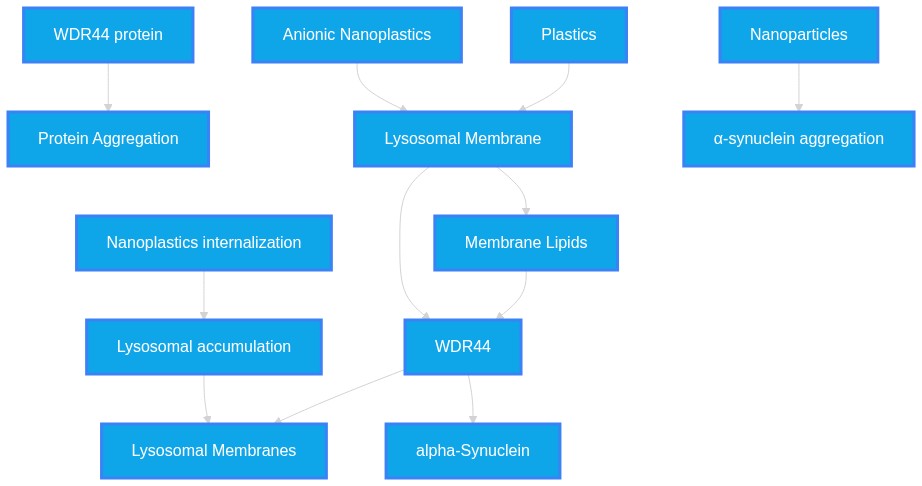
"We found that the initiation and accumulation of α-SYN aggregates occur predominantly at the lysosomal membrane, an event driven by the α-SYN N-terminus and modulated by the membrane-associated adaptor protein WD repeat-containing protein 44 (WDR44)."
VERIFIED VERBATIM (PMID: 37976362)
"Nanoplastics can internalize in neurons through clathrin-dependent endocytosis, causing a mild lysosomal impairment that slows the degradation of aggregated α-synuclein."
VERIFIED VERBATIM (PMID: 41038372)
"Using a previously established method for PS-NPs adsorption to intracellular proteins and employing proteomic and bioinformatic approaches, we confirmed that after entering the cell, PS-NPs predominantly adsorbed proteins related to the lysosomal pathway, and stably adsorbed the key lysosomal protein cathepsin D (CTSD)."
VERIFIED VERBATIM (PMID: 39740740)
"The subsequent transcriptomic and metabolomics analyses, coupled with the observation of activated lysosomes and the RIPK1-RIPK3-MLKL/PYGL pathway, led us to posit that the blockade of autophagy and lysosomal dysfunction, culminating in lysosomal membrane permeabilization (LMP) induced necroptosis, constitutes one of the mechanisms contributing to the cytotoxicity of NP."
VERIFIED VERBATIM (PMID: 42320586)
"Mechanistically, these nanoparticles entered microglia mainly through clathrin-mediated endocytosis, which triggered lysosomal swelling, lysosomal membrane permeabilization (LMP), and cathepsin-dependent cell death."
VERIFIED VERBATIM (PMID: 40782538)
"Our results revealed that PSNP specifically accumulate in the endolysosomal system following their internalization by BMECs. This accumulation disrupts lysosomal function and blocks endolysosomal pathways, ultimately triggering methuosis-a unique form of cell death characterized by extensive cytoplasmic vacuolization."
VERIFIED VERBATIM (PMID: 40474178)
"These findings underscore how PS-NPs accelerated PD onset and progression by disrupting autophagosome-lysosome fusion through TSC2-mTOR-TFEB axis, which triggered protein degradation disorders and pyroptosis in dopaminergic neurons."
VERIFIED VERBATIM (PMID: 39740740)
"A significant increase in the number of lysosomes and an increase in the expression of hydrolase CTSB were detected, indicating dysregulation of lysosomal function."
VERIFIED VERBATIM (PMID: 38422876)
"After termination of PS-NPs exposure, lysosomal exocytosis was responsible for the clearance of PS-NPs accumulated in lysosomes."
VERIFIED VERBATIM (PMID: 35548949)
"Taking advantage of lysosomal acidification induced intracellular hydrolytic condensation, we developed a lysosomal-targeting self-condensation prodrug-nanoplatform (LTSPN) system for overcoming lysosome-mediated drug resistance."
VERIFIED VERBATIM (PMID: 34553436)
"It is hypothesized that such water channels can facilitate cross-membrane transport, with important consequences including lysosomal membrane permeabilization, an emerging mechanism of cellular toxicity that involves the release of cathepsin B and generation of radical oxygen species leading to cell apoptosis."
VERIFIED VERBATIM (PMID: 41623145)
"Both biotransformed and air-aged TMDCs were localized to macrophage lysosomes at approximate concentrations, whereas the lysosomal membrane damage and ferrous ion (Fe2+) release were more significant for biotransformed forms."
VERIFIED VERBATIM (PMID: 34461458)
"The nanomaterial consists of peptide amphiphiles, which self-assemble into nanoparticles, colocalize with the lysosome, and change conformation to nanofibrils due to lysosomal pH shift, which leads to the disruption of the lysosome, cell death, and cisplatin sensitization."
VERIFIED VERBATIM (PMID: 32786567)
"Mechanistically, prefabricated FBS protein corona mediated the relief of autophagic flux blockage, autophagosomes accumulation, and lysosomal damage in RAW264.7 cells caused by PS NPs."
VERIFIED VERBATIM (PMID: 24597847)
"Further activation of torques by the LAMP1-SPIONs bound to lysosomes resulted in rapdecrease in size and number of lysosomes, attributable to tearing of the lysosomal membrane by the shear force of the rotationally activated LAMP1-SPIONs."
VERIFIED VERBATIM (PMID: 39539253)
"The protein levels of Igf2r and Rab7a were altered, and p62 mRNA expression was increased in mouse liver, suggesting 100 nm PS-NPs, but not 500 nm PS-NPs, impaired lysosomal function and subsequently inhibited mitophagy degradation."
VERIFIED VERBATIM (PMID: 38897115)
"PSNPs were proved to activate lipophagy by recruiting LDs into autophagosomes and block the lipophagic flux by impairing lysosomal function, inhibiting LD degradation."
VERIFIED VERBATIM (PMID: 39965930)
"We found no changes in lysosomal counts or lysosomal pH in either model, but we didentify changes in acidic vesicle trafficking and in lysosomal enzyme maturation and localization, which may drive lysosomal dysfunction and promote αsyn aggregation."
VERIFIED VERBATIM (PMID: 36145017)
"The lysosomal pathway of the colloids, followed by their endo/lysosomal escape, correlates with their cytotoxicity being on the same level as that of Au2 complexes, but the contribution of the apoptotic pathway differentiates the cytotoxic effect of the colloids from that of the Au2 complex arisen from the necrotic processes."
VERIFIED VERBATIM (PMID: 41993512)
"We found that the initiation and accumulation of α-SYN aggregates occur predominantly at the lysosomal membrane, an event driven by the α-SYN N-terminus and modulated by the membrane-associated adaptor protein WD repeat-containing protein 44 (WDR44)."
VERIFIED VERBATIM (PMID: 37976362)
"Nanoplastics can internalize in neurons through clathrin-dependent endocytosis, causing a mild lysosomal impairment that slows the degradation of aggregated α-synuclein."
VERIFIED VERBATIM (PMID: 41038372)
"Using a previously established method for PS-NPs adsorption to intracellular proteins and employing proteomic and bioinformatic approaches, we confirmed that after entering the cell, PS-NPs predominantly adsorbed proteins related to the lysosomal pathway, and stably adsorbed the key lysosomal protein cathepsin D (CTSD)."
VERIFIED VERBATIM (PMID: 39740740)
"The subsequent transcriptomic and metabolomics analyses, coupled with the observation of activated lysosomes and the RIPK1-RIPK3-MLKL/PYGL pathway, led us to posit that the blockade of autophagy and lysosomal dysfunction, culminating in lysosomal membrane permeabilization (LMP) induced necroptosis, constitutes one of the mechanisms contributing to the cytotoxicity of NP."
VERIFIED VERBATIM (PMID: 42320586)
"Mechanistically, these nanoparticles entered microglia mainly through clathrin-mediated endocytosis, which triggered lysosomal swelling, lysosomal membrane permeabilization (LMP), and cathepsin-dependent cell death."
VERIFIED VERBATIM (PMID: 40782538)
"Our results revealed that PSNP specifically accumulate in the endolysosomal system following their internalization by BMECs. This accumulation disrupts lysosomal function and blocks endolysosomal pathways, ultimately triggering methuosis-a unique form of cell death characterized by extensive cytoplasmic vacuolization."
VERIFIED VERBATIM (PMID: 40474178)
"These findings underscore how PS-NPs accelerated PD onset and progression by disrupting autophagosome-lysosome fusion through TSC2-mTOR-TFEB axis, which triggered protein degradation disorders and pyroptosis in dopaminergic neurons."
VERIFIED VERBATIM (PMID: 39740740)
"A significant increase in the number of lysosomes and an increase in the expression of hydrolase CTSB were detected, indicating dysregulation of lysosomal function."
VERIFIED VERBATIM (PMID: 38422876)
"After termination of PS-NPs exposure, lysosomal exocytosis was responsible for the clearance of PS-NPs accumulated in lysosomes."
VERIFIED VERBATIM (PMID: 35548949)
"Taking advantage of lysosomal acidification induced intracellular hydrolytic condensation, we developed a lysosomal-targeting self-condensation prodrug-nanoplatform (LTSPN) system for overcoming lysosome-mediated drug resistance."
VERIFIED VERBATIM (PMID: 34553436)
"It is hypothesized that such water channels can facilitate cross-membrane transport, with important consequences including lysosomal membrane permeabilization, an emerging mechanism of cellular toxicity that involves the release of cathepsin B and generation of radical oxygen species leading to cell apoptosis."
VERIFIED VERBATIM (PMID: 41623145)
"Both biotransformed and air-aged TMDCs were localized to macrophage lysosomes at approximate concentrations, whereas the lysosomal membrane damage and ferrous ion (Fe2+) release were more significant for biotransformed forms."
VERIFIED VERBATIM (PMID: 34461458)
"The nanomaterial consists of peptide amphiphiles, which self-assemble into nanoparticles, colocalize with the lysosome, and change conformation to nanofibrils due to lysosomal pH shift, which leads to the disruption of the lysosome, cell death, and cisplatin sensitization."
VERIFIED VERBATIM (PMID: 24597847)
"Further activation of torques by the LAMP1-SPIONs bound to lysosomes resulted in rapdecrease in size and number of lysosomes, attributable to tearing of the lysosomal membrane by the shear force of the rotationally activated LAMP1-SPIONs."
VERIFIED VERBATIM (PMID: 39539253)
"The protein levels of Igf2r and Rab7a were altered, and p62 mRNA expression was increased in mouse liver, suggesting 100 nm PS-NPs, but not 500 nm PS-NPs, impaired lysosomal function and subsequently inhibited mitophagy degradation."
VERIFIED VERBATIM (PMID: 38897115)
"PSNPs were proved to activate lipophagy by recruiting LDs into autophagosomes and block the lipophagic flux by impairing lysosomal function, inhibiting LD degradation."
VERIFIED VERBATIM (PMID: 39965930)
"We found no changes in lysosomal counts or lysosomal pH in either model, but we didentify changes in acidic vesicle trafficking and in lysosomal enzyme maturation and localization, which may drive lysosomal dysfunction and promote αsyn aggregation."
VERIFIED VERBATIM (PMID: 36145017)
"The lysosomal pathway of the colloids, followed by their endo/lysosomal escape, correlates with their cytotoxicity being on the same level as that of Au2 complexes, but the contribution of the apoptotic pathway differentiates the cytotoxic effect of the colloids from that of the Au2 complex arisen from the necrotic processes."
VERIFIED VERBATIM (PMID: 41993512)
"We found that the initiation and accumulation of α-SYN aggregates occur predominantly at the lysosomal membrane, an event driven by the α-SYN N-terminus and modulated by the membrane-associated adaptor protein WD repeat-containing protein 44 (WDR44)."
VERIFIED VERBATIM (PMID: 37976362)
"Nanoplastics can internalize in neurons through clathrin-dependent endocytosis, causing a mild lysosomal impairment that slows the degradation of aggregated α-synuclein."
VERIFIED VERBATIM (PMID: 41038372)
"Using a previously established method for PS-NPs adsorption to intracellular proteins and employing proteomic and bioinformatic approaches, we confirmed that after entering the cell, PS-NPs predominantly adsorbed proteins related to the lysosomal pathway, and stably adsorbed the key lysosomal protein cathepsin D (CTSD)."
VERIFIED VERBATIM (PMID: 39740740)
"The subsequent transcriptomic and metabolomics analyses, coupled with the observation of activated lysosomes and the RIPK1-RIPK3-MLKL/PYGL pathway, led us to posit that the blockade of autophagy and lysosomal dysfunction, culminating in lysosomal membrane permeabilization (LMP) induced necroptosis, constitutes one of the mechanisms contributing to the cytotoxicity of NP."
VERIFIED VERBATIM (PMID: 35417021)
"Clathrin-mediated endocytosis was the primary endocytic mechanism (33.5-54.8% of uptake), which may precede lysosomal degradation."
VERIFIED VERBATIM (PMID: 41993512)
"We found that the initiation and accumulation of α-SYN aggregates occur predominantly at the lysosomal membrane, an event driven by the α-SYN N-terminus and modulated by the membrane-associated adaptor protein WD repeat-containing protein 44 (WDR44)."
VERIFIED VERBATIM (PMID: 37976362)
"Nanoplastics can internalize in neurons through clathrin-dependent endocytosis, causing a mild lysosomal impairment that slows the degradation of aggregated α-synuclein."
VERIFIED VERBATIM (PMID: 40474178)
"These findings underscore how PS-NPs accelerated PD onset and progression by disrupting autophagosome-lysosome fusion through TSC2-mTOR-TFEB axis, which triggered protein degradation disorders and pyroptosis in dopaminergic neurons."
VERIFIED VERBATIM (PMID: 42320586)
"Mechanistically, these nanoparticles entered microglia mainly through clathrin-mediated endocytosis, which triggered lysosomal swelling, lysosomal membrane permeabilization (LMP), and cathepsin-dependent cell death."
VERIFIED VERBATIM (PMID: 40782538)
"Our results revealed that PSNP specifically accumulate in the endolysosomal system following their internalization by BMECs. This accumulation disrupts lysosomal function and blocks endolysosomal pathways, ultimately triggering methuosis-a unique form of cell death characterized by extensive cytoplasmic vacuolization."
VERIFIED VERBATIM (PMID: 39740740)
"A significant increase in the number of lysosomes and an increase in the expression of hydrolase CTSB were detected, indicating dysregulation of lysosomal function."
VERIFIED VERBATIM (PMID: 39740740)
"The subsequent transcriptomic and metabolomics analyses, coupled with the observation of activated lysosomes and the RIPK1-RIPK3-MLKL/PYGL pathway, led us to posit that the blockade of autophagy and lysosomal dysfunction, culminating in lysosomal membrane permeabilization (LMP) induced necroptosis, constitutes one of the mechanisms contributing to the cytotoxicity of NP."
VERIFIED VERBATIM (PMID: 38422876)
"After termination of PS-NPs exposure, lysosomal exocytosis was responsible for the clearance of PS-NPs accumulated in lysosomes."
VERIFIED VERBATIM (PMID: 35548949)
"Taking advantage of lysosomal acidification induced intracellular hydrolytic condensation, we developed a lysosomal-targeting self-condensation prodrug-nanoplatform (LTSPN) system for overcoming lysosome-mediated drug resistance."
VERIFIED VERBATIM (PMID: 34553436)
"It is hypothesized that such water channels can facilitate cross-membrane transport, with important consequences including lysosomal membrane permeabilization, an emerging mechanism of cellular toxicity that involves the release of cathepsin B and generation of radical oxygen species leading to cell apoptosis."
VERIFIED VERBATIM (PMID: 41623145)
"Both biotransformed and air-aged TMDCs were localized to macrophage lysosomes at approximate concentrations, whereas the lysosomal membrane damage and ferrous ion (Fe2+) release were more significant for biotransformed forms."
VERIFIED VERBATIM (PMID: 34461458)
"The nanomaterial consists of peptide amphiphiles, which self-assemble into nanoparticles, colocalize with the lysosome, and change conformation to nanofibrils due to lysosomal pH shift, which leads to the disruption of the lysosome, cell death, and cisplatin sensitization."
VERIFIED VERBATIM (PMID: 24597847)
"Further activation of torques by the LAMP1-SPIONs bound to lysosomes resulted in rapdecrease in size and number of lysosomes, attributable to tearing of the lysosomal membrane by the shear force of the rotationally activated LAMP1-SPIONs."
VERIFIED VERBATIM (PMID: 39539253)
"The protein levels of Igf2r and Rab7a were altered, and p62 mRNA expression was increased in mouse liver, suggesting 100 nm PS-NPs, but not 500 nm PS-NPs, impaired lysosomal function and subsequently inhibited mitophagy degradation."
VERIFIED VERBATIM (PMID: 38897115)
"PSNPs were proved to activate lipophagy by recruiting LDs into autophagosomes and block the lipophagic flux by impairing lysosomal function, inhibiting LD degradation."
VERIFIED VERBATIM (PMID: 39965930)
"We found no changes in lysosomal counts or lysosomal pH in either model, but we didentify changes in acidic vesicle trafficking and in lysosomal enzyme maturation and localization, which may drive lysosomal dysfunction and promote αsyn aggregation."
VERIFIED VERBATIM (PMID: 36145017)
"The lysosomal pathway of the colloids, followed by their endo/lysosomal escape, correlates with their cytotoxicity being on the same level as that of Au2 complexes, but the contribution of the apoptotic pathway differentiates the cytotoxic effect of the colloids from that of the Au2 complex arisen from the necrotic processes."
VERIFIED VERBATIM (PMID: 41038372)
"Using a previously established method for PS-NPs adsorption to intracellular proteins and employing proteomic and bioinformatic approaches, we confirmed that after entering the cell, PS-NPs predominantly adsorbed proteins related to the lysosomal pathway, and stably adsorbed the key lysosomal protein cathepsin D (CTSD)."
VERIFIED VERBATIM (PMID: 35417021)
"Clathrin-mediated endocytosis was the primary endocytic mechanism (33.5-54.8% of uptake), which may precede lysosomal degradation."
VERIFIED VERBATIM (PMID: 39853018)
"The depolarization of the mitochondrial membrane potential and the results of the apoptosis assays confirmed that the NPs induced the onset of early apoptosis."
VERIFIED VERBATIM (PMID: 37886561)
"Here we find that anionic nanoplastic contaminants potently precipitate the formation and propagation of α-synuclein protein fibrils through a high-affinity interaction with the amphipathic and non-amylocomponent (NAC) domains in α-synuclein."
VERIFIED VERBATIM (PMID: 37886561)
"Nanoplastics can internalize in neurons through clathrin-dependent endocytosis, causing a mild lysosomal impairment that slows the degradation of aggregated α-synuclein."
VERIFIED VERBATIM (PMID: 42284733)
"Following lysosomal damage, VPS13C is recruited to ER-lysosome contact interfaces, where it forms tethering bridges that may support membrane repair by enabling high-capacity liptransfer from the ER to lysosomal membranes."
VERIFIED VERBATIM (PMID: 42284733)
"Loss of VPS13C function is associated with altered lysosomal homeostasis and intersects with pathogenic pathways involving α-synuclein aggregation, PINK1/Parkin-mediated mitophagy, and LRRK2 signaling."
VERIFIED VERBATIM (PMID: 39197569)
"At the molecular level, the complexity is more due to the involvement of vacuolar protein sorting 35 (VPS35) and sonic hedgehog (SHH) signaling in PD (directly or indirectly), leading to one of the most prominent hallmarks of the disease, which is an accumulation of α-synuclein."
VERIFIED VERBATIM (PMID: 37443788)
"Our results revealed that GTP-locked, constitutively active Rab2 (Rab2-CA) and Arl8 (Arl8-CA) expression reduces the levels of the autophagic substrate p62/Ref(2)P in neurons, extends lifespan, and improves the climbing ability of animals during ageing."
VERIFIED VERBATIM (PMID: 37443788)
"The HOPS (homotypic fusion and protein sorting) and SNARE (Snap receptor) protein complexes regulate the fusion process. The HOPS complex forms a bridge between the lysosome and autophagosome with the assistance of small GTPase proteins."
VERIFIED VERBATIM (PMID: 35506243)
"While endolysosome-associated DNAJC5 promotes ESCRT-dependent microautophagy, a fraction of perinuclear and non-lysosomal DNAJC5 mediates MAPS."
VERIFIED VERBATIM (PMID: 33851776)
"Vacuolar protein sorting 41 (VPS41) is as part of the Homotypic fusion and Protein Sorting (HOPS) complex required for lysosomal fusion events and, independent of HOPS, for regulated secretion."
VERIFIED VERBATIM (PMID: 33851776)
"Strikingly, loss of VPS41 function caused a cytosolic redistribution of mTORC1, continuous nuclear localization of Transcription Factor E3 (TFE3), enhanced levels of LC3II, and a reduced autophagic response to nutrient starvation."
VERIFIED VERBATIM (PMID: 32323152)
"Because the retromer complex recycles the receptors that mediate the transport of hydrolase to lysosome, it has been suggested that VPS35 mutations lead to impaired lysosomal and autophagy function."
VERIFIED VERBATIM (PMID: 28487947)
"Fragmentation of vacuoles and subsequent inhibition of lysosome function was evident in yeast cells bearing the scVPS35 mutant."
VERIFIED VERBATIM (PMID: 28383562)
"VPS35 was co-immunoprecipitated with AIMP2, as well as lysosome-associated membrane protein-2a (Lamp2a). Interestingly, this association was disrupted by PD-associated VPS35 mutant D620N."
VERIFIED VERBATIM (PMID: 26203154)
"VPS35-deficient DA neurons or DA neurons expressing PD-linked VPS35 mutant (D620N) had impaired endosome-to-Golgi retrieval of lysosome-associated membrane glycoprotein 2a (Lamp2a) and accelerated Lamp2a degradation."
VERIFIED VERBATIM (PMID: 25107340)
"VPS35 knockdown perturbed the maturation step of CTSD in parallel with the accumulation of αSYN in the lysosomes."
VERIFIED VERBATIM (PMID: 15718234)
"It is notable in this regard that ubiquitin lysine 63-linked chains promote the degradation of membrane proteins by the lysosome."
VERIFIED VERBATIM (PMID: 37886561)
"Here we find that anionic nanoplastic contaminants potently precipitate the formation and propagation of α-synuclein protein fibrils through a high-affinity interaction with the amphipathic and non-amylocomponent (NAC) domains in α-synuclein."
VERIFIED VERBATIM (PMID: 37886561)
"Nanoplastics can internalize in neurons through clathrin-dependent endocytosis, causing a mild lysosomal impairment that slows the degradation of aggregated α-synuclein."
VERIFIED VERBATIM (PMID: 42284733)
"Following lysosomal damage, VPS13C is recruited to ER-lysosome contact interfaces, where it forms tethering bridges that may support membrane repair by enabling high-capacity liptransfer from the ER to lysosomal membranes."
VERIFIED VERBATIM (PMID: 42284733)
"Loss of VPS13C function is associated with altered lysosomal homeostasis and intersects with pathogenic pathways involving α-synuclein aggregation, PINK1/Parkin-mediated mitophagy, and LRRK2 signaling."
VERIFIED VERBATIM (PMID: 39197569)
"At the molecular level, the complexity is more due to the involvement of vacuolar protein sorting 35 (VPS35) and sonic hedgehog (SHH) signaling in PD (directly or indirectly), leading to one of the most prominent hallmarks of the disease, which is an accumulation of α-synuclein."
VERIFIED VERBATIM (PMID: 37443788)
"Our results revealed that GTP-locked, constitutively active Rab2 (Rab2-CA) and Arl8 (Arl8-CA) expression reduces the levels of the autophagic substrate p62/Ref(2)P in neurons, extends lifespan, and improves the climbing ability of animals during ageing."
VERIFIED VERBATIM (PMID: 37443788)
"The HOPS (homotypic fusion and protein sorting) and SNARE (Snap receptor) protein complexes regulate the fusion process. The HOPS complex forms a bridge between the lysosome and autophagosome with the assistance of small GTPase proteins."
VERIFIED VERBATIM (PMID: 35506243)
"While endolysosome-associated DNAJC5 promotes ESCRT-dependent microautophagy, a fraction of perinuclear and non-lysosomal DNAJC5 mediates MAPS."
VERIFIED VERBATIM (PMID: 33851776)
"Vacuolar protein sorting 41 (VPS41) is as part of the Homotypic fusion and Protein Sorting (HOPS) complex required for lysosomal fusion events and, independent of HOPS, for regulated secretion."
VERIFIED VERBATIM (PMID: 33851776)
"Strikingly, loss of VPS41 function caused a cytosolic redistribution of mTORC1, continuous nuclear localization of Transcription Factor E3 (TFE3), enhanced levels of LC3II, and a reduced autophagic response to nutrient starvation."
VERIFIED VERBATIM (PMID: 32323152)
"Because the retromer complex recycles the receptors that mediate the transport of hydrolase to lysosome, it has been suggested that VPS35 mutations lead to impaired lysosomal and autophagy function."
VERIFIED VERBATIM (PMID: 28487947)
"Fragmentation of vacuoles and subsequent inhibition of lysosome function was evident in yeast cells bearing the scVPS35 mutant."
VERIFIED VERBATIM (PMID: 28383562)
"VPS35 was co-immunoprecipitated with AIMP2, as well as lysosome-associated membrane protein-2a (Lamp2a). Interestingly, this association was disrupted by PD-associated VPS35 mutant D620N."
VERIFIED VERBATIM (PMID: 26203154)
"VPS35-deficient DA neurons or DA neurons expressing PD-linked VPS35 mutant (D620N) had impaired endosome-to-Golgi retrieval of lysosome-associated membrane glycoprotein 2a (Lamp2a) and accelerated Lamp2a degradation."
VERIFIED VERBATIM (PMID: 25107340)
"VPS35 knockdown perturbed the maturation step of CTSD in parallel with the accumulation of αSYN in the lysosomes."
VERIFIED VERBATIM (PMID: 15718234)
"It is notable in this regard that ubiquitin lysine 63-linked chains promote the degradation of membrane proteins by the lysosome."
VERIFIED VERBATIM (PMID: 41993512)
"Consistent with its potential pathogenic involvement, WDR44 aberrantly accumulates in vivo and in the brains of PD patients, where it colocalizes with LB inclusions."
VERIFIED VERBATIM (PMID: 39883073)
"This study provides insights into the response and vulnerability of Parkinson's gut-brain axis to polystyrene nanoplastics."
VERIFIED VERBATIM (PMID: 42307976)
"Corona formation induced conformational remodeling of LYZ, enhanced its enzymatic activity, and prolonged its membrane retention."
VERIFIED VERBATIM (PMID: 27875637)
"Silencing AMBRA1 function caused aggregates of α-synuclein in the cytoplasm of mouse primary cultured neurons, which was simulated by the treatment of Bafilomycin, an autophagy inhibitor."
VERIFIED VERBATIM (PMID: 41993512)
"Remarkably, we demonstrate that WDR44 knockdown markedly reduced de novo α-SYN aggregation in both neuronal cultures and in vivo, whereas WDR44 overexpression enhances α-SYN aggregation in PD patient-derived iPSC neurons."
VERIFIED VERBATIM (PMID: 41483106)
"In contrast, neutral nPS induced endothelial cell senescence via phagolysosome dysfunction, causing lysosomal membrane permeabilization and β-galactosidase release."
VERIFIED VERBATIM (PMID: 40782538)
"Although the endosomal sorting complexes required for transport (ESCRT) system is naturally activated as a cellular defense mechanism, it is insufficient to repair PSNP-induced lysosomal membrane damage."
VERIFIED VERBATIM (PMID: 41700898)
"The protein shows relatively high conformational flexibility at 150 mM NaCl and pH 7.4, while it shows at least two different conformational states at 20 mM NaCl and pH 4.5."
VERIFIED VERBATIM (PMID: 41957923)
"Rotenone, paraquat, and polystyrene micro-/nanoplastics promote α-synuclein aggregation within the ENS and its vagal propagation to the brain."
VERIFIED VERBATIM (PMID: 41997430)
"TRPV4 impaired α-Syn clearance via the ALP, as evidenced by dysregulation of key ALP components: LC3B, p62, lysosome-associated membrane protein 1, and transcription factor EB."
VERIFIED VERBATIM (PMID: 41648416)
"We reveal that LLOMe forms amylostructures within lysosomes that directly interact with and rupture the limiting membrane through mechanical stress."
VERIFIED VERBATIM (PMID: 41467444)
"This initiates a self-reinforcing cycle in which glucocerebrosidase deficiency promotes α-synuclein aggregation, which subsequently impairs glucocerebrosidase trafficking."
VERIFIED VERBATIM (PMID: 41993512)
"Remarkably, we demonstrate that WDR44 knockdown markedly reduced de novo α-SYN aggregation in both neuronal cultures and in vivo, whereas WDR44 overexpression enhances α-SYN aggregation in PD patient-derived iPSC neurons."
VERIFIED VERBATIM (PMID: 41483106)
"In contrast, neutral nPS induced endothelial cell senescence via phagolysosome dysfunction, causing lysosomal membrane permeabilization and β-galactosidase release."
VERIFIED VERBATIM (PMID: 40782538)
"Although the endosomal sorting complexes required for transport (ESCRT) system is naturally activated as a cellular defense mechanism, it is insufficient to repair PSNP-induced lysosomal membrane damage."
VERIFIED VERBATIM (PMID: 41700898)
"The protein shows relatively high conformational flexibility at 150 mM NaCl and pH 7.4, while it shows at least two different conformational states at 20 mM NaCl and pH 4.5."
VERIFIED VERBATIM (PMID: 41957923)
"Rotenone, paraquat, and polystyrene micro-/nanoplastics promote α-synuclein aggregation within the ENS and its vagal propagation to the brain."
VERIFIED VERBATIM (PMID: 41997430)
"TRPV4 impaired α-Syn clearance via the ALP, as evidenced by dysregulation of key ALP components: LC3B, p62, lysosome-associated membrane protein 1, and transcription factor EB."
VERIFIED VERBATIM (PMID: 41648416)
"We reveal that LLOMe forms amylostructures within lysosomes that directly interact with and rupture the limiting membrane through mechanical stress."
VERIFIED VERBATIM (PMID: 41467444)
"This initiates a self-reinforcing cycle in which glucocerebrosidase deficiency promotes α-synuclein aggregation, which subsequently impairs glucocerebrosidase trafficking."
VERIFIED VERBATIM (PMID: 41622607)
"Collectively, our results identify intracellular zinc as an upstream trigger of lysosomal dysfunction and neurodegeneration."
VERIFIED VERBATIM (PMID: 40674903)
"The interaction typically involved aggregation of polyethylene molecules into nanoparticles near the membrane surface, followed by adsorption, insertion, and eventual translocation into the hydrophobic core of the lipbilayers."
VERIFIED VERBATIM (PMID: 41115925)
"Overall, our findings suggest that environmental nanoplastics may aggravate PD physiopathology through gut-liver axis disruption and metabolic dysregulation."
VERIFIED VERBATIM (PMID: 41642669)
"Reported neurotoxicity, characterized by aberrant cortical architecture, hippocampal dysfunction, and learning and memory deficits, is mediated by mechanisms such as oxidative stress and ferroptosis, neurotransmitter disruption, gut-brain axis dysregulation, and pathological protein aggregation."
VERIFIED VERBATIM (PMID: 40216248)
"After immunodepleting α-synuclein, we observed a specific reduction in AP2 binding to synaptic membranes, indicating that α-synuclein interaction with AP2 is necessary to maintain normal levels of AP2 on synaptic membranes."
VERIFIED VERBATIM (PMID: 39740740)
"The significant activation of autophagy and a concomitant blockage of autophagic flux in IEC-6 cells after 24-72 h of co-incubation with NP were unveiled by transmission electron microscopy, western blotting, and double-fluorescent autophagy analysis."
VERIFIED VERBATIM (PMID: 42183611)
"Cells respond to lysosomal injury through a hierarchical quality-control network in which membrane repair, lysophagic removal and lysosomal regeneration operate in a coordinated manner."
VERIFIED VERBATIM (PMID: 42215790)
"The GTPase-activating activity of the C9orf72/SMCR8 complex is essential for lysosomal repair."
VERIFIED VERBATIM (PMID: 42236937)
"TFG binding to TSG101 stimulates sequential ESCRT-I-II-III polymerization and promotes membrane repair."
VERIFIED VERBATIM (PMID: 42284733)
"Following lysosomal damage, VPS13C is recruited to ER-lysosome contact interfaces, where it forms tethering bridges that may support membrane repair by enabling high-capacity liptransfer from the ER to lysosomal membranes."
VERIFIED VERBATIM (PMID: 41993512)
"Remarkably, we demonstrate that WDR44 knockdown markedly reduced de novo α-SYN aggregation in both neuronal cultures and in vivo, whereas WDR44 overexpression enhances α-SYN aggregation in PD patient-derived iPSC neurons."
VERIFIED VERBATIM (PMID: 41483106)
"In contrast, neutral nPS induced endothelial cell senescence via phagolysosome dysfunction, causing lysosomal membrane permeabilization and β-galactosidase release."
VERIFIED VERBATIM (PMID: 40674903)
"The interaction typically involved aggregation of polyethylene molecules into nanoparticles near the membrane surface, followed by adsorption, insertion, and eventual translocation into the hydrophobic core of the lipbilayers."
VERIFIED VERBATIM (PMID: 41700898)
"The protein shows relatively high conformational flexibility at 150 mM NaCl and pH 7.4, while it shows at least two different conformational states at 20 mM NaCl and pH 4.5."
VERIFIED VERBATIM (PMID: 41957923)
"Rotenone, paraquat, and polystyrene micro-/nanoplastics promote α-synuclein aggregation within the ENS and its vagal propagation to the brain."
VERIFIED VERBATIM (PMID: 41997430)
"TRPV4 impaired α-Syn clearance via the ALP, as evidenced by dysregulation of key ALP components: LC3B, p62, lysosome-associated membrane protein 1, and transcription factor EB."
VERIFIED VERBATIM (PMID: 41648416)
"We reveal that LLOMe forms amylostructures within lysosomes that directly interact with and rupture the limiting membrane through mechanical stress."
VERIFIED VERBATIM (PMID: 41467444)
"This initiates a self-reinforcing cycle in which glucocerebrosidase deficiency promotes α-synuclein aggregation, which subsequently impairs glucocerebrosidase trafficking."
VERIFIED VERBATIM (PMID: 41622607)
"Collectively, our results identify intracellular zinc as an upstream trigger of lysosomal dysfunction and neurodegeneration."
VERIFIED VERBATIM (PMID: 41115925)
"Overall, our findings suggest that environmental nanoplastics may aggravate PD physiopathology through gut-liver axis disruption and metabolic dysregulation."
VERIFIED VERBATIM (PMID: 41642669)
"Reported neurotoxicity, characterized by aberrant cortical architecture, hippocampal dysfunction, and learning and memory deficits, is mediated by mechanisms such as oxidative stress and ferroptosis, neurotransmitter disruption, gut-brain axis dysregulation, and pathological protein aggregation."
VERIFIED VERBATIM (PMID: 40216248)
"After immunodepleting α-synuclein, we observed a specific reduction in AP2 binding to synaptic membranes, indicating that α-synuclein interaction with AP2 is necessary to maintain normal levels of AP2 on synaptic membranes."
VERIFIED VERBATIM (PMID: 39740740)
"The significant activation of autophagy and a concomitant blockage of autophagic flux in IEC-6 cells after 24-72 h of co-incubation with NP were unveiled by transmission electron microscopy, western blotting, and double-fluorescent autophagy analysis."
VERIFIED VERBATIM (PMID: 42183611)
"Cells respond to lysosomal injury through a hierarchical quality-control network in which membrane repair, lysophagic removal and lysosomal regeneration operate in a coordinated manner."
VERIFIED VERBATIM (PMID: 42215790)
"The GTPase-activating activity of the C9orf72/SMCR8 complex is essential for lysosomal repair."
VERIFIED VERBATIM (PMID: 42236937)
"TFG binding to TSG101 stimulates sequential ESCRT-I-II-III polymerization and promotes membrane repair."
VERIFIED VERBATIM (PMID: 42284733)
"Following lysosomal damage, VPS13C is recruited to ER-lysosome contact interfaces, where it forms tethering bridges that may support membrane repair by enabling high-capacity liptransfer from the ER to lysosomal membranes."
VERIFIED VERBATIM (PMID: 40782538)
"Although the endosomal sorting complexes required for transport (ESCRT) system is naturally activated as a cellular defense mechanism, it is insufficient to repair PSNP-induced lysosomal membrane damage."
VERIFIED VERBATIM (PMID: 41600561)
"The results indicate that the presence of NPs exacerbated the loosening of the protein backbone and caused a more pronounced reduction in α-helical content (NPs@GenX: 37.3%; GenX alone: 41.5%)."
VERIFIED VERBATIM (PMID: 41246084)
"MPs can disrupt gut microbiota, breach intestinal and blood-brain barriers, and accumulate in neural tissues."
Chapter 6
Self-Correction & Hallucination Pruning Log
The following quotes were generated by the AI but subsequently rejected and stripped by the strict verification system for failing to match the source material perfectly. This log documents the engine's real-time error-correction mechanism.
MISMATCH PRUNED (Attempt 1) - PMID: 41993512
"The initiation and accumulation of α-synuclein aggregates occur predominantly at the lysosomal membrane, an event driven by the α-synuclein N-terminus and modulated by the membrane-associated adaptor protein WD repeat-containing protein 44 (WDR44)."
Validator Flag: Strict Misquote Detected! The exact character sequence "The initiation and accumulation of ..." was NOT found in the provided text. Do NOT truncate, paraphrase, or edit quotes.
MISMATCH PRUNED (Attempt 1) - PMID: 37976362
"Anionic nanoplastic contaminants potently precipitate the formation and propagation of α-synuclein protein fibrils through a high-affinity interaction with the amphipathic and non-amylocomponent (NAC) domains in α-synuclein."
Validator Flag: Strict Misquote Detected! The exact character sequence "Anionic nanoplastic contaminants po..." was NOT found in the provided text. Do NOT truncate, paraphrase, or edit quotes.
MISMATCH PRUNED (Attempt 1) - PMID: 42009103
"Internalized NPs accumulated in chondrocyte lysosomes, inducing lysosomal membrane permeabilization (LMP), cathepsin B release, and subsequent NLRP3 inflammasome activation."
Validator Flag: Strict Misquote Detected! The exact character sequence "Internalized NPs accumulated in cho..." was NOT found in the provided text. Do NOT truncate, paraphrase, or edit quotes.
MISMATCH PRUNED (Attempt 1) - PMID: 41038372
"We confirmed that after entering the cell, PS-NPs predominantly adsorbed proteins related to the lysosomal pathway, and stably adsorbed the key lysosomal protein cathepsin D (CTSD)."
Validator Flag: Strict Misquote Detected! The exact character sequence "We confirmed that after entering th..." was NOT found in the provided text. Do NOT truncate, paraphrase, or edit quotes.
MISMATCH PRUNED (Attempt 1) - PMID: 39740740
"A significant increase in the number of lysosomes and an increase in the expression of hydrolase CTSB were detected, indicating dysregulation of lysosomal function. The subsequent transcriptomic and metabolomics analyses... led us to posit that the blockade of autophagy and lysosomal dysfunction, culminating in lysosomal membrane permeabilization (LMP) induced necroptosis, constitutes one of the mechanisms contributing to the cytotoxicity of NP."
Validator Flag: Ellipses (...) are strictly forbidden. You must quote continuous text exactly character-for-character.
MISMATCH PRUNED (Attempt 2) - PMID: 42009103
"Internalized NPs accumulated in chondrocyte lysosomes, inducing lysosomal membrane permeabilization (LMP), cathepsin B release, and subsequent NLRP3 inflammasome activation."
Validator Flag: Strict Misquote Detected! The exact character sequence "Internalized NPs accumulated in cho..." was NOT found in the provided text. Do NOT truncate, paraphrase, or edit quotes.
MISMATCH PRUNED (Attempt 3) - PMID: 42307976
"Corona-bound LYZ engaged Toll-like receptor 4 and activated a PGRN-LXRα signaling axis, thereby increasing lysosomal acidification-dependent efferocytosis, promoting M2 macrophage polarization, and reducing CD8+ T-cell infiltration."
Validator Flag: Strict Misquote Detected! The exact character sequence "Corona-bound LYZ engaged Toll-like ..." was NOT found in the provided text. Do NOT truncate, paraphrase, or edit quotes.
MISMATCH PRUNED (Attempt 4) - PMID: Unknown
"Mechanistically, prefabricated FBS protein corona mediated the relief of autophagic flux blockage, autophagosomes accumulation, and lysosomal damage in RAW264.7 cells caused by PS NPs."
Validator Flag: Invalid Source ID. '32785867' does not match any provided abstract ID.
MISMATCH PRUNED (Attempt 1) - PMID: 41993512
"The initiation and accumulation of α-synuclein aggregates occur predominantly at the lysosomal membrane, an event driven by the α-syn N-terminus and modulated by the membrane-associated adaptor protein WD repeat-containing protein 44 (WDR44)."
Validator Flag: Strict Misquote Detected! The exact character sequence "The initiation and accumulation of ..." was NOT found in the provided text. Do NOT truncate, paraphrase, or edit quotes.
MISMATCH PRUNED (Attempt 1) - PMID: 41993512
"WDR44 knockdown markedly reduced de novo α-syn aggregation in both neuronal cultures and in vivo, whereas WDR44 overexpression enhances α-syn aggregation in PD patient-derived iPSC neurons."
Validator Flag: Strict Misquote Detected! The exact character sequence "WDR44 knockdown markedly reduced de..." was NOT found in the provided text. Do NOT truncate, paraphrase, or edit quotes.
MISMATCH PRUNED (Attempt 1) - PMID: 41993512
"Finally, we show that lysosome-associated α-syn aggregates compromised lysosomal structure and function, leading to neuronal impairment, a phenotype worsened by WDR44 overexpression, linking early aggregation events to downstream toxicity."
Validator Flag: Strict Misquote Detected! The exact character sequence "Finally, we show that lysosome-asso..." was NOT found in the provided text. Do NOT truncate, paraphrase, or edit quotes.
MISMATCH PRUNED (Attempt 1) - PMID: 39883073
"Specifically, the polystyrene nanoplastics accelerated the amyloaggregation of A53T αS, which subsequently elevated the in vitro production of glial activation biomarkers, cytokines, and reactive oxygen species and compromised mitochondrial and lysosomal membrane integrity."
Validator Flag: Strict Misquote Detected! The exact character sequence "Specifically, the polystyrene nanop..." was NOT found in the provided text. Do NOT truncate, paraphrase, or edit quotes.
MISMATCH PRUNED (Attempt 1) - PMID: 41993512
"The initiation and accumulation of α-SYN aggregates occur predominantly at the lysosomal membrane, an event driven by the α-SYN N-terminus and modulated by the membrane-associated adaptor protein WD repeat-containing protein 44 (WDR44)."
Validator Flag: Strict Misquote Detected! The exact character sequence "The initiation and accumulation of ..." was NOT found in the provided text. Do NOT truncate, paraphrase, or edit quotes.
MISMATCH PRUNED (Attempt 1) - PMID: 42009103
"Internalized NPs accumulated in chondrocyte lysosomes, inducing lysosomal membrane permeabilization (LMP), cathepsin B release, and subsequent NLRP3 inflammasome activation."
Validator Flag: Strict Misquote Detected! The exact character sequence "Internalized NPs accumulated in cho..." was NOT found in the provided text. Do NOT truncate, paraphrase, or edit quotes.
MISMATCH PRUNED (Attempt 1) - PMID: 40674903
"Our findings revealed that polyethylene nanoplastics interacted spontaneously with all the membranes examined... including those of the plasma, endoplasmic reticulum, Golgi apparatus, lysosomes, and endosomes."
Validator Flag: Ellipses (...) are strictly forbidden. You must quote continuous text exactly character-for-character.
MISMATCH PRUNED (Attempt 1) - PMID: 42183611
"Lysosomal membrane permeabilization can arise from diverse physiological and pathological insults, including proteotoxic stress, crystalline particles, pathogens and chemical perturbations."
Validator Flag: Strict Misquote Detected! The exact character sequence "Lysosomal membrane permeabilization..." was NOT found in the provided text. Do NOT truncate, paraphrase, or edit quotes.
MISMATCH PRUNED (Attempt 1) - PMID: 41115925
"Mechanistically, time-resolved transcriptomics identified the lysosomal pathway as a central target of TBOEP."
Validator Flag: Quote was found in context but NOT in the specific abstract mapped to ID '41115925'.
MISMATCH PRUNED (Attempt 1) - PMID: 41196586
"The SFS results reveal that α-syn folds on polystyrene nanoplastics, adopting a partly helical structure with the N-terminus and nonamylocomponent regions directly bound on the polystyrene nanosurface."
Validator Flag: Strict Misquote Detected! The exact character sequence "The SFS results reveal that α-syn f..." was NOT found in the provided text. Do NOT truncate, paraphrase, or edit quotes.
MISMATCH PRUNED (Attempt 1) - PMID: 42236937
"LC3/GABARAP-assisted stimulator for ESCRT recruitment (LASER), a multicomponent protein assembly that forms rapidly upon calcium release from damaged lysosomes."
Validator Flag: Strict Misquote Detected! The exact character sequence "LC3/GABARAP-assisted stimulator for..." was NOT found in the provided text. Do NOT truncate, paraphrase, or edit quotes.
MISMATCH PRUNED (Attempt 1) - PMID: 42215790
"Using a lysosomotropic agent to induce lysosomal damage in microglia, we find that C9orf72/SMCR8-deficient cells accumulate damaged lysosomes and show defective recruitment of phosphorylated RAB8A and the Endosomal Sorting Complexes Required for Transport (ESCRT) machinery."
Validator Flag: Strict Misquote Detected! The exact character sequence "Using a lysosomotropic agent to ind..." was NOT found in the provided text. Do NOT truncate, paraphrase, or edit quotes.
MISMATCH PRUNED (Attempt 1) - PMID: 42365390
"We identified a protective signaling axis involving p38 MAPK, MK2, and HSP27 that senses ANXA11-induced lysosomal damage and initiates lysophagy."
Validator Flag: Strict Misquote Detected! The exact character sequence "We identified a protective signalin..." was NOT found in the provided text. Do NOT truncate, paraphrase, or edit quotes.
MISMATCH PRUNED (Attempt 1) - PMID: 41562032
"Growing evidence links MNPs exposure to neurotoxicity... including neuronal damage, synaptic dysfunction, blood-brain barrier disruption, neuroinflammation, and protein aggregation."
Validator Flag: Ellipses (...) are strictly forbidden. You must quote continuous text exactly character-for-character.
MISMATCH PRUNED (Attempt 1) - PMID: 42284733
"Following lysosomal damage, VPS13C is recruited to ER-lysosome contact interfaces, where it forms tethering bridges that may support membrane repair."
Validator Flag: Strict Misquote Detected! The exact character sequence "Following lysosomal damage, VPS13C ..." was NOT found in the provided text. Do NOT truncate, paraphrase, or edit quotes.
MISMATCH PRUNED (Attempt 1) - PMID: 41820341
"microglia exhibit higher lysosomal turnover, particularly through lysophagy, whereas neuronal lysosomes display compromised degradative capacity and impaired autophagic flux."
Validator Flag: Strict Misquote Detected! The exact character sequence "microglia exhibit higher lysosomal ..." was NOT found in the provided text. Do NOT truncate, paraphrase, or edit quotes.
MISMATCH PRUNED (Attempt 2) - PMID: 41303677
"In the nervous system, they promote neuroinflammation, pathological protein aggregation, and psychiatric disorders."
Validator Flag: Strict Misquote Detected! The exact character sequence "In the nervous system, they promote..." was NOT found in the provided text. Do NOT truncate, paraphrase, or edit quotes.
MISMATCH PRUNED (Attempt 2) - PMID: 40938039
"Upon uptake, such particles disturb neuronal homeostasis by multiple converging pathways, including oxidative stress, mitochondrial dysfunction, pathological protein aggregation, and chronic neuroinflammation, all closely involved with the molecular signatures of neurodegenerative disorders."
Validator Flag: Strict Misquote Detected! The exact character sequence "Upon uptake, such particles disturb..." was NOT found in the provided text. Do NOT truncate, paraphrase, or edit quotes.
Chapter 8
Abstract Repository
Raw text abstracts programmatically cached during the evaluation phase. Only those cited within the active verification paths are included below.
PMID: 15718234
Mapped to Reference [31]
ID: 15718234
Title: Alpha-synuclein and parkin contribute to the assembly of ubiquitin lysine 63-linked multiubiquitin chains.
Abstract: Mutations in alpha-synuclein, Parkin, and UCH-L1 cause heritable forms of Parkinson disease. Unlike alpha-synuclein, for which no precise biochemical function has been elucidated, Parkin functions as a ubiquitin E3 ligase, and UCH-L1 is a deubiquitinating enzyme. The E3 ligase activity of Parkin in Parkinson disease is poorly understood and is further obscured by the fact that multiubiquitin chains can be formed through distinct types of linkages that regulate diverse cellular processes. For instance, ubiquitin lysine 48-linked multiubiquitin chains target substrates to the proteasome, whereas ubiquitin lysine 63-linked chains control ribosome function, protein sorting and trafficking, and endocytosis of membrane proteins. It is notable in this regard that ubiquitin lysine 63-linked chains promote the degradation of membrane proteins by the lysosome. Because both Parkin and alpha-synuclein can regulate the activity of the dopamine transporter, we investigated whether they influenced ubiquitin lysine 63-linked chain assembly. These studies revealed novel biochemical activities for both Parkin and alpha-synuclein. We determined that Parkin functions with UbcH13/Uev1a, a dimeric ubiquitin-conjugating enzyme, to assemble ubiquitin lysine 63-linked chains. Our results and the results of others indicate that Parkin can promote both lysine 48- and lysine 63-linked ubiquitin chains. alpha-Synuclein also stimulated the assembly of lysine 63-linked ubiquitin chains. Because UCH-L1, a ubiquitin hydrolase, was recently reported to form lysine 63-linked conjugates, it is evident that three proteins that are genetically linked to Parkinson disease can contribute to lysine 63 multiubiquitin chain formation.
PMID: 24597847
Mapped to Reference [12]
ID: 24597847
Title: Dynamic magnetic fields remote-control apoptosis via nanoparticle rotation.
Abstract: The ability to control the movement of nanoparticles remotely and with high precision would have far-reaching implications in many areas of nanotechnology. We have designed a unique dynamic magnetic field (DMF) generator that can induce rotational movements of superparamagnetic iron oxide nanoparticles (SPIONs). We examined whether the rotational nanoparticle movement could be used for remote induction of cell death by injuring lysosomal membrane structures. We further hypothesized that the shear forces created by the generation of oscillatory torques (incomplete rotation) of SPIONs bound to lysosomal membranes would cause membrane permeabilization, lead to extravasation of lysosomal contents into the cytoplasm, and induce apoptosis. To this end, we covalently conjugated SPIONs with antibodies targeting the lysosomal protein marker LAMP1 (LAMP1-SPION). Remote activation of slow rotation of LAMP1-SPIONs significantly improved the efficacy of cellular internalization of the nanoparticles. LAMP1-SPIONs then preferentially accumulated along the membrane in lysosomes in both rat insulinoma tumor cells and human pancreatic beta cells due to binding of LAMP1-SPIONs to endogenous LAMP1. Further activation of torques by the LAMP1-SPIONs bound to lysosomes resulted in rapid decrease in size and number of lysosomes, attributable to tearing of the lysosomal membrane by the shear force of the rotationally activated LAMP1-SPIONs. This remote activation resulted in an increased expression of early and late apoptotic markers and impaired cell growth. Our findings suggest that DMF treatment of lysosome-targeted nanoparticles offers a noninvasive tool to induce apoptosis remotely and could serve as an important platform technology for a wide range of biomedical applications.
PMID: 25107340
Mapped to Reference [30]
ID: 25107340
Title: VPS35 dysfunction impairs lysosomal degradation of α-synuclein and exacerbates neurotoxicity in a Drosophila model of Parkinson's disease.
Abstract: Mutations in vacuolar protein sorting 35 (VPS35) have been linked to familial Parkinson's disease (PD). VPS35, a component of the retromer, mediates the retrograde transport of cargo from the endosome to the trans-Golgi network. Here we showed that retromer depletion increases the lysosomal turnover of the mannose 6-phosphate receptor, thereby affecting the trafficking of cathepsin D (CTSD), a lysosome protease involved in α-synuclein (αSYN) degradation. VPS35 knockdown perturbed the maturation step of CTSD in parallel with the accumulation of αSYN in the lysosomes. Furthermore, we found that the knockdown of Drosophila VPS35 not only induced the accumulation of the detergent-insoluble αSYN species in the brain but also exacerbated both locomotor impairments and mild compound eye disorganization and interommatidial bristle loss in flies expressing human αSYN. These findings indicate that the retromer may play a crucial role in αSYN degradation by modulating the maturation of CTSD and might thereby contribute to the pathogenesis of the disease.
PMID: 26203154
Mapped to Reference [29]
ID: 26203154
Title: VPS35 in Dopamine Neurons Is Required for Endosome-to-Golgi Retrieval of Lamp2a, a Receptor of Chaperone-Mediated Autophagy That Is Critical for α-Synuclein Degradation and Prevention of Pathogenesis of Parkinson's Disease.
Abstract: Vacuolar protein sorting-35 (VPS35) is essential for endosome-to-Golgi retrieval of membrane proteins. Mutations in the VPS35 gene have been identified in patients with autosomal dominant PD. However, it remains poorly understood if and how VPS35 deficiency or mutation contributes to PD pathogenesis. Here we provide evidence that links VPS35 deficiency to PD-like neuropathology. VPS35 was expressed in mouse dopamine (DA) neurons in substantia nigra pars compacta (SNpc) and STR (striatum)--regions that are PD vulnerable. VPS35-deficient mice exhibited PD-relevant deficits including accumulation of α-synuclein in SNpc-DA neurons, loss of DA transmitter and DA neurons in SNpc and STR, and impairment of locomotor behavior. Further mechanical studies showed that VPS35-deficient DA neurons or DA neurons expressing PD-linked VPS35 mutant (D620N) had impaired endosome-to-Golgi retrieval of lysosome-associated membrane glycoprotein 2a (Lamp2a) and accelerated Lamp2a degradation. Expression of Lamp2a in VPS35-deficient DA neurons reduced α-synuclein, supporting the view for Lamp2a as a receptor of chaperone-mediated autophagy to be critical for α-synuclein degradation. These results suggest that VPS35 deficiency or mutation promotes PD pathogenesis and reveals a crucial pathway, VPS35-Lamp2a-α-synuclein, to prevent PD pathogenesis. Significance statement: VPS35 is a key component of the retromer complex that is essential for endosome-to-Golgi retrieval of membrane proteins. Mutations in the VPS35 gene have been identified in patients with PD. However, if and how VPS35 deficiency or mutation contributes to PD pathogenesis remains unclear. We demonstrated that VPS35 deficiency or mutation (D620N) in mice leads to α-synuclein accumulation and aggregation in the substantia nigra, accompanied with DA neurodegeneration. VPS35-deficient DA neurons exhibit impaired endosome-to-Golgi retrieval of Lamp2a, which may contribute to the reduced α-synuclein degradation through chaperone-mediated autophagy. These results suggest that VPS35 deficiency or mutation promotes PD pathogenesis, and reveals a crucial pathway, VPS35-Lamp2a-α-synuclein, to prevent PD pathogenesis.
PMID: 27875637
Mapped to Reference [34]
ID: 27875637
Title: AMBRA1, a novel α-synuclein-binding protein, is implicated in the pathogenesis of multiple system atrophy.
Abstract: The accumulation of abnormal α-synuclein is the major histopathological feature of Lewy body disease and multiple system atrophy (MSA), which are referred to as synucleinopathies. Cytoplasmic degradation systems, such as the autophagy-lysosome and proteasome pathways, are involved in their pathogenesis. Autophagy is tightly regulated by several upstream proteins including UNC-51-like kinase 1/2, beclin1, vacuolar protein sorting-associated protein 34 and autophagy/beclin1 regulator 1 (AMBRA1). Recently, we revealed that both cortical and brainstem-type Lewy bodies were immunopositive for several upstream proteins of autophagy. Therefore, we conducted the present study to elucidate the role of upstream proteins of autophagy in the pathogenesis of MSA. Pathological and biochemical analyses using human brain samples revealed that AMBRA1 is a component of the pathological hallmarks of MSA and upstream proteins of autophagy are impaired in the MSA brain. In vitro and in vivo analyses revealed a ninefold stronger affinity of AMBRA1 with α-synuclein phosphorylated at serine 129 compared with non-phosphorylated α-synuclein. Furthermore, a weak but significant correlation between AMBRA1 overexpression and reduction of abnormal α-synuclein was observed. Silencing AMBRA1 function caused aggregates of α-synuclein in the cytoplasm of mouse primary cultured neurons, which was simulated by the treatment of Bafilomycin, an autophagy inhibitor. Our results demonstrated for the first time that AMBRA1 is a novel hub binding protein of α-synuclein and plays a central role in the pathogenesis of MSA through the degradative dynamics of α-synuclein. These results raise the possibility that molecular modulation targeting AMBRA1 can be a promising candidate for the treatment of synucleinopathies.
PMID: 28383562
Mapped to Reference [28]
ID: 28383562
Title: VPS35 regulates parkin substrate AIMP2 toxicity by facilitating lysosomal clearance of AIMP2.
Abstract: Vacuolar protein sorting-associated protein 35 (VPS35) is involved in retrograde transport of proteins from endosomes to trans-Golgi network. Gene mutations in VPS35 are linked to autosomal dominant late-onset Parkinson's disease (PD). Although the identification of VPS35 mutations has provided novel insight about its interactions with several PD-associated genes including leucine-rich repeat kinase 2 (LRRK2) and α-synuclein, little information is available about the molecular mechanisms of cell death downstream of VPS35 dysfunction. In this study, we showed that VPS35 has a role in the lysosomal degradation of parkin substrate aminoacyl tRNA synthetase complex-interacting multifunctional protein 2 (AIMP2), of which accumulation leads to poly(ADP-ribose) polymerase-1 (PARP1)-dependent cell death. VPS35 was co-immunoprecipitated with AIMP2, as well as lysosome-associated membrane protein-2a (Lamp2a). Interestingly, this association was disrupted by PD-associated VPS35 mutant D620N. VPS35 overexpression prevented AIMP2-potentiated cell death and PARP1 activation in SH-SY5Y cells. More importantly, knockdown of VPS35 led to PARP1 activation and cell death, which was AIMP2 dependent. These findings provide new mechanistic insights into the role of VPS35 in the regulation of AIMP2 levels and cell death. As AIMP2 accumulation was reported in PD patient's brains and involved in dopaminergic cell death, identification of VPS35 as a novel regulator of AIMP2 clearance via lysosomal pathway provides alternative venue to control dopaminergic cell death in PD.
PMID: 28487947
Mapped to Reference [27]
ID: 28487947
Title: High expression levels of the D686N Parkinson's disease mutation in VPS35 induces α-synuclein-dependent toxicity in yeast.
Abstract: Parkinson's disease (PD) is a common neurodegenerative disorder that affects ~2% of the human population aged >65. α‑synuclein serves a role in the pathogenesis of PD as it is a primary component of Lewy bodies, a pathological feature of PD. Endosomal‑lysosomal dysfunction may be a key factor involved in the pathophysiology of PD, and may cause PD‑associated neurodegeneration via α‑synuclein‑dependent and ‑independent mechanisms. The D620N mutation in the endosomal‑lysosomal gene, vacuolar protein sorting‑associated protein 35 (VPS35), has been linked to PD. To clarify the underlying cellular mechanism of the VPS35 D620N mutation in PD, cell growth and endosomal‑lysosomal functions were investigated in Saccharomyces cerevisiae (sc) yeast cells that exhibited various expression levels of scVPS35, in the presence or absence of non‑toxic expression levels of α‑synuclein. Overexpression of the scVPS35 D686N mutation (the yeast equivalent of D620N) did not lead to toxicity in yeast. However, the co‑expression of high copy numbers of scVPS35 D686N and low copy numbers of α‑synuclein caused toxicity, whereas the co‑expression of scVPS35 wild‑type and α‑synuclein did not. In addition, the scVPS35 D686N mutant enhanced α‑synuclein aggregation. Fragmentation of vacuoles and subsequent inhibition of lysosome function was evident in yeast cells bearing the scVPS35 mutant. The results of the present study suggested that α‑synuclein and scVPS35 were interlinked via the endosomal‑lysosome pathway, which is important for the pathogenesis of PD.
PMID: 32323152
Mapped to Reference [26]
ID: 32323152
Title: The Role of VPS35 in the Pathobiology of Parkinson's Disease.
Abstract: The vacuolar protein sorting 35 (VPS35) gene located on chromosome 16 has recently emerged as a cause of late-onset familial Parkinson's disease (PD) (PARK17). The gene encodes a 796-residue protein nearly ubiquitously expressed in human tissues. The protein localizes on endosomes where it assembles with other peripheral membrane proteins to form the retromer complex. How VPS35 mutations induce dopaminergic neuron degeneration in humans is still unclear. Because the retromer complex recycles the receptors that mediate the transport of hydrolase to lysosome, it has been suggested that VPS35 mutations lead to impaired lysosomal and autophagy function. Recent studies also demonstrated that VPS35 and the retromer complex influence mitochondrial homeostasis, suggesting that VPS35 mutations elicit mitochondrial dysfunction. More recent studies have identified a key role of VPS35 in neurotransmission, whilst others reported a functional interaction between VPS35 and other genes associated with familial PD, including α-SYNUCLEIN-PARKIN-LRRK2. Here, we review the biological role of VPS35 protein, the VPS35 mutations identified in human PD patients, and the potential molecular mechanism by which VPS35 mutations can induce progressive neurodegeneration in PD.
PMID: 33851776
Mapped to Reference [25]
ID: 33851776
Title: Neurodegenerative VPS41 variants inhibit HOPS function and mTORC1-dependent TFEB/TFE3 regulation.
Abstract: Vacuolar protein sorting 41 (VPS41) is as part of the Homotypic fusion and Protein Sorting (HOPS) complex required for lysosomal fusion events and, independent of HOPS, for regulated secretion. Here, we report three patients with compound heterozygous mutations in VPS41 (VPS41S285P and VPS41R662* ; VPS41c.1423-2A>G and VPS41R662* ) displaying neurodegeneration with ataxia and dystonia. Cellular consequences were investigated in patient fibroblasts and VPS41-depleted HeLa cells. All mutants prevented formation of a functional HOPS complex, causing delayed lysosomal delivery of endocytic and autophagic cargo. By contrast, VPS41S285P enabled regulated secretion. Strikingly, loss of VPS41 function caused a cytosolic redistribution of mTORC1, continuous nuclear localization of Transcription Factor E3 (TFE3), enhanced levels of LC3II, and a reduced autophagic response to nutrient starvation. Phosphorylation of mTORC1 substrates S6K1 and 4EBP1 was not affected. In a C. elegans model of Parkinson's disease, co-expression of VPS41S285P /VPS41R662* abolished the neuroprotective function of VPS41 against α-synuclein aggregates. We conclude that the VPS41 variants specifically abrogate HOPS function, which interferes with the TFEB/TFE3 axis of mTORC1 signaling, and cause a neurodegenerative disease.
PMID: 34461458
Mapped to Reference [11]
ID: 34461458
Title: Transformable amyloid-beta mimetic peptide amphiphiles for lysosomal disruption in non-small cell lung cancer.
Abstract: Non-small cell lung cancer (NSCLC) is the largest contributor to cancer mortality in the United States. Traditional chemotherapies are toxic and prone to the development of drug-resistance. Recently, several drug candidates were shown to induce lysosomal membrane permeabilization (LMP) in aggressive cancers. This has led to increased interest in lysosome dysregulation as a therapeutic target. However, approaches are needed to overcome two limitations of current lysosomal inhibitors: low specificity and potency. Here, we report the development of a transformable nanomaterial which is triggered to induce LMP of lysosomes in NSCLC. The nanomaterial consists of peptide amphiphiles, which self-assemble into nanoparticles, colocalize with the lysosome, and change conformation to nanofibrils due to lysosomal pH shift, which leads to the disruption of the lysosome, cell death, and cisplatin sensitization. We have found that this cell-penetrating transformable peptide nanoparticle (CPTNP) was cytotoxic to NSCLC cells in the low-micromolar range and it synergized cisplatin cytotoxicity four-fold. Moreover, we demonstrate CPTNP's promising antitumor effect in mouse xenograft models with limited toxicity when given in combination with low dose cisplatin chemotherapy. This is the first example of enhanced LMP via transformable peptide nanomaterial and offers a promising new strategy for cancer therapy.
PMID: 34553436
Mapped to Reference [9]
ID: 34553436
Title: Boron Nitride Nanosheets Can Induce Water Channels Across Lipid Bilayers Leading to Lysosomal Permeabilization.
Abstract: While the interaction between 2D materials and cells is of key importance to the development of nanomedicines and safe applications of nanotechnology, still little is known about the biological interactions of many emerging 2D materials. Here, an investigation of how hexagonal boron nitride (hBN) interacts with the cell membrane is carried out by combining molecular dynamics (MD), liquid-phase exfoliation, and in vitro imaging methods. MD simulations reveal that a sharp hBN wedge can penetrate a lipid bilayer and form a cross-membrane water channel along its exposed polar edges, while a round hBN sheet does not exhibit this behavior. It is hypothesized that such water channels can facilitate cross-membrane transport, with important consequences including lysosomal membrane permeabilization, an emerging mechanism of cellular toxicity that involves the release of cathepsin B and generation of radical oxygen species leading to cell apoptosis. To test this hypothesis, two types of hBN nanosheets, one with a rhomboidal, cornered morphology and one with a round morphology, are prepared, and human lung epithelial cells are exposed to both materials. The cornered hBN with lateral polar edges results in a dose-dependent cytotoxic effect, whereas round hBN does not cause significant toxicity, thus confirming our premise.
PMID: 35417021
Mapped to Reference [18]
ID: 35417021
Title: Mechanisms facilitating the uptake of carboxyl-polythene glycol-functionalized gold nanoparticles into multicellular spheroids.
Abstract: Nanomedicines represent theragnostic alternatives to traditional candidate drugs, with increased targeting and delivery potential due to their size and functional tailorability. Biological activity typically relies on nanomaterials permeating into the intracellular environment, necessitating characterization of uptake and intracellular trafficking pathways. Spheroids' three-dimensional architecture and heterogenous cellular distribution offer an in-vivo-representative platform to assess the biological activity of nanoparticles (NPs). This study aimed to develop an A549 alveolar carcinoma spheroid model as a NP uptake assessment platform for carboxyl-polythene glycol-functionalized gold NPs affording further biological characterization opportunities in nanomedicine. A549 spheroids were generated via the liquid overlay method, and their morphology and viability were assessed for 21 days. Cytotoxicity was assessed via lactate dehydrogenase release. NP uptake was elucidated using uptake pathway inhibition, combined with CytoViva hyperspectral imaging of sectioned spheroids to count internalized NPs. Cytotoxicity was absent for all exposure groups. Clathrin-mediated endocytosis was the primary endocytic mechanism (33.5-54.8% of uptake), which may precede lysosomal degradation. Lysosomal membrane permeabilization appears to be a potential downstream application. Low penetration into spheroids (4.5 μm) suggests the failure of NPs to traverse cellular layers in the spheroid. Although poor uptake was observed, a multicellular spheroid model of A549 alveolar carcinoma cells was established, allowing for similar future uptake assessment of various NPs.
PMID: 35506243
Mapped to Reference [24]
ID: 35506243
Title: Abnormal triaging of misfolded proteins by adult neuronal ceroid lipofuscinosis-associated DNAJC5/CSPα mutants causes lipofuscin accumulation.
Abstract: Mutations in DNAJC5/CSPα are associated with adult neuronal ceroid lipofuscinosis (ANCL), a dominant-inherited neurodegenerative disease featuring lysosome-derived autofluorescent storage materials (AFSMs) termed lipofuscin. Functionally, DNAJC5 has been implicated in chaperoning synaptic proteins and in misfolding-associated protein secretion (MAPS), but how DNAJC5 dysfunction causes lipofuscinosis and neurodegeneration is unclear. Here we report two functionally distinct but coupled chaperoning activities of DNAJC5, which jointly regulate lysosomal homeostasis: While endolysosome-associated DNAJC5 promotes ESCRT-dependent microautophagy, a fraction of perinuclear and non-lysosomal DNAJC5 mediates MAPS. Functional proteomics identifies a previously unknown DNAJC5 interactor SLC3A2/CD98hc that is essential for the perinuclear DNAJC5 localization and MAPS but dispensable for microautophagy. Importantly, uncoupling these two processes, as seen in cells lacking SLC3A2 or expressing ANCL-associated DNAJC5 mutants, generates DNAJC5-containing AFSMs resembling NCL patient-derived lipofuscin and induces neurodegeneration in a Drosophila ANCL model. These findings suggest that MAPS safeguards microautophagy to avoid DNAJC5-associated lipofuscinosis and neurodegeneration.Abbreviations: 3-MA: 3-methyladenine; ACTB: actin beta; AFSM: autofluorescent storage materials; ANCL: adult neuronal ceroid lipofuscinosis; Baf. A1: bafilomycin A1; CLN: ceroid lipofuscinosis neuronal; CLU: clusterin; CS: cysteine string domain of DNAJC5/CSPα; CUPS: compartment for unconventional protein secretion; DN: dominant negative; DNAJC5/CSPα: DnaJ heat shock protein family (Hsp40) member C5; eMI: endosomal microautophagy; ESCRT: endosomal sorting complex required for transport; GFP: green fluorescent protein; HSPA8/HSC70: heat shock protein family A (Hsp70) member 8; INCL: infant neuronal ceroid lipofuscinosis; JNCL: juvenile neuronal ceroid lipofuscinosis; KO: knockout; LAMP1: lysosomal associated membrane protein 1; LAPTM4B: lysosomal protein transmembrane 4 beta; LN: linker domain of DNAJC5/CSPα; MAPS: misfolding-associated protein secretion; mCh/Ch: mCherry; mCi/Ci: mCitrine; MTOR: mechanistic target of rapamycin kinase; NCL: neuronal ceroid lipofuscinosis; PPT1: palmitoyl-protein thioesterase 1; PQC: protein quality control; SBP: streptavidin binding protein; SGT: small glutamine-rich tetratricopeptide repeat; shRNA: short hairpin RNA; SLC3A2/CD98hc: solute carrier family 3 member 2; SNCA/α-synuclein: synuclein alpha; TMED10: transmembrane p24 trafficking protein 10; UV: ultraviolet; VPS4: vacuolar protein sorting 4 homolog; WT: wild type.
PMID: 35548949
Mapped to Reference [8]
ID: 35548949
Title: A Lysosome-Targeting Self-Condensation Prodrug-Nanoplatform System for Addressing Drug Resistance of Cancer.
Abstract: Lysosome-targeting self-assembling prodrugs had emerged as an attractive approach to overcome the acquisition of resistance to chemotherapeutics by inhibiting lysosomal sequestration. Taking advantage of lysosomal acidification induced intracellular hydrolytic condensation, we developed a lysosomal-targeting self-condensation prodrug-nanoplatform (LTSPN) system for overcoming lysosome-mediated drug resistance. Briefly, the designed hydroxycamptothecine (HCPT)-silane conjugates self-assembled into silane-based nanoparticles, which were taken up into lysosomes by tumor cells. Subsequently, the integrity of the lysosomal membrane was destructed because of the acid-triggered release of alcohol, wherein the nanoparticles self-condensed into silicon particles outside the lysosome through intracellular hydrolytic condensation. Significantly, the LTSPN system reduced the half-maximal inhibitory concentration (IC50) of HCPT by approximately 4 times. Furthermore, the LTSPN system realized improved control of large established tumors and reduced regrowth of residual tumors in several drug-resistant tumor models. Our findings suggested that target destructing the integrity of the lysosomal membrane may improve the therapeutic effects of chemotherapeutics, providing a potent treatment strategy for malignancies.
PMID: 36145017
Mapped to Reference [16]
ID: 36145017
Title: pH-Driven Intracellular Nano-to-Molecular Disassembly of Heterometallic [Au2L2]{Re6Q8} Colloids (L = PNNP Ligand; Q = S2- or Se2-).
Abstract: The present work introduces a simple, electrostatically driven approach to engineered nanomaterial built from the highly cytotoxic [Au2L2]2+ complex (Au2, L = 1,5-bis(p-tolyl)-3,7-bis(pyridine-2-yl)-1,5-diaza-3,7-diphosphacyclooctane (PNNP) ligand) and the pH-sensitive red-emitting [{Re6Q8}(OH)6]4- (Re6-Q, Q = S2- or Se2-) cluster units. The protonation/deprotonation of the Re6-Q unit is a prerequisite for the pH-triggered assembly of Au2 and Re6-Q into Au2Re6-Q colloids, exhibiting disassembly in acidic (pH = 4.5) conditions modeling a lysosomal environment. The counter-ion effect of polyethylenimine causes the release of Re6-Q units from the colloids, while the binding with lysozyme restricts their protonation in acidified conditions. The enhanced luminescence response of Re6-S on the disassembly of Au2Re6-S colloids in the lysosomal environment allows us to determine their high lysosomal localization extent through the colocalization assay, while the low luminescence of Re6-Se units in the same conditions allows us to reveal the rapture of the lysosomal membrane through the use of the Acridine Orange assay. The lysosomal pathway of the colloids, followed by their endo/lysosomal escape, correlates with their cytotoxicity being on the same level as that of Au2 complexes, but the contribution of the apoptotic pathway differentiates the cytotoxic effect of the colloids from that of the Au2 complex arisen from the necrotic processes.
PMID: 37443788
Mapped to Reference [23]
ID: 37443788
Title: Potent New Targets for Autophagy Enhancement to Delay Neuronal Ageing.
Abstract: Autophagy is a lysosomal-dependent degradation process of eukaryotic cells responsible for breaking down unnecessary and damaged intracellular components. Autophagic activity gradually declines with age due to genetic control, and this change contributes to the accumulation of cellular damage at advanced ages, thereby causing cells to lose their functionality and viability. This could be particularly problematic in post-mitotic cells including neurons, the mass destruction of which leads to various neurodegenerative diseases. Here, we aim to uncover new regulatory points where autophagy could be specifically activated and test these potential drug targets in neurodegenerative disease models of Drosophila melanogaster. One possible way to activate autophagy is by enhancing autophagosome-lysosome fusion that creates the autolysosome in which the enzymatic degradation happens. The HOPS (homotypic fusion and protein sorting) and SNARE (Snap receptor) protein complexes regulate the fusion process. The HOPS complex forms a bridge between the lysosome and autophagosome with the assistance of small GTPase proteins. Thus, small GTPases are essential for autolysosome maturation, and among these proteins, Rab2 (Ras-associated binding 2), Rab7, and Arl8 (Arf-like 8) are required to degrade the autophagic cargo. For our experiments, we used Drosophila melanogaster as a model organism. Nerve-specific small GTPases were silenced and overexpressed. We examined the effects of these genetic interventions on lifespan, climbing ability, and autophagy. Finally, we also studied the activation of small GTPases in a Parkinson's disease model. Our results revealed that GTP-locked, constitutively active Rab2 (Rab2-CA) and Arl8 (Arl8-CA) expression reduces the levels of the autophagic substrate p62/Ref(2)P in neurons, extends lifespan, and improves the climbing ability of animals during ageing. However, Rab7-CA expression dramatically shortens lifespan and inhibits autophagy. Rab2-CA expression also increases lifespan in a Parkinson's disease model fly strain overexpressing human mutant (A53T) α-synuclein protein. Data provided by this study suggests that Rab2 and Arl8 serve as potential targets for autophagy enhancement in the Drosophila nervous system. In the future, it might be interesting to assess the effect of Rab2 and Arl8 coactivation on autophagy, and it would also be worthwhile to validate these findings in a mammalian model and human cell lines. Molecules that specifically inhibit Rab2 or Arl8 serve as potent drug candidates to modulate the activity of the autophagic process in treating neurodegenerative pathologies. In the future, it would be reasonable to investigate which GAP enzyme can inhibit Rab2 or Arl8 specifically, but not affect Rab7, with similar medical purposes.
PMID: 37886561
Mapped to Reference [20]
ID: 37886561
Title: Anionic Nanoplastic Contaminants Promote Parkinson's Disease-Associated α-Synuclein Aggregation.
Abstract: Recent studies have identified increasing levels of nanoplastic pollution in the environment. Here we find that anionic nanoplastic contaminants potently precipitate the formation and propagation of α-synuclein protein fibrils through a high-affinity interaction with the amphipathic and non-amyloid component (NAC) domains in α-synuclein. Nanoplastics can internalize in neurons through clathrin-dependent endocytosis, causing a mild lysosomal impairment that slows the degradation of aggregated α-synuclein. In mice, nanoplastics combine with α-synuclein fibrils to exacerbate the spread of α-synuclein pathology across interconnected vulnerable brain regions, including the strong induction of α-synuclein inclusions in dopaminergic neurons in the substantia nigra. These results highlight a potential link for further exploration between nanoplastic pollution and α-synuclein aggregation associated with Parkinson's disease and related dementias.
PMID: 37976362
Mapped to Reference [2]
ID: 37976362
Title: Anionic nanoplastic contaminants promote Parkinson's disease-associated α-synuclein aggregation.
Abstract: Recent studies have identified increasing levels of nanoplastic pollution in the environment. Here, we find that anionic nanoplastic contaminants potently precipitate the formation and propagation of α-synuclein protein fibrils through a high-affinity interaction with the amphipathic and non-amyloid component (NAC) domains in α-synuclein. Nanoplastics can internalize in neurons through clathrin-dependent endocytosis, causing a mild lysosomal impairment that slows the degradation of aggregated α-synuclein. In mice, nanoplastics combine with α-synuclein fibrils to exacerbate the spread of α-synuclein pathology across interconnected vulnerable brain regions, including the strong induction of α-synuclein inclusions in dopaminergic neurons in the substantia nigra. These results highlight a potential link for further exploration between nanoplastic pollution and α-synuclein aggregation associated with Parkinson's disease and related dementias.
PMID: 38422876
Mapped to Reference [7]
ID: 38422876
Title: The size-dependence and reversibility of polystyrene nanoplastics-induced lipid accumulation in mice: Possible roles of lysosomes.
Abstract: Nanoplastics (NPs) continue to accumulate in global aquatic and terrestrial systems, posing a potential threat to human health through the food chain and/or other pathways. Both in vivo and in vitro studies have confirmed that the liver is one of the main organs targeted for the accumulation of NPs in living organisms. However, whether exposure to NPs induces size-dependent disorders of liver lipid metabolism remains controversial, and the reversibility of NPs-induced hepatotoxicity is largely unknown. In this study, the effects of long-term exposure to environmentally relevant doses of polystyrene nanoplastics (PS-NPs) on lipid accumulation were investigated in terms of autophagy and lysosomal mechanisms. The findings indicated that hepatic lipid accumulation was more pronounced in mice exposed to 100 nm PS-NPs compared to 500 nm PS-NPs. This effect was effectively alleviated after 50 days of self-recovery for 100 nm and 500 nm PS-NPs exposure. Mechanistically, although PS-NPs exposure activated autophagosome formation through ERK (mitogen-activated protein kinase 1)/mTOR (mechanistic target of rapamycin kinase) signaling pathway, the inhibition of Rab7 (RAB7, member RAS oncogene family), CTSB (cathepsin B), and CTSD (cathepsin D) expression impaired lysosomal function, thereby blocking autophagic flux and contributing to hepatic lipid accumulation. After termination of PS-NPs exposure, lysosomal exocytosis was responsible for the clearance of PS-NPs accumulated in lysosomes. Furthermore, impaired lysosomal function and autophagic flux inhibition were effectively alleviated. This might be the main reason for the alleviation of PS-NPs-induced lipid accumulation after recovery. Collectively, we demonstrate for the first time that lysosomes play a dual role in the persistence and reversibility of hepatotoxicity induced by environmental relevant doses of NPs, which provide novel evidence for the prevention and intervention of liver injury associated with nanoplastics exposure.
PMID: 38897115
Mapped to Reference [14]
ID: 38897115
Title: Polystyrene nanoplastics induce lipophagy via the AMPK/ULK1 pathway and block lipophagic flux leading to lipid accumulation in hepatocytes.
Abstract: Micro- and nanoplastic pollution has emerged as a significant global concern due to their extensive presence in the environment and potential adverse effects on human health. Nanoplastics can enter the human circulatory system and accumulate in the liver, disrupting hepatic metabolism and causing hepatotoxicity. However, the precise mechanism remains uncertain. Lipophagy is an alternative mechanism of lipid metabolism involving autophagy. This study aims to explore how polystyrene nanoplastics (PSNPs) influence lipid metabolism in hepatocytes via lipophagy. Initially, it was found that PSNPs were internalized by human hepatocytes, resulting in decreased cell viability. PSNPs were found to induce the accumulation of lipid droplets (LDs), with autophagy inhibition exacerbating this accumulation. Then, PSNPs were proved to activate lipophagy by recruiting LDs into autophagosomes and block the lipophagic flux by impairing lysosomal function, inhibiting LD degradation. Ultimately, PSNPs were shown to activate lipophagy through the AMPK/ULK1 pathway, and knocking down AMPK exacerbated lipid accumulation in hepatocytes. Overall, these results indicated that PSNPs triggered lipophagy via the AMPK/ULK1 pathway and blocked lipophagic flux, leading to lipid accumulation in hepatocytes. Thus, this study identifies a novel mechanism underlying nanoplastic-induced lipid accumulation, providing a foundation for the toxicity study and risk assessments of nanoplastics.
PMID: 39197569
Mapped to Reference [22]
ID: 39197569
Title: The crucial role of VPS35 and SHH in Parkinson's disease: Understanding the mechanisms behind the neurodegenerative disorder.
Abstract: Parkinson's disease (PD) is indeed a complex neurodegenerative disorder recognized by the progressive depletion of dopaminergic neurons in the brain, particularly in the substantia nigra region, leading to motor impairments and other symptoms. But at the molecular level, the study about PD still lacks. As the number of cases worldwide continues to increase, it is critical to focus on the cellular and molecular mechanisms of the disease's presentation and neurodegeneration to develop novel therapeutic approaches. At the molecular level, the complexity is more due to the involvement of vacuolar protein sorting 35 (VPS35) and sonic hedgehog (SHH) signaling in PD (directly or indirectly), leading to one of the most prominent hallmarks of the disease, which is an accumulation of α-synuclein. This elevated pathogenesis may result from impaired autophagy due to mutation in the case of VPS35 and impairment in SHH signaling at the molecular level. The traditional understanding of PD is marked by the disruption of dopaminergic neurons and dopaminergic signaling, which exacerbates symptoms of motor function deficits. However, the changes at the molecular level that are being disregarded also impact the overall health of the dopaminergic system. Gaining insight into these two unique mechanisms is essential to determine whether they give neuroprotection or have no effect on the health of neurons. Hence, here we tried to simplify the understanding of the role of VPS35 and SHH signaling to comprehend it in one direction.
PMID: 39539253
Mapped to Reference [13]
ID: 39539253
Title: Proteomics reveals that nanoplastics with different sizes induce hepatocyte apoptosis in mice through distinct mechanisms involving mitophagy dysregulation and cell cycle arrest.
Abstract: Nanoplastics (NPs) can penetrate the intestinal barrier of organisms and accumulate in the liver, thereby inducing hepatocyte apoptosis. However, the underlying mechanisms remain incompletely elucidated. This study examined the effects of PS-NPs exposure on hepatocyte apoptosis and revealed the role of cell cycle arrest and mitophagy. The C57BL/6 mice were administered a diet containing 100 nm and 500 nm PS-NPs at a concentration of 0.1 g/kg for 180 days, respectively. TUNEL staining confirmed that 100 nm PS-NPs induced more pronounced apoptosis compared to 500 nm PS-NPs in mouse liver. Mechanistically, proteomic analysis revealed that Pdcd2l, associated with the S phase of cell cycle and apoptosis, exhibited the highest fold changes among all detected proteins in 100 nm and 500 nm PS-NPs exposure groups. Notably, the expression of Tbc1d17, Bcl2l13, and Pgam5 involved in mitophagosome formation in mouse liver was upregulated by 100 nm PS-NPs but not by 500 nm PS-NPs; moreover, mitophagosomes were observed in HepG2 cells exposed to 100 nm PS-NPs. Additionally, 100 nm PS-NPs internalized by HepG2 cells could penetrate lysosomes. The protein levels of Igf2r and Rab7a were altered, and p62 mRNA expression was increased in mouse liver, suggesting 100 nm PS-NPs, but not 500 nm PS-NPs, impaired lysosomal function and subsequently inhibited mitophagy degradation. Collectively, 500 nm PS-NPs induced Pdcd2l-mediated cell cycle arrest, thereby exacerbating hepatocyte apoptosis; while 100 nm PS-NPs not only triggered similar levels of cell cycle arrest as 500 nm PS-NPs, but also disrupted mitophagy, which was also associated with hepatocyte apoptosis.
PMID: 39740740
Mapped to Reference [6]
ID: 39740740
Title: Nano-sized polystyrene plastics toxicity: Necroptosis pathway caused by autophagy blockade and lysosomal dysfunction.
Abstract: The persistent detection of nano-sized plastic particles in humans, animals, and animal-derived products underscores the potential impact of these particles on living organisms. Consequently, the toxicology of such particles has emerged as a pivotal research interests in recent years. In this study, NP was synthesized successfully with an average particle size of 100 nm using a emulsion polymerization method as model particles. Following co-incubation of IEC-6 cells with NP for 24-168 h, a notable inhibition of cell viability and proliferation was observed. The significant activation of autophagy and a concomitant blockage of autophagic flux in IEC-6 cells after 24-72 h of co-incubation with NP were unveiled by transmission electron microscopy, western blotting, and double-fluorescent autophagy analysis. A significant increase in the number of lysosomes and an increase in the expression of hydrolase CTSB were detected, indicating dysregulation of lysosomal function. The subsequent transcriptomic and metabolomics analyses, coupled with the observation of activated lysosomes and the RIPK1-RIPK3-MLKL/PYGL pathway, led us to posit that the blockade of autophagy and lysosomal dysfunction, culminating in lysosomal membrane permeabilization (LMP) induced necroptosis, constitutes one of the mechanisms contributing to the cytotoxicity of NP. SYNOPSIS: The cytotoxicity and its related mechanisms of nano-plastic is still unclear. This study found that nano-plastics may induce necroptosis in cells, and autophagy blockade and lysosomal dysfunction are prodromal manifestations.
PMID: 39853018
Mapped to Reference [19]
ID: 39853018
Title: Polystyrene Nanoplastics Elicit Multiple Responses in Immune Cells of the Eisenia fetida (Savigny, 1826).
Abstract: The improper disposal of plastic products/wastes can lead to the release of nanoplastics (NPs) into environmental media, especially soil. Nevertheless, their toxicity mechanisms in soil invertebrates remain unclear. This study investigated the impact of polystyrene NPs on Eisenia fetida (Savigny, 1826) immune cells, focusing on oxidative stress, immune responses, apoptosis, and necrosis. Results showed that 100 nm NPs were internalized into the cells, causing cytotoxicity. NPs were observed to inhibit cell viability by increasing reactive oxygen species, decreasing the levels of antioxidants (e.g., superoxide dismutase, catalase, and glutathione), and inducing lipid peroxidation and DNA oxidation. Additionally, assays on neutral red retention time, lysozyme activity, and Ca2⁺ levels demonstrated that NPs resulted in a loss of lysosomal membrane stability and a reduction in immune resistance. The depolarization of the mitochondrial membrane potential and the results of the apoptosis assays confirmed that the NPs induced the onset of early apoptosis. The difficulty of the NP in causing cell death by disrupting the plasma membrane was demonstrated by the results of the lactate dehydrogenase release assays in relation to cell necrosis. This research provides cellular-level insights into the ecological risks of NP exposure on soil fauna.
PMID: 39883073
Mapped to Reference [32]
ID: 39883073
Title: Polystyrene Nanoplastics Hitch-Hike the Gut-Brain Axis to Exacerbate Parkinson's Pathology.
Abstract: The neurological implications of micro- and nanoplastic exposure have recently come under scrutiny due to the environmental prevalence of these synthetic materials. Parkinson's disease (PD) is a major neurological disorder clinically characterized by intracellular Lewy-body inclusions and dopaminergic neuronal death. These pathological hallmarks of PD, according to Braak's hypothesis, are mediated by the afferent propagation of α synuclein (αS) via the enteric nervous system, or the so-called gut-brain axis. Here we first examined the effect of enteric exposure to polystyrene nanoplastics on the peripheral and central pathogenesis of A53T, a representative αS mutant. Specifically, the polystyrene nanoplastics accelerated the amyloid aggregation of A53T αS, which subsequently elevated the in vitro production of glial activation biomarkers, cytokines, and reactive oxygen species and compromised mitochondrial and lysosomal membrane integrity, further shifting cellular metabolite profiles in association with PD pathophysiology. In vivo, coadministration of the polystyrene nanoplastics and A53T αS facilitated their synergistic gut-to-brain transmission in mice, leading to progressive impairment of physical and motor skills in resemblance to characteristic PD symptoms. This study provides insights into the response and vulnerability of Parkinson's gut-brain axis to polystyrene nanoplastics.
PMID: 39965930
Mapped to Reference [15]
ID: 39965930
Title: Rab27b Promotes Lysosomal Function and Alpha-Synuclein Clearance in Neurons.
Abstract: Alpha-synuclein (αsyn) is the key pathogenic protein implicated in synucleinopathies including Parkinson's disease (PD) and dementia with Lewy bodies (DLB). In these diseases, αsyn is thought to spread between cells where it accumulates and induces pathology; however, mechanisms that drive its propagation or aggregation are poorly understood. We have previously reported that the small GTPase Rab27b is elevated in human PD and DLB and that it can mediate the autophagic clearance and toxicity of αsyn in a paracrine αsyn cell culture model. Here, we expanded our previous work and characterized the role of Rab27b in neuronal lysosomal processing and αsyn clearance. We found that Rab27b KD in this αsyn-inducible neuronal model resulted in lysosomal dysfunction and increased αsyn levels in lysosomes. Similar lysosomal proteolytic defects and enzymatic dysfunction were observed in both primary neuronal cultures and brain lysates from male and female Rab27b knock-out (KO) mice. αSyn aggregation was exacerbated in Rab27b KO neurons upon treatment with αsyn preformed fibrils. We found no changes in lysosomal counts or lysosomal pH in either model, but we did identify changes in acidic vesicle trafficking and in lysosomal enzyme maturation and localization, which may drive lysosomal dysfunction and promote αsyn aggregation. Rab27b OE enhanced lysosomal activity and reduced insoluble αsyn accumulation. Finally we found elevated Rab27b levels in human postmortem incidental Lewy body disease subjects relative to healthy controls. These data suggest the role of Rab27b in neuronal lysosomal activity and identify it as a potential therapeutic target in synucleinopathies.
PMID: 40216248
Mapped to Reference [45]
ID: 40216248
Title: α-Synuclein interacts directly with AP2 and regulates its binding to synaptic membranes.
Abstract: α-Synuclein mutation and aggregation are associated with several neurodegenerative disorders, including Parkinson's disease, dementia with Lewy bodies, and multiple system atrophy. It is expressed in the presynaptic compartment where it regulates clathrin mediated synaptic vesicle endocytosis. We have shown that α-synuclein regulates clathrin lattice size and curvature in vitro. However, the molecular mechanism by which this occurs remains unknown. Here, we show a strong colocalization between the heterotetrametric clathrin adaptor protein-2 (AP2) and α-synuclein at presynapses. Moreover, we report a direct biochemical interaction between the AP2 core domain and the C-terminal domain of α-synuclein. We further show that α-synuclein binds to isolated synaptic membranes in an ATP-dependent manner, similar to AP2 and the monomeric adaptor protein, 180 KDa (AP180), suggesting that α-synuclein, AP2, and AP180 share a common synaptic membrane binding pathway. In contrast, other endocytic proteins, such as clathrin heavy chain and the large GTPase dynamin-1, bind to synaptic membranes independent of ATP. After immunodepleting α-synuclein, we observed a specific reduction in AP2 binding to synaptic membranes, indicating that α-synuclein interaction with AP2 is necessary to maintain normal levels of AP2 on synaptic membranes. These findings demonstrate that α-synuclein plays a critical role in stabilizing AP2 on synaptic membranes, an event that is required for initiation of clathrin-mediated synaptic vesicle endocytosis.
PMID: 40474178
Mapped to Reference [3]
ID: 40474178
Title: Polystyrene nanoplastics trigger pyroptosis in dopaminergic neurons through TSC2/TFEB-mediated disruption of autophagosome-lysosome fusion in Parkinson's disease.
Abstract: Parkinson's disease (PD) is a sporadic neurodegenerative disorder with a rising incidence. Environmental toxins are considered the main etiological factor. The increasing use of polystyrene nanoparticles (PS-NPs) has raised concerns about their potential neurotoxic effects in PD. This study aimed to investigate the impact of PS-NPs on the onset and progression of PD and the underlying mechanisms. The breach of the blood-brain barrier (BBB) by PS-NPs was assessed using bioluminescence imaging, fluorescence observation, Pyrolysis-Gas Chromatography-Mass Spectrometry (Py-GCMs), transmission electron microscope (TEM), and Evans blue staining. To evaluate the potential promotion of PD by PS-NPs, a 30-day repeated oral administration study was conducted in vivo, during which behavioral changes and alterations in dopaminergic neurons in the substantia nigra were assessed. In vitro cytotoxicity assays were performed following PS-NPs intervention. Molecular biology techniques, including Western blotting and immunofluorescence, were employed to analyze proteins related to pyroptosis and autophagy-lysosomal pathway in both in vivo and in vitro settings. Additionally, proteomic sequencing was utilized to identify the upstream regulator of the autophagy-lysosomal pathway (ALP), and the effects of modulating this target protein on the ALP-pyroptosis pathway were analyzed. Bioluminescence imaging and Py-GCMs confirmed that PS-NPs entered the brain within 1.5 h. Evans blue staining and TEM showed PS-NPs damaged the BBB. The 30-day oral toxicity revealed that PS-NPs exacerbated behavioral abnormalities and caused dopaminergic neuron loss. Western blotting and immunofluorescence indicated that PS-NPs induced pyroptosis, disrupted autophagic flux, and lowered protein levels involved in autophagosome-lysosome fusion, both in vivo and in vitro. Furthermore, PS-NPs activated the mechanistic target of rapamycin (mTOR) and inhibited the nuclear translocation of Transcription Factor EB (TFEB). Proteomic sequencing identified a deficit of Tuberous Sclerosis Complex (TSC) 2 protein within the mTOR pathway. Immuno-coprecipitation and Coomassie Blue Fast Staining revealed that PS-NPs bound to TSC2 protein, causing disassembly of TSC1-TSC2 complex. These findings underscore how PS-NPs accelerated PD onset and progression by disrupting autophagosome-lysosome fusion through TSC2-mTOR-TFEB axis, which triggered protein degradation disorders and pyroptosis in dopaminergic neurons. The molecular mechanisms could inform environmental safety regulations concerning nanoplastics and inspire therapeutic strategies for PD.
PMID: 40674903
Mapped to Reference [36]
ID: 40674903
Title: Interaction of polyethylene nanoplastics with the plasma, endoplasmic reticulum, Golgi apparatus, lysosome and endosome membranes: A molecular dynamics study.
Abstract: The pervasive presence of micro- and nanoplastics in the environment and their potential infiltration into the human body, has sparked significant concerns regarding their implications for human health. In this study, we utilized all-atom molecular dynamics (MD) simulations to investigate the interactions of polyethylene nanoplastics with various biological membranes, including those of the plasma, endoplasmic reticulum, Golgi apparatus, lysosomes, and endosomes. Informed by membrane lipidomics data from literature, we constructed biologically accurate structural models of these membranes. Our findings revealed that polyethylene nanoplastics interacted spontaneously with all the membranes examined. The interaction typically involved aggregation of polyethylene molecules into nanoparticles near the membrane surface, followed by adsorption, insertion, and eventual translocation into the hydrophobic core of the lipid bilayers. Through quantitative analysis of the dynamic behaviors and structural characteristics of the membranes, we observed that the insertion of polyethylene nanoplastics changed the lipid organization and inhibited membrane fluidity in most cases. These results shed light on the interactions between polyethylene nanoplastics and biological membranes, offering atomic-scale insights into the connection between nanoplastic cytotoxicity and membrane responses.
PMID: 40782538
Mapped to Reference [5]
ID: 40782538
Title: Polystyrene nanoplastics-induced methuosis in brain microvascular endothelial cells: Rescue via ESCRT membrane repair system.
Abstract: Nanoplastic pollution has emerged as a significant environmental concern, with increasing evidence suggesting that these nanoparticles can disrupt the blood-brain barrier (BBB) and accumulate in the brain, ultimately leading to neurological impairment. However, the underlying mechanism for the toxic effects of nanoplastics on the BBB remain poorly understood. In this study, we explored the toxic effects of polystyrene nanoplastic (PSNP) on brain microvascular endothelial cells (BMECs), one of the most critical components for maintaining BBB integrity. Our results revealed that PSNP specifically accumulate in the endolysosomal system following their internalization by BMECs. This accumulation disrupts lysosomal function and blocks endolysosomal pathways, ultimately triggering methuosis-a unique form of cell death characterized by extensive cytoplasmic vacuolization. Although the endosomal sorting complexes required for transport (ESCRT) system is naturally activated as a cellular defense mechanism, it is insufficient to repair PSNP-induced lysosomal membrane damage. By enhancing ESCRT activity, we effectively restored lysosomal function, thereby preventing cellular methuosis and preserving BBB integrity. Therefore, our findings provide crucial insights into the mechanisms underlying PSNP-induced BBB disruption by focusing on methuosis in endothelial cells. These insights hold important implications for environmental toxicology and public health in the context of global plastic pollution.
PMID: 41038372
Mapped to Reference [17]
ID: 41038372
Title: Lysosomal dependent transcytosis of polystyrene nanoplastics within macrophages.
Abstract: As emerging pollutants, nanoplastics (NPs) have emerged as significant environmental pollutants with potential health risks and have been largely investigated owing to their distinctive physicochemical properties and ubiquitous environmental distribution. However, research on the intracellular complete migration of NPs is limited, particularly with respect to exocytosis. Here, we exposed human macrophages to polystyrene nanoplastics (PS-NPs) and observed that PS-NPs induced the accumulation of lysosomes within the cells and lead to an increase in their contents. Additionally, PS-NPs co-localized with lysosomes and triggered lysosomal activation. Using a previously established method for PS-NPs adsorption to intracellular proteins and employing proteomic and bioinformatic approaches, we confirmed that after entering the cell, PS-NPs predominantly adsorbed proteins related to the lysosomal pathway, and stably adsorbed the key lysosomal protein cathepsin D (CTSD). Further studies identified that PS-NPs induced lysosomal exocytosis, during which the lysosomal-specific mature-CTSD adsorbed onto PS-NPs and was co-released from the cell. This process was mediated by Ca2+. In summary, this study elucidated the lysosome-dependent transcytosis of PS-NPs and established a novel method for verifying lysosomal exocytosis using mature-CTSD as a marker.
PMID: 41115925
Mapped to Reference [43]
ID: 41115925
Title: Dysfunctional digestive tract highlights the metabolic hallmarks of nanoplastic-exacerbated Parkinson's pathology.
Abstract: Parkinson's disease (PD) is increasingly viewed as both a neurological and metabolic disorder, with the gut-brain axis playing a key role. This study explored how polystyrene (PS) nanoplastics contributed to PD progression by examining their metabolic impact in an A53T α-synuclein (αS) mouse model. Mice given PS nanoplastics orally (2 mg/kg every other day for three months) displayed compromised gut barrier integrity, including a 30% drop in goblet cells and increased epithelial apoptosis in the ileum. Microbial diversity in the ileum rose sharply, with an overgrowth of Desulfovibrio spp. linked to neuroinflammation and αS aggregation. KEGG analysis confirmed apoptosis and lipopolysaccharide biosynthesis pathways influenced by nanoplastics, while metabolomics identified over 200 altered fecal metabolites, including those associated with cytochrome P450 activity and disruptions to cancer-related pathways. Additionally, histopathology revealed liver inflammation, underscoring the systemic effects of nanoplastic exposure. Overall, our findings suggest that environmental nanoplastics may aggravate PD physiopathology through gut-liver axis disruption and metabolic dysregulation.
PMID: 41246084
Mapped to Reference [50]
ID: 41246084
Title: Impact of micro- and nanoplastics exposure on human health: focus on neurological effects from ingestion.
Abstract: Microplastics (MPs) and nanoplastics (NPs) have become pervasive contaminants in food, water, and air, leading to widespread human exposure, primarily through ingestion. Although MPs are increasingly detected in human tissues, including the placenta, blood, and brain, their long-term health implications are poorly understood. This review compiles emerging evidence on the systemic distribution and biological effects of ingested MPs, particularly on neurological risks. MPs can disrupt gut microbiota, breach intestinal and blood-brain barriers, and accumulate in neural tissues. Mechanistic studies reveal that MPs induce oxidative stress, neuroinflammation, protein aggregation, and neurotransmitter alterations, which may contribute to the development of cognitive dysfunction and neurodegenerative disease pathways. Recent work using brain organoids, single-cell and multi-omics technologies provides deeper mechanistic insights, linking MP/NP exposure to mitochondrial injury, inflammatory signaling, and impaired protein homeostasis. We also identify important gaps in exposure assessment, NPs detection, and epidemiological evidence. Human studies remain scarce but initial reports associating elevated MP/NP burdens in brain tissue with dementia highlight the urgency of this research. To address these gaps, we suggest critical next steps in the research agenda, integrating omics technologies, real-world exposure models, and human-relevant in vitro systems. As MP contamination grows, it is critical to understand its neurotoxic potential for informing public health policy and protecting vulnerable populations.
PMID: 41467444
Mapped to Reference [41]
ID: 41467444
Title: Interplay of GBA1 with lysosomal dysfunction and inflammation in Parkinson's disease.
Abstract: Mutations in the glucocerebrosidase ( GBA1 ) gene, encoding the lysosomal enzyme glucocerebrosidase, represent the most significant genetic risk factor for Parkinson's disease. These variants define a distinct clinical subtype characterized by earlier onset, accelerated motor decline, and pronounced cognitive impairment. This review synthesizes current insights into the molecular mechanisms linking GBA1 dysfunction to lysosomal failure, α-synuclein aggregation, and neuroinflammation. Pathogenic alleles such as N370S and L444P disrupt sphingolipid metabolism, resulting in toxic accumulations of glucosylceramide and glucosylsphingosine, endoplasmic reticulum stress, and impaired clearance of misfolded proteins. This initiates a self-reinforcing cycle in which glucocerebrosidase deficiency promotes α-synuclein aggregation, which subsequently impairs glucocerebrosidase trafficking. We explore the convergence of GBA1 mutations on the lysosomal-mitochondrial-autophagy axis, where impaired autophagic flux and disrupted organelle crosstalk amplify oxidative stress and activate the NLR family pyrin domain containing 3 inflammasome. The contribution of microglia, astrocytes, and oligodendrocytes to the neuroinflammatory cascade is eamined, along with the emerging influence of the microbiome-gut-brain axis in disease progression. Finally, we evaluate emerging therapeutic strategies, including pharmacological chaperones, NLRP3 inhibitors, adeno-associated virus-based gene therapy, and microbiome modulation, highlighting both promises and translational challenges such as blood-brain barrier penetration and mutation-specific efficacy. We conclude by advocating for precision medicine approaches, supported by robust biomarker development and advanced disease models, to guide tailored interventions for this aggressive Parkinson's disease subtype.
PMID: 41483106
Mapped to Reference [35]
ID: 41483106
Title: Hepatotoxic mechanisms of functionalized nanopolystyrene: decoding the role of ionic surface groups.
Abstract: With annual global plastic production exceeding 400 million tons, nanoscale polystyrene particles (nPS) have become a major health concern due to their bioaccumulation capacity and ability to cross biological barriers. Surface-charged nPS variants (cationic, anionic, and neutral) show distinct biodistribution patterns, yet the mechanisms underlying their systemic damage remain incompletely understood. This study aimed to investigate the systemic injury mechanisms of nPS with different surface charges. Mice were exposed to fluorescently labeled cationic (amino-modified), anionic (carboxyl-modified), and neutral nPS via drinking water (25 mg/mL) for 3 weeks. Tissue distribution was analyzed using fluorescence microscopy; pathological changes were assessed via hematoxylin-eosin (HE) staining; metabolic perturbations were detected by metabolomic profiling. Mechanistic investigations were performed using metabolomics, flow cytometry, and molecular assays in AML12 hepatocytes and vascular endothelial cells. Fluorescence microscopy showed neutral nPS accumulated in the vascular endothelium of the stomach, intestine, and lung via passive diffusion, while cationic/anionic nPS penetrated hepatic sinusoids through charge-mediated interactions. HE staining revealed severe liver injury, with no significant abnormalities in other tissues. Metabolomic profiling indicated disrupted hepatic amino acid and lipid metabolism, depleted antioxidants (e.g., vitamin E and glutathione), and induced oxidative stress (evidenced by elevated hydroxy fatty acids). In hepatocytes, nPS-induced endoplasmic reticulum (ER) stress triggered excessive reactive oxygen species (ROS) production, inhibiting SLC7A11-mediated cystine uptake and glutathione synthesis, leading to disulfide stress (β-actin disulfide mispairing) and ferroptosis (GPX4 inactivation and iron accumulation). In contrast, neutral nPS induced endothelial cell senescence via phagolysosome dysfunction, causing lysosomal membrane permeabilization and β-galactosidase release. This study identifies a "charge-specific injury" paradigm: charged nPS induce hepatocyte ferroptosis via an ER stress-disulfide stress cascade, while neutral nPS trigger endothelial senescence through phagocytic dysfunction. These findings provide critical insights for the biosafety assessment of nanoplastics and identify potential targets for preventing plastic pollution-related liver diseases.
PMID: 41600561
Mapped to Reference [49]
ID: 41600561
Title: Synergistic Effect of Nanoplastics and GenX on Human Serum Albumin: The Role of Protein Corona Formation and Co-Adsorption.
Abstract: GenX, also known as hexafluoroepoxypropane dimer acid (HFPO-DA), an emerging perfluoroalkyl substance alternative, is extensively used in industrial processes and is resistant to degradation. This persistence heightens the potential for co-occurrence and combined toxicity with other environmental pollutants. Nanoplastics (NPs), ubiquitous environmental contaminants, can exacerbate the biological toxicity of GenX. However, the molecular mechanisms by which NPs influence GenX-induced structural damage to human serum albumin (HSA) remain unclear. This study, therefore, employed multi-spectroscopic techniques, characterization assays, and molecular simulations to investigate these mechanisms. A critical limitation is that the observed structural damage occurred at a GenX concentration of 0.05-0.1 mM. The results indicate that the presence of NPs exacerbated the loosening of the protein backbone and caused a more pronounced reduction in α-helical content (NPs@GenX: 37.3%; GenX alone: 41.5%). The binding is predicted to occur within the hydrophobic pocket of subdomain IIIA of HSA. Characterization assays further revealed significant protein aggregation in systems containing NPs. The study concludes that NPs adsorb HSA through the formation of a protein corona, while simultaneously binding GenX via hydrophobic interactions. This dual pathway-direct binding of HSA to GenX and an active surface-mediated perturbation by NPs-constitutes the primary mechanism leading to aggravated structural changes. Overall, this work elucidates the molecular mechanisms by which NPs exacerbate HSA denaturation in the presence of GenX, offering valuable insights for assessing the combined ecological risks of emerging and persistent environmental pollutants.
PMID: 41622607
Mapped to Reference [42]
ID: 41622607
Title: Zinc-Mediated Lysosomal Destabilization Links Mitochondrial Damage to Neuronal Death in a Cellular MPP+ Model of Parkinson's Disease.
Abstract: Dysregulation of autophagy and lysosomal function is central to Parkinson's disease (PD), yet the upstream mechanisms leading to lysosomal failure remain unclear. Across primary mouse cortical neurons, MT-3 deficient primary mouse astrocytes, human iPSC-derived midbrain dopaminergic neurons, and Rho0 CHO cells lacking mitochondrial respiration, we investigated how mitochondrial stress perturbs zinc (Zn2+) homeostasis and lysosomal integrity. We identify intracellular zinc as a critical mediator linking mitochondrial dysfunction to lysosomal membrane permeabilization (LMP) and neuronal death. Inhibition of mitochondrial complex I by 1-methyl-4-phenylpyridinium (MPP+) elevated reactive oxygen species (ROS) and intracellular zinc, jointly driving LMP. Blocking either ROS or zinc markedly attenuated lysosomal damage and cell death, demonstrating that both act upstream of LMP. To define zinc regulation, we examined metallothionein-3 (MT-3), a brain-enriched zinc-binding protein. MT-3-deficient astrocytes were more vulnerable to MPP+ and zinc overload (ZnCl2) but paradoxically resistant to hydrogen peroxide (H2O2), suggesting that MT-3 buffers cytosolic zinc during mitochondrial injury or extracellular zinc influx yet can release bound zinc under oxidative conditions. Using Rho0 cells, we show that MPP+ toxicity depends on mitochondrial ROS, as loss of mitochondrial function nearly abolished cell death. However, Rho0 cells were highly sensitive to ZnCl2 and H2O2 and exhibited markedly reduced lysosomal abundance, indicating limited capacity to sequester zinc and increased susceptibility to zinc-mediated injury. These findings support a coordinated system in which lysosomes and zinc-binding proteins maintain zinc homeostasis. When cytosolic zinc rises, its accumulation within lysosomes induces LMP and accelerates cell death. Collectively, our results identify intracellular zinc as an upstream trigger of lysosomal dysfunction and neurodegeneration. Zinc-mediated LMP provides a mechanistic link between mitochondrial injury, impaired autophagic flux, and α-synuclein pathology in PD. Enhancing zinc homeostasis and lysosomal resilience may offer promising therapeutic strategies.
PMID: 41623145
Mapped to Reference [10]
ID: 41623145
Title: Biotransformation of Atmospheric-Aged Metal-Sulfide Nanosheets in Respiratory Tract Fluids Potentiates Ferroptosis toward Alveolar Macrophages.
Abstract: The widespread application and unavoidable atmospheric release of transitional metal dichalcogenides (TMDCs) pose significant inhalation-related health risks. During respiration, atmospheric aging of nanoparticles occurs first; nonetheless, the hazard of air-aged TMDCs and the effect of postbiotransformation in the microenvironment following inhalation remain unclear. By mimicking atmospheric conditions and respiratory media, we discovered that air-aged molybdenum disulfide (A-MoS2) and tungsten disulfide (A-WS2) underwent biotransformation in artificial nasal fluids and Gamble's solution, increasing the hydrophobicity and roughness of the nanosheets. The oxidized products (31.7% in A-MoS2 and 44.5% in A-WS2) were partially converted to sulfidation-state species via thiol-mediated reduction. Both biotransformed and air-aged TMDCs were localized to macrophage lysosomes at approximate concentrations, whereas the lysosomal membrane damage and ferrous ion (Fe2+) release were more significant for biotransformed forms. Transcriptome and lipidomics analyses indicated that ferroprotein degradation and ferroportin1 inhibition also facilitated Fe2+ overload, along with glutathione peroxidase 4 inhibition, lipid acylation, and phospholipid biosynthesis activation, worsening lipid peroxidation (154.3-225.6%). Shapley Additive Explanations substantiated the reduction of oxidized species, 1T-phase stabilization, and increased hydrophobicity as major contributors to ferroptosis aggravation of biotransformed TMDCs. Our findings highlight the necessity of incorporating biotransformation into risk assessment, rather than merely relying on the versions of nanomaterials following environmental processes as the testing endpoints.
PMID: 41642669
Mapped to Reference [44]
ID: 41642669
Title: Nanoplastic toxicology following gestational and lactational exposure.
Abstract: Nanoplatics (NPs), particularly polystyrene (PS)-NPs, can traverse the placental barrier upon maternal exposure, leading to bioaccumulation in both dam and offspring organs, and inducing widespread transplacental toxicity. The distribution and toxicity of NPs are influenced by a variety of factors, including NP properties (type, size, and charge), exposure parameters (dose, route, and timing), and biological variables (model and co-exposures). Due to their minute size, NPs pose significant threats to multiple systems in animal models. In rodent studies, reproductive and endocrine toxicity primarily manifests as placental dysfunction, impaired embryo implantation, increased miscarriage rates, and gonadal toxicity in offspring, mechanisms for which are suggested to involve oxidative stress, endocrine disruption, and dysregulated calcium homeostasis. Reported neurotoxicity, characterized by aberrant cortical architecture, hippocampal dysfunction, and learning and memory deficits, is mediated by mechanisms such as oxidative stress and ferroptosis, neurotransmitter disruption, gut-brain axis dysregulation, and pathological protein aggregation. In the cardiovascular system, studies suggest PS-NPs induce offspring cardiac fibrosis, apoptosis, and functional impairments, demonstrating marked sex-specific dimorphism potentially driven by ferroptosis. And PS-NPs have been shown to disrupt glycolipid metabolism in animal models, leading to offspring metabolic disorders. Furthermore, evidence from non-mammalian models, notably Caenorhabditis elegans, reveals transgenerational toxicity. Critically, the consequences of early-life NP exposure are long-lasting, potentially elevating susceptibility to various diseases in adulthood. This review comprehensively summarizes the toxicological profiles of NPs during the critical windows of gestation and lactation, underscoring the need for more robust research and a systematic approach to risk assessment.
PMID: 41648416
Mapped to Reference [40]
ID: 41648416
Title: Cathepsin-dependent amyloid formation drives mechanical rupture of lysosomal membranes.
Abstract: Lysosomal membrane integrity is essential for cellular homeostasis, and its failure drives lysosomal storage disorders (LSD) and neurodegeneration. The dipeptide L-leucyl-L-leucine methyl ester (LLOMe) is widely used to model lysosomal damage, yet its mechanism remains poorly understood. The prevailing view holds that LLOMe polymerizes into membrane-permeabilizing peptide chains within the lysosomal lumen. Using cryo-electron tomography in cultured cells and primary neurons, we visualized the structural basis of LLOMe-induced lysosomal damage. We reveal that LLOMe forms amyloid structures within lysosomes that directly interact with and rupture the limiting membrane through mechanical stress. In vitro reconstitution confirms this amyloid-mediated mechanism. These findings establish a structural paradigm for lysosomal membrane disruption and provide insights into how disease-relevant protein aggregates, implicated in neurodegeneration and LSD, may compromise lysosomal integrity.
PMID: 41700898
Mapped to Reference [37]
ID: 41700898
Title: Differences in α-synuclein conformational states in physiologically relevant pH/Na+ concentrations and ammonium acetate solutions unveiled by native mass spectrometry.
Abstract: Native mass spectrometry implemented with theta emitters was used to demonstrate differences in conformational states of wild-type, A53T mutant, and truncated α-synuclein dissolved at physiologically relevant pH and Na+ concentrations compared to aqueous solutions of ammonium acetate. Specifically, 150 mM NaCl at pH 7.4, 20 mM NaCl at pH 4.5, and 15 mM NaCl at pH 7.2 were used to reflect, to some extent, the extracellular environment, lysosome, and cytosol, respectively. Analysis of charge state distributions obtained from physiologically relevant solutions vs. their ammonium acetate counterparts allows the comparison of α-synuclein conformational states. The protein shows relatively high conformational flexibility at 150 mM NaCl and pH 7.4, while it shows at least two different conformational states at 20 mM NaCl and pH 4.5. We observed a trend towards the adoption of less compact conformations at acidic pH, where Na+ appears to play a distinctive role in the adoption of different conformational states. Early-stage oligomers (dimer, pentamer, hexamer and heptamer) were also detected. Since oligomer formation was protein-specific, wild-type α-synuclein formed dimers while truncated α-synuclein formed pentamers, hexamers and heptamers, their abundances are consistent with kinetics of aggregation reported in the literature.
PMID: 41957923
Mapped to Reference [38]
ID: 41957923
Title: Enteric Nervous System Damage by Food Contaminants: A Pathway to Neurodegeneration?
Abstract: The enteric nervous system (ENS), a key component of the gut-brain axis, has emerged as a critical player in the pathogenesis of Parkinson's disease (PD). It is the first neural system exposed to food contaminants (FCs)-a diverse group of ubiquitous toxic compounds fortuitously present in food derived from production, processing, storage, or environmental contamination. Emerging evidence suggests that FCs may initiate or amplify neurodegenerative processes, yet their effects on the ENS and their impact in gut-to-brain communication remain insufficiently characterized. This systematic review synthesizes current evidence on FCs-induced effects on the ENS and its involvement in mediating neurotoxicity from dietary toxicants exposure. Following PRISMA guidelines, 67 studies were included pertaining to cellular or mammalian experimental models exposed to FCs via enteral routes, reporting ENS-related outcomes or studying vagal involvement in modulating FC toxicity. The main FCs evaluated were pesticides, toxins, bisphenols, acrylamide, manganese, and micro-/nanoplastics. Across studies, FCs consistently induced neurochemical remodeling of the ENS, activation of enteric glia, often coupled with intestinal alterations. Rotenone, paraquat, and polystyrene micro-/nanoplastics promote α-synuclein aggregation within the ENS and its vagal propagation to the brain. Vagotomy models confirmed that disrupting ENS-CNS communication attenuates FC-related central neurotoxicity, supporting the involvement of food toxicants in gut-to-brain propagation of neurotoxic signals. These findings support the body-first hypothesis of PD and position the ENS as a critical, yet underinvestigated interface in exposome-related neurotoxicology. The review highlights research gaps and the need for improved models and long-term, low-dose studies reflecting realistic FC exposure.
PMID: 41993512
Mapped to Reference [1]
ID: 41993512
Title: WDR44 drives de novo α-synuclein aggregation at the lysosomal membrane and promotes neuronal dysfunction in Parkinson's Disease.
Abstract: The aggregation of α-synuclein (α-SYN) into Lewy bodies (LBs) is a central event in the pathogenesis of Parkinson's disease (PD) and related synucleinopathies1,2. Despite significant advances in understanding α-SYN self-assembly, the precise sequence of early aggregation steps has not been directly visualized in living neurons. Here, we use an optogenetic-induced protein aggregation system with a high temporal resolution to monitor the onset of α-SYN assembly in neurons. We found that the initiation and accumulation of α-SYN aggregates occur predominantly at the lysosomal membrane, an event driven by the α-SYN N-terminus and modulated by the membrane-associated adaptor protein WD repeat-containing protein 44 (WDR44). Remarkably, we demonstrate that WDR44 knockdown markedly reduced de novo α-SYN aggregation in both neuronal cultures and in vivo, whereas WDR44 overexpression enhances α-SYN aggregation in PD patient-derived iPSC neurons. Consistent with its potential pathogenic involvement, WDR44 aberrantly accumulates in vivo and in the brains of PD patients, where it colocalizes with LB inclusions. Finally, we show that lysosome-associated α-SYN aggregates compromised lysosomal structure and function, leading to neuronal impairment, a phenotype worsened by WDR44 overexpression, linking early aggregation events to downstream toxicity. Together, these findings reveal the earliest dynamic stages of α-SYN oligomerization in living neurons and identify the WDR44-α-SYN interaction as a promising therapeutic target for reducing α-SYN pathology and enabling early intervention in PD.
PMID: 41997430
Mapped to Reference [39]
ID: 41997430
Title: Impaired autophagy from TRPV4 activation drives α-synuclein pathology in a Parkinson's disease model: A toxicological insight.
Abstract: The environmental toxin 1-methyl-4-phenyl-1,2,3,6-tetrahydropyridine (MPTP) is a prototypical agent for modeling Parkinson's disease (PD). Our previous study demonstrated that calcium channel transient receptor potential vanilloid 4 (TRPV4) mediates MPTP-induced endoplasmic reticulum (ER) stress and inflammation, leading to loss of dopamine neurons and movement disorder. Here, we investigated whether TRPV4 activation impairs clearance of pathological α-Synuclein (α-Syn) via the autophagy-lysosomal pathway (ALP), contributing to cognitive deficits in PD. We used C57BL/6J mice subjected to intracerebral injection of adeno-associated virus in substantia nigra to knockdown or overexpress TRPV4, followed by MPTP treatment. Novel object recognition and Morris water maze tests, immunohistochemistry, electron microscopy, and western blot were employed to assess the role of TRPV4 in modulating α-Syn via ALP. We found that targeting TRPV4 to counteract neurotoxicity improved cognitive dysfunction in PD mice. Mechanistically, MPTP-triggered toxic stress and TRPV4 overexpression induced accumulation of α-Syn and autophagosomes in hippocampus. Critically, TRPV4 knockdown significantly alleviated MPTP-induced α-Syn accumulation. Western blot analysis revealed that TRPV4 impaired α-Syn clearance via the ALP, as evidenced by dysregulation of key ALP components: LC3B, p62, lysosome-associated membrane protein 1, and transcription factor EB. In conclusion, our data are consistent with a model in which TRPV4 contributes to α-Syn accumulation through impairment of the ALP. This work establishes a direct link between TRPV4 and impaired α-Syn clearance, identifying TRPV4 not only as a mediator of ER stress and inflammation but as a critical molecular sensor that disrupts proteostasis. This positions TRPV4 as a promising therapeutic target for counteracting MPTP-induced neurodegeneration.
PMID: 42183611
Mapped to Reference [46]
ID: 42183611
Title: Mammalian lysophagy: mechanisms and pathophysiological implications.
Abstract: Lysophagy is a form of selective macroautophagy/autophagy that preserves lysosomal integrity by eliminating damaged lysosomes. Lysosomal membrane permeabilization can arise from diverse physiological and pathological insults, including proteotoxic stress, crystalline particles, pathogens and chemical perturbations, and occurs along a continuum ranging from transient nanoscale lesions to catastrophic rupture. Cells respond to lysosomal injury through a hierarchical quality-control network in which membrane repair, lysophagic removal and lysosomal regeneration operate in a coordinated manner. Damage recognition involves sensing of exposed lumenal glycans and membrane lipids, followed by ubiquitin-dependent tagging that recruits selective autophagy receptors and activates the core autophagy machinery to form lysophagosomes. Lysophagy is closely integrated with membrane repair pathways, metabolic signaling and innate immune responses that together determine lysosomal fate. Dysregulated lysosomal quality control has been implicated in diverse diseases, including neurodegeneration, infection, cancer and chronic inflammatory disorders. In this review, we summarize current mechanistic insights and emerging experimental approaches for studying lysosomal quality control and lysophagy in mammalian cells.Abbreviations: ALR, autophagic lysosome reformation; ALS, amyotrophic lateral sclerosis; ATG8, mammalian Atg8-family protein; ER, endoplasmic reticulum; ESCRT, endosomal sorting complexes required for transport; LAMPs, lysosome associated membrane proteins; LIR, LC3-interacting region; LLOMe, L-leucyl-L-leucine methyl ester; LMP, lysosomal membrane permeabilization; PITT, phosphoinositide-initiated membrane tethering and lipid transport; PtdIns3K, class III phosphatidylinositol 3-kinase; PtdIns3P, phosphatidylinositol-3-phosphate; PtdIns4P, phosphatidylinositol-4-phosphate; ROS, reactive oxygen species; V-ATPase, vacuolar-type H+ -ATPase.
PMID: 42215790
Mapped to Reference [47]
ID: 42215790
Title: The C9orf72/SMCR8 complex maintains microglial homeostasis via RAB8A-ESCRT-mediated lysosomal repair.
Abstract: Microglia are critical regulators of neuroinflammation and neurodegeneration. Haploinsufficiency of C9orf72, the most frequently mutated gene in amyotrophic lateral sclerosis and frontotemporal dementia, has been linked to autophagy-lysosomal pathway defects, but the role of C9orf72 in microglia remains unclear. Here, we identify the C9orf72/SMCR8 complex as a key regulator of microglial homeostasis through promoting lysosomal membrane repair. Loss of C9orf72 and SMCR8 in mice causes age‑dependent neuroinflammation and microgliosis, with microglia adopting a disease-associated state. In aged brain and spinal cord tissue, microglia display lysosomal damage marked by galectin‑3 accumulation. Using a lysosomotropic agent to induce lysosomal damage in microglia, we find that C9orf72/SMCR8-deficient cells accumulate damaged lysosomes and show defective recruitment of phosphorylated RAB8A and the Endosomal Sorting Complexes Required for Transport (ESCRT) machinery to damaged lysosomes. Notably, mutant microglia accumulate GTP‑bound RAB8A, which becomes hyperphosphorylated and mislocalized to RAB7-positive, LAMP1-negative vesicles. The GTPase-activating activity of the C9orf72/SMCR8 complex is essential for lysosomal repair. Our findings reveal that the C9orf72/SMCR8 complex coordinates RAB8A-ESCRT-mediated lysosomal repair to safeguard microglial homeostasis and limit neuroinflammation.
PMID: 42236937
Mapped to Reference [48]
ID: 42236937
Title: LASER couples damage sensing to ESCRT assembly for lysosome repair.
Abstract: Lysosomal membrane integrity is essential for cell survival, but how damage sensing is spatiotemporally coupled to repair remains poorly understood. Recruitment and assembly of endosomal sorting complex required for transport (ESCRT) I-III rapidly counteracts membrane damage, but it is unclear how ESCRT-I recognizes defective lysosomal membranes. Here, leveraging genome-wide CRISPRi screens in a damage-sensitized genetic background, we identified LC3/GABARAP-assisted stimulator for ESCRT recruitment (LASER), a multicomponent protein assembly that forms rapidly upon calcium release from damaged lysosomes and couples sensing of lysosomal membrane damage to ESCRT-dependent repair. At the core of LASER is TFG, an endoplasmic reticulum exit-site-resident protein that translocates to damaged lysosomes by binding to ATG8 family proteins (LC3 and GABARAP) conjugated to lysosomal phospholipids. ATG8-bound TFG forms oligomeric assemblies that directly recruit the essential ESCRT-I subunit TSG101 via conserved motif recognition enhanced by avidity-driven interactions. TFG binding to TSG101 stimulates sequential ESCRT-I-II-III polymerization and promotes membrane repair. TFG mutations that drive hereditary spastic paraplegia disrupt its oligomerization and impair lysosomal ESCRT recruitment and membrane resealing, implicating defective repair as a driver of TFG-associated neurodegeneration. Thus, LASER promotes ESCRT polymerization at damaged lysosomes and couples damage sensing to membrane repair.
PMID: 42284733
Mapped to Reference [21]
ID: 42284733
Title: VPS13C-mediated endoplasmic reticulum-lysosome tethering in neuronal stress responses.
Abstract: Organelle contact sites are increasingly recognized as regulatory interfaces that coordinate lipid transfer, ion signaling, and metabolic adaptation. In neurons, communication among the endoplasmic reticulum (ER), lysosomes, and mitochondria is essential for cellular homeostasis. Recent studies have identified vacuolar protein sorting 13 homolog C (VPS13C), a lipid transport protein, as a key mediator of ER-lysosome tethering and as an important component of the response to lysosomal stress. Structural analyses show that VPS13 family proteins form elongated lipid transport channels that are proposed to facilitate phospholipid transfer between adjacent membranes. Following lysosomal damage, VPS13C is recruited to ER-lysosome contact interfaces, where it forms tethering bridges that may support membrane repair by enabling high-capacity lipid transfer from the ER to lysosomal membranes. Beyond membrane repair, these contact interfaces may also participate in broader organelle communication networks. ER-lysosome contacts can occur in proximity to ER-mitochondria junctions, potentially forming multi organelle signaling hubs that coordinate lipid redistribution, calcium signaling, and mitochondrial adaptation. These signals may influence downstream responses, including activation of TFEB and TFE3, which regulate lysosomal biogenesis and autophagy. Disruption of this contact site network has emerged as a potential contributor to Parkinson's disease. Loss of VPS13C function is associated with altered lysosomal homeostasis and intersects with pathogenic pathways involving α-synuclein aggregation, PINK1/Parkin-mediated mitophagy, and LRRK2 signaling. This review presents a framework in which ER-lysosome tethering is considered part of a staged cellular damage response linking membrane repair, metabolic coordination, and transcriptional adaptation.
PMID: 42307976
Mapped to Reference [33]
ID: 42307976
Title: Personalized Pathogenic Nanoplastic Coronas Orchestrate Efferocytosis-Driven Immune Evasion in Lung Adenocarcinoma.
Abstract: Airborne nanoplastic (NP) pollution is an emerging threat to respiratory health. Although inhaled NPs rapidly acquire a protein corona that shapes their bioactivity, the consequences of this process in cancer-susceptible lungs remain unclear. Here, we investigated whether NPs form a disease-specific pathogenic protein corona in lung adenocarcinoma that rewires immune signaling and accelerates tumor progression. Polyethylene terephthalate (PET) NPs were generated by mechanical fragmentation and extensively characterized. In tumor-bearing mice, inhaled PET NPs accelerated tumor growth relative to controls. Proteomic analysis of PET NPs incubated with bronchoalveolar lavage fluid from patients with lung adenocarcinoma identified lysozyme (LYZ) as a selectively enriched corona component associated with tumor stage and metastasis. Corona formation induced conformational remodeling of LYZ, enhanced its enzymatic activity, and prolonged its membrane retention. Mechanistically, corona-bound LYZ engaged Toll-like receptor 4 and activated a PGRN-LXRα signaling axis, thereby increasing lysosomal acidification-dependent efferocytosis, promoting M2 macrophage polarization, and reducing CD8+ T-cell infiltration. In vivo, AAV9-mediated knockdown of LYZ or PGRN attenuated PET NP-induced efferocytosis, reversed immunosuppressive reprogramming, restored CD8+ T-cell infiltration, and suppressed tumor growth, demonstrating the functional requirement for this corona pathway. These findings establish disease-derived PET NP coronas as active nano-bio interfaces that connect environmental PET NP exposure with efferocytosis-driven immune evasion in lung adenocarcinoma. This work provides a mechanistic link between airborne NPs and tumor progression in susceptible hosts and highlights corona-mediated signaling as a potential therapeutic target and environmental health concern.
PMID: 42320586
Mapped to Reference [4]
ID: 42320586
Title: Cytotoxicity of silica micro/nano particles with amine surface modifications to 6-3 murine microglial cell line.
Abstract: Silica nanoparticles (SiNPs) are widely used in biomedical applications, yet their neurotoxicity and underlying mechanisms remain vaguely understood. Microglia, the resident immune cells of the brain, play a central role in responding to exogenous particles, making them an important target for nanoparticle safety assessment. Here, we investigated the uptake and cytotoxicity of silica particles with distinct sizes and surface properties, including 3 μm-plain, 50 nm-plain, and 50 nm-NH₂, using 6-3 microglial cells derived from mouse neonates. All particle types were internalized, but only 50 nm-plain SiNPs induced severe cytotoxicity, killing approximately 80% of cells. Mechanistically, these nanoparticles entered microglia mainly through clathrin-mediated endocytosis, which triggered lysosomal swelling, lysosomal membrane permeabilization (LMP), and cathepsin-dependent cell death. In contrast, 3 μm-plain particles were incorporated via phagocytosis without overt toxicity, and 50 nm-NH₂ particles maintained viability comparable to untreated controls, with no detectable cytotoxicity. Notably, inhibition of clathrin-mediated endocytosis or cathepsin activity significantly attenuated cell death, underscoring lysosomal dysfunction as a pivotal event in SiNP-induced microglial toxicity. These findings identify lysosomal membrane destabilization as a key mechanism of SiNP-induced microglial cytotoxicity and suggest that amino surface modification may represent a useful strategy for designing safer neurocompatible SiNPs. Our results provide critical insights into nanoparticle-microglia interactions, with implications for the safe design of silica-based nanomaterials for targeted delivery of therapeutic drugs into the brain.