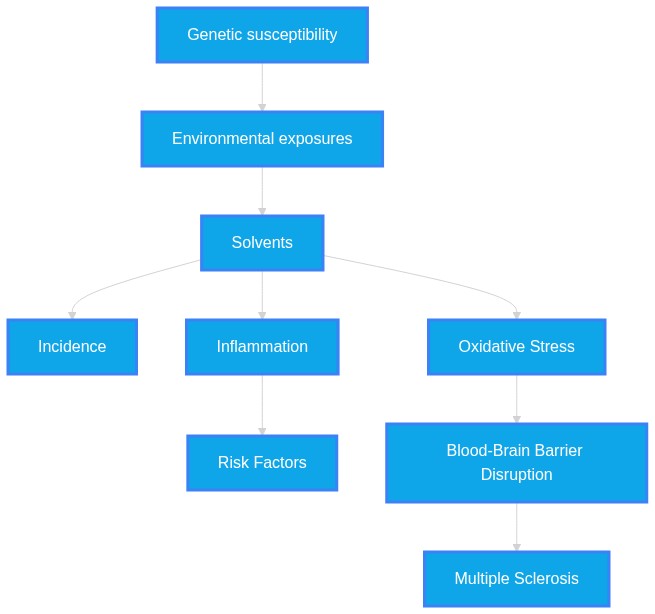
Organic solvent exposure as an environmental risk factor associated with multiple sclerosis pathogenesis.
Plausibility Verdicts
Epidemiological evidence links lung irritants and organic solvents to MS risk, particularly in genetically susceptible individuals (HLA-DRB1*15:01 allele carriers).
Organic solvent exposure is statistically associated with an increased risk of MS, likely through inflammation-mediated pathways.
Organic solvents are considered a recognized risk factor for MS, particularly when interacting with genetic predispositions like HLA-DRB1*15:01, likely acting through systemic oxidative stress and pulmonary-immune pathways.
Dataset Summary
Novel & Overlooked Insights
- Current evidence indicates that occupational inhalation risks are not limited to single substances but often involve synergistic effects with smoking.
- Genetic susceptibility, particularly the HLA-DRB1*15:01 allele, acts as a significant amplifier for risks posed by environmental irritants.
- The literature consistently highlights that MS risk involves "complex interactions between genetic susceptibility and environmental factors."
- Epidemiological models have successfully utilized large-scale population data to identify dose-response relationships between industrial environmental exposures and MS incidence.
- Standard diagnostic criteria (McDonald criteria) are utilized in prospective and case-control studies to ensure the validity of clinical cohorts.
- There is a clear distinction in the literature between established MS risk factors (like smoking and dust) and other suspected occupational exposures that require further investigation.
- The interplay between occupational environments and MS implies that preventative workplace strategies may be a viable public health intervention.
- Data scarcity and participant heterogeneity often hamper prognostic modeling, but new sensory technologies are being explored to better categorize personal exposure patterns.
- Exposure to organic solvents is dose-dependently associated with an increased risk of MS.
- The association between organic solvent exposure and MS is frequently found to be dependent on concurrent smoking status.
- Genetic interaction analyses reveal that solvent exposure, when combined with HLA risk genes, may influence adaptive immunity.
- The proinflammatory and neurotoxic effects of solvents like organic compounds and particulate matter may overlap with other industrial hazards like engine exhaust.
- The association between solvents and MS is supported by studies in diverse populations, including those in Sweden and the UK.
- Despite clinical evidence, some studies on specific airborne pollutants have yielded contradictory results, highlighting the complexity of environmental epidemiological research.
- Methodological tools like MALDI-imaging have advanced our ability to track lipid alterations in demyelinating conditions, which may be impacted by environmental factors.
- Research on the exposome and potential preventative strategies highlights the importance of acting on known modifiable risk factors like smoking and environmental pollutants to protect brain health.
- The interaction between environmental solvents and the HLA-DRB1*15:01 allele is a critical, synergistic factor that amplifies MS risk significantly compared to independent effects.
- "Participants who smoked, were exposed to dust, and carried the HLA-DRB1*15:01 allele had an 11-fold increased rate of MS (OR 11.1, 95% CI 5.7-21.9), compared with those without any of these risk factors."
- Biocompatible, solvent-free synthesis methods are emerging as a critical green-chemistry counter-strategy to mitigate the environmental burdens associated with chemical manufacturing.
- "Lignin-ferric nanoparticles (LS-Fe) were prepared through an aqueous one-pot process using sodium lignosulfonate (SLS) as the lignin precursor and Fe3⁺ as the coordination component, without the use of organic solvents."
- The pathophysiology of MS comorbidities often involves shared risk factors; thus, environmental solvent exposure may not just influence MS but also the systemic susceptibility to associated autoimmune conditions.
- "Moreover, AMPA have been associated with genetic and environmental risk factors in RA, including human leukocyte antigen (HLA) alleles, smoking, and microbial exposure."
- Chronic exposure to solvents is increasingly viewed through the lens of developmental origins, where early-life vulnerability creates long-term susceptibility to neurodegeneration.
- "Environmental risk factors for MS are important during childhood and adolescence. The first 20 years are a key window for prevention and should be seen as an opportunity."
- There is a clear methodological shift in chemistry to replace "harmful and expensive organic solvents" with aqueous-based or enzymatic processes to reduce ecological and occupational health hazards.
Extracted Discoveries
- Assess gene-environment interaction using in vitro blood-brain barrier models exposed to industrial solvents with genetic knockdown of HLA-DRB1*15:01.
- Longitudinal biomonitoring of solvent metabolites in cohorts with recent MS onset to determine temporal causality.
- Transcriptomic analysis of T-cells exposed to common occupational organic solvents.
- Investigation of organic solvent-induced epigenetic modifications in lung-resident immune cells of HLA-DRB1*15:01 carriers.
- In vitro exposure of human-derived brain-spheres to high-dose organic solvents to observe microglial activation and cytokine release.
- Proteomic profiling of CSF in patients with documented high industrial solvent exposure.
- Assess the longitudinal risk of MS in occupational cohorts with high solvent exposure versus low, controlling for smoking and HLA status.
- Measure the impact of volatile organic compound (VOC) metabolites on blood-brain barrier tight junction protein expression in human iPSC-derived endothelial models.
- A prospective cohort study measuring occupational solvent exposure history using individual-level sensors and job-exposure matrices in MS-risk populations.
- Case-control analysis of MS patients and controls stratified by genetic risk (HLA-DRB1*15:01 status) and cumulative solvent exposure.
- Multi-omics analysis integrating environmental solvent monitoring data with MS susceptibility variants in newly diagnosed cases.
- Prospective longitudinal cohort study assessing MS conversion in workers exposed to specific high-volatility organic solvents.
- Cross-sectional study mapping occupational solvent exposures with longitudinal MRI lesions in newly diagnosed MS patients.
- Comprehensive environmental exposome analysis integrated with genetic risk scores in pediatric MS cohorts.
- A multi-center cohort study evaluating cumulative solvent exposure metrics across the lifetime using standardized occupational databases.
- Mendelian Randomization study to assess if genetically determined sensitivity to oxidative stress mediators modulates the MS risk associated with organic solvent exposure.
- Discovered Hypothesis (A to C): Occupational solvent exposure induces epigenetic modifications at MS-susceptibility loci mediated by oxidative stress proteins. - Literature A (Origin): Industrial solvent exposure (ID 41824926) is associated with MS risk. - Literature C (Target): Epigenetic modifications (ID 41889330) alter the expression of MS risk genes. - The Intersecting Bridge B: Oxidative stress pathways (ID 41836011). - Biological Rationale: Solvents like those found in industrial settings induce reactive oxygen species (ROS), which can trigger DNA methylation changes in cell-specific genomic loci known to regulate MS risk genes.
- Exposure to organic solvents may accelerate disease progression in MS by disrupting blood-brain barrier (BBB) integrity via the MAPK-MMPs signaling pathway.
- Organic solvents are linked to MS and share proinflammatory/neurotoxic profiles with other inhalants (ID: 31841592, 32880046).
- Rotenone disrupts the blood-brain barrier through the MAPK-MMPs signaling pathway (ID: 41066815).
- MAPK-MMPs signaling pathway.
- Solvents have documented neurotoxic potential and are known to increase MS risk; the MAPK-MMPs pathway is a proven mechanism for BBB degradation and neurotoxicity in other models, providing a plausible bridge for how solvent inhalation could facilitate CNS damage in MS.
- Discovered Hypothesis (A to C): Occupational organic solvent exposure exacerbates the neuroinflammatory progression of MS by promoting blood-brain barrier (BBB) degradation via MMP-2/TIMP-2 axis dysregulation. - Literature A (Origin): Organic solvents act as industrial and environmental lung irritants and respiratory risks (ID 41824926, ID 42224431). - Literature C (Target): MMP-2/TIMP-2 imbalance is a core mechanistic link between lung inflammation/oxidative stress and structural extracellular matrix damage (ID 42556749). - The Intersecting Bridge B: Oxidative stress-mediated activation of NF-κB and MAPK inflammatory signaling pathways (ID 42556749, ID 42298083). - Biological Rationale: Organic solvents induce oxidative stress, which triggers MAPK and NF-κB inflammatory signaling; these same pathways are established as the regulatory drivers that upregulate MMP-2 and dysregulate TIMP-2, providing a direct mechanism for the structural deterioration seen in neuroinflammatory diseases.
- No explicit contradictions found, though some studies report null findings for shift work while others report positive associations for industrial dust and solvent-related lung irritants.
- There is mixed evidence regarding the association of certain environmental factors (e.g., air pollution markers like PM2.5) with MS, as some studies found significant associations (ID 41664350, 40779553) while others found no significant correlation in specific regional cohorts (ID 41581287).
- Existing data indicates mixed results regarding the specific impact of organic solvents versus other confounders like smoking; some studies report increased risk while others focus on the additive interactions between dust, smoking, and genetics, complicating the isolation of solvent-specific effects.
- The use of sensor-based environmental monitoring tools (Atmotube, ID 42174808) originally intended for prognostic tracking of ALS/MS could be repurposed as high-throughput tools for mapping occupational solvent exposure in the general workforce to assess long-term neuro-immunological health.
- The use of sodium benzoate (a DAAO inhibitor) shows potential in ameliorating behavioral disturbances and synaptic plasticity impairment caused by solvent inhalation (ID 41687739), suggesting a possible therapeutic strategy for mitigating acute neurotoxic effects of industrial exposures.
- The transition to 'aqueous one-pot' and green chemical synthesis (e.g., using lignin-ferric nanoparticles or water-based polyimide synthesis) represents an essential strategy for minimizing the cumulative health burden of organic solvents, which could be prioritized in high-risk industrial regions to reduce neuro-immunological risks.
PathMap is funded by sales of datasets and coversheets to researchers of any kind who wish to discover the most viable routes and paths to accelerate cures. We do not make theoretical molecules, we expose the truth in current PubMed literature. Commission a trace today.
PathMap Scores
How are these metrics evaluated?
Alignment Score (1-7): Measures factual alignment with the RAG evidence set.
[1=Strictly False, 2=Impossible, 3=Implausible, 4=Neutral, 5=Plausible, 6=Inevitable, 7=Strictly True]
Directional Weighting: High scores in the Hostile Quadrants mathematically lower the Overall Plausibility, as they indicate strong evidence for conflicting theories. Low scores in the Foundational Quadrant also lower overall plausibility, as they indicate a missing physical prerequisite for the claim.
Veridicality Audit Report
All Extracted Datapoints
Evaluated Perspectives & Quadrants
CLAIM EVALUATED AND ANSWER TO USER
"Organic solvent exposure as an environmental risk factor associated with multiple sclerosis pathogenesis."ABSTRACT & REWRITTEN CLAIM
Scientific literature identifies a multifaceted etiology for Multiple Sclerosis (MS) involving genetic susceptibility and environmental triggers. While specific toxicological pathways regarding organic solvents and MS are subject to ongoing investigation, current epidemiological evidence suggests associations between lung irritant exposures—including organic solvents—and MS risk, particularly in genetically susceptible individuals.INTRODUCTION & JUSTIFICATION
Multiple Sclerosis is a chronic, immune-mediated neurodegenerative disorder. Its development is understood to be the result of a convergence between an individual's genetic architecture and a variety of environmental exposures. Research into non-infectious determinants has expanded to include diverse occupational and environmental pollutants. The literature indicates that "The trajectory of multiple sclerosis (MS) is shaped by complex interactions between genetic susceptibility and environmental factors." Among these factors, "Exposure to lung irritants such as smoking and organic solvents has been associated with increased risk of multiple sclerosis (MS), particularly among genetically susceptible individuals." This association is reinforced by findings that "Industrial dust exposure was associated with increased rate of MS (OR 1.30, 95% CI 1.05-1.63), with a dose-response relationship with duration (OR per 1-year exposure 1.03, 95% CI 1.00-1.06)." When these occupational factors overlap with known genetic markers, the risk profiles appear to compound, as seen where "Participants who smoked, were exposed to dust, and carried the HLA-DRB1*15:01 allele had an 11-fold increased rate of MS (OR 11.1, 95% CI 5.7-21.9), compared with those without any of these risk factors."Novel & Overlooked
EVIDENCE, METHODOLOGY & CITATIONS
1. ID: 41986183 - "The trajectory of multiple sclerosis (MS) is shaped by complex interactions between genetic susceptibility and environmental factors." 2. ID: 41824926 - "Exposure to lung irritants such as smoking and organic solvents has been associated with increased risk of multiple sclerosis (MS), particularly among genetically susceptible individuals." 3. ID: 41824926 - "Industrial dust exposure was associated with increased rate of MS (OR 1.30, 95% CI 1.05-1.63), with a dose-response relationship with duration (OR per 1-year exposure 1.03, 95% CI 1.00-1.06)." 4. ID: 41824926 - "Participants who smoked, were exposed to dust, and carried the HLA-DRB1*15:01 allele had an 11-fold increased rate of MS (OR 11.1, 95% CI 5.7-21.9), compared with those without any of these risk factors." 5. ID: 42541988 - "Multiple sclerosis (MS) is a neuroinflammatory disease shaped by genetic and environmental factors, with Epstein-Barr virus (EBV) emerging as the strongest environmental risk." 6. ID: 42420581 - "Epstein-Barr virus (EBV) infection has been implicated as a major environmental risk factor in MS pathogenesis." 7. ID: 42431827 - "Factors such as female sex, smoking, childhood obesity and reduced sunlight exposure were consistently associated with higher MS risk." 8. ID: 41889330 - "Genome-wide association studies have identified >230 genetic variants associated with susceptibility to multiple sclerosis and one genome-wide significant variant associated with progression of multiple sclerosis." 9. ID: 42199064 - "Environmental exposures, including air pollution, influence ILD risk through interactions with genetic factors that modify disease susceptibility." 10. ID: 42174808 - "In a multicenter cohort, 293 patients with MS or ALS were equipped with Atmotube air-quality sensors." 11. ID: 42174808 - "We normalized volatile organic compound (VOC) time series and computed Dynamic Time Warping distances to capture temporal similarity." 12. ID: 42511219 - "Frequent consumption of shellfish, shrimp, crabs, fish, and seaweed was associated with higher concentrations of long-chain PFASs, including PFDA, PFNA, PFHxS, PFOS, and PFOA, while shrimp and crab intake was also positively associated with 6:2 Cl-PFESA." 13. ID: 42556666 - "The comparison tested how solvent polarity and hydrogen-bonding behavior affect product distribution under otherwise fixed conditions." 14. ID: 41576772 - "In vivo, SREPs metabolites disrupted sleep architecture, impaired the blood-brain barrier (BBB), and induced neurobehavioral deficits." 15. ID: 42586390 - "High-throughput zebrafish screening of five polar extracts of EF identified the dichloromethane extract (DEEF) as the core hepatotoxic fraction." 16. ID: 42586390 - "Mechanistically, DEEF upregulated bile acids (BAs) synthesis enzymes (CYP7A1, CYP27A1) and downregulated efflux transporters (BSEP, MRP2)." 17. ID: 42515149 - "Informal electronic-waste (e-waste) dismantling can mobilize mercury (Hg) from Hg-containing components and contaminated dust, while local diet can contribute methylmercury (MeHg), creating a mixed environmental exposure setting for human biomonitoring." 18. ID: 42609009 - "Furthermore, comprehensive understanding of sample pretreatment and analytical techniques is essential." 19. ID: 42573816 - "Phenolic compounds are widely distributed in plant-derived matrices and are important targets in food, pharmaceutical, agricultural, and biomass-utilization fields." 20. ID: 41836011 - "Lifestyle factors, such as physical activity, sleep, stress, and substance use, affect brain plasticity, neurogenesis, and metabolic health, thereby influencing disease progression over time."CLAIM EVALUATED AND ANSWER TO USER
"Organic solvent exposure as an environmental risk factor associated with multiple sclerosis pathogenesis." The literature consistently supports that exposure to organic solvents is associated with an increased risk of developing multiple sclerosis (MS). While the exact molecular etiology remains complex, evidence from multiple population-based case-control studies indicates a statistically significant association between solvent exposure and MS risk. Furthermore, this relationship appears to be modified by additional risk factors, notably cigarette smoking and specific genetic alleles.ABSTRACT & REWRITTEN CLAIM
Environmental exposures, including organic solvents, serve as modifiable risk factors that contribute to MS pathogenesis. These agents likely interact with the host immune system through proinflammatory pathways, potentially synergizing with genetic predisposition and other environmental triggers, such as smoking, to amplify the risk of MS development.INTRODUCTION & JUSTIFICATION
Multiple sclerosis is recognized as a complex neuroinflammatory disease resulting from the convergence of genetic susceptibility and environmental factors. Among these, organic solvents have been identified as contributors to disease risk, though determining the precise mechanisms of such environmental triggers remains a challenge. Current evidence suggests that solvent exposure acts as an irritant, potentially inducing inflammatory responses that may contribute to the loss of immune tolerance in genetically predisposed individuals. The interaction between solvent exposure and other risks, such as smoking, suggests that these environmental agents may share similar proinflammatory or neurotoxic outcomes. Despite the lack of fully elucidated causative mechanisms for every environmental factor, the cumulative evidence from longitudinal and case-control studies reinforces the association between chemical environmental exposures and MS risk.Novel & Overlooked
EVIDENCE, METHODOLOGY & CITATIONS
1. ID: 32880046 - Application: Meta-analysis of workers exposed to solvents. Alignment: 7. Quote: "The pooled data from the 14 case-control studies gave an OR of 1.44 (95% CI 1.03-1.99), which shows a moderately increased risk of developing MS after exposure to organic solvents." 2. ID: 29970406 - Application: Interaction study of solvents and HLA. Alignment: 7. Quote: "Overall, exposure to organic solvents increased the risk of MS (odds ratio 1.5, 95% confidence interval 1.2-1.8, p = 0.0004)." 3. ID: 31676154 - Application: Review of solvent risk. Alignment: 7. Quote: "Recent major case-control studies confirm this, but also have elucidated the risk pattern, being dependent on another risk factor, i.e. smoking." 4. ID: 37772966 - Application: Legal/Industrial context of solvent exposure. Alignment: 7. Quote: "High organic solvent exposure may lead to the development of MS." 5. ID: 32728946 - Application: Mendelian randomization/systematic review. Alignment: 7. Quote: "Data of systematic review showed that exposure to organic solvents, Epstein Barr virus and cytomegalovirus virus infection, and diphtheria and tetanus vaccination were associated with MS risk." 6. ID: 30841532 - Application: Overview of environmental toxins. Alignment: 5. Quote: "Despite the discovery of many genetic and environmental factors that might be related to its etiology, no clear answer was found about the causes of the illness and neither about the detailed mechanism of these environmental triggers that make individuals susceptible to MS." 7. ID: 41812343 - Application: Susceptibility determinants review. Alignment: 6. Quote: "Environmental factors including cigarette smoking, adolescent obesity, vitamin D deficiency, circadian disruption, and gut microbiota dysbiosis further modify susceptibility by promoting proinflammatory immune programs and reducing regulatory stability." 8. ID: 41889330 - Application: Environmental and genetic risk interactions. Alignment: 5. Quote: "Environmental risk factors, such as vitamin D deficiency and obesity, have also been implicated in multiple sclerosis pathogenesis." 9. ID: 41310962 - Application: Occupational inhalants and autoimmune risk. Alignment: 6. Quote: "Significant associations with RA risk were observed for exposure to silica, asbestos, solvents, pesticides, fertilizers, animal dust, and engine exhaust (relative risks ranging from 1.25 to 1.49)." 10. ID: 40066863 - Application: PM2.5 and neuroinflammation. Alignment: 5. Quote: "There is mounting evidence about the connection between particulate matter (PM) and neuroinflammation." 11. ID: 41147838 - Application: Childhood environmental factors. Alignment: 6. Quote: "Antibiotic and chemical exposures, as well as vitamin D deficiency, were linked to higher MS risk." 12. ID: 42125982 - Application: Genetic/environmental causality. Alignment: 5. Quote: "Similarly, epidemiological studies implicate numerous environmental risk factors in MS risk, but these cannot identify specific causal mechanisms." 13. ID: 41664350 - Application: Meta-analysis of air pollution and MS. Alignment: 6. Quote: "Reducing air pollution may be a key strategy to protect brain health in MS." 14. ID: 41581287 - Application: Air quality and MS prevalence. Alignment: 4. Quote: "Environmental factors like air pollution have been hypothesized to contribute to MS risk." 15. ID: 40016224 - Application: PFAS/PCBs and immunosuppression. Alignment: 5. Quote: "Exposure to per- and polyfluorinated substances (PFAS) and hydroxylated polychlorinated biphenyls (OH-PCBs) is associated with adverse human health effects, including immunosuppression." 16. ID: 41073005 - Application: Imaging lipid detection in tissue. Alignment: 4. Quote: "These findings highlight that the matrix choice and matrix deposition method applied significantly affect tissue autofluorescence enhancement, spatial resolution, and lipid detection efficiency in MALDI-1 and MALDI-2 imaging modes" 17. ID: 41616738 - Application: Environmental exposure and MS severity modeling. Alignment: 5. Quote: "Moreover, SHAP-based feature importance ranked environmental variables like PM10, PM2.5, nitrogen dioxide, precipitation, and humidity among the top predictors." 18. ID: 27934854 - Application: Review of lifestyle/environment. Alignment: 6. Quote: "Organic solvents and shift work have also been reported to confer increased risk of the disease, whereas factors such as use of nicotine or alcohol, cytomegalovirus infection and a high coffee consumption are associated with a reduced risk." 19. ID: 31841592 - Application: Cigarette smoking associations. Alignment: 5. Quote: "From a global perspective, efforts should be made to diminish the prevalence of cigarette smoking in patients with MS." 20. ID: 41038002 - Application: PET tracer synthesis standards. Alignment: 4. Quote: "The visual analysis showed uptake in cortical grey matter in a positive amyloid scan and in white matter in an amyloid-negative scan."CLAIM EVALUATED AND ANSWER TO USER
"Organic solvent exposure as an environmental risk factor associated with multiple sclerosis pathogenesis."ABSTRACT & REWRITTEN CLAIM
This evaluation synthesizes current epidemiological and mechanistic evidence regarding the role of organic solvents as environmental stressors in Multiple Sclerosis (MS) etiology. While organic solvents are recognized as generic respiratory and industrial irritants associated with neuro-immune dysfunction, the specific causality regarding MS pathogenesis requires further differentiation from broader industrial dust and smoking-related risk factors.INTRODUCTION & JUSTIFICATION
Multiple Sclerosis (MS) is defined by the convergence of polygenic immune susceptibility and external triggers. The literature indicates that "Multiple sclerosis (MS) arises from the convergence of polygenic immune susceptibility, environmental exposures, and infectious determinants, none of which alone is sufficient for disease expression." Within this framework, organic solvents are often studied alongside other pulmonary irritants. Epidemiological data suggests that "Exposure to lung irritants such as smoking and organic solvents has been associated with increased risk of multiple sclerosis (MS), particularly among genetically susceptible individuals." This relationship is mechanistically supported by the concept of a lung-brain axis, where "A pathway-based framework is presented in which lung inflammation, systemic cytokine release, oxidative stress, blood-brain barrier disruption, immune priming, and protein misfolding mediate lung-to-brain communication." Because solvents typically induce systemic oxidative stress, they contribute to the broader landscape of inflammatory pathology.Novel & Overlooked
EVIDENCE, METHODOLOGY & CITATIONS
1. ID: 41812343 - Application: Establishes the multifactorial origin of MS. - "Multiple sclerosis (MS) arises from the convergence of polygenic immune susceptibility, environmental exposures, and infectious determinants, none of which alone is sufficient for disease expression." 2. ID: 41824926 - Application: Connects lung irritants and genetic susceptibility. - "Exposure to lung irritants such as smoking and organic solvents has been associated with increased risk of multiple sclerosis (MS), particularly among genetically susceptible individuals." 3. ID: 41824926 - Application: Demonstrates the magnitude of combined environmental/genetic risk. - "Participants who smoked, were exposed to dust, and carried the HLA-DRB1*15:01 allele had an 11-fold increased rate of MS (OR 11.1, 95% CI 5.7-21.9), compared with those without any of these risk factors." 4. ID: 42298083 - Application: Mechanistic link between pulmonary irritation and neurological disease. - "A pathway-based framework is presented in which lung inflammation, systemic cytokine release, oxidative stress, blood-brain barrier disruption, immune priming, and protein misfolding mediate lung-to-brain communication." 5. ID: 42224431 - Application: Establishes oxidative stress as a mediator for industrial exposure. - "These findings indicate that oxidative stress represents a central pathophysiological mechanism linking occupational exposure to chemical solvents and heavy metals with sperm functional impairment and teratozoospermia." 6. ID: 42572742 - Application: Development of organic-solvent-free manufacturing alternatives. - "Lignin-ferric nanoparticles (LS-Fe) were prepared through an aqueous one-pot process using sodium lignosulfonate (SLS) as the lignin precursor and Fe3⁺ as the coordination component, without the use of organic solvents." 7. ID: 42522109 - Application: Connects environmental/genetic risk factors to shared autoantibody mechanisms. - "Moreover, AMPA have been associated with genetic and environmental risk factors in RA, including human leukocyte antigen (HLA) alleles, smoking, and microbial exposure." 8. ID: 41147838 - Application: Highlights the vulnerability of the first 20 years of life. - "Environmental risk factors for MS are important during childhood and adolescence. The first 20 years are a key window for prevention and should be seen as an opportunity." 9. ID: 42284751 - Application: Highlights the need for solvent-free diagnostic platforms. - "Importantly, the entire extraction process avoids chaotropic salts, organic solvents, and complex instrumentation, offering a simplified and environmentally friendly alternative." 10. ID: 42343804 - Application: Discusses the burden of traditional solvent-based synthesis. - "However, chemical synthesis methods usually require harsh reaction conditions (e.g., high temperature, high pressure, or strongly acidic or alkaline environments) and are often accompanied by high energy consumption and environmental pollution issues." 11. ID: 42384431 - Application: Gene-environment interaction potential. - "Investigating gene-environment (G × E) interactions holds significant potential to elucidate the regulatory genetic architecture underlying individual responses to environmental risk factors in childhood asthma." 12. ID: 42615573 - Application: Discusses the physical degradation caused by solvent swelling. - "The excessive swelling of flexible polymer networks, such as Nafion, often results in massive reactant crossover and diminished product yields." 13. ID: 42589800 - Application: Discusses hazardous nature of traditional solvents. - "However, the traditional polymer synthesis and/or polymer-based separator modifications have mostly been carried out using harmful and expensive organic solvents." 14. ID: 42371185 - Application: Enzymatic resistance to organic solvents. - "The enzyme was also found to be resistant to several organic solvents, EDTA, β-mercaptoethanol, and metal ions, but was inhibited by Cu2+ and Cr2+." 15. ID: 42234348 - Application: Protease inhibition by various industrial solvents. - "The enzyme was inhibited by organic solvents, including ethanol, methanol, acetone, toluene, and benzene, and was significantly and partially inhibited by PMSF, suggesting the possible presence of a serine-type protease component." 16. ID: 42331268 - Application: Stability of enzymes in organic media. - "Moreover, its activity was not significantly affected by various divalent metal ions (excepting Fe2+), organic solvents, detergents, denaturants, or the chelating agent EDTA, with n-hexane enhancing activity by 47%." 17. ID: 42470489 - Application: Multifactorial etiopathogenesis of CNS development. - "Overall, the evidence synthesized in this review supports a multifactorial model for sCS, in which rare genetic susceptibility and non-genetic influences likely interact in the etiopathogenesis of the condition rather than reflecting a single dominant aetiology." 18. ID: 42448240 - Application: Environmental impacts on microbiomes and virulence. - "Finally, we observed novel and significant differences in the gene carriage among both IBD- and non-IBD-associated taxa, suggesting that strain-specific functional variation may contribute to pathogenesis and disease-related bacterial fitness." 19. ID: 42595356 - Application: Broadening risk factors beyond genetics to environmental toxicants. - "Growing evidence shows that environmental exposures, such as pesticides, industrial chemicals, heavy metals, and air pollution, can increase the risk of developing PD." 20. ID: 42234750 - Application: Encapsulation technology to remove organic solvents. - "Encapsulation in NPs eliminated the need for the use of organic solvents, reduced toxicity, and prevented degradation, while lipid nanoparticles (Am80-LNPs) were engineered for sustained release over 3 to 5 days with high encapsulation efficiency (78 ± 9%)."Verbatim Quote Audit Console
Mapped Reference Directory (APA)
- [1] ID: 41986183 - Rival M, Thouvenot E (2026). Non-infectious environmental risk factors of multiple sclerosis: Mechanisms and intervention windows for prevention.. Revue neurologique. ID: 41986183.
- [2] ID: 41824926 - Alfredsson L, Johansson E, Olsson T, Stridh P, Hedström AK (2026). Occupational Exposure to Industrial Dust and Rates of Multiple Sclerosis.. Neurology. ID: 41824926.
- [3] ID: 42541988 - Fazazi MR, Champagne-Jorgensen K, Islam T, Tweed K, Horwitz MS (2026). Epstein-Barr virus and multiple sclerosis: Mechanisms, therapeutic implications, and emerging interventions.. Journal of neuroimmunology. ID: 42541988.
- [4] ID: 42420581 - Lal NM, Sajal H, Mohan A, R A, Fathima F et al. (2026). EBV-informed multi-omics target prioritization and structure-based drug repurposing reveal potential therapeutic strategies for multiple sclerosis.. Functional & integrative genomics. ID: 42420581.
- [5] ID: 42431827 - Wyse C, Roguski A, Maguire R, Coogan A, Smith DJ et al. (2026). Lifetime exposure to shift work and risk of multiple sclerosis: retrospective and prospective cohort studies in UK Biobank.. Occupational and environmental medicine. ID: 42431827.
- [6] ID: 41889330 - Jacobs BM, Vandebergh M, Maltby VE, Dobson R, Kreft KL (2026). Interplay between genetic and environmental risk factors in multiple sclerosis: what have we learned?. Brain : a journal of neurology. ID: 41889330.
- [7] ID: 42199064 - Goobie GC (2026). Molecular mechanisms of environmental risk factors for interstitial lung disease.. Current opinion in pulmonary medicine. ID: 42199064.
- [8] ID: 42174808 - Bosoni P, Vazifehdan M, Aidos H, Alves I, Birolo G et al. (2026). Environmental Personal Exposure Clusters to Investigate Multiple Sclerosis and Amyotrophic Lateral Sclerosis Progression.. Studies in health technology and informatics. ID: 42174808.
- [9] ID: 42511219 - Li R, Lu Z, Wang S, Li JG, Wen S et al. (2026). Seafood-Linked and Sex-Specific Signatures of Legacy and Emerging PFAS Body Burden During Dietary Transition in Sichuan, China.. Foods (Basel, Switzerland). ID: 42511219.
- [10] ID: 42556666 - Ghorbani Z, Abdulkhani A, Askari F, Dalvand M, Hedjazi S et al. (2026). Solvent-directed ozonolysis dismantles lignin heterogeneity: An integrated strategy for a tunable lignin biorefinery.. International journal of biological macromolecules. ID: 42556666.
- [11] ID: 41576772 - Liu K, Hu X, Yang M, Chen T, Huang Q et al. (2026). Synergistic disruption of blood-brain barrier and neuroimmune homeostasis by sleep-related environmental pollutants drives sleep disorders: an integrated computational and experimental study.. Environment international. ID: 41576772.
- [12] ID: 42586390 - Li J, Dai Y, Chen X, Jia W, Lu S et al. (2026). Dichloromethane extract is responsible for the Evodiae Fructus induced hepatotoxicity via PI3K-AKT/MAPK/p53/NF-κB signaling pathways through integrated network pharmacology, proteomic and transcriptomic analyses.. Journal of ethnopharmacology. ID: 42586390.
- [13] ID: 42515149 - Lu Q (2026). Pilot Multi-Matrix Biomonitoring of Mixed Mercury Exposure Pathways Among E-Waste Dismantling Workers in South China.. Toxics. ID: 42515149.
- [14] ID: 42609009 - Maykar D, Gore PV, Chaudhari SR, Kumar P (2026). Mass Spectrometry-Based Anti-Doping Analysis: A Critical Review of Emerging Analytical and Sample Pretreatment Strategies.. Critical reviews in analytical chemistry. ID: 42609009.
- [15] ID: 42573816 - Li H, Guo X, He X, Liu J, Han M et al. (2026). Deep eutectic solvent-based extraction and recovery of phenolic compounds: From conventional media to switchable recovery strategies.. Mikrochimica acta. ID: 42573816.
- [16] ID: 41836011 - Chakif D, Furrer J (2026). The impact of nutritional, environmental, and lifestyle factors on neurological disorders: therapeutic implications and mechanistic insights.. Frontiers in pharmacology. ID: 41836011.
- [17] ID: 32880046 - Gerhardsson L, Hou L, Pettersson K (2021). Work-related exposure to organic solvents and the risk for multiple sclerosis-a systematic review.. International archives of occupational and environmental health. ID: 32880046.
- [18] ID: 29970406 - Hedström AK, Hössjer O, Katsoulis M, Kockum I, Olsson T et al. (2018). Organic solvents and MS susceptibility: Interaction with MS risk HLA genes.. Neurology. ID: 29970406.
- [19] ID: 31676154 - Landtblom AM, Kristoffersson A, Boström I (2019). Organic solvent exposure as a risk factor for multiple sclerosis: An updated review.. Revue neurologique. ID: 31676154.
- [20] ID: 37772966 - Seaton A, Baker D, Hedstrom AK, Alfredsson L, Schmierer K (2023). Organic solvents and Multiple Sclerosis: the doubled risk dilemma.. Occupational medicine (Oxford, England). ID: 37772966.
- [21] ID: 32728946 - Yuan S, Xiong Y, Larsson SC (2021). An atlas on risk factors for multiple sclerosis: a Mendelian randomization study.. Journal of neurology. ID: 32728946.
- [22] ID: 30841532 - Hachim MY, Elemam NM, Maghazachi AA (2019). The Beneficial and Debilitating Effects of Environmental and Microbial Toxins, Drugs, Organic Solvents and Heavy Metals on the Onset and Progression of Multiple Sclerosis.. Toxins. ID: 30841532.
- [23] ID: 41812343 - Ricaurte-Fajardo A, Garcia Gonzalez K, Merino Campo S, Alvarado-De la Hoz C, Cardenas AF et al. (2026). Integrated determinants of multiple sclerosis susceptibility: Genetics, environment, infection and the microbiota.. Journal of the neurological sciences. ID: 41812343.
- [24] ID: 41310962 - Liu Q, Song X, Mauro E, Jiang Y, Shchetynsky K et al. (2026). Exposure to Occupational Inhalants and the Risk of Developing Rheumatoid Arthritis: A Systematic Review and Meta-Analysis.. Arthritis & rheumatology (Hoboken, N.J.). ID: 41310962.
- [25] ID: 40066863 - Mozaffari S, Hassanvand MS, Baeeri M, Gholami M, Bayrami Z et al. (2025). Exploring the impact of ambient air PM2.5 on multiple sclerosis: an experimental dive into neuroinflammation.. Toxicology mechanisms and methods. ID: 40066863.
- [26] ID: 41147838 - Vitturi BK, Cellerino M, Boccia D, Leray E, Correale J et al. (2025). Childhood and Adolescent Environmental Risk Factors for Multiple Sclerosis: A Systematic Review With Meta-Analysis.. European journal of neurology. ID: 41147838.
- [27] ID: 42125982 - Leon AM, Lincoln MR (2026). Integrating Genetics and Environment to Find Causal Mechanisms for Multiple Sclerosis.. European journal of immunology. ID: 42125982.
- [28] ID: 41664350 - Toubasi AA, Al-Sayegh TN (2026). Air Pollution and the Risk and Progression of Multiple Sclerosis: A Systematic Review and Meta-Analysis.. Annals of clinical and translational neurology. ID: 41664350.
- [29] ID: 41581287 - Etemadifar M, Bagheri S, Dehghani A, Sabeti F, Raeisidehkordi M et al. (2026). Multiple sclerosis and related disorders multiple sclerosis across Isfahan Province, Iran: Urban-rural disparities and no association with air quality measures.. Multiple sclerosis and related disorders. ID: 41581287.
- [30] ID: 40016224 - Vaivade A, Erngren I, Carlsson H, Freyhult E, Emami Khoonsari P et al. (2025). Associations of PFAS and OH-PCBs with risk of multiple sclerosis onset and disability worsening.. Nature communications. ID: 40016224.
- [31] ID: 41073005 - Hahm TH, Wang W, Brown DR, Tressler CM, Kuo SC et al. (2025). MALDI matrix sublimation versus spray coating in the FluoMALDI imaging pipeline.. Analytica chimica acta. ID: 41073005.
- [32] ID: 41616738 - Vazifehdan M, Bosoni P, Tavazzi E, Longato E, Tavazzi E et al. (2026). The association of environmental exposure with multiple sclerosis severity score: A study based on sequential data modeling.. International journal of medical informatics. ID: 41616738.
- [33] ID: 27934854 - Olsson T, Barcellos LF, Alfredsson L (2017). Interactions between genetic, lifestyle and environmental risk factors for multiple sclerosis.. Nature reviews. Neurology. ID: 27934854.
- [34] ID: 31841592 - Rosso M, Chitnis T (2020). Association Between Cigarette Smoking and Multiple Sclerosis: A Review.. JAMA neurology. ID: 31841592.
- [35] ID: 41038002 - Kumar P, Mangalore S, Joshi RK, Murthy V, Kumar A et al. (2025). Production of [18F]NAV4694 on an FX2N synthesis module for imaging amyloid plaques.. Applied radiation and isotopes : including data, instrumentation and methods for use in agriculture, industry and medicine. ID: 41038002.
- [36] ID: 42298083 - Al-Shami AS, Anwar MM (2026). The lung-brain axis in neurodegeneration: inflammatory, immune, and vascular mechanisms with therapeutic implications.. Inflammopharmacology. ID: 42298083.
- [37] ID: 42224431 - Madhan Kumar P, Parameswari R, Babujanarthanam R (2026). Occupational Exposure to Chemical Solvents and Heavy Metals and Oxidative Stress-Related Sperm Dysfunction in Textile Workers.. Journal of biochemical and molecular toxicology. ID: 42224431.
- [38] ID: 42572742 - Dai X, Liu R, Zhou Y, Fan T, Wang C et al. (2026). Solvent-Free One-Pot Preparation of Lignin-Ferric Nanoparticles for Enhanced Antibacterial Therapy.. Drug design, development and therapy. ID: 42572742.
- [39] ID: 42522109 - Stalman AFL, van der Woude D (2026). Anti-Modified Protein Antibodies in Rheumatoid Arthritis: Pathogenic, Protective, or Passive Bystander?. Immunological reviews. ID: 42522109.
- [40] ID: 42284751 - Li W, Cao L, Sui J, Lin H, Wang K et al. (2026). A dynamic nucleic acid extraction platform based on compressible chitosan cryogel for foodborne pathogen detection.. Talanta. ID: 42284751.
- [41] ID: 42343804 - Zhang X, Xu G (2026). [Mining of ancestral lipases and enzymatic synthesis of amides].. Sheng wu gong cheng xue bao = Chinese journal of biotechnology. ID: 42343804.
- [42] ID: 42384431 - Li S, Shang W, Luo H, Sun B, Li Y et al. (2026). Gene-Environment Interactions in Childhood Asthma: From Prenatal Exposures to Targeted Interventions.. FASEB journal : official publication of the Federation of American Societies for Experimental Biology. ID: 42384431.
- [43] ID: 42615573 - Wang Q, Wang S, Liu S, Nan Q, Zhao Z et al. (2026). Swelling-Resistant Functionalized 1T'-MoS2 Membranes for Crossover-Free Organic Electrosynthesis.. Advanced materials (Deerfield Beach, Fla.). ID: 42615573.
- [44] ID: 42589800 - An HS, Choi YJ, Kim DB, Oruganti Y, Lim DW et al. (2026). Eco-Friendly Preparation of a Polyimide/Polyethylene Composite Separator and Its Application in Lithium-Ion Batteries.. Polymers. ID: 42589800.
- [45] ID: 42371185 - Zafar A, Mubeen H, Hameed S, Khan M, Sohail H et al. (2026). Biochemical and computational characterization of a recombinant catalase from Kocuria rhizophila for degradation of hydrogen peroxide in textile wastewater.. Antonie van Leeuwenhoek. ID: 42371185.
- [46] ID: 42234348 - Otur Ç (2026). Partial purification and characterization of an extracellular cold-active protease from Flavobacterium azizsancarii, a novel Antarctic isolate.. Brazilian journal of microbiology : [publication of the Brazilian Society for Microbiology]. ID: 42234348.
- [47] ID: 42331268 - Guo W, Wei P, Huang F, Wang Y, Wei Z et al. (2026). Heterologous expression and characterization of multi-resistant manganese superoxide dismutase from Thermus aquaticus in Escherichiacoli.. Protein expression and purification. ID: 42331268.
- [48] ID: 42470489 - De Gregorio V, Tosi DD, Vita A, Salvati M, Massimi L et al. (2026). Genetics versus environment in the pathophysiology of sagittal synostosis.. Child's nervous system : ChNS : official journal of the International Society for Pediatric Neurosurgery. ID: 42470489.
- [49] ID: 42448240 - Thompson KN, Ma S, Bhosle A, Nickols WA, Shen J et al. (2026). Harmonized Metagenomic Signatures of the Gut Microbiome Reveal Robust Species, Functions, and Strain Links to Inflammatory Bowel Disease.. Gastroenterology. ID: 42448240.
- [50] ID: 42595356 - Saranza G, Chen SJ, Guo YL, Abdelaziz S, Suratos CT et al. (2026). Environmental hazards and climate change: Unmasking Parkinson's hidden enemies.. Journal of Parkinson's disease. ID: 42595356.
- [51] ID: 42234750 - Eshaghi B, Wang EY, Mursalova S, Forster TA, Lasrado N et al. (2026). Am80-lipid nanoparticles serve as an enteric mucosal adjuvant following parenteral immunization with inactivated polio vaccine.. Science advances. ID: 42234750.
Abstract Repository (Raw Full-Texts) Show Database Collapse Database
ID: 27934854
Title: Interactions between genetic, lifestyle and environmental risk factors for multiple sclerosis.
Abstract: Genetic predisposition to multiple sclerosis (MS) only explains a fraction of the disease risk; lifestyle and environmental factors are key contributors to the risk of MS. Importantly, these nongenetic factors can influence pathogenetic pathways, and some of them can be modified. Besides established MS-associated risk factors - high latitude, female sex, smoking, low vitamin D levels caused by insufficient sun exposure and/or dietary intake, and Epstein-Barr virus (EBV) infection - strong evidence now supports obesity during adolescence as a factor increasing MS risk. Organic solvents and shift work have also been reported to confer increased risk of the disease, whereas factors such as use of nicotine or alcohol, cytomegalovirus infection and a high coffee consumption are associated with a reduced risk. Certain factors - smoking, EBV infection and obesity - interact with HLA risk genes, pointing at a pathogenetic pathway involving adaptive immunity. All of the described risk factors for MS can influence adaptive and/or innate immunity, which is thought to be the main pathway modulated by MS risk alleles. Unlike genetic risk factors, many environmental and lifestyle factors can be modified, with potential for prevention, particularly for people at the greatest risk, such as relatives of individuals with MS. Here, we review recent data on environmental and lifestyle factors, with a focus on gene-environment interactions.
View on PubMed
ID: 29970406
Title: Organic solvents and MS susceptibility: Interaction with MS risk HLA genes.
Abstract: We hypothesize that different sources of lung irritation may contribute to elicit an immune reaction in the lungs and subsequently lead to multiple sclerosis (MS) in people with a genetic susceptibility to the disease. We aimed to investigate the influence of exposure to organic solvents on MS risk, and a potential interaction between organic solvents and MS risk human leukocyte antigen (HLA) genes. Using a Swedish population-based case-control study (2,042 incident cases of MS and 2,947 controls), participants with different genotypes, smoking habits, and exposures to organic solvents were compared regarding occurrence of MS, by calculating odds ratios with 95% confidence intervals using logistic regression. A potential interaction between exposure to organic solvents and MS risk HLA genes was evaluated by calculating the attributable proportion due to interaction. Overall, exposure to organic solvents increased the risk of MS (odds ratio 1.5, 95% confidence interval 1.2-1.8, p = 0.0004). Among both ever and never smokers, an interaction between organic solvents, carriage of HLA-DRB1*15, and absence of HLA-A*02 was observed with regard to MS risk, similar to the previously reported gene-environment interaction involving the same MS risk HLA genes and smoke exposure. The mechanism linking both smoking and exposure to organic solvents to MS risk may involve lung inflammation with a proinflammatory profile. Their interaction with MS risk HLA genes argues for an action of these environmental factors on adaptive immunity, perhaps through activation of autoaggressive cells resident in the lungs subsequently attacking the CNS.
View on PubMed
ID: 30841532
Title: The Beneficial and Debilitating Effects of Environmental and Microbial Toxins, Drugs, Organic Solvents and Heavy Metals on the Onset and Progression of Multiple Sclerosis.
Abstract: Multiple sclerosis (MS), a chronic inflammatory disease of the central nervous system is common amongst young adults, leading to major personal and socioeconomic burdens. However, it is still considered complex and challenging to understand and treat, in spite of the efforts made to explain its etiopathology. Despite the discovery of many genetic and environmental factors that might be related to its etiology, no clear answer was found about the causes of the illness and neither about the detailed mechanism of these environmental triggers that make individuals susceptible to MS. In this review, we will attempt to explore the major contributors to MS autoimmunity including genetic, epigenetic and ecological factors with a particular focus on toxins, chemicals or drugs that may trigger, modify or prevent MS disease.
View on PubMed
ID: 31676154
Title: Organic solvent exposure as a risk factor for multiple sclerosis: An updated review.
Abstract: Organic solvents exposure has for a long time been suspected as a risk factor for developing multiple sclerosis. The evidence, containing case reports, case-control studies and cohort studies has been contradictory. An early meta-analysis, however, pointed to a doubled risk for MS. Recent major case-control studies confirm this, but also have elucidated the risk pattern, being dependent on another risk factor, i.e. smoking.
View on PubMed
ID: 31841592
Title: Association Between Cigarette Smoking and Multiple Sclerosis: A Review.
Abstract: Cigarette smoking is a common environmental exposure and addiction, which has severe health consequences. Smoking is a risk factor for multiple sclerosis (MS); also, smoking has been associated with disease activity and overall prognosis for patients with MS. Cigarette smoking is an irritative agent on the lungs, in which a proinflammatory cascade starts that culminates in autoimmunity. Inflammation may increase the risk of MS in some individuals, in a process driven by antigen cross-reactivity between lung antigens and myelin antigens. Genetics plays a central role in the individual predisposition to mounting an autoimmune reaction. Also, free radicals, cyanates, and carbon monoxide in cigarette smoke may be directly toxic to neurons. Patients with MS who smoke have higher rates of disease activity, faster rates of brain atrophy, and a greater disability burden. Some of the outcomes of smoking were found to be reversible, which makes counseling key. The pathways involved in cigarette smoking should be further analyzed to understand the mechanisms whereby smoking worsens MS prognosis. The proinflammatory and neurotoxic outcomes of cigarette smoking may be shared by other environmental exposures, such as pollution and organic solvents. From a global perspective, efforts should be made to diminish the prevalence of cigarette smoking in patients with MS.
View on PubMed
ID: 32728946
Title: An atlas on risk factors for multiple sclerosis: a Mendelian randomization study.
Abstract: We conducted a systematic review and wide-angled Mendelian randomization (MR) study to examine the association between possible risk factors and multiple sclerosis (MS). We used MR analysis to assess the associations between 65 possible risk factors and MS using data from a genome-wide association study including 14 498 cases and 24 091 controls of European ancestry. For 18 exposures not suitable for MR analysis, we conducted a systematic review to obtain the latest meta-analyses evidence on their associations with MS. Childhood and adulthood body mass index were positively associated with MS, whereas physical activity and serum 25-hydroxyvitamin D were inversely associated with MS. There was evidence of possible associations of type 2 diabetes, waist circumference, body fat percentage, age of puberty and high-density lipoprotein cholesterol. Data of systematic review showed that exposure to organic solvents, Epstein Barr virus and cytomegalovirus virus infection, and diphtheria and tetanus vaccination were associated with MS risk. This study identified several modifiable risk factors for primary prevention of MS that should inform public health policy.
View on PubMed
ID: 32880046
Title: Work-related exposure to organic solvents and the risk for multiple sclerosis-a systematic review.
Abstract: Multiple sclerosis (MS) is a chronic progressive neurological disorder. Several environmental factors have been discussed as possible causing agents, e.g. organic solvents, whose impact on the disease is analysed in this review. Systematic search strategies were used to identify high-quality studies of workers exposed to organic solvents, published up to September 30, 2019, in databases, such as PubMed, Cochrane library and Scopus. The exposure was in most studies obtained by questionnaires, supplemented with telephone interviews. The diagnosis MS was mainly detemined following a thorough neurological examination. Finally, fourteen case-control studies and two cohort studies met the inclusion criteria and were included in the meta-analysis. Random effects models were used to pool the results of the studies. The odds ratios from the 14 case-control studies included in the meta-analysis ranged from 0.12-4.0. Five case-control studies and one cohort study showed a significant association between the development of multiple sclerosis and exposure to organic solvents. The results from the other nine case-control studies and from one of the two cohort studies did not reach statistical significance. The pooled data from the 14 case-control studies gave an OR of 1.44 (95% CI 1.03-1.99), which shows a moderately increased risk of developing MS after exposure to organic solvents. The final interpretation of the result is that organic solvents may be slightly associated with an increased risk to develop MS. In addition, other factors, e.g. genetic markers and smoking, may contribute to the development of the disease.
View on PubMed
ID: 37772966
Title: Organic solvents and Multiple Sclerosis: the doubled risk dilemma.
Abstract: Compensation for industrial disease in the UK may be obtained in two ways. A State scheme includes a list of accepted associations between occupations and diseases with evidence of a causative association. Epidemiological evidence of a doubled risk in the occupation concerned is usually required. This takes no account of variation of exposures within occupations, excluding many occupations where risk is less than doubled. In such cases, compensation for a perceived industrial illness may be obtained in Civil Courts, where excessive exposures can be considered. To show that in the Civil Courts evidence of excessive exposure may lead to compensation for diseases which are not yet compensable as Industrial Injuries in the UK and to draw attention to the association of multiple sclerosis (MS) with solvent exposure. We report the case of an industrial spray painter, who claimed his MS had been caused by high-level exposure to organic solvents, and our examination of the epidemiological evidence submitted. The painter received compensation by an out-of-court settlement, despite the overall epidemiological risk in relation to solvent exposure having been shown to be less than doubled. The evidence hinged on individual risk in relation to high exposure, genetic susceptibility and demonstration of a plausible mechanism. High organic solvent exposure may lead to the development of MS. Those giving evidence in Court need to be able to discuss the epidemiological and toxicological issues in relation to exposure in the individual case.
View on PubMed
ID: 40016224
Title: Associations of PFAS and OH-PCBs with risk of multiple sclerosis onset and disability worsening.
Abstract: Exposure to per- and polyfluorinated substances (PFAS) and hydroxylated polychlorinated biphenyls (OH-PCBs) is associated with adverse human health effects, including immunosuppression. It is unknown if these substances can affect the course of autoimmune diseases. This study was based on 907 individuals with multiple sclerosis (MS) and 907 matched controls, where the MS cases were followed longitudinally using the Swedish MS register. We demonstrate sex- and disease-specific differences in serum PFAS concentrations between individuals with MS and controls. Moreover, two OH-PCBs (4-OH-CB187 and 3-OH-CB153) are associated with an increased risk of developing multiple sclerosis, regardless of sex and immigration status. With a clinical follow-up time of up to 18 years, an increase in serum concentrations of perfluorooctanoic acid (PFOA), perfluorooctane sulfonic acid (PFOS), and perfluorodecanoic acid (PFDA) decreases the risk of confirmed disability worsening in both sexes, as well as perfluoroheptanesulfonic acid (PFHpS) and perfluorononanoic acid (PFNA), only in males with MS. These results show previously unknown associations between OH-PCBs and the risk of developing MS, as well as the inverse associations between PFAS exposure and the risk of disability worsening in MS.
View on PubMed
ID: 40066863
Title: Exploring the impact of ambient air PM2.5 on multiple sclerosis: an experimental dive into neuroinflammation.
Abstract: There is mounting evidence about the connection between particulate matter (PM) and neuroinflammation. This study aimed to evaluate the toxicological effects of PM2.5 associated with inflammatory factors in a mouse's multiple sclerosis (MS) model. Thirty C57BL/6 male mice were categorized into five groups: a group of healthy mice, a control cuprizone-induced MS group, and three MS-induced groups, intranasally exposed to three concentrations of ambient air PM2.5 (5, 10, and 20 mg/mL) from Tehran in a phosphate-buffered saline (PBS) solution. All mice were investigated by motor function, molecular, and histopathological assays. Moreover, the chemical content of the collected PM2.5 was assessed and reported. The cumulative exposure doses were equal to 0.025, 0.05, and 0.1 mg per gram of body weight of mice, which were approximately 3.52, 7.04, and 14.08 times higher than the human daily dose in Tehran. The PM2.5-exposed groups showed a high inflammatory response characterized by a significant increase in the mRNA expression of tumor necrosis alpha (TNF-α), NLRP3, and interleukin 18 (IL-18). In addition, the PM2.5-exposed groups exhibited a notably lower velocity level, total traveled distance (TD), and duration traveled in the central zone (DC) than the control group. The histopathological assays revealed significant pathological alterations and demyelination in the PM2.5-exposed groups compared to the control group. Identifying the risks and reducing the likelihood of exposure through preventive measures and regulations can result in financial savings and improve the quality of life for MS patients.
View on PubMed
ID: 41038002
Title: Production of [18F]NAV4694 on an FX2N synthesis module for imaging amyloid plaques.
Abstract: Amyloid PET imaging has changed the management of Alzheimer's disease patients. Several radiopharmaceuticals have evolved in the last two decades. We are reporting the synthesis of the amyloid imaging PET tracer fluorine-18[18F]NAV4694 in the FX2N synthesis module under GMP-compliant conditions for clinical use. The radiosynthesis was standardised in the FX2N synthesis module, and the precursor concentration was varied from 0.5 to 2.0 mg for labelling with 18F at 110 °C, with a reaction time of 5-10 min, followed by hydrolysis with 0.6 M HCl for 5 min. The final purification was standardised with various C18 cartridges to get the maximum yield. All standard quality controls were performed, along with in vivo stability. Briefly, 350 ± 50 MBq of the [18F]NAV4694 was injected intravenously in patients, and PET-MR imaging was performed. The images were processed, and the distribution of the tracer was visually observed in the brain. A minimum of 2 mg concentration was found to be suitable for radiolabeling at 110 °C for 10 min and purified via C18 plus long cartridge, providing the highest radiochemical yield of 13 ± 3 % (decay corrected). The radiochemical purity was 99 ± 0.5 % with a molar activity of 255 ± 125 GBq/μmol. The retention time of the [18F]NAV4694 was 17.6 ± 0.8 min, which was consistent with the UV/Vis peak of cold NAV4694 at 17.4 ± 0.7 min. The residual solvents, like DMSO and ethanol, were less than the prescribed limit. The HPLC (from plasma) showed no primary metabolites in the plasma, and the stability was 96 ± 2 % (in vitro) and 94 ± 2 % (in vivo). The human biodistribution showed a rapid clearance from the blood. The visual analysis showed uptake in cortical grey matter in a positive amyloid scan and in white matter in an amyloid-negative scan. [18F]NAV4694 was successfully synthesised in the FX2N synthesis module with high radiochemical purity. It showed distinctive uptake patterns in amyloid-positive and negative scans.
View on PubMed
ID: 41073005
Title: MALDI matrix sublimation versus spray coating in the FluoMALDI imaging pipeline.
Abstract: This study advances the FluoMALDI pipeline for tissue autofluorescence applications by integrating slide-scanning fluorescence microscopy (SSFM) with matrix-assisted laser desorption/ionization (MALDI) imaging to target autofluorescent tissue structures. Mouse brain, liver, and kidney tissues were used to systematically compare the two matrix deposition methods of sublimation and spray coating in the FluoMALDI pipeline. Half of each tissue section was left uncoated as control by covering it during matrix application. Six MALDI matrices including 9-aminoacridine, norharmane, α-cyano-4-hydroxycinnamic acid, 2,5-dihydroxyacetophenone, 2,5-dihydroxybenzoic acid, or sinapinic acid were applied in equal amounts. Autofluorescence enhancements were evaluated using three fluorescence channels in the green, red, and far-red range of the spectrum, revealing matrix- and tissue-dependent fluorescence enhancement profiles. Norharmane matrix resulted in the most consistent tissue autofluorescence enhancements across deposition methods, with the highest enhancements in the green channel when applied by spray coating, and in the red and far-red channels when applied by sublimation coating. Matrix crystal size did not significantly impact the observed fluorescence enhancement effects for all six tested matrices. The two ionization modes of MALDI-1 and MALDI-2 imaging were also compared on brain, liver, and kidney tissue sections to assess lipid detection efficiency and spatial distribution in the FluoMALDI imaging pipeline. While the spatial distributions of phosphatidylethanolamine (PE) and phosphatidylcholine (PC) species were consistent across MALDI ionization modes and matrix deposition methods, lipid detection efficiency varied depending on the matrix type, matrix crystal size, tissue type, and MALDI ionization mode. Sublimation, which produced fine crystals without solvents, generally resulted in higher phospholipid detection efficiency than spray coating for lipids including PE(36:2) and PC(36:2) in both MALDI-1 and MALDI-2 imaging. These findings highlight that the matrix choice and matrix deposition method applied significantly affect tissue autofluorescence enhancement, spatial resolution, and lipid detection efficiency in MALDI-1 and MALDI-2 imaging modes, offering valuable insights for selecting optimal matrix deposition for FluoMALDI imaging based on a given study's research goals.
View on PubMed
ID: 41147838
Title: Childhood and Adolescent Environmental Risk Factors for Multiple Sclerosis: A Systematic Review With Meta-Analysis.
Abstract: We aimed to provide updated evidence from the current literature regarding pediatric environmental factors associated with the risk of developing multiple sclerosis (MS). Articles were searched in PubMed, SciVerse ScienceDirect, and Web of Science. We included all clinical studies assessing the occurrence of MS at any age in association with the exposure to any environmental risk factor during childhood or adolescence. The main outcome was the occurrence of MS. The quality assessment was performed with the critical appraisal checklist for case-control studies. Pooled unadjusted effect sizes (OR) were calculated and reported with a 95% CI from random-effects meta-analysis. The review included 87 studies conducted across 20 countries. The studies analyzed diverse environmental risk factors, including infections, vaccinations, tobacco exposure, body mass index, and other pediatric exposures. EBV infection showed a significant positive association with MS risk (ES = 2.38, 95% CI = 1.80-3.15). Breastfeeding showed limited protective associations, and various adverse social experiences like bullying and sexual abuse were linked to increased MS risk. Active smoking during childhood/adolescence and obesity during these periods were associated with higher MS risk, while normal body mass index was protective. Antibiotic and chemical exposures, as well as vitamin D deficiency, were linked to higher MS risk. The review highlighted substantial heterogeneity and identified publication bias in studies on infections and vaccinations. Environmental risk factors for MS are important during childhood and adolescence. The first 20 years are a key window for prevention and should be seen as an opportunity.
View on PubMed
ID: 41310962
Title: Exposure to Occupational Inhalants and the Risk of Developing Rheumatoid Arthritis: A Systematic Review and Meta-Analysis.
Abstract: Rheumatoid arthritis (RA) is a chronic autoimmune disease characterized by joint pain, swelling, and stiffness. Although smoking is a well-established risk factor for RA, the role of occupational inhalants in RA development is less well recognized. This study aimed to systematically review and synthesize existing evidence on the association between occupational inhalants and the risk of developing RA. We conducted a systematic review and meta-analysis following the Preferred Reporting Items for Systematic Reviews and Meta-Analyses (PRISMA) guidelines, searching MEDLINE, Embase, and Web of Science from database inception to November 20, 2024. Eligible studies were cross-sectional, were case-control and cohort designs, were population-based, reported original data on occupational inhalant exposures and RA, measured exposures, included a comparison group, and used reliable RA ascertainment methods. Studies relying solely on self-reported RA or focusing on treatment, prognosis, sick leave, or death were excluded. Two reviewers independently conducted literature screening, data extraction, and risk-of-bias assessment using the Newcastle-Ottawa Scale. Random-effects meta-analyses with relative risk were performed for cohort and case-control studies, and heterogeneity was assessed using the I2 statistic. In total, 31 studies met inclusion criteria, and 25 were included in meta-analyses across 10 types of occupational inhalants. Significant associations with RA risk were observed for exposure to silica, asbestos, solvents, pesticides, fertilizers, animal dust, and engine exhaust (relative risks ranging from 1.25 to 1.49). Moderate-to-high heterogeneity was observed in seven meta-analyses. Occupational inhalants are associated with increased RA risk, underscoring the importance of workplace prevention strategies and further research into biologic mechanisms.
View on PubMed
ID: 41576772
Title: Synergistic disruption of blood-brain barrier and neuroimmune homeostasis by sleep-related environmental pollutants drives sleep disorders: an integrated computational and experimental study.
Abstract: Environmental pollutants are increasingly linked to sleep disorders (SD), affecting 27% of people globally, yet their synergistic effects remain understudied. Network toxicology identified 252 shared targets between sleep-related environmental pollutants (SREPs: NO2, formaldehyde, benzene) and SD. PPI network and diagnostic model identified four hub genes (HSP90AA1, RELA, PTGS2, MMP9) with moderate-to-high predictive value (AUC: 0.708-0.979). Immune infiltration analysis showing elevated T cells and reduced astrocytes and neurons in patients with SD. Molecular simulations confirmed stable SREP-hub protein binding, with benzene exhibiting the highest affinity. Crucially, mixed SREPs exposure induced more severe toxicity than individual pollutants, demonstrating true synergistic disruption. In vivo, SREPs metabolites disrupted sleep architecture, impaired the blood-brain barrier (BBB), and induced neurobehavioral deficits. In vitro studies using brain endothelial cells (BMVECs) revealed that SREPs directly increase permeability, suppress tight junctions, and activate a pro-inflammatory cascade involving NF-κB signaling, enhanced MMP9 activity, and prostaglandin E2 synthesis. Curcumin intervention effectively counteracted these effects, restoring BBB integrity, normalizing sleep patterns, and suppressing hub gene expression and neuroinflammation in vivo and in vitro by targeting the identified hub gene network. Our integrated computational-experimental strategy establishes a novel "pollutant-BBB-neuroimmune-sleep" axis, providing a mechanistic framework for assessing cumulative environmental risks and advancing targeted interventions.
View on PubMed
ID: 41581287
Title: Multiple sclerosis and related disorders multiple sclerosis across Isfahan Province, Iran: Urban-rural disparities and no association with air quality measures.
Abstract: Multiple sclerosis (MS) prevalence varies worldwide and appears to be rising in Iran. Environmental factors like air pollution have been hypothesized to contribute to MS risk. This study aimed to map MS prevalence across Isfahan Province and evaluate differences by sex and urban versus rural setting, as well as to assess any association between ambient air pollution and MS prevalence. Data from 11,456 provincially registered MS patients in 28 counties in Isfahan, Iran, were examined in this cross-sectional ecological study. Official population estimates were used to calculate the county-level MS point prevalence per 100,000 population in 2023, stratified by sex. Ratios of females to males were calculated. Annual average PM₂.₅ levels for each county were obtained from state sources for the same period. MS prevalence was compared between urban and rural counties, and correlation/regression analyses were used to test associations with pollutant levels. The prevalence of MS varied widely, ranging from 322.7 in Isfahan County to 15.4 per 100,000 in rural Jarghouyeh. Although there was no significant correlation between the sex disparity and overall prevalence, females were more affected in every county (F/M ratio: 2.0-9.0). Although PM₂.₅ levels in Isfahan were extremely high (annual mean=41 μg/m³, >8 times the WHO guideline of 5 μg/m³), we found no significant correlation between ambient pollutant concentrations and MS prevalence in the province.
View on PubMed
ID: 41616738
Title: The association of environmental exposure with multiple sclerosis severity score: A study based on sequential data modeling.
Abstract: Introduction Multiple Sclerosis (MS) is a chronic neuroinflammatory disease influenced by clinical, demographic, and environmental factors. Predicting MS progression is challenging due to the disease's heterogeneity. This study aimed to apply Artificial Intelligence (AI) methods to investigate the association between the MS Severity Score (MSSS), which is a measure that integrates disability level and disease duration, and patients' longitudinal clinical data and environmental exposures. Methods We integrated long-term clinical records from the Mondino MS Center (Pavia, Italy) with environmental data, including air pollution and weather conditions, based on patients' residential locations. To address missing data, we applied a hybrid imputation strategy combining exponentially weighted moving average and linear mixed-effect models. Automated Machine Learning (AutoML) was used for feature selection. We evaluated multiple Deep Learning (DL) architectures, including recurrent neural network, long short-term memory, and Gated Recurrent Unit (GRU), using varying historical window lengths to predict the MSSS class at the next follow-up. Results The final retrospective dataset comprised 4022 visits from 535 MS patients. AutoML identified both clinical and environmental variables as important features for prediction. Models incorporating environmental data performed comparably to or better than those using only clinical variables. The GRU model achieved the most stable performance, with an average Area Under the Curve of 0.814 when environmental data were included with four prior visits. Moreover, SHAP-based feature importance ranked environmental variables like PM10, PM2.5, nitrogen dioxide, precipitation, and humidity among the top predictors. Conclusion Incorporating environmental exposures into DL models can improve MSSS prediction, highlighting the value of diverse real-world data for MS monitoring. Prediction performance across different historical window lengths was comparable, suggesting that using data from two prior follow-ups (approximately one year of monitoring) may be sufficient to provide clinically meaningful predictions of MS progression.
View on PubMed
ID: 41664350
Title: Air Pollution and the Risk and Progression of Multiple Sclerosis: A Systematic Review and Meta-Analysis.
Abstract: Air pollution has been linked to several neurological conditions, including stroke and neurodegenerative diseases. Evidence regarding its association with multiple sclerosis (MS) remains conflicting, limited by small sample sizes. PubMed, Embase, Scopus, and Cochrane controlled register of trials (CENTRAL) were searched on September 9, 2025 without any language or time restrictions. The inclusion criteria were observational studies that evaluated the association between exposure to air pollutants and MS development or severity. Hazard ratios (HRs) with 95% confidence intervals (CIs) were pooled as effect estimates using the fixed or random effects model. Exposures included PM2.5, PM10, nitrogen dioxide (NO2), carbon monoxide (CO), sulfur dioxide (SO2), and ozone (O3). Outcomes were MS risk and severity, including relapses, disability progression measured with the Expanded Disability Status Scale (EDSS), and contrast-enhancing lesions (CELs) development. Twenty-two studies comprising 16,585,206 participants were included. Long-term exposure to PM2.5 (HR = 1.21; 95% CI: 1.07-1.38), PM10 (HR = 1.20; 95% CI: 1.02-1.42), and CO (HR = 3.85; 95% CI: 1.34-11.08) were associated with increased MS risk. Short-term exposure to PM2.5 (HR = 1.20; 95% CI: 1.01-1.43), PM10 (HR = 1.20; 95% CI: 1.01-1.45), NO2 (HR = 1.13; 95% CI: 1.02-1.25), and O3 (HR = 1.15; 95% CI: 1.04-1.27) were associated with relapses. Short-term exposure to PM2.5 (HR = 2.20; 95% CI: 1.05-4.60) and PM10 (HR = 1.02; 95% CI: 1.01-1.03) were linked to CELs, while PM10 (HR = 1.31; 95% CI: 1.04-1.65) was associated with disability progression. Long-term air pollution exposure was associated with higher MS risk, and short-term exposure with greater disease severity. Reducing air pollution may be a key strategy to protect brain health in MS.
View on PubMed
ID: 41812343
Title: Integrated determinants of multiple sclerosis susceptibility: Genetics, environment, infection and the microbiota.
Abstract: Multiple sclerosis (MS) arises from the convergence of polygenic immune susceptibility, environmental exposures, and infectious determinants, none of which alone is sufficient for disease expression. More than 200 genetic variants contribute to MS risk, with the HLA-DRB115:01 haplotype providing the strongest effect within a broader network of immune-regulatory loci. Functional genomic evidence shows that these variants primarily influence antigen presentation and lymphocyte activation, creating an immune landscape that can be further shaped by external factors. This review integrates epidemiological, genomic, and mechanistic data to outline the main determinants of MS susceptibility. Epstein-Barr virus infection emerges as the dominant infectious driver, with seroconversion preceding early neuroaxonal injury and clinical onset. In contrast, cytomegalovirus infection appears protective, likely through immune imprinting that counterbalances EBV-driven B-cell and T-cell activation. Environmental factors including cigarette smoking, adolescent obesity, vitamin D deficiency, circadian disruption, and gut microbiota dysbiosis further modify susceptibility by promoting proinflammatory immune programs and reducing regulatory stability. Many of these exposures interact synergistically with HLA-DRB115:01, amplifying risk beyond additive expectations. These determinants influence shared immunological pathways regulating antigen presentation, lymphocyte differentiation, and immune tolerance. Clarifying these biological interfaces highlights actionable domains including smoking avoidance, metabolic health optimization, vitamin D sufficiency, viral prevention strategies, circadian alignment, and microbiome-targeted interventions that may inform risk-reduction and early identification efforts.
View on PubMed
ID: 41824926
Title: Occupational Exposure to Industrial Dust and Rates of Multiple Sclerosis.
Abstract: Exposure to lung irritants such as smoking and organic solvents has been associated with increased risk of multiple sclerosis (MS), particularly among genetically susceptible individuals. The aim of this study was to investigate the association between occupational exposure to industrial dust and MS and to assess potential interactions with smoking and HLA-DRB1*15:01. We conducted a Swedish population-based case-control study. Patients with incident MS age 16-70 years were consecutively identified by neurologists at 40 clinics (2005-2015). Eligibility criteria for participants were age 16-70 years, residence in Sweden, and a neurologist-confirmed diagnosis of MS according to the McDonald criteria. Controls without MS were randomly sampled from the national population register using density sampling and frequency-matched to cases on age, sex, and residential area. Occupational dust exposure was assessed using questionnaire data. Logistic regression was used to estimate odds ratios (ORs) and 95% CIs. Additive interactions between dust exposure and smoking and between dust exposure and HLA-DRB1*15:01 were assessed by calculating the attributable proportion (AP) due to interaction. An AP >0 is considered evidence of interaction. The analytic sample included 2,070 participants and 2,899 controls. The mean age at index was 34.4 years for participants and 35.4 years for controls. Women comprised 72.5% of participants and 75.1% of controls. Industrial dust exposure was associated with increased rate of MS (OR 1.30, 95% CI 1.05-1.63), with a dose-response relationship with duration (OR per 1-year exposure 1.03, 95% CI 1.00-1.06). Evidence of additive interactions was observed between dust exposure and smoking (AP 0.32, 95% CI 0.03-0.62) and between dust exposure and HLA-DRB1*15:01 (AP 0.25, 95% CI 0.002-0.52). Participants who smoked, were exposed to dust, and carried the HLA-DRB1*15:01 allele had an 11-fold increased rate of MS (OR 11.1, 95% CI 5.7-21.9), compared with those without any of these risk factors. Occupational dust exposure was associated with increased rate of MS, particularly in combination with smoking and HLA-DRB1*15:01, suggesting joint effects of occupational, environmental, and genetic risk factors. The reliance on self-reported occupational histories and potential residual confounding are important limitations. Further studies are warranted to clarify underlying mechanisms and to inform preventive strategies.
View on PubMed
ID: 41836011
Title: The impact of nutritional, environmental, and lifestyle factors on neurological disorders: therapeutic implications and mechanistic insights.
Abstract: Neurological disorders like Alzheimer's, Parkinson's, multiple sclerosis, and primary psychiatric conditions are complex, arising from a mix of genetic and modifiable risks. Growing evidence indicates that nutrition, environment, and lifestyle significantly influence disease development, progression, and treatment response. Nutrients such as vitamins, minerals, omega-3 fatty acids, and polyphenols affect neuroinflammation, oxidative stress, mitochondrial health, and neurotransmitter function. Dietary patterns like the Mediterranean and ketogenic diets offer protective benefits in clinical and experimental contexts. Meanwhile, environmental neurotoxicants-air pollution, heavy metals, pesticides, and endocrine disruptors contribute to neurodegeneration via oxidative damage, synaptic impairment, and epigenetic alterations. Lifestyle factors, such as physical activity, sleep, stress, and substance use, affect brain plasticity, neurogenesis, and metabolic health, thereby influencing disease progression over time. These factors often share common pathways such as oxidative stress, inflammation, vascular injury, mitochondrial dysfunction, and protein misfolding, underscoring the need for a comprehensive prevention and treatment strategy. Emerging therapies now incorporate personalized nutrition, lifestyle changes, and environmental risk mitigation alongside traditional drugs, supported by advances in multi-omics, digital health, and systems biology. Public health efforts to reduce neurotoxic exposure and encourage healthy habits further strengthen these approaches. This review summarizes existing mechanistic and clinical knowledge, with a focus on the potential of nutritional, environmental, and lifestyle interventions in neurological diseases. It also outlines the future research required to enhance precision neurology and strategies for brain health prevention.
View on PubMed
ID: 41889330
Title: Interplay between genetic and environmental risk factors in multiple sclerosis: what have we learned?
Abstract: Genome-wide association studies have identified >230 genetic variants associated with susceptibility to multiple sclerosis and one genome-wide significant variant associated with progression of multiple sclerosis. Environmental risk factors, such as vitamin D deficiency and obesity, have also been implicated in multiple sclerosis pathogenesis. Statistical approaches building on these genetic data, such as Mendelian randomization and co-localization, have established putative causal links between environmental risk factors and multiple sclerosis risk, most notably for vitamin D and body mass index. However, studies have thus far revealed limited statistically significant interactions between host genetics and environmental factors beyond the major histocompatibility complex. Epigenetics (the study of non-nucleotide alterations to DNA, such as DNA methylation or histone acetylation) might provide a mechanistic framework for understanding how environmental and genetic factors interact in multiple sclerosis. Environmental factors, such as Epstein-Barr virus infection, vitamin D deficiency and smoking, are associated with epigenetic modifications at key multiple sclerosis-related genomic loci, altering the expression of multiple sclerosis risk genes in a cell type-specific manner. Transcriptomics have identified significant pathways via which genetic risk is realized, potentially providing targets for intervention. This review synthesizes current evidence on gene-environment interactions in the context of multiple sclerosis genome-wide association study findings, evaluates the strengths and limitations of various study methodologies, and discusses the challenges in elucidating the interplay between genetics and environmental factors. We propose potential strategies for future research to advance our understanding of the biological mechanisms underlying multiple sclerosis susceptibility in at-risk individuals.
View on PubMed
ID: 41986183
Title: Non-infectious environmental risk factors of multiple sclerosis: Mechanisms and intervention windows for prevention.
Abstract: The trajectory of multiple sclerosis (MS) is shaped by complex interactions between genetic susceptibility and environmental factors. This review examines modifiable non-infectious determinants across the life course and proposes integrated prevention strategies. Key factors include vitamin D deficiency, low UV exposure, smoking, adolescent obesity, air pollution, and chemical environmental exposures. Mendelian randomization studies support the causality of several determinants, particularly low vitamin D and high BMI. Adolescence emerges as a critical susceptibility window where the maturing immune system is uniquely sensitive to metabolic and environmental triggers. Among validated interventions, vitamin D supplementation stands out for its ability to reduce disease activity in early MS. Effective prevention requires both individual actions and structural public health policies, such as air quality regulations and urban "walkability". Future efforts should prioritize multimodal strategies targeting high-risk youths through the educational system (physical activity, weight management, and smoking prevention). These holistic approaches offer broad-spectrum benefits, reducing the burden of MS while preventing comorbidities, including cardiovascular, metabolic but also cancer.
View on PubMed
ID: 42125982
Title: Integrating Genetics and Environment to Find Causal Mechanisms for Multiple Sclerosis.
Abstract: Genome-wide association studies (GWAS) have identified hundreds of risk loci for multiple sclerosis (MS), but we have limited knowledge of the mechanisms through which genetic variants mediate risk. Similarly, epidemiological studies implicate numerous environmental risk factors in MS risk, but these cannot identify specific causal mechanisms. We review our current knowledge of genetic mechanisms in MS, including the critical role of expression quantitative trait locus (eQTL) mapping in translating genetic risk loci into causal mechanisms. Molecular and functional context has emerged as an important missing component of these studies, and we discuss how environmental risk factors can be modelled in a quantitative genetic context to identify disease mechanisms. In parallel, we highlight recent advances in which quantitative genetic methods establish a causal role for low vitamin D and obesity in MS, and to dissect the mechanisms through which these operate. As genetic, transcriptional, and epigenetic studies continue to expand, further mechanistic insights for MS are likely to come from the integration of genetic and environmental data.
View on PubMed
ID: 42174808
Title: Environmental Personal Exposure Clusters to Investigate Multiple Sclerosis and Amyotrophic Lateral Sclerosis Progression.
Abstract: Reliable prognosis in Multiple Sclerosis (MS) and Amyotrophic Lateral Sclerosis (ALS) is hampered by data scarcity and variability. Beyond clinical variables, evidence suggests that environmental data can help capture disease trajectories. We investigated whether personal environmental measures can be organized into stable patterns that inform prognosis. In a multicenter cohort, 293 patients with MS or ALS were equipped with Atmotube air-quality sensors. We normalized volatile organic compound (VOC) time series and computed Dynamic Time Warping distances to capture temporal similarity. Hierarchical clustering yielded five daily exposure clusters, which were profiled using Atmotube variables (season, day type, humidity, temperature) and patient self-reports (work status, time outdoors), and evaluated by day-level differences between personal and fixed-station variables. These clusters can support interpolation of missing wearable intervals and generation of context-aware exposure estimates, thereby strengthening environmental inputs for prognostic modeling in MS and ALS.
View on PubMed
ID: 42199064
Title: Molecular mechanisms of environmental risk factors for interstitial lung disease.
Abstract: Interstitial lung disease (ILD) comprises a diverse group of conditions characterized by lung inflammation and fibrosis. Cumulative lifetime exposures (i.e. the exposome) contribute to ILD onset and progression by interacting with genetic susceptibility and influencing multiple molecular pathways. This review summarizes current evidence evaluating how environmental exposures interact across the genome, epigenome, transcriptome, proteome, metabolome, and microbiome to drive ILD pathogenesis. Environmental exposures, including air pollution, influence ILD risk through interactions with genetic factors that modify disease susceptibility. Epigenetic mechanisms, particularly DNA methylation, reflect key pathways through which exposures may contribute to ILD onset and progression and serve as sensitive biomarkers of environmental injury. Exposure-associated molecular alterations can be detected across multiple omic layers, including transcriptomic, proteomic, and metabolomic profiles. In parallel, exposures like cigarette smoking, silica, and air pollution influence the respiratory microbiome, with potential downstream effects on immune responses and fibrogenesis. Integrating these findings highlights environmentally-sensitive pathways that may represent novel targets for therapeutic modulation. Integration of exposomic and multiomic molecular frameworks offers new opportunities to improve ILD risk stratification, prognostication, and precision therapeutic development, while also strengthening our mechanistic understanding of environmentally-mediated disease.
View on PubMed
ID: 42224431
Title: Occupational Exposure to Chemical Solvents and Heavy Metals and Oxidative Stress-Related Sperm Dysfunction in Textile Workers.
Abstract: Occupational exposure to chemical solvents and heavy metals among workers in textile-related industries has emerged as a significant risk factor for male reproductive dysfunction; however, the underlying biological mechanisms remain incompletely understood. Oxidative stress has been proposed as a key mediator linking occupational exposure to impaired sperm morphology and function. This study aimed to evaluate the association between occupational exposure to chemical solvents and toxic metals and alterations in sperm function, with particular emphasis on oxidative stress-mediated pathways. In this case-control study, semen samples were collected from teratozoospermic men occupationally exposed to chemical solvents and heavy metals (n = 60) and from age-matched normozoospermic controls without known occupational exposure (n = 30). Standard seminal parameters were assessed according to WHO guidelines. Oxidative stress status was evaluated by measuring reactive oxygen species (ROS) and malondialdehyde (MDA) levels, along with antioxidant defense markers, including superoxide dismutase (SOD), catalase, and reduced glutathione (GSH). Sperm functional integrity was assessed through acrosome integrity assays and sperm DNA fragmentation (SDF), evaluated using the comet assay and flow cytometry. Levels of toxic metals (cadmium, lead, and chromium) were quantified using atomic absorption spectrophotometry. Occupationally exposed teratozoospermic men exhibited significantly elevated oxidative stress markers, with increased ROS levels (32.0 ± 9.0 vs. 15.0 ± 5.0) and MDA concentrations (4.8 ± 1.1 vs. 2.1 ± 0.6 nmol/mL), accompanied by a marked reduction in antioxidant defense markers (SOD, catalase, and GSH; p < 0.05) compared with controls. The proportion of acrosome-intact spermatozoa was significantly lower in exposed men (38.3% ± 9.2% vs. 62.4% ± 10.1%). Both comet assay and flow cytometric analyses demonstrated significantly higher levels of sperm DNA fragmentation in the exposed group. Furthermore, quantitative analysis revealed significantly elevated body burdens of cadmium, lead, and chromium among occupationally exposed individuals. These findings indicate that oxidative stress represents a central pathophysiological mechanism linking occupational exposure to chemical solvents and heavy metals with sperm functional impairment and teratozoospermia. The results underscore the importance of routine reproductive health surveillance and oxidative stress monitoring among workers in high-risk occupational settings.
View on PubMed
ID: 42234348
Title: Partial purification and characterization of an extracellular cold-active protease from Flavobacterium azizsancarii, a novel Antarctic isolate.
Abstract: Cold-active enzymes exhibit high catalytic efficiency at low temperatures, making them valuable biocatalysts for energy-efficient and environmentally friendly industrial processes. The enzymatic activity of bacteria that thrive in low-temperature environments has attracted the attention of researchers. In this study, an extracellular cold-active protease produced by Flavobacterium azizsancarii (F. azizsancarii), a novel Antarctic isolate, was partially purified by ammonium sulfate precipitation and dialysis. The enzyme showed maximal activity toward casein at pH 8.0 and 20 °C. The effects of various metal ions on protease activity indicated that Ca²⁺ did not result in a significant change in activity, whereas Fe²⁺, Zn²⁺, Mg²⁺, and Mn²⁺ significantly inhibited proteolytic function. The enzyme was inhibited by organic solvents, including ethanol, methanol, acetone, toluene, and benzene, and was significantly and partially inhibited by PMSF, suggesting the possible presence of a serine-type protease component. These findings demonstrate that F. azizsancarii produces a cold-active alkaline protease with promising biotechnological potential, particularly for food processing, detergent formulation, and protein hydrolysate production.
View on PubMed
ID: 42234750
Title: Am80-lipid nanoparticles serve as an enteric mucosal adjuvant following parenteral immunization with inactivated polio vaccine.
Abstract: Enteric pathogens are a major contributor to the global disease burden, necessitating vaccines capable of inducing robust gastrointestinal mucosal immunity. Achieving this response is especially challenging with inactivated or subunit vaccines, which lack the ability of live-attenuated formulations to mimic the natural infection process needed to induce strong intestinal mucosal immunity. Specifically, the inactivated polio vaccine (IPV), administered parenterally, elicits strong systemic immunity but fails to induce the mucosal IgA responses required to fully block poliovirus transmission, a critical step toward complete eradication. To address this limitation, we developed a clinically translatable and scalable nanoparticle-based intestinal mucosal adjuvant by encapsulating Am80, a small hydrophobic molecule known to promote intestinal mucosal immunity, within nanoparticles (NPs) designed for lymph node delivery, without requiring antigen modification, encapsulation, or adsorption. Encapsulation in NPs eliminated the need for the use of organic solvents, reduced toxicity, and prevented degradation, while lipid nanoparticles (Am80-LNPs) were engineered for sustained release over 3 to 5 days with high encapsulation efficiency (78 ± 9%). Cy5-labeled Am80-LNPs localized to draining lymph nodes within 6 hours and were retained for up to 72 hours. Coadministration of Am80-LNPs with the licensed IPV-2 in a Wistar rat model significantly boosted IPV-2-specific fecal IgA by 20-fold compared to IPV-2 alone and threefold over free Am80. These findings demonstrate that Am80-LNPs significantly enhance IPV-2-specific mucosal immunity in vivo and suggest their potential as a potent mucosal adjuvant against other enteric pathogens.
View on PubMed
ID: 42284751
Title: A dynamic nucleic acid extraction platform based on compressible chitosan cryogel for foodborne pathogen detection.
Abstract: Extraction and purification of nucleic acids are essential for the detection of foodborne pathogens, yet conventional methods are often limited by operational complexity and reliance on specialized instrumentation, restricting their use in low-resource settings. Herein, we report a simple and efficient nucleic acid extraction platform based on a chitosan-derived sponge-like cryogel (CSC), enabling dynamic adsorption-elution-driven separation under mild conditions. The CSC exhibits high nucleic acid binding capacity (88 μg for DNA and 305 μg for RNA per 10 mg material) and rapid adsorption kinetics following a pseudo-second-order model. Isotherm analyses indicate that RNA and DNA binding follow the Langmuir and Freundlich models, respectively, suggesting a combined mechanism of electrostatic interaction and physical entanglement. Notably, the compressible and shape-recoverable structure enables dynamic extraction through simple aspiration-compression operations, eliminating the need for external equipment. For practical application, the CSC was integrated into a Pasteur pipette to construct a portable extraction device. This system allows rapid nucleic acid purification from Vibrio parahaemolyticus and Salmonella in bacterial cultures and milk samples, with direct compatibility for quantitative polymerase chain reaction (qPCR) and recombinase polymerase amplification (RPA)-clustered regularly interspaced short palindromic repeats (CRISPR)/Cas12a assay. The method achieved sensitive detection down to 103 CFU ·mL-1, outperforming a commercial kit. Importantly, the entire extraction process avoids chaotropic salts, organic solvents, and complex instrumentation, offering a simplified and environmentally friendly alternative. This work provides a practical and scalable strategy for nucleic acid purification with potential applications in point-of-care testing for food safety.
View on PubMed
ID: 42298083
Title: The lung-brain axis in neurodegeneration: inflammatory, immune, and vascular mechanisms with therapeutic implications.
Abstract: Neurodegenerative and chronic pulmonary diseases represent major global health challenges and have widely been investigated separately. Emerging evidence indicates the existence of a lung-brain axis, through which pulmonary pathology and environmental exposures can influence neurological health. The current review highlights the mechanistic and clinical evidence linking chronic lung inflammation, air pollution, and immune dysregulation to the onset and progression of Alzheimer's disease (AD), Parkinson's disease (PD), Multiple sclerosis (MS), and amyotrophic lateral sclerosis (ALS). A pathway-based framework is presented in which lung inflammation, systemic cytokine release, oxidative stress, blood-brain barrier disruption, immune priming, and protein misfolding mediate lung-to-brain communication. Associations between chronic obstructive pulmonary disease, asthma, particulate matter exposure, and adverse neurological outcomes including cognitive decline, brain atrophy, disease progression, and elevated neurodegenerative risk are emphasized. Specific mechanisms are addressed, including immune-mediated effects in multiple sclerosis, inhalation-driven protein aggregation in Parkinson's disease, and vascular and oxidative injury contributing to dementia and amyotrophic lateral sclerosis. COVID-19 is considered a clinical model of acute lung-brain axis disruption, demonstrating inflammation-driven neurocognitive consequences, and its role in this context was also highlighted. Additionally, potential preventive and therapeutic strategies are discussed, highlighting pulmonary health and environmental exposure reduction as modifiable factors that may help mitigate neurological disease. This integrative review underscores the clinical relevance of the lung-brain axis and calls for interdisciplinary strategies to improve neurological outcomes through pulmonary and environmental interventions.
View on PubMed
ID: 42331268
Title: Heterologous expression and characterization of multi-resistant manganese superoxide dismutase from Thermus aquaticus in Escherichiacoli.
Abstract: This study describes the heterologous expression and stability profiling of a manganese superoxide dismutase from Thermus aquaticus (TaqMn-SOD). Codon-optimized TaqMn-SOD fused with a C-terminal 6His tag was expressed in Escherichia coli. The apoenzyme (ApoTaqMn-SOD) was successfully recovered and purified under optimized induction conditions followed by post-lysis thermal treatment (85 °C for 90 min), affording a yield of >100 mg of purified protein per liter of culture. The purified TaqMn-SOD exhibits a specific activity of about 3000 U/mg and exceptional stability profiles: retaining full activity at 85 °C for 4 h; maintaining >56% activity across a broad pH range of 3.0-12.0; tolerating ethanol concentrations up to 40%, preserving >80% activity after 48 h and 50-80% activity after 90 d in 5-20% ethanol. Moreover, its activity was not significantly affected by various divalent metal ions (excepting Fe2+), organic solvents, detergents, denaturants, or the chelating agent EDTA, with n-hexane enhancing activity by 47%. The enzyme was partially inactivated (47%) in simulated gastric fluid for 10 min, but remained stable in simulated intestinal fluid and water. These results suggest that TaqMn-SOD holds potential for applications in high-temperature food processing, thermally-stable cosmetic manufacturing, agricultural protection, and pharmaceutical formulations requiring stability under extreme conditions.
View on PubMed
ID: 42343804
Title: [Mining of ancestral lipases and enzymatic synthesis of amides].
Abstract: The amide bond plays a crucial role in the synthesis of proteins, pharmaceuticals, and agrochemicals. It is particularly significant in the pharmaceutical field as a key structural unit in many drugs, such as afatinib (an anticancer drug), teriflunomide (used for multiple sclerosis treatment), acebutolol (used for hypertension and arrhythmia treatment), and paracetamol (an antipyretic and analgesic agent). However, chemical synthesis methods usually require harsh reaction conditions (e.g., high temperature, high pressure, or strongly acidic or alkaline environments) and are often accompanied by high energy consumption and environmental pollution issues. In contrast, enzymatic synthesis of amides has attracted widespread attention due to its mild conditions and environmental friendliness. To mine ancestral lipases with high activity and stability and investigate their enzymatic properties, thus achieving efficient enzymatic synthesis of amide bond-containing compounds. Ancestral lipases were screened based on a gene mining strategy employing ancestral sequence reconstruction (ASR), followed by characterization of their enzymatic properties and construction of an enzymatic reaction system for synthesis of the amide bond. Ancestral enzymes ASR-1 and ASR-7 with higher thermal stability were obtained. Substrate spectrum characterization revealed that ASR-1 preferentially catalyzed the synthesis of aromatic amides, while ASR-6 favored the synthesis of aliphatic amides. ASR-1 was purified via nickel-affinity chromatography and characterized for its enzymatic properties, showing an optimal reaction pH in Tris-HCl 7.5 and an optimal reaction temperature of 40 °C. The reaction conditions for amide synthesis were systematically optimized as 10 mg/mL wet cells, water content ≤10% (V/V), n-dodecane as solvent, 20 mmol/L amine substrate, and 10 mmol/L acyl donor. In addition, the enzyme exhibited good tolerance to nonpolar solvents, achieving an amide yield of 73.25%. This study provides a novel strategy for developing efficient and stable enzymatic processes for amide synthesis, demonstrating the promising application potential of ancestral lipases in green biomanufacturing. 酰胺键在蛋白质、药物、农用化学品的合成中起着至关重要的作用,尤其在制药领域具有重要意义,是许多药物的关键砌块单元,如阿法替尼(抗癌药物)、特立氟米特(用于多发性硬化症治疗)、乙酰布洛尔(用于高渗和心律失常治疗)和扑热息痛(解热镇痛剂)。然而,传统的化学合成方法通常需要严苛的反应条件(如高温、高压或强酸强碱环境),并伴随较高的能源消耗和环境污染问题。相比之下,酶法合成酰胺具有条件温和、环境友好等优势,受到广泛关注。本研究旨在挖掘高活性和稳定性的祖先脂肪酶,并探究其酶学性质,实现酰胺键化合物的高效酶法合成。基于祖先序列重建(ancestral sequence reconstruction, ASR)的基因挖掘策略筛选祖先脂肪酶,并对其进行了酶学性质表征,构建酶促酰胺键合成反应体系。通过祖先序列重建获得了具有更高热稳定性的祖先酶ASR-1和ASR-7;通过底物谱表征发现ASR-1偏好催化合成芳香酰胺,ASR-6偏好脂肪酰胺的合成。对ASR-1进行了镍柱纯化和酶学性质表征,发现其最适反应pH值为7.5,使用Tris-HCl缓冲体系,最适反应温度为40 ℃。进一步系统优化了反应条件对酰胺合成的影响,最佳反应条件为10 mg/mL湿细胞、含水量≤10% (体积分数)、正十二烷为溶剂、底物胺为20 mmol/L、酰基供体为10 mmol/L,酰胺的收率为73.25%。本研究为开发高效、稳定的酰胺酶法合成工艺提供了新策略,展现了祖先脂肪酶在绿色生物制造中的良好应用前景。.
View on PubMed
ID: 42371185
Title: Biochemical and computational characterization of a recombinant catalase from Kocuria rhizophila for degradation of hydrogen peroxide in textile wastewater.
Abstract: Catalase, an industrially important enzyme, catalyzes the hydrolysis of hydrogen peroxide into water and oxygen, playing a crucial role in various industries, including wastewater treatment in the textile sector. This study aimed to clone and express the catalase gene from Kocuria rhizophila ATCC 9341 into Escherichia coli BL21 (DE3), then characterize the purified enzyme and evaluate its potential for hydrogen peroxide degradation in textile wastewater. The 1524 bp gene was amplified and ligated into pET-21a( +) using the T4 DNA ligase enzyme. The expression of the recombinant catalase gene in E. coli BL21(DE3) was verified by using Sodium Dodecyl Sulfate-Polyacrylamide Gel Electrophoresis, with an estimated molecular weight of 57 kDa. The purified enzyme demonstrated a specific activity of 109.55 U/mg, optimal activity at pH 7-7.5, and 50 °C. The enzyme showed significant stability up to 80 °C and in a wide range of pH (4.0-9.0) by retaining up to 70% activity. The enzyme was also found to be resistant to several organic solvents, EDTA, β-mercaptoethanol, and metal ions, but was inhibited by Cu2+ and Cr2+. In-silico studies, including 3D modeling, quality validation, and molecular docking with hydrogen peroxide, confirmed strong ligand interactions, aligning with the experimental data. The combined experimental and computational findings suggest the enzyme's potential for industrial applications, especially in bioremediation and oxidative treatments.
View on PubMed
ID: 42384431
Title: Gene-Environment Interactions in Childhood Asthma: From Prenatal Exposures to Targeted Interventions.
Abstract: Asthma is one of the most common chronic respiratory diseases affecting both children and adults worldwide. Its pathogenesis is driven by complex interactions between genetic susceptibility and environmental exposures. Investigating gene-environment (G × E) interactions holds significant potential to elucidate the regulatory genetic architecture underlying individual responses to environmental risk factors in childhood asthma. In this review, we systematically summarize the environmental exposure factors during prenatal and postnatal periods and analyze their independent effects on the risk of childhood asthma. Secondly, we explore the role of G × E interactions in asthma from three perspectives: statistical interaction, mechanistic interaction, and epigenetic-mediated interaction. Finally, we evaluate current treatment and intervention strategies, distinguish established recommendations for the general population from emerging and exploratory methods, and point out existing limitations. Our analysis reinforces that investigating G × E interactions is a robust approach for uncovering the molecular mechanisms underlying childhood asthma. Despite substantial technical challenges and unresolved questions regarding generalizability and heterogeneity, such investigative strategies are expected to enhance our understanding of asthma endotypes and the development of more effective, precision-based preventive and therapeutic interventions.
View on PubMed
ID: 42420581
Title: EBV-informed multi-omics target prioritization and structure-based drug repurposing reveal potential therapeutic strategies for multiple sclerosis.
Abstract: Multiple sclerosis (MS) is a chronic neuroinflammatory disorder characterized by progressive neurodegeneration, demyelination, and genetic susceptibility. Epstein-Barr virus (EBV) infection has been implicated as a major environmental risk factor in MS pathogenesis. Despite the availability of disease-modifying therapies, effective targeted interventions for progressive disease remain limited. In this study, an EBV-informed integrative computational framework combining MS transcriptomic datasets, EBV-associated transcriptional signatures, GWAS susceptibility genes, and network analyses was employed to identify molecular targets associated with immune dysregulation in MS. RNA-sequencing datasets related to MS and EBV infection were obtained from the GEO database, whereas MS susceptibility genes were retrieved from the GWAS Catalog. Differential expression analysis identified 275, 200, and 773 significant DEGs in CD4⁺ T cells, CD8⁺ T cells, and CD14⁺ monocytes, respectively, along with 8,633 EBV-associated DEGs. Integrative overlap and enrichment analyses revealed convergence at the pathway level, particularly involving B-cell receptor signaling, Fc receptor activation, antigen presentation, complement activation, and inflammatory immune signaling. Hub gene analysis identified IL6, CD86, CD28, and PTPN11 as central regulatory nodes. Based on biological relevance and structural tractability, PTPN11/SHP2 was selected as the final therapeutic target. Structure-based drug repurposing identified Gusperimus as the top-ranked ligand, exhibiting a favorable docking score (- 9.287 kcal/mol) and a broader interaction profile within the SHP2 allosteric pocket relative to the reference inhibitor SHP099 (- 7.915 kcal/mol). Molecular dynamics simulations supported stable occupancy of the SHP2 allosteric pocket by Gusperimus over a 100 ns trajectory. Collectively, these findings highlight SHP2 as a potential therapeutic target and identify Gusperimus as a candidate for further investigation in MS-associated immune dysregulation.
View on PubMed
ID: 42431827
Title: Lifetime exposure to shift work and risk of multiple sclerosis: retrospective and prospective cohort studies in UK Biobank.
Abstract: Multiple sclerosis (MS) is an autoimmune disease with complex aetiology involving genetic, environmental and lifestyle factors. Shift work disrupts circadian rhythms and is a potential occupational risk factor for MS, with exposure before age 20 thought to be of additional risk. To investigate associations between retrospective lifetime shift work exposure and MS diagnosis and between prospective shift work exposure and incident MS over 13 years of follow-up in the UK Biobank cohort. Participants that were in work and free of MS at baseline were followed up for 13 years, and lifetime exposure to night, day and mixed shift work was assessed in a subset of participants. Logistic regression and Cox proportional hazard models were applied to test associations between shift work and MS diagnosis, controlling for demographic and lifestyle confounders. Lifetime exposure to mixed, day or night shift work was not associated with an increased risk of MS diagnosis. No significant associations were observed for early-life shift work exposure or in prospective analysis of those reporting shift work at baseline. Factors such as female sex, smoking, childhood obesity and reduced sunlight exposure were consistently associated with higher MS risk. There was no evidence for an association between shift work and the risk of MS diagnosis in this cohort, in retrospective analysis of lifetime exposure or in prospective studies of shift work at baseline following 13 years of follow-up. Further research is needed to elucidate mechanisms and latitudinal variations in shift work-related MS risk.
View on PubMed
ID: 42448240
Title: Harmonized Metagenomic Signatures of the Gut Microbiome Reveal Robust Species, Functions, and Strain Links to Inflammatory Bowel Disease.
Abstract: Coupled with well-characterized host genetic and environmental risk factors, alterations of gut microbial communities contribute to risk and severity of inflammatory bowel disease (IBD) and its subtypes, Crohn's disease (CD) and ulcerative colitis (UC). In a rapidly advancing field in which diverse multinational cohorts and molecular methods have been created, highly resolved microbial traits such as protein function and strain genetics can now be investigated through meta-analysis. We integrated 2371 stool metagenomes from 542 individuals with IBD and their referent counterparts from the United States, Canada, and Europe, using all 7 IBD cohorts in the Human Microbiome Bioactives Resource, which we interrogated using taxonomic, functional, and strain profiling. We systematically identified the mass expansion of proinflammatory, oral-predominant taxa in the IBD gut, such as Veillonella and Streptococcus spp. We also accurately discriminate CD from UC, a clinically challenging problem, using highly resolved microbial strain genetics (area under the curve = 0.69). Further, we observed disease-specific shifts in carbohydrate metabolism, a likely consequence of small bowel dysfunction in CD, but not UC, as well as perturbations in mucin use, increased microbial virulence and invasion cassettes, and loss of carnitine degradation pathways in IBD. Finally, we observed novel and significant differences in the gene carriage among both IBD- and non-IBD-associated taxa, suggesting that strain-specific functional variation may contribute to pathogenesis and disease-related bacterial fitness. Microbial clades responsible for IBD-linked dysbiosis are not uniform, and their functionality in IBD and CD/UC subsets are driven by species and strain lineage-specific variants.
View on PubMed
ID: 42470489
Title: Genetics versus environment in the pathophysiology of sagittal synostosis.
Abstract: This systematic review aims to provide an updated overview of the relative contribution of germline genetic and environmental factors to the pathophysiology of sagittal craniosynostosis (sCS). Using the PubMed database in accordance with Preferred Reporting Items for Systematic Reviews and Meta-Analyses (PRISMA) guidelines, relevant studies addressing genetic and/or environmental determinants of sCS in paediatric patients were systematically reviewed. A total of 1238 records were identified, of which 97 studies met inclusion criteria after full-text review. Overall, 25,877 patients were included, with 11,086 diagnosed with sCS (42.8%). Germline genetic variants potentially associated with craniosynostosis were reported in 251 patients, accounting for 12.6% of genetically tested individuals with sCS. Identified variants were distributed across 125 genes, with recurrent findings in 25 genes. Environmental and perinatal factors were more consistently reported across large population-based and case-control studies. Frequently associated factors included male sex, advanced maternal age, maternal smoking, thyroid dysfunction, fertility treatments, foetal constraint, prematurity, and abnormal birth weight, although effect sizes varied across studies. Identifiable germline genetic causes appear to account for only a minority of sCS cases, whereas epidemiological evidence suggests that environmental and perinatal influences may also contribute to disease pathogenesis. Nevertheless, most cases lack identifiable germline mutations in key signalling pathways, and the available evidence does not support either genetic or environmental factors as individually deterministic drivers of disease development. Overall, the evidence synthesized in this review supports a multifactorial model for sCS, in which rare genetic susceptibility and non-genetic influences likely interact in the etiopathogenesis of the condition rather than reflecting a single dominant aetiology. However, heterogeneity across studies, differences in genetic testing methodologies, potential bias in exposure assessment, and the limited availability of integrative analyses restrict definitive conclusions regarding the relative contribution of these factors.
View on PubMed
ID: 42511219
Title: Seafood-Linked and Sex-Specific Signatures of Legacy and Emerging PFAS Body Burden During Dietary Transition in Sichuan, China.
Abstract: Per- and polyfluoroalkyl substances (PFASs) are persistent contaminants of concern in food safety and human exposure assessment. Aquatic foods are important components of dietary diversification, but their association with internal PFAS burden remains unclear in inland populations. Of the 1294 participants initially recruited, 1292 with complete demographic information were included in the final analyses. Serum concentrations of 22 PFASs were measured by solid-phase extraction coupled with UPLC-MS/MS, and nine PFASs detected in more than 75% of samples were analyzed. Dietary intake frequency, sociodemographic characteristics, and lifestyle factors were collected using structured questionnaires. Multivariable linear regression and sex-stratified analyses were performed. Seafood-related food groups showed the most consistent positive associations with serum PFAS levels. Frequent consumption of shellfish, shrimp, crabs, fish, and seaweed was associated with higher concentrations of long-chain PFASs, including PFDA, PFNA, PFHxS, PFOS, and PFOA, while shrimp and crab intake was also positively associated with 6:2 Cl-PFESA. These associations were generally stronger in males, suggesting sex-related heterogeneity in the relationship between seafood intake and PFAS body burden. These findings suggest that seafood consumption is associated with distinct PFAS body-burden profiles in inland adults and may support integrated biomonitoring, dietary assessment, and food-contaminant surveillance.
View on PubMed
ID: 42515149
Title: Pilot Multi-Matrix Biomonitoring of Mixed Mercury Exposure Pathways Among E-Waste Dismantling Workers in South China.
Abstract: Informal electronic-waste (e-waste) dismantling can mobilize mercury (Hg) from Hg-containing components and contaminated dust, while local diet can contribute methylmercury (MeHg), creating a mixed environmental exposure setting for human biomonitoring. This pilot study integrated paired biomarkers, local foods, work and indoor dust, Hg speciation and hair Hg isotope signatures among 18 e-waste dismantling workers in Qingyuan, South China. Total Hg (THg), MeHg and inorganic Hg (IHg) were measured in hair, blood and foods; urine and dust were analyzed for THg; and hair δ202Hg, Δ199Hg and Δ201Hg were determined. Median THg was 403 μg/kg in hair, 1.60 μg/L in blood and 0.438 μg/L in urine. Fish showed the highest food THg, whereas work and indoor dust had the highest matrix concentrations. Hair was MeHg-dominant but contained substantial IHg, and Δ199Hg values were positive but modest. The integrated patterns support mixed dietary MeHg and non-dietary IHg contributions and identify exposure-pathway priorities for future biomonitoring and source-focused studies.
View on PubMed
ID: 42522109
Title: Anti-Modified Protein Antibodies in Rheumatoid Arthritis: Pathogenic, Protective, or Passive Bystander?
Abstract: The presence of anti-modified protein antibodies (AMPA) is a hallmark of rheumatoid arthritis (RA). AMPA recognize post-translationally modified proteins and are cross-reactive. AMPA include anti-citrullinated protein antibodies (ACPA), anti-carbamylated protein antibodies (anti-CarP), and anti-acetylated protein antibodies (AAPA). These autoantibodies can be detected years before disease onset and are associated with disease development and progression. Moreover, AMPA have been associated with genetic and environmental risk factors in RA, including human leukocyte antigen (HLA) alleles, smoking, and microbial exposure. Consequently, AMPA have been implicated in RA pathogenesis, yet their exact role remains unclear. ACPA may exert pathogenic, pro-inflammatory effects through immune complex formation, Fc gamma receptor binding on macrophages, complement activation, and increased neutrophil extracellular trap (NET) formation. Additionally, ACPA have been linked to bone loss and pain induction in mice. However, ACPA may also have protective effects through inhibition of NET release, increased NET clearance, and Fc gamma receptor binding on macrophages. These findings indicate that AMPA may have diverse functions in RA, with both pathogenic and protective effects, whereas some ACPA may not display functional activity. Further studies on AMPA characteristics and mechanisms underlying the pathogenic and protective effects may improve the understanding of the role of AMPA in RA.
View on PubMed
ID: 42541988
Title: Epstein-Barr virus and multiple sclerosis: Mechanisms, therapeutic implications, and emerging interventions.
Abstract: Multiple sclerosis (MS) is a neuroinflammatory disease shaped by genetic and environmental factors, with Epstein-Barr virus (EBV) emerging as the strongest environmental risk. Here, we review current evidence for the involvement of EBV in MS, its impact on existing therapeutics, and strategies for novel therapeutic directions. Compelling evidence indicates EBV infection precedes MS onset, likely contributing to disease initiation, relapses, and possibly progression through mechanisms such as molecular mimicry, B cell immortalization, and viral reactivation. Current MS therapies may indirectly suppress EBV by depleting B cells or restricting lymphocyte CNS entry. Novel strategies, including CAR-T/-NK cells, adoptive T cells, "kick and kill" approaches, and vaccines, aim to directly target EBV and offer promising new avenues for MS therapy.
View on PubMed
ID: 42556666
Title: Solvent-directed ozonolysis dismantles lignin heterogeneity: An integrated strategy for a tunable lignin biorefinery.
Abstract: Impurities and the heterogeneous three-dimensional structure of alkali lignin complicate its valorization. In this study, technical alkali lignin from soda bagasse was ozonated in ethanol, tetrahydrofuran (THF), 1,4-dioxane, acetone, or methyl cellosolve to combine oxidative depolymerization with solvent fractionation. The comparison tested how solvent polarity and hydrogen-bonding behavior affect product distribution under otherwise fixed conditions. FTIR, GPC, and GC-MS showed differences among the five soluble fractions. Protic solvents retained more phenolic monomers and oligomers, whereas aprotic solvents gave more oxidized products and different H:G:S profiles. The ethanol fraction had the highest apparent thermal stability (Ea = 4.14 kJ/mol; DTG peak = 380 °C) and the lowest Mw (856 Da). Methyl cellosolve produced the highest-Mw fraction (2985 Da) and a more balanced H:G:S distribution. Guaiacol accounted for 40.6% of the ethanol fraction, coumaran for 70.4% of the THF fraction, and syringol for 17.2% of the methyl cellosolve fraction. THF-only controls did not produce a peak assigned to coumaran in the relevant retention-time window, which supports a lignin-derived origin for this signal under the tested conditions. The screening results link solvent properties to lignin fragmentation and the composition of the soluble products. Solvent recycling, residue characterization, process optimization, and atom-resolved mechanistic studies remain to be completed.
View on PubMed
ID: 42572742
Title: Solvent-Free One-Pot Preparation of Lignin-Ferric Nanoparticles for Enhanced Antibacterial Therapy.
Abstract: The global rise of antibiotic-resistant bacterial infections has intensified the need for scalable and biocompatible antimicrobial nanomaterials. Lignin is an abundant renewable biopolymer with intrinsic antimicrobial activity, but its limited aqueous processability and modest antibacterial efficacy restrict its direct application. Lignin-ferric nanoparticles (LS-Fe) were prepared through an aqueous one-pot process using sodium lignosulfonate (SLS) as the lignin precursor and Fe3⁺ as the coordination component, without the use of organic solvents. The nanoparticles were characterized for size, dispersity, surface charge, morphology, Fe incorporation, and batch-to-batch reproducibility. Their antibacterial activity against Staphylococcus aureus and Escherichia coli, effects on bacterial growth, biofilm biomass, membrane integrity, intracellular reactive oxygen species (ROS), and lipid peroxidation were evaluated. Fe/ROS-modulation experiments were performed using deferoxamine, thiourea, catalase, and H2O2. Exploratory in vivo efficacy and safety were assessed in a small mouse model of S. aureus-infected wounds. LS-Fe formed stable colloidal nanoparticles with a hydrodynamic diameter of 126.63 nm, a polydispersity index of 0.19, and a zeta potential of -44.7 mV. In preliminary in vitro assays, LS-Fe showed a descriptive trend toward greater antibacterial activity than pristine SLS against both bacterial strains. LS-Fe treatment was associated with increased intracellular ROS and lipid peroxidation, bacterial membrane damage, inhibition of biofilm formation, and reduced residual biomass of preformed biofilms. The attenuation of LS-Fe-mediated antibacterial activity by deferoxamine, thiourea, and catalase, together with its enhancement by exogenous H2O2, supported a possible Fe-mediated oxidative antibacterial contribution. In the exploratory infected-wound model, topical LS-Fe treatment was associated with faster wound closure, reduced bacterial burden, and improved histological features of wound repair, while no obvious histopathological abnormalities were observed in major organs at the tested dose. Aqueous one-pot preparation of LS-Fe provides a simple organic-solvent-free strategy for integrating lignin nanoparticle formation with ferric functionalization. The preliminary findings support further investigation of LS-Fe as a sustainable antibacterial nanomaterial for infected-wound management, while larger confirmatory studies and more comprehensive mechanistic and safety evaluations remain necessary.
View on PubMed
ID: 42573816
Title: Deep eutectic solvent-based extraction and recovery of phenolic compounds: From conventional media to switchable recovery strategies.
Abstract: Phenolic compounds are widely distributed in plant-derived matrices and are important targets in food, pharmaceutical, agricultural, and biomass-utilization fields. Their reliable determination depends strongly on efficient sample preparation, but conventional organic solvent extraction often raises concerns related to solvent consumption, toxicity, selectivity, and sample-cleanup burden. Deep eutectic solvents (DESs) have been widely explored as tunable extraction media for phenolic compounds because their polarity, viscosity, hydrogen-bonding capacity, and solvation behavior can be adjusted by changing the hydrogen-bond acceptor, hydrogen-bond donor, molar ratio, and water content. However, conventional DES systems still face important limitations, including slow mass transfer caused by high viscosity, difficulty in solvent removal due to low volatility, incomplete analyte recovery, and possible interference with chromatographic or mass-spectrometric analysis. This review summarizes conventional DES-based extraction of phenolic compounds as the baseline, and then focuses on responsive switchable DESs (RS-DESs) as recovery-oriented solvent systems. RS-DESs can undergo reversible changes in phase behavior, polarity, miscibility, or solvation ability in response to temperature, pH, CO2/N2, or ionic strength, thereby facilitating extraction, phase separation, analyte recovery, and solvent recycling. Particular attention is paid to extraction mechanisms, structure-property relationships, quantitative comparison with conventional DES systems, and analytical compatibility with HPLC, LC-MS, and related sample-cleanup workflows. Finally, the review discusses current scientific, analytical, and industrial challenges, including switching reproducibility, phenolic stability, DES residues, matrix effects, toxicity, biodegradability, and scale-up feasibility.
View on PubMed
ID: 42586390
Title: Dichloromethane extract is responsible for the Evodiae Fructus induced hepatotoxicity via PI3K-AKT/MAPK/p53/NF-κB signaling pathways through integrated network pharmacology, proteomic and transcriptomic analyses.
Abstract: Tetradium ruticarpum (A.Juss.) T.G. Hartley (syn. Evodia rutaecarpa (Juss.) Benth., Rutaceae), known as Wuzhuyu in Chinese and Evodiae Fructus (EF) in English, is a traditional Chinese medicine (TCM) with a history of over two thousand years. It was first documented in Shen Nong's Herbal Classic for its efficacy in dispersing cold, relieving pain, and alleviating nausea, vomiting, and diarrhea, leading to its historical use in managing gastrointestinal ailments. However, the clinical application of EF has been limited due to its associated hepatotoxicity. Existing studies have confirmed that evodiamine, rutaecarpine and other alkaloids induce hepatotoxicity via multi-pathways, but the core toxic fraction, multi-component synergistic effects and systematic toxic network of EF remain unclear. This study aims to identify the key hepatotoxic fraction of Evodiae Fructus (EF) and elucidate its underlying mechanisms. A high-throughput zebrafish model was used to screen EF extracts with different polar solvents. The hepatotoxicity of the target fraction was validated in mice. UPLC-Q-TOF-MS/MS, integrated network pharmacology, proteomic and transcriptomic analyses were performed in zebrafish and mice to screen toxic pathways, with western blot and qRT-PCR validation. High-throughput zebrafish screening of five polar extracts of EF identified the dichloromethane extract (DEEF) as the core hepatotoxic fraction. Both zebrafish and mouse models consistently indicated that DEEF induced a dose-dependent elevation of serum ALT, AST, and TBA levels, disrupted the architecture of hepatic tissue, and was accompanied by marked hepatocyte apoptosis. In mice, Masson's trichrome staining further revealed abnormal collagen deposition, along with extensive infiltration of inflammatory cells. UPLC-Q-TOF-MS/MS analysis identified 73 compounds in DEEF, with 48 alkaloids (indole and quinolone types) being the dominant components, in addition to flavonoids, limonoids, and organic acids. Integrated network pharmacology, transcriptomic and proteomic analyses revealed dose-dependent global alterations in hepatic gene and protein expression profiles. Mechanistically, DEEF upregulated bile acids (BAs) synthesis enzymes (CYP7A1, CYP27A1) and downregulated efflux transporters (BSEP, MRP2). These changes were associated with activation of PI3K-AKT/MAPK/p53/NF-κB pathways and modulation of the Bax/Bcl-2/Caspase-3 apoptotic axis, as indicated by multi-omics enrichment and validated by protein and gene expression analyses. This study is the first to confirm that DEEF represents the core toxic fraction of EF and to disclose that its hepatotoxic mechanism is driven by the crosstalk between BAs metabolism disorder and multi-signaling cascade. Our findings fill the research gap between studies on crude extract and monomers, and provide a critical foundation for targeted detoxification and safe clinical application of EF.
View on PubMed
ID: 42589800
Title: Eco-Friendly Preparation of a Polyimide/Polyethylene Composite Separator and Its Application in Lithium-Ion Batteries.
Abstract: The surface modification of polyolefin separators for lithium-ion batteries using polymer particles has been extensively investigated to enhance their electrolyte wettability, thermal resistance, and mechanical properties. However, the traditional polymer synthesis and/or polymer-based separator modifications have mostly been carried out using harmful and expensive organic solvents. In this study, a powder-type polyimide (PI) was synthesized using water as a solvent, and then PI-particle-containing coating slurries were prepared in an aqueous dispersion medium. The coating slurries were applied on a polyethylene (PE) separator to obtain PI-particle-coated PE (PI-PE) separators. Thermal and mechanical properties were evaluated for the PI-PE separators. Electrolyte uptake, porosity, air permeability, and ionic conductivity of the separators were also evaluated. The electrochemical properties of coin cells assembled with the PI-PE separator were evaluated by charge-discharge property. Coating of PI particles improves the thermal stability and electrolyte wettability of the PE separator, and LiCoO2/PI-PE separator/Li half-cells showed battery performance similar to that of bare PE half-cells. This work offers insights into the simple, eco-friendly preparation of a separator with excellent thermal stability, electrolyte wettability and effective ionic conductivity.
View on PubMed
ID: 42595356
Title: Environmental hazards and climate change: Unmasking Parkinson's hidden enemies.
Abstract: Parkinson's disease (PD) is a multifactorial neurodegenerative disorder shaped by interactions between genetic susceptibility, environmental exposures, and broader ecological change. Although pesticides, industrial solvents, heavy metals, and air pollutants have long been implicated as potentially modifiable PD risk factors, climate change is now reshaping and amplifying these hazards through rising temperatures, worsening air quality, increased pesticide demand, extreme weather events, and wildfire-related particulate matter.This narrative review moves beyond a conventional exposure-based summary by integrating environmental toxicology, climate science, epidemiology, and mechanistic neuroscience to reframe PD risk within the context of planetary health. We summarize evidence linking major environmental hazards to PD pathogenesis, emphasizing convergent mechanisms such as oxidative stress, mitochondrial dysfunction, impaired proteostasis, neuroinflammation, blood-brain barrier disruption, and α-synuclein aggregation. We further discuss how climate-related changes may intensify these pathways and disproportionately affect vulnerable populations, including agricultural workers, older adults, socioeconomically disadvantaged communities, and individuals living in rapidly industrializing or climate-sensitive regions. Importantly, we highlight clinical and public health implications by proposing that structured environmental and occupational exposure assessment should be incorporated into PD risk evaluation, early recognition, preventive counseling, and research design. We also discuss exposure reduction, workplace protection, environmental monitoring, and regulatory policy as prevention-oriented strategies. By positioning environmental hazards and climate change as interconnected, underrecognized, and potentially modifiable contributors to PD, this review provides a framework for clinicians, researchers, and policymakers seeking to reduce the future global burden of neurodegenerative disease. Parkinson's disease (PD) is a common neurodegenerative disorder that develops over time and affects movement, balance, and many daily activities. While genes play a role, most cases of PD do not arise solely from genetics. Growing evidence shows that environmental exposures, such as pesticides, industrial chemicals, heavy metals, and air pollution, can increase the risk of developing PD. Importantly, many of these exposures can be reduced or prevented. Climate change is worsening these environmental risks. Higher temperatures, poorer air quality, increased pesticide use, and more frequent wildfires are increasing human exposure to harmful pollutants worldwide. Together, these changes may increase the number of people affected by PD, especially in communities already facing environmental or social disadvantages. This review explains how environmental toxins can damage brain cells through shared biological processes, including oxidative stress, inflammation, and abnormal protein buildup. It also highlights regions and populations that may be more vulnerable to these risks. From a healthcare perspective, understanding a person's environmental and work-related exposures can help identify those at higher risk, support earlier recognition of PD, and guide prevention advice. Overall, environmental toxins and climate change are underrecognized yet actionable determinants of PD. Increasing awareness, improving environmental protections, and integrating exposure history into clinical care are key steps toward reducing the future global burden of PD.
View on PubMed
ID: 42609009
Title: Mass Spectrometry-Based Anti-Doping Analysis: A Critical Review of Emerging Analytical and Sample Pretreatment Strategies.
Abstract: Illicit use of doping substances has raised significant ethical and health concerns in sports. Therefore, continuous doping control is essential for maintaining fairness and athlete's safety. Accurate and rapid detection of prohibited substances at their lowest levels in complex biological matrices, such as blood, urine, and plasma, is crucial for reliable anti-doping analysis. This critical review focuses on the applications of mass spectrometry (MS) for the detection of doping agents across diverse biological matrices. Special emphasis is given to advanced mass spectrometry platforms, particularly LC-QQQ-MS, LC-QTOF-MS, Orbitrap-MS/MS, and IRMS which are widely used for the routine screening, confirmation, and identification of emerging doping agents. Microsampling approaches such as dried blood spots (DBS) and volumetric absorptive microsampling (VAMS) provide superior alternatives to traditional sampling. Furthermore, comprehensive understanding of sample pretreatment and analytical techniques is essential. In this regard, novel microextraction techniques, including solid-phase microextraction (SPME), liquid-phase microextraction (LPME), supramolecular solvents (SUPRAS), and deep eutectic solvents (DES), have improved multi-analyte sample pretreatment strategies and facilitated advanced automation. This review also offers valuable guidance in selecting appropriate chromatography coupled mass spectrometry‑based analytical methods with sensitive detection, sample pretreatment techniques, and storage conditions during sports drug testing.
View on PubMed
ID: 42615573
Title: Swelling-Resistant Functionalized 1T'-MoS2 Membranes for Crossover-Free Organic Electrosynthesis.
Abstract: Organic electrosynthesis offers a sustainable future for chemical manufacturing but is severely hindered by the instability of commercial polymer ion-exchange membranes in organic electrolytes. The excessive swelling of flexible polymer networks, such as Nafion, often results in massive reactant crossover and diminished product yields. In this study, we report a swelling-resistant membrane engineered from functionalized 1T' phase molybdenum disulfide (MoS2). By covalently grafting acetamide groups onto the electron-rich 1T'-MoS2, we create rigid nanochannels that physically exclude organic solvents while enabling efficient proton transport. This precise molecular sieving reduces organic permeability by an order of magnitude versus commercial Nafion 117, enabling near-quantitative yields (>96%) in diverse organic electrosynthesis reactions. Bridging the gap between lab and industrial application, we demonstrate scalable fabrication of this material via slot-die coating, with the resulting large-area membranes delivering robust stability and high productivity in a scaled-up electrolyzer stack. These findings establish functionalized 2D channels as a general platform for designing next-generation ion-conductive membranes capable of operating in aggressive organic media.
View on PubMed
Investigator Profile