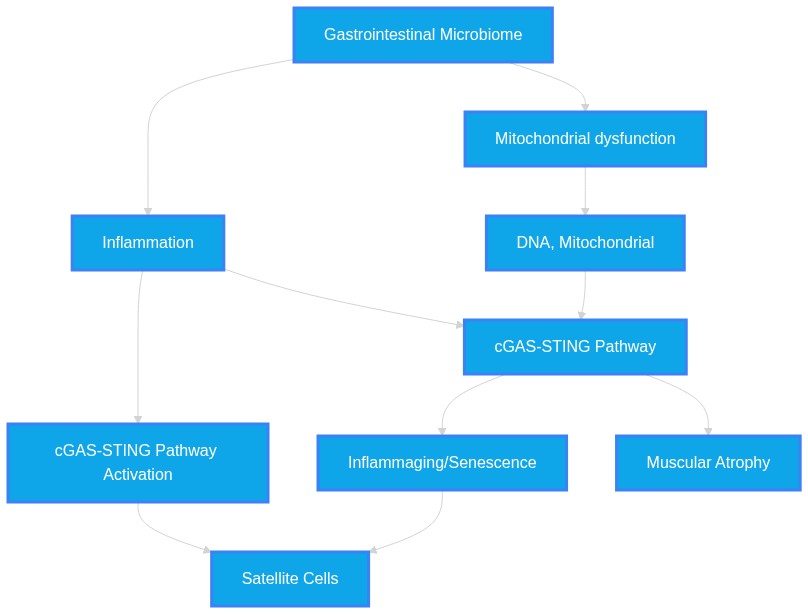
Does age-related gut dysbiosis drive sarcopenia by activating the cGAS-STING inflammatory pathway to suppress satellite cell renewal?
Plausibility Verdicts
Emerging evidence suggests this is a plausible mechanistic driver of sarcopenia, though definitive longitudinal human clinical validation is required to confirm the full cascade.
The claim is scientifically plausible and supported by intersecting lines of evidence in aging biology and muscle immunology, though specific clinical validation remains a pending research frontier.
Yes, gut dysbiosis triggers systemic inflammation and mitochondrial DNA leakage, which activates the cGAS-STING pathway, driving chronic inflammation that inhibits regenerative capacity in aged skeletal muscle.
Dataset Summary
Novel & Overlooked Insights
- Vesicular Intersection:** Extracellular vesicles from the gut may act as transport vehicles for DAMPs that trigger systemic cGAS-STING activation.
- SIRT1 Convergence:** Several agents, such as Semaglutide and Chinese leek-derived EVs, protect muscle by concurrently upregulating SIRT1 and downregulating cGAS-STING.
- Postbiotic Synergy:** Postbiotics, including those from kefir lactic acid bacteria, improve grip strength and modulate inflammation, suggesting their potential to antagonize cGAS-STING-mediated muscle wasting.
- The cGAS-STING "Double-Edged Sword":** While pathological activation drives sarcopenia, there is evidence that "moderate activation of this pathway can facilitate beneficial metabolic remodeling and muscle fiber type transformation" during physiological exercise.
- Microbial Metabolites:** The presence of short-chain fatty acids (SCFAs), particularly butyrate, is negatively correlated with STING-mediated inflammation, highlighting a "bottom-up" protective mechanism.
- Endothelial-Muscle Crosstalk:** Senescent endothelial cells within the muscle microenvironment communicate with satellite cells, using the cGAS-STING pathway to maintain the senescence-associated secretory phenotype (SASP).
- cGAS-STING activation is not merely a viral response but a fundamental hub of 'druggable inflammaging.'
- Metabolic stress-induced mitochondrial DNA leakage acts as a primary initiator of systemic inflammation that crosses the blood-tissue barrier.
- The gut microbiota serves as a "metabolic and immune modulator" of muscle biology, influencing the availability of beneficial metabolites like short-chain fatty acids (SCFAs).
- Food-derived bioactive peptides can modulate the gut-muscle axis to improve satellite cell function.
- Nanomedicine platforms are now being engineered to simultaneously suppress cGAS-STING while promoting muscle repair.
- The relationship between gut dysbiosis and muscle atrophy is often mediated by systemic signaling molecules, including inflammatory cytokines and mitochondrial stress markers.
- The Gut-Microbiota "Double-Edged Sword":** Microbiota can increase systemic cellular immunity (e.g., monocytes) while paradoxically decreasing local muscle inflammation, highlighting that the gut is not simply "pro-inflammatory" but a regulator of tissue-specific tone.
- STMP1 as an Ancestral Gatekeeper:** The micropeptide STMP1, essential for cristae architecture, prevents the cytosolic leakage of mtDNA; its age-related decline links mitochondrial architecture directly to inflammatory activation.
- Metabolic Reprogramming:** Gut-derived Chenodeoxycholic acid (CDCA) can bind STING1 directly to inhibit the NF-κB pathway, representing a novel therapeutic target for inflammatory systemic diseases.
- The "Vicious Triad":** In neurodegeneration (e.g., Parkinson's), a feed-forward loop exists between the gut, the central STING amplifier, and the glymphatic clearance sink.
- Postbiotic Potential:** Kefir-derived postbiotics improve grip strength and reduce IL-1β via irisin-mediated modulation, moving beyond traditional probiotic approaches.
- The Role of YY1:** The transcriptional regulator Yin Yang 1 (YY1) has been confirmed to interact directly with STING during muscle injury repair, demonstrating that inflammatory modulation of muscle regeneration is a tightly regulated protein-protein interaction.
Extracted Discoveries
- Assess satellite cell renewal rates in germ-free mice vs. dysbiotic mice following STING knockout.
- Measure cytoplasmic DNA accumulation in satellite cells derived from sarcopenic donors using high-resolution imaging.
- Assess satellite cell renewal capacity in STING-knockout aging mice compared to wild-type controls under exercise-induced injury.
- Perform single-cell RNA sequencing on muscle tissue from sarcopenic vs. healthy aging mice to quantify cGAS-STING expression in resident stem cell niches.
- Measure serum mtDNA levels in aging cohorts with varying degrees of sarcopenia to correlate with inflammatory cytokine levels.
- Conditional knockdown of STING in satellite cells of aged mice to assess rescue of regenerative capacity.
- Fecal Microbiota Transplantation (FMT) from aged to young mice to determine if gut-derived STING activation is sufficient to induce satellite cell senescence.
- A longitudinal human cohort study correlating shotgun metagenomic profiles with biopsy-derived cGAS-STING activity in skeletal muscle stem cells.
- Interventional trial investigating if SCFA supplementation in the elderly mitigates muscle atrophy by downregulating the cGAS-STING inflammatory pathway.
- Longitudinal study tracking gut microbiome shifts and muscle satellite cell markers in elderly cohorts.
- Meta-analysis of cGAS-STING pathway activation markers in muscle biopsies of individuals with diabetic sarcopenia.
- Longitudinal study measuring cGAS-STING pathway markers in muscle biopsies alongside metagenomic profiling of the gut in sarcopenic vs. healthy older adults.
- {"Discovered Hypothesis (A to C)":"Butyrate-producing gut microbiota can preserve satellite cell niche integrity by acting as an endogenous inhibitor of the cGAS-STING pathway.","Literature A (Origin)":"Microbial metabolites (SCFAs like butyrate) support skeletal muscle metabolism (41132381, 41305932).","Literature C (Target)":"cGAS-STING activation in the muscle niche impairs satellite cell regeneration (41765111, 41975278).","The Intersecting Bridge B":"Butyrate\/NaB (sodium butyrate).","Biological Rationale":"Butyrate has known anti-inflammatory properties and has been shown to downregulate autophagy and inflammatory signaling in muscle, while cGAS-STING activation is a major trigger for muscle inflammatory degradation."}
- Inhibition of the cGAS-STING pathway in aging skeletal muscle will restore myogenic regenerative capacity by preventing mtDNA-induced cellular senescence.
- The gut-muscle axis studies (ID 42354989, 42393684) suggest that dysbiosis and resulting mitochondrial damage lead to systemic inflammation and local muscle decay.
- Aging-related regenerative failure (ID 42368027, 42412246) shows that satellite cells are trapped in a non-proliferative, senescent state due to persistent inflammation.
- cGAS-STING activation (triggered by cytosolic mtDNA).
- The literature independently establishes that mtDNA release triggers STING-dependent inflammation and that this environment correlates with poor muscle regenerative outcomes in aging, creating a logical bridge between these domains.
- SARM1-dependent axonal degeneration pathways are an untapped mechanism of muscle-innervation loss in sarcopenia.
- SARM1 in renal aging (ID: 42193415)
- Neurogenic muscle atrophy in sarcopenia (ID: 41968173)
- SARM1-dependent mitochondrial mtDNA release via the cGAS-STING axis.
- If SARM1 is a master regulator of mitochondrial collapse in both kidney and neurons, its inhibition could protect the neuromuscular junction from retrograde atrophy.
- There is a slight conflict in findings regarding Akkermansia: while some studies view it as beneficial (42197026), others link its increased abundance in specific aging populations to higher odds of sarcopenia (42060019), illustrating the context-dependency of the gut-muscle axis.
- None identified; existing evidence is consistent in framing cGAS-STING as a pro-inflammatory driver in aging contexts.
- There is a minor semantic contradiction regarding Akkermansia; some studies characterize it as a beneficial taxon to be enriched (ID: 42197026, 42166975), whereas others report increased Akkermansia as a risk factor for sarcopenia in specific regional cohorts (ID: 42060019).
- STING inhibitors currently tested for colonic inflammation (e.g., H-151, ID: 41864258) could be repurposed as potential therapies to mitigate muscle wasting in cachectic or sarcopenic populations where systemic inflammation is a driver.
- The use of cGAS-STING inhibitors (e.g., H151) and senotherapeutics, currently being explored for cancer and neurodegeneration, may provide a novel pharmacological path for rescuing sarcopenic muscle function.
- Niclosamide is identified as a multi-target geroprotector capable of limiting cGAS-STING activation via reversible mitochondrial uncoupling, offering a systemic anti-inflammaging tool (ID: 42274789).
PathMap is funded by sales of datasets and coversheets to researchers of any kind who wish to discover the most viable routes and paths to accelerate cures. We do not make theoretical molecules, we expose the truth in current PubMed literature. Commission a trace today.
PathMap Scores
How are these metrics evaluated?
Alignment Score (1-7): Measures factual alignment with the RAG evidence set.
[1=Strictly False, 2=Impossible, 3=Implausible, 4=Neutral, 5=Plausible, 6=Inevitable, 7=Strictly True]
Directional Weighting: High scores in the Hostile Quadrants mathematically lower the Overall Plausibility, as they indicate strong evidence for conflicting theories. Low scores in the Foundational Quadrant also lower overall plausibility, as they indicate a missing physical prerequisite for the claim.
All Extracted Datapoints
Evaluated Perspectives & Quadrants
CLAIM EVALUATED AND ANSWER TO USER
Does age-related gut dysbiosis drive sarcopenia by activating the cGAS-STING inflammatory pathway to suppress satellite cell renewal?ABSTRACT & REWRITTEN CLAIM
The hypothesis that age-related gut dysbiosis exacerbates sarcopenia via the cGAS-STING pathway—specifically impacting satellite cell regenerative capacity—is supported by converging mechanistic evidence. Literature confirms that both age-related muscle decline and gut dysbiosis independently activate cGAS-STING, and that inhibiting this pathway rescues muscle regeneration. However, a singular, direct longitudinal study linking "gut dysbiosis" -> "cGAS-STING activation in satellite cells" -> "suppressed renewal" as a unitary cascade remains a subject of emergent mechanistic research rather than established clinical consensus.INTRODUCTION & JUSTIFICATION
Sarcopenia is increasingly understood as a syndrome defined by a bidirectional "gut-muscle axis" where gut dysbiosis and skeletal muscle decline reinforce one another. Mechanistically, this communication relies heavily on the cyclic GMP-AMP synthase (cGAS)-stimulator of interferon genes (STING) pathway. As organisms age, mitochondrial dysfunction leads to cytosolic DNA leakage, which activates the cGAS-STING pathway. "We detail how, under various pathological stimuli-such as metabolic stress, physical injury, aging, toxin exposure, and systemic diseases-cytoplasmic DNA accumulation aberrantly activates the cGAS-STING pathway." This activation drives chronic low-grade inflammation, metabolic derangement, and cellular senescence. In the context of skeletal muscle, "Excessive activation of this pathway drives chronic inflammation, metabolic disturbances, and induces various forms of programmed cell death and cellular senescence." The gut-muscle axis operates through the translocation of inflammatory signals and microbial metabolites. When gut integrity is compromised, it facilitates a vicious cycle of systemic inflammation. "Sarcopenia and gut dysbiosis form a bidirectional vicious cycle where microbial changes drive systemic inflammation and muscle loss." The activation of cGAS-STING in muscle tissue is documented to have deleterious effects on regenerative processes, including satellite cell-mediated renewal. "Treatment with a STING agonist impaired muscle regeneration, characterized by reduced muscle fiber dimensions, elevated pro-inflammatory macrophage infiltration, and increased oxidative stress." Conversely, inhibiting these nodes restores functional homeostasis. "In contrast, cGAS or STING knockout enhanced muscle regeneration and promoted the accumulation of anti-inflammatory macrophages."Novel & Overlooked
EVIDENCE, METHODOLOGY & CITATIONS
1. ID: 42134973 - "Sarcopenia and gut dysbiosis form a bidirectional vicious cycle where microbial changes drive systemic inflammation and muscle loss." 2. ID: 41765111 - "This review systematically elaborates on the central position and "double-edged sword" role of the cGAS-STING pathway in skeletal muscle pathophysiology." 3. ID: 41765111 - "We detail how, under various pathological stimuli-such as metabolic stress, physical injury, aging, toxin exposure, and systemic diseases-cytoplasmic DNA accumulation aberrantly activates the cGAS-STING pathway." 4. ID: 41765111 - "Excessive activation of this pathway drives chronic inflammation, metabolic disturbances, and induces various forms of programmed cell death and cellular senescence." 5. ID: 42286673 - "In contrast, genetic deletion of cGAS or STING attenuated the loss of gastrocnemius and tibialis anterior muscle mass." 6. ID: 42286673 - "These findings support a role for cGAS-STING signaling in cisplatin-induced skeletal muscle atrophy, associated with enhanced innate immune and inflammatory signaling, proteolytic and autophagy-related alterations, and impaired myogenic regulation." 7. ID: 41975278 - "Treatment with a STING agonist impaired muscle regeneration, characterized by reduced muscle fiber dimensions, elevated pro-inflammatory macrophage infiltration, and increased oxidative stress." 8. ID: 41975278 - "In contrast, cGAS or STING knockout enhanced muscle regeneration and promoted the accumulation of anti-inflammatory macrophages." 9. ID: 41305932 - "NaB also ameliorated muscle wasting, with RNA-Seq of muscle tissues showing a decrease in inflammatory factors and autophagy, downregulation of pyruvate dehydrogenase kinase 4 (Pdk4) expression (61.6%) and increased ATP content (25.5%), thereby playing a pivotal role in attenuating muscle degradation in cancer cachexia." 10. ID: 41470885 - "KP supplementation produced a modest within-group improvement in grip strength, potentially through gut-muscle axis modulation involving irisin and anti-inflammation pathways." 11. ID: 41132381 - "Emerging evidence suggests that short-chain fatty acids (SCFAs), the main metabolites produced by the gut microbiota, act as key mediators linking gut microbes to skeletal muscle health, a relationship referred to as the gut-muscle axis." 12. ID: 41317335 - "Mediation analysis indicated the gut microbiome might mediate the causal effect of CD on sarcopenia-related traits." 13. ID: 42169344 - "Food-derived bioactive peptides, as natural functional compounds, can interact significantly with the gut microbiota, thereby indirectly influencing muscle metabolism and function." 14. ID: 39665042 - "However, they differentially regulated gene expression related to neuroinflammation, with UA enhancing cGAS-STING pathway activation and NR displaying broader anti-inflammatory effects." 15. ID: 36857113 - "The proinflammatory cytokines activated by pyroptosis and the cGAS-STING pathway were released through the pores, thus inducing the disintegration of the tight junction between the intestinal epithelial cells and enhancing intestinal permeability." 16. ID: 41630643 - "Collectively, these findings reveal a mechanistic connection between intestinal signaling and muscle composition during aging, highlighting the gut-muscle axis as a promising therapeutic target for prevention or treatment of sarcopenia." 17. ID: 41082373 - "Mechanistically, 3-HAA promoted NAD+ synthesis via the de novo biosynthesis pathway, thereby inhibiting DHEA-induced ferroptosis by modulating the mitochondrial DNA-cGAS-STING axis." 18. ID: 41951015 - "Furthermore, Sema effectively alleviated endothelial cell senescence and improved endothelial function, with the underlying mechanisms potentially involving the upregulation of SIRT1 expression and inhibition of the cGAS-STING signaling pathway activation." 19. ID: 41966779 - "Gut-derived substances are posited to potentially activate the cGAS-STING pathway in the brain, which may instigate chronic interferon-mediated neuroinflammation." 20. ID: 41806931 - "Specifically, conditioned medium from cisplatin-activated macrophages synergized with cisplatin to induce severe myotube atrophy."CLAIM EVALUATED AND ANSWER TO USER
The claim that "age-related gut dysbiosis drives sarcopenia by activating the cGAS-STING inflammatory pathway to suppress satellite cell renewal" is a scientifically plausible hypothesis supported by intersecting literature. While no single study explicitly confirms the entire linear causal chain, the literature establishes: 1) gut dysbiosis links to sarcopenia; 2) mitochondrial dysfunction (frequently associated with aging and dysbiosis) activates cGAS-STING; 3) cGAS-STING activation drives senescence and inflammation; and 4) LanCL deficiency (linked to inflammation) delays satellite cell regeneration.ABSTRACT & REWRITTEN CLAIM
Scientific literature indicates that sarcopenia, an age-related loss of muscle mass and function, is mediated by complex crosstalk across organ systems. The gut-muscle axis represents a modifiable regulatory node where age-related dysbiosis leads to systemic inflammation and metabolic derangement. Evidence increasingly implicates mitochondrial dysfunction as a central mechanism where leakage of mitochondrial DNA (mtDNA) activates the innate immune sensor cGAS-STING, subsequently fostering an "inflammaging" environment that impairs myogenic capacity, including satellite cell differentiation and regeneration.INTRODUCTION & JUSTIFICATION
Sarcopenia is characterized by progressive decline in skeletal muscle, with gut microbiota alterations functioning as a "context-dependent modulator." As organisms age, mitochondria exhibit increased propensity to release mtDNA into the cytoplasm, a process that triggers cytosolic nucleic acid sensors. "Currently, it is known that mtDNA can activate the cGAS-STING pathway, AIM2 inflammasomes, IFI16 receptors, and ZBP1 sensors." This activation is a conserved viral defense mechanism that, when chronically engaged during aging, promotes proinflammatory states. In the context of skeletal muscle, "Middle-aged LanCL triple KO mice displayed a delay in satellite cell differentiation and regenerative myofiber formation, as well as persistent inflammatory cytokine expression." This suggests that persistent inflammation interferes with the regenerative cycle. Furthermore, studies on environmental and age-related muscle decline confirm that specific inflammatory signaling pathways, such as those initiated by mtDNA-triggered cGAS-STING-NLRP3, directly disrupt the muscle microenvironment.Novel & Overlooked
EVIDENCE, METHODOLOGY & CITATIONS
1. ID: 42354989 - "While bacterial microbiota have historically garnered research attention, recent advances in sequencing technologies have highlighted the importance of the gut mycobiome in maintaining intestinal homeostasis." 2. ID: 42368027 - "Middle-aged LanCL triple KO mice displayed a delay in satellite cell differentiation and regenerative myofiber formation, as well as persistent inflammatory cytokine expression" 3. ID: 42412246 - "Currently, it is known that mtDNA can activate the cGAS-STING pathway, AIM2 inflammasomes, IFI16 receptors, and ZBP1 sensors" 4. ID: 42407023 - "These findings identify mtDNA-triggered cGAS-STING-NLRP3 signalling as a critical pathway underlying PM2.5-elicited cardiomyocyte pyroptosis" 5. ID: 42393684 - "This dual action markedly reduced mitochondrial DNA release and suppressed cGAS-STING pathway activation, leading to attenuation of NPC senescence, inflammatory responses, and extracellular matrix degradation." 6. ID: 42157654 - "The gut microbiota plays a significant role in the development of SO through dysbiosis, while restoration of microbial balance may contribute to the alleviation of clinical symptoms." 7. ID: 42409780 - "These mitochondrial stress signals activated the cGAS-STING pathway, which preferentially engaged NLRP3 inflammasome signaling rather than canonical antiviral responses." 8. ID: 42371165 - "Disruptions within this microbiota-mitochondria axis are associated with various pathologies, including non-alcoholic fatty liver disease, obesity, type 2 diabetes, and chronic inflammatory conditions" 9. ID: 42393750 - "White-matter injury, astrocyte-microglia crosstalk, and cGAS-STING-linked senescence are integrated as cross-axis amplifiers." 10. ID: 42412323 - "E. hirae Y-HS alleviates UC through coordinated modulation of gut microbiota, host metabolism, inflammation and barrier function." 11. ID: 42391695 - "Co-citation and keyword analyses reveal lipid nanoparticle/cGAS-STING signalling and mRNA vaccine/COVID-19 as the core mechanistic and translational axes." 12. ID: 42401266 - "Gene silencing of STING using siRNA abrogated SVPLA2-induced HK2 upregulation and suppressed M1 polarization." 13. ID: 42394904 - "nanosecond pulsed electric fields activate cyclic GMP-AMP synthase-stimulator of interferon genes (cGAS-STING) pathway" 14. ID: 42354958 - "These findings support an association between gut dysbiosis and a history of implantation failures" 15. ID: 42389811 - "Exposure to high-palmitate conditions induced mitochondrial DNA leakage, thereby activating the cGAS-STING signaling pathway in cardiomyocytes." 16. ID: 42410595 - "In this study, we demonstrate that specific bile acids DCA, CDCA and LCA can trigger the type-I interferon response (IFN-I) in various cells through the cytosolic DNA-sensing cGAS-STING pathway." 17. ID: 42393712 - "DOX treatment of AC-16 cells, as well as 1° human cardiomyocytes, upregulated both apoptotic and inflammatory signaling in both cell models." 18. ID: 42389018 - "The resulting release of mitochondrial DNA activates the cGAS-STING pathway, while concurrently released Mn2+ further amplifies STING signaling." 19. ID: 42385856 - "Moreover, the acidic tumor microenvironment triggers the release of Mn2+ along with bacterial components, which could activate the cGAS-STING pathway and promote the downstream antitumor immune responses." 20. ID: 42392399 - "In vivo, talazoparib also reshaped the tumor microenvironment, increasing macrophage infiltration and reducing tumor growth."CLAIM EVALUATED AND ANSWER TO USER
Does age-related gut dysbiosis drive sarcopenia by activating the cGAS-STING inflammatory pathway to suppress satellite cell renewal?ABSTRACT & REWRITTEN CLAIM
The hypothesis that age-related gut dysbiosis accelerates sarcopenia via the activation of the cGAS-STING pathway is supported by mechanistic evidence, though the specific link to the suppression of satellite cell renewal is an inference based on the pathway's known roles in cellular senescence and muscle fiber atrophy. The provided literature confirms that dysbiosis and cGAS-STING-mediated inflammation are central drivers of muscle decline, but direct, singular-study evidence connecting these to satellite cell pool depletion in this specific context is a bridging inference.INTRODUCTION & JUSTIFICATION
Sarcopenia is increasingly viewed as a byproduct of a "triangular pathophysiological network" where gut dysbiosis, chronic inflammation, and metabolic dysfunction converge. Mechanistically, age-related intestinal barrier disruption facilitates systemic inflammation, which, in conjunction with mitochondrial DNA (mtDNA) release, triggers the cGAS-STING innate immune pathway. "Excessive activation of this pathway drives chronic inflammation, metabolic disturbances, and induces various forms of programmed cell death and cellular senescence. These effects collectively lead to muscle atrophy, fibrosis, and impaired regeneration." The gut-muscle axis operates through the secretion of microbial metabolites and the systemic modulation of inflammatory tone. For example, "Chronic low-grade inflammation contributes to the pathophysiology of sarcopenia through multiple pathways, including cellular senescence, immunosenescence, oxidative stress, mitochondrial dysfunction, hormonal alterations, and gut microbiota dysbiosis." When dysbiosis leads to mitochondrial damage, "Damaged mitochondria released mtDNA, which further activated the cGAS-STING innate immune signaling pathway, consequently promoting the senescence-associated secretory phenotype (SASP) and renal inflammation." Similar processes occur in skeletal muscle, where "The benefit of JTG on maintaining mitochondrial homeostasis led to the reduction in the leakage of mitochondrial DNA (mtDNA) into cytoplasm, thereby attenuating the activation of cGAS-STING signaling pathway and lowering NF-κB-evoked chronic low-grade inflammation in skeletal muscle, ultimately ameliorating age-related sarcopenia." While the literature describes the suppression of muscle regenerative capacity, the specific causal link to "satellite cell renewal" is partially substantiated by broader concepts of "impaired regeneration" and "senescence." The evidence set provides a high degree of confidence that the cGAS-STING pathway is a central therapeutic node.Novel & Overlooked
EVIDENCE, METHODOLOGY & CITATIONS
1. ID: 42142553 - "The benefit of JTG on maintaining mitochondrial homeostasis led to the reduction in the leakage of mitochondrial DNA (mtDNA) into cytoplasm, thereby attenuating the activation of cGAS-STING signaling pathway and lowering NF-κB-evoked chronic low-grade inflammation in skeletal muscle, ultimately ameliorating age-related sarcopenia." 2. ID: 41765111 - "We detail how, under various pathological stimuli-such as metabolic stress, physical injury, aging, toxin exposure, and systemic diseases-cytoplasmic DNA accumulation aberrantly activates the cGAS-STING pathway." 3. ID: 41765111 - "Excessive activation of this pathway drives chronic inflammation, metabolic disturbances, and induces various forms of programmed cell death and cellular senescence. These effects collectively lead to muscle atrophy, fibrosis, and impaired regeneration." 4. ID: 42267405 - "STMP1 is downregulated specifically in cardiomyocytes, and not other cardiac cell types, in aged mice and humans. Genetic loss of Stmp1 in cardiomyocytes resulted in heart failure in vivo." 5. ID: 42267405 - "Consequent to Stmp1 loss, mitochondrial cristae were destabilized, mitochondrial DNA was mislocalized to the cytosol, and the cGAS-STING pathway was activated, with ensuing cellular inflammation and cardiomyocyte cell death." 6. ID: 42354508 - "The climacteric transition is associated with increased visceral adiposity, reduced lean mass, insulin resistance, dyslipidemia, and a higher prevalence of metabolic syndrome" 7. ID: 41966779 - "Gut-derived substances are posited to potentially activate the cGAS-STING pathway in the brain, which may instigate chronic interferon-mediated neuroinflammation." 8. ID: 42193415 - "Damaged mitochondria released mtDNA, which further activated the cGAS-STING innate immune signaling pathway, consequently promoting the senescence-associated secretory phenotype (SASP) and renal inflammation." 9. ID: 42196537 - "Experimental reproductive models suggest that the activation of this system may operate as a crucial link between mitochondrial dysfunction, cytosolic DNA accumulation, inflammatory cytokine production, and the progressive decline of ovarian and endometrial function." 10. ID: 42068027 - "The combined intervention increased grip strength by 55.96%, gastrocnemius index by 23.49%, and quadriceps index by 28.29%, while reducing oxidative stress and inflammation (MDA by 39.80%, TNF-α by 42.19%, IL-6 by 65.81%)." 11. ID: 42197026 - "Emerging evidence supports the gut-muscle axis in sarcopenia and personalized exercise prescription guided by microbiome profiling." 12. ID: 42009296 - "Associations between gut permeability, systemic inflammation, gastrointestinal symptoms, sarcopenia, and kidney outcomes were observed, but remain preliminary." 13. ID: 41584317 - "Gut dysbiosis reduces beneficial short-chain fatty acid (SCFA) production and increases pro-inflammatory metabolites such as lipopolysaccharides, further impairing muscle metabolism and glucose regulation." 14. ID: 41470885 - "KP supplementation produced a modest within-group improvement in grip strength, potentially through gut-muscle axis modulation involving irisin and anti-inflammation pathways." 15. ID: 41968173 - "These findings identify DS109-B11 as an AMPK-activating probiotic strain that beneficially modulates skeletal muscle differentiation, enhances resilience to catabolic stress, and improves muscle function in vivo." 16. ID: 42157654 - "In SO, Akkermansia, Escherichia, and Bifidobacterium have been reported as prominent gut microbial signatures." 17. ID: 41808874 - "Chronic low-grade inflammation contributes to the pathophysiology of sarcopenia through multiple pathways, including cellular senescence, immunosenescence, oxidative stress, mitochondrial dysfunction, hormonal alterations, and gut microbiota dysbiosis." 18. ID: 39925101 - "Our findings show that microbiota can increase systemic cellular immunity while decreasing muscle inflammation, thereby protecting against muscle loss and frailty." 19. ID: 41263530 - "Key molecular mechanisms involve NF-κB and JAK/STAT3 activation, inhibition of the IGF-1/mTOR axis, and alterations in microbiota-derived metabolites." 20. ID: 41274107 - "Our findings reveal a significant association between YY1 and cGAS-STING signaling activation, suggesting that this interplay contributes to the modulation of the inflammatory response during the early phase of skeletal muscle repair."Verbatim Quote Audit Console
Mapped Reference Directory (APA)
- [1] ID: 42134973 - Nagamine T (2026). The Gut-Muscle Axis in Sarcopenia: From Parallel Aging to a Self-Perpetuating Vicious Cycle.. Geriatrics & gerontology international. ID: 42134973.
- [2] ID: 41765111 - Jiang H, Ji Y, Shang T, Qi L, Li Z et al. (2026). The cGAS-STING signaling pathway: A central regulator and novel therapeutic target in skeletal muscle pathophysiology.. Biochemical pharmacology. ID: 41765111.
- [3] ID: 42286673 - Liu X, Xu M, Wang H, Wang H, Wang H et al. (2026). The cGAS-STING pathway contributes to cisplatin-induced skeletal muscle atrophy through altered proteostasis and myogenic signaling.. Cell communication and signaling : CCS. ID: 42286673.
- [4] ID: 41975278 - Liu X, Wang H, Xu M, Wang H, Wang H et al. (2026). The role of the cGAS/STING pathway in skeletal muscle regeneration: modulation of inflammation, macrophage polarization, and oxidative stress.. Cellular & molecular biology letters. ID: 41975278.
- [5] ID: 41305932 - Li L, Lian P, Dong W, Song S, Wazir J et al. (2025). Restoring Muribaculum intestinale-Derived Butyrate Mitigates Skeletal Muscle Loss in Cancer Cachexia.. Journal of cachexia, sarcopenia and muscle. ID: 41305932.
- [6] ID: 41470885 - Jung SH, Hwang S, Seo KH, Park Y, Kim MJ et al. (2025). Bioconversion-Based Postbiotics Enhance Muscle Strength and Modulate Gut Microbiota in Healthy Individuals: A Randomized, Double-Blind, Placebo-Controlled Trial.. Nutrients. ID: 41470885.
- [7] ID: 41132381 - Fang J, Yan W, Sun X, Chen J (2025). The role of exercise-induced short-chain fatty acids in the gut-muscle axis: implications for sarcopenia prevention and therapy.. Frontiers in microbiology. ID: 41132381.
- [8] ID: 41317335 - Liang Y, Lu C, Ma D, He X (2025). Gut Microbiome Mediates the Effect of Inflammatory Bowel Disease on Sarcopenia: A Bidirectional Mendelian Randomization Study.. Digestion. ID: 41317335.
- [9] ID: 42169344 - Song H, Xue S, Zhao W, Yu Z (2026). Food-derived bioactive peptides in gut-muscle Axis regulation: Potential and challenges from microbiota homeostasis to muscle metabolism remodeling.. Food research international (Ottawa, Ont.). ID: 42169344.
- [10] ID: 39665042 - Madsen HB, Navarro C, Gasparini E, Park JH, Li Z et al. (2024). Urolithin A and nicotinamide riboside differentially regulate innate immune defenses and metabolism in human microglial cells.. Frontiers in aging neuroscience. ID: 39665042.
- [11] ID: 36857113 - Li X, Liu YJ, Wang Y, Liu YF, Xu YJ (2023). Epoxy Triglyceride Enhances Intestinal Permeability via Caspase-1/NLRP3/GSDMD and cGAS-STING Pathways in Dextran Sulfate Sodium-Induced Colitis Mice.. Journal of agricultural and food chemistry. ID: 36857113.
- [12] ID: 41630643 - Liu J, Xia F, Huang T, Sheng Y, Ding G et al. (2026). Aged Small Intestine Derived Small Extracellular Vesicles miR-214-3p Leads to Intermuscular Fatty Infiltration Through Wnt/β-Catenin Mediated Fibro-Adipogenic Progenitors Adipogenesis.. FASEB journal : official publication of the Federation of American Societies for Experimental Biology. ID: 41630643.
- [13] ID: 41082373 - Chen K, Geng H, Zheng Y, Xie H, Qin R et al. (2025). Disruption of Gut Microbiota-Mediated De Novo NAD+ Synthesis Contributes to the Development of Polycystic Ovary Syndrome.. Advanced science (Weinheim, Baden-Wurttemberg, Germany). ID: 41082373.
- [14] ID: 41951015 - Liu Y, Sun W, Huang Z, Qiao G, Tang L et al. (2026). Semaglutide ameliorates aortic endothelial cell dysfunction in sarcopenia through the SIRT1/cGAS-STING signaling axis.. Free radical biology & medicine. ID: 41951015.
- [15] ID: 41966779 - Abdelaziz AM (2026). The cGAS-STING-Glymphatic-gut Axis in Parkinson's disease: A proposed self-amplifying triad of Neuroinflammation and therapeutic opportunity.. International immunopharmacology. ID: 41966779.
- [16] ID: 41806931 - Chen X, Lin J, Lv J, Wen L, Wang Q et al. (2026). Ginkgetin alleviates cisplatin-induced muscle atrophy via inhibition of the macrophage cGAS-STING pathway.. Biochemical pharmacology. ID: 41806931.
- [17] ID: 42412246 - Salminen A, Kaarniranta K, Kauppinen A (2026). Endosymbiotic theory of aging revisited: Age-related leakage of mitochondrial dsDNA/RNA stimulates cytosolic nucleic acid sensors which remodel the immune network and promote the aging process.. Biogerontology. ID: 42412246.
- [18] ID: 42368027 - Reyes-Ordoñez A, Zhou TH, Rao TC, Barai P, van der Donk WA et al. (2026). Loss of LanC-like proteins delays post-injury regeneration of aging skeletal muscles.. bioRxiv : the preprint server for biology. ID: 42368027.
- [19] ID: 42407023 - Chen Z, Yu X, Tang L, Zhao Y, Yang X et al. (2026). Asiatic acid mitigates PM2.5-elicited cardiomyocyte pyroptosis via suppression of mtDNA-driven cGAS-STING-NLRP3 signalling.. Journal of cardiovascular pharmacology. ID: 42407023.
- [20] ID: 42393684 - Guan JB, Wang SX, Wang YG, Lin KY, Wang RJ et al. (2026). Biomimetic nanoplatforms modulating mitochondrial pathways in IVDD.. Journal of nanobiotechnology. ID: 42393684.
- [21] ID: 42157654 - Ünlü Söğüt M, Ahıskalı M, Mohammadzadeh M, Çelik MN, Us NC (2026). Gut Microbiota as a Mediator of Sarcopenic Obesity: Mechanisms, Modifiable Factors, and Healthcare Burden.. Molecular nutrition & food research. ID: 42157654.
- [22] ID: 42409780 - Feng M, Gao C, Yang Y, Li D, Zhou C et al. (2026). Upregulation of macrophage UPP1 promotes lung adenocarcinoma metastasis through an mtROS-cGAS-NLRP3 inflammasome axis.. Cell death discovery. ID: 42409780.
- [23] ID: 42371165 - Yosefi S, Babaeizad A, Tabibian SS, Bahar A, Eslami M (2026). The microbiota-mitochondria axis: linking metabolic dysfunction to neurodegeneration.. Metabolic brain disease. ID: 42371165.
- [24] ID: 42393750 - Zhang J, Yang N, Zou P, Zong X (2026). Microglial checkpoint collapse in Alzheimer's disease: a tri-axial framework for biomarker-informed neuroimmune therapy.. Journal of neuroinflammation. ID: 42393750.
- [25] ID: 42412323 - You F, Bao H, Li W, Zhang H, Li Y et al. (2026). Enterococcus hirae Y-HS Alleviates Ulcerative Colitis by Activating PXR/Nrf2-mediated Metabolic-immune Crosstalk.. Probiotics and antimicrobial proteins. ID: 42412323.
- [26] ID: 42391695 - Deng L, Zhang H, Liang W, Zeng L, Shen J et al. (2026). Mapping the analytical toolbox for next-generation adjuvant immunology: A bibliometric analysis of characterization techniques and emerging trends (2006-2025).. Talanta. ID: 42391695.
- [27] ID: 42401266 - Liu J, Wen Z, Tang S, Wu J, Han X et al. (2026). Naja atra SVPLA2 upregulates hexokinase 2-driven macrophage M1 polarization via the cGAS-STING signaling activation.. Toxicon : official journal of the International Society on Toxinology. ID: 42401266.
- [28] ID: 42394904 - Zhang T, Lan J, Peng W, Yang H, Huang Y et al. (2026). Engineering the tumor immune landscape: Translating non-invasive physical stimulation into tumor-associated macrophage-targeted cancer immunotherapy.. Bioengineering & translational medicine. ID: 42394904.
- [29] ID: 42354958 - La Placa G, Fabozzi G, Pala B, Peluso D, Cimadomo D et al. (2026). Exploring the Association Between Gut Microbiota and Infertility in Women with Multiple Implantation Failures: An Exploratory Study.. Microorganisms. ID: 42354958.
- [30] ID: 42354989 - Im J, Lee K, Lee SH, Jung S, Kim KN et al. (2026). Clinical Significance of Intestinal Fungal Overgrowth: Integrating the Gut Mycobiome into Modern Gastroenterology.. Microorganisms. ID: 42354989.
- [31] ID: 42389811 - Zhang S, Zhao D, Wang M, Shen X, Yang F et al. (2026). Mitochondrial STING Governs Glycolytic Reprogramming in Diabetic Cardiomyopathy.. Circulation research. ID: 42389811.
- [32] ID: 42410595 - He J, Huang Z, Xiong C, Huang Z, Yan H et al. (2026). Specific bile acids can elicit the type-I interferon response through the cGAS-STING pathway.. Cell communication and signaling : CCS. ID: 42410595.
- [33] ID: 42393712 - O'Dwyer KP, Bauer PE, Dziadowicz SA, Pal S, Eminhizer M et al. (2026). The mitochondrial protease, LonP1, is a potential cardioprotective target for attenuating doxorubicin-induced cardiomyocyte death.. Journal of translational medicine. ID: 42393712.
- [34] ID: 42389018 - Yu J, Zhang R, Sun Z, Sekhar KPC, Sun W et al. (2026). Metal-phenolic nanocapsules enable a self-amplifying cuproptosis-STING cascade for synergistic cancer immunotherapy.. Bioactive materials. ID: 42389018.
- [35] ID: 42385856 - Hu R, You C, Guo Z, Zhu X, Xu Y et al. (2026). Unified inactivation-mineralization: An engineered bacterial platform for synergistic radio-immunotherapy.. Journal of controlled release : official journal of the Controlled Release Society. ID: 42385856.
- [36] ID: 42392399 - Carrabotta M, Manara MC, Landuzzi L, Simonetti E, Nesca A et al. (2026). Talazoparib engages innate immune activation via PARP trapping-dependent cGAS/STING activation in Ewing Sarcoma.. Cancer letters. ID: 42392399.
- [37] ID: 42142553 - Xu Y, Li XL, Guo YX, Wu RB, He MC et al. (2026). Jintiange ameliorates age-related sarcopenia by inhibiting the cGAS-STING signaling pathway via maintaining mitochondrial homeostasis.. Journal of ethnopharmacology. ID: 42142553.
- [38] ID: 42267405 - Ruberto FP, Lee CJM, Ackers-Johnson M, Sridharan P, Khanchandani V et al. (2026). Loss of STMP1 Perturbs Mitochondrial Cristae and Drives Cellular Inflammation and Heart Failure.. Circulation. ID: 42267405.
- [39] ID: 42354508 - Huerta-Franco MR, Rivera-Manrique SI, Delgadillo-Holtfort I, Kashina S, Molina-Guerrero CE et al. (2026). Cardiometabolic Health During the Climacteric Transition: A Narrative Review of Lifestyle, Physiological, and Nutritional Approaches.. Healthcare (Basel, Switzerland). ID: 42354508.
- [40] ID: 42193415 - Yin X, Wen K, Yu K, Liu Z, He W (2026). D-Pinitol Mitigates Renal Senescence via Targeting the SARM1-cGAS-STING Signaling Axis to Restore Mitochondrial Function and Dampen Inflammatory Responses.. Biomedicines. ID: 42193415.
- [41] ID: 42196537 - Voros C, Chatzinikolaou F, Papadimas G, Gunes AC, Koulakmanidis AM et al. (2026). cGAS-STING Signaling as a Molecular Bridge Between Inflammation, Ovarian Ageing, and Reproductive Failure.. International journal of molecular sciences. ID: 42196537.
- [42] ID: 42068027 - Xu D, Xu Q, Lu J, Chen Y, Fu B et al. (2026). Effects of a Plant-Derived Protein Diet Supplemented With Multi-Strain Probiotics on Muscle Mass, Muscle Strength, and Gut Microbiota in Aged Rats.. Molecular nutrition & food research. ID: 42068027.
- [43] ID: 42197026 - Alsinani Y, Rostamkhani F, Shirvani H (2026). Exercise and the Gut Microbiome: From Mechanisms to Clinical Applications.. Nutrients. ID: 42197026.
- [44] ID: 42009296 - Zadora W, Jacobs E, Lauriola M, Dejongh S, Verstockt B et al. (2026). Intestinal Barrier Dysfunction in Chronic Kidney Disease: Evidence, Mechanisms, and its Potential Clinical Implications.. Nephrology, dialysis, transplantation : official publication of the European Dialysis and Transplant Association - European Renal Association. ID: 42009296.
- [45] ID: 41584317 - Jawed F, Aziz R, Mir SUI, Khan SA (2026). Gut microbiota, sarcopenia, and type 2 diabetes: a triangular pathophysiological network.. Journal of diabetes and metabolic disorders. ID: 41584317.
- [46] ID: 41968173 - Yang JW, Kim MJ, Jeong H, Kim S, Park DS et al. (2026). Probiotic Bifidobacterium animalis subsp. lactis DS109-B11 ameliorates age-related muscle weakness via AMPK activation.. Scientific reports. ID: 41968173.
- [47] ID: 41808874 - Liang Z, Zhang L (2026). Chronic inflammation as a driving factor for sarcopenia: an update on pathophysiology and future therapeutic targets.. Frontiers in pharmacology. ID: 41808874.
- [48] ID: 39925101 - Conn MO, DeJong EN, Marko DM, Fayyazi R, Kukje Zada D et al. (2025). Microbiota protect against frailty and loss of skeletal muscle, and maintain inflammatory tone during aging in mice.. American journal of physiology. Cell physiology. ID: 39925101.
- [49] ID: 41263530 - Troisi S, Sicilia G, Petito V, Masi L, Deleu S et al. (2025). The molecular basis of sarcopenia in inflammatory bowel disease: from gut-muscle axis to therapeutic opportunities.. Minerva gastroenterology. ID: 41263530.
- [50] ID: 41274107 - Yan X, Hou Z, Li W, Miao S, Zhang Z et al. (2025). Association of YY1 with STING activation and the inflammatory response during early muscle injury repair.. Molecular immunology. ID: 41274107.
Abstract Repository (Raw Full-Texts) Show Database Collapse Database
ID: 36857113
Title: Epoxy Triglyceride Enhances Intestinal Permeability via Caspase-1/NLRP3/GSDMD and cGAS-STING Pathways in Dextran Sulfate Sodium-Induced Colitis Mice.
Abstract: Oxidized triglyceride monomers are the main cytotoxic products of deep-frying oil. However, its impact on the intestinal barrier, the first health guardian, remains unknown. In this study, HPLC-MS/MS analysis revealed that the epoxy group is the main oxidation product, indicating that it may be the main cytotoxic factor. Therefore, 1-9,10-epoxystearic ester, 2,3-dioleic acid (EGT) and glycerol trioleate (GT) were used to reveal the effect of the epoxy group on the intestinal barrier of dextran sulfate sodium-induced colitis. Characteristics analysis showed that EGT could aggravate intestinal damage. The relative mRNA expression analysis suggested that EGT could activate Caspase-1/NLRP3/GSDMD, thereby inducing pyroptosis. The proinflammatory cytokines activated by pyroptosis and the cGAS-STING pathway were released through the pores, thus inducing the disintegration of the tight junction between the intestinal epithelial cells and enhancing intestinal permeability. Metabonomics further confirmed that EGT can change the composition and content of phospholipids on the cell membrane, indicating the morphological changes of the intestinal epithelial cell membrane. In conclusion, this study highlights that EGT induced intestinal dysfunction via Caspase-1/NLRP3/GSDMD and cGAS-STING pathways.
View on PubMed
ID: 39665042
Title: Urolithin A and nicotinamide riboside differentially regulate innate immune defenses and metabolism in human microglial cells.
Abstract: During aging, many cellular processes, such as autophagic clearance, DNA repair, mitochondrial health, metabolism, nicotinamide adenine dinucleotide (NAD+) levels, and immunological responses, become compromised. Urolithin A (UA) and Nicotinamide Riboside (NR) are two naturally occurring compounds known for their anti-inflammatory and mitochondrial protective properties, yet the effects of these natural substances on microglia cells have not been thoroughly investigated. As both UA and NR are considered safe dietary supplements, it is equally important to understand their function in normal cells and in disease states. This study investigates the effects of UA and NR on immune signaling, mitochondrial function, and microglial activity in a human microglial cell line (HMC3). Both UA and NR were shown to reduce DNA damage-induced cellular senescence. However, they differentially regulated gene expression related to neuroinflammation, with UA enhancing cGAS-STING pathway activation and NR displaying broader anti-inflammatory effects. Furthermore, UA and NR differently influenced mitochondrial dynamics, with both compounds improving mitochondrial respiration but exhibiting distinct effects on production of reactive oxygen species and glycolytic function. These findings underscore the potential of UA and NR as therapeutic agents in managing neuroinflammation and mitochondrial dysfunction in neurodegenerative diseases.
View on PubMed
ID: 39925101
Title: Microbiota protect against frailty and loss of skeletal muscle, and maintain inflammatory tone during aging in mice.
Abstract: Chronic low-level inflammation or "inflammaging" is hypothesized to contribute to sarcopenia and frailty. Resident microbiota are thought to promote inflammaging, frailty, and loss of skeletal muscle mass. We tested immunity and frailty in male C57BL6/N germ-free (GF), specific pathogen-free (SPF) mice, and mice that were born germ-free and colonized (COL) with an SPF microbiota. Male and female GF mice had lower systemic cellular inflammation indicated by lower blood Ly6Chigh monocytes across their lifespan. Male GF mice had lower body mass, but relative to body mass, GF mice had smaller hindlimb muscles and smaller muscle fibers compared with SPF mice across the lifespan. Male and female GF mice had increased frailty at 18 mo or older. Colonization of female GF mice increased blood Ly6Chigh monocytes but did not affect frailty at 18 mo or older. Colonization of male GF mice increased blood Ly6Chigh monocytes, skeletal muscle size, myofiber fiber size, and decreased frailty at 18 mo or older. Transcriptomic analysis of the tibialis anterior muscle revealed a microbiota-muscle axis with over 550 differentially expressed genes in COL male mice at 18 mo or older. Colonized male mice had transcripts indicative of lower tumor necrosis factor (TNF)-α signaling via nuclear factor κB (NF-κB). Our findings show that microbiota can increase systemic cellular immunity while decreasing muscle inflammation, thereby protecting against muscle loss and frailty. We also found sex differences in the role of microbiota regulating frailty. We propose that microbiota components protect against lower muscle mass and frailty across the lifespan in mice.NEW & NOTEWORTHY Germ-free mice had increased frailty, lower muscle mass, and lower circulating inflammatory monocytes. Therefore, lower systemic inflammation coincided with worse frailty and muscle loss. Microbial colonization decreased frailty, restored muscle mass, and increased circulating inflammatory monocytes while lowering transcripts in inflammatory TNF and NF-κB pathways within muscle. Hence, microbiota can increase circulating inflammation but decrease muscle inflammation to protect against frailty. This microbiota-muscle axis should be investigated for therapeutic potential in muscle wasting and sarcopenia.
View on PubMed
ID: 41082373
Title: Disruption of Gut Microbiota-Mediated De Novo NAD+ Synthesis Contributes to the Development of Polycystic Ovary Syndrome.
Abstract: Polycystic ovary syndrome (PCOS) is a severe disorder that compromises female ovarian health and elevates the risk of various diseases, including endometrial cancer. The pathogenesis of PCOS remains poorly understood, which has hindered the development of effective interventions. In this study, it is demonstrated that patients with PCOS exhibit significant gut dysbiosis. FMT from PCOS patients (P-FMT) into mice induced PCOS-associated symptoms and histological alterations. Notably, both PCOS patients and P-FMT mice exhibit distinct metabolic profiles in the gut, suggesting a gut microbiota-mediated metabolic reprogramming. Furthermore, impaired tryptophan metabolism, particularly reduced levels of 3-hydroxyanthranilic acid (3-HAA), is observed in both PCOS patients and P-FMT mice. Administration of 3-HAA to mice alleviated DHEA-induced PCOS. Mechanistically, 3-HAA promoted NAD+ synthesis via the de novo biosynthesis pathway, thereby inhibiting DHEA-induced ferroptosis by modulating the mitochondrial DNA-cGAS-STING axis. Collectively, these findings reveal the critical role of gut microbiota-mediated NAD+ synthesis in the pathogenesis of PCOS, underscoring the potential of targeting gut microbiota and NAD+ homeostasis as a therapeutic strategy for PCOS prevention and management.
View on PubMed
ID: 41132381
Title: The role of exercise-induced short-chain fatty acids in the gut-muscle axis: implications for sarcopenia prevention and therapy.
Abstract: Sarcopenia is an age-related syndrome characterized by a progressive loss of skeletal muscle mass and function, with its prevalence increasing annually and severely compromising the quality of life in older adults. The pathogenesis of sarcopenia is complex and closely associated with gut microbiota dysbiosis. Emerging evidence suggests that short-chain fatty acids (SCFAs), the main metabolites produced by the gut microbiota, act as key mediators linking gut microbes to skeletal muscle health, a relationship referred to as the gut-muscle axis. SCFAs not only regulate muscle protein metabolism and inflammatory responses but also improve skeletal muscle insulin sensitivity and mitochondrial function, thereby playing a crucial role in maintaining muscle health. Notably, exercise has been shown to increase the abundance of SCFA-producing bacteria in the gut of older adults, thereby elevating circulating SCFA levels. This review summarizes the effects of different exercise modalities on SCFA-producing gut microbiota and circulating SCFA levels in older adults. Furthermore, it discusses the potential mechanisms through which exercise-induced SCFAs contribute to the prevention and management of age-related sarcopenia, thereby providing new insights and scientific references for exercise-based strategies to prevent and treat this condition.
View on PubMed
ID: 41263530
Title: The molecular basis of sarcopenia in inflammatory bowel disease: from gut-muscle axis to therapeutic opportunities.
Abstract: Sarcopenia, characterized by the progressive loss of skeletal muscle mass and function, represents a significant yet underrecognized extraintestinal manifestation of inflammatory bowel disease (IBD). Imaging techniques such as dual-energy X-ray absorptiometry (DXA), computed tomography (CT), magnetic resonance imaging (MRI), and ultrasound, combined with functional performance tests, offer promising strategies for early diagnosis. However, elucidating the molecular drivers of muscle wasting remains crucial. In IBD, chronic systemic inflammation, gut microbiota dysbiosis, and malnutrition synergistically disrupt muscle homeostasis by activating catabolic pathways and suppressing anabolic signals. Key molecular mechanisms involve NF-κB and JAK/STAT3 activation, inhibition of the IGF-1/mTOR axis, and alterations in microbiota-derived metabolites. Emerging evidence supports the existence of a gut-muscle axis, mediating the systemic effects of intestinal dysbiosis on skeletal muscle integrity. This review provides a comprehensive analysis of the molecular drivers of IBD-associated sarcopenia and explores potential therapeutic interventions targeting the gut-muscle interplay to improve clinical outcomes.
View on PubMed
ID: 41274107
Title: Association of YY1 with STING activation and the inflammatory response during early muscle injury repair.
Abstract: Skeletal muscle injury is a common sports injury. Although the cGAS-STING signaling pathway is implicated in myoblast differentiation and muscle regeneration, its precise mechanisms remain unclear. Yin Yang 1 (YY1), a multifunctional transcriptional and chromatin regulator involved in various pathologies, also requires investigation for its specific role in regeneration. This study aimed to investigate the association between YY1 and cGAS-STING pathway activation during early muscle regeneration, and explore its potential role in the inflammatory phase of myoblast differentiation. A skeletal muscle injury model was established in C57BL/6 mice using 1.2 % barium chloride. H&E staining evaluated muscle regeneration. Immunohistochemistry (IHC) quantified MyoG, YY1, H2Bub, and RNF20 expression. Immunofluorescence (IF) determined STING and YY1 expression. Western blotting measured cGAS, STING, YY1, caspase-3, IRF3, P-IRF3,P-TBK1, H2Bub and RNF20 protein levels. qPCR analyzed mRNA of inflammatory factors (IL-6, IL-17, IL-1β, TNF-α), myogenic regulators (MyoD, MyoG, Myf5), and signaling molecules (cGAS, STING, YY1, IRF3, caspase-3). Co-immunoprecipitation (Co-IP) assessed STING-YY1 interaction. Post-injury histology revealed significant pathology and inflammation. qPCR indicated upregulated mRNA levels of inflammatory factors and myogenic/signaling molecules at day 3, with partial recovery by day 7. Consistently, IHC (YY1, H2Bub, RNF20), IF (STING, YY1), and WB (cGAS, STING, YY1, caspase-3, IRF3, P-IRF3,P-TBK1, H2Bub and RNF20) all demonstrated elevated expression at day 3, declining by day 7. Co-IP confirmed a direct STING-YY1 interaction. Our findings reveal a significant association between YY1 and cGAS-STING signaling activation, suggesting that this interplay contributes to the modulation of the inflammatory response during the early phase of skeletal muscle repair.
View on PubMed
ID: 41305932
Title: Restoring Muribaculum intestinale-Derived Butyrate Mitigates Skeletal Muscle Loss in Cancer Cachexia.
Abstract: Muscle wasting in cancer cachexia patients is a major clinical challenge. Although reduced levels of short-chain fatty acids (SCFAs) in cachexia patients have been associated with muscle atrophy, their precise role remains unclear. Given that the gut microbiota is the primary source of SCFAs, modulating SCFA composition through probiotic supplementation has shown promise in preclinical studies of cancer cachexia. In this study, we aimed to elucidate the dysregulation of the gut microbiota in cachexia mice and investigate the potential protective effect of supplementation with the inulin diet, Muribaculum intestinale (MI) and sodium butyrate (NaB) against cachexia-induced muscle wasting. We analysed the gut microbiota composition using 16S rRNA gene amplicon sequencing and measured SCFA levels to evaluate metabolic changes in faecal samples from cancer cachexia models. We identified the associations between the microbiota and metabolites and evaluated the impacts of MI (108 CFU per mouse), NaB (50 mg/kg) and inulin diet on cancer cachexia models. The mechanism of NaB was elucidated by muscle RNA-Seq and confirmed by Western blotting, qPCR, ATP assays and other experimental approaches, revealing the effects of altered gut microbiota composition and metabolite levels on muscle metabolism in cachectic mouse models. Faecal analysis in cachectic mice revealed a significant alteration in gut microbiota composition, particularly a reduction in Muribaculaceae (76.0%) and Muribaculum intestinale (82.0%). Direct supplementation with MI increased its abundance and butyrate level (p < 0.05), reducing muscle wasting in cachexia. Correlation analysis underscored a significant positive association between Muribaculaceae, Muribaculum intestinale and butyrate levels (p < 0.05). NaB also ameliorated muscle wasting, with RNA-Seq of muscle tissues showing a decrease in inflammatory factors and autophagy, downregulation of pyruvate dehydrogenase kinase 4 (Pdk4) expression (61.6%) and increased ATP content (25.5%), thereby playing a pivotal role in attenuating muscle degradation in cancer cachexia. Supplementation with inulin diet increased the levels of Muribaculaceae and Muribaculum intestinale (p < 0.05), also alleviating cachexia symptoms in mice. In cachectic mouse models, Muribaculaceae and Muribaculum intestinale are reduced and exhibit a significant positive correlation with SCFA butyrate. Inulin or MI supplementation increased these bacteria, ameliorating cachexia. NaB attenuates muscle wasting through coordinated modulation of autophagy suppression, anti-inflammatory effects and metabolic reprogramming (including PDK4 downregulation and ATP elevation), collectively indicating the existence of a gut-muscle axis in cachexia progression. These findings underscore the potential of microbiota-targeted interventions in managing cancer cachexia and highlight the intricate interplay between gut microbiota and skeletal muscle health.
View on PubMed
ID: 41317335
Title: Gut Microbiome Mediates the Effect of Inflammatory Bowel Disease on Sarcopenia: A Bidirectional Mendelian Randomization Study.
Abstract: Inflammatory bowel disease (IBD), including Crohn's disease (CD) and ulcerative colitis (UC), imposes a global health burden. Observational studies suggest links between IBD and sarcopenia as well as obesity, but establishing causality is challenging due to confounding factors. This study utilized two-sample Mendelian randomization (MR) analyses to explore bidirectional causality between obesity, sarcopenia, and IBD, using genetic instruments from summary-level data. The primary causal estimates were derived using the inverse-variance weighted method. To ensure robustness, we performed a range of sensitivity analyses, including MR-Egger regression and the weighted median method to detect and adjust for horizontal pleiotropy, and MR-PRESSO to identify and remove potential outliers. MR analysis revealed significant associations between obesity, sarcopenia, and IBD, especially CD. Trunk fat percentage, body fat percentage, and abdominal subcutaneous adipose tissue volume were positively associated with an increased risk of CD, whereas hand grip strength showed a negative association, highlighting the role of obesity and sarcopenia in CD risk. Conversely, CD was causally linked to lower abdominal fat, muscle mass, and strength. For UC, only visceral adipose tissue volume showed an association with disease risk. Mediation analysis indicated the gut microbiome might mediate the causal effect of CD on sarcopenia-related traits. This MR study confirms bidirectional causality between sarcopenia, obesity, and IBD, particularly CD. It highlights the complex interplay between body composition and IBD pathogenesis. Moreover, the gut microbiome may mediate the relationship between CD and sarcopenia. These findings underscore the importance of managing obesity and sarcopenia in IBD treatment and suggest potential therapeutic targets related to the gut-muscle axis.
View on PubMed
ID: 41470885
Title: Bioconversion-Based Postbiotics Enhance Muscle Strength and Modulate Gut Microbiota in Healthy Individuals: A Randomized, Double-Blind, Placebo-Controlled Trial.
Abstract: Postbiotics produced by kefir lactic acid bacteria through bioconversion of polyphenol-rich extract and whey protein are emerging as promising modulators of gut microbiota and muscle health. This study investigated whether Lentilactobacillus kefiri DH5-derived postbiotics, prepared with Cucumis melo L. and whey protein (KP, Kefir lactic acid bacteria-derived postbiotics), improve muscle strength and gut microbiota composition in healthy adults. In this 12-week, randomized, double-blind, placebo-controlled trial, participants consumed either KP (6 g/day) or placebo. Handgrip strength, circulating biomarkers, and fecal microbiota profiling (using 16S rRNA sequencing) were analyzed. Correlations between microbial taxa and muscle-related biomarkers were assessed. KP supplementation significantly increased dominant-hand grip strength and plasma irisin and reduced IL-1β concentrations after 12 weeks, whereas IGF-1, lean mass, and non-dominant grip strength showed no significant changes. Gut microbiota profiling revealed enrichment of Bifidobacterium adolescentis, Latilactobacillus sakei, Lentihominibacter hominis, Mediterraneibacter gnavus, Streptococcus anginosus and Phocaeicola plebeius, with concomitant reductions in Lachnospira eligens, Roseburia inulinivorans, Ruthenibacterium lactatiformans and Vescimonas fastidiosa. Notably, relative abundance of Faecalibacterium prausnitzii was positively correlated with plasma irisin concentration. KP supplementation produced a modest within-group improvement in grip strength, potentially through gut-muscle axis modulation involving irisin and anti-inflammation pathways. These preliminary findings suggest that kefir-derived postbiotics may have potential relevance for muscle health.
View on PubMed
ID: 41584317
Title: Gut microbiota, sarcopenia, and type 2 diabetes: a triangular pathophysiological network.
Abstract: Type 2 diabetes mellitus (T2DM), sarcopenia, and gut microbiota dysbiosis are increasingly recognized as interrelated conditions. T2DM accelerates muscle wasting through insulin resistance, inflammation, and oxidative stress, while sarcopenia worsens metabolic dysfunction. This review explores the interconnected conditions of Type 2 Diabetes, sarcopenia, and gut microbiota dysbiosis, highlighting their therapeutic potential and the need for interventions targeting these conditions for metabolic and musculoskeletal health. An extensive literature search was performed in PubMed, EMBASE, Scopus, and Web of Science up to July 2025 using terms related to gut microbiota, sarcopenia, and T2DM. Both preclinical and human studies were included if they addressed microbial composition, metabolites, inflammation, insulin resistance, or muscle protein turnover. Evidence indicates bidirectional relationships: T2DM patients show higher prevalence of sarcopenia, while reduced muscle mass increases T2DM risk. Gut dysbiosis in T2DM is characterized by depletion of SCFA-producing taxa (e.g., Faecalibacterium prausnitzii) and enrichment of endotoxin-producing bacteria, leading to systemic inflammation and impaired insulin signaling. Germ-free and antibiotic-treated rodent models demonstrate muscle atrophy, whereas probiotic or prebiotic supplementation restores muscle mass and improves glucose metabolism. Limited clinical trials suggest dietary fibre, probiotics, and fecal microbiota transplantation improve glycemic control and inflammatory markers, with potential secondary benefits on muscle function. T2DM, sarcopenia, and gut microbiota are linked through insulin resistance, inflammation, and altered signaling. Targeting gut-muscle-metabolism axis through diet, microbiota modulation, and exercise is promising. Future longitudinal and interventional studies are needed to establish causality and develop precision microbiome-based therapies. Type 2 diabetes mellitus (T2DM), sarcopenia, and gut microbiota dysbiosis are interconnected in a triangular pathophysiological network. T2DM accelerates muscle loss through insulin resistance, inflammation, and oxidative stress, while sarcopenia worsens glycaemic control. Gut dysbiosis reduces beneficial short-chain fatty acid (SCFA) production and increases pro-inflammatory metabolites such as lipopolysaccharides, further impairing muscle metabolism and glucose regulation. Preclinical and emerging clinical evidence shows that dietary fibre, probiotics, and fecal microbiota transplantation can modulate this axis. Targeting the gut-muscle-metabolism triad offers promising integrative strategies for preventing and managing diabetic sarcopenia.
View on PubMed
ID: 41630643
Title: Aged Small Intestine Derived Small Extracellular Vesicles miR-214-3p Leads to Intermuscular Fatty Infiltration Through Wnt/β-Catenin Mediated Fibro-Adipogenic Progenitors Adipogenesis.
Abstract: Age-related fat infiltration of skeletal muscle contributes to sarcopenia, declines in physical performance, and metabolic disorders such as insulin resistance in the elderly. However, the underlying mechanisms remain incompletely defined. Here, we investigated the effects of small extracellular vesicles (sEVs) derived from aged small-intestinal on intermuscular adipose tissue (IMAT) infiltration. In mouse models, systemic tail-vein administration of these sEVs in vivo, together with direct exposure of cultured cells to sEVs in vitro, promoted adipogenic differentiation of fibro-adipogenic progenitors (FAPs), thereby increasing IMAT infiltration and decreasing muscle strength in young recipient mice. High-throughput sequencing and functional analyses identified sEVs-derived miR-214-3p as a critical mediator of this phenotype; this microRNA suppresses the Wnt/β-catenin pathway by directly targeting the gene encoding β-catenin. Collectively, these findings reveal a mechanistic connection between intestinal signaling and muscle composition during aging, highlighting the gut-muscle axis as a promising therapeutic target for prevention or treatment of sarcopenia.
View on PubMed
ID: 41765111
Title: The cGAS-STING signaling pathway: A central regulator and novel therapeutic target in skeletal muscle pathophysiology.
Abstract: The cGAS-STING signaling pathway is a central component of the innate immune system. Skeletal muscle, the body's largest metabolic and endocrine organ, is essential for overall health, and maintaining its homeostasis is critically important. This review systematically elaborates on the central position and "double-edged sword" role of the cGAS-STING pathway in skeletal muscle pathophysiology. We detail how, under various pathological stimuli-such as metabolic stress, physical injury, aging, toxin exposure, and systemic diseases-cytoplasmic DNA accumulation aberrantly activates the cGAS-STING pathway. Excessive activation of this pathway drives chronic inflammation, metabolic disturbances, and induces various forms of programmed cell death and cellular senescence. These effects collectively lead to muscle atrophy, fibrosis, and impaired regeneration. Conversely, during physiological adaptation like exercise training, moderate activation of this pathway can facilitate beneficial metabolic remodeling and muscle fiber type transformation. This article critically assesses current research challenges and limitations, particularly regarding cell specificity, the distinction between physiological and pathological activation, disease heterogeneity, and model systems. It also explores potential therapeutic strategies, supported by molecular docking analyses that predict high-affinity interactions between key inhibitors and cGAS/STING proteins. These include small-molecule inhibitors, intervention with upstream activating signals, lifestyle management, and novel biologics with targeted delivery systems. Ultimately, we emphasize that a deeper understanding and precise modulation of cGAS-STING signaling will open new perspectives and offer a promising translational medicine outlook for preventing and treating a range of refractory muscle diseases.
View on PubMed
ID: 41806931
Title: Ginkgetin alleviates cisplatin-induced muscle atrophy via inhibition of the macrophage cGAS-STING pathway.
Abstract: Chemotherapy-induced muscle atrophy is a severe side effect, impairing patients' quality of life and overall survival. However, the persistence of muscle atrophy in cancer survivors long after treatment completion suggests that it is driven not only by the agent's direct toxicity, but also by a persistent, chemotherapy-induced pathological immune microenvironment. Elucidating the interplay between chemotherapy drugs, the immune microenvironment, and muscle cells is essential for identifying mechanisms and potential therapeutic targets. In this study, we investigated the critical role of macrophages in potentiating cisplatin-induced muscle atrophy by identifying a novel "amplification effect". Specifically, conditioned medium from cisplatin-activated macrophages synergized with cisplatin to induce severe myotube atrophy. We identify that cisplatin activates the cGAS-STING pathway in macrophages by inducing cytosolic DNA leakage, which drives their M1 polarization and pro-inflammatory cytokines release. The pro-inflammatory microenvironment amplifies the myotoxicity of cisplatin and promotes severe muscle atrophy. Notably, ginkgetin reverses the cisplatin-induced inflammatory microenvironment by binding to the STING protein within macrophage. The mechanism of the cisplatin-macrophage-muscle cell axis was also validated in an in vivo mouse model of cisplatin-induced muscle atrophy. Furthermore, we discovered that multiple chemotherapeutic agents could promote macrophages to polarize towards the M1 phenotype and release various inflammatory factors. These findings suggest that the macrophage cGAS-STING pathway is a key common mechanism and a broad-spectrum therapeutic target for treating chemotherapy-induced muscle atrophy. Collectively, this study elucidates the critical role of macrophage-mediated microenvironment in cisplatin-induced muscle atrophy, thereby providing a promising therapeutic target for chemotherapy-induced muscle atrophy.
View on PubMed
ID: 41808874
Title: Chronic inflammation as a driving factor for sarcopenia: an update on pathophysiology and future therapeutic targets.
Abstract: Sarcopenia is a syndrome characterized by an age-related progressive decline in skeletal muscle mass, strength, and function. It represents a significant public health concern because of its adverse impact on the quality of life and prognosis of older adults. Chronic low-grade inflammation contributes to the pathophysiology of sarcopenia through multiple pathways, including cellular senescence, immunosenescence, oxidative stress, mitochondrial dysfunction, hormonal alterations, and gut microbiota dysbiosis. To elucidate the role of chronic inflammation in the development of sarcopenia, we systematically searched PubMed and Web of Science databases using combinations of keywords such as "sarcopenia," "chronic inflammation," "inflammaging," "cytokines" and "muscle atrophy," which specifically addressed mechanistic pathways linking inflammation to muscle loss and emerging therapeutic targets. Moreover, obesity, a chronic inflammatory condition, is associated with sarcopenia, leading to sarcopenic obesity, which further exacerbates muscle loss and functional impairment. In terms of interventions, exercise, nutritional supplementation, and combined approaches have demonstrated efficacy in improving muscle mass and function, as well as conferring demonstrable anti-inflammatory benefits. In addition to conventional hormonal therapies, pharmacological strategies, particularly anti-inflammatory agents and treatments targeting inflammatory pathways, show considerable therapeutic promise. This review systematically examines the central role of chronic inflammation in the development and progression of sarcopenia, as well as its underlying mechanistic basis. It also elaborates on the roles of key inflammatory cytokines, such as C-reactive protein (CRP), interleukin-6 (IL-6), and tumor necrosis factor-α (TNF-α), in regulating muscle protein metabolic balance and their potential utility as biomarkers. A deeper understanding of the relationship between inflammation and sarcopenia will not only help elucidate its complex pathogenesis but also offer critical directions for the future development of early diagnostic tools and targeted anti-inflammatory interventions.
View on PubMed
ID: 41951015
Title: Semaglutide ameliorates aortic endothelial cell dysfunction in sarcopenia through the SIRT1/cGAS-STING signaling axis.
Abstract: Sarcopenia associated with aging is a significant health issue affecting the quality of life in the elderly, yet research on effective treatments remains insufficient. This study aims to investigate the therapeutic effects and mechanisms of Semaglutide (Sema) in D-gal-induced aging-related sarcopenia and endothelial cell senescence. By establishing D-gal-induced mouse models and human aortic endothelial cells (HAEC), and employing methods such as grip strength tests, ELISA, and immunohistochemistry, the therapeutic efficacy and underlying mechanisms of Sema were systematically evaluated. The results demonstrated that Sema significantly improved grip strength in D-gal-induced mice and reduced serum levels of IL-1β and TNF-α, indicating its protective role against sarcopenia. Furthermore, Sema effectively alleviated endothelial cell senescence and improved endothelial function, with the underlying mechanisms potentially involving the upregulation of SIRT1 expression and inhibition of the cGAS-STING signaling pathway activation. This study systematically reveals, for the first time, the therapeutic potential of Sema in aging-related sarcopenia, especially its protective effect against aortic endothelial senescence, providing new perspectives and evidence for its clinical application.
View on PubMed
ID: 41966779
Title: The cGAS-STING-Glymphatic-gut Axis in Parkinson's disease: A proposed self-amplifying triad of Neuroinflammation and therapeutic opportunity.
Abstract: Parkinson's disease (PD) is increasingly recognized not as a disorder of a single brain region but as a systems-level failure involving both peripheral and central networks. This review summarizes emerging evidence across these domains to propose an innovative integrative model: the vicious triad of PD pathogenesis. The idea suggests that inflammatory signals from the gut, alongside pathologic protein aggregates such as misfolded α-synuclein, may trigger and sustain a central innate immune response. Gut-derived substances are posited to potentially activate the cGAS-STING pathway in the brain, which may instigate chronic interferon-mediated neuroinflammation. This inflammatory condition could, in turn, impair glymphatic clearance by inducing the mislocalization of aquaporin-4 channels on astrocytes. The inability to eliminate cytotoxic waste, such as mitochondrial DNA and α-synuclein clumps, establishes a continual reservoir of damage-associated molecular patterns. These agonists may then enhance cGAS-STING signaling, potentially creating a self-sustaining, closed-loop pathogenic cycle that could mechanistically link gut dysbiosis, neuroinflammation, and glymphatic dysfunction. While each pairwise interaction within this triad is supported by indicative experimental evidence from human, animal, and cellular studies, direct proof of their triadic causation within a single system remains an unresolved issue requiring thorough confirmation. Moving beyond linear or parallel models, this framework reinterprets PD as a dynamic systems disorder fueled by this feed-forward circuit. The triad model explains the disease's chronic progression, the stereotypical spread of pathology, and its clinical heterogeneity. Crucially, this framework necessitates a paradigm shift from monotherapeutic approaches to combinatorial strategies that simultaneously target all three components: the peripheral trigger (gut), the central immune amplifier (cGAS-STING), and the clearance sink (glymphatics). Promising therapies consistent with this concept include microbiota engineering, STING antagonists, astrocyte manipulation, and sleep therapy. A framework for biomarker-driven, individualized clinical studies aimed at testing this notion is delineated. The vicious triad theory presents a framework for significant disease change in PD by integrating the gut-brain axis, neuroinflammation, and waste clearance into a cohesive pathogenic cycle.
View on PubMed
ID: 41968173
Title: Probiotic Bifidobacterium animalis subsp. lactis DS109-B11 ameliorates age-related muscle weakness via AMPK activation.
Abstract: Sarcopenia, the age-related loss of skeletal muscle mass and function, represents a growing health burden with limited therapeutic options. Given the emerging roles of the gut–muscle axis and AMP-activated protein kinase (AMPK) in muscle homeostasis, we sought to identify gut-derived microbial strains that enhance muscle function via AMPK activation. We identified Bifidobacterium animalis subsp. lactis DS109-B11 as a potent AMPK activator. DS109-B11 microbial culture supernatant (MCS) increased AMPK phosphorylation during C2C12 myoblast differentiation, enhanced myogenic differentiation, and mitigated dexamethasone-induced myotube atrophy in vitro. In aged mice, oral administration of live DS109-B11 improved grip strength and motor performance and increased myofiber cross-sectional area, accompanied by elevated AMPK phosphorylation, upregulated mitochondrial and oxidative phosphorylation genes, and downregulated atrophy- and inflammation-related genes in skeletal muscle. In a botulinum toxin–induced neurogenic atrophy model, DS109-B11 treatment partially preserved tibialis anterior muscle mass, improved myofiber cross-sectional area, and suppressed atrophy-related gene expression. These findings identify DS109-B11 as an AMPK-activating probiotic strain that beneficially modulates skeletal muscle differentiation, enhances resilience to catabolic stress, and improves muscle function in vivo.
View on PubMed
ID: 41975278
Title: The role of the cGAS/STING pathway in skeletal muscle regeneration: modulation of inflammation, macrophage polarization, and oxidative stress.
Abstract: BACKGROUND: Skeletal muscle regeneration is essential for restoring muscle structure and function following injury. This process is influenced by various signaling pathways. Recent studies suggest that cGAS/STING signaling, which is known for its role in innate immunity, may also play a crucial role in tissue regeneration. This study investigated the regulatory role of the cGAS/STING pathway in skeletal muscle regeneration. METHODS: Skeletal muscle injury was induced via intramuscular injection of cardiotoxin (CTX) into the tibialis anterior (TA) muscle of mice. Genetic knockout models of cGAS and STING, as well as treatment with a STING agonist (DMXAA), were used to explore the role of the pathway in muscle regeneration. Histological analysis, flow cytometry, RNA extraction, and gene expression analysis were performed to evaluate muscle tissue morphology, macrophage infiltration, and the expression of inflammatory and oxidative stress markers. RESULTS: STING expression was significantly increased following injury. Treatment with a STING agonist impaired muscle regeneration, characterized by reduced muscle fiber dimensions, elevated pro-inflammatory macrophage infiltration, and increased oxidative stress. In contrast, cGAS or STING knockout enhanced muscle regeneration and promoted the accumulation of anti-inflammatory macrophages. CONCLUSIONS: The cGAS/STING pathway plays a critical role in skeletal muscle regeneration by influencing inflammation, macrophage polarization, and oxidative stress.
View on PubMed
ID: 42009296
Title: Intestinal Barrier Dysfunction in Chronic Kidney Disease: Evidence, Mechanisms, and its Potential Clinical Implications.
Abstract: The gut-kidney axis plays a critical role in chronic kidney disease (CKD), with evidence suggesting that intestinal barrier dysfunction contributes to systemic inflammation and toxin accumulation. However, findings remain inconsistent due to heterogeneous study designs and outcome measures. This scoping review systematically assessed experimental and clinical evidence on gut permeability in CKD and identified gaps in current knowledge.We searched Embase, PubMed, Web of Science, Cochrane Library, and Scopus (March 2024; updated June 2025) using a protocol registered on the Open Science Framework. Eligible studies investigated intestinal barrier function in CKD with a control group. Two reviewers screened records, assessed risk of bias with the OHAT tool, and extracted data on permeability markers, tight junction proteins (TJPs), and related outcomes. Of 10,661 records screened, 143 studies were included: 6 in vitro, 93 animal, 36 human and 8 papers with a combination of study types. In vitro models showed increased permeability after exposure to uremic toxins, although effects on TJP expression were inconsistent. Animal models demonstrated impaired barrier function as assessed by Fluorescein isothiocyanate-dextran, reduced transepithelial electrical resistance, and decreased expression of the TJPs. Human studies reported elevated biomarkers of permeability in advanced CKD and dialysis, while early-stage disease showed variable results. Limited human data indicated reduced occludin expression. Associations between gut permeability, systemic inflammation, gastrointestinal symptoms, sarcopenia, and kidney outcomes were observed, but remain preliminary. Interpretation of the results should consider the high level of bias and the lack of power calculations in both the in vitro and animal data. Current evidence supports impaired intestinal barrier function in CKD, particularly in advanced stages. However, study heterogeneity and frequent risk of bias limit firm conclusions. Standardized methods and longitudinal clinical studies are needed to clarify the role of gut permeability in CKD progression and to evaluate whether barrier-targeted interventions may improve outcomes.
View on PubMed
ID: 42068027
Title: Effects of a Plant-Derived Protein Diet Supplemented With Multi-Strain Probiotics on Muscle Mass, Muscle Strength, and Gut Microbiota in Aged Rats.
Abstract: This study examined whether a plant-derived protein diet combined with multi-strain probiotics protects against sarcopenia in naturally aged rats (21 months old) via the gut-muscle axis following a 12-week intervention.Compared with the aged control group,The combined intervention increased grip strength by 55.96%, gastrocnemius index by 23.49%, and quadriceps index by 28.29%, while reducing oxidative stress and inflammation (MDA by 39.80%, TNF-α by 42.19%, IL-6 by 65.81%). Mechanistically, it enhanced gut microbiota diversity, enriched beneficial taxa (e.g., Alistipes, Lachnospiraceae_UCG-006), elevated fecal SCFAs, modulated serum amino acids, and upregulated muscle synthesis-related proteins (AMPK-α1, p70 S6K). These findings suggest that a plant-derived protein diet supplemented with multi-strain probiotics represents a promising nutritional strategy to counteract age-related sarcopenia and support healthy ageing.
View on PubMed
ID: 42134973
Title: The Gut-Muscle Axis in Sarcopenia: From Parallel Aging to a Self-Perpetuating Vicious Cycle.
Abstract: Sarcopenia and gut dysbiosis form a bidirectional vicious cycle where microbial changes drive systemic inflammation and muscle loss. Conversely, declining muscle metabolism further disrupts the microbiome. While "bottom-up" microbial interventions show promise in restoring muscle integrity, more research is needed on "top-down" muscle rejuvenation to fully confirm this interaction.
View on PubMed
ID: 42142553
Title: Jintiange ameliorates age-related sarcopenia by inhibiting the cGAS-STING signaling pathway via maintaining mitochondrial homeostasis.
Abstract: Jintiange (JTG), a substitute for natural tiger bone, has been approved in China for the treatment of osteoporosis, osteoarthritis and rheumatoid arthritis. Clinical observations indicate that JTG can improve skeletal muscle atrophy and enhance skeletal muscle strength. However, the role and mechanism of action of JTG in sarcopenia remain unclear. This study aimed to investigate the therapeutic effects and the underlying mechanisms of JTG on age-related sarcopenia. The 12-month-old male mice were orally treated with three doses of JTG for 3 months. The grip strength, weight-loaded swimming time, muscle mass (quadriceps femoris, gastrocnemius, tibialis anterior and soleus muscles), and the cross-sectional area (CSA) of myofibers were measured. The transcriptomic sequencing, RT-PCR, Western blot, immunofluorescence, and immunohistochemistry were employed. Additionally, the other mice, after oral administration with JTG for 3 months, experienced a 3-month withdrawal period to observe the long-term effects of JTG on skeletal muscle. The treatment with JTG significantly enhanced grip strength and muscle mass, extended weight-loaded swimming time, elevated CSA, and up-regulated the expressions of muscular regulatory factors, as well as down-regulated the expressions of MuRF-1 and Atrogin-1 in the ubiquitin-proteasome system. The administration of 12-month-old mice with JTG for 3 months profoundly reduced the expression levels of senescence-associated secretory phenotypes and of age-related markers (β-gal, P53 & P16). JTG improved mitochondrial quality by promoting mitochondrial biogenesis through increased expression of peroxisome proliferator-activated receptor-γ coactivator-1α (PGC-1α) and mitochondrial transcription factor A (TFAM), restoring mitochondrial dynamics via regulation of mitofusin-1 (MFN-1) and fission 1 (FIS-1), and activating PINK1/Parkin-mediated mitochondrial autophagy. The benefit of JTG on maintaining mitochondrial homeostasis led to the reduction in the leakage of mitochondrial DNA (mtDNA) into cytoplasm, thereby attenuating the activation of cGAS-STING signaling pathway and lowering NF-κB-evoked chronic low-grade inflammation in skeletal muscle, ultimately ameliorating age-related sarcopenia. After drug withdrawal for 3 months, the mice in JTG-treated groups still displayed better muscular performance than those vehicle-treated mice with the same age (18-month-old). JTG benefits for alleviating aging conditions of skeletal muscle by maintaining mitochondrial homeostasis, thus, effectively ameliorates age-related sarcopenia by blocking the cGAS-STING signaling pathway.
View on PubMed
ID: 42157654
Title: Gut Microbiota as a Mediator of Sarcopenic Obesity: Mechanisms, Modifiable Factors, and Healthcare Burden.
Abstract: Sarcopenic obesity (SO) is condition characterized by coexistence of reduced skeletal muscle mass and increased body fat mass. Several factors contribute to development of SO, including aging, chronic inflammation, oxidative stress, physical inactivity, obesity, inadequate nutrition, and gut dysbiosis. Currently, there is no definitive treatment protocol for SO; existing management strategies primarily focus on alleviating symptoms and improving quality of life through lifestyle modifications. The gut microbiota plays a significant role in the development of SO through dysbiosis, while restoration of microbial balance may contribute to the alleviation of clinical symptoms. In SO, Akkermansia, Escherichia, and Bifidobacterium have been reported as prominent gut microbial signatures. Therapeutic approaches for SO include nutritional and exercise interventions, biotics (probiotics, prebiotics, synbiotics, and postbiotics), protein and vitamin supplementation, and dietary patterns such as ketogenic and MIND diets. These strategies may contribute to SO management through the gut-muscle axis by modulating gut microbiota composition and influencing metabolic mechanisms such as inflammation, energy metabolism, and muscle protein synthesis. This review examines the relationship between SO and the gut microbiota, the mechanisms underlying the gut-muscle axis, and microbiota-based therapeutic approaches, highlighting the importance of evidence-based strategies for managing the health burden associated with this condition.
View on PubMed
ID: 42169344
Title: Food-derived bioactive peptides in gut-muscle Axis regulation: Potential and challenges from microbiota homeostasis to muscle metabolism remodeling.
Abstract: The global population is aging at an accelerating pace, and sarcopenia has emerged as a central challenge to elderly health. Food-derived bioactive peptides, as natural functional compounds, can interact significantly with the gut microbiota, thereby indirectly influencing muscle metabolism and function. This review systematically summarizes the pathological mechanisms of sarcopenia and its associated complications. Moreover, it reveals the complex interactions between food-derived bioactive peptides and the gut microbiome, and innovatively summarizes the multi-level mechanisms by which these peptides regulate the gut-muscle axis. Furthermore, we discuss current research limitations, including the limited translational potential of animal models, insufficient precision of detection techniques, and lack of clinical validation. Future research directions are proposed, including leveraging multi-omics and artificial intelligence approaches for peptide-microbiota-metabolite functional prediction, employing organoid and organ-on-a-chip platforms for mechanistic validation, and advancing systematic translation through high-quality clinical trials. This review aims to provide a comprehensive theoretical framework and offer direction for the application of food-derived bioactive peptides based on gut-muscle axis interventions.
View on PubMed
ID: 42193415
Title: D-Pinitol Mitigates Renal Senescence via Targeting the SARM1-cGAS-STING Signaling Axis to Restore Mitochondrial Function and Dampen Inflammatory Responses.
Abstract: Background: Renal aging represents a pivotal contributor to the pathogenesis and progression of age-related kidney disorders. D-Pinitol (DP), a bioactive cyclitol naturally present in food plants, exhibits multiple beneficial biological activities. Nevertheless, its role in counteracting renal aging remains unclear. Methods: This study employed both in vitro (HK-2 cells) and in vivo (C57BL/6J mice) models of D-galactose (DG)-induced renal aging. A panel of experimental approaches was applied to characterize the protective effects and molecular mechanisms of DP against renal aging, including Western blot, qPCR, ELISA, transcriptomic profiling, transmission electron microscopy, surface plasmon resonance (SPR), immunohistochemistry, and immunofluorescence staining. Results: DP significantly attenuated DG-induced renal aging-like changes in vitro and in vivo by preserving mitochondrial function and alleviating inflammatory responses. Transcriptomic analysis suggested SARM1 as a potential key target responsible for the beneficial effects of DP. In DG-induced aging models, SARM1 was remarkably upregulated in a tubule-specific pattern and acted as a critical mediator of mitochondrial dysfunction. Damaged mitochondria released mtDNA, which further activated the cGAS-STING innate immune signaling pathway, consequently promoting the senescence-associated secretory phenotype (SASP) and renal inflammation. Mechanistically, molecular docking and related assays suggested that DP may stabilize the auto-inhibitory conformation of SARM1, thereby potentially preventing its activation. Conclusions: DP attenuates DG-induced renal aging-like changes via suppressing the SARM1-cGAS-STING axis, thereby restoring mitochondrial homeostasis and mitigating inflammation. Given the lack of effective interventions targeting renal aging, these findings suggest SARM1 as a novel potential therapeutic target for renal aging and highlight DP as a promising food-derived anti-aging ingredient for renal protection.
View on PubMed
ID: 42196537
Title: cGAS-STING Signaling as a Molecular Bridge Between Inflammation, Ovarian Ageing, and Reproductive Failure.
Abstract: Infertility and ovarian ageing are increasingly acknowledged as illnesses affected not just by endocrine decline but also by chronic inflammatory stress and mitochondrial dysfunction in the reproductive milieu. The cGAS-STING signalling pathway has emerged as a significant possibility linking these activities. The cGAS-STING pathway, originally defined as a cytosolic DNA-sensing mechanism essential for innate immune defence, is now recognised as a broader modulator of sterile inflammation, cellular senescence, and tissue failure. Experimental reproductive models suggest that the activation of this system may operate as a crucial link between mitochondrial dysfunction, cytosolic DNA accumulation, inflammatory cytokine production, and the progressive decline of ovarian and endometrial function. The activation of cGAS-STING in granulosa cells has been associated with inflammatory signalling and impaired steroidogenic activity.
View on PubMed
ID: 42197026
Title: Exercise and the Gut Microbiome: From Mechanisms to Clinical Applications.
Abstract: Background/Objectives: The gut microbiome is a critical regulator of host metabolism, immunity, and the gut-brain axis. Exercise is a promising non-pharmacological modulator of microbial ecology, yet human evidence remains heterogeneous and the translational gap persists. This narrative review synthesizes mechanisms, human and animal evidence, and future directions for the exercise-gut microbiome axis. Methods: PubMed, Scopus, Web of Science, and SID were searched for articles published between January 2000 and February 2025. Keywords included exercise, physical activity, gut microbiome, gut microbiota, short-chain fatty acids, and gut-muscle axis. From 218 initial records, 89 original studies (47 human, 42 animal) met inclusion criteria and were critically appraised. Results: Exercise modulates the gut microbiome via splanchnic hypoperfusion, hyperthermia, altered transit time, and immune-mediated barrier regulation. Moderate-intensity continuous training consistently increases alpha diversity and enriches butyrate-producing taxa (Faecalibacterium prausnitzii, Roseburia hominis) and mucin-degrading Akkermansia muciniphila. High-intensity interval training transiently increases intestinal permeability in untrained individuals but, following adaptation, stimulates butyrate production via lactate cross-feeding metabolism-a recent breakthrough. Effects are transient and reversible upon detraining. Animal models establish causality through fecal microbiota transplantation; human randomized controlled trials demonstrate modest, intensity-dependent, and highly individualistic responses. Emerging evidence supports the gut-muscle axis in sarcopenia and personalized exercise prescription guided by microbiome profiling. Conclusion: Exercise shows promise as a low-cost modulator of the gut microbiome for enriching health-associated taxa and improving metabolic outcomes. Definitive evidence linking exercise-induced microbial shifts to enhanced athletic performance in humans remains lacking. Future research requires diet-controlled randomized controlled trials with ≥12-week interventions, shotgun metagenomics, and mechanistic validation of the gut-muscle axis in humans.
View on PubMed
ID: 42267405
Title: Loss of STMP1 Perturbs Mitochondrial Cristae and Drives Cellular Inflammation and Heart Failure.
Abstract: Heart failure is a leading cause of morbidity and mortality worldwide, particularly among the growing elderly population. In degenerative aging and autoimmune diseases, the cytoplasmic leak of mitochondrial DNA, resulting from mitochondrial cristae compromise, triggers persistent low-grade cellular inflammation through activation of the cGAS (cyclic GMP [guanosine monophosphate]-AMP [adenosine monophosphate] synthase)-STING (stimulator of interferon genes) pathway and the IFN-I (type I interferon) response. However, how and whether mitochondrial architectural components and cardiomyocyte inflammation drive cardiac aging and failure are not yet well understood. We investigated the function of STMP1 (short transmembrane mitochondrial protein 1), a 47-amino acid nuclear-encoded mitochondrial-localized peptide featuring a distinctive GxxxGxxxG glycine zipper domain. A mouse with cardiomyocyte-specific knockout of Stmp1 (Stmp1-KO) was generated to investigate its role in cardiac function. We profiled the transcriptome, proteome, and metabolome of Stmp1-KO hearts to determine its functional mechanism of action. Electron microscopy was used to assess the impact of STMP1 depletion and functional rescue after adeno-associated virus 9-mediated gene restoration in the Stmp1-KO mouse. STMP1 is downregulated specifically in cardiomyocytes, and not other cardiac cell types, in aged mice and humans. Genetic loss of Stmp1 in cardiomyocytes resulted in heart failure in vivo. STMP1 interacts with components of the cristae organizing complexes MICOS (mitochondrial contact site and cristae organizing complex) and SAM (sorting and assembly machinery). Consequent to Stmp1 loss, mitochondrial cristae were destabilized, mitochondrial DNA was mislocalized to the cytosol, and the cGAS-STING pathway was activated, with ensuing cellular inflammation and cardiomyocyte cell death. Restoration of wild-type Stmp1 or STING inhibition significantly rescued cardiac function in vivo. Our work reveals a mechanism connecting the micropeptide STMP1 to mitochondrial cristae architecture and cardiomyocyte cellular inflammation, both of which are present as potential drivers of heart failure and cardiac aging.
View on PubMed
ID: 42286673
Title: The cGAS-STING pathway contributes to cisplatin-induced skeletal muscle atrophy through altered proteostasis and myogenic signaling.
Abstract: Cisplatin chemotherapy is widely used for cancer treatment but frequently induces skeletal muscle atrophy, which compromises physical function and patient outcomes. The molecular mechanisms underlying this process remain incompletely understood. The cyclic GMP-AMP synthase-stimulator of interferon genes (cGAS-STING) signaling pathway, classically involved in innate immune responses, has recently been implicated in cellular stress and tissue dysfunction. Whether cGAS-STING signaling contributes to cisplatin-induced skeletal muscle atrophy remains unclear. We employed both pharmacological and genetic approaches. Wild-type (WT) mice received a single intraperitoneal injection of the STING agonist DMXAA prior to cisplatin administration. Genetic models included global cGAS and STING knockout mice, as well as skeletal muscle-specific cGAS knockout mice. Cisplatin was administered intraperitoneally (3 mg/kg/day) for four consecutive days. Body weight, skeletal muscle mass, myofiber cross-sectional area (CSA), and fiber diameter were assessed. Molecular and transcriptional analyses were performed using Western blotting, quantitative polymerase chain reaction, and RNA sequencing. Pretreatment with the STING agonist DMXAA exacerbated cisplatin-induced body weight loss and skeletal muscle atrophy. In contrast, genetic deletion of cGAS or STING attenuated the loss of gastrocnemius and tibialis anterior muscle mass. Skeletal muscle-specific cGAS deficiency preserved muscle weight and myofiber diameter following cisplatin exposure. Although CSA was also assessed, no significant difference was observed between groups. Transcriptomic analysis identified 696 differentially expressed genes upon cGAS deletion, with enrichment in pathways related to inflammatory signaling, proteasome function, and autophagy. Further analyses in skeletal muscle-specific cGAS-deficient mice showed reduced expression of muscle atrophy-associated genes (FBXO32 and Murf1), together with preservation of key myogenic regulators after cisplatin treatment. Consistently, NF-κB signaling and interferon-stimulated gene expression were diminished, accompanied by altered Beclin1 responses and partial attenuation of selected autophagy-related genes. These findings support a role for cGAS-STING signaling in cisplatin-induced skeletal muscle atrophy, associated with enhanced innate immune and inflammatory signaling, proteolytic and autophagy-related alterations, and impaired myogenic regulation. Targeting the cGAS-STING pathway may represent a potential therapeutic strategy to mitigate chemotherapy-associated skeletal muscle atrophy.
View on PubMed
ID: 42354508
Title: Cardiometabolic Health During the Climacteric Transition: A Narrative Review of Lifestyle, Physiological, and Nutritional Approaches.
Abstract: Background/Objectives: The climacteric transition is a critical stage in women's health characterized by significant endocrine, metabolic, cardiovascular, and autonomic changes that increase cardiometabolic vulnerability during midlife. This narrative review aimed to synthesize current evidence on body composition, heart rate variability and autonomic function, phytoestrogens & estrobolome interactions, and exercise-based lifestyle approaches during the climacteric transition. Methods: A structured literature search was conducted across four domains (body composition, heart rate variability, phytoestrogens, and exercise) using PubMed/MEDLINE, Web of Science, Scopus, Google Scholar, and the Cochrane Library. Studies were selected based on relevance, study design, and methodological rigor, and synthesized using a narrative approach. Additional thematic components, including dietary patterns and gut microbiota estrobolome interactions, were incorporated through targeted searches. Results: The climacteric transition is associated with increased visceral adiposity, reduced lean mass, insulin resistance, dyslipidemia, and a higher prevalence of metabolic syndrome, while body mass index may underestimate metabolically relevant adiposity. Altered autonomic regulation, reflected by reduced heart rate variability and sympathetic predominance, is linked to increased cardiovascular risk, although its independent contribution is influenced by aging and comorbidities. Mediterranean and plant-based dietary patterns may improve metabolic and inflammatory profiles and modulate estrogen metabolism through gut microbiota mechanisms. Phytoestrogens show potential benefits for vasomotor symptoms and selected metabolic markers, although evidence remains heterogeneous. Exercise interventions consistently improve body composition, cardiometabolic parameters, and autonomic function. Conclusions: A multidimensional lifestyle-based approach integrating exercise, dietary strategies, and modulation of estrogen-related pathways may help mitigate cardiometabolic risk and support healthier aging during the climacteric transition.
View on PubMed
ID: 42354958
Title: Exploring the Association Between Gut Microbiota and Infertility in Women with Multiple Implantation Failures: An Exploratory Study.
Abstract: Implantation failure remains a major challenge in IVF, and the contribution of the gut microbiota to implantation success is still poorly defined. We conducted a pilot matched case-control study (February 2023-December 2024) to compare gut microbiota profiles between women with RIF (defined according to ESHRE good practice recommendations) and fertile controls with documented fertility (≥1 prior spontaneous pregnancy). All participants underwent standardized clinical and nutritional assessment of medical history, dietary habits, anthropometry, and body composition. Stool samples were collected for 16S rRNA gene sequencing. In women with RIF, sampling occurred within 1 year after the last failed embryo transfer. Of 45 enrolled women, 41 completed the study (20 RIF and 21 controls; mean age 38.46 ± 4.53 years), with no significant between-group age differences. Women with RIF showed reduced alpha diversity (Shannon p = 0.003; inverse Simpson p = 0.002) and a distinct community structure versus controls (Bray-Curtis PERMANOVA F = 7.16; R2 = 0.16; p = 0.001), which remained significant after adjustment for clinical covariates including waist-to-hip ratio (p = 0.018). At the phylum level, women with RIF had fewer Firmicutes (52.7% vs. 65.0%; p = 0.012) and more Proteobacteria (9.1% vs. 3.6%; p < 0.001). These findings support an association between gut dysbiosis and a history of implantation failures and warrant confirmation in larger, longitudinal cohorts.
View on PubMed
ID: 42354989
Title: Clinical Significance of Intestinal Fungal Overgrowth: Integrating the Gut Mycobiome into Modern Gastroenterology.
Abstract: Intestinal fungal overgrowth (IFO) is an increasingly recognized yet underexplored component of gut dysbiosis with potential implications for gastrointestinal and systemic disease. While bacterial microbiota have historically garnered research attention, recent advances in sequencing technologies have highlighted the importance of the gut mycobiome in maintaining intestinal homeostasis. Disruption of fungal-bacterial balance, particularly involving Candida albicans, C. tropicalis, and C. glabrata, may contribute to symptom generation through immune activation, epithelial barrier dysfunction, biofilm formation, and the production of toxic metabolites such as acetaldehyde and candidalysin. Emerging clinical evidence suggests that IFO is associated with persistent gastrointestinal symptoms, including bloating, abdominal discomfort, and altered bowel habits, particularly in patients who do not respond to conventional therapies targeting bacterial overgrowth. Furthermore, fungal dysbiosis involving Malassezia restricta and Saccharomyces cerevisiae has been associated with inflammatory bowel disease, metabolic disorders, and systemic immune dysregulation; however, the nature and directionality of these relationships remain incompletely understood. Despite increasing recognition, the diagnosis of IFO remains challenging due to a lack of standardized criteria and validated non-invasive tools. Therapeutic strategies, including antifungal agents such as fluconazole and nystatin, as well as microbiome-targeted interventions, show promise but require further validation. This review provides a comprehensive synthesis of current evidence regarding the epidemiology, pathophysiology, clinical manifestations, diagnostic challenges, and therapeutic implications of IFO, with particular emphasis on species-specific mechanisms. Recognition of the intestinal mycobiome as a potentially important component of gut health may provide new perspectives for understanding gastrointestinal disorders and inform future precision medicine approaches.
View on PubMed
ID: 42368027
Title: Loss of LanC-like proteins delays post-injury regeneration of aging skeletal muscles.
Abstract: The adult skeletal muscle regenerates robustly upon injury, but this regenerative capacity rapidly declines with age. In this study, we identify the lanthionine synthetase C-Like (LanCL) proteins, mammalian homologs of the bacterial peptide cyclase LanC, as positive regulators of muscle regeneration in middle-aged mice. In a barium chloride-induced injury model, we found the protein levels of LanCL1 and LanCL2 to increase during an early phase of regeneration in middle-aged (12-month-old) but not young adult (4-month-old) mice. Utilizing a mouse line lacking all three LanCL proteins (LanCL triple KO or LTKO), we examined a potential role of LanCL in injury-induced muscle regeneration. Consistent with an age-dependent function of LanCL, we observed a delayed regeneration of the tibialis anterior (TA) muscle after injury, as reflected by reduced sizes of regenerating myofibers at day 7 after injury in middle-aged (but not young) LTKO compared to age-matched WT mice. Although the pool size of quiescent satellite cells (Pax7+) was comparable between 12-month-old LTKO and WT muscles without injury, the number of Pax7+ cells was significantly higher in regenerating LTKO muscles at day 5 after injury, accompanied by drastically decreased numbers of MyoD+ and MyoG+ cells, as well as increased numbers of proliferating cells. In addition, we detected elevated expression of pro-inflammatory cytokines in regenerating LTKO muscles, while the number of macrophages was similar comparing LTKO and WT muscles. Taken together, our observations suggest that in aging muscles LanCLs are important for proper timing of inflammation resolution and regeneration upon injury. Physiological roles of the mammalian homologs of bacterial LanC, LanCLs, are poorly understood. Our work uncovers a function of LanCLs in post-injury regeneration of aging skeletal muscles. Middle-aged LanCL triple KO mice displayed a delay in satellite cell differentiation and regenerative myofiber formation, as well as persistent inflammatory cytokine expression, suggesting that LanCLs may have an age-dependent role in modulating inflammation in the injured muscles to facilitate regeneration.
View on PubMed
ID: 42371165
Title: The microbiota-mitochondria axis: linking metabolic dysfunction to neurodegeneration.
Abstract: The interplay between gut microbiota and mitochondria represents a dynamic relationship that profoundly impacts host physiology, ranging from maintaining intestinal homeostasis to regulating systemic metabolic and neurological functions. Microbial metabolites such as short-chain-fatty-acids, bile acids, and amino acid derivatives serve as pivotal modulators of mitochondrial bioenergetics, oxidative stress management, and fission-fusion processes. These interactions are vital for preserving epithelial integrity, supporting energy metabolism, shaping immune responses, and managing inflammatory signaling pathways. Disruptions within this microbiota-mitochondria axis are associated with various pathologies, including non-alcoholic fatty liver disease, obesity, type 2 diabetes, and chronic inflammatory conditions like inflammatory bowel disease. Additionally, growing evidence connects gut dysbiosis and mitochondrial dysfunction to neurodegenerative disorders such as Parkinson's disease and Alzheimer's disease, highlighting the importance of this bidirectional relationship in maintaining neuronal health. On a mechanistic level, pathways involving AMPK, sirtuins, and PGC-1α govern mitochondrial biogenesis and adaptive responses to microbial signals. Dysregulation of these pathways can heighten oxidative stress, hinder mitophagy, and contribute to systemic inflammation. Emerging therapeutic strategies aim to target this axis through dietary modifications, probiotics and engineered microbes, FMT, and mitochondria-specific pharmacological treatments. These interventions focus on restoring metabolic stability, enhance resilience against oxidative damage, and slowing disease progression. By integrating insights from fields such as metabolism, immunology, and neuroscience, this review positions the microbiota-mitochondria axis as a critical area of focus in biomedical research. A deeper understanding of this communication network offers promising opportunities for precision therapies aimed at addressing metabolic, inflammatory, and neurodegenerative diseases.
View on PubMed
ID: 42385856
Title: Unified inactivation-mineralization: An engineered bacterial platform for synergistic radio-immunotherapy.
Abstract: Radiotherapy (RT) can induce immunogenic cell death (ICD) and stimulate antitumor immunity, but its efficacy is hindered by the immunosuppressive tumor microenvironment (TME). Herein, we develop an inactivated Pseudomonas aeruginosa (PAO1) vehicle by repurposing potassium permanganate (KMnO₄), a classic disinfectant, for the facile one-pot biomineralization and inactivation. This construct, PP-Mn-PAO1, serves as an integrated platform for concurrent radiosensitization and immune activation. The manganese oxide coating consumes glutathione (GSH) and amplifies radiation-induced reactive oxygen species (ROS), thereby enhancing ICD and dendritic cell maturation under low-dose irradiation. Moreover, the acidic tumor microenvironment triggers the release of Mn2+ along with bacterial components, which could activate the cGAS-STING pathway and promote the downstream antitumor immune responses. In the B16-OVA melanoma mouse model, PP-Mn-PAO1 combined with low-dose X-ray (2 Gy) achieves 66.7% primary tumor eradication and suppresses distal tumor growth. Additionally, the one-pot biomineralization enables rapid bacterial inactivation and efficient manganese oxide loading via a simplified procedure. This strategic integration of radio-enhancement and immune activation provides a scalable solution to boost radiotherapy and overcome immunosuppressive barriers.
View on PubMed
ID: 42389018
Title: Metal-phenolic nanocapsules enable a self-amplifying cuproptosis-STING cascade for synergistic cancer immunotherapy.
Abstract: Immunosuppressive tumor microenvironment remains a major obstacle to effective cancer immunotherapy, largely due to insufficient initiation and amplification of antitumor immune responses. Herein, we report a mechanism-driven nanotherapeutic strategy that establishes a self-amplifying cuproptosis-STING cascade to overcome tumor immune resistance. The multifunctional copper/manganese-phenolic nanocapsules (HLCM@Cap) undergo pH-responsive release in the acidic tumor microenvironment, enabling efficient intratumoral copper accumulation and triggering cuproptosis characterized by mitochondrial dysfunction and proteotoxic stress. The resulting release of mitochondrial DNA activates the cGAS-STING pathway, while concurrently released Mn2+ further amplifies STING signaling. Meanwhile, Mn2+ also enables T1-weighted magnetic resonance imaging for real-time monitoring of intratumoral nanocapsule accumulation and release, allowing optimization of the administration window. To counteract tumor adaptive resistance, a Wnt/β-catenin inhibitor is incorporated to suppress glycolytic reprogramming and copper efflux, thereby enhancing intracellular copper toxicity and metabolic stress. This coordinated regulation forms a positive feedback loop that reinforces STING activation through persistent damage-associated signaling. Consequently, the cascade promotes dendritic cell maturation, enhances CD8+ T cell infiltration, remodels the immunosuppressive tumor microenvironment, and induces durable immune memory. In a 4T1 tumor model, HLCM@Cap achieves significant antitumor and antimetastatic effects, which are further enhanced in combination with αPD-L1 therapy. Overall, this work presents a self-amplifying cuproptosis-STING cascade to convert immunologically "cold" tumors into "hot" tumors, offering a promising and translatable strategy for synergistic cancer immunotherapy.
View on PubMed
ID: 42389811
Title: Mitochondrial STING Governs Glycolytic Reprogramming in Diabetic Cardiomyopathy.
Abstract: Diabetic cardiomyopathy, a severe complication of diabetes, is marked by mitochondrial dysfunction, metabolic inflammation, and progressive cardiac impairment. Although STING (stimulator of interferon genes) is well recognized as a central mediator of innate immunity, its noncanonical role in metabolic regulation and mitochondrial dynamics in the diabetic heart remains largely unexplored. To elucidate the role of STING in diabetic cardiac remodeling, we used single-cell RNA sequencing, echocardiography, and transmission electron microscopy in both genetic (db/db) and chemically induced (high-fat diet [HFD] plus streptozotocin, HFD/streptozotocin) diabetic mouse models. STING knockout mice and primary neonatal mouse cardiomyocytes were used for mechanistic investigations and functional validation. Mitochondrial respiration and glycolytic flux were assessed using Seahorse extracellular flux analysis. Posttranslational modifications of STING, including S-palmitoylation and S-sulfhydration, were evaluated via acyl-biotin exchange and biotin-switch assays, respectively. ENO1 (enolase 1) enzymatic activity was measured in vitro to assess glycolytic reprogramming. Furthermore, 13C-glucose tracing-based targeted metabolomics was performed to quantify cardiac metabolic flux in db/db mice. Glycolytic metabolites, including lactate and pyruvate, were quantified in cardiac tissues and cultured cardiomyocytes to assess glycolytic activity. Exposure to high-palmitate conditions induced mitochondrial DNA leakage, thereby activating the cGAS-STING signaling pathway in cardiomyocytes. Mechanistically, STING underwent aberrant translocation to mitochondria, where it interacted with the outer membrane protein TOM (translocase of outer mitochondrial membrane) 40 to impair mitochondrial protein import and disrupt mitochondrial homeostasis. In addition, mitochondrial STING functioned as a scaffold to recruit and activate the glycolytic enzyme ENO1, thereby enhancing its enzymatic activity, accelerating glycolytic flux, and promoting lactate accumulation in diabetic cardiac tissues. Notably, diabetes-associated depletion of endogenous hydrogen sulfide reduced S-sulfhydration of STING at Cys88/91, facilitating its S-palmitoylation and mitochondrial localization. Genetic ablation of STING or pharmacological restoration of hydrogen sulfide levels with GYY4137 effectively rescued mitochondrial dysfunction, decreased lactate overproduction, and preserved cardiac contractile performance in diabetic mice. These findings identify STING as a spatial immunometabolic modulator that bridges mitochondrial dysfunction with metabolic imbalance in diabetic cardiomyopathy. Enhancing STING S-sulfhydration or targeting its palmitoylation through hydrogen sulfide-based interventions represents a promising therapeutic strategy for the treatment of diabetic cardiomyopathy.
View on PubMed
ID: 42391695
Title: Mapping the analytical toolbox for next-generation adjuvant immunology: A bibliometric analysis of characterization techniques and emerging trends (2006-2025).
Abstract: This study presents a comprehensive bibliometric analysis of next-generation immunomodulatory adjuvants (NIAs) and advanced immune characterisation research from 2006 to 2025, aiming to delineate the global landscape, thematic structure, and emerging frontiers in adjuvant immunology. A total of 8637 unique publications retrieved from the Web of Science Core Collection and Scopus were analysed using bibliometric, network, and co-occurrence approaches. The results show a sharp surge in research output since 2020, driven by mRNA-lipid nanoparticle vaccine development, with the United States and China emerging as dual global research hubs. Publications are distributed across five disciplinary domains centred on general/vaccine immunology, and institutional collaboration forms three major clusters dominated by the U.S., China, and Europe-Oceania respectively. Co-citation and keyword analyses reveal lipid nanoparticle/cGAS-STING signalling and mRNA vaccine/COVID-19 as the core mechanistic and translational axes. Advanced techniques including single-cell RNA sequencing, proteomics, and flow cytometry serve as critical bridges connecting adjuvant engineering to immune mechanism dissection. To our knowledge, this study represents the first systematic, data-driven mapping of the analytical technique landscape in next-generation adjuvant research. We uncover a previously unrecognised design-characterisation-mechanism-translation pipeline, revealing how advanced characterisation tools serve as the critical bridge between biomaterial engineering and immune mechanism dissection. These findings not only chart the intellectual structure of this rapidly expanding field but also provide a strategic roadmap for analytical chemists aiming to develop next-generation methodologies for adjuvant characterisation and programmable immunomodulation.
View on PubMed
ID: 42392399
Title: Talazoparib engages innate immune activation via PARP trapping-dependent cGAS/STING activation in Ewing Sarcoma.
Abstract: Ewing sarcoma (EwS) shows a limited clinical response to poly (ADP-ribose) polymerase (PARP) inhibitors (PARPi), despite promising preclinical data. In this study, we compared five PARPi with different PARP-trapping capacities in PDX-derived cell lines and mouse models. Talazoparib, the strongest PARP-trapping agent, showed markedly greater efficacy than olaparib or veliparib. It triggered extensive DNA damage, micronuclei formation, and activation of the cyclic GMP-AMP synthase (cGAS)/stimulator of interferon genes (STING) pathway, leading to robust type I interferon and pro-inflammatory cytokine release, an effect not seen in osteosarcoma. In vivo, talazoparib also reshaped the tumor microenvironment, increasing macrophage infiltration and reducing tumor growth. In vitro, conditioned media from treated EwS cells promoted M0-like macrophage polarization towards an inflammatory M1-like status. These immunostimulatory effects were initiated by tumor-derived interferons and were absent in talazoparib-resistant and olaparib-treated EwS cells, underscoring the importance of the PARP trapping activity of PARPi rather than catalytic inhibition. Combination of talazoparib with exogenous 2'-3'-cyclic GMP-AMP (cGAMP) does not further increase phagocytosis of EwS cells when co-cultured with macrophages, and no additive effects were observed under the tested conditions. Thus, talazoparib is a potent cytotoxic agent with innate immune activation/macrophage-mediated effects, prompting further clinical evaluation in this tumor type.
View on PubMed
ID: 42393684
Title: Biomimetic nanoplatforms modulating mitochondrial pathways in IVDD.
Abstract: To develop and evaluate a mitochondria-targeted biomimetic nanoplatform (nMitoQ-SNA-CMT) for the treatment of intervertebral disc degeneration (IVDD). A rat IVDD model and an H2O2-induced oxidative stress model in nucleus pulposus cells (NPCs) were established to investigate the effects of nMitoQ-SNA-CMT on mitochondrial function, oxidative stress, mitophagy, inflammatory signaling, and cellular senescence. Molecular, cellular, and histological analyses were used to evaluate therapeutic efficacy in vitro and in vivo. nMitoQ-SNA-CMT efficiently targeted mitochondria, scavenged excessive reactive oxygen species (ROS), and silenced miR-141-3p, thereby activating SESN2-dependent UPRmt and mitophagy. This dual action markedly reduced mitochondrial DNA release and suppressed cGAS-STING pathway activation, leading to attenuation of NPC senescence, inflammatory responses, and extracellular matrix degradation. In IVDD rat models, nMitoQ-SNA-CMT significantly restored disc structure and function and outperformed free MitoQ and non-coated nanoparticles. nMitoQ-SNA-CMT represents a potent and safe therapeutic strategy for IVDD by coordinately regulating mitochondrial oxidative stress, mitophagy, and innate immune activation, providing a promising platform for precision nanomedicine in degenerative disc diseases.
View on PubMed
ID: 42393712
Title: The mitochondrial protease, LonP1, is a potential cardioprotective target for attenuating doxorubicin-induced cardiomyocyte death.
Abstract: Doxorubicin (DOX), a first-line chemotherapeutic agent, has been linked to severe off-target cardiotoxicity in the clinic. Previous works suggest that mitochondria are key mediators of this cardiotoxicity. Leakage of mitochondrial contents after DOX treatment, including mitochondrial DNA (mtDNA), is thought to activate apoptotic and inflammatory signaling pathways implicated in cardiomyocyte cell death. Whether the master mitochondrial protease, LonP1, can dampen these pathways and improve cardiomyocyte viability following DOX treatment remains unknown. Human cardiac cells (AC-16) and primary (1°) human cardiomyocytes were subjected to DOX treatment, followed by bulk RNA-Seq, RT-qPCR, qPCR, and immunoblotting to assess apoptotic signaling, inflammatory signaling, mtDNA release, and LonP1 expression, respectively. Lentivirus transduction of AC-16 cells was used to generate both knockdown (KD) and overexpression (OE) LonP1 cell lines to determine the effects of altered LonP1 levels on DOX-induced apoptosis and mtDNA release. Further, levels of mitochondrial DNA (mtDNA) were measured using qPCR from serum samples obtained from patients undergoing DOX treatment to assess the clinical relevance of released mtDNA as a potential biomarker for the development of DOX cardiotoxicity. DOX treatment of AC-16 cells, as well as 1° human cardiomyocytes, upregulated both apoptotic and inflammatory signaling in both cell models. Increased LonP1 levels were also observed under DOX treatment in AC-16 cells and 1° human cardiomyocytes. Likewise, DOX increased mtDNA release from both cell lines, both prior to, and as a sequel to cell death. Decreasing LonP1 levels exacerbated DOX-mediated apoptotic signaling and mtDNA release, whereas overexpression of LonP1 attenuated these effects. Furthermore, DOX treatment in cancer patients increases plasma mtDNA levels. These findings suggest LonP1 plays a protective role in the heart following DOX treatment, supporting LonP1 as a potential novel therapeutic target for prevention of DOX cardiotoxicity. Patterns of mtDNA release within patients undergoing DOX treatment also highlight the potential of mtDNA as a potential biomarker and target for prevention of DOX cardiotoxicity, justifying the need for more extensive, prospectively monitored cohort studies to expand upon these findings and statistically model mtDNA release patterns.
View on PubMed
ID: 42393750
Title: Microglial checkpoint collapse in Alzheimer's disease: a tri-axial framework for biomarker-informed neuroimmune therapy.
Abstract: Anti-amyloid antibodies have validated amyloid-β (Aβ) as a disease-relevant target in Alzheimer's disease (AD), but their modest clinical effect, efficacy largely restricted to early disease, and amyloid-related imaging abnormalities (ARIA) indicate that Aβ removal alone does not resolve the glial, lipid, and inflammatory programmes that sustain neurodegeneration. Microglia sit at the centre of this therapeutic gap. Single-nucleus and spatial profiling has resolved several AD-associated microglial states, yet state labels remain descriptive and do not explain why adaptive engagement becomes maladaptive. We frame AD-relevant microglial dysfunction as checkpoint collapse: progressive failure of regulatory nodes that coordinate lipid sensing, lysosomal competence, neuronal restraint, and inflammatory threshold control. The central nodes are TREM2-mediated lipid and apolipoprotein sensing, progranulin-associated lysosomal regulation, CX3CR1-dependent neuron-microglia restraint, and CD33/Siglec-3 inhibitory tone. When these controls destabilise, downstream pathology can be organised around three coupled effector axes: a lipid axis centred on APOE-biased cholesterol trafficking, ACSL1/DGAT2-driven lipid-droplet accumulation, and impaired lysosomal flux; an iron/ferroptosis axis involving labile iron, phospholipid peroxidation, and insufficient GPX4/FSP1 defences; and an inflammation/complement axis linking NLRP3 activation, type-I interferon signalling, and C1q/C3-dependent synaptic engulfment to tau pathology and synapse loss. White-matter injury, astrocyte-microglia crosstalk, and cGAS-STING-linked senescence are integrated as cross-axis amplifiers. This framework is proposed as a hypothesis-generating scaffold for biomarker-informed translational studies, rather than as a validated clinical stratification system. It may help organise stage-aware therapeutic hypotheses, including regulatory-node preservation in early disease, lipid-handling restoration and ferroptosis control at intermediate stages, and complement- or senescence-directed modulation in later disease. Current glial, iron, inflammatory, and imaging biomarkers remain insufficiently specific to assign individual patients reliably to discrete pathological axes in clinical practice.
View on PubMed
ID: 42394904
Title: Engineering the tumor immune landscape: Translating non-invasive physical stimulation into tumor-associated macrophage-targeted cancer immunotherapy.
Abstract: Tumor-associated macrophages (TAMs) shape the tumor microenvironment through plastic transitions between pro-inflammatory M1-like and immunosuppressive M2-like states, yet clinical drug therapies are limited by toxicity, resistance, and delivery barriers. This review explains how non-invasive physical stimulation (NIPS) reprograms TAMs via defined couplings between physical inputs and signaling pathways. Hypoxia-tolerant photodynamic strategies and mild photothermal heating reset hypoxia- and lactate-driven programs; cavitation-dominant ultrasound and sonodynamic therapy trigger danger signaling and reactive oxygen species; ultrasound microbubble destruction provides endothelial repair cues; nanosecond pulsed electric fields activate cyclic GMP-AMP synthase-stimulator of interferon genes (cGAS-STING) pathway; piezoelectric materials convert mechanical input into calcium-dependent transcription; and appropriately dosed radiotherapy elicits immune-active responses while avoiding hypoxia-driven M2 recruitment. Across models, these regimens promote pro-inflammatory reprogramming, normalize aberrant vasculature, and strengthen antitumor immunity while restraining immunosuppression. We synthesize parameter windows, delivery options, and combination strategies with checkpoint blockade and macrophage-directed agents to guide the translation of NIPS into precise, low-toxicity TAM-targeted immunotherapy.
View on PubMed
ID: 42401266
Title: Naja atra SVPLA2 upregulates hexokinase 2-driven macrophage M1 polarization via the cGAS-STING signaling activation.
Abstract: Snake venom phospholipase A2 (SVPLA2) from Naja atra (N. atra) drives macrophage M1 polarization through hexokinase 2 (HK2)-mediated glycolytic reprogramming; however, the upstream mechanism by which SVPLA2 upregulated HK2 remains unclear. The cGAS-STING pathway has been widely shown to regulate HK2 expression in macrophages, but whether it participated in SVPLA2-induced HK2 upregulation was unknown. Herein, we found that in RAW 264.7 macrophages, N. atra SVPLA2 triggered mitochondrial dysfunction and mtDNA release. Subsequently, SVPLA2 activated the cGAS-STING pathway. Gene silencing of STING using siRNA abrogated SVPLA2-induced HK2 upregulation and suppressed M1 polarization. Taken together, this study revealed the cGAS-STING-HK2 axis as an important upstream mechanism underlying N. atra SVPLA2-induced metabolic reprogramming of macrophages, providing new insights into the pathogenic mechanisms of snake venom.
View on PubMed
ID: 42407023
Title: Asiatic acid mitigates PM2.5-elicited cardiomyocyte pyroptosis via suppression of mtDNA-driven cGAS-STING-NLRP3 signalling.
Abstract: Fine particulate matter (PM2.5) is a pervasive air pollutant strongly linked to cardiovascular morbidity, yet effective countermeasures remain elusive. Here, we report that the natural triterpenoid asiatic acid (AA) protects against PM2.5-induced cardiotoxicity in male BALB/c mice by interrupting a mitochondrial DNA-driven pyroptotic cascade. Animals exposed to intranasal PM2.5 (16.2 mg kg-1, every 48 h for 21 days) developed cardiac hypertrophy, contractile dysfunction, extensive fibrosis and ultrastructural mitochondrial damage concomitant with cytosolic release of mtDNA fragments (CO1, ND1, Cytb), down-regulation of TFAM, and robust activation of cGAS-STING signalling (cGAS, STING, p-TBK1, p-IRF3). Downstream, NLRP3 inflammasome assembly, caspase-1 cleavage, GSDMD pore formation and maturation of IL-1β/IL-18 were markedly elevated. Oral administration of AA (12.5 or 25 mg kg-1 from day 7) dose-dependently restored TFAM expression, reduced cytosolic mtDNA, blunted cGAS-STING-NLRP3 axis activation, attenuated pyroptosis and preserved cardiac architecture and function. These findings identify mtDNA-triggered cGAS-STING-NLRP3 signalling as a critical pathway underlying PM2.5-elicited cardiomyocyte pyroptosis and establish AA as a promising therapeutic agent against air-pollution-associated cardiovascular injury.
View on PubMed
ID: 42409780
Title: Upregulation of macrophage UPP1 promotes lung adenocarcinoma metastasis through an mtROS-cGAS-NLRP3 inflammasome axis.
Abstract: Metastasis and immunosuppression remain major barriers to effective treatment of lung adenocarcinoma (LUAD), yet the metabolic mechanisms governing the pro-tumor functions of tumor-associated macrophages are incompletely understood. In this study, we identified Uridine Phosphorylase 1 (UPP1) as a macrophage-enriched metabolic regulator associated with LUAD progression. By integrating single-cell RNA sequencing with clinical cohort analyses, we found that UPP1 was preferentially expressed in tumor-associated macrophages and was associated with adverse clinical outcomes. Functional and mechanistic studies demonstrated that dysregulated UPP1 disrupted nucleotide homeostasis, leading to mitochondrial reactive oxygen species accumulation and mitochondrial DNA leakage. These mitochondrial stress signals activated the cGAS-STING pathway, which preferentially engaged NLRP3 inflammasome signaling rather than canonical antiviral responses. Consequently, macrophages underwent pyroptosis and released elevated levels of interleukin-1β (IL-1β). Through paracrine signaling, macrophage-derived IL-1β promoted epithelial-mesenchymal transition in LUAD cells and enhanced their invasive capacity in vitro. Consistent with these findings, co-injection of UPP1-overexpressing macrophages significantly increased spontaneous lung metastasis in vivo. Clinically, elevated UPP1 expression served as an independent predictor of poor survival. Furthermore, pharmacological blockade of this signaling cascade or neutralization of IL-1β attenuated macrophage-induced malignant phenotypes in tumor cells, highlighting the therapeutic relevance of this pathway. Collectively, our findings identify a macrophage-specific immunometabolic circuit in which UPP1-driven mitochondrial stress activates the mtROS-cGAS-NLRP3 axis, promoting IL-1β-dependent macrophage-tumor crosstalk and metastatic progression. These results suggest that UPP1 may serve as both a prognostic biomarker and a potential therapeutic target in LUAD.
View on PubMed
ID: 42410595
Title: Specific bile acids can elicit the type-I interferon response through the cGAS-STING pathway.
Abstract: Bile acids are metabolites crucial to lipid metabolism and immune regulation, yet their biological functions and mechanistic underpinnings remain largely elusive. In this study, we demonstrate that specific bile acids DCA, CDCA and LCA can trigger the type-I interferon response (IFN-I) in various cells through the cytosolic DNA-sensing cGAS-STING pathway. Phosphoproteomics indicates that bile acids can elicit a wide array of changes across numerous signaling pathways, culminating in the downregulation of Bcl-2 and p-BAD, resulting in the formation of Bax/Bak pore for the cytosolic release of mitochondrial DNA. The induction of the IFN-I response also depends on inter-organelle interactions among the endolysosome, ER, and mitochondria, leading to calcium flux and mitochondrial dysfunction, which also contribute to mtDNA release. Further, while systemic administration of bile acid DCA can trigger the STING-dependent IFN-I response in various tissues and bloodstream, tissue-restricted application of DCA can exert antiviral and antitumor effects. Together, these findings identify the cGAS-STING pathway as a mechanistic underpinning of specific bile acids and provide new insights into harnessing bile acids for future therapy.
View on PubMed
ID: 42412246
Title: Endosymbiotic theory of aging revisited: Age-related leakage of mitochondrial dsDNA/RNA stimulates cytosolic nucleic acid sensors which remodel the immune network and promote the aging process.
Abstract: About 1.5-2 billion years ago, an endosymbiosis between aerobic α-proteobacteria and anaerobic archaeal cells generated mitochondria, i.e., organelles capable of producing oxidative energy. The bacterial genome was fundamentally reduced and a circular mitochondrial genome evolved containing mainly the genes coding for the subunits of the electron transport chain. Before the symbiotic event, there existed a virus-host co-evolution which involved the development of sensors for detecting dangerous viral DNA/RNA molecules. Endosymbiosis supplied eukaryotic cells not only with an oxidative powerhouse to allow the evolution of more complex multicellular organisms but it also meant that cells now housed an organelle which was able to generate reactive oxygen species (ROS) and to leak mitochondrial DNA (mtDNA) and double-stranded RNA (dsRNA) into the cytoplasm. There is now abundant evidence that during aging and age-related diseases mitochondria are prone to release both mtDNA and dsRNA. In the cytoplasm, mtDNA/dsRNA molecules activate a number of cytosolic nucleic acid sensors leading to the secretion of type-1 interferons (IFN) and many other cytokines which promote an age-related proinflammatory state. Currently, it is known that mtDNA can activate the cGAS-STING pathway, AIM2 inflammasomes, IFI16 receptors, and ZBP1 sensors and in addition mitochondrial dsRNA stimulates RIG-1/MDA5 signaling. Interestingly, there is abundant evidence that all these receptors are drivers of cellular senescence and inflammaging. For decades, there has been mounting evidence that mitochondria have a crucial role in the aging process. We will examine this question from the perspective of evolution and propose that mitochondrial evolution created an endogenic source for the leakage of dangerous mtDNA/dsRNA which subsequently stimulated cytosolic DNA/RNA sensors, an evolutionarily conserved viral defence mechanism. It seems that these two evolutionary events provided not only the basis for the inevitable process of aging but also ensuring the death of parental organisms.
View on PubMed
ID: 42412323
Title: Enterococcus hirae Y-HS Alleviates Ulcerative Colitis by Activating PXR/Nrf2-mediated Metabolic-immune Crosstalk.
Abstract: Ulcerative colitis (UC) is a chronic inflammatory bowel disease with limited non-invasive biomarkers and variable responses to probiotics. This study investigates the probiotic potential of Enterococcus hirae Y-HS isolated from healthy beef cattle and its mechanisms in alleviating UC. In vitro probiotic properties of Y-HS were assessed. Public transcriptomic datasets (GSE179285, GSE87466, GSE206285) were analysed to identify differentially expressed genes in UC patients. Machine learning integrated with protein-protein interaction network analysis identified core diagnostic genes. A DSS-induced murine colitis model was established to evaluate Y-HS intervention effects. Y-HS exhibited excellent gastrointestinal tolerance, no haemolytic activity and antibiotic susceptibility. Transcriptomic analysis identified 768 DEGs in UC patients. Machine learning yielded four metabolism-associated signature genes-CYP3A4, UGT1A6, HSD17B6 and SRD5A3-with diagnostic accuracy (AUC 0.72-0.84). In DSS-induced colitis, Y-HS dose-dependently attenuated disease activity, remodelled gut microbiota (increasing Lactobacillus, decreasing Escherichia-Shigella), activated PXR/Nrf2 signalling, upregulated detoxification enzymes (CYP3A4, UGT1A6) and tight junction proteins, while downregulating HSD17B6, SRD5A3 and cleaved caspase-3. These changes were accompanied by reduced pro-inflammatory cytokines and elevated IL-10. E. hirae Y-HS alleviates UC through coordinated modulation of gut microbiota, host metabolism, inflammation and barrier function. The identified metabolic gene signature offers potential non-invasive biomarkers for UC.
View on PubMed
Investigator Profile