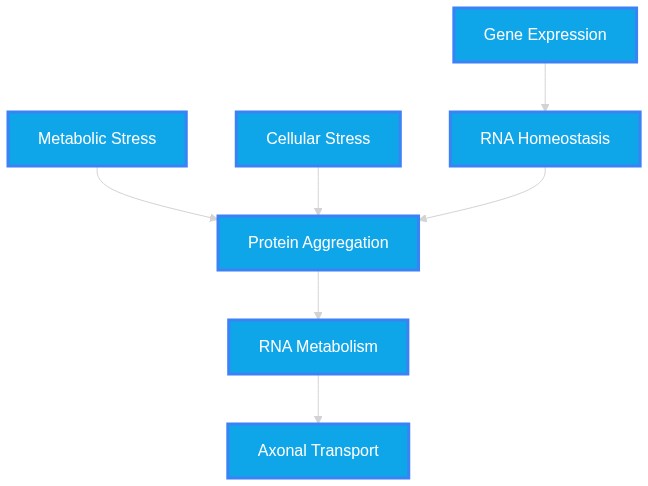
What is the current evidence for RGNEF (ARHGEF28) functioning as a primary upstream regulator of axonal transport and TDP-43 homeostasis in ALS, and how does the failure of this 'terminal tether' initiate the pathological continuum compared to downstream protein aggregation?
Plausibility Verdicts
RGNEF (ARHGEF28) is a crucial dual-function regulator that, upon failing and co-aggregating with TDP-43, disrupts critical RNA homeostasis, significantly driving ALS pathology as a disease modifier.
RGNEF functions as a pro-survival RBP and GEF that co-aggregates with TDP-43, but its status as a single upstream master regulator remains a subject of active research.
Evidence supports a complex pathological loop between RGNEF and TDP-43 rather than a simple linear upstream failure.
Dataset Summary
Novel & Overlooked Insights
- RGNEF functions as a pro-survival factor under stress conditions, potentially masking early signs of pathology until its sequestration into inclusions renders it unavailable.
- The interaction between RGNEF and TDP-43 is mediated by the leucine-rich domain of RGNEF and the RNA recognition motifs of TDP-43.
- RGNEF's inclusion formation is linked to micronuclei formation induced by metabolic stress, offering a spatial mechanism for protein aggregate seeding.
- Rare coding variants of ARHGEF28 (e.g., p.Asn1046Ser) have been identified in sporadic ALS cohorts, suggesting a genetic susceptibility layer beyond sporadic environmental stress.
- RGNEF loss-of-function acts antagonistically to TDP-43-mediated gene regulation, particularly regarding the expression of axon guidance genes.
- RGNEF expression is actively upregulated in spinal motor neurons following injury, suggesting an attempt at endogenous compensatory repair that eventually fails during the disease process.
- RGNEF serves as a bridge between the Rho-family GTPase signaling pathway and RNA metabolism, effectively coupling structural cytoskeletal changes to gene regulation.
- RGNEF's interaction with TDP-43 is not just coincident but includes the formation of inclusions within micronuclei, a novel mechanism of aggregate generation.
- RGNEF expression is not static; it is upregulated in murine spinal motor neurons following distal sciatic nerve injury, suggesting a dynamic compensatory role.
- The interaction between RGNEF and NFL mRNA is highly specific to disease states, appearing in ALS lysates but not in controls.
- RGNEF functions as a pro-survival factor in response to oxidative and osmotic stress via its NH2-terminus domain.
- The "two-hit" mechanism of TDP-43 aggregation, involving RNA depletion or microtubule transport failure, is mirrored by the loss of function in RGNEF.
- Transcriptomic analysis reveals that RGNEF and TDP-43 act antagonistically when regulating the expression of specific axon guidance genes.
- Micronuclei containing RGNEF/TDP-43 inclusions are released into the cytoplasm, suggesting a potential transmission pathway.
- Rare coding variants of ARHGEF28 are enriched in sporadic ALS cases, reinforcing its role as a genetic modifier.
- RGNEF exhibits a unique dual-mode regulation: it acts as a canonical RhoGEF for RhoA activation and as a post-transcriptional regulator of NFL mRNA.
- The interaction between RGNEF and TDP-43 is mediated by specific domains, including the leucine-rich domain for micronuclei localization.
- RGNEF is also implicated in cancer progression, suggesting a conserved mechanism in cellular proliferation and migration (e.g., in rectal and ovarian cancers).
- Evidence suggests that rare, but not common, coding variants of ARHGEF28 are linked to sporadic ALS.
- RGNEF is an effector of Gα13 signaling, linking G-protein-coupled receptors to cytoskeletal remodeling.
- Metabolic stress can induce the formation of micronuclei where RGNEF and TDP-43 co-aggregate before potential cytoplasmic release.
- RGNEF functions as a pro-survival factor under stress conditions, potentially through Staufen1-positive granules.
Extracted Discoveries
- Assess the effect of RGNEF-NF242 expression on TDP-43 cryptic splicing patterns in patient-derived motor neurons.
- Perform proteomics on RGNEF-depleted versus control neuronal cell lines to identify novel mRNA stability targets beyond NEFL.
- Evaluate the impact of acute oxidative stress on the physical interaction between RGNEF and the 3'UTR of candidate axon guidance genes.
- Perform longitudinal transcriptomic analysis in RGNEF-depleted iPSC-derived motor neurons under oxidative stress.
- Evaluate the effect of stabilizing the RGNEF-TDP-43 interaction on the aggregation kinetics of mutant TDP-43 constructs.
- Assess the effect of targeted RGNEF knockdown on TDP-43 localization and RNA-binding capacity in motor neuron cell models under metabolic stress.
- Characterize the specific interaction kinetics between the NF242 fragment of RGNEF and TDP-43 using surface plasmon resonance.
- Longitudinal analysis of ARHGEF28 variant carriers to correlate specific mutations with the rate of cognitive and motor decline.
- Systematic mapping of the interactome of RGNEF inclusions versus soluble RGNEF across disease progression stages.
- Comparative RNA-sequencing of motor neurons in ALS patients with and without ARHGEF28 mutations.
- Clinical correlation study assessing the expression levels of RGNEF and RNA-binding proteins in pre-symptomatic vs symptomatic familial ALS patients.
- Structural biology study of the RGNEF-TDP-43 interface to identify small molecule stabilization targets.
- Systemic longitudinal study of RGNEF expression in pre-symptomatic ALS models to clarify the timing of its sequestration relative to TDP-43 aggregation.
- Large-scale screen for modifiers of RGNEF-TDP-43 co-aggregation using CRISPR-Cas9 in motor neuron cultures.
- KIF21B-mediated microglial surveillance could be compromised by RGNEF inclusion formation, accelerating the spread of proteinopathy.
- KIF21B regulates microglial migration and phagocytosis of neuronal debris (ID: 42423226).
- RGNEF co-aggregates with TDP-43, impairing RNA homeostasis and seeding inclusions (ID: 39360635; ID: 31882736).
- Microtubule network stability and cytoskeletal-dependent degradation pathways.
- RGNEF is known to influence the microtubule network and is essential for RNA homeostasis; impaired RGNEF/TDP-43 dynamics lead to inclusion formation. If RGNEF dysfunction in microglia (which utilize KIF21B for migration to debris) occurs, the clearance of proteinaceous debris and axonal transport of essential RNA stabilizers will fail, exacerbating the spread of neurodegeneration.
- RGNEF-mediated stabilization of long-intron processivity acts as a downstream protective mechanism against stress-induced micronuclei formation in neurodegenerative diseases.
- RGNEF role in RNA homeostasis and stress response (Source ID: 28495450, 39360635)
- TDP-43 protein inclusion formation within micronuclei under metabolic stress (Source ID: 31882736)
- RNA-binding protein network stabilization (specifically involving long-intron removal and RBP co-aggregation).
- Since RGNEF regulates long-intron processivity and is a stress-response protein, its loss-of-function during metabolic stress likely triggers the very micronuclei formation that facilitates TDP-43 aggregation.
- RGNEF sequestration into cytoplasmic aggregates impairs the cellular antioxidant response, thereby increasing susceptibility to oxidative stress-induced neurodegeneration.
- RGNEF/ARHGEF28 role in ovarian cancer protection from reactive oxygen species via NF-kB (Source: 31308489)
- RGNEF co-aggregation with TDP-43 in spinal motor neurons (Source: 39360635)
- RGNEF-NF-kB signaling pathway and oxidative stress response.
- Since RGNEF is essential for facilitating NF-kB-mediated antioxidant gene expression in cancer, its sequestration in ALS inclusions likely results in a functional deficit of this protective response, leaving motor neurons hyper-vulnerable to oxidative stress.
- There is a minor discrepancy regarding whether common/low-frequency variants of ARHGEF28 contribute to sporadic ALS, with some studies suggesting only rare variants are enriched, while biochemical evidence emphasizes the importance of the protein's overall function regardless of specific variant status (ID: 31060816, ID: 24712971).
- No direct contradictions found; rather, evidences demonstrate a complex, multi-modal function of RGNEF that varies by cellular context.
- There is no direct contradiction, but there is a nuance in the hierarchy; some evidence frames RGNEF as a primary regulator of stability, while others frame it as a co-aggregate victim; this tension suggests a bidirectional loss-of-function model.
- The RGNEF N-terminal fragment (NF242) acts as a structural stabilizer or competitor, preventing toxic TDP-43 aggregation; this fragment could be repurposed as a gene therapy vector to mitigate TDP-43 proteinopathy in diverse neurodegenerative disorders (ID: 38739752).
- The use of an N-terminal fragment (NF242) to compete with RNA sequestration for TDP-43 represents a therapeutic avenue for restoring RNA homeostasis in ALS (ID 38739752).
- The use of the N-terminal RGNEF fragment (NF242) has been shown to suppress the toxic phenotype of TDP-43 in models (Source: 38739752). This provides a potential therapeutic avenue for mitigating the proteinopathy.
PathMap is funded by sales of datasets and coversheets to researchers of any kind who wish to discover the most viable routes and paths to accelerate cures. We do not make theoretical molecules, we expose the truth in current PubMed literature. Commission a trace today.
PathMap Scores
How are these metrics evaluated?
Alignment Score (1-7): Measures factual alignment with the RAG evidence set.
[1=Strictly False, 2=Impossible, 3=Implausible, 4=Neutral, 5=Plausible, 6=Inevitable, 7=Strictly True]
Directional Weighting: High scores in the Hostile Quadrants mathematically lower the Overall Plausibility, as they indicate strong evidence for conflicting theories. Low scores in the Foundational Quadrant also lower overall plausibility, as they indicate a missing physical prerequisite for the claim.
AI Overview (Non-Expert Explanation)
Veridicality Audit Report
All Extracted Datapoints
Evaluated Perspectives & Quadrants
Verbatim Quote Audit Console
Mapped Reference Directory (APA)
Abstract Repository (Raw Full-Texts) Show Database
Investigator Profile