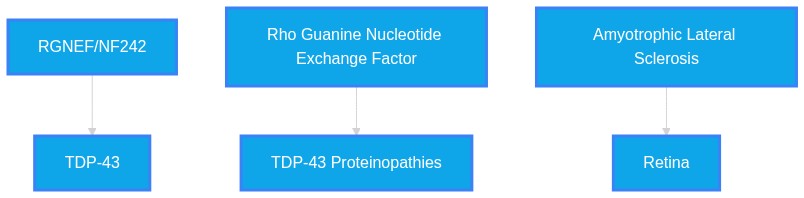
If the RGNEF NF 242 Terminal loses its functional ability to agitate or compete with TDP-43, perhaps from misfolding or sequestration, could it cause the TDP-43 proteinopathy seen in the retina, post-mortem, in Sporadic Amyotrophic Lateral Sclerosis patients, if the RGNEF failures were localized in the retina?
Dataset Summary
Novel & Overlooked Insights
- RGNEF functions as both a guanine exchange factor and an RNA-binding protein, enabling it to modulate neurofilament light chain RNA stability directly.
- RGNEF-TDP-43 co-aggregation is not restricted to motor neurons; it is a shared feature found in spinal motor neurons of both familial and sporadic ALS cases.
- The N-terminal fragment NF242 provides a therapeutic advantage by competing with RNA for binding to TDP-43, thereby preventing neurodegeneration.
- Retinal ganglion cells show increased cleaved caspase-3 and microglia density alongside TDP-43 misplacement in ALS patients, confirming retinal neurodegeneration.
- Micro-RNA downregulation, such as miR-b2122, acts as a common regulatory upstream factor that simultaneously impacts the expression levels of both TDP-43 and RGNEF.
- Metabolic stress induces the formation of micronuclei where TDP-43 and RGNEF co-aggregate, representing a novel mechanism for inclusion formation.
- Specific retinal cells, such as cone bipolar cells, can harbor p62-positive/TDP-43-negative inclusions, revealing distinct cell-type-specific pathological vulnerabilities.
Extracted Discoveries
- Assess the effect of RGNEF-NF242 viral vector injection (AAV9/NF242) on retinal TDP-43 aggregate clearance in hemizygous TDP-43M337V mouse retinas.
- Perform co-immunoprecipitation assays on retinal tissue from sporadic ALS patient autopsies to determine if endogenous NF242 expression is reduced in regions containing TDP-43 inclusions.
- Retinal proteomic profiling comparing ALS patients with high vs. low RGNEF expression to establish the correlation between RGNEF loss and TDP-43 pathology.
- Longitudinal study using OCT and retinal imaging in ALS patients to determine if RGNEF markers correlate with early-stage visual function changes.
- Localized deficiency of NF242 in the retina may serve as a pre-symptomatic biomarker for the formation of toxic TDP-43 aggregates in sporadic ALS.
- RGNEF NF242 therapeutic potential in motor neurons (ID: 38739752).
- Retinal ganglion cell layer pathology and biomarkers in ALS (ID: 37009460).
- RNA-binding protein stability/protective co-aggregation regulation.
- Since NF242 competitively prevents TDP-43 RNA sequestration and retinal neurons mirror CNS proteostatic collapse in ALS, local loss of this 'holdase' activity in the retina would provide a molecular mechanism for the observed localized retinal TDP-43 aggregation.
- There is a slight variation in the interpretation of RNA-binding protein sequestration: ID 32905541 suggests RNA-binding protein sequestration is not the major contributor to C9orf72 toxicity in neurons, whereas ID 22835604 and 38739752 emphasize the central role of RGNEF/TDP-43 RNA-binding mechanics in the pathogenesis of other ALS subtypes.
- Use of the NF242 fragment as an intracellular nanobody/chaperone for gene therapy applications in the eye to prevent retinal TDP-43 aggregation, as it directly competes for binding sites on TDP-43.
PathMap is funded by sales of datasets and coversheets to researchers of any kind who wish to discover the most viable routes and paths to accelerate cures. We do not make theoretical molecules, we expose the truth in current PubMed literature. Commission a trace today.
PathMap Scores
How are these metrics evaluated?
Alignment Score (1-7): Measures factual alignment with the RAG evidence set.
[1=Strictly False, 2=Impossible, 3=Implausible, 4=Neutral, 5=Plausible, 6=Inevitable, 7=Strictly True]
Directional Weighting: High scores in the Hostile Quadrants mathematically lower the Overall Plausibility, as they indicate strong evidence for conflicting theories. Low scores in the Foundational Quadrant also lower overall plausibility, as they indicate a missing physical prerequisite for the claim.
AI Overview (Non-Expert Explanation)
Veridicality Audit Report
All Extracted Datapoints
Evaluated Perspectives & Quadrants
Verbatim Quote Audit Console
Mapped Reference Directory (APA)
Abstract Repository (Raw Full-Texts) Show Database
Investigator Profile