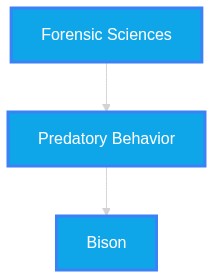
bison attack
Plausibility Verdicts
The forensic classification 'attack' in livestock is a broad category, and while bison are documented in veterinary records, they are typically the victims of disease or environmental factors rather than the primary cause of livestock mortality via 'attack'.
Dataset Summary
Novel & Overlooked Insights
- Bison demonstrate high susceptibility to the 2022-2025 reassortant Oropouche virus (OROV), showing the greatest replication success among eight tested mammalian cell lines.
- Digital dermatitis, associated with *Treponema* spp., has reached a 94.4% prevalence in Swiss European bison populations.
- "Attack" is the most frequent cause of mortality in livestock within the retrospective study of Italian IIZZSS archives, yet this classification aggregates various sources of trauma.
- European bison (Bison bonasus) and American bison (Bison bison) were identified as species experiencing high morbidity during the 2024 Bluetongue virus Serotype 3 outbreak in Belgian zoos.
- A 4-year-old captive European bison was the first documented case of molecular evidence for H1N1pdm influenza infection, highlighting interspecies spillover risks.
- While forest disturbances enhance habitat suitability for large herbivores, such as bison, over the long term, they also facilitate interactions that may increase the risk of disease transmission or wildlife-livestock conflict.
Extracted Discoveries
- Conduct a prospective analysis of livestock trauma to differentiate between inter-species and intra-species aggression.
- Evaluate the transmission dynamics of BTV-3 from wildlife bison to domestic livestock in shared grazing environments.
- A multi-center survey of farm-level biosecurity measures specifically targeting bison-livestock interface pathogens.
- Assessment of forensic database coding improvements to distinguish specific perpetrator species in 'attack' mortality categories.
- Forest disturbance-driven bison migration may increase the prevalence of zoonotic spillover of Influenza A to domestic livestock.
- Forest disturbances increase habitat suitability for bison, leading to larger population dispersal (ID: 42362926).
- Bison act as documented hosts for H1N1pdm influenza, with potential for transmission from domestic animals or humans (ID: 41863702).
- Landscape-level spatial overlap between wild ungulate ranges and livestock-human contact zones.
- Forest disturbance increases the likelihood of bison foraging in proximity to human-managed landscapes, providing the spatial bridge required for cross-species viral exchange.
- None identified; the literature is consistent regarding bison as disease subjects.
- The use of microbiome and parasite monitoring as non-invasive health indicators for rewilded bison can be repurposed to monitor and mitigate potential zoonotic pathogen spread to domestic livestock (ID: 42326879).
PathMap is funded by sales of datasets and coversheets to researchers of any kind who wish to discover the most viable routes and paths to accelerate cures. We do not make theoretical molecules, we expose the truth in current PubMed literature. Commission a trace today.
PathMap Scores
How are these metrics evaluated?
Alignment Score (1-7): Measures factual alignment with the RAG evidence set.
[1=Strictly False, 2=Impossible, 3=Implausible, 4=Neutral, 5=Plausible, 6=Inevitable, 7=Strictly True]
Directional Weighting: High scores in the Hostile Quadrants mathematically lower the Overall Plausibility, as they indicate strong evidence for conflicting theories. Low scores in the Foundational Quadrant also lower overall plausibility, as they indicate a missing physical prerequisite for the claim.
AI Overview (Non-Expert Explanation)
Veridicality Audit Report
All Extracted Datapoints
Evaluated Perspectives & Quadrants
Verbatim Quote Audit Console
Mapped Reference Directory (APA)
Abstract Repository (Raw Full-Texts) Show Database
Investigator Profile