Amyotrophic lateral sclerosis; Biomarkers; Clinical trials; Neuron-derived extracellular vesicles; Neuropathology; Pharmacodynamic biomarkers; Surrogate endpoints; TDP-43
Plausibility Verdicts
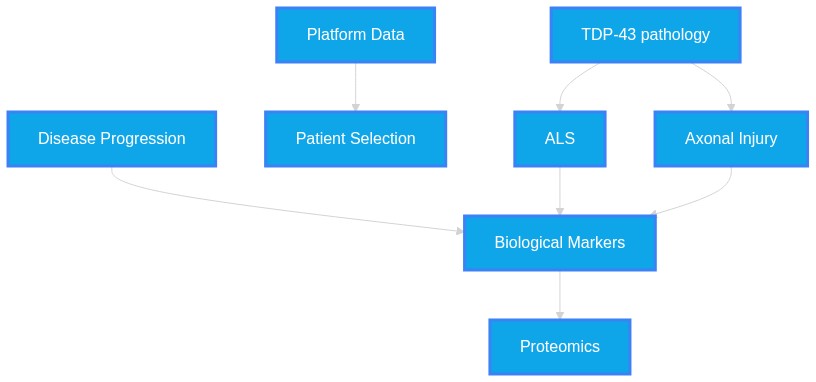
ALS research is shifting towards a precision medicine framework, utilizing TDP-43, neurofilaments, and synaptic proteins as key biomarkers to enhance diagnosis and drug efficacy monitoring.
Integrative use of NDEVs and established markers like NfL/GFAP provides the most robust path for biomarker-driven clinical trials in ALS.
Dataset Summary
Novel & Overlooked Insights
- TDP-43 pathology is not restricted to the CNS but is also found in peripheral tissues such as skeletal muscle and intramuscular nerves.
- Synaptic proteins, such as Neurogranin and VAMP2, provide distinct information regarding synaptic dysfunction that does not necessarily correlate with neurofilament-based markers of axonal damage.
- Annexin A11 co-aggregates with TDP-43, supporting the concept of a pathogenic continuum linking frontotemporal lobar degeneration and ALS.
- Glymphatic dysfunction, measurable via MRI metrics like the ALPS index and choroid plexus volume, represents a common pathological pathway in ALS that may be independent of chronological age.
- Truncated NEK1 mutants interfere with ribosomal RNA metabolism, revealing a gain-of-function mechanism in ALS pathogenesis.
- Lipid dysregulation, particularly involving cholesterol handling in astrocytes, is an early driver of neurodegeneration that precedes overt neuronal loss.
- Microglial TDP-43 is essential for myelin refinement, and its loss leads to cryptic exon inclusion in *Tyrobp* mRNA, disrupting TREM2 signaling.
- Plasma proteomic analysis has identified IGFBP2 and ADIPOQ as markers of metabolic dysregulation shared across multiple neurodegenerative diseases.
- Nonlinear combinations of blood transcriptomes (e.g., *PRKAR1A, QPCT, TMEM71*) can distinguish ALS from healthy controls with high diagnostic accuracy.
- Exosomal HERV-K transcripts are significantly elevated in ALS patients, offering potential for tracking endogenous retroviral activity.
- Transcriptomic PBMC signatures, including genes like *Mctp1* and *Penk*, provide high diagnostic accuracy (AUC 0.87-1.00) mirroring central pathology.
- NfL prognostic value is robust, with pooled HRs for survival ranging from 2.8 to 4.3.
- Brain-derived EVs (BDEVs) from patients with early-stage disease may capture neuronal status more accurately than peripheral blood measures.
- Targeting the NAD+-PARP1-XRCC1 axis is an emerging therapeutic priority, with potential for poly(ADP-ribose) and NAD+ metabolites to serve as pharmacodynamic markers.
- Machine learning models using transcriptomic data have demonstrated classification accuracies exceeding 97% for ALS versus controls.
- TDP-43 seeding activity and mislocalization remain critical research targets for diagnostics, despite existing technical hurdles in assay standardization.
- NDEVs cross the blood-brain barrier, providing a direct systemic readout of brain-specific molecular pathology.
- TDP-43 pathology is not confined to the CNS but is detectable in peripheral tissues, including skeletal muscle.
- ROCK inhibition (using fasudil) serves as a successful proof-of-concept for target engagement demonstrated via CSF and plasma NDEV analysis.
- DICER activation via enoxacin has been demonstrated to modulate cell-free miRNA levels, providing a pharmacodynamic readout for ALS trials.
- GFAP levels provide a distinct, complementary biomarker to Neurofilament light (NfL), specifically reflecting astrocytic activation in addition to neuroaxonal injury.
- Sex-based neuroinflammatory dimorphism (e.g., higher GFAP/IL-6 in males) is a significant variable for patient stratification in trials.
- Proximity-based assays (NULISA) allow for multiplexed interrogation of serum proteins, potentially enhancing diagnostic sensitivity beyond traditional assays.
Extracted Discoveries
- Longitudinal assessment of synaptic proteins in combination with NfL to determine if dual-biomarker profiles improve prognosis prediction.
- Validation of the identified PRKAR1A-QPCT-TMEM71 transcriptomic signature in diverse global cohorts to ensure cross-population robustness.
- Functional studies of NEK1 truncated mutants in human-derived iPSC motor neurons to screen for small-molecule inhibitors of nuclear translocation.
- Cross-validation of GPNMB in sporadic ALS cohorts using automated immunoassay platforms.
- Multiplexed proteomic profiling of NDEVs in longitudinal clinical trials assessing therapeutic response.
- Validation of the PBMC gene-miRNA signature (Mctp1, Penk, etc.) in multi-ethnic populations.
- Longitudinal correlation of NDEV-TDP-43 cargo with NfL decline in Phase 2 clinical trials.
- Multiplexed proteomic profiling of NDEVs to determine if patient-specific resistance to therapeutic intervention can be predicted.
- Large-scale prospective clinical trial comparing the performance of exosomal HERV-K and TDP-43 species against standard MRI metrics in disease staging.
- Multi-center validation study of the GFAP/NfL ratio as a fluid-based marker for distinguishing between different ALS clinical phenotypes (e.g., bulbar vs. spinal onset).
- Long-term longitudinal follow-up study of patients participating in RCTs using the TALS GNHS framework to establish definitive surrogate endpoint correlations with motor function.
- Prospective longitudinal study on exosomal HERV-K levels in patients treated with antiretroviral therapies.
- Comparative analysis of NDEV protein versus total plasma protein cargo regarding disease staging.
- Multicenter prospective study assessing the diagnostic sensitivity of a combinatorial panel (TDP-43/NfL/GFAP/miRNAs) in early-stage sALS.
- Clinical utility study of NDEV-based target engagement markers in antisense oligonucleotide (ASO) therapy.
- Discovered Hypothesis (A to C): Ribosomal stress mediated by truncated NEK1 mutants contributes to the failure of microglial myelin maintenance in ALS.
Literature A (Origin): NEK1-associated nucleolar stress (ID: 42443201).
Literature C (Target): Microglial TDP-43 and myelin refinement (ID: 42420559).
The Intersecting Bridge B: Ribosomal RNA regulation / nucleolar stress.
Biological Rationale: Truncated NEK1 mutants cause nucleolar stress and impede ribosomal RNA biogenesis; microglia are highly sensitive to ribosome-related protein homeostasis and require efficient translation to maintain their myelin-degrading and remodeling capacity. - Inhibition of the cGAS-STING pathway may counteract the neuroinflammatory progression triggered by HERV-K activation in ALS patients.
- HERV-K activation in ALS (ID: 42436372)
- cGAS-STING signaling in neurodegeneration (ID: 42092970)
- Cytosolic DNA-sensing and innate immune activation (DNA-stress triggers)
- HERV-K reactivation produces nucleic acids that serve as potential ligands for the cGAS-STING pathway; suppressing this pathway could dampen the secondary microglial inflammatory loop.
- FMRP levels in CSF-derived extracellular vesicles could serve as a non-invasive prognostic biomarker for proteasome-dysfunction-linked disease severity in sporadic ALS.
- FMRP modulates proteasome activity and is elevated in transgenic mouse models (ID: 42363684)
- Neuron-derived EVs capture CNS-specific pathological protein content and cargo reservoirs (ID: 40325332)
- Extracellular vesicles as a transport mechanism for brain-specific protein chaperones/regulators.
- Since FMRP regulates TDP-43 aggregation via proteasome modulation and EV content directly reflects CNS protein composition, NDEV-FMRP should correlate with the severity of TDP-43 proteinopathy.
- There is conflicting evidence regarding the clinical relevance of lipid (cholesterol) levels in ALS; some cohorts show positive associations with survival, which lose significance after adjustment for BMI and nutritional status (ID: 42405014).
- There is disagreement regarding the utility of plasma sTREM2 as a diagnostic biomarker (some indicate elevation, others highlight lack of clinical relevance), and findings on TDP-43 as a fluid biomarker are inconsistent across studies.
- There is disagreement regarding the utility of plasma TDP-43 as a biomarker: while some indicate it is elevated in biofluids, others note it has not been demonstrated to be consistently altered or that methodological variability precludes standalone use (ID: 42383305, 40832743).
- The repurposing of antioxidant natural products like Fisetin or Resveratrol as adjunctive therapy to mitigate oxidative stress and improve TDP-43 mislocalization (ID: 42431519, 42400730).
- Repurposing PARP1 inhibitors combined with NAD+ support to address the DNA damage and metabolic collapse inherent in ALS pathology.
- The repurposing of ROCK inhibitors (Fasudil) as an ALS treatment, monitored specifically by the pAKT/tAKT ratio in neuron-derived extracellular vesicles (ID: 42372734), illustrates the utility of integrating pharmacodynamic markers into trial monitoring.
PathMap is funded by sales of datasets and coversheets to researchers of any kind who wish to discover the most viable routes and paths to accelerate cures. We do not make theoretical molecules, we expose the truth in current PubMed literature. Commission a trace today.
PathMap Scores
How are these metrics evaluated?
Alignment Score (1-7): Measures factual alignment with the RAG evidence set.
[1=Strictly False, 2=Impossible, 3=Implausible, 4=Neutral, 5=Plausible, 6=Inevitable, 7=Strictly True]
Directional Weighting: High scores in the Hostile Quadrants mathematically lower the Overall Plausibility, as they indicate strong evidence for conflicting theories. Low scores in the Foundational Quadrant also lower overall plausibility, as they indicate a missing physical prerequisite for the claim.
AI Overview (Non-Expert Explanation)
Veridicality Audit Report
All Extracted Datapoints
Evaluated Perspectives & Quadrants
Verbatim Quote Audit Console
Mapped Reference Directory (APA)
Abstract Repository (Raw Full-Texts) Show Database
Investigator Profile