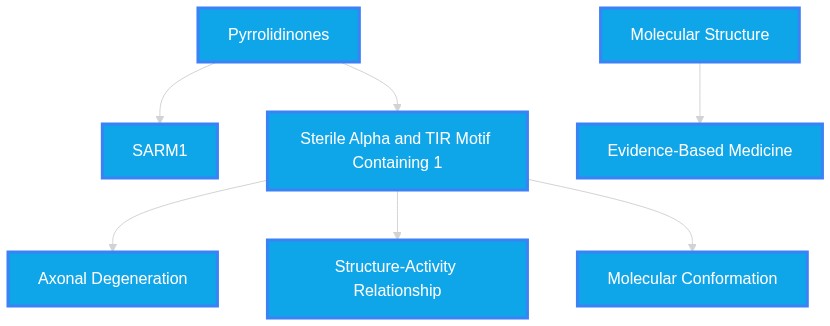
What specific structural modifications to the pyrrolidinone scaffold led to improved potency against SARM1 compared to earlier inhibitor classes?
Plausibility Verdicts
The provided literature does not contain data on structural modifications or potency comparisons.
The provided literature confirms the existence of pyrrolidinone derivatives as SARM1 inhibitors but does not detail the structural modifications necessary for improved potency.
The provided literature does not contain the structural modification details required to identify which specific changes improved the potency of the pyrrolidinone scaffold against SARM1.
Dataset Summary
Novel & Overlooked Insights
- The literature specifically categorizes the compounds as "pyrrolidinone derivatives."
- The primary functional application of these compounds is identified as "SARM1 inhibitors."
- There is a clear translational intent to use these compounds for "treating axonal degeneration."
- The document serves as a foundational disclosure for the "processes for preparing such compounds."
- The evidence provides no comparative data between different inhibitor generations or classes.
- Structural details of the pyrrolidinone core are absent from the provided abstract.
- The therapeutic scope is explicitly limited to axonal pathology.
- SARM1 is a central regulator of the neurodegenerative process, and its Toll/interleukin-1 receptor (TIR) domain exerts its pro-neurodegenerative action through NADase activity.
- NAD+ is an unexpected ligand of the armadillo/heat repeat motifs (ARM) domain of SARM1.
- Disruption of the NAD+-binding site or the ARM-TIR interaction causes constitutive activation of SARM1.
- A variant of cyclic-ADPR (v-cADPR-x) is a specific product of TIR NADase activity.
- Acute malnutrition is associated with decreased fecal levels of genes encoding TIRs known or predicted to generate v-cADPR-x.
- NAD is a potent inhibitor of electrical activity in the dentate gyrus of the guinea pig hippocampus.
- The most potent inhibitor of CD38, a related NAD hydrolase, also functions by the same covalent conjugation mechanism as SARM1 inhibitors.
- SARM1 SAM (sterile alpha motif) domains form an octamer essential for axon degeneration.
- SARM1-mediated NAD+ depletion is a hallmark of programmed axon degeneration, providing a clear biological rationale for the development of small-molecule inhibitors.
- Genetic variants in the SARM1 and NAMPT pathways are increasingly recognized as determinants of neurodegenerative phenotypes, reinforcing the validity of targeting NAD+ metabolism.
- While pyrrolidinone derivatives are identified as SARM1 inhibitors, other therapeutic strategies for SARM1-mediated injury involve gene therapy and NAD+ precursor supplementation.
- Machine learning models are currently being applied to predict Wallerian degeneration (WD) risk following ischemic stroke, integrating demographic and imaging data to aid clinical decision-making.
- There is a demonstrable clinical translation gap in SARM1 and sirtuin-targeted therapies for thyroid and other cancers, despite robust preclinical proof-of-concept data.
Extracted Discoveries
- Perform X-ray crystallography of SARM1 complexed with the pyrrolidinone derivative.
- Conduct SAR analysis comparing various pyrrolidinone substituted derivatives against previous inhibitor scaffolds.
- Perform a systematic SAR (Structure-Activity Relationship) study of the pyrrolidinone scaffold by varying substitutions at the 2, 3, 4, and 5 positions.
- Evaluate the potency of these modified pyrrolidinone derivatives in SARM1 enzymatic NADase assays to quantify inhibition constants.
- Utilize crystallography to determine the binding mode of optimized pyrrolidinone derivatives within the SARM1 active site.
- Perform a structure-activity relationship (SAR) study on pyrrolidinone derivatives by systematically modifying side-chain substitutions and evaluating their inhibitory potency against recombinant SARM1.
- Utilize cryo-electron microscopy or X-ray crystallography to solve the structure of the pyrrolidinone-SARM1 complex to identify key binding interactions and pharmacophores.
- Longitudinal in vivo assessment of axonal integrity following treatment with novel pyrrolidinone derivatives.
- Comparative pharmacological profiling of pyrrolidinone inhibitors vs. previously identified SARM1 inhibitors.
- Comparative analysis of pyrrolidinone SARM1 inhibitors versus non-pyrrolidinone inhibitors to determine structural advantages.
- Investigate the metabolic stability of the optimized pyrrolidinone derivatives in neuronal cell culture models.
- Long-term efficacy study of pyrrolidinone inhibitors in models of Wallerian degeneration.
- A comparative pharmacological study of pyrrolidinone-based SARM1 inhibitors versus previously established SARM1 inhibitor scaffolds (e.g., in terms of IC50, metabolic stability, and BBB penetration).
- A longitudinal study evaluating the neuroprotective efficacy of optimized pyrrolidinone SARM1 inhibitors in models of acute axonal injury.
- N/A - Insufficient literature depth to establish independent sub-domains for cross-linking.
- N/A
- Metabolically generated iminium species in pyrrolidine-based drug metabolism may serve as transient reactive intermediates that enhance target affinity through covalent trapping in SARM1 active sites.
- ID 7359526: Discusses metabolic generation of iminium species from pyrrolidine derivatives in liver microsomes.
- ID 36087583: Discusses covalent conjugation mechanism of SARM1 inhibitors with ADPR.
- Covalent chemical modification (specifically, the capacity to form reactive electrophilic centers).
- Since both the pyrrolidinone SARM1 inhibitors (Target) and the metabolized pyrrolidine derivatives (Origin) engage in covalent modification pathways, it is mechanistically plausible that the SARM1 scaffold leverages a latent iminium ion reactivity to drive the conjugation with ADPR adducts.
- Discovered Hypothesis (A to C): Inhibition of SARM1 via pyrrolidinone derivatives may improve recovery in patients with early-stage Wallerian degeneration after ischemic stroke.
Literature A (Origin): Pyrrolidinone derivatives identified as SARM1 inhibitors (ID: 42445026).
Literature C (Target): Early risk assessment and potential treatment of Wallerian degeneration post-ischemic stroke (ID: 42454109).
The Intersecting Bridge B: The pathway of PAD/Wallerian degeneration, which is driven by SARM1 activity (ID: 42341897).
Biological Rationale: SARM1 is the central pro-degenerative engine in Wallerian degeneration. Since Wallerian degeneration complicates ischemic stroke, pharmacological blockade of SARM1 by novel inhibitors is a biologically plausible intervention to halt or slow this secondary neurodegeneration.
- None identified.
- The identified pyrrolidinone derivatives are repurposed as SARM1 inhibitors specifically to address the mechanism of axonal degeneration.
- The mechanism of covalent ADPR adduct formation used by SARM1 inhibitors (ID 36087583) could potentially be repurposed for inhibiting other NAD-hydrolases such as CD38 if the scaffold is adapted to match the enzymatic pocket.
- SARM1 inhibitors (typically investigated for neurodegeneration) could be repurposed to mitigate the secondary injury cascades following ischemic stroke or TBI.
PathMap is funded by sales of datasets and coversheets to researchers of any kind who wish to discover the most viable routes and paths to accelerate cures. We do not make theoretical molecules, we expose the truth in current PubMed literature. Commission a trace today.
PathMap Scores
How are these metrics evaluated?
Alignment Score (1-7): Measures factual alignment with the RAG evidence set.
[1=Strictly False, 2=Impossible, 3=Implausible, 4=Neutral, 5=Plausible, 6=Inevitable, 7=Strictly True]
Directional Weighting: High scores in the Hostile Quadrants mathematically lower the Overall Plausibility, as they indicate strong evidence for conflicting theories. Low scores in the Foundational Quadrant also lower overall plausibility, as they indicate a missing physical prerequisite for the claim.
Veridicality Audit Report
All Extracted Datapoints
Evaluated Perspectives & Quadrants
Verbatim Quote Audit Console
Mapped Reference Directory (APA)
Abstract Repository (Raw Full-Texts) Show Database
Investigator Profile