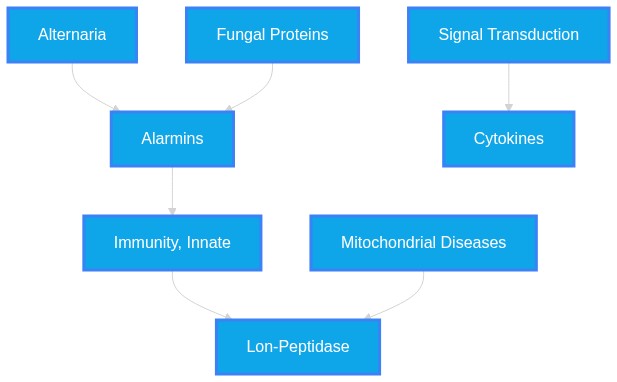
Lon Protease, Alternaria; IL-33; TSLP; alarmins; asthma; chronic rhinosinusitis; fungal allergen; innate lymphoid cells
Plausibility Verdicts
Fungal allergens trigger alarmin release, activating ILC2s, a process modulated by SLPI and mitochondrial metabolic checkpoints like LONP1.
Fungal allergens stimulate epithelial release of alarmins like IL-33 and TSLP, which activate ILC2s; LONP1 modulates the underlying mitochondrial fitness necessary to sustain these inflammatory responses.
Lon protease serves as a protective checkpoint against mitochondrial stress; its failure exacerbates pro-inflammatory signals like IL-33 and TSLP that drive ILC2-mediated asthma.
Dataset Summary
Novel & Overlooked Insights
- Alternaria-induced ILC2 activation is not merely a consequence of alarmin signaling but is subject to mechanical checkpoints like Piezo1.
- LONP1 acts as a potential immunometabolic checkpoint, where mitochondrial protein quality control directly impacts the inflammatory trajectory of the airway epithelium.
- The severity of Alternaria-driven responses is modulated by SLPI, which serves as a molecular brake on the protease-mediated activation of IL-33.
- ILC2s exhibit significant phenotypic plasticity, particularly when transitioning toward ILC3-like or steroid-resistant states.
- The cross-talk between eosinophils and epithelial cells is bi-directional and foundational to tissue-resident remodeling in chronic rhinosinusitis.
- Mitochondrial dysfunction (driven by LONP1/Drp1) is an upstream contributor to the cytokine/chemokine environment of the asthma/CRSwNP mucosa.
- Fungal allergens can initiate a "two-hit" inflammatory model where live spore exposure exacerbates pre-existing, OVA-primed airway damage.
- LONP1 serves as a dual-function gatekeeper, maintaining mitochondrial DNA integrity while modulating inflammatory cell polarization in response to oxidative stress.
- The "residual molecular scar" phenomenon explains why some patients with ECRS exhibit persistent mucus hyperviscosity even after successful biological blockade of IL-4/IL-13.
- ILC2s are not merely passive responders; they exhibit subset heterogeneity (migratory, transitional, inflammatory, exhausted) that correlates with clinical severity in nasal polyps.
- Treg/Th2 imbalance in severe asthma is reversible, as shown by benralizumab therapy restoring immune homeostasis and modifying adhesion molecule expression.
- The gut-lung axis utilizes tryptophan metabolism to reprogram ILC2s, potentially allowing microbiome-derived postbiotics to serve as non-live therapeutic alternatives.
- Fungal *Alternaria* allergens act not only as biochemical triggers for alarmins but also cause physical and oxidative damage that necessitates mitochondrial quality control.
- Mitochondrial proteases (LonP1) serve as an immunometabolic checkpoint, where their dysfunction directly links mitochondrial DNA release to chronic inflammation via the cGAS-STING axis.
- The IL-22BP decoy receptor has been shown to play a paradoxical role; while IL-22 is typically protective, "These findings suggest that inhibition of IL-22BP attenuates the development of allergen-induced AHR, an effect likely mediated through enhanced IL-22 activity rather than alterations in airway inflammation or type 2 cytokine production."
- Biologics targeting TSLP, such as tezepelumab, are effective across diverse asthma endotypes, emphasizing the hierarchy of alarmins as "source-directed" intervention targets.
- The metabolic state of ILC2s (glycolysis, lipid metabolism) is an emerging regulator of their plasticity, suggesting that metabolic modulation (e.g., via serotonin catabolism or MAOA inhibition) can alter immune responsiveness.
- Epigenetic memory, established through DNA methylation and histone modifications in basal epithelial progenitors, explains why asthma is often a relapsing, chronic condition rather than a simple acute response to fungal allergens.
Extracted Discoveries
- Investigate the impact of LONP1 knockdown in human primary ILC2s on their susceptibility to IL-33/TSLP-induced activation.
- Assess whether SLPI administration in a humanized mouse model of Alternaria-induced asthma modulates the mitochondrial stress signatures in airway epithelium.
- Examine if Piezo1 pharmacological inhibition alters the proteomic landscape of ILC2s during Alternaria exposure.
- Test the impact of LONP1 knockdown in primary human bronchial epithelial cells on the secretion of IL-33/TSLP upon Alternaria challenge.
- Evaluate whether iron chelation therapy provides synergistic benefits with current anti-TSLP (tezepelumab) therapy in suppressing ILC2 activation.
- Assess whether LonP1 overexpression in airway epithelial cells reduces IL-33 and TSLP release following Alternaria exposure.
- Determine if pharmacological activators of LonP1 decrease NLRP3 inflammasome activation in ILC2-asthma models.
- Investigate if MAOA inhibition alters the metabolic threshold required for ILC2 activation in patients with fungal-sensitized asthma.
- A longitudinal clinical trial monitoring LONP1 levels in nasal brushings from CRSwNP patients as a biomarker of corticosteroid response.
- A multi-omic mapping of the ILC2 metabolic landscape in patients with recalcitrant asthma stratified by SLPI deficiency.
- A prospective multi-omics study tracking mitochondrial protease profiles (LONP1/CLPXP) in nasal polyp tissues of CRSwNP patients treated with tezepelumab.
- A longitudinal study correlating patient plasma mtDNA levels (a byproduct of mitochondrial stress) with disease activity in eosinophilic asthma.
- Longitudinal analysis of LonP1 expression in bronchial biopsies from patients with severe refractory asthma versus healthy controls.
- Prospective cohort study correlating circulating mitochondrial DNA levels with asthma exacerbation frequency and alarmin serum levels.
- Discovered Hypothesis (A to C): LONP1-mediated mitochondrial stress modulation is required for the maintenance of ILC2 metabolic fitness under chronic allergen challenge. - Literature A (Origin): LONP1 regulates mitochondrial quality and stress adaptation in systemic organ injury (42302976). - Literature C (Target): ILC2 effector function is highly dependent on glycolytic and mitochondrial metabolic pathways to maintain type 2 inflammatory output (41960844; 42381636). - The Intersecting Bridge B: Mitochondrial oxidative stress (ROS) and metabolic reprogramming. - Biological Rationale: LONP1 is known to stabilize metabolic enzymes and manage oxidative stress; if this protease is lost in activated ILC2s, the resultant mitochondrial dysfunction would likely compromise the cells' ability to maintain prolonged cytokine secretion and exacerbate their inflammatory profile.
- LONP1 upregulation in airway epithelial cells may represent a compensatory mechanism to limit chronic ILC2-driven airway inflammation by preventing mtDNA-driven cGAS-STING signaling.
- LONP1 dysfunction and its role in suppressing inflammation via mtDNA quality control (ID: 42302976, ID: 42413666).
- ILC2-driven allergic airway inflammation and the role of epithelial alarmins in disease persistence (ID: 42421946, ID: 424253476).
- mtDNA release and cGAS-STING-mediated inflammatory signaling.
- The literature links LONP1 dysfunction to mtDNA-driven cGAS-STING inflammation. Since epithelial damage in asthma releases IL-33, enhancing LONP1-mediated mtDNA degradation could reduce the secondary inflammatory threshold, preventing the chronicity of the ILC2-Th2 axis.
- Discovered Hypothesis (A to C): LonP1-mediated protection of the airway epithelial barrier limits the release of alarmins and subsequent ILC2-driven airway hyperreactivity in fungal-sensitized asthma. - Literature A (Origin): Mitochondrial protease LonP1 manages mtDNA release and prevents inflammatory cell death (ID: 42393712). - Literature C (Target): Airway epithelial alarmins IL-33/TSLP drive ILC2-mediated asthma pathogenesis (ID: 42189350). - The Intersecting Bridge B: Mitochondrial stress (ROS and mtDNA release) as a common trigger for both apoptosis/inflammation pathways. - Biological Rationale: Given that fungal proteases induce oxidative stress in epithelial cells, the upregulation of LonP1 is necessary to stabilize the mitochondrial genome and prevent the leak of mtDNA which serves as a potent DAMP for amplifying the alarmin-mediated inflammatory loop.
- There is a subtle tension between studies highlighting the 'pathogenic' vs 'protective' roles of ILC2-derived factors in bone regeneration versus lung inflammation; the inflammatory environment modulates the function of these cells context-dependently.
- There is no direct contradiction, but evidence on LONP1 suggests it acts as a context-dependent regulator—potentially pro-inflammatory or anti-inflammatory depending on the specific mitochondrial state, which may explain variable treatment responses observed in severe airway disease endotypes.
- None identified in the primary literature provided.
- SLPI could be repurposed as a therapeutic adjunct to neutralize protease-dependent alarmin release in recalcitrant CRSwNP, moving beyond traditional anti-cytokine biologics.
- Iron chelators and mitochondrial protease modulators (pharmacological activators of LONP1) could be repurposed as adjuvant therapies for steroid-resistant, eosinophilic airway inflammatory conditions, as they address the metabolic/mitochondrial triggers upstream of the alarmin-driven cytokine cascade.
- The use of serotonin-modifying therapies (SSRIs) may be repurposed as adjunctive immunomodulators to suppress Tc2 and ILC2 function, as they have been associated with reduced IgE sensitization and altered lymphocyte inflammatory phenotypes.
PathMap is funded by sales of datasets and coversheets to researchers of any kind who wish to discover the most viable routes and paths to accelerate cures. We do not make theoretical molecules, we expose the truth in current PubMed literature. Commission a trace today.
PathMap Scores
How are these metrics evaluated?
Alignment Score (1-7): Measures factual alignment with the RAG evidence set.
[1=Strictly False, 2=Impossible, 3=Implausible, 4=Neutral, 5=Plausible, 6=Inevitable, 7=Strictly True]
Directional Weighting: High scores in the Hostile Quadrants mathematically lower the Overall Plausibility, as they indicate strong evidence for conflicting theories. Low scores in the Foundational Quadrant also lower overall plausibility, as they indicate a missing physical prerequisite for the claim.
Veridicality Audit Report
All Extracted Datapoints
Evaluated Perspectives & Quadrants
Verbatim Quote Audit Console
Mapped Reference Directory (APA)
Abstract Repository (Raw Full-Texts) Show Database
Investigator Profile