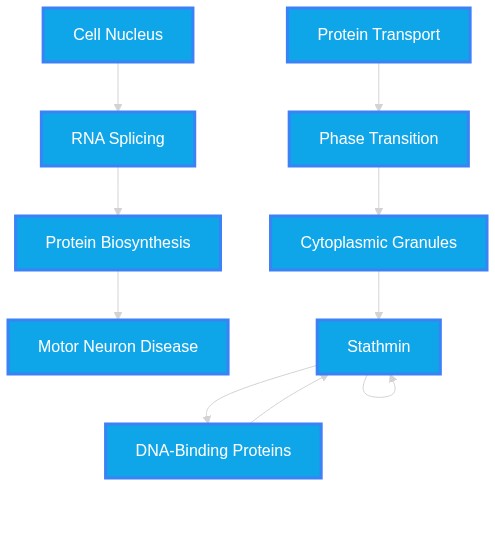
ALS; FUS; STMN2; TDP-43; protein translation; stress granule
Plausibility Verdicts
Yes, FUS, STMN2, TDP-43, and stress granule dynamics are mechanistically linked in ALS pathology, where RBP loss leads to splicing and translational defects.
STMN2 is a central hub in ALS pathogenesis, functionally linked to TDP-43-dependent splicing and translational control, whereas FUS mutations independently modulate stress granule kinetics, creating a convergent toxic environment.
Dataset Summary
Novel & Overlooked Insights
- TDP-43 and FUS pathology can independently disrupt the same key downstream survival targets (e.g., STMN2).
- Stress granules were initially thought to be the cause of TDP-43 aggregation, but evidence now suggests they can occur independently in vivo.
- Translation inhibition in axons is a localized defect directly exacerbated by FUS mutations.
- STMN2 protein levels are highly sensitive to chronic, low-grade translation stress, providing a target for neuroprotection.
- The "Molecular Zipper" hypothesis provides a structural mechanism for how TDP-43 transitions from soluble dimers to pathological monomers.
- A "cross-seeding" barrier exists between TAF15 and FUS, yet partial incorporation occurs during aggregation, suggesting complex co-pathology.
- Ribosomal protein RPS29 is a potential quality controller for STMN2 translation.
- RNA-based therapeutics (snRNAs/U7) demonstrate that it is possible to correct splicing without necessarily requiring the restoration of the mislocalized protein.
- STMN2 depletion occurs through two parallel pathways: TDP-43-mediated splicing loss and direct translational repression in stress granules.
- HSP70 and DNAJB1 act as critical chaperone components within stress granules, where "In vitro, HSP70 and DNAJB1 partition into G3BP1 condensates and reduce their size in an ATP-dependent manner."
- RNA G-quadruplexes serve as tunable switches for FUS phase separation, demonstrating that RNA structure itself dictates the transition to toxicity.
- The C-terminal domain of TDP-43 is identified as the primary driver of both liquid-liquid phase separation and pathological amyloid conversion.
- Nuclear export modulation can effectively mitigate the formation of cytoplasmic TDP-43 aggregates, representing a viable, underutilized target.
- ALS patients exhibit a sex-dependent neuroinflammatory profile, with male patients showing higher GFAP, IL-6, and IL-18 levels.
- Sorbic acid, a food preservative, induces translational repression in yeast models through eIF2α phosphorylation and stress granule formation, mirroring stress responses in human neurons.
- STMN2 is susceptible to translational suppression by stress granules independently of TDP-43 function.
- TDP-43 nuclear condensation is a non-liquid state that inactivates splicing function.
- Stress granule disassembly is energy-dependent and mediated by a competitive resource pool of chaperones.
- RPS29 serves as a translational gatekeeper that, when downregulated, limits STMN2 protein levels.
- ALS-linked FUS mutations differentially activate the integrated stress response depending on the specific NLS mutation site.
- The interaction between STMN2 loss and TDP-43 dysfunction is specific to human biology, as murine models do not replicate the same splicing landscape.
- CHMP7 nuclear entry is an early indicator of nucleoporin damage driven by SMN complex dysregulation.
- Annexin A11 co-aggregates with TDP-43, forming heteromeric filaments in FTLD-TDP type C.
- S-acylation of TDP-43 at Cys244 is necessary to maintain its liquid-like properties and solubility.
Extracted Discoveries
- Quantify STMN2 protein recovery in vivo using AAV-delivered U7 snRNAs in FUS-ALS mouse models to test cross-protein therapeutic efficacy.
- Perform single-molecule imaging of translation machinery in motor axons under chronic low-grade stress to validate the sensitivity of STMN2.
- Investigate the specific threshold concentration of cytoplasmic TDP-43 required to trigger the transition from stress granule sequestration to irreversible solid aggregate formation.
- Examine if pharmacological inhibition of SGK1, which regulates microglial phagocytosis, can simultaneously alter the recruitment of FUS into pathological aggregates in motor neurons.
- Determine the efficacy of combined ASO targeting of cryptic exons and pharmacological stabilization of the mevalonate pathway on preserving axonal integrity in hiPSC-derived spinal neurons.
- Assess if FUS-induced stress granule persistence directly hinders the nucleocytoplasmic transport of TDP-43, independent of existing aggregation markers.
- Utilize CRISPR-based STMN2 modulation to determine if sustained STMN2 levels can override the translational toxicity induced by FUSP525L in motor neurons.
- Longitudinal analysis of STMN2 cryptic exon levels as a biomarker for disease progression in presymptomatic gene carriers.
- Comparative study of stress granule disassembly kinetics across different ALS genetic subtypes (C9orf72 vs FUS vs TDP-43 mutants).
- A longitudinal clinical study comparing the anticholinergic burden of ALS patients with their rate of STMN2 protein decline measured in peripheral biofluids.
- Comprehensive comparative study of the inflammatory cytokine profiles (IL-6, IL-18) in male versus female ALS patients across multiple ethnic cohorts.
- Functional screening of small molecules that modulate the nuclear export of TDP-43 to validate therapeutic rescue of nuclear homeostasis.
- Cross-comparative transcriptomic analysis of ALS patient cohorts stratified by FUS mutations vs TDP-43 loss to identify shared translational target nodes.
- Longitudinal study of chaperone resource exhaustion in models containing both C9orf72-DPRs and FUS aggregation.
- Spermidine-mediated Eif5a hypusination may rescue translational efficiency in STMN2-depleted neurons resulting from TDP-43 pathology.
- ID: 41430470 (Axonal Eif5a hypusination mitigation of defects in FUS-ALS)
- ID: 41573891 (snRNA therapy for STMN2 splicing)
- Eif5a hypusination and translation maintenance.
- Since STMN2 is translationally suppressed by chronic stress and TDP-43 loss, restoring translation factor activity (Eif5a) provides a secondary node for maintaining STMN2 levels, complementary to primary splicing correction.
- Sorbic acid-mediated induction of stress granules and translation repression could be used as a probe to identify neurons with lower thresholds for STMN2 depletion.
- Sorbic acid induces translational repression and eIF2a phosphorylation (Source: 42394718)
- STMN2 depletion is a hallmark of ALS/TDP-43 proteinopathy (Source: 42343570)
- Stress granule (SG) assembly and translational repression
- Since STMN2 is highly sensitive to translational repression within stress granules (SG), exogenous SG induction using metabolic stressors like sorbic acid could reveal inherent vulnerability of specific motor neuron subtypes to proteinopathy.
- Discovered Hypothesis (A to C): Ribosome-Associated Quality Control (RQC) mechanisms are a critical buffering system against FUS-driven translational toxic stress in ALS.
Literature A (Origin): IRE1 regulates TDP-43 proteostasis via RQC factors (Source: 42341041).
Literature C (Target): FUS mutations drive larger stress granule formation and ISR activation (Source: 41656808).
The Intersecting Bridge B: Ribosome-associated quality control (RQC) pathway components (e.g., NEMF).
Biological Rationale: Since both TDP-43 and FUS aggregates impact translational fidelity and stress granule components, RQC likely functions as a general maintenance system that, if compromised, converts FUS-mediated translational stalling into irreversible aggregation.
- Evidence regarding the necessity of stress granules for TDP-43 pathology: ID: 41727136 indicates TDP-43 pathology occurs independently of stress granules in vivo, while ID: 41292721 and ID: 42359165 suggest a more central role for SG dynamics in protein aggregation.
- There is a minor ambiguity regarding the role of HDAC6: some evidence suggests it is neuroprotective by facilitating autophagic clearance (via aggresomes), while other evidence suggests its inhibition is therapeutic for reducing aggregation (ID: 42261159).
- There is a minor dispute regarding the necessity of stress granules in TDP-43 pathology. Some earlier models assumed SG-dependency, while ID: 41727136 provides evidence that TDP-43 nuclear clearance can occur independently of stress granules in vivo.
- Statins (mevalonate pathway inhibition) as inducers of the ATF3-STMN2 regenerative program; Spermidine for restoring axonal Eif5a hypusination.
- The use of Dehydrocostus lactone (DHE) as an astrocyte-targeting anti-inflammatory and antioxidant agent (ID: 42458512) and the potential for repurposing antidiabetic drugs like metformin (ID: 42394935) to address the metabolic-neurological interface in ALS.
- The literature suggests that IRE1 activation could be repurposed to handle translational products of both TDP-43 and potentially other RBP aggregates. Additionally, the use of snRNA-based therapies (Source: 41573891) for STMN2 splicing correction is a high-potential therapeutic avenue for broad TDP-43 proteinopathies.
PathMap is funded by sales of datasets and coversheets to researchers of any kind who wish to discover the most viable routes and paths to accelerate cures. We do not make theoretical molecules, we expose the truth in current PubMed literature. Commission a trace today.
PathMap Scores
How are these metrics evaluated?
Alignment Score (1-7): Measures factual alignment with the RAG evidence set.
[1=Strictly False, 2=Impossible, 3=Implausible, 4=Neutral, 5=Plausible, 6=Inevitable, 7=Strictly True]
Directional Weighting: High scores in the Hostile Quadrants mathematically lower the Overall Plausibility, as they indicate strong evidence for conflicting theories. Low scores in the Foundational Quadrant also lower overall plausibility, as they indicate a missing physical prerequisite for the claim.
Veridicality Audit Report
All Extracted Datapoints
Evaluated Perspectives & Quadrants
CLAIM EVALUATED AND ANSWER TO USER
"ALS; FUS; STMN2; TDP-43; protein translation; stress granule"ABSTRACT & REWRITTEN CLAIM
The intersection of Amyotrophic Lateral Sclerosis (ALS) pathology with key proteins (FUS, TDP-43) and essential substrates (STMN2) reveals a complex, interdependent network of protein translation and biomolecular condensate (stress granule) regulation. The loss of nuclear homeostasis of TDP-43 and FUS leads to downstream mis-splicing (notably of STMN2) and disrupted translational fidelity, which collectively drive motor neuron degeneration.INTRODUCTION & JUSTIFICATION
In ALS, the pathological landscape is dominated by the mislocalization and aggregation of RNA-binding proteins, most notably TDP-43 and FUS. The dysregulation of these proteins triggers a cascading failure in cellular logic, characterized by "Prion-like RBPs such as TDP-43 and FUS exhibit age-dependent mislocalisation, nuclear depletion, and cytoplasmic aggregation, contributing to splicing defects, impaired RNA transport, and neurodegeneration in amyotrophic lateral sclerosis" (ID: 42347120). A critical downstream consequence of TDP-43 nuclear loss is the cryptic splicing of essential neuronal genes, specifically *STMN2*. The importance of this target is underscored by the finding that "The inclusion of cryptic exons in genes such as STMN2 and UNC13A has emerged as a hallmark of TDP-43 loss of function, as demonstrated in TDP-43 knockdown models and postmortem analyses" (ID: 42254864). Furthermore, this process is compounded by translational stress: "Early in stress, STMN2 is suppressed via activated proteasomal degradation, phosphorylation and translation repression by stress granules, independently of TDP-43 loss of function in splicing" (ID: 42343570). As FUS is also integral to this process, "Amyotrophic lateral sclerosis (ALS)-associated mutations in the RNA-binding protein fused in sarcoma (FUS), which suppress local translation, disrupt the compartment-specific RNA signatures, including components of the translation machinery" (ID: 41430470). Therapeutic interventions are now focusing on restoring these regulatory pathways, with studies confirming that "The engineered snRNAs restored normal pre-mRNA processing of both STMN2 and UNC13A transcripts despite TDP-43 loss of function, rescuing stathmin-2 protein levels in iPSC derived motor neurons" (ID: 41573891).Novel & Overlooked
EVIDENCE, METHODOLOGY & CITATIONS
1. ID: 42397263 - "We report a minimally disruptive labeling strategy for stress granule protein, G3BP Stress Granule Assembly Factor 1 (G3BP1), and ALS-linked protein, TAR DNA-binding protein 43 (TDP-43), using the fluorescent non-canonical amino acid Anap." 2. ID: 42343570 - "Early in stress, STMN2 is suppressed via activated proteasomal degradation, phosphorylation and translation repression by stress granules, independently of TDP-43 loss of function in splicing." 3. ID: 42347120 - "Prion-like RBPs such as TDP-43 and FUS exhibit age-dependent mislocalisation, nuclear depletion, and cytoplasmic aggregation, contributing to splicing defects, impaired RNA transport, and neurodegeneration in amyotrophic lateral sclerosis" 4. ID: 42299014 - "TDP-43 proteinopathy, present in nearly all ALS cases, involves cytoplasmic mislocalization, misfolding, and aggregation, disrupting RNA processing, protein transport, and DNA repair." 5. ID: 42262924 - "We find that human HSP70 and a subset of J-domain proteins (JDPs) localize to stress granules and that chemical or genetic inhibition of these chaperones markedly slows granule disassembly." 6. ID: 42254864 - "The inclusion of cryptic exons in genes such as STMN2 and UNC13A has emerged as a hallmark of TDP-43 loss of function, as demonstrated in TDP-43 knockdown models and postmortem analyses." 7. ID: 42167675 - "TDP-43 mislocalization, post-translational modifications, and aggregation potentiate neuronal loss through disruption of RNA metabolism, nucleocytoplasmic transport, and protein homeostasis." 8. ID: 42135750 - "In this review, we propose the "Molecular Zipper" hypothesis to describe the maintenance of TDP-43 structural homeostasis." 9. ID: 42096556 - "These short RNAs engage and stabilize the TDP-43 RNA recognition motifs, which allosterically destabilizes a conserved helical region in the prion-like domain, thereby promoting aggregation-resistant conformers." 10. ID: 41996987 - "Mutations or mislocalization of these proteins result in nuclear loss-of-function and cytoplasmic gain-of-function toxicity, promoting protein aggregation, sequestering spliceosomal components, and impairing spliceosome assembly." 11. ID: 41969219 - "Notably, the Q331K variant, which has a mutation in the transient α-helical region in the CTD, has reduced propensity to form biomolecular condensates but can undergo amyloid assembly in the absence of condensate formation" 12. ID: 41727136 - "Strikingly, in mutant TDP-43 mice with a compromised acute stress granule response, stress exposure provokes TDP-43 nuclear export and cytoplasmic deposition, culminating in selective loss of spinal α-motor neurons after recurrent stress." 13. ID: 41656808 - "Sodium arsenite treatment increased eIF2α phosphorylation across all groups, eliminating inter-mutant differences." 14. ID: 41573891 - "The engineered snRNAs restored normal pre-mRNA processing of both STMN2 and UNC13A transcripts despite TDP-43 loss of function, rescuing stathmin-2 protein levels in iPSC derived motor neurons" 15. ID: 41292721 - "In the presence of TDP-43 aggregates or yeast amyloid proteins called prions, stress granule disassembly is slowed or halted disassembly." 16. ID: 41430470 - "Amyotrophic lateral sclerosis (ALS)-associated mutations in the RNA-binding protein fused in sarcoma (FUS), which suppress local translation, disrupt the compartment-specific RNA signatures, including components of the translation machinery." 17. ID: 42343570 - "We further show that STMN2 protein level is highly sensitive to chronic translation deficits, such as those elicited by prolonged low-grade stress." 18. ID: 42228326 - "Knockdown of FUS in HeLa cells resulted in a significant increase in global R-loop levels, as assessed by immunofluorescence and dot blot assays." 19. ID: 42400802 - "When comparing the differential expression of genes between the GS>7 and GS≤7 groups, six genes (STMN2, CYP1A1, THRSP, LIPC, GBX2, and SPSB4) in the GS>7 group and eight genes (FBXL16, KLK14, DIRAS2, TERB2, PRAME, UTS2B, UGT2B15, and LINC02798) in the GS≤7 group were significantly correlated with PET-related parameters." 20. ID: 42359392 - "Knockdown of PRKAR1A, QPCT, or TMEM71 in motor neurons increased the TDP-43 expression levels, and PRKAR1A knockdown induced the mislocalization of TDP-43, accompanied by phosphorylation, suggesting a potential link to ALS-related pathophysiology."CLAIM EVALUATED AND ANSWER TO USER
"ALS; FUS; STMN2; TDP-43; protein translation; stress granule" (Evaluation of the mechanistic convergence and pathological interplay of these entities in ALS).ABSTRACT & REWRITTEN CLAIM
The interplay between RNA-binding proteins (TDP-43 and FUS), translational regulation, and stress granules (SGs) constitutes a core mechanism in ALS pathogenesis. STMN2 (Stathmin-2) depletion, driven by both TDP-43-dependent splicing and TDP-43-independent stress granule translation repression, serves as a central indicator of neuronal dysfunction.INTRODUCTION & JUSTIFICATION
In ALS, the pathological landscape is defined by the mislocalization and aggregation of RNA-binding proteins. "Neurodegenerative diseases such as Alzheimer's, Parkinson's, frontotemporal dementia, and ALS are characterized by amyloid protein aggregation involving intrinsically disordered proteins that are also capable of liquid-liquid phase separation (LLPS)." These proteins, particularly TDP-43 and FUS, are central to this process. "Key hotspots include LLPS-driven aggregation of TARDBP (TDP-43), FUS, and α-synuclein, alongside stress granule dysfunction and nucleocytoplasmic transport defects." A critical downstream effect of this pathology is the loss of STMN2, essential for axonal maintenance. "TDP-43 pathology, a hallmark of ALS, disrupts splicing and RNA transport, while C9orf72 repeat expansions and FET protein mutations exacerbate cytoplasmic aggregation and stress granule dynamics." STMN2 levels are uniquely vulnerable: "Early in stress, STMN2 is suppressed via activated proteasomal degradation, phosphorylation and translation repression by stress granules, independently of TDP-43 loss of function in splicing." This confirms that translational inhibition via stress granules provides an additional, independent layer of toxicity. Therapeutic efforts, such as those targeting the conserved region of TDP-43, emphasize that "Mechanistically, targeting CR suppressed TDP-43 mitochondrial localization and restored mitochondrial function, likely through liquid-liquid phase separation."Novel & Overlooked
EVIDENCE, METHODOLOGY & CITATIONS
1. ID: 42418847 - Application: Core definition of neurodegenerative proteins as LLPS-capable. - "Neurodegenerative diseases such as Alzheimer's, Parkinson's, frontotemporal dementia, and ALS are characterized by amyloid protein aggregation involving intrinsically disordered proteins that are also capable of liquid-liquid phase separation (LLPS)." 2. ID: 42418280 - Application: Identified TDP-43 and FUS as the major hotspots for LLPS-driven aggregation. - "Key hotspots include LLPS-driven aggregation of TARDBP (TDP-43), FUS, and α-synuclein, alongside stress granule dysfunction and nucleocytoplasmic transport defects." 3. ID: 42399370 - Application: Mechanism of neuroprotection through CR targeting. - "Mechanistically, targeting CR suppressed TDP-43 mitochondrial localization and restored mitochondrial function, likely through liquid-liquid phase separation." 4. ID: 42397263 - Application: Methodology for visualizing TDP-43 pathology. - "We report a minimally disruptive labeling strategy for stress granule protein, G3BP Stress Granule Assembly Factor 1 (G3BP1), and ALS-linked protein, TAR DNA-binding protein 43 (TDP-43), using the fluorescent non-canonical amino acid Anap." 5. ID: 42367958 - Application: Impact of protease variants on phase behavior. - "The widely used pRK793 TEV protease forms large RNA-associated aggregates. We further show that RNA-TEV aggregation alters the morphology and organization of protein-RNA condensates formed by well-characterized phase-separating proteins, including PGL-3 and FUS." 6. ID: 42343570 - Application: Mechanistic divergence of STMN2 depletion. - "Early in stress, STMN2 is suppressed via activated proteasomal degradation, phosphorylation and translation repression by stress granules, independently of TDP-43 loss of function in splicing." 7. ID: 42295787 - Application: Conditions promoting irreversible aggregation. - "the dysregulation of LLPS by either disease-associated mutations, altered RNA-binding, aberrant post-translational modifications, or proteolytic cleavage can promote the transition toward irreversible, pathogenic aggregates." 8. ID: 42262924 - Application: Chaperone involvement in stress granule disassembly. - "In vitro, HSP70 and DNAJB1 partition into G3BP1 condensates and reduce their size in an ATP-dependent manner." 9. ID: 42239455 - Application: Circadian regulation of proteins in stress. - "Under timed exercise as a physiological stressor, WT mice displayed robust diurnal rhythms in the levels of stress granule markers (G3BP1 and FUS) and TDP-43 as a function of exercise timing." 10. ID: 42227825 - Application: C-terminal domain role in aggregation. - "The C-terminal domain of TAR DNA-binding protein 43 (TDP-43CTD) drives both liquid-liquid phase separation (LLPS) and amyloid formation." 11. ID: 42207631 - Application: RBP diversity and phase behavior. - "Elevated RNA levels and protein chaperone activity have already emerged as key factors preventing aberrant phase separation." 12. ID: 42193936 - Application: Convergent mechanisms across ALS and AD. - "Across AD, PD, and ALS, convergent molecular mechanisms, including protein misfolding, oxidative stress, and disrupted proteostasis, present opportunities for cross-disease therapeutic targeting." 13. ID: 42072681 - Application: Physiological role of condensates. - "Physiological condensation can buffer aggregation by maintaining macromolecular solubility and providing partner interactions that compete against pathological protein-protein interactions." 14. ID: 41996987 - Application: Interplay of splicing defects and aggregation. - "TDP-43 pathology, a hallmark of ALS, disrupts splicing and RNA transport, while C9orf72 repeat expansions and FET protein mutations exacerbate cytoplasmic aggregation and stress granule dynamics." 15. ID: 41993496 - Application: Nuclear export as a regulator. - "inhibition of nuclear export reshapes the nuclear environment in favor of an RNA-dependent TDP-43 liquid-liquid phase separation (LLPS) state, which mitigates cytoplasmic TDP-43 aggregation." 16. ID: 42394718 - Application: Sorbic acid induced translational repression. - "We found that sorbic acid stress also induces eIF2 α phosphorylation and the sequestration of Ded1 into SGs." 17. ID: 42458512 - Application: Astrocyte-mediated neurotoxicity. - "DHE exerted neuroprotective effects through a dual mechanism involving suppression of NF-κB-dependent inflammatory signaling and activation of NRF2-mediated antioxidant pathways in astrocytes exhibiting FUS or TDP-43 proteinopathy." 18. ID: 42429860 - Application: Functional alteration in FUS models. - "Our data indicate that the FUS (P525L) mutation reduces the maturation rates and the function of hiPSC-derived spinal neurons, with a strong decrease of inhibitory transmission, which may affect the excitatory/inhibitory balance, possibly predisposing to excitotoxicity and neurodegeneration." 19. ID: 42459857 - Application: Electroacupuncture efficacy. - "Regarding secondary outcomes, EA intervention alleviated neuroinflammation, promoted neuronal survival, improved axonal regeneration inhibition, and stabilized RNA metabolism homeostasis." 20. ID: 42385702 - Application: TOP1-mediated damage. - "TOP1-associated sIndel mutagenesis and genome instability thus represent a mechanism shared by both TDP-43 and tau neurodegeneration."CLAIM EVALUATED AND ANSWER TO USER
The claim evaluated is the mechanistic relationship between ALS, FUS, STMN2, TDP-43, protein translation, and stress granule dynamics. The literature confirms that STMN2 is a critical downstream target of TDP-43, whose depletion leads to motor neuron degeneration, while FUS mutations exacerbate stress granule pathology and dysregulate protein translation, revealing a convergence of these molecular pathways in ALS pathogenesis.ABSTRACT & REWRITTEN CLAIM
Amyotrophic lateral sclerosis (ALS) is characterized by a multi-layered collapse of proteostasis, RNA metabolism, and stress granule (SG) regulation. The primary hallmark, TDP-43 nuclear clearance, directly results in cryptic splicing of essential genes such as STMN2. Simultaneously, FUS mutations and other ALS-linked genetic factors drive pathological phase separation, stress granule persistence, and translation deficits. This evidence suggests an interconnected pathogenic landscape where STMN2 loss and SG dysregulation synergistically accelerate motor neuron demise.INTRODUCTION & JUSTIFICATION
The convergence of RNA-binding protein (RBP) dysfunction serves as a primary axis of ALS pathology. TDP-43 nuclear loss is a canonical event leading to the aberrant inclusion of cryptic exons. "TDP-43 nuclear depletion in amyotrophic lateral sclerosis (ALS) causes de-repression of cryptic exons (CEs) in multiple transcripts, including UNC13A and STMN2, disrupting synaptic transmission and neurite outgrowth." (41394711). This molecular deficiency directly impacts axonal health, as "In almost all instances of ALS and other TDP-43 proteinopathies, stathmin-2 encoding mRNAs are cryptically spliced and polyadenylated in motor neurons, a pathogenic consequence of nuclear loss of function of the RNA binding protein TDP-43." (40392845). Furthermore, the pathophysiology is not limited to loss of function, as cytoplasmic aggregates also sequester essential factors. "TDP-43 pathology, a hallmark of ALS, disrupts splicing and RNA transport, while C9orf72 repeat expansions and FET protein mutations exacerbate cytoplasmic aggregation and stress granule dynamics." (41996987). FUS mutations introduce further heterogeneity into this stress response. "FUSP525L promotes the formation of larger stress granules, whereas FUSR514S more readily activates the cellular ISR." (41656808). The depletion of STMN2 protein, whether through TDP-43-dependent splicing or broader translational deficits, creates a vulnerability that sensitizes neurons. "These findings demonstrate that partial loss of STMN2 significantly exacerbates TDP-43-associated phenotypes, suggesting that STMN2 restoration could ameliorate TDP-43 related disease before the onset of degeneration." (39603486).Novel & Overlooked
EVIDENCE, METHODOLOGY & CITATIONS
1. ID: 41996987 - Application: Establishes that FET mutations and TDP-43 pathology are central to aggregate and SG dynamics. "TDP-43 pathology, a hallmark of ALS, disrupts splicing and RNA transport, while C9orf72 repeat expansions and FET protein mutations exacerbate cytoplasmic aggregation and stress granule dynamics." 2. ID: 40392845 - Application: Links TDP-43 nuclear loss to STMN2 cryptic splicing. "In almost all instances of ALS and other TDP-43 proteinopathies, stathmin-2 encoding mRNAs are cryptically spliced and polyadenylated in motor neurons, a pathogenic consequence of nuclear loss of function of the RNA binding protein TDP-43." 3. ID: 41727136 - Application: Challenges the dependence of TDP-43 pathology on SGs. "Our results reveal that TDP-43 nuclear clearance and cytoplasmic aggregation can occur independently of stress granules in vivo, overturning a central assumption of TDP-43 pathogenesis." 4. ID: 39603486 - Application: Shows synergy between STMN2 loss and TDP-43 mutation. "These findings demonstrate that partial loss of STMN2 significantly exacerbates TDP-43-associated phenotypes, suggesting that STMN2 restoration could ameliorate TDP-43 related disease before the onset of degeneration." 5. ID: 38941189 - Application: Explains nuclear condensation mechanism. "Stress-induced nuclear condensation transiently inactivates TDP-43, leading to loss of interaction with its protein binding partners and loss of function in splicing." 6. ID: 42341041 - Application: Links IRE1 and RQC to TDP-43 levels. "Mechanistically, our findings suggest that IRE1 regulates TDP-43 protein level by promoting the degradation of aberrant TDP-43 translation product through the RQC pathway." 7. ID: 41656808 - Application: Distinguishes FUS mutants in stress response. "FUSP525L promotes the formation of larger stress granules, whereas FUSR514S more readily activates the cellular ISR." 8. ID: 41292721 - Application: Defines resource competition in SG clearance. "Our results demonstrate that the competition for shared resources, such as molecular chaperones, can limit stress granule disassembly." 9. ID: 40775435 - Application: RPS29 and translation. "RPS29 downregulation suppresses translation of STMN2, an essential protein for motor neurons, in iPSC-derived motor neurons." 10. ID: 41614607 - Application: Stress and TDP-43 maturation. "oxidative stress drives the maturation of TDP-43 assemblies from puncta into aggregates through interactions with stress granule components." 11. ID: 41573891 - Application: Rescue of STMN2 via snRNA. "adeno-associated virus (AAV) delivery of the snRNAs to the murine central nervous system in the constitutive cryptic splicing model Stmn2 HumΔGU fully restored cortical Stmn2 pre-mRNA processing" 12. ID: 41394711 - Application: TDP-43 causing cryptic exons. "TDP-43 nuclear depletion in amyotrophic lateral sclerosis (ALS) causes de-repression of cryptic exons (CEs) in multiple transcripts, including UNC13A and STMN2, disrupting synaptic transmission and neurite outgrowth." 13. ID: 41256508 - Application: Systems-level proteomic subnetwork. "Integrative network analysis identified a high-confidence disease-specific subnetwork of over 700 interacting proteins, enriched for mRNA processing, synaptic function, and autophagy." 14. ID: 41121980 - Application: RT-qPCR biomarker. "Because cryptic-exon signals are diluted in bulk tissue, we developed a junction-spanning STMN2 RT-qPCR with sub-percent sensitivity." 15. ID: 40140908 - Application: SRSF7 interaction. "In neurons, we found that depletion of one of these RBPs, SRSF7 (serine/arginine-rich splicing factor 7), resulted in decreased abundance of STMN2 (stathmin-2), though not TDP-43." 16. ID: 39486415 - Application: SMN complex and CHMP7. "Crucially, overexpressing SmD1 in ALS iPSC-MNs restored CHMP7's cytoplasmic localization and corrected STMN2 splicing." 17. ID: 38562780 - Application: STMN2 species specificity. "The interaction between STMN2 loss and TDP-43 dysfunction has not been studied in mice because TDP-43 regulates human but not murine Stmn2 splicing." 18. ID: 42240196 - Application: Condensate growth mechanisms. "For these two proteins, condensates form through diffusion-limited growth and unexpectedly primarily grow via fusion rather than Ostwald ripening, either simultaneously or with a short lag time." 19. ID: 42127907 - Application: S-acylation of TDP43. "TDP43 undergoes S-acylation primarily at the Cys244 residue by the S-acyltransferase zDHHC23." 20. ID: 41508039 - Application: Granulophagy and SG persistence. "SGs are dynamic cytoplasmic assemblies that normally disassemble after stress relief; however, their aberrant persistence has arisen as a pathological feature of neurodegenerative disorders, including amyotrophic lateral sclerosis (ALS)."Verbatim Quote Audit Console
Mapped Reference Directory (APA)
- [1] ID: 42397263 - Chen H, Wang H, Lu YN, Chen P, Zheng Z et al. (2026). Non-canonical amino acid incorporation enables minimally disruptive labeling of stress granule and TDP-43 proteinopathy.. eLife. ID: 42397263.
- [2] ID: 42343570 - Ellis BCS, Avila AS, Huang WP, John SJ, Bonsall S et al. (2026). STMN2 protein depletion via translation deficits and stress granules in amyotrophic lateral sclerosis.. Brain : a journal of neurology. ID: 42343570.
- [3] ID: 42347120 - Alves Ferreira JM, Tukaiev S, Giannouli V (2026). RNA-Binding Proteins in Ageing and Age-Related Disease.. Neurology international. ID: 42347120.
- [4] ID: 42299014 - Kaur H, Kaur M, Sethi GK, Kaur AS, Mishra A et al. (2026). Pathogenic Proteins Driving ALS Pathogenesis: Molecular Mechanisms and Translational Therapeutic Perspectives.. CNS & neurological disorders drug targets. ID: 42299014.
- [5] ID: 42262924 - Mastromarco GJ, Earnshaw R, Moore G, Xu XYS, Sadek NH et al. (2026). Human J-domain proteins promote stress granule disassembly and suppress neurodegeneration-linked protein aggregation.. Cell reports. ID: 42262924.
- [6] ID: 42254864 - Yokoi S, Iguchi Y, Katsuno M (2026). Human iPSC-derived motor neurons as a platform for elucidating TDP-43-related amyotrophic lateral sclerosis pathogenesis: a mini review.. Frontiers in molecular neuroscience. ID: 42254864.
- [7] ID: 42167675 - Roy A, Chhetry S, Deka H, Roy R, Bhattacharya P et al. (2026). TDP-43: a critical amplifier of Alzheimer's disease beyond amyloid and tau.. Neuroscience. ID: 42167675.
- [8] ID: 42135750 - Tamaki Y, Kaneko S, Urushitani M (2026). Maintenance and disruption of the physiological dimer structure of TDP-43 in amyotrophic lateral sclerosis and frontotemporal lobar degeneration.. BMC medicine. ID: 42135750.
- [9] ID: 42096556 - Copley KE, Mauna JC, Danielson HL, Chen Q, Ozguney B et al. (2026). Short RNA chaperones promote aggregation-resistant TDP-43 conformers to mitigate neurodegeneration.. Science (New York, N.Y.). ID: 42096556.
- [10] ID: 41996987 - Priya R, Tanti GK, Jain BP (2026). Decoding RNA splicing pathology: Alternative splicing in amyotrophic lateral sclerosis and its therapeutic potential.. Biochemical and biophysical research communications. ID: 41996987.
- [11] ID: 41969219 - Byrd EJ, Crossley JA, Chau CCC, Actis P, Calabrese AN (2026). An ALS-associated mutation in the C-terminal α-helix of TDP-43 uncouples condensate formation and amyloid assembly.. Protein science : a publication of the Protein Society. ID: 41969219.
- [12] ID: 41727136 - Dubinski A, Ferdi A, Choughari M, Spence H, Adhikary A et al. (2026). TDP-43 pathology is linked to motor neuron loss and is independent of stress granules in vivo.. bioRxiv : the preprint server for biology. ID: 41727136.
- [13] ID: 41656808 - Yu C, Zeng W, Meekrathok P, Bu Y, Wang J et al. (2025). [Heterogeneity in the regulation of cellular stress responses by FUS gene mutations associated with amyotrophic lateral sclerosis].. Zhong nan da xue xue bao. Yi xue ban = Journal of Central South University. Medical sciences. ID: 41656808.
- [14] ID: 41573891 - Gomberg TA, Elmsaouri S, Kopalle HM, Baughn MW, Beccari MS et al. (2025). Dual-targeting snRNA gene therapy rescues STMN2 and UNC13A splicing in TDP-43 proteinopathies.. bioRxiv : the preprint server for biology. ID: 41573891.
- [15] ID: 41292721 - Buchholz HE, Martin SA, Dorweiler JE, Prosser DC, Sontag EM et al. (2025). Stress granules and protein aggregates reveal intracellular resource competition.. bioRxiv : the preprint server for biology. ID: 41292721.
- [16] ID: 41430470 - Piol D, Khalil B, Robberechts T, Killian T, Georgopoulou M et al. (2026). Axonal Eif5a hypusination controls local translation and mitigates defects in FUS-ALS.. Nature neuroscience. ID: 41430470.
- [17] ID: 42228326 - Dey A, Das R, Uppal S (2026). FUS modulates R-loops by functionally interacting with RNase H1.. Human cell. ID: 42228326.
- [18] ID: 42400802 - Qu L, Li K, Wang M, Xiao Y, Jin X et al. (2026). Identifying genetics biomarkers in correlation with pathological and PSMA PET/CT characteristics in prostate cancer.. EJNMMI research. ID: 42400802.
- [19] ID: 42359392 - Imamura K, Nagahashi A, Okusa A, Yamamoto T, Izumi Y et al. (2026). Nonlinear combinatorial analysis of blood transcriptomes identifies PRKAR1A as a regulator of TDP-43 pathophysiology in amyotrophic lateral sclerosis.. Biology methods & protocols. ID: 42359392.
- [20] ID: 42418847 - de La Seiglière H, Letourneur Æ, Ichas F, De Giorgi F (2026). Phase separation and protein aggregation in neurodegenerative diseases.. Biophysical chemistry. ID: 42418847.
- [21] ID: 42418280 - Zhang C, Chen S, Zhao H, Wang Y, Zhou L et al. (2026). Phase Separation Drives Pathological Aggregation in Neurodegenerative Diseases: A 15-Year Bibliometric Landscape (2009-2024).. Annals of the New York Academy of Sciences. ID: 42418280.
- [22] ID: 42399370 - Gao J, Shukla D, Ding M, Qin S, Tang F et al. (2026). Therapeutic targeting of the conserved region within the low-complexity domain of TDP-43 is neuroprotective and extends survival in amyotrophic lateral sclerosis mice.. Nature aging. ID: 42399370.
- [23] ID: 42367958 - Larson JA, Iglesias-Fuller D, Putnam AA (2026). RNA-dependent aggregation of a common TEV protease variant alters in vitro biomolecular condensate reconstitution.. bioRxiv : the preprint server for biology. ID: 42367958.
- [24] ID: 42295787 - Zangrando L, Buratti E, Paron F (2026). TDP-43 Aggregation: The Healthy-Toxic Balance of the Prion-Like Domain.. Advanced science (Weinheim, Baden-Wurttemberg, Germany). ID: 42295787.
- [25] ID: 42239455 - Lim JY, Wi J, Wirianto M, Han C, Kim SY et al. (2026). FBXL21 regulates diurnal proteostasis and stress response by targeting DNAJB6 and client proteins.. bioRxiv : the preprint server for biology. ID: 42239455.
- [26] ID: 42227825 - Watson MD, Lee JC (2026). Site-Specific Raman Probes Reveal Droplet Aging and Residue-Level Fibril Polymorphism in TDP-43CTD.. Journal of the American Chemical Society. ID: 42227825.
- [27] ID: 42207631 - Valenti D, Joshi V, Pankivskyi S, Cai HH, Hamon L et al. (2026). RNA-binding protein diversity and NLS arginines regulate FUS mixing in mRNA-rich compartments.. Cell reports. ID: 42207631.
- [28] ID: 42193936 - Sepehrimanesh M, Melen SV, Yeasmin F, Ojo VA, Walden F et al. (2026). Emerging Therapeutic Strategies for Neurodegenerative Diseases: A Comprehensive Review of Recent Advances and Future Directions.. Cells. ID: 42193936.
- [29] ID: 42072681 - Lucas L, Ferreon JC, Ferreon ACM (2026). Condensate State as Determinant of Amyloid Pathology in Neurodegeneration.. Biomolecules. ID: 42072681.
- [30] ID: 41993496 - Chin N, Zhang Q, Zou J, Cheng KC, Zheng W et al. (2026). Nuclear export modulates TDP-43 phase transition and cytoplasmic aggregation.. bioRxiv : the preprint server for biology. ID: 41993496.
- [31] ID: 42394718 - Yoshiyama H, Nomura W, Izawa S (2026). Fungistatic effect of sorbic acid on yeast cells via translational repression involving eIF2 α phosphorylation and formation of Ded1- and eIF2B-granules.. Microbial cell (Graz, Austria). ID: 42394718.
- [32] ID: 42458512 - Jo M, Kim S, Woo J, Park JS, Kim SH et al. (2026). Targeting astrocyte-mediated neurotoxicity induced by ALS/FTD-associated RNA binding proteins.. Cell communication and signaling : CCS. ID: 42458512.
- [33] ID: 42429860 - D'Andrea T, Benedetti MC, Mochi M, De Turris V, Rosa A et al. (2026). Human iPSC-Derived Spinal Neurons Carrying the ALS FUS (P525L) Mutation Exhibit Lower Response to Inhibitory Neurotransmitters.. Cellular and molecular neurobiology. ID: 42429860.
- [34] ID: 42459857 - Hu M, You L, Zhang X, Xuan Z, Ma S et al. (2026). Experimental evidence of electroacupuncture in ALS mouse models: a systematic review and meta-analysis.. Frontiers in neurology. ID: 42459857.
- [35] ID: 42385702 - Zhou Z, Luquette LJ, Dong G, Kim J, Ku J et al. (2026). Recurrent patterns of TOP1-mediated neuronal genomic damage shared by major neurodegenerative disorders.. Cell. ID: 42385702.
- [36] ID: 40392845 - Beccari MS, Arnold-Garcia O, Baughn MW, Artates JW, McAlonis-Downes M et al. (2025). Stathmin-2 enhances motor axon regeneration after injury independent of its binding to tubulin.. Proceedings of the National Academy of Sciences of the United States of America. ID: 40392845.
- [37] ID: 39603486 - Krus KL, Benitez AM, Strickland A, Milbrandt J, Bloom AJ et al. (2025). Two cardinal features of ALS, reduced STMN2 and pathogenic TDP-43, synergize to accelerate motor decline in mice.. Experimental neurology. ID: 39603486.
- [38] ID: 38941189 - Huang WP, Ellis BCS, Hodgson RE, Sanchez Avila A, Kumar V et al. (2024). Stress-induced TDP-43 nuclear condensation causes splicing loss of function and STMN2 depletion.. Cell reports. ID: 38941189.
- [39] ID: 42341041 - Liu D, Li Y, Huang S, Xu Y, Sun L et al. (2026). IRE1 regulates the proteostasis of TDP-43/TARDBP in ALS/FTD through ribosome-associated quality control.. Proceedings of the National Academy of Sciences of the United States of America. ID: 42341041.
- [40] ID: 40775435 - Xu W, Guo Z, Guan Y, Lv S, Gao X et al. (2025). Machine learning-based proteomics profiling of ALS identifies downregulation of RPS29 that maintains protein homeostasis and STMN2 level.. Communications biology. ID: 40775435.
- [41] ID: 41614607 - Combe P, Subecz C, Le Goff G, Plamont MA, Bohl D et al. (2026). Concentration-dependent cytoplasmic phase separation of TDP-43 drives aggregation and proteinopathy.. The FEBS journal. ID: 41614607.
- [42] ID: 41394711 - Mehta PR, Solomon T, Pickles S, Harley P, Barioglio M et al. (2025). U7 small nuclear RNA splice-switching therapeutics for STMN2 and UNC13A in Amyotrophic Lateral Sclerosis.. bioRxiv : the preprint server for biology. ID: 41394711.
- [43] ID: 41256508 - Kozareva V, Liu Z, Blake K, Qi YA, Rollinson S et al. (2025). Integrative multiomic analysis links TDP-43-driven splicing defects to cascading proteomic disruption of ALS/FTD pathways.. bioRxiv : the preprint server for biology. ID: 41256508.
- [44] ID: 41121980 - Koide S, Ikegami I, Hanyu R, Koike YM, Yamagishi T et al. (2026). Quantifying subpercent nuclear TDP-43 loss in cells and ALS cortex using junction-specific cryptic exon RT-qPCR.. FEBS letters. ID: 41121980.
- [45] ID: 40140908 - Wang KS, Smeyers J, Eggan K, Budnik B, Mordes DA (2025). C9ORF72 poly-PR disrupts expression of ALS/FTD-implicated STMN2 through SRSF7.. Acta neuropathologica communications. ID: 40140908.
- [46] ID: 39486415 - Al-Azzam N, To JH, Gautam V, Street LA, Nguyen CB et al. (2024). Inhibition of RNA splicing triggers CHMP7 nuclear entry, impacting TDP-43 function and leading to the onset of ALS cellular phenotypes.. Neuron. ID: 39486415.
- [47] ID: 38562780 - Krus KL, Benitez AM, Strickland A, Milbrandt J, Bloom AJ et al. (2024). Reduced STMN2 and pathogenic TDP-43, two hallmarks of ALS, synergize to accelerate motor decline in mice.. bioRxiv : the preprint server for biology. ID: 38562780.
- [48] ID: 42240196 - Kamagata K, Fujita R, Mano E, Hirashita N, Nozawa RS (2026). Condensate Growth Analysis Platform for Proteins Using Ultra-Widefield Dark-Field Microscopy and Image Analysis.. The journal of physical chemistry. B. ID: 42240196.
- [49] ID: 42127907 - Xu W, Li H, Zhang W, Bai G, Shen C et al. (2026). S-acylation of TDP43 regulates its condensation in amyotrophic lateral sclerosis.. Molecular cell. ID: 42127907.
- [50] ID: 41508039 - Kim SH, So JH, Kim YH, Kim HS, Park NY et al. (2026). Proteasome inhibition by VR23 enhances autophagic clearance of FUSP525L-mediated persistent stress granule in SH-SY5Y cells.. Molecular brain. ID: 41508039.
Abstract Repository (Raw Full-Texts) Show Database Collapse Database
ID: 38562780
Title: Reduced STMN2 and pathogenic TDP-43, two hallmarks of ALS, synergize to accelerate motor decline in mice.
Abstract: Pathological TDP-43 loss from the nucleus and cytoplasmic aggregation occurs in almost all cases of ALS and half of frontotemporal dementia patients. Stathmin2 (Stmn2) is a key target of TDP-43 regulation and aberrantly spliced Stmn2 mRNA is found in patients with ALS, frontotemporal dementia, and Alzheimer's Disease. STMN2 participates in the axon injury response and its depletion in vivo partially replicates ALS-like symptoms including progressive motor deficits and distal NMJ denervation. The interaction between STMN2 loss and TDP-43 dysfunction has not been studied in mice because TDP-43 regulates human but not murine Stmn2 splicing. Therefore, we generated trans-heterozygous mice that lack one functional copy of Stmn2 and express one mutant TDP-43Q331K knock-in allele to investigate whether reduced STMN2 function exacerbates TDP-43-dependent pathology. Indeed, we observe synergy between these two alleles, resulting in an early onset, progressive motor deficit. Surprisingly, this behavioral defect is not accompanied by detectable neuropathology in the brain, spinal cord, peripheral nerves or at neuromuscular junctions (NMJs). However, the trans-heterozygous mice exhibit abnormal mitochondrial morphology in their distal axons and NMJs. As both STMN2 and TDP-43 affect mitochondrial dynamics, and neuronal mitochondrial dysfunction is a cardinal feature of many neurodegenerative diseases, this abnormality likely contributes to the observed motor deficit. These findings demonstrate that partial loss of STMN2 significantly exacerbates TDP-43-associated phenotypes, suggesting that STMN2 restoration could ameliorate TDP-43 related disease before the onset of degeneration.
View on PubMed
ID: 38941189
Title: Stress-induced TDP-43 nuclear condensation causes splicing loss of function and STMN2 depletion.
Abstract: TDP-43 protein is dysregulated in several neurodegenerative diseases, which often have a multifactorial nature and may have extrinsic stressors as a "second hit." TDP-43 undergoes reversible nuclear condensation in stressed cells including neurons. Here, we demonstrate that stress-inducible nuclear TDP-43 condensates are RNA-depleted, non-liquid assemblies distinct from the known nuclear bodies. Their formation requires TDP-43 oligomerization and ATP and is inhibited by RNA. Using a confocal nanoscanning assay, we find that amyotrophic lateral sclerosis (ALS)-linked mutations alter stress-induced TDP-43 condensation by changing its affinity to liquid-like ribonucleoprotein assemblies. Stress-induced nuclear condensation transiently inactivates TDP-43, leading to loss of interaction with its protein binding partners and loss of function in splicing. Splicing changes are especially prominent and persisting for STMN2 RNA, and STMN2 protein becomes rapidly depleted early during stress. Our results point to early pathological changes to TDP-43 in the nucleus and support therapeutic modulation of stress response in ALS.
View on PubMed
ID: 39486415
Title: Inhibition of RNA splicing triggers CHMP7 nuclear entry, impacting TDP-43 function and leading to the onset of ALS cellular phenotypes.
Abstract: Amyotrophic lateral sclerosis (ALS) is linked to the reduction of certain nucleoporins in neurons. Increased nuclear localization of charged multivesicular body protein 7 (CHMP7), a protein involved in nuclear pore surveillance, has been identified as a key factor damaging nuclear pores and disrupting transport. Using CRISPR-based microRaft, followed by gRNA identification (CRaft-ID), we discovered 55 RNA-binding proteins (RBPs) that influence CHMP7 localization, including SmD1, a survival of motor neuron (SMN) complex component. Immunoprecipitation-mass spectrometry (IP-MS) and enhanced crosslinking and immunoprecipitation (CLIP) analyses revealed CHMP7's interactions with SmD1, small nuclear RNAs, and splicing factor mRNAs in motor neurons (MNs). ALS induced pluripotent stem cell (iPSC)-MNs show reduced SmD1 expression, and inhibiting SmD1/SMN complex increased CHMP7 nuclear localization. Crucially, overexpressing SmD1 in ALS iPSC-MNs restored CHMP7's cytoplasmic localization and corrected STMN2 splicing. Our findings suggest that early ALS pathogenesis is driven by SMN complex dysregulation.
View on PubMed
ID: 39603486
Title: Two cardinal features of ALS, reduced STMN2 and pathogenic TDP-43, synergize to accelerate motor decline in mice.
Abstract: Pathological TDP-43 loss from the nucleus and cytoplasmic aggregation occurs in almost all cases of ALS and half of frontotemporal dementia patients. Stathmin2 (Stmn2) is a key target of TDP-43 regulation and aberrantly spliced Stmn2 mRNA is found in patients with ALS, frontotemporal dementia, and Alzheimer's Disease. STMN2 participates in the axon injury response and its depletion in vivo partially replicates ALS-like symptoms including progressive motor deficits and distal NMJ denervation. The interaction between STMN2 loss and TDP-43 dysfunction has not been studied in mice because TDP-43 regulates human but not murine Stmn2 splicing. Therefore, we generated trans-heterozygous mice that lack one functional copy of Stmn2 and express one mutant TDP-43Q331K knock-in allele to investigate whether reduced STMN2 function exacerbates TDP-43-dependent pathology. Indeed, we observe synergy between these two alleles, resulting in an early onset, progressive motor deficit. Surprisingly, this behavioral defect is not accompanied by detectable neuropathology in the brain, spinal cord, peripheral nerves or at neuromuscular junctions (NMJs). However, the trans-heterozygous mice exhibit abnormal mitochondrial morphology in their distal axons and NMJs. As both STMN2 and TDP-43 affect mitochondrial dynamics, and neuronal mitochondrial dysfunction is a cardinal feature of many neurodegenerative diseases, this abnormality likely contributes to the observed motor deficit. These findings demonstrate that partial loss of STMN2 significantly exacerbates TDP-43-associated phenotypes, suggesting that STMN2 restoration could ameliorate TDP-43 related disease before the onset of degeneration.
View on PubMed
ID: 40140908
Title: C9ORF72 poly-PR disrupts expression of ALS/FTD-implicated STMN2 through SRSF7.
Abstract: A hexanucleotide repeat expansion in C9ORF72 is the most common genetic cause of amyotrophic lateral sclerosis (ALS), frontotemporal dementia (FTD), and combined ALS/FTD. The repeat is transcribed in the sense and the antisense directions to produce several dipeptide repeat proteins (DPRs) that have toxic gain-of-function effects; however, the mechanisms by which DPRs lead to neural dysfunction remain unresolved. Here, we observed that poly-proline-arginine (poly-PR) was sufficient to inhibit axonal regeneration of human induced pluripotent stem cell (iPSC)-derived neurons. Global phospho-proteomics revealed that poly-PR selectively perturbs nuclear RNA binding proteins (RBPs). In neurons, we found that depletion of one of these RBPs, SRSF7 (serine/arginine-rich splicing factor 7), resulted in decreased abundance of STMN2 (stathmin-2), though not TDP-43. STMN2 supports axon maintenance and repair and has been recently implicated in the pathogenesis of ALS/FTD. We observed that depletion of SRSF7 impaired axonal regeneration, a phenotype that could be rescued by exogenous STMN2. We propose that antisense repeat-encoded poly-PR perturbs RBPs, particularly SRSF7, resulting in reduced STMN2 and axonal repair defects in neurons. Hence, we provide a potential link between DPRs gain-of-function effects and STMN2 loss-of-function phenotypes in neurodegeneration.
View on PubMed
ID: 40392845
Title: Stathmin-2 enhances motor axon regeneration after injury independent of its binding to tubulin.
Abstract: Stathmin-2 (also known as SCG10) is encoded by the STMN2 gene, whose mRNA is one of the most abundantly expressed in human motor neurons. In almost all instances of ALS and other TDP-43 proteinopathies, stathmin-2 encoding mRNAs are cryptically spliced and polyadenylated in motor neurons, a pathogenic consequence of nuclear loss of function of the RNA binding protein TDP-43. While stathmin-2 has been shown to enhance regeneration after axonal injury to axons of cultured motor neurons, here, we show that after crush injury within the adult murine nervous system of wild-type or stathmin-2-null mice, the presence of stathmin-2 reduces axonal and neuromuscular junction degeneration and stimulates reinnervation and functional recovery. Mechanistically, although stathmin-2 has been proposed to function through direct binding to α/β tubulin heterodimers and correspondingly to affect microtubule assembly and dynamics, stathmin-2's role in axon regeneration after axotomy is shown to be independent of its tubulin binding abilities.
View on PubMed
ID: 40775435
Title: Machine learning-based proteomics profiling of ALS identifies downregulation of RPS29 that maintains protein homeostasis and STMN2 level.
Abstract: Amyotrophic lateral sclerosis (ALS) is a devastating motor neuron disease. The molecular understanding of ALS is hampered by the lack of experimental models recapitulating disease heterogeneity and analytical framework integrating multi-omics datasets. Here, we developed a pipeline integrating machine learning and consensus clustering to analyze a large-scale dataset of patient-derived motor neuron models from Answer ALS. Compared to the transcriptome, proteomic profiling closely correlates with ALS pathology, which is interrogated to identify 110 proteomics-based biomarkers (Proteomics Markers for ALS 110, PMA110). Functional enrichment highlights dysregulation of ALS pathways, including protein translation and neuronal function. By integrating ALS subtype-specific proteins with patient postmortem proteomics, we found that RPS29 was consistently downregulated in ALS models and patient motor neurons. RPS29 is required for neuronal viability by maintaining ribosome profiling and accurate translation, and suppressing pathological translation. RPS29 downregulation suppresses translation of STMN2, an essential protein for motor neurons, in iPSC-derived motor neurons. Taken together, this study provides a robust framework for ALS proteomics, identifies RPS29 as a quality controller of protein translation, and presents a translational mechanism for STMN2 maintenance in ALS.
View on PubMed
ID: 41121980
Title: Quantifying subpercent nuclear TDP-43 loss in cells and ALS cortex using junction-specific cryptic exon RT-qPCR.
Abstract: Amyotrophic lateral sclerosis (ALS) and frontotemporal dementia (FTD) are progressive neurodegenerative diseases characterised by nuclear TDP-43 loss. Its hallmark, cryptic exon (CE) splicing, is often masked in bulk tissue analyses by the low abundance of affected neurons. We developed an ultrasensitive RT-qPCR assay targeting STMN2 CE using one exon-CE junction-spanning primer and the other within the CE. The design expands the dynamic range sevenfold: TDP-43 knockdown boosted STMN2 CE levels 1395-fold in differentiated SH-SY5Y neurons. Spike-in tests set detection at 0.16% deficient cells. Crucially, the assay revealed a 42-fold CE increase in ALS motor cortex, previously missed by conventional primers. This streamlined tool enables precise quantification of TDP-43 dysfunction and sensitive pharmacodynamic monitoring for future ALS-FTD therapeutic studies. Impact statement Because cryptic-exon signals are diluted in bulk tissue, we developed a junction-spanning STMN2 RT-qPCR with sub-percent sensitivity. This deployable biomarker will aid ALS/FTD researchers and drug developers by standardizing measurements and enabling sensitive pharmacodynamic monitoring of therapies targeting nuclear TDP-43 dysfunction.
View on PubMed
ID: 41256508
Title: Integrative multiomic analysis links TDP-43-driven splicing defects to cascading proteomic disruption of ALS/FTD pathways.
Abstract: Loss of nuclear TDP-43 is a hallmark of amyotrophic lateral sclerosis (ALS) and frontotemporal dementia (FTD). Although TDP-43 is known to regulate RNA processing, including repression of cryptic exons, we currently lack a systems-level understanding of the consequences of TDP-43 loss. To address this, we generated multiomic datasets, including RNA-seq and proteomics, from human iPSC-derived neurons depleted of TDP-43. We found that differentially spliced genes, many expressing cryptic exons, had the greatest protein reductions. Surprisingly, nearly half of differentially expressed proteins were neither mis-spliced, nor differentially expressed genes; most of these also had no reported mis-splicing in seven additional post-mortem and iPSC-derived neuron datasets. Integrative network analysis identified a high-confidence disease-specific subnetwork of over 700 interacting proteins, enriched for mRNA processing, synaptic function, and autophagy. Comparison with post-mortem ALS and FTD samples revealed convergent protein and pathway disruptions. We experimentally validated network-predicted effects of cryptic splicing in ATG4B, STMN2, and DAPK1. Our analyses reveal new TDP-43-dependent molecular cascades and nominate central genes as potential ALS/FTD therapeutic targets.
View on PubMed
ID: 41292721
Title: Stress granules and protein aggregates reveal intracellular resource competition.
Abstract: Stress granules are biomolecular condensates that form in response to environmental stress and disassemble once normal conditions are restored. However, when disassembly fails, stress granules can persist and solidify. While stress granule solidification has been well documented, the cellular mechanisms underlying the transition from reversible to persistent stress granules remain unclear. Persistent stress granules can seed the formation of pathological aggregates, such as TDP-43 in amyotrophic lateral sclerosis1, 2. Although amyloid and tau aggregates are hallmarks of Alzheimer's disease, a subset of patients also develop TDP-43 deposits, suggesting a possible role for stress granule solidification in Alzheimer's disease progression3-5. Despite theoretical models explaining why persistence and ensuing solidification occurs, strong in vivo evidence is lacking6. Here we show that competition for limited chaperone resources drive stress granule persistence. In the presence of TDP-43 aggregates or yeast amyloid proteins called prions, stress granule disassembly is slowed or halted disassembly. Using yeast prions as a model, we show that the addition of chaperones, specifically the AAA+ ATPase molecular chaperone, Hsp104, resulted in resumption of stress granule disassembly. Our results demonstrate that the competition for shared resources, such as molecular chaperones, can limit stress granule disassembly. We suspect that the presence of pathological aggregates results in resource competition within the aging brain, contributing to the persistence of stress granules and their subsequent solidification and aggregation.
View on PubMed
ID: 41394711
Title: U7 small nuclear RNA splice-switching therapeutics for STMN2 and UNC13A in Amyotrophic Lateral Sclerosis.
Abstract: TDP-43 nuclear depletion in amyotrophic lateral sclerosis (ALS) causes de-repression of cryptic exons (CEs) in multiple transcripts, including UNC13A and STMN2, disrupting synaptic transmission and neurite outgrowth. We developed a therapeutic U7 snRNA (tU7) approach that suppresses TDP-43-dependent mis-splicing, restores target gene expression, rescues neuronal functions in human iPSC-derived neurons, and shows target engagement in vivo, positioning tU7-mediated splicing correction as a promising therapeutic strategy for ALS.
View on PubMed
ID: 41430470
Title: Axonal Eif5a hypusination controls local translation and mitigates defects in FUS-ALS.
Abstract: Local protein synthesis is vital for neuronal function, but its dysregulation in neurodegenerative diseases remains poorly defined. Here we applied spatial transcriptomics to adult mouse motor nerve axons and cell bodies to enable subcellular mapping. Among transcripts found in mature axons, the most enriched biological process is protein translation, and localization of translation machinery was confirmed using multiplexed single-molecule spatial transcriptomics combined with immunofluorescence. Amyotrophic lateral sclerosis (ALS)-associated mutations in the RNA-binding protein fused in sarcoma (FUS), which suppress local translation, disrupt the compartment-specific RNA signatures, including components of the translation machinery. In particular, eukaryotic initiation factor 5a (Eif5a), a translation factor involved in elongation and termination, is found to be locally impaired in mutant FUS axons with reduced levels of its active hypusinated form. Axon-specific treatment with polyamine spermidine restores Eif5a hypusination and ameliorates mutant FUS-dependent neuronal defects, including suppression of local protein synthesis. Finally, in vivo spermidine treatment reduces ALS-related toxicity in mutant FUS and TDP-43 Drosophila models, which may have implications for therapy development.
View on PubMed
ID: 41508039
Title: Proteasome inhibition by VR23 enhances autophagic clearance of FUSP525L-mediated persistent stress granule in SH-SY5Y cells.
Abstract: Autophagy is a conserved catabolic pathway that preserves cellular homeostasis through lysosomal degradation. Beyond its general role in proteostasis, selective autophagy mediates the clearance of selective cellular targets such as persistent stress granules (SGs), in a process termed granulophagy. SGs are dynamic cytoplasmic assemblies that normally disassemble after stress relief; however, their aberrant persistence has arisen as a pathological feature of neurodegenerative disorders, including amyotrophic lateral sclerosis (ALS). However, the molecular regulation of granulophagy remains incompletely understood. Here, we established a tandem fluorescent SG reporter system with mCherry-pHluorin-FUSP525L, enabling live-cell visualization of granulophagic flux. Using this system, we screened a chemical library and identified VR23, a proteasome inhibitor, as a potent inducer of granulophagy. VR23 promoted SG clearance through autophagic mechanisms, as evidenced by enhanced LC3 colocalization, lysosome-dependent degradation, and Bafilomycin A1-sensitive flux. Notably, disruption of SG assembly via G3BP1 inhibition abolished VR23-induced clearance, confirming its SG selectivity. These findings suggest a link between proteasome inhibition and granulophagy, highlighting VR23 as a valuable tool compound to dissect the mechanisms of SG turnover, and provide a platform for discovering modulators of pathological SG clearance in protein aggregation.
View on PubMed
ID: 41573891
Title: Dual-targeting snRNA gene therapy rescues STMN2 and UNC13A splicing in TDP-43 proteinopathies.
Abstract: Amyotrophic lateral sclerosis (ALS) is a neurodegenerative disorder caused by the selective deterioration of motor neurons in the central nervous system (CNS). A key driver of this pathogenesis is nuclear loss of ALS-associated protein TDP-43, leading to mis-splicing of TDP-43 targets including important neuronal genes STMN2 and UNC13A . Here, we have developed a gene therapy strategy for ALS and related TDP-43 proteinopathies, to correct mis-splicing of both STMN2 and UNC13A cryptic exons using small nuclear RNAs (snRNAs) encoded from a single vector. We identified promoter sequence elements to increase therapeutic snRNA expression by 10-fold, then further optimized the expression cassette with combinatorial snRNA targeting to rescue multiple cryptic splicing targets. The engineered snRNAs restored normal pre-mRNA processing of both STMN2 and UNC13A transcripts despite TDP-43 loss of function, rescuing stathmin-2 protein levels in iPSC derived motor neurons, restoring their axonal regeneration capacity to wild-type levels. In addition, adeno-associated virus (AAV) delivery of the snRNAs to the murine central nervous system in the constitutive cryptic splicing model Stmn2 HumΔGU fully restored cortical Stmn2 pre-mRNA processing, highlighting the utility of snRNAs as a therapeutic modality in vivo . Together, this study demonstrates that snRNAs are a promising and versatile therapeutic strategy for the simultaneous correction of multiple aberrant transcripts affected by cryptic splicing in TDP-43 proteinopathies.
View on PubMed
ID: 41614607
Title: Concentration-dependent cytoplasmic phase separation of TDP-43 drives aggregation and proteinopathy.
Abstract: TDP-43 mislocalization and aggregation are common features of several neurodegenerative diseases, including amyotrophic lateral sclerosis (ALS) and frontotemporal lobar degeneration (FTLD). However, the mechanisms underlying the transition of nuclear TDP-43 to cytoplasmic aggregates, and their contribution to disease pathogenesis, remain poorly understood. To address this gap, we present a methodology to chemically control the assembly and disassembly of cytoplasmic TDP-43 condensates. By fusing TDP-43 to a phase separation-prone protein scaffold, we can induce the formation of cytoplasmic TDP-43 condensates or, conversely, promote nuclear localization upon addition of a disassembly molecule. TDP-43 accumulates into various assemblies, ranging from submicrometric puncta to larger aggregate-like structures that display hallmarks of proteinopathy in a concentration-dependent manner. Furthermore, oxidative stress drives the maturation of TDP-43 assemblies from puncta into aggregates through interactions with stress granule components. Finally, we show that cytoplasmic TDP-43 aggregates deplete nuclear endogenous TDP-43 and induce cytotoxicity. Collectively, these findings highlight the local cytoplasmic concentration of TDP-43 and stress exposure as key determinants in the onset of TDP-43 proteinopathy, providing a relevant model to study pathological TDP-43 aggregation.
View on PubMed
ID: 41656808
Title: [Heterogeneity in the regulation of cellular stress responses by FUS gene mutations associated with amyotrophic lateral sclerosis].
Abstract: Amyotrophic lateral sclerosis (ALS) is a progressive neurodegenerative disease characterized by the selective death of motor neurons, exhibiting marked clinical heterogeneity and lacking effective treatment. The etiology and pathogenic mechanisms remain incompletely understood. The FUS (fused in sarcoma) gene is one of the key causative genes in ALS. Pathogenic mutations in the encoded protein are predominantly clustered in the C-terminal nuclear localization signal (NLS) region, and distinct NLS mutation sites show considerable differences in pathogenic potency, clinical phenotypes, and molecular mechanisms. This study focuses on 2 representative pathogenic NLS mutations of FUS (FUSR514S and FUSP525L) to investigate their differential regulation of cellular stress responses and explore the underlying mechanisms. Multiple sequence alignment of FUS protein homologs from 12 species was performed using an online tool from the National Center for Biotechnology Information (NCBI) to determine the evolutionary conservation of residues R514 and P525. The three-dimensional (3D) structure of the nuclear transport receptor-FUS complex [Protein Data Bank (PDB) ID: 5YVG] was analyzed and visualized using PyMOL. Structure of FUS mutants were generated using the mutation wizard tool in PyMOL by selecting the target conformational isomer and executing the mutation workflow. Tet-on inducible expression cell models for FUS wild-type (WT) and mutant FUS (FUSR514SS and FUSP525L) were established in human embryonic kidney 293T (HEK293T) cells. Protein expression levels and subcellular localization of FUS were assessed by Western blotting and immunofluorescence assay, respectively. FUS aggregation states were compared between WT and mutant FUS using a digitonin-based permeabilization and extraction assay, followed by sodium dodecylsulfate-polyacrylamide gel electrophoresis-polyacrylamide gel electrophoresis (SDS-PAGE) and Western blotting analysis. Blue native PAGE (BN-PAGE) was used to evaluate the stability of FUS-containing complexes. Mitochondrial membrane potential and reactive oxygen species (ROS) levels were measured by flow cytometry. Stress granule (SG) formation was induced using sodium arsenite, and the effects of WT and mutant FUS on SG dynamics were analyzed by immunofluorescence assay. Protein expression changes of mitochondrial function-related proteins [translocase of outer membrane 20 kD subunit (Tom20) and voltage-dependent anion channel 1 (VDAC1)] and key molecules of the integrated stress response (ISR) pathway [phosphorylated-eukaryotic initiation factor 2 alpha (p-eIF2α) and activating transcription factor 4 (ATF4)] were examined by Western blotting. Sequence alignment revealed that R514 and P525 are highly conserved across FUS homologs from 12 species. Structural analysis indicated that the FUSR514S and FUSP525L mutations disrupt hydrogen bonding or hydrophobic interactions between FUS and importin-β2, weakening the stability of these interactions. Western blotting confirmed the successful establishment of inducible WT and mutant FUS expression cell models, and exogenous FUS expression slightly suppressed endogenous FUS protein levels. Immunofluorescence assay demonstrated that WT FUS is predominantly localized in the nucleus, whereas both FUSR514S and FUSP525L mutants mislocalize to the cytoplasm with a punctate, granular distribution. Compared with WT FUS, neither mutant significantly affected mitochondrial membrane potential, ROS levels, or the homeostasis of mitochondrial function-related proteins (all P>0.05). Upon sodium arsenite exposure, mutant FUS formed SGs more rapidly, generated SGs with larger diameters, and displayed distinct intracellular distribution and aggregation patterns relative to WT (P>0.05). After drug withdrawal, WT and mutant FUS showed no significant difference in their effects on SG disassembly (P<0.05). Under basal conditions, FUSR514S exhibited significantly higher eIF2α phosphorylation levels than WT, and ATF4 protein levels also showed an increasing trend (P<0.05). No statistically significant difference was observed between FUSP525L and WT FUS in these measures (P>0.05). Sodium arsenite treatment increased eIF2α phosphorylation across all groups, eliminating inter-mutant differences. Distinct pathogenic NLS mutations of FUS differentially regulate cellular stress responses through different mechanisms, contributing to ALS initiation and progression. Among these, FUSP525L promotes the formation of larger stress granules, whereas FUSR514S more readily activates the cellular ISR. 目的: 肌萎缩侧索硬化(amyotrophic lateral sclerosis,ALS)是一种以运动神经元选择性死亡为核心特征的进行性神经退行性疾病,临床异质性显著且缺乏有效治疗手段,其病因与致病机制尚未完全阐明。融合性肉瘤(fused in sarcoma,FUS)基因作为ALS的关键致病基因之一,其编码蛋白质的致病突变主要分布于C端的核定位信号(nuclear localization signal,NLS)区域,而不同NLS突变位点在致病力、临床表型及分子机制上存在明显差异。本研究聚焦FUS蛋白NLS区域的2种典型致病突变(FUSR514S和FUSP525L),探究其对细胞应激反应的调控差异并进行相关机制探索。方法: 采用美国国家生物技术信息中心(National Center for Biotechnology Information,NCBI)在线工具对12个物种的FUS蛋白序列进行同源性比对,明确R514和P525位点的进化保守性。利用PyMOL软件对蛋白质数据库(Protein Data Bank,PDB)中核转运蛋白与FUS蛋白复合物的三维结构(PDB ID:5YVG)进行分析,并通过PyMOL软件完成可视化展示。FUS突变体模型的构建采用PyMOL中的突变向导工具,通过选择目标构象异构体并执行突变流程实现。基于人胚肾细胞株(human embryonic kidney 293T,HEK293T)构建FUS基因野生型(FUSWT)和突变型(FUSR514S、FUSP525L)Tet-on诱导表达细胞模型,分别采用蛋白质印迹法和免疫荧光法检测FUS蛋白的表达水平及亚细胞定位。采用洋地黄皂苷透化提取实验,结合十二烷基硫酸钠聚丙烯酰胺凝胶电泳(sodium dodecylsulfate-polyacrylamide gel electrophoresis-polyacrylamide gel electrophoresis,SDS-PAGE)与蛋白质印迹法比较野生型和突变型FUS蛋白的聚集状态。采用蓝色非变性聚丙烯酰胺凝胶电泳(blue native PAGE,BN-PAGE)技术检测FUS蛋白突变对复合体稳定性的影响。采用流式细胞术测定线粒体膜电势及活性氧(reactive oxygen species,ROS)水平。利用亚砷酸钠诱导应激颗粒(stress granules,SGs)形成,并通过免疫荧光分析野生型和突变型FUS蛋白对SGs的影响。通过蛋白质印迹法检测线粒体功能相关蛋白[线粒体外膜转运酶20 kD亚基(translocase of outer membrane 20 kD subunit,Tom20)、电压依赖性阴离子通道1(voltage-dependent anion channel 1,VDAC1)等]及整合应激反应(integrated stress response,ISR)通路关键分子[磷酸化真核起始因子2α(eukaryotic initiation factor 2 alpha,eIF2α)、激活转录因子4(activating transcription factor 4,ATF4)]的蛋白质表达水平变化。结果: 序列比对分析显示R514和P525位点在12个物种的FUS蛋白中高度保守。三维结构的蛋白模型分析显示,FUSR514S和FUSP525L的突变破坏了FUS与核输入蛋白β2之间的氢键作用或疏水相互作用,削弱了二者结合的稳定性。蛋白质印迹法结果表明诱导表达野生型和突变型FUS蛋白的细胞模型建立成功,且外源性FUS蛋白表达对内源性FUS蛋白有轻微抑制作用。免疫荧光法结果显示野生型FUS蛋白主要定位于细胞核,而FUSR514S和FUSP525L突变型FUS蛋白均异常定位于细胞质,呈颗粒状分布。与野生型FUS蛋白相比,2种突变型FUS蛋白对线粒体膜电势、ROS水平及线粒体功能相关蛋白质的稳态水平均无显著影响(均P>0.05)。亚砷酸钠诱导后,突变型FUS蛋白形成SGs的速度比野生型快,形成的SGs直径更大,且突变型FUS蛋白在细胞中的分布和聚集状态与野生型不同(均P<0.05)。亚砷酸钠撤药后野生型与突变型FUS蛋白对SGs解聚影响的差异无统计学意义(P>0.05)。基础状态下,FUSR514S突变型FUS蛋白的eIF2α磷酸化水平显著高于野生型,ATF4蛋白水平也呈升高趋势(均 P<0.05);而FUSP525L突变型与野生型FUS蛋白之间的差异无统计学意义(P>0.05)。亚砷酸钠处理后各组eIF2α磷酸化水平均升高,但突变型间的差异消失。结论: FUS蛋白NLS序列的不同致病突变通过不同机制影响细胞应激反应,参与ALS的发生和发展,其中P525L可促进较大应激颗粒形成,R514S更易激活细胞ISR。.
View on PubMed
ID: 41727136
Title: TDP-43 pathology is linked to motor neuron loss and is independent of stress granules in vivo.
Abstract: Nuclear depletion and cytoplasmic aggregation of TDP-43 define a pathological signature across amyotrophic lateral sclerosis (ALS), frontotemporal dementia (FTD), Alzheimer's disease, and limbic-predominant age-related TDP-43 encephalopathy (LATE). Stress granule persistence and chronic activation of the integrated stress response (ISR) have been proposed to trigger this pathology, yet clinical trials targeting these pathways have failed despite robust target engagement suggesting that the prevailing model may be incomplete. Here, we use a physiologically relevant recurrent hyperthermia paradigm to directly test the relationship between stress granules and TDP-43 pathology in vivo. We find that RNA-binding proteins typically associated with stress granules persist as dynamic, phase-separated cytoplasmic assemblies in spinal motor neurons of both wild-type and mutant TDP-43 mice. These structures resolve spontaneously and are spatially distinct from TDP-43 puncta. Strikingly, in mutant TDP-43 mice with a compromised acute stress granule response, stress exposure provokes TDP-43 nuclear export and cytoplasmic deposition, culminating in selective loss of spinal α-motor neurons after recurrent stress. Our results reveal that TDP-43 nuclear clearance and cytoplasmic aggregation can occur independently of stress granules in vivo, overturning a central assumption of TDP-43 pathogenesis. This paradigm shift reframes the mechanistic link between cellular stress and TDP-43 pathology, providing a new perspective for therapeutic strategies related to ISR modulation.
View on PubMed
ID: 41969219
Title: An ALS-associated mutation in the C-terminal α-helix of TDP-43 uncouples condensate formation and amyloid assembly.
Abstract: TAR DNA-binding protein 43 (TDP-43) plays a critical role in RNA metabolism and is incorporated into biomolecular condensates called stress granules. In amyotrophic lateral sclerosis (ALS) and several other neurodegenerative disorders, TDP-43 undergoes aberrant phase transitions, forming insoluble amyloid aggregates, including fibrils composed of solely its intrinsically disordered C-terminal domain (CTD). Despite its central role in disease, the conformational dynamics of the CTD remain poorly understood due to its heterogeneous and transient conformational landscape. Here, we employ native ion mobility-mass spectrometry (IM-MS) using nanopipette sub-micron nano electrospray ionization (nanoESI) emitters to characterize the conformational landscape of wild-type and ALS-associated TDP-43 CTD variants (Q331K and R361S) under different solution conditions. Our data suggest that mutations and salt concentration modulate the CTD's conformations. Combined with thioflavin T fluorescence, light scattering, and microscopy, we reveal that these conformational shifts correlate with altered amyloid assembly kinetics and propensity to form condensates. Notably, the Q331K variant, which has a mutation in the transient α-helical region in the CTD, has reduced propensity to form biomolecular condensates but can undergo amyloid assembly in the absence of condensate formation, suggesting that sequence alterations in this α-helical region can tune the molecular mechanism of amyloid assembly. This study demonstrates the power of IM-MS in probing disordered proteins and reveals mechanistic insights into how disease-associated mutations differentially tune TDP-43 CTD amyloid assembly mechanisms.
View on PubMed
ID: 41993496
Title: Nuclear export modulates TDP-43 phase transition and cytoplasmic aggregation.
Abstract: RNA-binding protein TAR DNA-binding protein 43 (TDP-43) can form liquid-like, nuclear assemblies whose phase behavior may influence its aggregation propensity and neurotoxic activity. The mechanism(s) that modulates the transition of TDP-43 from a liquid to solid phase is poorly defined. Here we combine chemical and genome-wide genetic screenings to identify cellular factors that modulate the phase behavior of an RNA-binding defective TDP-43 mutant that mimics an Amyotrophic Lateral Sclerosis (ALS)-associated variant. Our screens uncover multiple cellular processes including RNA splicing, protein translation, proteostasis imbalance and nuclear export as TDP-43 phase regulators. Importantly, TDP-43 phase transition can be dynamically recapitulated in vitro in a semi-permeabilized cell system, which reveals that the inhibition of nuclear export reshapes the nuclear environment in favor of an RNA-dependent TDP-43 liquid-liquid phase separation (LLPS) state, which mitigates cytoplasmic TDP-43 aggregation. We validated this mechanism in a brain organoid model bearing an ALS-associated mutation, showing that nuclear export deficiency can limit pathogenic phospho-TDP-43 accumulation. These findings establish nuclear export as a key regulator of TDP-43 phase transitions and define a mechanistic framework that links altered nuclear transport and phase dynamics to TDP-43 aggregation potential.
View on PubMed
ID: 41996987
Title: Decoding RNA splicing pathology: Alternative splicing in amyotrophic lateral sclerosis and its therapeutic potential.
Abstract: Amyotrophic lateral sclerosis (ALS) is a fatal neurodegenerative disorder marked by progressive motor neuron loss, leading to muscle weakness, paralysis, and respiratory failure. Dysregulation of RNA metabolism and splicing has emerged as a central mechanism in ALS pathogenesis. TARDBP (TAR DNA-binding protein), FET family proteins (FUS, EWSR1, TAF15), SOD1 (Superoxide Dismutase 1), and C9orf72 (Chromosome 9 Open Reading Frame 72) are key genes associated with ALS that regulate RNA processing, alternative splicing, and nuclear-cytoplasmic transport. Mutations or mislocalization of these proteins result in nuclear loss-of-function and cytoplasmic gain-of-function toxicity, promoting protein aggregation, sequestering spliceosomal components, and impairing spliceosome assembly. This leads to the aberrant inclusion of cryptic exons in essential neuronal genes, such as STMN2 (Stathmin 2) and UNC13A (Unc-13 Homolog A), resulting in the production of truncated proteins, defective axonal maintenance, and impaired synaptic function. TDP-43 pathology, a hallmark of ALS, disrupts splicing and RNA transport, while C9orf72 repeat expansions and FET protein mutations exacerbate cytoplasmic aggregation and stress granule dynamics. Mutant SOD1 contributes via mitochondrial dysfunction, endoplasmic reticulum stress, and disrupted axonal transport. Therapeutic strategies targeting these mechanisms are advancing rapidly. Gene replacement therapy, which restores STMN2 expression, and antisense oligonucleotides (ASOs) targeting mutant transcripts show promise in preclinical and early clinical studies. Complementary approaches, including the inhibition of stress kinases and the activation of autophagy, reduce cytoplasmic protein aggregation and support neuronal homeostasis. This review provides a comprehensive overview of RNA splicing regulation, spliceosomal dysfunction, and cryptic exon incorporation in ALS. Understanding the interplay among splicing defects, RNA-binding protein pathology, and neuronal degeneration is critical for developing next-generation multimodal therapies to restore RNA processing, reduce toxic protein accumulation, and promote motor neuron survival.
View on PubMed
ID: 42072681
Title: Condensate State as Determinant of Amyloid Pathology in Neurodegeneration.
Abstract: Neurodegenerative diseases arise when normally functional aggregation-prone proteins transition into stable cross-β amyloid fibrils. Although these fibrils share a conserved architecture, the pathways that lead to fibrillation vary across proteins and cellular environments. Liquid-liquid phase separation is now recognized as a central organizer of intracellular biochemistry that modulates protein aggregation. Physiological condensation can buffer aggregation by maintaining macromolecular solubility and providing partner interactions that compete against pathological protein-protein interactions. However, condensates can transform and age into gel-like states that can favor the emergence of β-rich oligomers and solid-state fibrils. Across six disease-linked proteins that include Tau, α-synuclein, amyloid-β, TDP-43, FUS, and hnRNPA1, we compare how sequence-encoded interaction motifs, cellular cofactors, and interfacial microenvironments shape the balance between physiological condensates and pathological amyloids. Here, we highlight the unifying drivers of aggregation and intervention points that preserve native function while limiting toxic amyloid formation.
View on PubMed
ID: 42096556
Title: Short RNA chaperones promote aggregation-resistant TDP-43 conformers to mitigate neurodegeneration.
Abstract: Aberrant aggregation of the prion-like RNA binding protein TDP-43 drives several fatal neurodegenerative proteinopathies, including amyotrophic lateral sclerosis (ALS). In this work, we define how short, specific RNAs solubilize TDP-43. These short RNAs engage and stabilize the TDP-43 RNA recognition motifs, which allosterically destabilizes a conserved helical region in the prion-like domain, thereby promoting aggregation-resistant conformers. Sequence-space mining identified short RNA chaperones with enhanced activity against TDP-43 and disease-linked variants. Enhanced short RNA chaperones mitigated aberrant TDP-43 phenotypes in optogenetic models and in ALS patient-derived and control motor neurons. In mice with cytoplasmic TDP-43 aggregation and motor neuron loss, an enhanced short RNA chaperone reduced pathological aggregation, restored TDP-43 function, and conferred neuroprotection. These results define a mechanistic and therapeutic framework for RNA-based strategies to counter TDP-43 proteinopathies.
View on PubMed
ID: 42127907
Title: S-acylation of TDP43 regulates its condensation in amyotrophic lateral sclerosis.
Abstract: TDP43 inclusion bodies are widely present in the majority of patients with familial and sporadic amyotrophic lateral sclerosis (ALS). The mechanisms regulating TDP43 solubility remain incompletely understood. Here, we report that TDP43 undergoes S-acylation primarily at the Cys244 residue by the S-acyltransferase zDHHC23. This S-acylation maintains the liquid-like properties of TDP43 by reducing the aberrant interaction with poly(ADP-ribose) polymerase 1 (PARP1) and PARylated proteins, thereby countering the pathological condensation of TDP43. S-acylation-deficient TDP43 inclusions sequester the translational machinery and inhibit cytoplasmic protein translation, ultimately resulting in neurotoxicity. Importantly, TDP43 S-acylation is decreased in the familial ALS-associated TDP43 mutants as well as in SOD1-G93A mice and C9orf72-ALS induced pluripotent stem cell (iPSC)-derived neurons, suggesting the widespread involvement of TDP43 S-acylation in ALS pathogenesis. Our findings reveal an undescribed modification of TDP43 and provide deeper insight into the regulation of TDP43 pathological condensation in ALS.
View on PubMed
ID: 42135750
Title: Maintenance and disruption of the physiological dimer structure of TDP-43 in amyotrophic lateral sclerosis and frontotemporal lobar degeneration.
Abstract: Transactive response DNA-binding protein of 43 kDa (TDP-43) is an essential regulator of RNA metabolism, playing a pivotal role in splicing, transport, and stability. While its cytoplasmic aggregation is the pathological hallmark of amyotrophic lateral sclerosis (ALS) and frontotemporal lobar degeneration (FTLD), recent evidence suggests that the earliest pathogenic event is the disruption of its physiological homodimeric structure. Under healthy conditions, TDP-43 forms dimers via its N-terminal domain, a configuration that is crucial for its nuclear solubility and cooperative RNA binding. In this review, we propose the "Molecular Zipper" hypothesis to describe the maintenance of TDP-43 structural homeostasis. In this framework, the N-terminal domain acts as a stabilizing "NTD-mediated anchor" that keeps the protein in a functional, "zipped" dimeric state, effectively sequestering its aggregation-prone C-terminal regions. Pathogenic triggers-including genetic mutations, aberrant post-translational modifications such as phosphorylation and acetylation, and environmental stressors-can "unzip" this structure, leading to the formation of pathogenic monomers. These pathogenic monomers show increased propensity for cytoplasmic mislocalization and recruit wild-type protein into aggregates through a prion-like seeded aggregation mechanism, culminating in nuclear functional loss and cytoplasmic gain-of-toxicity. We further evaluate the emerging diagnostic landscape, focusing on methods to monitor the dimer-to-monomer ratio. Integrating prior biochemical data on TDP-43 dimerization with structural modeling enables a more coherent account of the transition from the physiological dimer to pathological conformers. The Molecular Zipper framework offers a conceptual foundation for reconciling existing experimental findings and for guiding future studies on early structural changes in TDP-43 proteinopathy.
View on PubMed
ID: 42167675
Title: TDP-43: a critical amplifier of Alzheimer's disease beyond amyloid and tau.
Abstract: TAR DNA-binding protein 43 (TDP-43) proteinopathy has recently emerged as a pivotal, yet underrecognized, contributor to the multifaceted neuropathology of Alzheimer's disease (AD). While amyloid-β and tau have long been established as cardinal pathological hallmarks, growing evidence delineates TDP-43 as a critical participant of neurodegeneration, intricately interwoven with amyloid and tau pathologies. TDP-43 mislocalization, post-translational modifications, and aggregation potentiate neuronal loss through disruption of RNA metabolism, nucleocytoplasmic transport, and protein homeostasis. This tripartite interplay manifests in synergistic and possibly multidirectional pathological cascades that amplify neuronal vulnerability and cognitive decline, thereby complicating the clinical and pathological complexity of AD. Here, we critically reviewed the mechanistic crosstalk among TDP-43, amyloid-β, and tau, focusing on preclinical and clinical evidence, highlighting possible convergent pathways of aggregation, propagation, and neurodegeneration. Moreover, this review also evaluates mitochondrial dysfunction, autophagy failure, and inflammation as underlying events associated with TDP-43 pathology. Therefore, we argue for a reconceptualization of AD as a dynamic proteinopathy network, with TDP-43 as a core integrative node influencing disease onset and its progression. Notably, we discuss emerging diagnostic modalities associated with molecular tracers of TDP-43, providing prospects for future biomarker identification. Finally, this review articulates the translational relevance of TDP-43 therapy in AD and related neurological disorders, emphasizing the necessity of holistic approaches that transcend the traditional amyloid-tau paradigm to effectively tackle the full spectrum of AD pathobiology.
View on PubMed
ID: 42193936
Title: Emerging Therapeutic Strategies for Neurodegenerative Diseases: A Comprehensive Review of Recent Advances and Future Directions.
Abstract: Neurodegenerative diseases, including Alzheimer's disease (AD), Parkinson's disease (PD), and amyotrophic lateral sclerosis (ALS; Lou Gehrig's disease), represent a growing global health burden characterized by progressive neuronal loss and functional decline. Despite decades of intensive research, effective disease-modifying therapies remain limited, underscoring the urgent need for innovative therapeutic strategies. This review highlights recent advances in the understanding of disease etiology and emerging treatment approaches, with a particular focus on modalities with translational potential. We discussed novel disease-modifying interventions, including gene and cell therapies, RNA-targeting strategies, and immunotherapies aimed at clearing misfolded proteins such as amyloid-β, tau, and α-synuclein. In parallel, we examined the evolving recognition of neuroinflammation and mitochondrial dysfunction as actionable therapeutic targets, alongside progress in precision medicine and biomarker-guided approaches that enable early diagnosis and individualized treatment. Additionally, we summarized developments in repurposed pharmacological agents, neuroprotective compounds, and lifestyle interventions, emphasizing the importance of integrative, multimodal strategies. Across AD, PD, and ALS, convergent molecular mechanisms, including protein misfolding, oxidative stress, and disrupted proteostasis, present opportunities for cross-disease therapeutic targeting. Finally, we addressed key challenges and future directions, including translating preclinical efficacy into clinical success, optimizing CNS-targeted delivery systems, and navigating ethical considerations surrounding gene editing and stem cell therapies.
View on PubMed
ID: 42207631
Title: RNA-binding protein diversity and NLS arginines regulate FUS mixing in mRNA-rich compartments.
Abstract: Despite being prone to condensation, many RNA-binding proteins (RBPs) do not form large condensates in cells. This issue is still widely researched, particularly because aggregation of RBPs, such as FUS, is the hallmark of some neurodegenerative diseases. Elevated RNA levels and protein chaperone activity have already emerged as key factors preventing aberrant phase separation. Here, we explored the role of RBP diversity in mRNA-rich condensates. While FUS and its partners form distinct compartments when probed one by one, increasing RBP diversity buffers FUS spatial segregation. In addition, we found that frequently mutated arginine residues in the nuclear localization signal (NLS) at the C-terminal end promote FUS mixing with multiple RBPs. Therefore, we anticipate that pathological NLS mutations in FUS not only alter its active nuclear import but also regulate FUS interactions with its partners in mRNA-rich compartments with putative consequences for the onset and progression of FUS-related neurodegenerative diseases.
View on PubMed
ID: 42227825
Title: Site-Specific Raman Probes Reveal Droplet Aging and Residue-Level Fibril Polymorphism in TDP-43CTD.
Abstract: The C-terminal domain of TAR DNA-binding protein 43 (TDP-43CTD) drives both liquid-liquid phase separation (LLPS) and amyloid formation. Understanding how TDP-43CTD droplets convert into amyloid aggregates, a process implicated in amyotrophic lateral sclerosis and frontotemporal dementia, requires methodology capable of site-specific structural characterization with spatial resolution. Here, we used confocal Raman spectroscopy in conjunction with an alkyne-modified amino acid (4-ethynyl-l-phenylalanine, FCC) to probe aging in individual TDP-43CTD droplets at seven aromatic sites. While nascent droplets are composed of disordered proteins, β-sheet conformers develop in aged droplets and amyloid aggregates. All three states are spectrally distinct via the alkyne stretching band, with sensitivity that varies depending on the aromatic site probed. C-terminal sites (Y374FCC, W385FCC, and F397FCC) are highly sensitive amyloid probes, revealing multiple polymorphs at the single-residue level that are not resolvable by global secondary structure or morphological characterization alone. Strikingly, while W334FCC abolishes β-sheet formation in droplets, de novo aggregation still occurs, demonstrating that droplet aging is not required for amyloid formation. Given its broad applicability to other proteins and compatibility with cellular imaging, this work establishes a generalizable approach for investigating conformational changes underlying LLPS and amyloid formation in cellulo.
View on PubMed
ID: 42228326
Title: FUS modulates R-loops by functionally interacting with RNase H1.
Abstract: R-loops are three-stranded nucleic acid structures consisting of an RNA:DNA hybrid and a displaced single-stranded DNA, typically formed during transcription. Emerging evidence indicates that R-loops are not merely transcriptional byproducts, but serve as functional regulatory structures that influence chromatin organization, transcriptional pausing, and RNA processing. However, dysregulated accumulation of R-loops can induce DNA damage and genomic instability, necessitating precise mechanisms for their regulation. This study aims to elucidate the role of the RNA-binding protein FUS (Fused in Sarcoma), a protein mutated in Amyotrophic Lateral Sclerosis (ALS) and cancer, in modulating R-loop dynamics. Knockdown of FUS in HeLa cells resulted in a significant increase in global R-loop levels, as assessed by immunofluorescence and dot blot assays. Proximity ligation assay (PLA) demonstrated that FUS is in close proximity to R-loops and nascent RNA. Further, FUS was found to interact with RNase H1, a key endonuclease involved in R-loop resolution, in an R-loop dependent manner, as demonstrated by PLA and co-immunoprecipitation assay. Importantly, in vitro assays show that FUS enhances RNase H1-mediated degradation of RNA:DNA hybrids. Moreover, FUS depletion reduces RNase H1 proximity to elongating RNA polymerase II, suggesting altered engagement of RNase H1 with the transcription machinery. These findings highlight a crucial role for FUS-RNase H1 axis in regulating R-loop levels, providing insights into the potential mechanisms underlying R-loop-associated pathologies in neurodegenerative diseases linked to FUS.
View on PubMed
ID: 42239455
Title: FBXL21 regulates diurnal proteostasis and stress response by targeting DNAJB6 and client proteins.
Abstract: Circadian regulation of proteostasis, a key determinant of muscle health, remains poorly understood. Here, we identified DNAJB6, an Hsp40 (DnaJ) co-chaperone, as a substrate of the circadian E3 ligase FBXL21. FBXL21 mediated the ubiquitination-dependent proteasomal degradation of both DNAJB6 and its client proteins including Desmin; causative mutations of DNAJB6 in myopathies, however, rendered resistance to FBXL21-directed degradation. Fbxl21 KO C2C12 cells displayed aberrant accumulation of Desmin, and showed aggravated cytoplasmic accumulation of TDP-43, another DNAJB6 client protein, in heat shock response. Under timed exercise as a physiological stressor, WT mice displayed robust diurnal rhythms in the levels of stress granule markers (G3BP1 and FUS) and TDP-43 as a function of exercise timing. In contrast, the Fbxl21 hypomorph Psttm mutant mice showed elevated expression of these proteins without exercise, which was exacerbated under exercise-induced stress conditions; importantly, these abnormalities were rescued by skeletal muscle-specific FBXL21 expression. Our study elucidates a novel diurnal regulatory mechanism of skeletal muscle proteostasis via FBXL21 as a chaperone-linked E3 ligase, highlighting the FBXL21-DNAJB6 axis as a potential therapeutic target for myopathies.
View on PubMed
ID: 42240196
Title: Condensate Growth Analysis Platform for Proteins Using Ultra-Widefield Dark-Field Microscopy and Image Analysis.
Abstract: Biomolecular condensates, which are membraneless organelles formed through liquid-liquid phase separation, serve as fields that regulate chemical reactions and functions by linking functionally related molecules. Accumulated data from the field of phase separation chemistry suggests that biomolecular condensates form and grow via the widely involved mechanisms, including diffusion-limited growth, fusion, and Ostwald ripening. However, tracking individual emerging or growing condensates is required to differentiate and quantify these mechanisms. In this study, we developed a label-free condensate growth analysis platform based on ultra-widefield dark-field microscopy and image analysis. Our system enables long-term detection for at least 30 min, high-time-resolution imaging at 0.1 s, and an ultra-wide imaging area of 5.8 mm2. Using this platform, we characterized the growth processes of approximately 10,000 condensates in two model proteins, HP1α and FUS, by counting the occurrences of the three growth mechanisms. For these two proteins, condensates form through diffusion-limited growth and unexpectedly primarily grow via fusion rather than Ostwald ripening, either simultaneously or with a short lag time. Our results demonstrate that the platform can analyze the formation and growth of various biomolecular condensates in vitro without labeling the sample.
View on PubMed
ID: 42254864
Title: Human iPSC-derived motor neurons as a platform for elucidating TDP-43-related amyotrophic lateral sclerosis pathogenesis: a mini review.
Abstract: TAR DNA-binding protein 43 (TDP-43) is a major pathogenic RNA-binding protein associated with amyotrophic lateral sclerosis (ALS). Heterozygous mutations in TDP-43 cause familial ALS, known as ALS10. TDP-43 is predominantly localized in the nucleus under physiological conditions. Not only ALS patients with TARDBP mutations but also the majority of sporadic ALS patients exhibit TDP-43 pathology, which is defined by nuclear clearance and cytoplasmic aggregation. The inclusion of cryptic exons in genes such as STMN2 and UNC13A has emerged as a hallmark of TDP-43 loss of function, as demonstrated in TDP-43 knockdown models and postmortem analyses. However, it is not yet clear how TDP-43 levels and location change from healthy to pathological conditions in ALS. Motor neurons derived from induced pluripotent stem cells (iPSCs) have been widely used in ALS research and provide a promising platform to investigate early-stage disease mechanisms. However, challenges remain in generating models that faithfully recapitulate ALS pathogenesis. In this review, we summarize recent advances in TDP-43-related iPSC-derived motor neuron models and discuss future perspectives for elucidating ALS pathogenesis. We propose that longitudinal analyses of TDP-43 dynamics and co-culture systems will be essential to better model early ALS pathogenesis.
View on PubMed
ID: 42262924
Title: Human J-domain proteins promote stress granule disassembly and suppress neurodegeneration-linked protein aggregation.
Abstract: Stress granules are conserved biomolecular condensates that form under stress and rapidly disassemble during recovery. Stress granules have been linked to pathological protein aggregation and their impaired disassembly reduces cell viability, yet the mechanisms governing their clearance and protein aggregation remain unclear. We find that human HSP70 and a subset of J-domain proteins (JDPs) localize to stress granules and that chemical or genetic inhibition of these chaperones markedly slows granule disassembly. Conversely, overexpressing these JDPs, particularly DNAJB1, accelerates disassembly without altering assembly. In vitro, HSP70 and DNAJB1 partition into G3BP1 condensates and reduce their size in an ATP-dependent manner. In cells expressing amyotrophic lateral sclerosis (ALS)-linked mutant FUS, DNAJB1 depletion further impairs stress granule clearance and promotes pre-amyloid accumulation, while depleting a non-stress granule JDP has no effect. Our findings demonstrate that specific JDP chaperones enhance stress granule disassembly and help limit aberrant protein aggregation.
View on PubMed
ID: 42295787
Title: TDP-43 Aggregation: The Healthy-Toxic Balance of the Prion-Like Domain.
Abstract: TAR DNA-binding protein 43 (TDP-43) is a ubiquitously expressed RNA-binding protein that plays essential roles in RNA metabolism, including transcription, splicing, transport, and stability. Pathological TDP-43 aggregates have become a defining hallmark of neurodegenerative diseases such as amyotrophic lateral sclerosis (ALS) and a large subset of frontotemporal lobar degeneration (FTLD). In the last decade, increasing evidence has challenged the initial thought of TDP-43 condensates as a purely pathological event, highlighting instead the physiological relevance of reversible self-association, polymerization and liquid-liquid phase separation (LLPS) in regulating TDP-43 functions. In this review, we provide an integrated overview of the structural determinants governing TDP-43 two-faced polymerization, with a particular focus on the prion-like domain and its parallelism with prion proteins. Indeed, while physiological assemblies support normal RNA processing, the dysregulation of LLPS by either disease-associated mutations, altered RNA-binding, aberrant post-translational modifications, or proteolytic cleavage can promote the transition toward irreversible, pathogenic aggregates. Finally, we summarize strategies aimed at eliminating TDP-43 aggregates or modulating its phase-separation behavior. Altogether, this review frames TDP-43 polymerization in both healthy and pathological conditions, offering a prion-like centered view of TDP-43 proteinopathies.
View on PubMed
ID: 42299014
Title: Pathogenic Proteins Driving ALS Pathogenesis: Molecular Mechanisms and Translational Therapeutic Perspectives.
Abstract: Amyotrophic Lateral Sclerosis (ALS) is a fatal neurodegenerative disease characterized by the progressive degeneration of motor neurons, with protein aggregation as a central pathological hallmark. Key pathogenic proteins, including TDP-43, SOD1, FUS, and dipeptide repeat proteins (DPRs) from C9orf72 expansions, drive disease progression through diverse but converging mechanisms. TDP-43 proteinopathy, present in nearly all ALS cases, involves cytoplasmic mislocalization, misfolding, and aggregation, disrupting RNA processing, protein transport, and DNA repair. Similarly, SOD1 and FUS mutations promote toxic protein aggregation, impairing cellular homeostasis and contributing to neuronal dysfunction. C9orf72-derived DPRs exert toxicity by interfering with nucleocytoplasmic transport. The propagation of these pathogenic proteins between neurons and glia, often via prion-like mechanisms, underlies the characteristic spread of ALS pathology throughout the nervous system. Cellular protective responses, such as molecular chaperones and the ubiquitin-proteasome system, attempt to mitigate aggregation but are often overwhelmed in disease states. Mitochondrial dysfunction, oxidative stress, and disturbances in calcium homeostasis are also implicated, with evidence showing that SOD1 mutations can alter redox balance and mitochondrial function in both neurons and non-neuronal cells. Impaired DNA repair mechanisms, involving proteins such as TDP-43, FUS, NEK1, and VCP, have emerged as important contributors to ALS pathogenesis, linking protein aggregation to genomic instability. Recent therapeutic strategies focus on directly targeting misfolded proteins using small molecules, peptides, or antisense oligonucleotides to inhibit aggregation or enhance clearance, offering hope for disease modification. Understanding the interplay between protein aggregation, impaired RNA metabolism, and cellular stress responses is crucial for developing effective translational therapies for ALS.
View on PubMed
ID: 42341041
Title: IRE1 regulates the proteostasis of TDP-43/TARDBP in ALS/FTD through ribosome-associated quality control.
Abstract: Amyotrophic lateral sclerosis (ALS) and frontotemporal dementia (FTD) are progressive neurodegenerative disorders characterized by motor neuron degeneration, leading to muscle weakness, atrophy, and cognitive impairments. A defining pathological hallmark of ALS/FTD is the cytosolic mislocalization and accumulation of TAR DNA-binding protein 43 (TDP-43), highlighting its critical role in ALS pathogenesis. However, the molecular mechanisms underlying TDP-43 proteostasis remain poorly understood. Through a genetic screening approach, we identify inositol-requiring enzyme 1 (IRE1), an endoplasmic reticulum-resident transmembrane protein, as a potent suppressor of TDP-43 protein levels. Furthermore, we show that ribosome-associated quality control (RQC) factors play a crucial role in regulating TDP-43 proteostasis and cellular toxicity. Activation of the RQC pathway prevents excessive accumulation of TDP-43 and associated toxicity. Mechanistically, our findings suggest that IRE1 regulates TDP-43 protein level by promoting the degradation of aberrant TDP-43 translation product through the RQC pathway. IRE1 acts canonically to enhance the transcription of the RQC core component Clbn/NEMF and noncanonically to physically interact with Clbn/NEMF, thereby ameliorating TDP-43-induced proteotoxicity. Moreover, ectopic expression or pharmacological activation of IRE1 alleviates TDP-43 pathology and restores cognitive function in the TDP-43 A315T ALS mouse models. Collectively, our study identifies a role for IRE1 in the translational quality control of TDP-43 and establishes its potential as a therapeutic target for ALS/FTD.
View on PubMed
ID: 42343570
Title: STMN2 protein depletion via translation deficits and stress granules in amyotrophic lateral sclerosis.
Abstract: STMN2 is an abundant neurospecific protein dysregulated in neurodegenerative diseases such as amyotrophic lateral sclerosis (ALS). We previously reported that cellular stress can lead to STMN2 loss due to TDP-43 nuclear condensation. Here, using human and murine neuronal cell models, multiple pharmacological tools, in situ single-molecule analysis of translation and RNA localisation, and longitudinal analysis of neuronal fitness/survival, we establish TDP-43-independent mechanisms of STMN2 depletion under stress. We find that human STMN2 protein level is extremely labile under acute high-magnitude stress. Early in stress, STMN2 is suppressed via activated proteasomal degradation, phosphorylation and translation repression by stress granules, independently of TDP-43 loss of function in splicing. We further show that STMN2 protein level is highly sensitive to chronic translation deficits, such as those elicited by prolonged low-grade stress. We find that low pre-stress STMN2 sensitises neuronal cells to stress-induced apoptosis, whereas moderately increased STMN2 is protective under stress. Finally, we demonstrate that STMN2 mRNA is upregulated in non-TDP ALS (ALS-FUS) models, which may compensate for translation/stress granule defects in this disease subtype. Consistent with the compensation hypothesis, STMN2 mRNA is also upregulated in the relatively spared (cortex), but not severely affected (spinal cord), CNS regions in ALS-TDP. In conclusion, our study implicates two common denominators in neurodegeneration - dysregulation of translation and stress granules - in STMN2 depletion, independent of TDP-43 loss of function. It also describes an RNA-based compensatory mechanism in ALS underling the unique vulnerability of neurons with developing TDP-43 pathology.
View on PubMed
ID: 42347120
Title: RNA-Binding Proteins in Ageing and Age-Related Disease.
Abstract: RNA-binding proteins (RBPs) are essential regulators of all aspects of RNA metabolism, including splicing, stability, localisation, translation, and degradation. Through their ability to recognise specific cis-elements in target transcripts, often via RNA-recognition motifs or other conserved domains, RBPs enable rapid cellular adaptation to stress and maintain proteostasis, particularly in post-mitotic tissues with limited transcriptional flexibility. Accumulating evidence positions RBPs as both modulators and drivers of the molecular hallmarks of ageing, including genomic instability, loss of proteostasis, mitochondrial dysfunction, cellular senescence, and chronic inflammation. This review synthesises peer-reviewed studies on the multifaceted roles of RNA-binding proteins in organismal ageing and age-related diseases. Key themes include the tissue- and age-dependent changes in expression of turnover and translation regulatory RBPs such as HuR (ELAVL1), AUF1 (HNRNPD), TIA-1, and tristetraprolin (ZFP36), which alter the stability of mRNAs encoding cell-cycle regulators, pro-inflammatory cytokines, and stress-response proteins. Systematic downregulation of core splicing factors, including PTBP1 and several heterogeneous nuclear ribonucleoproteins, drives widespread senescence-associated splicing alterations in pathways governing cell division, autophagy, DNA repair, and mitochondrial function, suggesting a causal contribution to the senescent phenotype. Prion-like RBPs such as TDP-43 and FUS exhibit age-dependent mislocalisation, nuclear depletion, and cytoplasmic aggregation, contributing to splicing defects, impaired RNA transport, and neurodegeneration in amyotrophic lateral sclerosis, frontotemporal dementia, and limbic-predominant age-related TDP-43 encephalopathy. Interactions between RBPs and non-coding RNAs, together with disrupted liquid-liquid phase separation dynamics, further exacerbate age-related decline. By integrating mechanistic studies from cellular and animal models with observations in human cohorts, this review underscores RBPs as central nodes linking multiple ageing hallmarks and highlights their potential as biomarkers and therapeutic targets to promote healthy ageing. Limitations of current models and priorities for future translational research are discussed.
View on PubMed
ID: 42359392
Title: Nonlinear combinatorial analysis of blood transcriptomes identifies PRKAR1A as a regulator of TDP-43 pathophysiology in amyotrophic lateral sclerosis.
Abstract: Amyotrophic lateral sclerosis (ALS) is a fatal neurodegenerative disease characterized by progressive loss of motor neurons. Accurate and accessible blood-based diagnostics for neurodegenerative diseases, including ALS, are being progressively required. Although blood cell gene expression profiles have potential clinical utility for distinguishing ALS, robust transcriptomic biomarkers for supportive diagnosis have not yet been established. Here, we analyzed publicly available peripheral blood mononuclear cell (PBMC) transcriptomic data from ALS patients using Maximum Mean Discrepancy, a kernel-based method that captures nonlinear distributional differences in a reproducing kernel Hilbert space and enables the extraction of informative gene combinations while minimizing multicollinearity, a common issue in multiple regression models. Using this approach, we identified a nonlinear three-gene combination-PRKAR1A, QPCT, and TMEM71-that distinguished ALS from healthy controls with an area under the curve (AUC) of 0.83 in a public PBMC dataset. This achievement was confirmed in laboratory PBMC samples with an AUC of 0.85, supporting the robustness of the identified gene signature in independent samples. Furthermore, these genes also enabled ALS classification in induced pluripotent stem cell-derived motor neurons with an AUC of 0.79. Knockdown of PRKAR1A, QPCT, or TMEM71 in motor neurons increased the TDP-43 expression levels, and PRKAR1A knockdown induced the mislocalization of TDP-43, accompanied by phosphorylation, suggesting a potential link to ALS-related pathophysiology. These findings suggest that nonlinear gene combinations may provide a useful strategy for identifying blood-based biomarkers and offer insights into ALS pathogenesis. This nonlinear, data-driven analytical framework enabled the transition from unbiased gene discovery to the identification of pathophysiology-associated molecules by in vitro functional validation.
View on PubMed
ID: 42367958
Title: RNA-dependent aggregation of a common TEV protease variant alters in vitro biomolecular condensate reconstitution.
Abstract: Biomolecular condensates formed by liquid-liquid phase separation (LLPS) are commonly studied in vitro using protease-mediated removal of solubilizing tags to induce condensation under controlled conditions. Tobacco Etch Virus (TEV) protease is widely used for this purpose and is generally assumed to remain soluble and inert during condensate reconstitution. Here, we show that in RNA-containing systems, TEV protease variants can interact with RNA, leading to aggregation and changes in the phase behavior of the target protein. Using confocal microscopy, turbidity measurements, and mass photometry, we demonstrate that commonly used TEV protease variants differ in their propensity to undergo RNA-dependent aggregation. The widely used pRK793 TEV protease forms large RNA-associated aggregates. We further show that RNA-TEV aggregation alters the morphology and organization of protein-RNA condensates formed by well-characterized phase-separating proteins, including PGL-3 and FUS. Together, our findings show that TEV protease can directly impact in vitro LLPS assays through RNA binding and aggregation. These results underscore the importance of validating protease-based induction strategies and incorporating appropriate controls when reconstituting biomolecular condensates, particularly in RNA-rich systems.
View on PubMed
ID: 42385702
Title: Recurrent patterns of TOP1-mediated neuronal genomic damage shared by major neurodegenerative disorders.
Abstract: Amyotrophic lateral sclerosis (ALS), frontotemporal dementia (FTD), and Alzheimer's disease (AD) represent two major categories of neurodegenerative disorders-TAR DNA-binding protein 43 (TDP-43) and tau proteinopathies-for which the mechanisms driving neuronal death remain unclear. Single-cell whole-genome sequencing of 469 neurons from C9ORF72 ALS, C9ORF72 FTD, AD, and control brains revealed increased somatic single-nucleotide variants (sSNVs) and insertions/deletions (sIndels) in all three diseases. Mutational signature analysis identified a disease-associated sSNV signature consistent with oxidative damage and an sIndel process affecting 22% of ALS, 76% of FTD, and 61% of AD neurons-but only 2% of control neurons-resembling signature ID4, previously linked to topoisomerase 1 (TOP1)-mediated mutagenesis. Rapid approach to DNA adduct recovery (RADAR) assays confirmed increased TOP1-DNA covalent complexes, and duplex sequencing confirmed the increased sIndels and identified single-strand events as likely precursor lesions. TOP1-associated sIndel mutagenesis and genome instability thus represent a mechanism shared by both TDP-43 and tau neurodegeneration.
View on PubMed
ID: 42394718
Title: Fungistatic effect of sorbic acid on yeast cells via translational repression involving eIF2 α phosphorylation and formation of Ded1- and eIF2B-granules.
Abstract: Sorbic acid is a lipophilic weak acid with fungistatic activity, and it has been widely used as a food preservative, along with its potassium and calcium salts. Although the fungistatic effect of sorbic acid is thought to be primarily due to acidification within fungal cells, the detailed fungistatic mechanism remains unclear. We investigated the effects of sorbic acid on yeast translation in Saccharomyces cerevisiae. At sublethal concentrations (2-4 mM), sorbic acid quickly repressed translation. Conversely, removal of sorbic acid restored translation activity, indicating that the sorbic acid-induced translational repression is reversible. Pronounced translational repression induced by various stress conditions or nutrient starvation is often accompanied by eIF2 α phosphorylation, eIF2B-body and stress granule (SG) formation, and the sequestration of Ded1 (which plays a role in translation initiation as a DEAD-box RNA helicase) into SGs. We found that sorbic acid stress also induces eIF2 α phosphorylation and the sequestration of Ded1 into SGs. In contrast, sorbic acid stress induced the formation of not eIF2B bodies but eIF2B granules, which colocalized with SGs. These results suggest that the functional arrest of translation-related factors, including eIF2 α , eIF2B, and Ded1, correlates strongly with the translational repression in the presence of sorbic acid. Notably, Gcn2 deficiency delayed translational repression and SG formation, and significantly suppressed eIF2B granule formation, suggesting the involvement of Gcn2 in these stress responses during sorbic acid stress. Our findings provide new insights into the physiological effects of sorbic acid on yeast cells, specifically regarding the regulation of translation-related factors.
View on PubMed
ID: 42397263
Title: Non-canonical amino acid incorporation enables minimally disruptive labeling of stress granule and TDP-43 proteinopathy.
Abstract: We report a minimally disruptive labeling strategy for stress granule protein, G3BP Stress Granule Assembly Factor 1 (G3BP1), and ALS-linked protein, TAR DNA-binding protein 43 (TDP-43), using the fluorescent non-canonical amino acid Anap. By integrating the genetic code expansion (GCE) with rational site selection, we achieved precise incorporation of Anap that preserves protein structure and function. In live cells and neurons, Anap labeling faithfully recapitulated localization, stress-induced dynamics, and recovery behavior, outperforming conventional fluorescent tags, and enabling physiologically relevant visualization of protein pathobiology.
View on PubMed
ID: 42399370
Title: Therapeutic targeting of the conserved region within the low-complexity domain of TDP-43 is neuroprotective and extends survival in amyotrophic lateral sclerosis mice.
Abstract: Autosomal dominant mutations in TARDBP, encoding TAR DNA-binding protein 43 (TDP-43), cause amyotrophic lateral sclerosis (ALS), and TDP-43 pathology is a hallmark of multiple aging-associated neurodegenerative diseases. Despite its pathological role, effective therapies remain limited by the lack of safe, potent molecules targeting TDP-43 neurotoxicity. Here we show that the conserved α-helical region spanning residues 320-340 (conserved region or CR) is a therapeutically actionable target for TDP-43 neurotoxicity. Deletion of CR markedly suppressed TDP-43-induced neuronal death. Structure-based virtual screening identified XL20, a brain-penetrant small molecule that engages CR and confers neuroprotection without affecting TDP-43 splicing activity. XL20 alleviated motor neuron loss, extended survival in TDP-43 p.Ala315Thr ALS mice and enhanced neuronal function in p.Gln331Lys induced pluripotent stem cell-derived human ALS motor neurons. Mechanistically, targeting CR suppressed TDP-43 mitochondrial localization and restored mitochondrial function, likely through liquid-liquid phase separation. Our findings highlight CR as a therapeutic target for TDP-43-associated neurodegeneration and support CR-binding small molecules as therapeutic candidates.
View on PubMed
ID: 42400802
Title: Identifying genetics biomarkers in correlation with pathological and PSMA PET/CT characteristics in prostate cancer.
Abstract: Prostate cancer is a prevalent disease with diverse tumor characteristics that complicate treatment. The integration of spatial patterns from prostate-specific membrane antigen (PSMA) positron emission tomography/computed tomography (PET/CT), pathology and expanding genomic data represents a groundbreaking advancement in histo-imaging genomics. The aim of this study was to elucidate the internetwork mapping between genetic biomarkers and PSMA PET/CT imaging in prostate cancer patients. mRNA sequencing and clinical data from 433 prostate cancer patients were retrieved from The Cancer Genome Atlas (TCGA) database. Differential gene expression between the Gleason score (GS) > 7 and GS ≤ 7 groups was analyzed. Feature selection was performed following the univariate and multivariate logistic regression analyses. A GS predictive model was developed using multivariate logistic regression. Additionally, local samples and images from 27 patients were collected. PSMA PET/CT imaging was performed before radical prostatectomy, and mRNA sequencing of prostate cancer lesions was conducted using next-generation sequencing. Differentially expressed genes identified from the TCGA dataset were subsequently analyzed for correlations with PET-related metrics in the local dataset by utilizing Pearson correlation analysis.Out of the TCGA dataset, 174 genes exhibited differential expression. After feature selection, 53 genes remained. In the local dataset, ten genes (EFNA2, CACNA1I, CA1, MYBPC3, CYP1A1, TLCD3B, LRTM2, GBX2, SPSB4, and GDF3) demonstrated significant associations with PET-related metrics. When comparing the differential expression of genes between the GS>7 and GS≤7 groups, six genes (STMN2, CYP1A1, THRSP, LIPC, GBX2, and SPSB4) in the GS>7 group and eight genes (FBXL16, KLK14, DIRAS2, TERB2, PRAME, UTS2B, UGT2B15, and LINC02798) in the GS≤7 group were significantly correlated with PET-related parameters. This study identified genetic markers significantly correlated with PSMA PET/CT imaging features in prostate cancer patients. These findings may provide a valuable foundation for optimizing prostate cancer diagnostic procedures and tailoring therapeutic approaches based on genetic and imaging biomarkers.
View on PubMed
ID: 42418280
Title: Phase Separation Drives Pathological Aggregation in Neurodegenerative Diseases: A 15-Year Bibliometric Landscape (2009-2024).
Abstract: Liquid-liquid phase separation (LLPS), a biophysical driver of membraneless organelle assembly, is central to pathological aggregation in neurodegenerative diseases. Initially linked to amyotrophic lateral sclerosis (ALS), LLPS dysregulation has now been implicated in Alzheimer's, Parkinson's, and frontotemporal dementia, where aberrant transitions convert dynamic condensates into insoluble fibrils. To systematically map this landscape, we employed CiteSpace-based bibliometrics to analyze 784 Web of Science articles from 2009 to 2024. Our analyses reveal dominant contributions from the United States, China, and Germany, with collaborative networks focusing on protein dynamics. Key hotspots include LLPS-driven aggregation of TARDBP (TDP-43), FUS, and α-synuclein, alongside stress granule dysfunction and nucleocytoplasmic transport defects. Emerging frontiers highlight therapeutic strategies targeting pathological condensates utilizing small-molecule chaperones and posttranslational modification modulators to restore cellular homeostasis. Our findings underscore LLPS as a critical axis bridging molecular pathology and translational innovation. The field is rapidly shifting from mechanistic exploration to therapeutic applications, emphasizing interventions to halt or reverse aggregation. By delineating global trends and changing priorities, our study highlights the transformative potential of phase-targeted interventions and provides a roadmap of groundbreaking interdisciplinary research into neurodegenerative disorders.
View on PubMed
ID: 42418847
Title: Phase separation and protein aggregation in neurodegenerative diseases.
Abstract: Neurodegenerative diseases such as Alzheimer's, Parkinson's, frontotemporal dementia, and ALS are characterized by amyloid protein aggregation involving intrinsically disordered proteins that are also capable of liquid-liquid phase separation (LLPS). LLPS, known to drive the formation of dynamic membraneless organelles essential for cellular functions, can play a role in limiting fibrillation process or aberrantly transition into solid aggregates under pathological conditions. Here we review how mutations, post-translational modifications, and environmental factors can modulate LLPS of proteins like Tau, TDP-43, FUS, and α-synuclein, potentially regulating amyloid aggregation. We also examine the interplay of these proteins exploring how LLPS and condensate maturation could impinge on the emergence of co-pathologies contributing to disease progression. Finally we discuss emerging therapeutic strategies, aimed at modulating phase separation dynamics.
View on PubMed
ID: 42429860
Title: Human iPSC-Derived Spinal Neurons Carrying the ALS FUS (P525L) Mutation Exhibit Lower Response to Inhibitory Neurotransmitters.
Abstract: Amyotrophic lateral sclerosis (ALS) is a progressive neuromuscular disorder characterized by motoneurons degeneration. Functional studies have linked ALS to hyperexcitability and excitotoxicity, but the cause of the disease is unknown, though familial ALS cases are linked to pathogenic variants in several genes, including SOD1, TARDBP and FUS. Here we focused on the effect of the severe FUS (P525L) mutation on the functional properties of human spinal neurons derived from induced pluripotent stem cells (hiPSCs). This mutation delayed functional maturation, as revealed by the observation that mutated neurons showed alterations of membrane potential, reduced spontaneous synaptic activity, and altered action potentials at early differentiation stages. FUS (P525L) mutation was associated with a significant alteration of inhibitory signalling transmission: mutated neurons showed a significantly lower current response to GABA and glycine compared to control isogenic WT neurons of the same age. Also, glutamatergic currents exhibited a different temporal evolution in control and mutated neurons, but at a lower extent in comparison to inhibitory neurotransmitters. The decrease in the glycine-evoked currents was confirmed by the reduction of the expression of the α1 subunit of glycine receptor, measured by immunofluorescence assay. Similar functional alterations were measured in spinal neurons differentiated form a second hiPSC line, confirming the causative role of the FUS (P525L) mutation. Our data indicate that the FUS (P525L) mutation reduces the maturation rates and the function of hiPSC-derived spinal neurons, with a strong decrease of inhibitory transmission, which may affect the excitatory/inhibitory balance, possibly predisposing to excitotoxicity and neurodegeneration.
View on PubMed
ID: 42458512
Title: Targeting astrocyte-mediated neurotoxicity induced by ALS/FTD-associated RNA binding proteins.
Abstract: Amyotrophic lateral sclerosis (ALS) and frontotemporal dementia (FTD) are neurodegenerative disorders characterized by reactive astrocytes that contribute to neuronal injury through TAR DNA-binding protein 43 (TDP-43)-or fused in sarcoma (FUS)-driven neuroinflammatory signaling. Dehydrocostus lactone (DHE), a blood-brain barrier-permeable sesquiterpene lactone with established anti-inflammatory activity, represents a promising but unexplored therapeutic candidate for ALS/FTD. The therapeutic effects of DHE were evaluated in primary mouse and human astrocytes expressing ALS/FTD-associated RNA-binding protein pathology, ALS patient-derived fibroblasts, and primary cortical neurons exposed to astrocyte-conditioned medium. Drosophila models expressing mutant FUS or TDP-43 in glial cells were used to assess locomotor performance and survival. Molecular analyses examined nuclear factor kappa B (NF-κB) signaling, nuclear factor erythroid 2-related factor 2 (NRF2)-dependent antioxidant responses, protein aggregation, mitochondrial function, and inflammatory mediator production. Plasma concentrations of inflammatory cytokines and chemokines were measured in patients with sporadic ALS. DHE exerted neuroprotective effects through a dual mechanism involving suppression of NF-κB-dependent inflammatory signaling and activation of NRF2-mediated antioxidant pathways in astrocytes exhibiting FUS or TDP-43 proteinopathy. DHE attenuated astrocyte-mediated neurotoxicity and improved neuronal mitochondrial function in conditioned-medium assays. In addition, DHE reduced pathological FUS accumulation in FUS P525L-expressing astrocytes and in stress-challenged patient-derived fibroblasts. In Drosophila models, DHE significantly improved locomotor function and extended survival. Translationally, the chemokines CXCL10, CCL3, and CCL19 were elevated in plasma from patients with ALS, were induced by FUS or TDP-43 pathology in astrocytes, and were suppressed by DHE treatment, supporting the clinical relevance of the inflammatory pathways targeted by DHE. DHE mitigates astrocyte-driven neurotoxicity associated with ALS/FTD-related RNA-binding protein pathology by suppressing inflammatory signaling and enhancing antioxidant defense mechanisms. The consistent therapeutic effects observed across mouse and human cellular models, patient-derived samples, and in vivo Drosophila models support further investigation of DHE as a potential therapeutic strategy for ALS/FTD and highlight astrocyte-mediated signaling pathways as actionable targets in neurodegenerative disease.
View on PubMed
ID: 42459857
Title: Experimental evidence of electroacupuncture in ALS mouse models: a systematic review and meta-analysis.
Abstract: This study aimed to systematically evaluate the therapeutic efficacy of electroacupuncture (EA) in amyotrophic lateral sclerosis (ALS) and to elucidate the underlying neurobiological mechanisms by synthesizing preclinical evidence. According to the PICOS principle, relevant studies were searched in the following databases: PubMed, Web of Science, Embase, Cochrane Library, Scopus, and CNKI. Search terms and strategies were determined based on MeSH terms. The methodological quality of the included studies was assessed using the SYRCLE's Risk of Bias tool and the CAMARADES checklist. Meta-analysis was performed using Stata 15.0 and Rstudio software. Seventeen studies involving 372 animals were included. The quality scores of the included studies ranged from 5 to 8, with an average score of 7. The meta-analysis of the primary outcome, the rotarod test score, showed a significant improvement in the EA group compared to the control group [SMD = 3.31, 95% CI (2.05, 4.57), Z = 5.151, p < 0.001], indicating that EA can enhance motor function in ALS mice. Regarding secondary outcomes, EA intervention alleviated neuroinflammation, promoted neuronal survival, improved axonal regeneration inhibition, and stabilized RNA metabolism homeostasis. Consequently, it slowed disease progression, improved motor performance, prolonged survival time, and effectively protected motor neurons at the histopathological level (p < 0.05). These findings underscore the potential of EA as a promising multimodal therapeutic strategy for ALS. For the heterogeneity observed in the rotarod test, sensitivity analysis, subgroup analysis, and meta-regression did not identify its source. However, potential publication bias was detected, which might contribute to the heterogeneity. The heterogeneity for other outcome measures might originate from differences in stimulation parameters (e.g., waveform), acupoint selection, or treatment duration. This meta-analysis demonstrates that EA confers significant neuroprotective benefits in preclinical ALS models, primarily through multi-target modulation of key pathological processes such as neuroinflammation, aberrant cell death signaling, and RNA metabolism. These preclinical findings underscore the potential of electroacupuncture as a complementary neuroprotective strategy and warrant further investigation in rigorous clinical trials. https://www.crd.york.ac.uk/PROSPERO/view/CRD420251229183.
View on PubMed
Investigator Profile