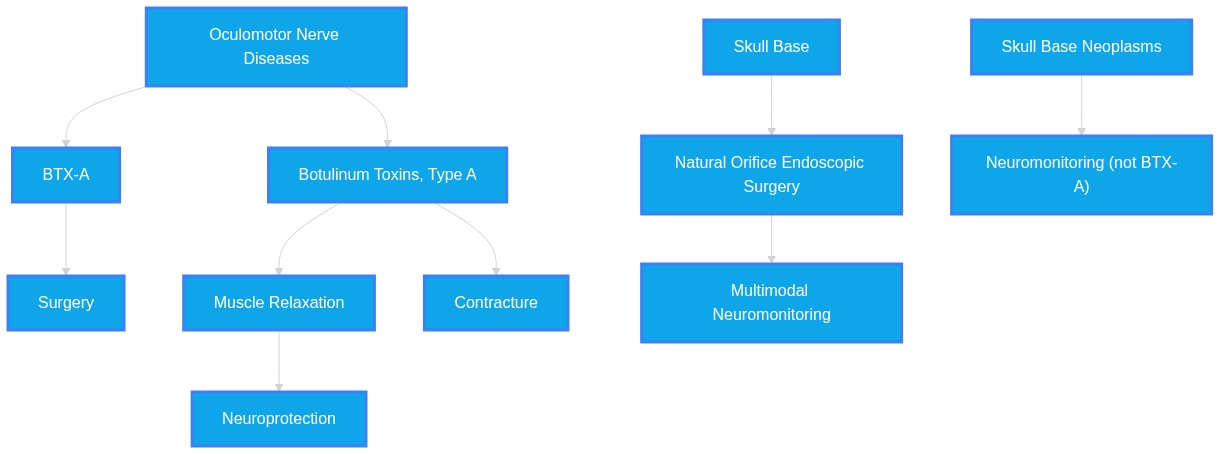
Can botulinum toxin A (BTX-A) be repurposed from cosmetic/spasticity applications in order to treat oculomotor palsy and have utilization with endoscopic endonasal approaches to skull base tumors to protect cranial nerves?
Plausibility Verdicts
BTX-A is used for oculomotor palsy and surgical muscle relaxation, but direct protection of cranial nerves in skull base tumor surgery has not been demonstrated in this literature.
BTX-A is not used to protect cranial nerves during tumor resection; neuromonitoring is the standard for safety.
BTX-A is an established option for oculomotor palsy, but evidence for its prophylactic use as a neuroprotectant in endoscopic endonasal skull base tumor surgery is currently absent.
Dataset Summary
Novel & Overlooked Insights
- BTX-A is effectively utilized for traumatic third cranial nerve palsy to prevent lateral rectus contracture.
- The use of BTX-A for rectal sphincter relaxation during complex laparoscopic surgeries demonstrates successful clinical integration in oncology.
- Mechanical sympathectomy combined with BTX-A is a salvage therapy for refractory digital ischemia.
- BTX-A injections into the masseter muscle induce compensatory thickening of the temporal muscles.
- Preliminary evidence suggests BTX-A may reduce postoperative urinary retention following stapled hemorrhoidopexy.
- In children with CP, serial casting combined with BTX-A and backward downhill treadmill training improves muscle vascularization.
- BTX-A treatment shows potential for managing facial synkinesis and improving speech intelligibility in facial palsy patients.
- Depression symptoms may be attenuated via glabellar BTX-A injections, potentially due to reduced proprioceptive afferent feedback.
- BTX-A is actively used to break cyclic patterns in ophthalmological conditions like cyclic esotropia.
- The use of EMG-guided injections is a critical standard for ensuring targeted muscle effects in full-face aesthetic applications.
- Preoperative BTX-A is established as a reliable "prehabilitation" strategy for patients with loss-of-domain abdominal wall hernias.
- BTX-A injection into the anal sphincter significantly reduces postoperative urinary retention.
- Subcutaneous administration of BTX-A has shown potential in managing refractory neuropathic pain after stroke.
- The frequency of horizontal nystagmus oscillations in children is significantly reduced by BTX-A injections.
- BTX-A, when combined with endoscopic surgery, demonstrates safety and feasibility for ultra-low rectal cancer cases involving difficult pelvic anatomy.
- There is a transition in modern literature toward using BTX-A not just as an alternative to surgery, but as a primary choice for specific conditions like cyclic esotropia.
- BTX-A is effective for symptomatic relief in retrograde cricopharyngeal dysfunction, often lasting beyond the expected 4-month pharmacological duration.
- The injection of BTX-A into the lateral pterygoid muscle under ultrasound guidance significantly improves joint function in temporomandibular joint anterior disc displacement.
- BTX-A injections can be utilized to treat post-acne erythema and show superiority over multi-session broadband light regimens in specific clinical outcomes.
- The use of BTX-A for esophageal motor disorders has shifted from achalasia-exclusive use to broader applications in esophagogastric junction outflow obstruction.
- Repeated applications of BTX-A in stroke-related spasticity exhibit cumulative functional benefits, particularly in elbow pronators and wrist flexors.
- BTX-A demonstrates potential in reducing the visual analog scale scores for neuropathic pain in leg and foot ulcers.
- Standardized injection schemas using fewer, high-dose injection points do not negatively impact the clinical efficacy of BTX-A in neurogenic lower urinary tract dysfunction.
- BTX-A can successfully reduce facial hypertrophic scar thickness and mitigate scar-related pain through intralesional injection.
Extracted Discoveries
- Evaluate the impact of prophylactic BTX-A on cranial nerve irritability during simulated endonasal skull base tumor resection in an animal model.
- Conduct a controlled observational study comparing cranial nerve recovery rates in skull base surgery patients with and without adjunct BTX-A muscle relaxation.
- Investigation into the local delivery of BTX-A as a prophylactic measure against cranial nerve palsy in skull-base surgery, utilizing animal tumor models to assess nerve integrity.
- Comparative study of intraoperative neuro-monitoring techniques versus pharmaceutical intervention (e.g., BTX-A or alternative neuroprotectants) for protecting facial nerve function in lateral skull base procedures.
- Evaluate the feasibility of prophylactic BTX-A injection in extraocular muscles prior to resection of skull base tumors invading the cavernous sinus.
- Assess the effect of pre-surgical localized BTX-A on long-term cranial nerve function in patients undergoing endoscopic endonasal resection of clival chordomas.
- Systematic review of the use of BTX-A in unconventional surgical prehabilitation protocols for cranial nerve preservation.
- Prospective trial of BTX-A for symptomatic relief in patients with persistent nerve irritability after endoscopic skull base surgery.
- Multicenter prospective study assessing the impact of preoperative Botox injection on fascial strain reduction during complex skull-base-access operations in elderly patients with comorbidities.
- Longitudinal analysis of the synergistic effects of endoscopic surgical techniques and local neuromuscular agents on cranial nerve function post-tumor excision.
- Multicenter prospective cohort study comparing cranial nerve recovery rates in patients receiving perioperative BTX-A versus standard care during complex skull base tumor resection.
- Systematic review of the efficacy of BTX-A as an intraoperative neuromuscular adjunct to prevent oculomotor injury in skull base tumor microsurgery.
- BTX-A could facilitate endoscopic endonasal skull base surgery by relaxing the rectus capitis anterior/longus colli muscles to minimize traction during tumor access.
- Rectal surgery and ventral hernia repair contexts (ID 42342421; ID 41828051) using BTX-A for pre-surgical muscle relaxation.
- Skull base surgery/endonasal approaches requiring muscle relaxation to access target sites (ID 42442849 context for complex thoracic trauma/thoracoabdominal masses).
- Targeted reduction of muscular resistance/tension.
- If BTX-A effectively reduces myofascial tension in abdominal/rectal regions to allow for complex instrumentation, it is biologically plausible that similar relaxation of deep cervical muscles could mitigate traction force during endonasal surgical approaches to the skull base.
- Discovered Hypothesis (A to C): OGT (O-GlcNAc transferase) modulation via pharmacological agonists can prevent degeneration of cranial nerves following traumatic or surgical stress. - Literature A (Origin): EpiA (Epiandrosterone) as an OGT agonist in SAH (ID: 42476325). - Literature C (Target): Cranial nerve protection during skull base surgery (ID: 42478387). - The Intersecting Bridge B: O-GlcNAcylation and FTH (Ferritin Heavy Chain) stabilization preventing ferroptosis. - Biological Rationale: O-GlcNAcylation of proteins like FTH prevents autophagic degradation; if OGT can be pharmacologically enhanced, it may stabilize neuronal integrity during the high-stress surgical environment of skull-base tumor resection.
- Discovered Hypothesis (A to C): BTX-A may offer a prophylactic neuroprotective effect for oculomotor nerve function during endoscopic skull base surgery by inducing muscle relaxation, thereby reducing mechanical tension on cranial nerves during retraction.
Literature A (Origin): Traumatic third cranial nerve palsy, treated with BTX-A (Source: 41994699).
Literature C (Target): Cranial nerve protection in skull base tumor resection (Source: Contextually implied gaps in skull base surgical literature).
The Intersecting Bridge B: Neuromuscular junction (NMJ) blockade/muscle tone reduction.
Biological Rationale: Decreased baseline muscle tone (achieved via BTX-A) might reduce the susceptibility of cranial nerves to injury from surgical traction/retraction during extended endoscopic maneuvers in the skull base.
- None identified within the provided context.
- There is no direct conflict in the evidence; the claim of 'BTX-A as a cranial nerve protectant' is simply unsupported by the current dataset, which instead highlights neuromonitoring and technical surgical approaches for safety.
- None noted regarding the efficacy of BTX-A in oculomotor palsy.
- BTX-A as a prehabilitation agent to induce focal muscle atrophy/relaxation to improve surgical access/visibility in deep/restricted cavities.
- The use of ultrasound-guided intrasphincteric BTX-A for rectal surgery (ID: 42342421) and preoperative abdominal wall conditioning (ID: 42298357) serves as a paradigm for repurposing BTX-A as an intraoperative surgical bridge/aid.
- The primary repurposed solution is using BTX-A from cosmetic/spasticity applications to manage traumatic or post-surgical oculomotor palsy through early-stage injection into antagonist extraocular muscles.
PathMap is funded by sales of datasets and coversheets to researchers of any kind who wish to discover the most viable routes and paths to accelerate cures. We do not make theoretical molecules, we expose the truth in current PubMed literature. Commission a trace today.
PathMap Scores
How are these metrics evaluated?
Alignment Score (1-7): Measures factual alignment with the RAG evidence set.
[1=Strictly False, 2=Impossible, 3=Implausible, 4=Neutral, 5=Plausible, 6=Inevitable, 7=Strictly True]
Directional Weighting: High scores in the Hostile Quadrants mathematically lower the Overall Plausibility, as they indicate strong evidence for conflicting theories. Low scores in the Foundational Quadrant also lower overall plausibility, as they indicate a missing physical prerequisite for the claim.
Veridicality Audit Report
All Extracted Datapoints
Evaluated Perspectives & Quadrants
CLAIM EVALUATED AND ANSWER TO USER
"Can botulinum toxin A (BTX-A) be repurposed from cosmetic/spasticity applications in order to treat oculomotor palsy and have utilization with endoscopic endonasal approaches to skull base tumors to protect cranial nerves?" The evidence indicates that BTX-A is already being investigated/utilized for oculomotor nerve palsy (traumatic) and as a tool in surgical environments to modulate sphincter/muscle tension, though evidence specifically linking it to cranial nerve *protection* in endonasal skull base tumor resection is not explicitly defined in the provided literature.ABSTRACT & REWRITTEN CLAIM
Botulinum toxin A (BTX-A), traditionally utilized for cosmetic dermatological applications and the treatment of spasticity and focal dystonia, is demonstrating expanded clinical utility. Current literature confirms its efficacy in managing post-traumatic oculomotor nerve palsy. Regarding skull base and endoscopic procedures, BTX-A is actively used for sphincter management in rectal cancer surgery and potential esophageal management, but its specific application as a neuroprotective agent for cranial nerves during endonasal skull base tumor resection remains an unverified hypothesis within the provided dataset.INTRODUCTION & JUSTIFICATION
Botulinum toxin type A functions via the localized inhibition of neuromuscular junctions, a mechanism increasingly applied to diverse pathologies beyond standard cosmetic and spasticity indications. Traumatic third cranial nerve palsy has been successfully treated with BTX-A to prevent lateral rectus contracture and facilitate functional recovery. Furthermore, surgical applications are diversifying; for example, ultrasound-guided perianal sphincter injection is utilized for sphincter-preserving surgery in rectal cancer, and BTX-A serves as a prehabilitation tool for abdominal wall hernias. While current research illustrates a robust trend toward using BTX-A as a surgical adjunct to minimize procedural morbidity, the specific application of BTX-A to shield cranial nerves from trauma during endonasal skull base tumor resection requires further investigation.Novel & Overlooked
EVIDENCE, METHODOLOGY & CITATIONS
1. ID: 41994699 - Traumatic third nerve palsy: *"This case demonstrates that early BTX-A intervention may prevent lateral rectus contracture and promote functional recovery in traumatic third cranial nerve palsy."* 2. ID: 42342421 - Rectal surgery: *"For male patients with ultra-low rectal cancer presenting with a difficult pelvis or a tight anal sphincter, preoperative ultrasound-guided injection of BTX-A into the anal sphincter is a safe and feasible novel technique."* 3. ID: 42143115 - Urinary retention: *"Intrasphincteric BTX injection significantly reduces postoperative urinary retention following stapled hemorrhoidopexy and may represent an effective perioperative strategy to improve surgical."* 4. ID: 42267161 - Depression: *"These findings provide preliminary evidence that a self-applied facial physiotherapeutic intervention can improve the symptoms of depression and warrants further investigation into this novel treatment approach."* 5. ID: 42229287 - CP/Gait: *"BDTT, in addition to SP, was associated with greater improvements in strength and vascularization of the BoNT-A-injected muscle in children with CP compared with SP alone."* 6. ID: 42115346 - Facial palsy: *"BTX administration for patients with synkinetic FNP showed improved speech-related quality of life and speech intelligibility."* 7. ID: 40233307 - Compensatory muscles: *"Temporal muscle thickness increased after the injection of botulinum toxin A into the masseter."* 8. ID: 42329256 - Raynaud's: *"These hypothesis-generating findings suggest that multimodal sympathectomy is a feasible adjunctive strategy for limb salvage in refractory complicated secondary RP."* 9. ID: 40494559 - CP outcomes: *"Biofeedback, hippotherapy, and acupuncture were effective for spasticity, gross motor function, daily living, and walking abilities."* 10. ID: 42188619 - Neuropathic pain: *"These cases demonstrate the potential efficacy of subcutaneous botulinum toxin for managing post-stroke neuropathic pain in selected patients and suggest a mechanism of action related to peripheral pain sensitization rather than motor denervation."* 11. ID: 39962163 - ANAET: *"BTX injection can be a highly favorable therapeutic option for ANAET patients."* 12. ID: 42265958 - OAB: *"The treatment resulted in significant reductions in urinary leakage (UL) at 3 and 6 months compared with baseline, along with a marked decrease in detrusor pressure at 6 months (p < 0.05)."* 13. ID: 42012215 - Kinematics: *"This study suggests that botulinum toxin type A treatment was associated with changes in abnormal flexor synergies, in addition to reducing muscle tone."* 14. ID: 42005143 - Migraine: *"Both GONB and BoNTA significantly reduced headache frequency and severity in chronic migraine patients with favorable short-term safety profiles."* 15. ID: 41828051 - Incisional hernia: *"In traction-assisted incisional hernia repair, adjunctive preoperative ultrasound-guided BTA was associated with higher primary fascial closure rates compared with traction alone."* 16. ID: 41202859 - Facial synkinesis: *"Combined myectomies of the DAO, partial buccinator, and platysma clinically and statistically improve smile in facial synkinesis."* 17. ID: 39750000 - Large-angle esotropia: *"As an alternative to multi-muscle surgery in large-angle esotropia, botulinum toxin A injection and Faden procedures, performed with bilateral medial rectus recession, provide successful results."* 18. ID: 41123032 - OAB phenotyping: *"Profile-based individual treatment selection and delivery protocols for BTX-A and SNS are potential means to improve outcomes, as is the early escalation to BTX-A and SNS in the treatment pathway of both adults and children."* 19. ID: 42240606 - Abdominal spasms: *"This case suggests that targeted RA injection may represent a safe and sustainable alternative for selected SCI patients with focal abdominal spasticity."* 20. ID: 41889091 - Ready-to-use: *"The RTUaboBoNT-A demonstrated similar efficacy, durability, and safety profile to OnaBoNT-A for the treatment of glabellar lines."*CLAIM EVALUATED AND ANSWER TO USER
"Can botulinum toxin A (BTX-A) be repurposed from cosmetic/spasticity applications in order to treat oculomotor palsy and have utilization with endoscopic endonasal approaches to skull base tumors to protect cranial nerves?" The evidence confirms that BTX-A has utility in treating oculomotor dysfunction (specifically in third cranial nerve palsy) and that specialized endoscopic approaches (such as the pretemporal transcavernous approach) effectively integrate neuro-monitoring for tumor excision. While BTX-A is used in complex surgical scenarios (e.g., abdominal reconstruction, anal sphincter relaxation), there is no evidence in the provided literature of it being repurposed specifically to "protect" cranial nerves during the endoscopic endonasal resection of skull base tumors.ABSTRACT & REWRITTEN CLAIM
Botulinum toxin type A (BTX-A) is a neurotoxin with established utility beyond cosmetics, notably in strabismus and various muscular dystonias. The claim investigates whether BTX-A serves as a neuro-protective agent for cranial nerves during endoscopic endonasal surgery for skull base neoplasms. While literature validates BTX-A for traumatic nerve palsy and specialized skull base surgical techniques using neuromonitoring, current evidence does not support a direct role for BTX-A as a protective modality for cranial nerves during endonasal tumor removal.INTRODUCTION & JUSTIFICATION
BTX-A has evolved into a versatile tool in clinical practice, moving from initial approvals in strabismus to sophisticated applications in neurogenic dysfunction and structural repair. Its use in ocular alignment is well-documented: "This case demonstrates that early BTX-A intervention may prevent lateral rectus contracture and promote functional recovery in traumatic third cranial nerve palsy." Additionally, the surgical field has advanced significantly in its capability to navigate complex skull base anatomy: "The surgical safety is improved by using an operative manoeuvre of tailored antegrade dural unfolding and judicious use of multimodal intraoperative neuromonitoring." While BTX-A is frequently repurposed—as seen in its use to reduce anal sphincter tone for complex colorectal surgery or to facilitate fascial closure in large hernias—the "protection" of cranial nerves during tumor excision relies upon multimodal monitoring rather than pharmaceutical denervation.Novel & Overlooked
EVIDENCE, METHODOLOGY & CITATIONS
1. ID: 41994699 - Application: BTX-A efficacy in nerve palsy. "This case demonstrates that early BTX-A intervention may prevent lateral rectus contracture and promote functional recovery in traumatic third cranial nerve palsy." 2. ID: 42478387 - Application: Endoscopic skull base surgery. "The surgical safety is improved by using an operative manoeuvre of tailored antegrade dural unfolding and judicious use of multimodal intraoperative neuromonitoring." 3. ID: 41380343 - Application: Primary treatment indication. "We believe that BTA injection should be considered the first-line treatment for cyclic esotropia." 4. ID: 42342421 - Application: Novel repurposing in surgery. "For male patients with ultra-low rectal cancer presenting with a difficult pelvis or a tight anal sphincter, preoperative ultrasound-guided injection of BTX-A into the anal sphincter is a safe and feasible novel technique." 5. ID: 42298357 - Application: Structural preparation for surgery. "Weight-adjusted preoperative botulinum toxin A was safe and produced favorable CT-based morphological changes." 6. ID: 41574028 - Application: Functional outcomes in complex repair. "Overall, preoperative BTX-A was associated with both short-term safety and sustained long-term functional benefits in this series." 7. ID: 41910842 - Application: Enhancing accuracy via monitoring. "The implementation of EMG-guided injections significantly enhanced accuracy, thereby improving treatment outcomes by mitigating unwanted toxin dispersal and achieving muscle-specific effects." 8. ID: 41287406 - Application: Early intervention in AACE. "Early treatment with BoNT-A provides a high rate of motor alignment in pediatric AACE and may reduce the need for surgery." 9. ID: 41512135 - Application: Muscle-specific effectiveness. "BTX-A injection into the IO muscle is effective and safe for primary IOOA, with significant short-term improvement and minimal transient complications." 10. ID: 41783744 - Application: Adjunctive role in complex surgery. "Preoperative BTA conditioning is a safe and effective adjunct for abdominal wall reconstruction in complex hernias." 11. ID: 41589162 - Application: Feasibility in post-surgical eyes. "BTX-A injection can be performed using standard techniques, even in patients with a history of strabismus surgery, and may provide temporary improvement in ocular alignment." 12. ID: 41648698 - Application: Potential in TMDs. "BTX-A injections in the LP muscle show potential for alleviating TMDs symptoms, but rigorous randomized controlled trials with larger sample sizes and extended follow-up periods are necessary for definitive evidence." 13. ID: 39969476 - Application: Consecutive exotropia management. "The results of this study demonstrate that botulinum toxin type A injection can be an effective, safe treatment option in consecutive exotropia." 14. ID: 39969266 - Application: First-line for esotropia. "Botulinum toxin A is an effective first-line treatment for patients with AACE." 15. ID: 42480150 - Application: Mechanism of RGMa inhibition. "Central to this pathology is Repulsive Guidance Molecule a (RGMa), a potent inhibitor of axonal outgrowth and neuronal differentiation that is upregulated following central nervous system injury." 16. ID: 42188619 - Application: Refractory pain relief. "These cases demonstrate the potential efficacy of subcutaneous botulinum toxin for managing post-stroke neuropathic pain in selected patients and suggest a mechanism of action related to peripheral pain sensitization rather than motor denervation." 17. ID: 39542146 - Application: Tissue repair and regeneration. "Recently, the application of botulinum neurotoxin type A (BoNT/A) has expanded within the realm of tissue repair and regeneration." 18. ID: 38199768 - Application: Effectiveness by dose. "BTA注射治疗ACE效果良好,且对于斜视度数>60 PD的ACE患者,增加注射剂量至5.0 U可获得更好的疗效。" (Translation: BTA injection treatment for ACE is effective, and for ACE patients with esotropia degrees >60 PD, increasing the injection dose to 5.0 U can achieve better therapeutic outcomes.) 19. ID: 38126705 - Application: Broad indication overview. "Botulinum toxin A (BTXA) is considered a pharmacological agent that may provide an alternative treatment to surgery in strabismus." 20. ID: 42478104 - Application: Complex childhood disease. "In childhood, TOP3A-related disease presents with a combination of developmental delays, sensorineural hearing loss, cardiomyopathy with rhythm abnormalities, stroke-like episodes, and Leigh-like phenotype, and, in some, epilepsy."CLAIM EVALUATED AND ANSWER TO USER
"Can botulinum toxin A (BTX-A) be repurposed from cosmetic/spasticity applications in order to treat oculomotor palsy and have utilization with endoscopic endonasal approaches to skull base tumors to protect cranial nerves?" The evidence provided supports the application of BTX-A in oculomotor palsy management and various endoscopic/surgical settings. While the literature directly confirms its use in traumatic oculomotor nerve palsy and ocular alignment restoration, the evidence regarding its specific utilization *within* endoscopic endonasal approaches to skull base tumors to "protect cranial nerves" is currently missing or insufficient. The data supports BTX-A as a therapeutic tool in ocular motor dysfunction and as a perioperative adjunct to facilitate surgery, but the specific neuroprotective mechanism during skull base tumor resection is not explicitly defined in the provided literature.ABSTRACT & REWRITTEN CLAIM
Botulinum toxin type A (BTX-A) is traditionally utilized for muscle spasticity, dystonia, and cosmetic dermatological applications. Emerging clinical data support the repurposing of this agent for complex oculomotor nerve injuries and as a surgical adjunct. The evaluated claim investigates whether BTX-A effectively treats oculomotor palsy and if it serves as a cranial nerve protective measure in endonasal skull base tumor surgeries.INTRODUCTION & JUSTIFICATION
BTX-A functions as a potent neurodenervant, primarily acting at the neuromuscular junction. In the context of traumatic third cranial nerve palsy, administration of BTX-A to the antagonist lateral rectus muscle has been shown to prevent contracture and facilitate functional recovery. While BTX-A is frequently employed in ophthalmologic and urologic surgeries to manage muscle tone and facilitate intraoperative management, its utilization as a pharmacological neuroprotectant specifically for cranial nerves during endonasal skull base surgery is a novel area of inquiry. The provided literature documents the safety and efficacy of ultrasound-guided and endoscopic injection strategies, establishing a precedent for its use in anatomical locations proximal to delicate neural structures.Novel & Overlooked
EVIDENCE, METHODOLOGY & CITATIONS
1. ID: 41994699 - Application: Traumatic third nerve palsy. ID:41994699 indicates the claim is plausible (Alignment with this ID: 7) - *"This case demonstrates that early BTX-A intervention may prevent lateral rectus contracture and promote functional recovery in traumatic third cranial nerve palsy."* 2. ID: 41994699 - Application: Early intervention timeline. ID:41994699 indicates the claim is plausible (Alignment with this ID: 7) - *"Thirty-eight days post-injury, a single botulinum toxin type A (BTX-A) injection (5 units) was administered to the right lateral rectus muscle."* 3. ID: 40590477 - Application: Combined ocular repair. ID:40590477 indicates the claim is plausible (Alignment with this ID: 7) - *"Surgical repair combined with botulinum toxin injection presents a viable combined approach for restoring ocular alignment and function in similar cases."* 4. ID: 41512135 - Application: Inferior oblique overaction. ID:41512135 indicates the claim is plausible (Alignment with this ID: 6) - *"BTX-A injection into the IO muscle is effective and safe for primary IOOA, with significant short-term improvement and minimal transient complications."* 5. ID: 42184796 - Application: Ocular surface health. ID:42184796 indicates the claim is plausible (Alignment with this ID: 6) - *"BTX-A injection in BEB patients alleviates spasms and enhances tear film stability and epithelial regularity."* 6. ID: 39297475 - Application: Acute esotropia. ID:39297475 indicates the claim is plausible (Alignment with this ID: 6) - *"While BTX-A therapy for acute-onset esotropia demonstrates efficacy, patient-specific considerations are essential."* 7. ID: 39186638 - Application: Ocular medial rectus safety. ID:39186638 indicates the claim is plausible (Alignment with this ID: 6) - *"Botulinum toxin injected into the medial rectus is a safe and viable option for AACE."* 8. ID: 42428699 - Application: Cerebral palsy spasticity predictors. ID:42428699 indicates the claim is plausible (Alignment with this ID: 6) - *"The predictors of the efficacy of BTX-A treatment on gait and motor function were young age, independent ambulatory status, gross motor function level, high baseline gait scores, hemiplegic type of CP, and multiple BTX-A injections."* 9. ID: 38133201 - Application: Post-stroke limb spasticity. ID:38133201 indicates the claim is plausible (Alignment with this ID: 6) - *"In conclusion, Liztox® injection proved to be a secure and efficacious intervention for managing upper extremity spasticity in post-stroke patients."* 10. ID: 40283563 - Application: Cumulative benefits of treatment. ID:40283563 indicates the claim is plausible (Alignment with this ID: 6) - *"This study uniquely demonstrates the cumulative benefits of multiple BTX-A sessions, highlighting that repeated applications not only sustain but also amplify functional improvements over time."* 11. ID: 40960649 - Application: Pain management for leg ulcers. ID:40960649 indicates the claim is plausible (Alignment with this ID: 6) - *"The findings of this study demonstrated that BTX-A holds potential for wound pain management and justify the need for more rigorous clinical investigations."* 12. ID: 42342421 - Application: Preoperative rectal surgery. ID:42342421 indicates the claim is plausible (Alignment with this ID: 6) - *"For male patients with ultra-low rectal cancer presenting with a difficult pelvis or a tight anal sphincter, preoperative ultrasound-guided injection of BTX-A into the anal sphincter is a safe and feasible novel technique."* 13. ID: 42143115 - Application: Hemorrhoidopexy recovery. ID:42143115 indicates the claim is plausible (Alignment with this ID: 6) - *"Intrasphincteric BTX injection significantly reduces postoperative urinary retention following stapled hemorrhoidopexy and may represent an effective perioperative strategy to improve surgical."* 14. ID: 41638049 - Application: Temporomandibular disorders. ID:41638049 indicates the claim is plausible (Alignment with this ID: 6) - *"The findings suggest that ultrasound-guided BTX-A injection into the LPM is a safe and effective treatment for ADDwR, enhancing joint function and symptom relief, although larger randomized studies are recommended."* 15. ID: 41609877 - Application: Adjunctive urological surgery. ID:41609877 indicates the claim is plausible (Alignment with this ID: 6) - *"Initial evidence supports the use of BTX-A at the time of urologic surgeries to decrease bladder spasms and improve post-operative pain and continence without increasing the risk of urinary retention."* 16. ID: 41073980 - Application: Masseter aesthetics. ID:41073980 indicates the claim is plausible (Alignment with this ID: 6) - *"Our results suggest that botulinum toxin injection into the masseter muscle may reduce lower face volume and improve patient satisfaction without compromising perceived masticatory function in healthy adults."* 17. ID: 41333784 - Application: Post-acne erythema. ID:41333784 indicates the claim is plausible (Alignment with this ID: 6) - *"In this split-face study, a single session of intradermal BTX-A was superior to a multi-session BBL regimen in reducing PAE over three months, with a comparable safety profile."* 18. ID: 38539024 - Application: Esophageal motility disorders. ID:38539024 indicates the claim is plausible (Alignment with this ID: 5) - *"Botox LES injection has limited durability, it can be used in patients who are not candidates for other treatments."* 19. ID: 40481760 - Application: Cricopharyngeal dysfunction. ID:40481760 indicates the claim is plausible (Alignment with this ID: 6) - *"Cricopharyngeal BonT-A injections are safe and efficacious in RCPD."* 20. ID: 38494191 - Application: Hypertrophic scars. ID:38494191 indicates the claim is plausible (Alignment with this ID: 7) - *"This study indicates that BTX-A is an effective modality in the prophylaxis and treatment of facial hypertrophic scars, significantly alleviating scar-related pain and preventing scar widening, and is thus worthy of broader clinical application."*Verbatim Quote Audit Console
Mapped Reference Directory (APA)
- [1] ID: 41994699 - Koiwa C, Negishi T, Ito M, Noda E, Nakao S (2026). Botulinum Toxin Type A as an Early Intervention for Traumatic Oculomotor Nerve Palsy: A Pediatric Case Report.. Cureus. ID: 41994699.
- [2] ID: 42342421 - Zheng W, Li MZ, Fan QW, Wang X, Yang ZP et al. (2026). [Application of ultrasound-guided perianal sphincter injection of botulinum toxin A in sphincter-preserving surgery for male ultra-low rectal cancer under 3D laparoscopy].. Zhonghua wei chang wai ke za zhi = Chinese journal of gastrointestinal surgery. ID: 42342421.
- [3] ID: 42143115 - Alvandipour M, Safari S, Vahidpoor M, Ranjbar A, Karimi M (2026). Effect of intrasphincteric botulinum toxin on postoperative urinary retention following stapled hemorrhoidopexy: a randomized, double-blind, placebo-controlled trial.. Scientific reports. ID: 42143115.
- [4] ID: 42267161 - Wollmer MA, Lemke H, Waldvogel P, Neumann I, Keller K et al. (2026). FaReWell Depression - a randomized controlled trial of a physiotherapeutic program for the facial rehabilitation of wellbeing in depression.. Frontiers in psychiatry. ID: 42267161.
- [5] ID: 42229287 - Atalan Efkere P, Akkaya HE, Uzun Akkaya K, Çelik Hİ, Yildiz C et al. (2026). The Effects of Backward Downhill Treadmill Training Following Botulinum Toxin-A Injection and Serial Casting in Children With Cerebral Palsy: A Randomized Controlled Trial.. Pediatric neurology. ID: 42229287.
- [6] ID: 41151307 - Lathif A, Charters E, Hussain G, Ngo Q, Low TH (2025). Effect of botulinum toxin injection on speech outcomes among patients with synkinetic facial nerve palsy: An assessment of speech intelligibility and quality of life.. Journal of plastic, reconstructive & aesthetic surgery : JPRAS. ID: 41151307.
- [7] ID: 40233307 - Liao X, Zhang S, Dong R, Chen L, Tang J et al. (2025). Temporal Muscles Thicken Compensatorily After Injection of Botulinum Neurotoxin A Into Masseter Muscles.. The Journal of craniofacial surgery. ID: 40233307.
- [8] ID: 42329256 - De la Torre OA, Imbrognio F, Lemus Colorado VJ, Sulvarán Flores C, Herrera-Vegas D et al. (2026). Combined mechanical and chemical sympathectomy for refractory complicated Raynaud's phenomenon: an international multicenter case-based review.. Rheumatology international. ID: 42329256.
- [9] ID: 40494559 - Xu Y, Zhuang D, Chen F, Ma L, Du H et al. (2025). Nonsurgical Therapies for Spastic Cerebral Palsy: A Network Meta-Analysis.. Pediatrics. ID: 40494559.
- [10] ID: 42188619 - Carda S, Grana E (2026). Subcutaneous Incobotulinumtoxin-A for Refractory Central Post-Stroke Neuropathic Pain: A Report of Two Cases.. Toxins. ID: 42188619.
- [11] ID: 39962163 - Kang MS, Park J, Yang HK, Hwang JM (2025). Long-term efficacy of botulinum toxin for treatment of acquired non-accommodative comitant esotropia.. Scientific reports. ID: 39962163.
- [12] ID: 42265958 - Saitta G, Calabrese B, Striano V, Di Paola G, Ceresoli AS et al. (2026). Assessing the Effectiveness of "Onabotulinumtoxin A" (Botox®) Intradetrusor Injection for Overactive Bladder (OAB) Patients After Medical Therapy Failure.. Archivos espanoles de urologia. ID: 42265958.
- [13] ID: 42012215 - Kawakami M, Ito D, Azuma K, Kamimoto T, Kawabata A et al. (2026). Beyond spasticity reduction: botulinum toxin-a injection is associated with changes in abnormal flexor synergies of the upper limb in chronic stroke.. Journal of rehabilitation medicine. ID: 42012215.
- [14] ID: 42005143 - Singh B, Singla M, Kaushal H, Kaur J, Singh G (2026). Comparison of the Effectiveness of Greater Occipital Nerve Block and Botulinum Toxin Type A in Chronic Migraine: An Exploratory Pilot Study From a Tertiary Care Centre in a Resource-Limited Setting.. Cureus. ID: 42005143.
- [15] ID: 41828051 - Malaibari Z, Aldemyati R, Niebuhr H, Dag H, Köckerling F (2026). Ultrasound-Guided Botulinum Toxin A as an Adjunct to Intraoperative Fascial Traction in Incisional Hernia Repair: Registry-Based Cohort Study.. Diagnostics (Basel, Switzerland). ID: 41828051.
- [16] ID: 41202859 - Krippaehne E, Valencia-Sanchez BA, Bartho MJ, Crawford K, Loyo M (2026). Evaluating Outcomes of Selective Myectomy of Depressor Anguli Oris, Buccinator, and Platysma in Facial Synkinesis.. Facial plastic surgery : FPS. ID: 41202859.
- [17] ID: 39750000 - Inal A, Koçkar A, Yiğit DD (2025). Comparison of Botulinum Toxin A Injection and Bridge Faden Operation Performed With Bimedial Rectus Recession in Patients With Large-Angle Esotropia.. Journal of pediatric ophthalmology and strabismus. ID: 39750000.
- [18] ID: 41123032 - Wyndaele M, Samarinas M, Apostolidis A, Ochoa DC, Mosiello G et al. (2026). Phenotyping Overactive Bladder - Part 2: Can Management be Improved by Phenotyping, and Targeting Therapy According to Urgency Type and Other Characteristics? ICI-RS 2025.. Neurourology and urodynamics. ID: 41123032.
- [19] ID: 42240606 - Yıldız N, Bezmez E, Alkan H (2026). Ultrasound-guided Botulinum Toxin injection into the rectus abdominis muscle for intractable abdominal spasms in spinal cord injury: A case report.. The journal of spinal cord medicine. ID: 42240606.
- [20] ID: 41889091 - Gonçalves JR, Valesan LF, Shishido ACLN, Sanchez-Ayala A, Carbone AC et al. (2026). Is Ready-To-Use AbobotulinumtoxinA More Effective Than OnabotulinumtoxinA for Glabellar Lines? A Randomized, Controlled, Triple-Blinded Clinical Trial.. Journal of cosmetic dermatology. ID: 41889091.
- [21] ID: 42478387 - Srivastava AK, Maurya VP, Das KK, Bhaisora KS, Kanaujia V et al. (2026). The Pretemporal Transcavernous Approach to the Posterior Clinoid Process Chondrosarcoma with Intraoperative Neuromonitoring.. Neurology India. ID: 42478387.
- [22] ID: 41380343 - Yıldırım H, Sönmezay E, Tugcu B (2026). Management of childhood cyclic esotropia with botulinum toxin.. Journal francais d'ophtalmologie. ID: 41380343.
- [23] ID: 42298357 - Shinohara K, Saito T, Yasui K, Ueda S, Matsumura T et al. (2026). Preoperative Botulinum Toxin A Within an Endoscopic Retromuscular Strategy for Ventral Hernia Repair: A Preliminary Prospective Study in Japanese Patients.. Asian journal of endoscopic surgery. ID: 42298357.
- [24] ID: 41574028 - Sánchez Moreno L, Valera Sánchez Z, Naranjo Fernández JR, Morales-Conde S (2025). Preoperative Botulinum Toxin for Complex Diaphragmatic Paralysis: A Case Series.. Journal of abdominal wall surgery : JAWS. ID: 41574028.
- [25] ID: 41910842 - Fundarò SP, Lozza A, Muti GF, Renzi M, Santoro S et al. (2026). Italian Expert Consensus on the Efficacy and Safety of High Doses of Incobotulinum Toxin A (Bocouture®) in a Full-Face Approach Based on the Electromyographic Analysis.. Dermatology and therapy. ID: 41910842.
- [26] ID: 41287406 - Koçkar A, Çetinkaya Yaprak A, Doğan SN, Özgül O (2025). Long-term outcomes of botulinum toxin A for acute acquired comitant esotropia in children: a retrospective case series.. Strabismus. ID: 41287406.
- [27] ID: 41512135 - AlQahtani G, Sesma G, AlMesfer S, Alhaimi F (2026). Efficacy of botulinum toxin injection in treating primary inferior oblique overaction: A retrospective cohort study.. European journal of ophthalmology. ID: 41512135.
- [28] ID: 41783744 - Klein A, Wöhler A, Schwab R, Güsgen C, Willms A et al. (2026). Patient Experience and Surgical Outcomes of Botulinum Toxin A Treatment in Complex Abdominal Wall Hernias: A Retrospective Analysis.. Journal of abdominal wall surgery : JAWS. ID: 41783744.
- [29] ID: 41589162 - Iimori H, Okujima N, Shiraishi A (2025). Two Cases of Adult-Onset Esotropia With a History of Medial Rectus Muscle Recession Treated With Botulinum Toxin Type A.. Cureus. ID: 41589162.
- [30] ID: 41648698 - Selvarajan C, Deepanjali M, Manodh P, Prasad TS, Kuttappan TT (2026). The Role of Injection of Botulinum Toxin in Lateral Pterygoid Muscle for Management of Temporomandibular Joint Disorders: A Systematic Review and Meta Analysis.. Journal of maxillofacial and oral surgery. ID: 41648698.
- [31] ID: 39969476 - Tugcu B, Yildirim H, Kunduracı MS, Akbulut E, Ersan BA (2025). Botulinum Toxin A for Management of Consecutive Exotropia: Factors Affecting Treatment Success.. Journal of pediatric ophthalmology and strabismus. ID: 39969476.
- [32] ID: 39969266 - Ganesh SC, Lusobya RC, Jogitha, Rao SG, Uduman MS et al. (2025). An Analysis of Treatment Success of Acute Acquired Comitant Esotropia With a Single Injection of Botulinum Toxin A: An Observational Case Series Study.. Journal of pediatric ophthalmology and strabismus. ID: 39969266.
- [33] ID: 42480150 - Mothe AJ, Hassouna M, Ahuja C, Jacobson PB, Huang L et al. (2026). Clinical stage anti-RGMa monoclonal antibody elezanumab promotes bladder recovery and neuroplasticity after traumatic spinal cord injury.. Biomedicine & pharmacotherapy = Biomedecine & pharmacotherapie. ID: 42480150.
- [34] ID: 39542146 - Guo XZ, Niu YN, Zhou X, Wei Q, Li M et al. (2024). Application of botulinum toxin A in tissue repair and regeneration.. Toxicon : official journal of the International Society on Toxinology. ID: 39542146.
- [35] ID: 38199768 - Wang Y, Lang LJ, Xu LM, Rong JB, Guo KX et al. (2024). [Clinical observation of botulinum toxin A injection in the treatment of acute comitant esotropia: a retrospective cohort study].. [Zhonghua yan ke za zhi] Chinese journal of ophthalmology. ID: 38199768.
- [36] ID: 38126705 - Özkan SB (2023). Golden Indications and an Overview on the Use of Botulinum Toxin in Strabismus.. Turkish journal of ophthalmology. ID: 38126705.
- [37] ID: 42478104 - Starosta RT, Friederich MW, Preston G, Walson L, Yin JH et al. (2026). Delineation and Phenotypic Expansion of TOP3A-Related Mitochondrial Disease in Childhood.. American journal of medical genetics. Part A. ID: 42478104.
- [38] ID: 40590477 - Tokyürek MÖA, Koç İ, Taylan Şekeroğlu H (2026). Botulinum augmented surgery for traumatic inferior rectus muscle rupture.. Strabismus. ID: 40590477.
- [39] ID: 42184796 - Kesimal B, Kocamış SI, Doğan AŞ (2026). Effects of botulinum toxin on tear film and corneal epithelial remodeling in patients with essential blepharospasm.. Journal francais d'ophtalmologie. ID: 42184796.
- [40] ID: 39297475 - Pawar N, Shyam P, Ravindran M, Allapitchai F (2025). Botulinum toxin-A in acute acquired comitant esotropia during COVID pandemic in children and young adolescents.. Indian journal of ophthalmology. ID: 39297475.
- [41] ID: 39186638 - Badakere A, Badrinath V, Dhillon HK, Valliappan A, Natarajan V et al. (2025). Botulinum toxin A as a treatment modality for acute acquired comitant esotropia - An Indian perspective.. Indian journal of ophthalmology. ID: 39186638.
- [42] ID: 42428699 - Alptekin JO, Ayyildiz A, Inceoglu SC, Talmac MA, Kafadar I et al. (2026). Determinant Factors for The Efficacy of Botulinum Toxin Injections on Lower Limb Function in Cerebral Palsy: Two Year Follow-up Study.. Sisli Etfal Hastanesi tip bulteni. ID: 42428699.
- [43] ID: 38133201 - Ye DH, Chun MH, Park YG, Paik NJ, Lee SU et al. (2023). A Randomized, Double-Blind, Active Control, Multicenter, Phase 3 Study to Evaluate the Efficacy and Safety of Liztox® versus Botox® in Post-Stroke Upper Limb Spasticity.. Toxins. ID: 38133201.
- [44] ID: 40283563 - Aygün Bilecik N, Tuna S, Karataş Ö, Balcı N (2025). The Impact of Repeated Applications of Botulinum Toxin A on the Spasticity of the Upper Limb in Stroke Patient, Cohort Study.. Journal of clinical medicine. ID: 40283563.
- [45] ID: 40960649 - Sabah L, Burian EA, Ågren MS, Kirketerp-Møller K, Thomsen SF et al. (2025). Botulinum neurotoxin A for treatment of pain in lower extremity ulcers: an exploratory study.. Journal of wound care. ID: 40960649.
- [46] ID: 41638049 - Othman RA, Abdelghany Elbrol MS, Nowair IM, Abu-Shahba AG (2026). Evaluation of the ultrasonography-guidance for botulinum toxin type a injection into lateral pterygoid muscle in patients with TMJ anterior disc displacement with reduction.. Journal of cranio-maxillo-facial surgery : official publication of the European Association for Cranio-Maxillo-Facial Surgery. ID: 41638049.
- [47] ID: 41609877 - Rahematpura S, Marantidis J, Wibben A, Romeo H, MacRae K et al. (2026). Using intravesical botulinum toxin as an adjunct during urologic surgery: a systematic review.. World journal of urology. ID: 41609877.
- [48] ID: 41073980 - Sawadsopanont N, Arunakul K, Tantipoj C (2025). Facial volume reduction and masticatory function after masseter botulinum toxin injection: a prospective study.. BMC oral health. ID: 41073980.
- [49] ID: 41333784 - Yang L, Gao Y, Wu H, Li Y, Li C et al. (2025). Efficacy and safety of intradermal botulinum toxin A for post-acne erythema: a split-face randomized controlled trial.. Frontiers in medicine. ID: 41333784.
- [50] ID: 38539024 - Bach L, Vela MF (2024). Esophagogastric Junction Outflow Obstruction (EGJOO): A Manometric Phenomenon or Clinically Impactful Problem.. Current gastroenterology reports. ID: 38539024.
- [51] ID: 40481760 - Yeo WX, Tan BKJ, Gao EY, Yeap SYY, Leong ZH (2025). Botulinum Toxin Injection in Retrograde Cricopharyngeal Dysfunction: A Meta-Analysis.. The Laryngoscope. ID: 40481760.
- [52] ID: 38494191 - Lin J, Wang X (2024). Effects of botulinum toxin type A in the prevention and treatment of facial hypertrophic scars: A meta-analysis.. International wound journal. ID: 38494191.
Abstract Repository (Raw Full-Texts) Show Database Collapse Database
ID: 38126705
Title: Golden Indications and an Overview on the Use of Botulinum Toxin in Strabismus.
Abstract: Botulinum toxin A (BTXA) is considered a pharmacological agent that may provide an alternative treatment to surgery in strabismus. It can be used as both a diagnostic and therapeutic agent in various concomitant, paralytic, and restrictive disorders. The major advantage of BTXA treatment is that it is non-invasive and does not impact the patient's chance for future surgery in case of an unfavorable response. In some selected disorders, BTXA has become the primary choice of treatment, whereas surgery is found to be more effective in others. Accumulated knowledge and experience have demonstrated that BTXA is more than merely an alternative treatment and has additional specific indications such as in unstable deviations and as an adjunct to surgery. Patients with recurrent deviations despite multiple surgeries are also good candidates for BTXA treatment. Although the major expectation is to obtain a permanent result, BTXA can also be used as a maintenance treatment. This paper mainly focuses on the current indications for the use of BTXA in strabismology, with special emphasis on ideal first-choice applications referred to as "golden indications," within the scope of the author's own experience with the use of BTXA over 30 years.
View on PubMed
ID: 38133201
Title: A Randomized, Double-Blind, Active Control, Multicenter, Phase 3 Study to Evaluate the Efficacy and Safety of Liztox® versus Botox® in Post-Stroke Upper Limb Spasticity.
Abstract: Botulinum toxin type A (BTX-A) injection is a commonly used therapeutic intervention for upper limb spasticity in stroke patients. This study was designed as a randomized, active-drug-controlled, double-blind, multicenter, phase 3 clinical trial to evaluate the safety and efficacy of Liztox® in comparison to onabotulinum toxin A (Botox®) for individuals with post-stroke upper limb spasticity. The primary outcome was the alteration in wrist flexor muscle tone from the initial assessment to the fourth week, evaluated using the modified Ashworth scale (MAS). Secondary outcomes included MAS score changes for the wrist at weeks 8 and 12 from baseline; MAS score changes for finger and elbow flexors; and changes in the Disability Assessment Scale (DAS), Subject's Global Assessment (SGA), the Investigator's Global Assessment (IGA), and Caregiver Burden Scale (CBS) at weeks 4, 8, and 12 from baseline. The MAS score for wrist flexor spasticity decreased by -1.14 ± 0.59 in the Liztox® group and -1.22 ± 0.59 in the Botox® group from baseline to week 4. The difference [97.5% confidence interval (CI)] between the test and control groups was 0.08 [-∞, 0.26], confirming the non-inferiority of the test group compared to the control group. Furthermore, there were consistent improvements in the IGA, SGA, and CBS scores across all assessment intervals, with no statistically significant variances detected between the two groups. No safety-related concerns were reported during the study. In conclusion, Liztox® injection proved to be a secure and efficacious intervention for managing upper extremity spasticity in post-stroke patients.
View on PubMed
ID: 38199768
Title: [Clinical observation of botulinum toxin A injection in the treatment of acute comitant esotropia: a retrospective cohort study].
Abstract: Objective: To observe the efficacy and safety of botulinum toxin A (BTA) injection in the treatment of acute comitant esotropia (ACE) with different doses. Methods: This retrospective cohort study included data from patients with ACE who received BTA injection treatment at the First Affiliated Hospital of Zhengzhou University from June 2019 to June 2022. All patients underwent routine ophthalmic examinations, including best-corrected visual acuity (BCVA), spherical equivalent (SE), as well as specialized examinations for strabismus, including the degree of esotropia, eye movement status, and binocular visual function. Patients were categorized into small esotropia [≤60 prism diopters (PD)] and large esotropia (>60 PD) groups based on the pre-treatment degree of esotropia. Each group was further divided into 2.5 U and 5.0 U dose subgroups. Monocular injections were administered to the non-dominant eye. The esotropia degree was recorded and compared at 1, 2, 3, and 6 months of follow-up. The proportion of effectively treated patients in each group was documented. The number of cases with various levels of visual functions (including simultaneous vision, near stereopsis, and distance stereopsis) at 6 months post-treatment was compared, and complications during the follow-up period were observed. Statistical analyses were conducted using t-tests, Mann-Whitney U tests, and χ2 tests. Results: A total of 70 patients were included in the study, comprising 46 males and 24 females, with a median age of 5.0 (4.0, 8.3) years. Among them, 37 patients had small esotropia, with 25 in the 2.5 U group and 12 in the 5.0 U group. Thirty-three patients had large esotropia, with 18 in the 2.5 U group and 15 in the 5.0 U group. There were no statistically significant differences in baseline data, including age, duration of the condition, pre-treatment esotropia degree, BCVA and SE, between the two dose groups in both small and large esotropia patients (all P>0.05). In small esotropia patients, at 1 and 2 months post-treatment, the esotropia degree in the 5.0 U group was -20.00 (-37.50, -7.00) and 0.00 (0.00, 0.00) PD, respectively, which was significantly lower than the 0.00 (-10.00, 4.50) and 5.00 (0.00, 6.50) PD in the 2.5 U group (all P<0.05). At 3 and 6 months post-treatment, the esotropia degree in the 2.5 U group was 5.00 (0.00, 15.00) and 2.00 (0.00, 6.00) PD, respectively, while in the 5.0 U group, it was 0.00 (0.00, 4.50) and 0.00 (0.00, 3.75) PD, with no statistically significant differences between the two groups (all P>0.05). In the 2.5 U group, 20 cases were effectively treated, accounting for 80.0%, while in the 5.0 U group, 10 cases were effective, accounting for 10/12, with no significant difference between the two groups (P>0.05). In the 2.5 U group and the 5.0 U group, the proportions of cases with various levels of visual functions were as follows: simultaneous vision, 76.0% (19/25) and 10/12; near stereopsis, 48.0% (12/25) and 7/12; distance stereopsis, 44.0% (11/25) and 7/12, respectively. No statistically significant differences were observed in these proportions (all P>0.05). In patients with large esotropia, the esotropia degrees in the 5.0 U group at various follow-up times were -5.00 (-25.00, 5.00), 0.00 (0.00, 7.00), 2.00 (0.00, 10.00), and 5.00 (0.00, 7.00) PD, respectively. For the 2.5 U group, the corresponding values were 5.00 (2.75, 27.75), 10.00 (3.75, 24.75), 12.00 (3.75, 38.75), and 14.00 (3.50, 54.00) PD, respectively. The esotropia degrees in the 5.0 U group were consistently lower than those in the 2.5 U group (all P<0.05). The proportion of effective treatment in the 5.0 U group (13/15) was higher than that in the 2.5 U group (9/18), and the proportion of cases with distance stereopsis in the 5.0 U group (9/15) was higher than that in the 2.5 U group (4/18), both showing statistically significant differences (all P<0.05). The number of cases with simultaneous vision and near stereopsis showed no significant differences between the two groups (all P>0.05). The proportion of complications in the 2.5 U and 5.0 U groups in both large and small esotropia patients was 9/18, 13/15, 80.0% (20/25), and 10/12, respectively, with no statistically significant differences (all P>0.05). All complications spontaneously resolved within 3 months post-treatment. Conclusions: BTA injection is effective in the treatment of ACE, and for ACE patients with esotropia degrees greater than 60 PD, increasing the injection dose to 5.0 U can achieve better therapeutic outcomes. 目的: 观察不同剂量的A型肉毒毒素(BTA)注射治疗急性共同性内斜视(ACE)的效果和安全性。 方法: 回顾性队列研究。纳入2019年6月至2022年6月于郑州大学第一附属医院就诊并接受BTA注射治疗的ACE患者资料。所有患者行最佳矫正视力(BCVA)、等效球镜度数(SE)等常规眼科检查和斜视专科检查,包括斜视度数、眼球运动状况和双眼视功能。将患者按治疗前斜视度数分为小斜视度数[≤60三棱镜度(PD)]和大斜视度数(>60 PD),两种类型的患者均按注射剂量分为2.5 U组和5.0 U组。单眼注射者均为非主导眼注射。记录并比较各组患者治疗前和治疗后1、2、3、6个月随访时的斜视度数。记录各组治疗有效患者占比。比较治疗后6个月时具有各级视功能(包括同时视、近立体视和远立体视)的例数,观察随访期间内并发症的情况。采用t检验、Mann-Whitney U检验和χ2检验进行统计学分析。 结果: 共纳入患者70例,其中男性46例,女性24例,年龄为5.0(4.0,8.3)岁。小斜视度数患者37例,其中2.5 U组25例,5.0 U组12例;大斜视度数患者33例,其中2.5 U组18例,5.0 U组15例。小斜视度数和大斜视度数ACE患者中2个组的年龄、病程、治疗前斜视度数、BCVA、SE等基线资料差异均无统计学意义(均P>0.05)。小斜视度数患者中,治疗后1和2个月时,5.0 U组的斜视度数分别为-20.00(-37.50,-7.00)和0.00(0.00,0.00)PD,小于2.5 U组的0.00(-10.00,4.50)和5.00(0.00,6.50)PD,差异均有统计学意义(均P<0.05);治疗后3和6个月时2.5 U组的斜视度数分别为5.00(0.00,15.00)和2.00(0.00,6.00)PD,5.0 U组分别为0.00(0.00,4.50)和0.00(0.00,3.75)PD,差异均无统计学意义(均P>0.05)。2.5 U组20例治疗有效,占80.0%,5.0 U组10例有效,占10/12,差异无统计学意义(P>0.05)。2.5 U组和5.0 U组具有各级视功能的例数占比分别为同时视76.0%(19/25)和10/12,近立体视48.0%(12/25)和7/12;远立体视44.0%(11/25)和7/12,差异均无统计学意义(均P>0.05)。大斜视度数患者中,5.0 U组治疗后各随访时间的斜视度数分别为-5.00(-25.00,5.00)、0.00(0.00,7.00)、2.00(0.00,10.00)、5.00(0.00,7.00)PD;2.5 U组分别为5.00(2.75,27.75)、10.00(3.75,24.75)、12.00(3.75,38.75)、14.00(3.50,54.00)PD;5.0 U组均小于2.5 U组(均P<0.05)。5.0 U组的治疗有效例数占比(13/15)大于2.5 U组(9/18),5.0 U组具有远立体视的例数占比(9/15)大于2.5 U组(4/18),差异均有统计学意义(均P<0.05)。2个组具有同时视的例数分别占10/18和10/15,具有近立体视的例数分别占6/18和9/15,差异均无统计学意义(均P>0.05)。大、小斜视度数患者中2.5 U组和5.0 U组出现并发症的例数占比分别为9/18、13/15和80.0%(20/25)、10/12,差异均无统计学意义(均P>0.05),所有并发症于治疗后3个月内自行消失。 结论: BTA注射治疗ACE效果良好,且对于斜视度数>60 PD的ACE患者,增加注射剂量至5.0 U可获得更好的疗效。.
View on PubMed
ID: 38494191
Title: Effects of botulinum toxin type A in the prevention and treatment of facial hypertrophic scars: A meta-analysis.
Abstract: A meta-analysis was conducted to comprehensively evaluate the prophylactic and therapeutic efficacy of botulinum toxin type A (BTX-A) in the treatment of facial hypertrophic scars. Computerised searches were performed in databases, from their inception to November 2023, including Embase, Google Scholar, Cochrane Library, Wanfang, PubMed and China National Knowledge Infrastructure databases, focusing on randomised controlled trials (RCTs) that investigated the use of BTX-A for treating facial hypertrophic scars. Two researchers independently screened the literature, extracted data and conducted quality assessments. Stata 17.0 software was employed for data analysis. Seventeen RCTs were ultimately included, involving 1605 patients who underwent facial cosmetic surgery. The analysis revealed that compared with conventional treatments, BTX-A significantly reduced visual analogue scale (VAS) scores (standardized mean difference [SMD]: -3.50, 95% confidence interval [CI]: -5.16 to -1.84, p < 0.001) and Vancouver scar scale (VSS) scores (SMD: -2.86, 95% CI: -4.03 to -1.68, p < 0.001), and narrowed scar width (SMD: -1.80, 95% CI: -2.48 to -1.13, p < 0.001), while also enhancing the overall effectiveness of the treatment. This study indicates that BTX-A is an effective modality in the prophylaxis and treatment of facial hypertrophic scars, significantly alleviating scar-related pain and preventing scar widening, and is thus worthy of broader clinical application.
View on PubMed
ID: 38539024
Title: Esophagogastric Junction Outflow Obstruction (EGJOO): A Manometric Phenomenon or Clinically Impactful Problem.
Abstract: Esophagogastric junction outflow obstruction (EGJOO), defined manometrically by impaired esophagogastric junction relaxation (EGJ) with preserved peristalsis, can be artifactual, due to secondary etiologies (mechanical, medication-induced), or a true motility disorder. The purpose of this review is to go over the evolving approach to diagnosing and treating clinically relevant EGJOO. Timed barium esophagram (TBE) and the functional lumen imaging probe (FLIP) are useful to identify clinically relevant EGJOO that merits lower esophageal sphincter (LES) directed therapies. There are no randomized controlled trials evaluating EJGOO treatment. Uncontrolled trials show effectiveness for pneumatic dilation and peroral endoscopic myotomy to treat confirmed EGJOO; Botox and Heller myotomy may also be considered but data for confirmed EGJOO is more limited. Diagnosis of clinically relevant idiopathic EGJOO requires symptoms, exclusion of mechanical and medication-related etiologies, and confirmation of EGJ obstruction by TBE or FLIP. Botox LES injection has limited durability, it can be used in patients who are not candidates for other treatments. PD and POEM are effective in confirmed EGJOO, Heller myotomy may also be considered but data for confirmed EGJOO is limited. Randomized controlled trials are needed to clarify optimal management of EGJOO.
View on PubMed
ID: 39186638
Title: Botulinum toxin A as a treatment modality for acute acquired comitant esotropia - An Indian perspective.
Abstract: To analyze the outcomes of botulinum toxin A injection in acute acquired comitant esotropia (AACE). This is a retrospective study that included cases diagnosed as AACE between January 2022 and February 2023. Patients who were treated with Botox and completed a minimum 3 months follow-up were included in the study. All the patients underwent a complete ophthalmic, orthoptic examination and neuroimaging. The effects of age, onset of esotropia, screen time, deviation pre injection, mode of injection (transconjunctival/ open sky) and whether injection was administered in one/both eyes on successful outcome were analysed. Twenty-seven patients (20 male, seven female) were included in the study. The median age was 10 years. The median deviation for distance and near preinjection was 35 and 40 prism diopters, respectively. Complete resolution of symptoms was noted in 18 patients (66.6%). Four patients needed prisms, two required repeat injections, and one each needed surgery and divergence therapy. Six patients developed ptosis. None of the risk factors seemed to affect outcomes. Botulinum toxin injected into the medial rectus is a safe and viable option for AACE. Preinjection counseling about ptosis, recurrence needing prisms, reinjection, or surgery is important.
View on PubMed
ID: 39297475
Title: Botulinum toxin-A in acute acquired comitant esotropia during COVID pandemic in children and young adolescents.
Abstract: To study the effectiveness of botulinum toxin A (BTX-A) in the treatment of patients with acute acquired comitant esotropia (AACE) due to excessive use of mobile and laptops in the COVID era in the pediatric population and adolescents. This was a retrospective, interventional study of pediatric patients and young adults who presented with AACE and received unilateral or bilateral BTX-A. All the patients complained of binocular diplopia and sudden onset of esotropia with a history of mobile or laptop usage during the COVID era (2020-2023). Twenty-seven patients with acute-onset esotropia in 3 years (2020-2023) were included. All patients were administered 2.5-7.5 units of BTX-A (Botox, Allergan, India) into the unilateral or bilateral medial rectus muscle of the deviating eye under short general anesthesia or local anesthesia. The main outcome measures were pre- and post-injection angle of deviation, pre- and post-injection stereopsis, final level of stereopsis achieved, recurrence, and whether strabismus surgery was later required. The mean age of patients was 12.85 ± 7.15 years (range: 4-25 years). The mean dosage of Botox was 6 U (2.5-7.5 U). The mean follow-up was 6 months (6 months-2 years). The mean preoperative angle of deviation (AOD) was 41.11 ± 10.9 prism diopters (PD) for distance and 41.67 ± 10.9 PD for near. The maximum effect of BTX-A was seen at 1 month; post-injection AOD was 13.65 ± 14.7 PD for distance and 14.87 ± 15.8 PD for near ( P < 0.001). Over half of the patients achieved optimal outcomes, with improvements in stereopsis and sensory fusion. Early intervention (within 3 months of symptom onset) significantly correlated with treatment success. While BTX-A therapy for acute-onset esotropia demonstrates efficacy, patient-specific considerations are essential. This study highlights the evolving nature in the digital age and early administration of BTX-A along with close follow-up to monitor residual and recurrence of esotropia. The surgical intervention can increase the final success rate.
View on PubMed
ID: 39542146
Title: Application of botulinum toxin A in tissue repair and regeneration.
Abstract: Tissue repair and regeneration present significant clinical challenges. Despite the array of treatments currently available in this domain, the urgent demand for innovative therapies persists, with the goal of enhancing patient quality of life. Recently, the application of botulinum neurotoxin type A (BoNT/A) has expanded within the realm of tissue repair and regeneration. This review critically examines the utilization of BoNT/A, specifically focusing on its vascular effects, potential in nerve regeneration, and contributions to bone healing. This analysis not only offers fresh insights into the diverse mechanisms of action of BoNT/A but also explores additional therapeutic possibilities for patients.
View on PubMed
ID: 39750000
Title: Comparison of Botulinum Toxin A Injection and Bridge Faden Operation Performed With Bimedial Rectus Recession in Patients With Large-Angle Esotropia.
Abstract: To compare the results of botulinum toxin A injection and bridge Faden operation performed with bimedial rectus recession in the treatment of large-angle esotropia. The medical charts of patients with large-angle esotropia who underwent bimedial rectus recession combined with the Faden operation or botulinum toxin A injection between January 2018 and March 2022 were retrospectively screened. The degree of deviations measured before surgery and at 1, 3, 6, and 12 months after surgery were compared between the two groups. The sample consisted of 26 patients, of whom 15 (57.7%) were male and 11 (42.3%) were female. In the botulinum toxin A group (n = 11), the mean age was 42.1 ± 22.6 months at admission and 65.3 ± 17.1 months at surgery, and the mean preoperative near and far distance deviations were 49.8 ± 8.4 and 44.3 ± 9.4 PD, respectively. In the Faden group (n = 15), the mean age was 54.9 ± 21.7 months at admission and 71.3 ± 12.6 months at surgery, and the mean preoperative deviations at near and far distances were 49.3 ± 11.2 and 44.3 ± 9.2 PD, respectively. The complete success rates of the botulinum toxin A and Faden groups evaluated 12 months after treatment were 63.6% and 66.7%, respectively, for the near distance deviation and 72.7% and 73.3%, respectively, for the far distance deviation. After the botulinum toxin A injection, 2 patients developed transient ptosis and 1 developed consecutive exotropia. As an alternative to multi-muscle surgery in large-angle esotropia, botulinum toxin A injection and Faden procedures, performed with bilateral medial rectus recession, provide successful results. [J Pediatr Ophthalmol Strabismus. 2025;62(2):128-134.].
View on PubMed
ID: 39962163
Title: Long-term efficacy of botulinum toxin for treatment of acquired non-accommodative comitant esotropia.
Abstract: Acquired non-accommodative comitant esotropia (ANAET) represents a distinct subclass of esotropia that predominantly manifests in older children and adults. Injection of Botulinum Toxin A (BTX) to the extraocular muscle has been used to treat strabismus and a variety of other ocular conditions. In this study, we aimed to evaluate the long-term effectiveness of BTX injections for treating ANAET. In the Department of Ophthalmology at Seoul National University Bundang Hospital between the years 2010 to 2022, a total of 42 patients diagnosed as ANAET with a distant angle of esodeviation ≤ 25 PD and treated with BTX injection were retrospectively reviewed. Data collected from the patients' records included the angle of distant and near esodeviation before injection, post-treatment ocular alignment at distance and near at 2 weeks, 3 months, 6 months, 1 year, and the last follow-up examination, the number of injections and dosage of BTX, and complications after treatment. Treatment was considered successful if the final ocular alignment showed esophoria of 6 PD or less during distant fixation. The baseline esodeviation, determined by the maximum angle of esodeviation at distance before the first BTX injection, was 14.5 ± 5.6 PD. The mean duration from the last BTX injection to the final outpatient visit was 23.7 ± 16.1 months. The treatment success rates for all patients were 90.5% (38/42) at 6 months, 76.2% (32/42) at 1 year, and 73.8% (31/42) at the final examination. By multivariate analysis, the baseline angle of esodeviation (p = 0.008) was the only significant factor related to final success. BTX injection can be a highly favorable therapeutic option for ANAET patients. Specifically, if the maximum angle of deviation in ANAET patients is 15PD or less before treatment, it is advisable to attempt BTX therapy as a first-line treatment option for long-term success.
View on PubMed
ID: 39969266
Title: An Analysis of Treatment Success of Acute Acquired Comitant Esotropia With a Single Injection of Botulinum Toxin A: An Observational Case Series Study.
Abstract: To evaluate the efficacy of a single dose of botulinum toxin A injection into the medial rectus muscle to treat acute acquired concomitant esotropia (AACE). This observational case series study included patients diagnosed as having AACE from January 2021 to December 2023 at a tertiary eye care center in South India willing to undergo botulinum toxin injections as the first treatment who experienced sudden-onset esotropia with diplopia. Their demographics, duration of symptoms, and visual acuity were recorded. Orthoptic evaluations, including measurement of esodeviation (prism cover test) for distance and near fixation, assessment of binocularity (Worth 4-dot test), anterior and posterior segment evaluations, and cycloplegic refraction, were conducted for all cases. Neurological examinations and relevant imaging studies were performed. All participants received a predetermined botulinum toxin A dose injected into the medial rectus muscle. Evaluations were conducted at 1 week, 1, 3, and 6 months, and 1 year after injection. Main outcome measures were ocular deviation and restoration of binocularity after botulinum toxin A injection. Motor success after injection was defined as angle of deviation less than 8 prism diopters of esotropia and sensory success as absence of diplopia . A total of 72 patients were included in the study. Their mean age was 10.39 ± 5.73 years (range: 2 to 24 years) and 49 (68.1%) were male and 23 (31.9%) were female. Forty-nine (63.88%) had emmetropia, 7 (9.7%) had myopia, and 19 (26.38%) had hyperopia. After injection, the percentage of patients experiencing diplopia reduced from 79.2% at presentation (n = 57) to 18.6% at 1 week after injection (n = 13), 4.9% at 1 month after injection (n = 3), 2.2% at 3 months after injection (n = 1), and none at 6 months and 1 year after injection. Forty-two (58.3%) patients for distance and 41 (56.9%) for near attained motor and sensory success as early as 1 week after injection. Of the 28 patients who attended follow-up visits more than 1 year after injection, 85.7% maintained both motor and sensory success. Botulinum toxin A is an effective first-line treatment for patients with AACE. It provides sustainable motor and sensory restoration, faster rehabilitation, and reduced need for invasive surgery in at least two-thirds of patients. [J Pediatr Ophthalmol Strabismus. 2025;62(4):237-244.].
View on PubMed
ID: 39969476
Title: Botulinum Toxin A for Management of Consecutive Exotropia: Factors Affecting Treatment Success.
Abstract: To assess the efficacy of botulinum toxin type A injection as a re-treatment procedure in patients with consecutive exotropia. The medical records of 34 patients who underwent botulinum toxin type A injection for consecutive exotropia were retrospectively reviewed. Five units of botulinum toxin type A was applied to the unilateral lateral rectus muscle, and the injection was administered under electromyography guidance. Successful motor alignment was defined as a far deviation within 10 prism diopters (PD). A total of 34 patients were included in the study. Twenty-six patients (76.5%) had acquired esotropia and 8 patients (23.5%) had infantile esotropia. The average age of the patients was 169 ± 88.9 months. The mean time elapsed between the last surgery and botulinum toxin injection was 67.8 ± 78 months. The mean before botulinum toxin type A injection deviation was 20.03 ± 8.42 PD at near and 21.41 ± 8.87 PD at distance. The deviation after botulinum toxin type A injection was 9.65 ± 7.42 PD at near and 10.82 ± 7.33 PD at distance. All patients were followed up for 19.8 ± 20 months. The average number of injections was 1.6 ± 1.1. The final success rate was 73.5%. The first month's near deviation was significantly associated with treatment success (P = .012). Post-injection fusion potential had a weak association with the 6-month and overall treatment success (P = .073 and .057, respectively). The results of this study demonstrate that botulinum toxin type A injection can be an effective, safe treatment option in consecutive exotropia. [J Pediatr Ophthalmol Strabismus. 2025;62(4):258-264.].
View on PubMed
ID: 40233307
Title: Temporal Muscles Thicken Compensatorily After Injection of Botulinum Neurotoxin A Into Masseter Muscles.
Abstract: The masseter and temporal muscles are primary jaw muscles vital for chewing and speaking, which work in tandem for effective mastication. On the basis of the reported studies that masseter botulinum toxin A injection causes masseter muscle atrophy without impairing chewing function in most patients, this study explores whether the temporal muscle thickens compensatively after injection of botulinum toxin A into masseter muscle. In this prospective study, the authors analyzed data from 10 patients who were treated with botulinum toxin A injection into the masseter. Ultrasonographic images of the masseter and temporal muscles were obtained to measure the muscle thickness at rest and in contraction before and 1, 2, 4, 8, and 12 weeks after the injection. Repeated measures one-way ANOVA was used to compare the statistical significance of the data and simpler linear regression to find the relationship of thickness changes between the masseter and temporal muscles. During the 3-month follow-up, there was a statistically significant decrease in masseter thickness and a corresponding increase in temporalis thickness. Masseter thickness decreased from 14.21±2.95 to 10.42±1.59 mm at rest, and from 15.08±3.11 to 11.30±1.8 mm in contraction ( P <0.0001). Temporalis thickness increased from 9.27±2.18 to 13.05±1.49 mm at rest and from 10.12±2.44 to 13.74±1.59 mm in contraction ( P <0.0001). There was a negative linear relationship between the thickness of masseter and temporal muscles. No serious complications occurred. Temporal muscle thickness increased after the injection of botulinum toxin A into the masseter.
View on PubMed
ID: 40283563
Title: The Impact of Repeated Applications of Botulinum Toxin A on the Spasticity of the Upper Limb in Stroke Patient, Cohort Study.
Abstract: Background: Spasticity is a muscle stiffness issue often caused by spinal cord or cerebral diseases, notably impairing stroke patients. This study aims to evaluate the long-term effectiveness of repeated Botulinum Toxin A injections on spasticity and arm function, to understand if the treatment's effects accumulate or diminish over time. Methods: This study examines 85 stroke patients treated with one or five sessions of BTX-A injections between 2013 and 2019. Patients were divided into two groups based on the number of sessions and evaluated using Modified Ashworth Scores, Brunnstrom Stage, and Frenchay Arm Test. Results: This study includes 85 hemiplegic patients with an average age of around 50, and various muscle groups were treated with BTX-A injections. Group 2, who received five sessions, showed significantly greater improvement in MAS scores for certain muscle groups and had higher FAT scores compared to Group 1, who received just one session. Overall, BTX-A treatment led to significant improvements in MAS, Brunnstrom, and FAT scores across all patients. Conclusions: Our findings corroborate existing literature by affirming that Botox injections effectively mitigate spasticity and enhance arm functionality. Notably, our data reveal that repeated Botox treatments yield significantly greater benefits in reducing spasticity in the elbow pronators, wrists, and finger flexors compared to a single session. This study uniquely demonstrates the cumulative benefits of multiple BTX-A sessions, highlighting that repeated applications not only sustain but also amplify functional improvements over time. These results advocate for the feasibility and augmented effectiveness of administering a series of five Botox injections in the management of post-stroke spasticity.
View on PubMed
ID: 40481760
Title: Botulinum Toxin Injection in Retrograde Cricopharyngeal Dysfunction: A Meta-Analysis.
Abstract: Retrograde cricopharyngeal dysfunction (RCPD) is defined by the inability to burp, sometimes with gurgling, chest/abdominal discomfort, and excessive flatulence. Treatment involves cricopharyngeal Botulinum Toxin-A (BonT-A) injection. However, the optimal dose and route are unclear. We quantitatively summarize the efficacy, safety, and optimization of BonT-A injections for RCPD. PubMed, Embase, Scopus; till October 19, 2024. We included randomized and non-randomized studies, published as full-length peer-reviewed articles, that investigated the efficacy and safety of BonT-A injections for RCPD among participants of all ages. Two blinded authors selected studies, extracted data, and evaluated bias (ROBINS-I), following a PROSPERO-registered protocol (CRD42024606413). We pooled logit-transformed proportions using random-effects inverse-variance meta-analyses, identified associated factors using meta-regression, and quantitatively analyzed publication bias. From 189 records, we included 13 single-arm case series (N = 699), with some concerns for bias. Pooled early (1-4 weeks) and sustained (mean 3-29 months) overall symptom relief were 91.45% (95% CI = 83.66%-95.72%, I 2 = 72%) and 79.90% (95% CI = 70.76%-86.72%, I 2 = 53%) respectively. Complications were minor; the most common was transient dysphagia (51.04%, 95% CI = 37.61%-64.32%, I 2 = 71%). Injections under direct rigid-endoscopic visualization were associated with greater (p = 0.0096) early success (92.19%, 95% CI = 88.29%-94.86%, I 2 = 18%) than percutaneous electromyography-guided injections (85.03%, 95% CI = 21.90%-99.14%, I 2 = 78%). Higher BonT-A dose (from 50 to 100 units) was associated with higher (p = 0.0382) sustained success (71.36%-92.79%); diminishing returns were projected for subsequent increments. Publication bias was not evident. Cricopharyngeal BonT-A injections are safe and efficacious in RCPD. Larger doses of 100 units, injected under direct rigid-endoscopic visualization, may improve and maintain success. Randomized studies are needed to confirm causality.
View on PubMed
ID: 40494559
Title: Nonsurgical Therapies for Spastic Cerebral Palsy: A Network Meta-Analysis.
Abstract: Spastic cerebral palsy (SCP) presents daily challenges because of spasms, impacting motor function. Although multiple nonsurgical therapies exist, their comparative efficacy remains uncertain. To compare the effectiveness of various nonsurgical therapies for SCP. A systematic search of PubMed, Embase, Web of Science, CINAHL, and Cochrane Library up to February 10, 2025. Randomized controlled trials (RCTs) measuring the effectiveness of nonsurgical therapies in improving spasticity, gross motor function, walking, and living ability among patients with SCP. Effect sizes for outcomes were extracted and calculated through a random effects model. Of 5765 studies retrieved, 81 were included. Biofeedback, transcranial direct current stimulation, extracorporeal shockwave therapy, botulinum toxin A with cast, transcutaneous electrical nerve stimulation, cast, whole-body vibration, acupuncture, and 1 pharmacotherapy (botulinum toxin A) significantly reduced spasticity (standardized mean difference [SMD], -3.29 to -0.73). Hippotherapy, gaming, acupuncture, and whole-body vibration improved gross motor function (SMD, 0.91-6.75). Acupuncture significantly enhanced daily living and walking (SMDs of 0.72 and 2.04, respectively). The limited number of RCTs supporting the top-ranked therapies, combined with small sample sizes that may overestimate treatment effects, methodological biases, and heterogeneity in key analyses, necessitates cautious interpretation of the findings in the real world. Biofeedback, hippotherapy, and acupuncture were effective for spasticity, gross motor function, daily living, and walking abilities. Extracorporeal shockwave therapy worked across various spasticity levels. Acupuncture demonstrated consistent and significant efficacy across all outcome measures, highlighting its substantial therapeutic potential. This study provides comprehensive recommendations for optimizing treatment strategies for SCP.
View on PubMed
ID: 40590477
Title: Botulinum augmented surgery for traumatic inferior rectus muscle rupture.
Abstract: This case report aims to present a case with traumatic rupture of the inferior rectus muscle and its management. A 62-year-old male patient presented with a complaint of double vision following blunt head trauma. Orthoptic examination was performed to assess ocular alignment and motility. Surgical exploration of the inferior bulbar conjunctiva was conducted to identify the extent of the injury. The patient had limited downgaze with diplopia. Surgical exploration confirmed rupture of the left inferior rectus muscle horizontally as well as vertically. Both ends of the ruptured muscle could be partially found, and the posterior Tenon's capsule was successfully repaired. Botulinum toxin was injected to the left superior rectus muscle. The findings highlight the importance of detailed orthoptic examination and surgical exploration in diagnosing and managing such complex ocular muscle injuries. Surgical repair combined with botulinum toxin injection presents a viable combined approach for restoring ocular alignment and function in similar cases.
View on PubMed
ID: 40960649
Title: Botulinum neurotoxin A for treatment of pain in lower extremity ulcers: an exploratory study.
Abstract: Pain in patients with leg ulcers is common and there is a need for effective treatments. The analgesic effects of botulinum neurotoxin A (BTX-A) have been well-documented and this exploratory study primarily investigated its analgesic effect in patients with leg ulcers. In this prospective, investigator-initiated, open-label, clinical trial, patients with leg and foot ulcers dominated by neuropathic wound pain were enrolled consecutively and treated with perilesional injections of BTX-A on day 0 (D0). The patients were followed-up on D21, D60 and D90. A total of 10 patients with leg and foot ulcers were enrolled in this study (≥30mm on a visual analogue scale (VAS) for pain from 0-100mm)-seven with venous leg ulcers and three with inflammatory ulcers. After starting treatment with BTX-A, pain was reduced by ≥20mm on the VAS at D21 (pre-defined endpoint) in seven (70%) patients (p<0.05). Neuropathic pain scores (Douleur Neuropathique 4 questionnaire) were significantly (p<0.05) reduced at all follow-up visits, while wellbeing scores (World Health Organization-5) increased significantly (p<0.05) after BTX-A injection. Percentage reduction of wound area was significant from D60 onwards. The wound fluid levels of interleukin-1β and the neuropeptide calcitonin gene-related peptide resembled the wound healing course. BTX-A was well-tolerated with no drug-related severe adverse events. The findings of this study demonstrated that BTX-A holds potential for wound pain management and justify the need for more rigorous clinical investigations.
View on PubMed
ID: 41073980
Title: Facial volume reduction and masticatory function after masseter botulinum toxin injection: a prospective study.
Abstract: Botulinum toxin type A (BTX-A) is widely used for masseter reduction to improve lower facial contour. While its esthetic effects are well established, the potential impact on masticatory function remains unclear, particularly in healthy individuals. This study aimed to evaluate changes in facial volume, patient satisfaction, and perceived chewing function following BTX-A injection. A quasi-experimental clinical trial was conducted in 24 healthy adults who received bilateral masseter injections of BTX-A (50 units total). Lower face volume was assessed using 3D stereophotogrammetry at baseline and at 4, 8, and 12 weeks post-injection. Patient satisfaction was measured using the FACE-Q™ questionnaire, and masticatory function was assessed with the Chewing Function Questionnaire (CFQ) and visual analog scale (VAS). Friedman and Wilcoxon signed-rank tests were used for statistical analysis. Significant reductions in lower face volume were observed at all follow-up time points (p < 0.05), with the greatest change occurring by week 12. Satisfaction scores with facial appearance and treatment outcome significantly increased. Masticatory function remained stable, with no significant changes in CFQ or VAS scores. Participants reported no perceived decline in chewing ability throughout the study period. Our results suggest that botulinum toxin injection into the masseter muscle may reduce lower face volume and improve patient satisfaction without compromising perceived masticatory function in healthy adults. These findings provide preliminary evidence for the esthetic application of BTX-A and may contribute to future investigations into its potential roles in areas such as bruxism management and prosthodontic planning. TCTR20240617001. Registered on June 17th, 2024.
View on PubMed
ID: 41123032
Title: Phenotyping Overactive Bladder - Part 2: Can Management be Improved by Phenotyping, and Targeting Therapy According to Urgency Type and Other Characteristics? ICI-RS 2025.
Abstract: Management of overactive bladder (OAB) has a stepwise approach in adults and children. This does not account for individual patient variations, which may explain suboptimal outcomes in many patients. Distinct OAB profiles, based on patient characteristics, symptoms, urodynamic findings and imaging have been discussed in Part 1. Personalized treatment and escalation pathways based on OAB profiling may lead to faster OAB symptom control and quality of life improvement, reduced cumulative side effects and costs, and improved treatment adherence. A Think Tank at the International Consultation on Incontinence-Research Society (ICI-RS) 2025 discussed the question, "Can OAB management be improved by phenotyping, and targeting therapy according to urgency type and other characteristics?" The group discussed the current literature on this topic and developed a list of research questions and strategies to help shape the future of the field. Tailored combination of antimuscarinics and/or beta3 agonists, with botulinum toxin A (BTX-A) and/or sacral nerve stimulation (SNS) was considered a high priority research topic. Profile-based individual treatment selection and delivery protocols for BTX-A and SNS are potential means to improve outcomes, as is the early escalation to BTX-A and SNS in the treatment pathway of both adults and children. Finally, phenotype-based treatment requires tight treatment outcome follow-up and possible adjustment (including re-phenotyping) for which tools need to be developed. Development and validation of a patient-based flow-chart to replace the current stepwise approach in OAB management will allow tailored treatment, aimed to improve therapeutic success, and to reduce side effects.
View on PubMed
ID: 41151307
Title: Effect of botulinum toxin injection on speech outcomes among patients with synkinetic facial nerve palsy: An assessment of speech intelligibility and quality of life.
Abstract: Facial nerve palsy (FNP) considerably impairs functional outcomes and quality of life. For patients with synkinetic FNP, physiotherapy and botulinum toxin A (BTX) are commonly used to reduce hyperkinesis and improve facial expression. This study assessed the effect of BTX administration on oral competence in patients with FNP. Patients referred for BTX for management of their synkinetic FNP were recruited from the Sydney Facial Nerve Service. BTX was administered by a single surgeon. Their oral competence was measured using clinician and patient-rated outcome measures before and 4 weeks after BTX administration. This included a consonant analysis of a recorded reading sample, a subjective intelligibility rating by the clinician and patient, as well as 3 validated patient-reported questionnaires: the Speech Handicap Index (SHI), the Facial Disability Index (FDI), and the Oral Competence Questionnaire (OCQ). Twenty participants were recruited for analysis. Patients were administered an average of 31.5 u of BTX on the ipsilateral side, and 9.25 u on the contralateral side. This resulted in statistically significant improvements in the percentage of correct consonants (p < 0.001), particularly post-alveolar/alveolar fricative sounds (s, z, and sh; p < 0.001). This corresponded with significantly better speech-related quality of life (SHI p = 0.003). There was no significant change in the OCQ or FDI scores. BTX administration for patients with synkinetic FNP showed improved speech-related quality of life and speech intelligibility.
View on PubMed
ID: 41202859
Title: Evaluating Outcomes of Selective Myectomy of Depressor Anguli Oris, Buccinator, and Platysma in Facial Synkinesis.
Abstract: Selective myectomy has gained popularity for treating facial synkinesis. We examined the combined effectiveness of depressor anguli oris (DAO), partial buccinator, and platysma myectomies. Retrospective case series. Pre- and postoperative botulinum toxin-A (BTX-A) treatments of selective myectomy patients were collected. Facial photographs were analyzed using Emotrics + . Facial Asymmetry Index (FAI) and electronic facial paralysis assessment (eFACE) scores were calculated. Twenty patients underwent myectomies. Improvements (mean ± standard error) were seen in several smile metrics, including FAI by 2.80 ± 0.68 mm, nasolabial fold angle by 4.78 ± 1.83 degrees, and smile angle by 4.43 ± 1.18 degrees (all p < 0.05). Postoperative FAI was 2.79 mm. Total BTX-A decreased by 10.85 ± 4.48 units (p = 0.03). eFACE revealed improved oral commissure movement and platysmal synkinesis (p < 0.05 for both). Combined myectomies of the DAO, partial buccinator, and platysma clinically and statistically improve smile in facial synkinesis.
View on PubMed
ID: 41287406
Title: Long-term outcomes of botulinum toxin A for acute acquired comitant esotropia in children: a retrospective case series.
Abstract: To evaluate the long-term efficacy of botulinum toxin A (BoNT-A) in children with acute acquired comitant esotropia (AACE). This retrospective study included pediatric patients treated with BoNT-A for AACE between January 2021 and September 2024. Deviation angles at near (40 cm) and distance (5 m) were recorded before treatment and at 1, 3, 6, 12 months, and final follow-up. Outcomes were categorized as successful (≤10 prism diopters [PD]), partially successful (11-20 PD), or unsuccessful ( >20 PD). Twenty patients (mean age 5 ± 1 years; 65% female) were included. BoNT-A was administered a mean of 4 ± 2 weeks after symptom onset. A second injection was required in 35% of patients. At final follow-up (mean: 20.4 ± 12.0 months), mean near and distance deviations were 8 ± 17 PD and 10 ± 17 PD, respectively. Thirteen patients (65%) had successful outcomes, four (20%) were partially successful, and three (15%) were unsuccessful. Patients receiving a single injection had significantly better outcomes than those requiring a second (p = .041). Mild, self-resolving ptosis occurred in two cases (10%). Early treatment with BoNT-A provides a high rate of motor alignment in pediatric AACE and may reduce the need for surgery. These results support its use as an effective first-line treatment option.
View on PubMed
ID: 41333784
Title: Efficacy and safety of intradermal botulinum toxin A for post-acne erythema: a split-face randomized controlled trial.
Abstract: Post-acne erythema (PAE) is a common aesthetic sequela in patients with acne. Although numerous treatments for PAE have been investigated, the efficacy of intradermal botulinum toxin A (BTX-A) remains controversial. This study aimed to evaluate and compare the efficacy and safety of intradermal BTX-A versus broadband light (BBL) for treating PAE. This study included 30 patients diagnosed with PAE at the Dermatology Outpatient Department of Henan Provincial People's Hospital in China between January 2023 and July 2023. In a split-face design, one cheek of each patient was randomly assigned to receive a single intradermal injection of BTX-A (experimental group), while the other cheek received three BBL treatments at one-month intervals (control group). The Clinician Erythema Assessment (CEA) score, VISIA results, L*a*b* values, skin physiological parameters, and adverse events were compared between the two groups. The two groups showed no significant differences in baseline characteristics. At the one-month follow-up, the experimental group demonstrated significantly greater reduction in CEA, erythema index (EI), a* value, and sebum secretion compared to the control group (p < 0.05). The reduction in sebum secretion remained significantly greater in the experimental group at both the two- and three-month follow-ups (p < 0.05). Additionally, the experimental group showed a significantly greater reduction in the CEA score at 2 months and in the a* value at 3 months (p < 0.05). Compared to baseline, both groups exhibited a declining trend in EI, transepidermal water loss (TEWL), CEA score, sebum secretion, and a* value, along with an increase in skin hydration. Pain or discomfort, assessed by the visual Analog scale, was significantly higher in the experimental group (p < 0.001); however, there was no significant difference in satisfaction scores between the groups. In this split-face study, a single session of intradermal BTX-A was superior to a multi-session BBL regimen in reducing PAE over three months, with a comparable safety profile. These findings suggest that intradermal BTX-A is a promising and viable therapeutic option for PAE, warranting further investigation in larger, long-term studies. The trial was registered before patient enrolment at http://www.chictr.org.cn (ChiCTR2500098527).
View on PubMed
ID: 41380343
Title: Management of childhood cyclic esotropia with botulinum toxin.
Abstract: We aimed to describe three cases of childhood cyclic esotropia and report the outcomes of botulinum toxin type A (BTA) treatment. Three children with cyclic esotropia manifesting in a 48-hour cycle were included in the study. BTA (5 IU) was injected into the medial rectus muscles. The first patient was a 9-year-old boy with esodeviation (55-50 PD at near and distance) beginning after phacoemulsification surgery for juvenile cataracts. Injection of BTA resulted in breaking the cycle, and a second BTA injection was performed for residual deviation. During the 6-year follow-up, he remained orthophoric with a stereoacuity of 40arcseconds. The second patient was a 9-year-old girl with latent nystagmus and anisometric amblyopia. She experienced diplopia and esotropia (65-45 PD at near and distance). After two BTA injections and 8 years of follow-up, she remained stable with a stereo acuity of 800 arcseconds. The third patient was a 5-year-old boy with a history of falls and right esotropia (40 PD at near and distance). Following a single BTA injection, he was found to be orthophoric with a 4-year follow-up. Based on our cases, BTA injection was found to be an effective method for achieving long-term orthotropia. After breaking the cycle with the first BTA injection, recurrent injections may be useful for residual deviations. We believe that BTA injection should be considered the first-line treatment for cyclic esotropia.
View on PubMed
ID: 41512135
Title: Efficacy of botulinum toxin injection in treating primary inferior oblique overaction: A retrospective cohort study.
Abstract: ObjectiveTo evaluate the efficacy and short-term safety of botulinum toxin type A (BTX-A) injection into the inferior oblique muscle for treating inferior oblique overaction (IOOA) in a pediatric cohort.MethodsWe conducted a retrospective cohort study at King Khaled Eye Specialist Hospital & Research Center, Riyadh, Saudi Arabia, including children aged 2-15 years with IOOA treated with BTX-A injections between June 2022 and September 2024. Data on demographics, baseline IOOA grade, associated strabismus, and postoperative complications were collected. All included eyes had a baseline IOOA grade of 2+ to 4+ and underwent a 5.00 units injection of BTX-A (Botox, Allergan Inc., Irvine, California, USA) to the inferior oblique muscle in a trans-conjunctival technique. The primary outcome was IOOA resolution, defined as postoperative IOOA grade of 0 or +1 at three months following the injection.ResultsTwenty-three patients (42 eyes) were analyzed. Median age was 6 years (IQR: 5-8), with 56% were female. Bilateral IOOA was present in 83% of included patients, esotropia in 91%, and exotropia in 9%. Three months after injection, 54% of eyes achieved complete or near complete IOOA resolution, and 76% improved by at least one grade. Exotropia decreased from 36% at two weeks to 5% at three months (p < 0.001), while ptosis declined from 29% to 2% (p < 0.001).ConclusionsBTX-A injection into the IO muscle is effective and safe for primary IOOA, with significant short-term improvement and minimal transient complications. The long-term sustainability of the IOOA improvement post BTX-A injection is unknown.
View on PubMed
ID: 41574028
Title: Preoperative Botulinum Toxin for Complex Diaphragmatic Paralysis: A Case Series.
Abstract: The management of giant diaphragmatic paralysis remains a significant surgical challenge, frequently associated with high rates of recurrence and the risk of developing abdominal compartment syndrome. While the use of Botulinum Toxin Type A (BTX- A) as an adjuvant therapy has been established in complex ventral hernia repair, its application in diaphragmatic paralysis is novel and sparsely documented. This study aims to present our institutional experience with BTX-A as a prehabilitation strategy in patients with complex diaphragmatic paralysis and to evaluate short- and long-term outcomes. Three patients with complex diaphragmatic paralysis underwent preoperative administration as part of a prehabilitation protocol prior to surgical repair. Loss of domain (LD) was calculated using the Sabbagh formula. According to Sabbagh, LD is defined as the ratio of herniated volume to total peritoneal volume (LD = HV/TPV), with a loss >20% being considered significant. All patients received a standardized BTX-A administration protocol consisting of ultrasound-guided injection of 500 units of botulinum toxin type A, administered at six sites following the technique described by Smoot, with three injection points on each side targeting the internal oblique muscle 4 weeks before surgery. Preoperative administration of Botulinum Toxin Type A (BTX-A) was safe in all three patients, with no postoperative complications or development of abdominal compartment syndrome, which was monitored through continuous intra-abdominal pressure measurements during the hospital stay (short-term outcomes). Six months postoperatively, all patients demonstrated significant improvement in respiratory function, assessed by standard pulmonary function tests, and reported improved quality of life, including relief from dyspnoea and enhanced daily functioning. At twelve months, two patients remained asymptomatic, with no clinical or radiological evidence of recurrence (long-term outcomes). Overall, preoperative BTX-A was associated with both short-term safety and sustained long-term functional benefits in this series. Preoperative BTX-A appears to be safe and well-tolerated in complex diaphragmatic paralysis. The results suggest that BTX-A may reduce complications, improve functional outcomes, enhance respiratory function, and increase quality of life, with effects maintained for at least 1 year in most patients.
View on PubMed
ID: 41589162
Title: Two Cases of Adult-Onset Esotropia With a History of Medial Rectus Muscle Recession Treated With Botulinum Toxin Type A.
Abstract: Reports on the use of botulinum toxin type A (BTX-A) in patients with esotropia who have previously undergone strabismus surgery are limited. We present two cases of acquired adult-onset esotropia treated with medial rectus recession followed by BTX-A injection and describe the outcomes. In Case 1, a 49-year-old woman underwent bilateral medial rectus recession for acquired concomitant esotropia. Postoperatively, diplopia resolved, but intermittent recurrence was noted 12 months later. At 26 months postoperatively, BTX-A (2.5 units) was injected into the left medial rectus muscle transconjunctivally under electromyography (EMG) guidance. Diplopia resolved shortly after the injection but recurred three months later, prompting a second injection. Follow-up is ongoing. In Case 2, a 62-year-old woman with high myopia and mild abduction limitation underwent bilateral medial rectus recession for esotropia, but ocular alignment did not improve. Five months postoperatively, BTX-A (2.5 units) was injected into both medial rectus muscles transconjunctivally under EMG guidance. Although temporary exotropia developed, ocular alignment gradually improved, and diplopia resolved. As of three months after the injection, there has been no recurrence of esotropia, and the patient remains under observation. In both cases, strabismus surgery and BTX-A injections were performed by the same surgeon. Although the observation period after BTX-A injection was limited to three months in both cases, the treatment was associated with improvement in ocular alignment and resolution of diplopia, while recurrence was noted in one case. BTX-A injection can be performed using standard techniques, even in patients with a history of strabismus surgery, and may provide temporary improvement in ocular alignment. This report provides illustrative evidence of the feasibility of BTX-A treatment, suggesting that it may be considered as one of the potential options for managing recurrent or undercorrected esotropia following medial rectus recession.
View on PubMed
ID: 41609877
Title: Using intravesical botulinum toxin as an adjunct during urologic surgery: a systematic review.
Abstract: Intravesical onabotulinum toxin-A (BTX-A) has been studied as a curative therapy for overactive bladder (OAB), neurogenic bladder, and interstitial cystitis. Limited evidence supports adjunctive BTX-A during urologic surgeries to reduce bladder spasms and improve outcomes. This study examines the role of adjunctive BTX-A at the time of urologic surgery. A literature search of four databases (MEDLINE, Embase, Cochrane Library, and Web of Science) was performed for studies describing adjunctive BTX-A during urologic surgery and its impact primarily on quality of life and urinary outcomes. Studies investigating BTX-A as a curative therapy or in the post-operative setting were excluded. Literature search identified 2175 studies. Thirteen studies were included. Three studies investigated BTX-A at the time of benign prostatic hyperplasia surgery. All studies found that combination therapy led to improved patient-reported continence scores. Seven studies investigated BTX-A at the time of mid-urethral sling to treat urgency incontinence (UI) in patients with mixed incontinence. Five of seven studies found that combination therapy led to improved OAB and UI symptom scores. Two studies explored BTX-A at the time of bladder reconstruction and found that BTX-A reduced postoperative pain and improved lower urinary tract symptoms. One study found that pre-operative BTX-A use before vesicovaginal fistula repair reduced bladder spasms. No studies found a significantly increased risk of urinary retention with adjunctive BTX-A. Initial evidence supports the use of BTX-A at the time of urologic surgeries to decrease bladder spasms and improve post-operative pain and continence without increasing the risk of urinary retention. Further study is required to understand its optimal role and indication.
View on PubMed
ID: 41638049
Title: Evaluation of the ultrasonography-guidance for botulinum toxin type a injection into lateral pterygoid muscle in patients with TMJ anterior disc displacement with reduction.
Abstract: Anterior disc displacement with reduction (ADDwR) is a common temporomandibular joint disorder associated with pain, joint sounds, and limited jaw movement. Conservative treatments are considered first-line but often yield unsatisfactory results. Botulinum toxin type A (BTX-A) injection into the lateral pterygoid muscle (LPM) offers a minimally invasive alternative, and ultrasonography enhances safety and accuracy through real-time, radiation-free guidance. This single-arm clinical trial included ten patients (20 TMJs), aged 19-38 years, diagnosed with ADDwR. Each patient received 25 units of BTX-A into the LPM under ultrasound guidance. Clinical outcomes, including pain (NPRS), clicking sound, maximum interincisal opening (MIO), and lateral excursion of the mandible, were assessed at 2, 6, 12, and 24 weeks. MRI was performed at baseline and 12 weeks to evaluate disc position, while Fonseca's questionnaire was applied preoperatively and at 24 weeks. Significant improvements were observed in pain, clicking, MIO, and lateral excursion, with MRI confirming improved disc position at 12 weeks and Fonseca scores demonstrating marked improvement at 24 weeks. The findings suggest that ultrasound-guided BTX-A injection into the LPM is a safe and effective treatment for ADDwR, enhancing joint function and symptom relief, although larger randomized studies are recommended.
View on PubMed
ID: 41648698
Title: The Role of Injection of Botulinum Toxin in Lateral Pterygoid Muscle for Management of Temporomandibular Joint Disorders: A Systematic Review and Meta Analysis.
Abstract: This systematic review and meta analysis rigorously examines the effectiveness of botulinum toxin type A (BTX-A) injections into the lateral pterygoid (LP) muscle for treating temporomandibular disorders (TMDs). Adhering to PRISMA guidelines, the review analyzes studies from 2000 to 2022, identified through various databases and manual searches. Following the PICO framework, the inclusion criteria focus on clinical trials investigating BTX-A injections in the LP muscle to manage TMDs symptoms. The Cochrane risk of bias tool assessed study quality. Out of 124 reports, five studies with 117 participants met the criteria. Most trials reported symptom improvements, particularly in reducing pain and clicking sounds. However, discrepancies in study design, assessment methods, and participant characteristics led to moderate to high bias, resulting in an overall assessment of moderate to poor quality evidence. While results are promising, consensus on the therapeutic efficacy of BTX-A for TMDs is lacking due to inconsistencies among studies. The proposed mechanisms include chemical denervation and analgesic effects, but further research is necessary to determine optimal dosages and injection sites. Adverse effects were typically temporary and manageable, though considerations about the cost-effectiveness of BTX-A therapy compared to alternatives are needed. BTX-A injections in the LP muscle show potential for alleviating TMDs symptoms, but rigorous randomized controlled trials with larger sample sizes and extended follow-up periods are necessary for definitive evidence. Patients should be aware of possible transient effects and the need for repeated injections, which may complement other treatments for improved outcomes.
View on PubMed
ID: 41783744
Title: Patient Experience and Surgical Outcomes of Botulinum Toxin A Treatment in Complex Abdominal Wall Hernias: A Retrospective Analysis.
Abstract: Botulinum toxin A (BTA) is increasingly used for preoperative conditioning in patients with large or complex abdominal wall hernias. Injection into the lateral abdominal muscles 4-6 weeks before surgery induces temporary muscular relaxation and facilitates primary fascial closure, even in extensive defects (EHS W3), potentially reducing the need for component separation. While surgical outcomes are well documented, data on patient-reported experiences during the preoperative period remain limited. This retrospective study evaluated patient-reported symptoms between BTA injection and surgery and analyzed surgical results in this cohort. Between 2018 and 2024, 50 patients with complex abdominal wall hernias received preoperative BTA treatment followed by surgical repair. Demographic and surgical data, as well as BTA-related complications, were analyzed descriptively. A retrospective questionnaire assessed subjective experiences from injection to surgery, focusing on pain, physical changes (e.g., abdominal contour, trunk stability), and functional impairments (e.g., breathing, urination, defecation). The study included 31 men and 19 women (mean age 63.5 years, BMI 28 kg/m2). The mean transverse defect width was 12.06 cm, with an average area of 170.24 cm2. Thirty eight patients had W3 hernias according to EHS (≥10 cm), while BTA was also used in selected cases with smaller defects with complicating factors. No major BTA-related complications occurred; minor hematomas were observed. The mean interval between injection and surgery was 39 days. Primary fascial closure was achieved in all patients. Mesh reinforcement was used in all cases, most commonly in sublay position (n = 47). A transversus abdominis release was performed in 28 cases (52%), and anterior component separation in five. Twenty-two patients (44%) completed the questionnaire. Injection pain ranged from NRS 1-8, typically resolving within 1-3 days; three patients reported no pain. Eight noticed abdominal contour changes, and two reported altered trunk function. One patient experienced mild shortness of breath and another constipation; no urinary issues occurred. Preoperative BTA conditioning is a safe and effective adjunct for abdominal wall reconstruction in complex hernias. The treatment facilitates fascial closure, avoids major complications, and causes only minor, short-lived discomfort or functional limitations, maintaining overall quality of life in the preoperative phase.
View on PubMed
ID: 41828051
Title: Ultrasound-Guided Botulinum Toxin A as an Adjunct to Intraoperative Fascial Traction in Incisional Hernia Repair: Registry-Based Cohort Study.
Abstract: Background: AchievTing primary fascial closure in complex incisional hernia repair can be challenging when abdominal wall compliance is reduced. Preoperative ultrasound-guided botulinum toxin A (BTA) is used as a chemical component relaxation adjunct, and intraoperative fascial traction (IFT) is a traction-based technique to facilitate medialization. This study assessed the association of adding BTA to a traction-treated cohort. Methods: Retrospective observational analysis of prospectively collected Herniamed Registry data from the Hamburg Hernia Center (1 February 2022-13 October 2025) was conducted. Elective incisional hernia repairs with IFT were included and stratified into BTA + IFT versus IFT-only. The primary outcome was primary fascial closure as documented in the registry. Categorical variables were compared using Fisher's exact test. Results: A total of 81 patients were analyzed (BTA + IFT, n = 64; IFT-only, n = 17). Primary fascial closure was achieved in 51/64 (79.7%) in the BTA + IFT group and 8/17 (47.1%) in the IFT-only group (OR 4.3, 95% CI 1.22-15.84; p = 0.013). Mean operative time was similar (193 vs. 195 min). Mean length of stay was longer in the BTA + IFT group (8 vs. 5 days). Perioperative complications were recorded 8/64 (12.5%) in the BTA + IFT group and 0/17 (0.0%) in the IFT-only group. Conclusions: In traction-assisted incisional hernia repair, adjunctive preoperative ultrasound-guided BTA was associated with higher primary fascial closure rates compared with traction alone. Findings are hypothesis-generating due to non-randomized allocation and baseline differences between cohorts.
View on PubMed
ID: 41889091
Title: Is Ready-To-Use AbobotulinumtoxinA More Effective Than OnabotulinumtoxinA for Glabellar Lines? A Randomized, Controlled, Triple-Blinded Clinical Trial.
Abstract: Most commercially available botulinum toxin A (BoNT-A) formulations are lyophilized or vacuum-dried powders requiring reconstitution. Recently a ready-to-use formulation (RTUaboBoNT-A) has been introduced. Although its efficacy in reducing glabellar lines has been reported, comparative data with powder onabotulinumtoxinA (OnaBoNT-A) remain limited. To evaluate the efficacy, durability, and safety of RTUaboBoNT-A compared with OnaBoNT-A for moderate to severe glabellar wrinkles: METHODS: Forty women (25-50 years) were randomly allocated to receive either OnaBoNT-A (n = 20) or RTUaboBoNT-A (n = 20) at equivalent doses in the procerus and corrugator muscles. Outcomes included Electromyography activity (EMG), Merz 5-point glabellar lines scale, FACE-Q satisfaction scores, perceived age and pain intensity (VAS). Assessments were performed at baseline and 1, 2-, 3-, 4- and 5-months post-injection. Statistical analysis included two-way repeated-measures ANOVA with Bonferroni's post hoc, chi-squared tests and independent Student's t-tests. No significant intergroup differences were observed in EMG activity of the assessed muscles across follow-ups (p > 0.05). Glabellar lines severity was comparable between groups at rest and maximum contraction throughout the study (p > 0.05). Higher satisfaction scores were observed at 2-months in the OnaBoNT-A group (p = 0.01). Pain during injection was greater with RTUaboBoNT-A (p = 0.02). No intergroup differences were found in perceived age (p > 0.05). The RTUaboBoNT-A demonstrated similar efficacy, durability, and safety profile to OnaBoNT-A for the treatment of glabellar lines. With minor differences in satisfaction and injection disconfort.
View on PubMed
ID: 41910842
Title: Italian Expert Consensus on the Efficacy and Safety of High Doses of Incobotulinum Toxin A (Bocouture®) in a Full-Face Approach Based on the Electromyographic Analysis.
Abstract: Incobotulinum toxin A (Bocouture®) is a highly purified formulation of botulinum toxin A, devoid of complexing proteins. This characteristic minimises immunogenicity and promotes targeted action. Its high efficacy and safety make it particularly suitable for aesthetic applications, such as full-face and neck rejuvenation. Nonetheless, there exists a lack of standardised dosing protocols for applications in a comprehensive full-face treatment. The present study aims to establish an expert consensus regarding the appropriate dosing and specific injection techniques for incobotulinum toxin A in holistic full-face and neck aesthetic treatments. A multidisciplinary panel comprising six Italian experts in dermatology, plastic surgery, and neurology comprehensively reviewed existing literature (PubMed) on the aesthetic applications of incobotulinum toxin A, supplemented by their clinical experiences. Incobotulinum toxin A was administered to patients with the assistance of a portable electromyography (EMG) device to ensure precise targeting of the muscles. The primary focus was to define optimal injection sites and dosages for various facial and neck muscles, aiming to maximise aesthetic outcomes while minimising toxin diffusion. The unique characteristics of incobotulinum toxin A, including its high purity and low immunogenicity, facilitate its safe utilisation in a full-face approach with a decreased risk of adverse events. The implementation of EMG-guided injections significantly enhanced accuracy, thereby improving treatment outcomes by mitigating unwanted toxin dispersal and achieving muscle-specific effects. The consensus reached underscored the validity of a full-face approach, highlighting the necessity of a thorough understanding of muscle anatomy and the application of precise injection techniques. An overwhelming consensus (83.3-100.0%) was attained for most of the proposed strategies, indicating that the full-face treatment regimen employing incobotulinum toxin A yields effective and enduring results.
View on PubMed
ID: 41994699
Title: Botulinum Toxin Type A as an Early Intervention for Traumatic Oculomotor Nerve Palsy: A Pediatric Case Report.
Abstract: Traumatic third cranial nerve palsy is a rare complication of head injury, with an incidence of approximately 1% and a characteristically poor prognosis. Conventional management remains conservative, often yielding unsatisfactory outcomes. We report the case of a 13-year-old girl who developed complete right third cranial nerve palsy following a 15-meter fall, presenting with exotropia (35Δ), ptosis, complete ophthalmoplegia, and pupillary dysfunction. Brain CT revealed hemorrhage in the right cavernous sinus, and subsequent MRI demonstrated focal nerve damage. Thirty-eight days post-injury, a single botulinum toxin type A (BTX-A) injection (5 units) was administered to the right lateral rectus muscle. Progressive improvement in ocular alignment and motility was observed, with resolution of diplopia by 4.5 months and sustained orthotropia at 10 months post-injury. Although pupillary dilation persisted, functional recovery was substantial. This case demonstrates that early BTX-A intervention may prevent lateral rectus contracture and promote functional recovery in traumatic third cranial nerve palsy. BTX-A represents a promising minimally invasive therapeutic option that warrants further investigation in larger patient populations.
View on PubMed
ID: 42005143
Title: Comparison of the Effectiveness of Greater Occipital Nerve Block and Botulinum Toxin Type A in Chronic Migraine: An Exploratory Pilot Study From a Tertiary Care Centre in a Resource-Limited Setting.
Abstract: Background Chronic migraine, defined as ≥15 headache days/month with ≥8 migraine days, is a disabling condition with limited effective treatment options. Greater occipital nerve block (GONB) and botulinum toxin type A (BoNTA) are used in chronic migraine management, yet data from certain regions remain scarce. Objective The objective of this study was to demonstrate the safety and efficacy of GONB and BoNTA treatments in patients with chronic migraine. Methods This prospective, observational, non-blinded exploratory pilot study included 20 adult patients with chronic migraine at a tertiary hospital in India (March 2020-October 2021). Patients were offered either GONB or BoNTA via a cafeteria approach. GONB was administered under ultrasound guidance using lidocaine and methylprednisolone, while BoNTA was injected following the PREEMPT (Phase III REsearch Evaluating Migraine Prophylaxis Therapy) protocol. Headache diaries tracked frequency, severity (via visual analogue scale (VAS)), and medication use for four weeks post intervention. Results Sixteen patients (80%) chose GONB, while four (20%) opted for BoNTA. Mean baseline headache days were 22.63 ± 5.1 (GONB) and 26 ± 4.0 (BoNTA). At four weeks, headache days decreased to 10.81 (GONB) and 12.0 (BoNTA). Mean headache-free days post intervention were 17.19 (GONB) and 15.75 (BoNTA). VAS severity scores improved in both groups, with a marked reduction in high-intensity headache days. No serious adverse events occurred; minor local site pain and transient fatigue were the only reported side effects. Conclusion Both GONB and BoNTA significantly reduced headache frequency and severity in chronic migraine patients with favorable short-term safety profiles. GONB, being more accessible and cost-effective, may offer a viable alternative in resource-limited settings. Both GONB and BoNTA are effective and safe in chronic migraine, with GONB offering a cost-effective, practical option for resource-limited settings.
View on PubMed
ID: 42012215
Title: Beyond spasticity reduction: botulinum toxin-a injection is associated with changes in abnormal flexor synergies of the upper limb in chronic stroke.
Abstract: This study aimed to investigate the association between botulinum toxin type A treatment and changes in spasticity and abnormal flexor synergies in patients with chronic stroke. Twenty-eight patients with chronic stroke (mean age 56.5 years; mean time since onset 6.3 years) who received botulinum toxin type A injections into upper-arm flexor muscles (biceps brachii, brachialis, or brachioradialis) were enrolled. This was a retrospective, single-centre cohort study. Assessments were performed before and approximately 2 months after injection. Primary outcomes were changes in spasticity measured by the Modified Ashworth Scale and the abnormal flexor synergy index based on kinematic analysis. Secondary outcomes included changes in voluntary shoulder flexion angle and subgroup analyses according to baseline upper extremity motor severity and responder/non-responder status based on changes in the Modified Ashworth Scale scores of the elbow flexors. Generalized estimating equation analyses showed significant changes in Modified Ashworth Scale elbow flexor scores and the abnormal flexor synergy index after injection. In severity-stratified analyses, significant Time × Severity interactions were observed for Modified Ashworth Scale scores of the elbow and wrist flexors, whereas no significant interaction was found for the abnormal flexor synergy index. In responder/non-responder analyses, a significant Time × Responder-status interaction was observed for the abnormal flexor synergy index. Non-responders showed no significant changes in Modified Ashworth Scale scores or the abnormal flexor synergy index and showed reduced maximum voluntary shoulder flexion angle. This study suggests that botulinum toxin type A treatment was associated with changes in abnormal flexor synergies, in addition to reducing muscle tone. These findings highlight the value of incorporating kinematic assessments such as the abnormal flexor synergy index into the clinical evaluation of botulinum toxin treatment.
View on PubMed
ID: 42143115
Title: Effect of intrasphincteric botulinum toxin on postoperative urinary retention following stapled hemorrhoidopexy: a randomized, double-blind, placebo-controlled trial.
Abstract: Postoperative urinary retention (POUR) is a frequent and clinically significant complication following stapled hemorrhoidopexy, often resulting in catheterization, prolonged hospitalization, and patient discomfort. Strategies to reduce POUR remain limited. Intrasphincteric botulinum toxin (BTX) injection may decrease internal anal sphincter tone and indirectly reduce urinary dysfunction. To evaluate the effect of intrasphincteric BTX type A injection on the incidence of POUR following stapled hemorrhoidopexy in a secondary analysis of a prospective randomized controlled trial originally designed to assess postoperative pain outcomes. In this double-blind, placebo-controlled trial, 68 adult patients with grade III-IV hemorrhoids undergoing stapled hemorrhoidopexy at two tertiary hospitals were randomized (1:1) to receive either 50 units of BTX A or placebo injected into the internal anal sphincter intraoperatively. The primary outcome was POUR, defined as failure to void within six hours postoperatively with a bladder volume > 400 mL on ultrasound requiring catheterization. Secondary outcomes included postoperative pain, gas incontinence, bleeding, and anal stenosis. POUR occurred in 30 patients (44.1%). The incidence was significantly lower in the BTX group compared with placebo (20.6% vs. 67.6%, P < 0.001). In multivariable logistic regression adjusted for age and sex, placebo treatment was independently associated with higher odds of POUR (adjusted OR 8.87, 95% CI 2.82-27.95; P < 0.001). No significant differences were observed in postoperative bleeding or gas incontinence. Intrasphincteric BTX injection significantly reduces postoperative urinary retention following stapled hemorrhoidopexy and may represent an effective perioperative strategy to improve surgical.Registration: IRCT20130826014483N12; Registered 25 June 2025 (Retrospectively registered).
View on PubMed
ID: 42184796
Title: Effects of botulinum toxin on tear film and corneal epithelial remodeling in patients with essential blepharospasm.
Abstract: Benign essential blepharospasm (BEB) is a focal dystonia characterized by involuntary eyelid contractions that can disrupt tear film stability and corneal morphology. Botulinum toxin type A (BTX-A) injection is the standard treatment, yet its impact on ocular surface health and corneal epithelial structure remains unclear. This study aimed to assess the effects of periocular BTX-A on tear film parameters and corneal epithelial remodeling using anterior segment optical coherence tomography (AS-OCT). This retrospective, single-center study included 35 eyes of 35 BEB patients treated with standardized periocular BTX-A injection (total dose ∼12.5 units). Ocular surface parameters Ocular Surface Disease Index (OSDI), tear breakup time (TBUT), Schirmer test, tear meniscus height (TMH), and meibomian gland dropout were evaluated at baseline and 3 months post-treatment. Corneal epithelial maps obtained via AS-OCT provided central, superior, and inferior epithelial thicknesses and irregularity indices. Corneal power and astigmatism were analyzed by topography. Pre- and post-treatment values were compared using paired tests. At 3 months, blepharospasm severity and OSDI scores improved significantly (P<0.001). TBUT and TMH increased (P<0.001), while Schirmer test and gland dropout were unchanged. Superior epithelial thickness increased and irregularity indices decreased (P<0.001), indicating smoother remodeling. Corneal power and astigmatism decreased significantly (P<0.001), consistent with corneal flattening. No adverse effects were observed. Improvements correlated with reduced spasm severity. BTX-A injection in BEB patients alleviates spasms and enhances tear film stability and epithelial regularity. The treatment is safe and well tolerated, offering additional ocular surface benefits beyond motor symptom control.
View on PubMed
ID: 42188619
Title: Subcutaneous Incobotulinumtoxin-A for Refractory Central Post-Stroke Neuropathic Pain: A Report of Two Cases.
Abstract: Post-stroke neuropathic pain, particularly central post-stroke pain and facial pain syndromes, continues to be challenging to manage with conventional pharmacological approaches. While botulinum toxin A (BoNT-A) is well established for treating spasticity after stroke, its use in the management of central neuropathic pain remains less well established. This report presents two cases of patients with refractory neuropathic pain following ischemic cerebrovascular accidents who achieved significant pain relief through subcutaneous botulinum toxin administration, after failure of multiple conventional and intramuscular BoNT-A approaches. Case 1 involves a 66-year-old patient with 18 years of post-stroke hemicorporeal pain who responded dramatically to subcutaneous BoNT-A injections after extensive prior treatment failures. Case 2 describes a 54-year-old with trigeminal-region and mandibular pain following ICA dissection who achieved complete pain resolution at facial sites with subcutaneous administration of BoNT-A. These cases demonstrate the potential efficacy of subcutaneous botulinum toxin for managing post-stroke neuropathic pain in selected patients and suggest a mechanism of action related to peripheral pain sensitization rather than motor denervation. Our findings support further investigation of subcutaneous administration techniques for pain management in specialized centers.
View on PubMed
ID: 42229287
Title: The Effects of Backward Downhill Treadmill Training Following Botulinum Toxin-A Injection and Serial Casting in Children With Cerebral Palsy: A Randomized Controlled Trial.
Abstract: To investigate the effects of Backward Downhill Treadmill Training (BDTT) and structured physiotherapy (SP) following botulinum toxin-A (BoNT-A) injection and serial casting in children with cerebral palsy (CP). The study included 17 children with CP, aged 5-10 years, who had been injected with BoNT-A into the medial gastrocnemius muscles and then followed by a serial casting protocol. Exercises including functional strengthening and stretching were applied to the children in the SP group (n = 9). The BDTT + SP group engaged in BDTT sessions in addition to SP training 3 days a week, for 6 weeks, and for 15 minutes each session. Muscle strength, range of motion, spasticity, selective motor control, gait, morphology of the gastrocnemius muscle, and activities of daily living were evaluated before and after the training. The effectiveness of the BDTT + SP programs together and SP program only was compared using Quade analysis of covariance test. The ankle dorsiflexor muscle strength, the range of motion for dorsiflexion and hip flexion, the dynamic catch response of spasticity, and the morphological aspects of the medial gastrocnemius muscle demonstrated improvement following both BDTT + SP and SP training alone. The BDTT + SP group exhibited greater improvements in several key parameters, including strength of plantar flexors and hip abductors, gait scores, vascularization, and stiffness of the medial gastrocnemius muscle, when compared to the group taking the SP program only. BDTT, in addition to SP, was associated with greater improvements in strength and vascularization of the BoNT-A-injected muscle in children with CP compared with SP alone.
View on PubMed
ID: 42240606
Title: Ultrasound-guided Botulinum Toxin injection into the rectus abdominis muscle for intractable abdominal spasms in spinal cord injury: A case report.
Abstract: Abdominal spasms following spinal cord injury (SCI) can be a source of severe pain and functional impairment, often proving resistant to systemic antispastic medications. While botulinum toxin A (BoNT-A) is widely used for limb spasticity, its application for abdominal wall spasms in SCI is documented infrequently. We present the case of a 43-year-old male with C4 AIS-C tetraplegia suffering from severe, painful spasms of the rectus abdominis (RA) muscle, which were refractory to high-dose oral baclofen. Due to the localized nature of the symptoms and the risks associated with intrathecal baclofen, ultrasound-guided BoNT-A was administered specifically to the RA muscle. The intervention resulted in a significant reduction in spasm frequency and severity (Penn Spasm Scale), improved sitting comfort, and enhanced quality of life. This case suggests that targeted RA injection may represent a safe and sustainable alternative for selected SCI patients with focal abdominal spasticity.
View on PubMed
ID: 42265958
Title: Assessing the Effectiveness of "Onabotulinumtoxin A" (Botox®) Intradetrusor Injection for Overactive Bladder (OAB) Patients After Medical Therapy Failure.
Abstract: Urge urinary incontinence (UUI) is a persistent and disabling condition that occurs in Overactive Bladder (OAB) patients without evidence of urinary tract infection (UTI). At our institution, intradetrusor injections of onabotulinumtoxinA (BTX-A) are implemented as a second-line therapy for patients in whom pharmacological management has failed. Between January 2020 and March 2023, 62 patients (38 women, 24 men) with prior treatment using antimuscarinic agents and/or β3-adrenoceptor agonists were evaluated. Of these, 14 had significant comorbidities, including 8 patients with neurological disorders. Those with neurological involvement received 200 U of onabotulinumtoxinA, whereas the remaining 54 received 100 U (Botox®, Allergan, Irvine, CA, USA). Follow-up assessments at 3, 6, 12 and 24 months included urinary leakage (Pad test), the need for clean intermittent catheterisation (CIC), completion of the OAB questionnaire and monitoring of adverse events. The treatment resulted in significant reductions in urinary leakage (UL) at 3 and 6 months compared with baseline, along with a marked decrease in detrusor pressure at 6 months (p < 0.05). Both the 100 U and 200 U regimens maintained clinical efficacy for up to one year postprocedure. The incidence of adverse events was comparable to that observed with oral pharmacotherapy. Intradetrusor BTX-A is a safe and effective therapeutic option for OAB patients who are unresponsive to other therapeutic options. The major benefits observed were lowered detrusor pressure and reduced UL at 6 months, as well as reduced CIC at 6 and 12 months. A 100 U dose appears adequate for most cases, although its benefit tends to diminish after 12 months. Thus, we propose to repeat the procedure after about one year. However, no clinically relevant differences were observed between the 100 U and 200 U doses.
View on PubMed
ID: 42267161
Title: FaReWell Depression - a randomized controlled trial of a physiotherapeutic program for the facial rehabilitation of wellbeing in depression.
Abstract: Facial feedback mechanisms can modulate affective states. A series of clinical trials have shown that injection of botulinum toxin A can improve the symptoms of depression, probably via the disruption of proprioceptive afferences from the glabellar region to the brain. In extension of this research, we developed a physiotherapeutic program for the facial rehabilitation of wellbeing in depression (FaReWell Depression) with the objective to relax key facial muscles involved in the expression and experience of negative emotions and to tone and strengthen key facial muscles for the expression and experience of positive emotions. The program comprises a massage module with a focus on the glabellar (corrugator supercilii and procerus muscles) and perioral (mentalis and depressor anguli oris muscles) regions and a strength-training module with a focus on the cheek region (zygomaticus and orbicularis oculi muscles). We tested the therapeutic potential of this program in a randomized controlled trial. We assigned 49 patients with mild to moderate depression to either do a daily 15 minutes training session with the FaReWell Depression program or a rest exercise for the same duration as a control condition. The primary endpoint of the study was the change on the Montgomery-Åsberg Depression Rating Scale (MADRS) from the baseline to the point in time six weeks later. The repeated measures analysis of covariance (ANCOVA) of the MADRS scores showed a significant group × time interaction effect (F = 6.37, p = .017, partial η² = .166), indicating lower depression severity in the intervention group (meanpre = 20.64, SDpre = 5.56, meanpost = 13.29, SDpost = 7.76) compared to the control group (meanpre = 20.10, SDpre = 7.23, meanpost = 18.26, SDpost = 6.78) after the training. Secondary outcome measures of among others anhedonia, short-term mood changes, facial self-perception, and facial appearance did not show significant group differences over time. These findings provide preliminary evidence that a self-applied facial physiotherapeutic intervention can improve the symptoms of depression and warrants further investigation into this novel treatment approach.
View on PubMed
ID: 42298357
Title: Preoperative Botulinum Toxin A Within an Endoscopic Retromuscular Strategy for Ventral Hernia Repair: A Preliminary Prospective Study in Japanese Patients.
Abstract: We have developed a stapler repair technique as an endoscopic retromuscular strategy for ventral hernia repair. Because transversus abdominis release before stapled fascial closure is technically difficult in this technique, preoperative reduction of fascial tension may be valuable even in moderate-sized hernias. Botulinum toxin A may address this limitation, but its necessity and appropriate dosing in Asian patients remain unclear. This prospective, single-center study included 10 patients with midline ventral hernias ≥ 5 cm in width. Ultrasound-guided botulinum toxin A was injected into the bilateral lateral abdominal wall muscles using a weight-adjusted dose of 200 units of Botox Vista for patients weighing ≥ 50 kg and 100 units for those weighing < 50 kg. Surgery was scheduled 4 weeks later, and endoscopic retromuscular repair using the stapler repair technique was the preferred approach. CT-based changes in defect width and muscle length, surgical outcomes, and treatment-related adverse events were evaluated. Eight patients underwent endoscopic repair, one open repair, and one intraperitoneal onlay mesh plus repair. Median defect width decreased from 5.7 to 4.5 cm (p = 0.004), and lateral abdominal wall muscles significantly elongated bilaterally. No treatment-related adverse events occurred. Primary fascial closure was achieved in all patients, with no recurrence during a median follow-up of 12 months. Weight-adjusted preoperative botulinum toxin A was safe and produced favorable CT-based morphological changes. These changes may reduce fascial tension before stapled closure and help expand the applicability of the stapler repair technique to selected patients with moderate-sized ventral hernias.
View on PubMed
ID: 42329256
Title: Combined mechanical and chemical sympathectomy for refractory complicated Raynaud's phenomenon: an international multicenter case-based review.
Abstract: Secondary Raynaud's Phenomenon (RP) associated with connective tissue diseases (CTD) frequently presents as critical digital ischemia refractory to standard protocols. This review describes the clinical feasibility of a combined approach involving mechanical (surgical adventitial stripping) and chemical (Botulinum Toxin Type A [BTX-A] and/or prostanoid analogues) sympathectomy. We retrospectively reviewed four patients from tertiary centers in Mexico and Argentina presenting with severe refractory RP. Interventions involved periarterial digital sympathectomy augmented by intradigital BTX-A and/or intravenous (IV) prostanoids. Longitudinal clinical observations were recorded regarding pain reduction using the Visual Analog Scale (VAS), digital ulcer healing, and vascular imaging. Clinical remission was achieved in 3/4 patients. Case one healed a 0.5 cm necrotic lesion following bilateral stripping and 80 IU BTX-A. Case two, achieved complete tissue stabilization at 16-month follow-up; intraoperative angiography confirmed the immediate restoration of digital arch perfusion post-intervention. Case three, presented with a "late" capillaroscopy pattern, maintained a 60-month ulcer-free interval using 80 IU BTX-A and Alprostadil. Case four involved 8/10 ischemic digits; the course was complicated by a radial artery thrombosis requiring a radio-radial venous graft bypass. This patient suffered a relapse with three new distal ulcers immediately following an administrative gap in Bosentan therapy. These hypothesis-generating findings suggest that multimodal sympathectomy is a feasible adjunctive strategy for limb salvage in refractory complicated secondary RP. Current literature enforces these findings supporting the notion for standardized dosing and stepwise approach for future research to support these hypothesis generating views.
View on PubMed
ID: 42342421
Title: [Application of ultrasound-guided perianal sphincter injection of botulinum toxin A in sphincter-preserving surgery for male ultra-low rectal cancer under 3D laparoscopy].
Abstract: Objective: To investigate the safety and preliminary efficacy of ultrasound-guided perianal sphincter injection of botulinum toxin type A (BTX-A) in sphincter-preserving surgery in male patients with ultra-low rectal cancer. Methods: A descriptive case series study was conducted. The clinical data of 25 consecutive male patients with ultra-low rectal cancer who underwent sphincter-preserving surgery with a preoperative botulinum toxin type A (BTX-A) injection strategy in the Department of Gastrointestinal Surgery, Henan Provincial People's Hospital from January 2022 to January 2024 were retrospectively analyzed. All patients presented with a difficult pelvis or a tight anal sphincter identified by preoperative digital rectal examination. Patients received an ultrasound-guided injection of 100 U of BTX-A into the external anal sphincter 1 month preoperatively. The main outcome measures included the surgical success rate, perioperative parameters (operative time, intraoperative blood loss, and length of hospital stay), the rate of prophylactic stoma, postoperative complications, and the Low Anterior Resection Syndrome (LARS) score at 6 months postoperatively. Results: All 25 patients successfully underwent 3D laparoscopic sphincter-preserving surgery without conversion to open surgery or perioperative mortality. The mean operative time was (235.2±48.4) minutes, and the mean intraoperative blood loss was (80.4±35.9) ml. The mean postoperative hospital stay was (13.7±4.9) days. Only 2 patients (8%) underwent prophylactic stoma creation. The postoperative complication rate was 12% (3/25), including 1 case (4%) of anastomotic leakage, 1 case (4%) of perianal infection, and 1 case (4%) of urinary retention. All patients achieved recovery and were discharged from the hospital subsequent to undergoing symptomatic conservative treatment. No patient developed distal rectal ischemia/necrosis or anastomotic stenosis. At 6 months postoperatively, the mean LARS score was (21.7±6.1), and the incidence of major LARS was 12% (3/25). Conclusions: For male patients with ultra-low rectal cancer presenting with a difficult pelvis or a tight anal sphincter, preoperative ultrasound-guided injection of BTX-A into the anal sphincter is a safe and feasible novel technique. 目的: 探讨超声引导下肛周括约肌注射A型肉毒素(BTX-A)在男性超低位直肠癌保肛手术中的应用安全性及初步疗效。 方法: 本文采用描述性病例系列研究方法,回顾性分析2022年1月至2024年1月,河南省人民医院胃肠外科连续收治的25例应用术前BTX-A注射策略的男性超低位直肠癌保肛手术患者的临床资料。所有患者均为困难骨盆或术前指诊肛门过紧者。患者于术前1个月在超声引导下向肛门外括约肌注射BTX-A 100 U。主要观察指标包括手术成功率、围手术期指标(手术时间、出血量、住院时间)、预防性造口率、术后并发症及术后6个月的低位前切除综合征(LARS)评分。 结果: 25例患者均顺利完成3D腹腔镜下保肛手术,无中转开腹及围手术期死亡。全组手术时间为(235.2±48.4)min,术中出血量为(80.4±35.9)ml。术后住院时间为(13.7±4.9)d。仅2例(8%)患者接受了预防性造口。术后并发症发生率为12%(3/25),其中吻合口漏1例(4%),肛周感染1例(4%),尿潴留1例(4%),均经对症保守治疗后痊愈出院。无一例患者出现远端直肠缺血坏死或吻合口狭窄。患者术后6个月LARS评分为(21.7±6.1)分,其中重度LARS发生率为12%(3/25)。 结论: 对于存在困难骨盆或肛门过紧的男性超低位直肠癌患者,术前应用超声引导下括约肌注射BTX-A是一种安全、可行的新技术。.
View on PubMed
ID: 42428699
Title: Determinant Factors for The Efficacy of Botulinum Toxin Injections on Lower Limb Function in Cerebral Palsy: Two Year Follow-up Study.
Abstract: This study evaluated the factors predicting the effect of long-term intramuscular botulinum toxin-A (BTX-A) treatment on motor and gait functions in children with spastic cerebral palsy (CP). Two hundred children diagnosed with CP were treated with BTX-A, with particular attention given to the lower limbs. The children were followed up for over two years. The severity of spasticity was evaluated using the Modified Ashworth Scale. The Gross Motor Function Classification System (GMFCS) and Observational Gait Scale (OGS) were used to assess changes in motor and gait function scores. Outcomes at the end of two years were compared with baseline values. After two years, the severity of spasticity and the GMFCS and OGS scores improved with BTX-A treatment. The most important factors predicting improvement in motor scores after treatment were young age, high baseline OGS scores, independent walking, baseline GMFCS scores, and hemiplegia. The determinant factors for improvement in gait scores were the number of injections and a high baseline GMFCS level. The predictors of the efficacy of BTX-A treatment on gait and motor function were young age, independent ambulatory status, gross motor function level, high baseline gait scores, hemiplegic type of CP, and multiple BTX-A injections.
View on PubMed
ID: 42478104
Title: Delineation and Phenotypic Expansion of TOP3A-Related Mitochondrial Disease in Childhood.
Abstract: TOP3A-related mitochondrial disease is a rare autosomal recessive primary mitochondrial cytopathy caused by loss-of-function of the mitochondrial-specific isoform of topoisomerase 3α, leading to multiple mitochondrial DNA deletions and mitochondrial DNA depletion. This condition has been associated with two different phenotypes. Very young patients present with severe growth faltering and early mortality, that is consistent with a Bloom syndrome-like disorder. Adult-onset chronic progressive external ophthalmoplegia, myopathy, and sensory ataxia, with rare hypertrophic cardiomyopathy (a MIRAS-like phenotype), reflects a mitochondrial disorder. In this article, we expand the phenotype spectrum of TOP3A-related mitochondrial disease with a mitochondrial childhood onset form and present four previously unreported patients, including the outcomes of heart transplantation for three patients. Histopathological, electron microscopical, biochemical, and molecular characterization of muscle and heart tissue indicated mitochondrial dysfunction with combined complex deficiency associated with a mitochondrial DNA maintenance disorder primarily expressed in the heart. Heart transplantation was successful in patients with TOP3A-related mitochondrial disease that presented with cardiomyopathy in childhood, although there is slowly progressive neurological disease. In childhood, TOP3A-related disease presents with a combination of developmental delays, sensorineural hearing loss, cardiomyopathy with rhythm abnormalities, stroke-like episodes, and Leigh-like phenotype, and, in some, epilepsy. These mitochondrial phenotypes are different from the infantile Bloom-like syndrome and the adult-onset form.
View on PubMed
ID: 42478387
Title: The Pretemporal Transcavernous Approach to the Posterior Clinoid Process Chondrosarcoma with Intraoperative Neuromonitoring.
Abstract: The pretemporal transcavernous approach (PTTCA) is used for complex aneurysms and skull base tumors. Four levels of PTTCA have been described depending on the extent of exposure of the cavernous sinus. The unfolding of dural layers between the lateral cavernous sinus membrane and temporal dura propria is a crucial step of the PTTCA. In this video article, we intend to demonstrate the surgical technique of the PTTCA with integration of multimodal intraoperative neuromonitoring to excise posterior clinoid chondrosarcoma. In this case, right frontotemporal craniotomy and PTTCA were employed to excise posterior clinoid chondrosarcoma. The surgical safety is improved by using an operative manoeuvre of tailored antegrade dural unfolding and judicious use of multimodal intraoperative neuromonitoring. The patient had an uneventful recovery and was functionally independent at the 3-month follow-up. Hence, we can conclude that the PTTCA is a valuable surgical technique for the lesions of the posterior clinoid process.
View on PubMed
ID: 42480150
Title: Clinical stage anti-RGMa monoclonal antibody elezanumab promotes bladder recovery and neuroplasticity after traumatic spinal cord injury.
Abstract: Spinal cord injury (SCI) causes severe and often permanent neurological deficits, including neurogenic lower urinary tract dysfunction. Although restoration of bladder function is a major clinical priority after SCI and would profoundly improve care and quality of life, it remains underrepresented in neurotrauma research. Central to this pathology is Repulsive Guidance Molecule a (RGMa), a potent inhibitor of axonal outgrowth and neuronal differentiation that is upregulated following central nervous system injury. In this study, we evaluated the therapeutic efficacy of elezanumab, a human anti-RGMa monoclonal antibody tested in clinical trial for acute SCI, on bladder function in a clinically relevant bilateral impact-compression model of traumatic thoracic SCI in female rats. Quantitative urodynamic and cystometric analyses demonstrated that elezanumab administered initially at 3 h post-SCI and then weekly for 6 weeks significantly reduced urinary retention, reflex bladder activity, and intravesical pressure in SCI rats. Morphological assessment revealed that RGMa neutralization limited pathological bladder hypertrophy, with reductions in bladder mass correlating with reduced urine retention. Neuroanatomical mapping via retrograde tracing, together with exploratory transsynaptic tracing, was consistent with increased supraspinal connectivity in pathways involved in micturition. Moreover, elezanumab promoted axonal plasticity of descending catecholaminergic and serotonergic fibers within the lumbosacral spinal cord. These structural changes were associated with reduced bladder pressure and improved neurological recovery. Together, these findings suggest that RGMa inhibition via elezanumab promotes recovery within key components of the micturition circuitry following traumatic SCI.
View on PubMed
Investigator Profile