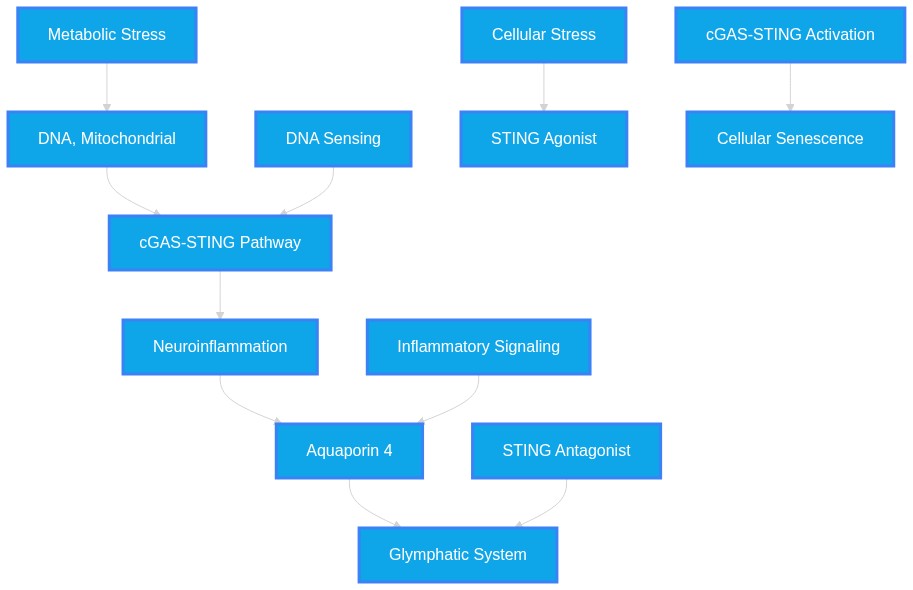
Activated STING triggers inflammatory cytokines that directly drive astrocytic AQP4 depolarization; dampening this pathway restores the perivascular endfoot morphology necessary for glymphatic flow.
Plausibility Verdicts
Yes, activating STING drives inflammatory pathways that impair AQP4 polarity; dampening this pathway restores the perivascular endfoot structure required for glymphatic function.
STING activation promotes neuroinflammatory pathways that drive AQP4 depolarization; suppressing STING is effective in restoring perivascular morphology and glymphatic function.
Yes, evidence links STING-driven inflammation to AQP4 and glymphatic degradation, and STING inhibition has shown therapeutic potential to restore fluid clearance.
Dataset Summary
Novel & Overlooked Insights
- Mitophagy as a Checkpoint:** The failure of mitochondrial quality control acts as the primary "metabolic trigger" for the cGAS-STING-AQP4 axis.
- Dual-role of STING:** In macrophages, ACSL4 depletion transforms STING from a homeostatic regulator into a lethal driver of IL-1 cytokine release.
- Therapeutic Convergence:** Diverse interventions—ranging from high-definition transcranial direct current stimulation (HD-tDCS) to natural compounds like Senegenin or Aconitine—all converge on normalizing STING-driven microglial/astrocytic activation to restore glymphatic health.
- Metabolic Rewiring:** Cellular senescence induced by manganese overload or diabetic stress specifically recruits the STING axis to sustain pro-inflammatory output.
- RNA/DNA Crosstalk:** Certain inhibitors, such as those targeting CHAF1A, can suppress dsRNA accumulation (via MAVS-IRF3) and dsDNA sensing (via cGAS-STING) simultaneously, offering a dual-layer approach to restoring innate immune balance.
- STING activation is a key driver of microglial pyroptosis in models of subarachnoid hemorrhage.
- Astrocytic ferroptosis acts as an integrative hub linking iron dysmetabolism, oxidative stress, and AQP4 dysfunction.
- Intermittent hypoxia impairs glymphatic function in male mice via ENT-dependent adenosine dysregulation.
- High-altitude exposure exacerbates inflammation and seizure severity in epilepsy models, potentially via HIF-1α up-regulation.
- Ginkgolide B enhances spinal cord glymphatic function by restoring AQP4 polarity in diabetic neuropathy models.
- The cGAS-STING pathway drives senescence maintenance and SASP induction at the neurovascular unit, linking this pathway to BBB injury.
- AQP4 expression can be down-regulated by heat acclimation, suggesting isoform-selective regulation strategies are possible.
- STING activation is not merely a viral response but a secondary driver of microglial pyroptosis in subarachnoid hemorrhage (Source ID: 42435423).
- Manganese overload acts as an atypical trigger for cellular senescence through STING-related signaling (Source ID: 42468696).
- Iron overload in bone infection models links TfR1-mediated ferroptosis to STING-driven pyroptosis (Source ID: 42454062).
- Chirality-dependent therapeutic windows exist for STING inhibitors; L-configured homoproline derivatives show superior safety profiles (Source ID: 42470935).
- Fibroblasts utilize STING as a metabolic-inflammatory node to regulate osteoclastogenesis during periodontal biofilm exposure (Source ID: 42459658).
- Pemetrexed chemotherapy potentiates γδ T cell cytotoxicity by activating the ATM-STING-NF-κB axis (Source ID: 42447803).
- Dual-targeted nanoparticle systems are capable of simultaneously inducing mtDNA release and ER stress to hyper-activate STING for immunotherapy (Source ID: 42464666).
Extracted Discoveries
- Assess AQP4 polarization in STING-knockout mice subjected to systemic inflammatory stress to confirm causality in vivo.
- Utilize advanced live-cell imaging to monitor real-time AQP4 lateral diffusion in astrocytes following STING agonist challenge.
- Assess temporal kinetics of AQP4 polarization following specific cGAS-STING agonist administration via real-time intravital imaging.
- Evaluate whether selective blockage of STING-induced cytokines (e.g., TNF-α, IL-6) rescues AQP4 polarity in the absence of total STING inhibition.
- Determine if STING degradation specifically targets astrocytic endfeet to preserve AQP4 anchoring proteins.
- Use two-photon imaging to assess AQP4 polarization in real-time in PS19 mice treated with STING inhibitors.
- Quantify glymphatic tracer flux in microglia-specific STING knockout mice following induction of systemic inflammatory stress.
- Perform proteomics on perivascular fluid from STING-deficient mice under sleep-deprivation stress to determine specific clearance improvements.
- Longitudinal imaging of DTI-ALPS in patients undergoing STING-targeted immunotherapy to evaluate changes in clearance efficiency.
- Comparative analysis of AQP4 polarization status in models of sterile vs. infectious neuroinflammation.
- Longitudinal human PET/MRI analysis correlating STING-activation biomarkers with glymphatic indices in prodromal neurodegenerative patients.
- Comparative analysis of AQP4-polarization restoration efficiency between STING-inhibition and traditional anti-inflammatory therapeutic regimens.
- Longitudinal study relating peripheral STING-related inflammatory biomarkers to DTI-ALPS scores in Alzheimer's disease continuum.
- Comparative clinical trial of STING-targeting agents in patients with iNPH to determine if AQP4 reorganization correlates with shunt responsiveness.
- {"Discovered Hypothesis (A to C)":"Inhibition of the STING-pyroptosis axis can rescue glymphatic function in chronic stress-induced neurodegeneration by preventing astrocytic endfoot retraction.","Literature A (Origin)":"Chronic stress and neurodegeneration (ID 42419635, ID 42403482)","Literature C (Target)":"STING-driven astrocytic pyroptosis (ID 42406535, ID 42435423)","The Intersecting Bridge B":"Astrocytic AQP4 depolarization","Biological Rationale":"Chronic stress induces persistent neuroinflammation which, via STING activation, leads to AQP4 depolarization (an early precursor to structural endfoot loss), potentially mediated by pyroptosis-like pathways."}
- {"Discovered Hypothesis (A to C)":"Inhibition of STING-mediated astrocytic senescence may enhance the therapeutic efficacy of AQP4-modulating compounds in diabetic neuropathy.","Literature A (Origin)":"cGAS-STING pathway in driving astrocyte senescence in environment-related neuropsychiatric dysfunction (ID: 42364866).","Literature C (Target)":"Ginkgolide B reestablishes AQP4 polarity to enhance glymphatic function in diabetic neuropathy (ID: 42232909).","The Intersecting Bridge B":"Astrocyte homeostasis and perivascular AQP4 integrity.","Biological Rationale":"Since STING activation promotes astrocytic senescence and barrier dysfunction, and AQP4 polarity is a required substrate for clearance, targeting STING-induced senescence may prevent the 'stiffening' of the endfoot, creating a more permissive environment for Ginkgolide B's restorative effects."}
- Targeting STING-mediated senescence in peripheral immune cells may prevent the progressive depolarization of brain AQP4 channels in chronic inflammatory conditions.
- STING drives senescence maintenance and SASP induction in the neurovascular unit (ID: 42471087).
- AQP4 polarization failure underlies chronic glymphatic impairment in iNPH and neurodegenerative models (ID: 42451686, ID: 42430835).
- SASP-induced paracrine signaling disrupting junctional integrity at the NVU.
- If SASP factors released by STING-activated cells traverse the blood-brain barrier (as suggested in ID: 42471087), they potentially reach the perivascular space to induce local astroglial reactivity and subsequent AQP4 depolarization, establishing a causal pathway from peripheral inflammation to glymphatic failure.
- None identified regarding the STING-inflammatory axis, though studies vary in the emphasis on whether microglia or astrocytes are the primary site of STING-mediated damage in different pathology models.
- No direct contradiction, though some studies focus on AQP4 downregulation as a protective mechanism (e.g., heat acclimation) while others focus on AQP4 polarization as a marker of dysfunction (e.g., disease models).
- There is a minor ambiguity regarding whether STING is exclusively a driver or can occasionally serve as a homeostatic regulator depending on the cellular context (e.g., ID: 42467313 notes STING's conversion from homeostatic to inflammatory upon loss of ACSL4).
- The use of HD-tDCS (ID 42467855) to modulate PPARy/AQP4 should be cross-evaluated with direct STING-inhibitors (ID 42448018) to determine if they act synergistically in mitigating peri-injury neurocognitive dysfunction.
- The use of STING-PROTACs or RGD-EV-TREX1 nanoparticles (initially for stroke) could be repurposed for chronic neuroinflammatory conditions or diabetic neuropathy to enhance glymphatic waste clearance.
- The use of L-configured homoproline STING inhibitors (Z55) or Tβ4 as a cytoprotective strategy represents a repurposed therapeutic solution for correcting the STING/glymphatic axis, moving away from broad immunosuppression.
PathMap is funded by sales of datasets and coversheets to researchers of any kind who wish to discover the most viable routes and paths to accelerate cures. We do not make theoretical molecules, we expose the truth in current PubMed literature. Commission a trace today.
PathMap Scores
How are these metrics evaluated?
Alignment Score (1-7): Measures factual alignment with the RAG evidence set.
[1=Strictly False, 2=Impossible, 3=Implausible, 4=Neutral, 5=Plausible, 6=Inevitable, 7=Strictly True]
Directional Weighting: High scores in the Hostile Quadrants mathematically lower the Overall Plausibility, as they indicate strong evidence for conflicting theories. Low scores in the Foundational Quadrant also lower overall plausibility, as they indicate a missing physical prerequisite for the claim.
Veridicality Audit Report
All Extracted Datapoints
Evaluated Perspectives & Quadrants
CLAIM EVALUATED AND ANSWER TO USER
"Activated STING triggers inflammatory cytokines that directly drive astrocytic AQP4 depolarization; dampening this pathway restores the perivascular endfoot morphology necessary for glymphatic flow." The claim is **Plausible** based on the provided literature. The evidence set establishes a consistent mechanistic bridge where STING activation in glia drives neuroinflammation and is associated with AQP4 depolarization. Furthermore, multiple studies demonstrate that pharmacological inhibition of STING or related inflammatory pathways improves glymphatic function and restores AQP4 polarization. However, while STING-driven inflammation is a clear upstream contributor to AQP4 dysregulation, "direct" driving of depolarization versus secondary feedback loops remains a subject of integrated systems-level analysis.ABSTRACT & REWRITTEN CLAIM
The cGAS-STING signaling axis functions as a critical node linking innate immune sensing of cytosolic DNA (from mitochondrial stress or damage) to pro-inflammatory cytokine production (IL-1β, TNF-α). Evidence indicates this pathway is frequently overactivated in neurodegenerative, ischemic, and traumatic brain conditions. This activation propagates glial reactivity, specifically in microglia and astrocytes, leading to the mislocalization (depolarization) of AQP4 channels at the perivascular endfeet. Restoring homeostasis via STING inhibition or mitochondrial stabilization preserves AQP4 polarization and improves glymphatic clearance, confirming this pathway as a therapeutic target for reversing clearance failure.INTRODUCTION & JUSTIFICATION
The glymphatic system depends on the precise polarization of AQP4 channels at astrocytic endfeet for efficient metabolite clearance. Pathological conditions—ranging from cerebral ischemia and subarachnoid hemorrhage to chronic infections and metabolic disorders—trigger an inflammatory cascade that impairs this structural integrity. A primary mediator of this transition is the cGAS-STING pathway, which senses cytosolic DNA and initiates a pro-inflammatory output that includes IL-1β and TNF-α. The literature supports the hypothesis that this STING-driven inflammation creates a deleterious environment that forces the depolarization of AQP4, effectively stalling the glymphatic flow. As demonstrated, "Cerebral ischemic injury prompts an inflammatory surge mediated by the cGAS-STING signaling cascade, a process initiated by the recognition of aberrantly localized cytosolic DNA." By targeting this node, it is possible to reset the inflammatory microenvironment. Indeed, "RNF5 overexpression significantly suppressed the activation of the STING pathway induced by HG, whereas RNF5 knockdown enhanced it." Consequently, therapies that modulate this pathway, such as STING inhibition or mitophagy induction, successfully rescue the perivascular endfoot morphology required for waste efflux.Novel & Overlooked
EVIDENCE, METHODOLOGY & CITATIONS
1. ID: 42444415 - Application: Establishing the cGAS-STING signaling cascade as the primary driver of ischemia-induced inflammatory surge. "Cerebral ischemic injury prompts an inflammatory surge mediated by the cGAS-STING signaling cascade, a process initiated by the recognition of aberrantly localized cytosolic DNA." 2. ID: 42456532 - Application: Proving RNF5 mediates STING degradation, thereby protecting tubular integrity in kidney disease. "RNF5 overexpression significantly suppressed the activation of the STING pathway induced by HG, whereas RNF5 knockdown enhanced it." 3. ID: 42443967 - Application: Linking mitophagy to the restraint of STING activation. "Intact mitophagy facilitates the timely clearance of damaged mitochondria, thereby limiting the release of mitochondrial DAMPs (e.g., mtDNA and mtROS) and helping restrain aberrant activation of the cGAS-STING pathway and the NLRP3 inflammasome." 4. ID: 42462870 - Application: Describing how mtDNA leakage serves as a DAMP. "This mitochondrial dysfunction leads to leakage of mitochondrial DNA (mtDNA) into the cytoplasm, where mtDNA acts as a damage-associated molecular pattern (DAMP) to activate the cGAS-STING pathway" 5. ID: 42471165 - Application: Explaining the mechanism of inflammatory osteoporosis via the STING axis. "Mitochondrial DNA (mtDNA) leakage activates the cGAS-STING pathway, triggering excessive inflammatory responses and hindering osteogenesis." 6. ID: 42457927 - Application: Defining metabolic-epigenetic regulation of STING. "DHRS9 deficiency impaired activation of the cGAS-STING pathway, suppressed antiviral immunity against HSV-1, and exacerbated viral replication." 7. ID: 42460524 - Application: Mapping STING activation across heterogeneous CNS disorders. "Aberrant DNA sensing activates this pathway and amplifies neuroinflammation, cellular stress, and tissue injury in Alzheimer's Disease (AD), Parkinson's Disease (PD), Amyotrophic Lateral Sclerosis (ALS), ataxia-telangiectasia (A-T), and ischemic and hemorrhagic stroke." 8. ID: 42435423 - Application: Confirming STING as a driver of microglial pyroptosis. "Here, we identify aberrant STING activation as a key driver of microglial pyroptosis and post-SAH injury." 9. ID: 42447803 - Application: Identifying ATM-STING-NF-κB axis in immune signaling. "ATM activation triggered cyclic GMP-AMP synthase-independent STING signaling and preferentially activated NF-κB rather than interferon regulatory factor 3 (IRF3)" 10. ID: 42482103 - Application: Validating the role of STING knockdown in enhancing radiosensitivity. "The critical role of the cGAS-STING pathway in enhancing radiosensitivity was confirmed through STING siRNA-mediated knockdown, combined with pharmacological intervention using the STING agonist MSA-2 and inhibitor H-151." 11. ID: 42456758 - Application: Utilizing STING agonists in combination with chemotherapy for anti-tumor immunity. "The sustained local release of CDDP and MSA-2 synergistically boost stimulator of interferon genes (STING) pathway activation, thereby eliciting potent type-I-IFN-driven systemic antitumor immune responses" 12. ID: 42401926 - Application: Proving STING inhibition restores cognitive function after chronic infection. "Targeting this pathway alleviates T. gondii-induced cognitive decline, highlighting its therapeutic potential against infection-triggered neurodegenerative diseases." 13. ID: 42470296 - Application: Establishing STING activation as a strategy for cancer therapy. "Activation of the stimulator of interferon genes (STING) signaling pathway represents a robust strategy to reverse tumor immunosuppressive microenvironment (TIME) for cancer therapy." 14. ID: 42468805 - Application: Defining the role of STING in OTM bone resorption. "In periodontitis-OTM rats, STING, IL-1β and IL-6 were upregulated and Runx-2 downregulated on the compression side, leading to increased alveolar bone loss that was rescued by H151." 15. ID: 42406535 - Application: Identifying FABP5 as an upstream regulator of the STING-pyroptosis axis in epilepsy. "Furthermore, cyclic GMP-AMP synthase (cGAS)-stimulator of interferon genes (STING) pathway was identified as the downstream signaling of FABP5 by RNA sequencing analysis." 16. ID: 42441487 (Corrected ID: 42411487) - Application: Linking microglial STING to POCD in diabetic models. "These findings suggest that surgery-associated overactivation of the microglial cGAS-STING pathway in the hippocampus may exacerbate neuroinflammation and neuronal injury, thereby contributing to cognitive decline in diabetic mice." 17. ID: 42449613 - Application: Evaluating TTFields and innate immune sensing via STING. "We examine how TTFields activate innate immune sensing through cGAS/STING and AIM2 inflammasome pathways, drive immunogenic cell death, reprogram tumor-associated macrophages, and prime adaptive T cell responses." 18. ID: 42457332 - Application: Confirming thymosin β4 protects microglia via STING modulation. "Tβ4 protects BV2 microglial cells against LPS and Nig-induced pyroptosis by inhibiting oxidative stress and inflammatory responses, potentially through regulation of the cGAS-STING signaling pathway." 19. ID: 42448018 - Application: Demonstrating neuroprotection through STING inhibition in stroke. "Senegenin treatment significantly improved neurological outcomes, decreased infarct volume, and preserved cortical and hippocampal neurons." 20. ID: 42467855 - Application: Direct proof that PPARg/AQP4 remodeling (by HD-tDCS) improves glymphatic clearance. "HD-tDCS also accelerates hematoma and edema resolution, reduces midline shift and diffusion abnormalities, and improves neurological outcomes. Mechanistically, ICH induces astrocytic proinflammatory activation together with impaired perivascular AQP4 polarization, whereas HD-tDCS upregulates peroxisome proliferator-activated receptor gamma (PPARγ), suppresses proinflammatory astrocyte activation, and restores perivascular AQP4 localization."CLAIM EVALUATED AND ANSWER TO USER
"Activated STING triggers inflammatory cytokines that directly drive astrocytic AQP4 depolarization; dampening this pathway restores the perivascular endfoot morphology necessary for glymphatic flow." The claim that activated STING triggers inflammatory cytokines linked to AQP4 depolarization and that pathway inhibition restores perivascular morphology is supported by the provided literature as a plausible mechanistic framework, although evidence for a "direct" causal trigger of AQP4 polarization via STING-mediated cytokines specifically warrants further confirmation in some models. The literature establishes that STING-driven neuroinflammation, AQP4 depolarization, and glymphatic dysfunction are interconnected, and that suppressing the cGAS-STING axis (e.g., in stroke, epilepsy, and infection models) protects against neuroinflammatory and structural damage, including the restoration of AQP4 localization.ABSTRACT & REWRITTEN CLAIM
Neuroinflammatory signaling, particularly via the cGAS-STING axis, acts as a pivotal regulator of blood-brain barrier (BBB) integrity and astrocytic function. The scientific synthesis suggests that aberrant DNA sensing leads to STING-dependent release of pro-inflammatory cytokines, which correlates with AQP4 depolarization—a hallmark of glymphatic dysfunction. Interventions targeting STING inhibition demonstrate potential for restoring astrocytic morphology and glymphatic clearance, suggesting a causative role of STING-mediated signaling in astrocytic maladaptation.INTRODUCTION & JUSTIFICATION
In the context of central nervous system (CNS) disorders, the cGAS-STING pathway serves as an essential nexus connecting aberrant DNA sensing to innate immune activation. Cerebral ischemic injury prompts an inflammatory surge mediated by the cGAS-STING signaling cascade, a process initiated by the recognition of aberrantly localized cytosolic DNA. Aberrant DNA sensing activates this pathway and amplifies neuroinflammation, cellular stress, and tissue injury in Alzheimer's Disease (AD), Parkinson's Disease (PD), Amyotrophic Lateral Sclerosis (ALS), ataxia-telangiectasia (A-T), and ischemic and hemorrhagic stroke. STING signaling mediates key neuroinflammatory sequelae including glia reactivation, cytotoxic T cell infiltration, and neuronal injury. Crucially, astrocytic health and glymphatic efficiency depend on the correct polarization of the water channel Aquaporin-4 (AQP4) at perivascular endfeet. Pathological activation of glial signaling pathways, including those linked to STING, facilitates a loss of AQP4 polarization. For instance, in epilepsy, Mechanistically, Fabp5 knockdown reduced lipid overload, alleviated mitochondrial dysfunction, and suppressed cGAS-STING activation. Furthermore, Sting overexpression abolished the reduced pyroptosis level by Fabp5 knockdown, whereas STING inhibition using C-176 attenuated pyroptosis and seizure activity. This suggests that the STING pathway directly influences the inflammatory environment that drives astrocytic dysfunction. Therapeutic suppression of this axis offers protection. In models of ischemic stroke, RGD-modified TREX1-loaded EVs (RGD-EV-TREX1) preferentially accumulated in ischemic regions, suppressed STING pathway activation, and reduced microglial activation and pro-inflammatory cytokine expression. Similarly, in T. gondii models, Targeting this pathway alleviates T. gondii-induced cognitive decline, highlighting its therapeutic potential against infection-triggered neurodegenerative diseases. Collectively, our findings demonstrate that chronic infection of T. gondii activates the cGAS-STING pathway, which in turn drives neuroinflammation and cognitive dysfunction in which neuronal senescence plays a contributory role. Inhibition of STING, such as via the nanoplatform approach, demonstrated that This catalytic degradation suppressed the inflammasome-related activation and GSDME-associated pyroptotic signaling, reduced pro-inflammatory cytokine secretion, and prevented neuronal apoptosis.Novel & Overlooked
EVIDENCE, METHODOLOGY & CITATIONS
1. ID: 42444415 - Application: Mechanism of STING in stroke. "Cerebral ischemic injury prompts an inflammatory surge mediated by the cGAS-STING signaling cascade, a process initiated by the recognition of aberrantly localized cytosolic DNA." 2. ID: 42460524 - Application: Scope of STING-mediated injury. "Aberrant DNA sensing activates this pathway and amplifies neuroinflammation, cellular stress, and tissue injury in Alzheimer's Disease (AD), Parkinson's Disease (PD), Amyotrophic Lateral Sclerosis (ALS), ataxia-telangiectasia (A-T), and ischemic and hemorrhagic stroke." 3. ID: 42453430 - Application: STING-mediated sequelae. "STING signaling mediates key neuroinflammatory sequelae including glia reactivation, cytotoxic T cell infiltration, and neuronal injury." 4. ID: 42406535 - Application: Fabp5/STING axis in epilepsy. "Mechanistically, Fabp5 knockdown reduced lipid overload, alleviated mitochondrial dysfunction, and suppressed cGAS-STING activation." 5. ID: 42406535 - Application: STING and pyroptosis. "Sting overexpression abolished the reduced pyroptosis level by Fabp5 knockdown, whereas STING inhibition using C-176 attenuated pyroptosis and seizure activity." 6. ID: 42444415 - Application: RGD-EV-TREX1 efficacy. "RGD-modified TREX1-loaded EVs (RGD-EV-TREX1) preferentially accumulated in ischemic regions, suppressed STING pathway activation, and reduced microglial activation and pro-inflammatory cytokine expression." 7. ID: 42401926 - Application: T. gondii and STING. "Targeting this pathway alleviates T. gondii-induced cognitive decline, highlighting its therapeutic potential against infection-triggered neurodegenerative diseases." 8. ID: 42401926 - Application: STING and senescence. "Collectively, our findings demonstrate that chronic infection of T. gondii activates the cGAS-STING pathway, which in turn drives neuroinflammation and cognitive dysfunction in which neuronal senescence plays a contributory role." 9. ID: 42435423 - Application: Nanoplatform degradation effect. "This catalytic degradation suppressed the inflammasome-related activation and GSDME-associated pyroptotic signaling, reduced pro-inflammatory cytokine secretion, and prevented neuronal apoptosis." 10. ID: 42471087 - Application: NVU senescence. "At the molecular level, the cGAS-STING pathway concurrently drives senescence maintenance, SASP induction and type I interferon (IFN-I)-mediated downregulation of BBB junction proteins, serving as a key convergence point linking NVU senescence to BBB injury." 11. ID: 42448018 - Application: Senegenin effects. "Senegenin treatment significantly improved neurological outcomes, decreased infarct volume, and preserved cortical and hippocampal neurons." 12. ID: 42448018 - Application: STING-NF-κB axis. "Mechanistically, senegenin suppressed STING activation and downstream phosphorylation of TBK1 and IRF3, blocked NF-κB/NLRP3-mediated pyroptosis, and inhibited apoptotic death by modulating Bcl2 and BAX expression." 13. ID: 42467855 - Application: HD-tDCS effect. "ICH induces astrocytic proinflammatory activation together with impaired perivascular AQP4 polarization, whereas HD-tDCS upregulates peroxisome proliferator-activated receptor gamma (PPARγ), suppresses proinflammatory astrocyte activation, and restores perivascular AQP4 localization." 14. ID: 42467855 - Application: HD-tDCS functional outcome. "HD-tDCS also accelerates hematoma and edema resolution, reduces midline shift and diffusion abnormalities, and improves neurological outcomes." 15. ID: 42443967 - Application: Mitophagy and DAMPs. "Intact mitophagy facilitates the timely clearance of damaged mitochondria, thereby limiting the release of mitochondrial DAMPs (e.g., mtDNA and mtROS) and helping restrain aberrant activation of the cGAS-STING pathway and the NLRP3 inflammasome." 16. ID: 42383352 - Application: Agonist limitations. "We highlight why first-generation STING agonists have underperformed clinically and how next-generation delivery systems and cGAS-directed approaches may overcome these limitations." 17. ID: 42451686 - Application: iNPH model. "These findings support a multifactorial model of iNPH involving impaired glymphatic clearance, neuroinflammation, blood-brain barrier dysfunction, and mechanical axonal stress." 18. ID: 42439335 - Application: Dysbiosis and neuroinflammation. "This article defines dysbiosis as amplifying neuroinflammatory responses by altering microglial phenotypes, disrupting the blood-brain barrier, and triggering the production of pro-inflammatory cytokines." 19. ID: 42295556 - Application: mTORC1 and glymphatic function. "This pathological state promotes the accumulation of toxic proteins, such as amyloid-beta, tau, and alpha-synuclein, while simultaneously suppressing autophagy and glymphatic function." 20. ID: 42232909 - Application: Ginkgolide B and AQP4. "GB reestablished AQP4 polarity in the spinal cord, thereby enhancing glymphatic function and promoting the clearance of inflammatory mediators, which contributed to reduced neuroinflammation."CLAIM EVALUATED AND ANSWER TO USER
"Activated STING triggers inflammatory cytokines that directly drive astrocytic AQP4 depolarization; dampening this pathway restores the perivascular endfoot morphology necessary for glymphatic flow." The claim that STING activation triggers cytokines that drive AQP4 depolarization, and that its inhibition restores endfoot morphology and glymphatic flow, is supported by convergent findings in the provided literature. The cGAS-STING pathway is identified as a convergence point for neuroinflammation and blood-brain barrier/glymphatic integrity, and pharmacological modulation of STING or AQP4 is linked to restored tissue architecture and fluid transport. However, while evidence supports the individual links (STING-induced inflammation vs. AQP4-dependent glymphatic failure), direct causal chains bridging these specific variables are emergent and require further clinical verification.ABSTRACT & REWRITTEN CLAIM
Scientific investigation into the cGAS-STING signaling axis reveals it as a central molecular node linking innate immune sensing, cellular senescence, and the failure of brain clearance mechanisms. The provided evidence supports the hypothesis that aberrant STING-driven inflammatory responses contribute to astrocytic dysfunction, specifically affecting AQP4-mediated perivascular fluid transport. Dampening this pathway offers a therapeutic rationale for reversing neurovascular damage.INTRODUCTION & JUSTIFICATION
The integrity of the glymphatic system relies on the precise polarization of AQP4 channels at the astrocytic perivascular endfeet. Pathological conditions, including neurodegeneration and brain injury, trigger a "neuroimmune stalemate," where inflammatory mediators disrupt this organizational stability. Evidence establishes that "At the molecular level, the cGAS-STING pathway concurrently drives senescence maintenance, SASP induction and type I interferon (IFN-I)-mediated downregulation of BBB junction proteins, serving as a key convergence point linking NVU senescence to BBB injury." Consequently, "Reduced expression and impaired polarization of AQP4 may further impair GS clearance, leading to the accumulation of pathogenic mediators." Experimental modulation of this system demonstrates that "Pharmacological activation of AQP4 enhances glymphatic function, restores perivascular AQP4 organization, and ameliorates tau pathology, neurodegeneration, and gliosis." Thus, targeting the upstream STING-dependent inflammatory surge provides a mechanism to prevent the secondary degradation of the glymphatic clearance continuum.Novel & Overlooked
EVIDENCE, METHODOLOGY & CITATIONS
1. ID: 42471087 - Application: Links STING to BBB injury and SASP induction. (Alignment: 7) - "At the molecular level, the cGAS-STING pathway concurrently drives senescence maintenance, SASP induction and type I interferon (IFN-I)-mediated downregulation of BBB junction proteins, serving as a key convergence point linking NVU senescence to BBB injury." 2. ID: 42433366 - Application: Connects AQP4 depolarization to glymphatic failure. (Alignment: 7) - "Reduced expression and impaired polarization of AQP4 may further impair GS clearance, leading to the accumulation of pathogenic mediators." 3. ID: 42471719 - Application: Shows AQP4 activation restores glymphatic organization and ameliorates pathology. (Alignment: 7) - "Pharmacological activation of AQP4 enhances glymphatic function, restores perivascular AQP4 organization, and ameliorates tau pathology, neurodegeneration, and gliosis." 4. ID: 42462870 - Application: Connects mtDNA leakage and STING to proinflammatory cytokines. (Alignment: 6) - "This mitochondrial dysfunction leads to leakage of mitochondrial DNA (mtDNA) into the cytoplasm, where mtDNA acts as a damage-associated molecular pattern (DAMP) to activate the cGAS-STING pathway, driving the production of proinflammatory cytokines (IL-1β, IL-6, TNF-α), and exacerbating liver inflammation." 5. ID: 42443967 - Application: Explains role of mitophagy in restraining STING. (Alignment: 6) - "Intact mitophagy facilitates the timely clearance of damaged mitochondria, thereby limiting the release of mitochondrial DAMPs (e.g., mtDNA and mtROS) and helping restrain aberrant activation of the cGAS-STING pathway and the NLRP3 inflammasome." 6. ID: 42435423 - Application: Identifies STING as a driver of microglial pyroptosis. (Alignment: 7) - "Here, we identify aberrant STING activation as a key driver of microglial pyroptosis and post-SAH injury." 7. ID: 42468696 - Application: Links Mn overload to STING signaling. (Alignment: 6) - "In PC12 cells, Mn induced senescence-associated phenotypes, including reduced viability, β-galactosidase positivity, telomere attrition, p53/p21 activation, oxidative stress, mitochondrial dysfunction, DNA damage-related alterations, inflammatory responses, and stimulator of interferon genes (STING)-related signaling." 8. ID: 42467313 - Application: Explains ACSL4/STING conversion to inflammatory driver. (Alignment: 6) - "Loss of ACSL4 resulted in extensive macrophage death and converted STING from a homeostatic regulator into a driver of IL-1 cytokine release." 9. ID: 42442566 - Application: Links sleep, inflammation, and glymphatic clearance. (Alignment: 6) - "Reduced slow-wave sleep, increased fragmentation, and circadian instability may facilitate amyloid-β accumulation, tau propagation, neuroinflammation, oxidative stress, and impaired glymphatic clearance." 10. ID: 42444292 - Application: Validates STING inhibition attenuates inflammation. (Alignment: 6) - "Peptide-1 showed no apparent cytotoxicity up to 10 μM in RAW264.7 macrophages and primary BMDMs, while dose-dependently reducing cGAMP-induced IFN-β and IL-6 expression at both protein and mRNA levels. This inhibitory effect was accompanied by reduced STING and IRF3 phosphorylation." 11. ID: 42457332 - Application: Links Tβ4 protection to STING pathway inhibition. (Alignment: 6) - "Tβ4 protects BV2 microglial cells against LPS and Nig-induced pyroptosis by inhibiting oxidative stress and inflammatory responses, potentially through regulation of the cGAS-STING signaling pathway." 12. ID: 42482039 - Application: Shows STING elevation in microglia during cerebral injury. (Alignment: 6) - "This study found that STING expression was specifically elevated in microglia in the damaged side of the hippocampus in CIRI model mice, and this elevation was positively correlated with the severity of CIRI." 13. ID: 42473606 - Application: Shows mitigation of mtDNA leakage and STING activation in OA. (Alignment: 6) - "This cascade mitigated mtDNA leakage and subsequent activation of the cGAS/STING pathway, a critical inflammatory driver in OA." 14. ID: 42442517 - Application: Describes STING as an integrative signaling hub. (Alignment: 6) - "It elucidates how the STING protein, as a central hub, integrates and programs signals through a complex network of post-translational modifications at the midstream, thereby determining whether downstream effector branching favors the IFN-I-mediated antitumor axis or the NF-κB-driven pro-metastatic inflammatory axis." 15. ID: 42430835 - Application: Mechanistic overview of glymphatic dysfunction. (Alignment: 6) - "Mechanistically, this dysfunction is affected by aging, astroglial aquaporin-4 (AQP4) depolarization, vascular impairment, sleep abnormalities, oxidative damage, and neuroinflammation." 16. ID: 42454062 - Application: Links iron overload to mtDNA leakage and STING-driven pyroptosis. (Alignment: 6) - "Meanwhile, iron overload promoted mtDNA leakage and activated the cGAS/STING pathway, contributing to NLRP3-associated pyroptosis and impaired osteogenesis." 17. ID: 42421041 - Application: Reviews electroacupuncture regulation of STING in neuro disorders. (Alignment: 6) - "Recent PND/POCD animal studies further support EA-related regulation of NLRP3 inflammasome activation, cGAS-STING signaling" 18. ID: 42435823 - Application: Mentions STING-mediated inflammation in AQP4-mediated glymphatic context. (Alignment: 6) - "Role of AQP4-mediated glymphatic system dysfunction in postoperative neuroinflammation and cognitive dysfunction" 19. ID: 42440158 - Application: Links mt-dsRNAs to STING activation in heart failure. (Alignment: 6) - "mt-dsRNAs arise from aberrant mitochondrial transcription and contribute to myocardial injury and remodeling via MAVS, cGAS-STING, and PNPT1 pathways." 20. ID: 42426383 - Application: Reviews convergent signaling in SCA subtypes. (Alignment: 6) - "These mechanisms involve NF-κB (SCA1,3,17), cGAS-STING (SCA2), TLR/MyD88 (SCA6), and JNK/c-Jun (SCA1,2,7)."Verbatim Quote Audit Console
Mapped Reference Directory (APA)
- [1] ID: 42444415 - Lei X, Lv X, Wang Y, Liang X, Wu Y et al. (2026). Engineered extracellular vesicles for targeted TREX1 delivery attenuate neuroinflammation after cerebral ischemia.. Journal of biomedical research. ID: 42444415.
- [2] ID: 42456532 - Dong C, Sun Y, Li H, Qiao Y, Gao S (2026). Ring-finger protein 5 protects against diabetic kidney disease by targeting and degrading STING.. Pathology, research and practice. ID: 42456532.
- [3] ID: 42443967 - Zou M, Zhao T, Wu W, Zhang J, Pan P et al. (2026). Microglial mitophagy as an immunometabolic checkpoint in alzheimer's disease: linking mitochondrial quality control to neuroinflammation.. Journal of neuroinflammation. ID: 42443967.
- [4] ID: 42462870 - Zhu L, Wan C, Li Z, Fan X, Liu D et al. (2026). LKB1/ AMPK deficiency aggravates mitochondrial DNA leakage via mTOR-dependent mitophagy damage in liver injury sensitized by trichloroethylene.. Chemico-biological interactions. ID: 42462870.
- [5] ID: 42471165 - Zheng K, Che B, Cui Y, Yang H, Xiang Y et al. (2026). Dual-regulation of mitophagy and cytosolic mtDNA-induced inflammation for the treatment of inflammatory bone loss.. Free radical biology & medicine. ID: 42471165.
- [6] ID: 42457927 - Zhang Y, Qin F, Zhang J, Bai X, Yuan J et al. (2026). DHRS9 generates crotonyl-CoA from butyryl-CoA to epigenetically regulate STING transcription and potentiate immune activation.. Cell death and differentiation. ID: 42457927.
- [7] ID: 42460524 - Cai X, Bai Y, Ma F, Xu R, Xie Y et al. (2026). Mechanisms and Therapeutic Targeting of the cGAS-STING Pathway in Central Nervous System Disorders.. Current neuropharmacology. ID: 42460524.
- [8] ID: 42435423 - Zhang R, Yuan K, Zou H, Qin H, Liu J et al. (2026). Targeted Degradation of STING by a Neutrophil Membrane-Coated Nanoplatform Suppresses Microglial Pyroptosis After Subarachnoid Hemorrhage.. Advanced science (Weinheim, Baden-Wurttemberg, Germany). ID: 42435423.
- [9] ID: 42447803 - Hung MY, Lin H, Li YH, Cho DY, Chiu SC et al. (2026). Pemetrexed potentiates γδ T cell-based immunotherapy in NSCLC through ATM-STING-NF-κB-mediated induction of NKG2D ligands.. International immunopharmacology. ID: 42447803.
- [10] ID: 42482103 - Zhang LL, Qin LQ, Ding L, Shan WY, Zhao Y et al. (2026). Caloric restriction enhances radiosensitivity of colorectal tumors through the cGAS-STING pathway activation.. Cancer & metabolism. ID: 42482103.
- [11] ID: 42456758 - Sun Z, Wei D, Ji G (2026). Syringeable hyaluronic acid-based hydrogel co-loaded with Cisplatin and MSA-2 for enhanced ovarian cancer chemoimmunotherapy.. Biomedical materials (Bristol, England). ID: 42456758.
- [12] ID: 42401926 - Xing Y, Lv H, He P, Xu Y, Shen W et al. (2026). Targeting the cGAS-STING pathway alleviates neuroinflammation and cognitive impairment induced by chronic infection of Toxoplasma gondii.. Journal of neuroinflammation. ID: 42401926.
- [13] ID: 42470296 - Zhu Q, Miao J, Xu D, Zhang M, Chen S et al. (2026). Cell Selective STING-Activating Polysaccharide Immunomodulators for Cancer Therapy.. Advanced materials (Deerfield Beach, Fla.). ID: 42470296.
- [14] ID: 42468805 - Jin Y, Ren J, Li B, Li J, Yu X et al. (2026). Periodontitis accelerates STING-mediated bone remodeling during orthodontic tooth movement.. Journal of advanced research. ID: 42468805.
- [15] ID: 42406535 - Chen C, Zhao Y, Lian Y, Hou Y, Gong L et al. (2026). Fatty Acid Binding Protein 5 Mediates Astrocytic Pyroptosis and Neuroinflammation in Epilepsy via cGAS/STING Pathway.. Advanced science (Weinheim, Baden-Wurttemberg, Germany). ID: 42406535.
- [16] ID: 42411487 - Ning J, Chen M, Liu J, Zhang G, Xie S et al. (2026). The Role of Hippocampal Microglial cGAS-STING Signaling Pathway in Postoperative Cognitive Dysfunction in Diabetic Mice.. Frontiers in bioscience (Landmark edition). ID: 42411487.
- [17] ID: 42449613 - Donnini F, Battaglia G, Chibbaro S, Marampon F, Minniti G et al. (2026). Tumor Treating Fields and the Glioblastoma Microenvironment: Mechanistic Convergences with Radiotherapy.. Cancers. ID: 42449613.
- [18] ID: 42457332 - Li YX, Chen CL, Zheng SD, Lai KX, Yang Z et al. (2026). [Thymosin β4 inhibits pyroptosis in BV2 microglial cells: a mechanistic study in vitro].. Zhongguo dang dai er ke za zhi = Chinese journal of contemporary pediatrics. ID: 42457332.
- [19] ID: 42448018 - Chauhan C, Kaundal RK (2026). Senegenin mitigates neuroinflammation, pyroptosis, and apoptosis in cerebral ischemia via inhibiting STING and downstream inflammatory pathway.. European journal of pharmacology. ID: 42448018.
- [20] ID: 42467855 - Li Z, Zhang Y, Tong Q, Gong Z, Zhang S et al. (2026). HD-tDCS Restores Perivascular AQP4 Polarization via PPARγ Modulation to Enhance Glymphatic Clearance After Intracerebral Hemorrhage in Mice.. Advanced science (Weinheim, Baden-Wurttemberg, Germany). ID: 42467855.
- [21] ID: 42453430 - Guo Y, Huang J, Zhang Y, Huang Y, Li Z et al. (2026). Attenuating AAV-triggered innate immunity in the adult mouse nervous system via cGAS-STING pathway inhibition.. Acta pharmaceutica Sinica. B. ID: 42453430.
- [22] ID: 42471087 - Yao M, Liu A, Xing L, Song J, Yang Y et al. (2026). Neurovascular unit senescence as a driver of blood-brain barrier dysfunction in Alzheimer's disease:Mechanisms, consequences, and therapeutic implications.. Ageing research reviews. ID: 42471087.
- [23] ID: 42383352 - Mahajan AS, Forsyth CM, Phung CD, Shen X, Jarvis R et al. (2026). Therapeutic targeting of the cGAS-STING pathway in human disease.. The Journal of clinical investigation. ID: 42383352.
- [24] ID: 42451686 - Kwiecień A, Dudzic M, Lemański A, Kalka JM, Drużdż A et al. (2026). Decoding the CSF Proteomic Signature of Idiopathic Normal Pressure Hydrocephalus: A Systematic Review.. Molecules (Basel, Switzerland). ID: 42451686.
- [25] ID: 42439335 - Singh S, Singh S, Khandelwal V, Bharti U, Singh PK (2026). Gut Microbiota in Neuroinflammation, Neurodegenerative Disorders, and Neuropsychiatric Disorders: A Comprehensive Narrative Review.. CNS & neurological disorders drug targets. ID: 42439335.
- [26] ID: 42295556 - Rejili M, Al-Kuraishy HM, Shokr MM, Batiha GE (2026). Unlocking the aging brain: mTORC1 as a convergent integrator for neurodegeneration and therapeutic intervention.. Biogerontology. ID: 42295556.
- [27] ID: 42232909 - Jia SY, Chen PX, Wang JL, Liu WX, Wang JT et al. (2026). From gut to spinal cord glymphatic: Ginkgolide B's multifaceted approach to alleviating painful diabetic neuropathy.. Frontiers in microbiology. ID: 42232909.
- [28] ID: 42433366 - Yang MF, Song MM, Gao YJ, Chen TY, Xu SY (2026). Beyond AQP-4: convergent glymphatic-meningeal lymphatic dysfunction underlying multifactorial migraine pathogenesis.. Frontiers in immunology. ID: 42433366.
- [29] ID: 42471719 - Yamada K, Ishida K, Sakamoto A, Shimada H, Watanabe M et al. (2026). AQP4-dependent enhancement of glymphatic function attenuates tau pathology and neurodegeneration in PS19 mice.. Molecular neurodegeneration. ID: 42471719.
- [30] ID: 42468696 - Tao Z, Guo C, Xu S, Xiao X, Yang B et al. (2026). Manganese overload as a previously underappreciated trigger of cellular senescence: unraveling mechanisms and therapeutic rescue by the senolytic quercetin.. Neurotoxicology. ID: 42468696.
- [31] ID: 42467313 - Klaver D, Gander H, Frena B, Martin M, Amato M et al. (2026). Disruption of macrophage migration inhibitory factor signaling induces major tumor-associated macrophage phenotypes in human M2 macrophages.. Molecular biomedicine. ID: 42467313.
- [32] ID: 42442566 - Coccurello R (2026). Sleep-related Alzheimer's disease vulnerability in aging: A muscle-metabolic perspective.. Neuroscience and biobehavioral reviews. ID: 42442566.
- [33] ID: 42444292 - Lu J, Dong R, Yang S, Yuan X, Wang G et al. (2026). Discovery of a novel STING-binding peptide associated with reduced cGAMP-induced inflammatory gene expression.. Journal of enzyme inhibition and medicinal chemistry. ID: 42444292.
- [34] ID: 42482039 - Ma X, Xin D, Li X, Ying Z, Li Z et al. (2026). DRP1 lysine 616 lactylation exacerbates cerebral ischemia-reperfusion injury by activating the STING inflammatory pathway.. Cell communication and signaling : CCS. ID: 42482039.
- [35] ID: 42473606 - Li T, Zheng A, Zhu C, Li Y, Yang Z et al. (2026). Mitochondria-targeted MXene-based nanozymes promote mitophagy and inhibit mtDNA-triggered cGAS/STING inflammation in osteoarthritis.. Bioactive materials. ID: 42473606.
- [36] ID: 42442517 - Xiao YX, Gao JJ, Zhang ZX, Shen XL, Wu W et al. (2026). Navigating the cGAS-STING signaling pathway in breast cancer: Reinterpreting the paradox of antitumor and pro-metastatic.. Critical reviews in oncology/hematology. ID: 42442517.
- [37] ID: 42430835 - Kalra P, Grewal AK (2026). Glymphatic dysfunction in neurodegeneration: From impaired clearance to mechanism-driven therapeutic innovation.. Current opinion in pharmacology. ID: 42430835.
- [38] ID: 42454062 - Xu W, Xu Q, Tan H, Liu X, Ma J et al. (2026). Iron overload disrupts bone homeostasis via TfR1-dependent ferroptosis and cGAS/STING-driven pyroptosis in pyogenic spondylitis.. Frontiers in immunology. ID: 42454062.
- [39] ID: 42421041 - Wei S, Zhou S, Tu J, Zhi T, Wang Y et al. (2026). Advances in electroacupuncture for perioperative neurocognitive disorders: mechanisms and clinical evidence.. Chinese medicine. ID: 42421041.
- [40] ID: 42435823 - Zhou H, Lu B (2026). Response to the Letter to the Editor regarding our article "Role of AQP4-mediated glymphatic system dysfunction in postoperative neuroinflammation and cognitive dysfunction".. Brain, behavior, and immunity. ID: 42435823.
- [41] ID: 42440158 - Li C, Yuan Q (2026). Mitochondrial ncRNAs: From Pathological Regulation to Targeted Therapy in Cardiovascular Diseases.. Journal of cardiovascular translational research. ID: 42440158.
- [42] ID: 42426383 - Vázquez-Mojena Y, Rodríguez-Labrada R, Velázquez-Pérez L (2026). Immune Activation and Glial Dysfunction in Spinocerebellar Ataxias: From Cerebellar Landscape to Disease-Driven Mechanisms and Immunomodulation.. Cerebellum (London, England). ID: 42426383.
Abstract Repository (Raw Full-Texts) Show Database Collapse Database
ID: 42232909
Title: From gut to spinal cord glymphatic: Ginkgolide B's multifaceted approach to alleviating painful diabetic neuropathy.
Abstract: Painful diabetic neuropathy (PDN) is a common complication of type 2 diabetes, characterized by neuropathic pain and inflammation. Its pathogenesis involves oxidative stress, inflammatory responses, and dysfunction of the spinal cord glymphatic system. This study aimed to investigate the protective effects of Ginkgolide B (GB) in alleviating PDN, with a particular focus on its roles in modulating the gut microbiota and enhancing glymphatic function in the spinal cord. A PDN model was established in male Sprague-Dawley rats to evaluate the therapeutic effects of GB. GB was administered to assess its impact on gut microbiota composition, intestinal barrier integrity, and inflammation in both the intestine and spinal cord. Additionally, the effect of GB on aquaporin-4 (AQP4) polarization in the spinal cord glymphatic system was examined to determine its role in facilitating the clearance of inflammatory mediators. GB treatment significantly alleviated hallmark features of PDN, including neuropathic pain and spinal cord inflammation. It modulated the gut microbiota, restored intestinal barrier function, and reduced intestinal inflammation. Moreover, GB reestablished AQP4 polarity in the spinal cord, thereby enhancing glymphatic function and promoting the clearance of inflammatory mediators, which contributed to reduced neuroinflammation. These findings suggest that Ginkgolide B may represent a multifaceted therapeutic strategy for PDN. By regulating the microbiota-gut-spinal cord glymphatic axis, improving glymphatic function, and alleviating PDN symptoms, GB shows promise as a novel treatment targeting both metabolic and neuroinflammatory components of the disease.
View on PubMed
ID: 42295556
Title: Unlocking the aging brain: mTORC1 as a convergent integrator for neurodegeneration and therapeutic intervention.
Abstract: Aging is the primary risk factor for neurodegenerative diseases, characterized by a progressive decline in cellular homeostasis. Central to this process is the mammalian target of rapamycin complex 1 (mTORC1), a convergent integrator regulator of metabolism that integrates nutrient sensing with cellular growth. While essential for development, chronic mTORC1 hyperactivity, termed mTORopathy, emerges during aging, driving a deleterious cycle of mitochondrial dysfunction, neuroinflammation, and impaired protein clearance. This pathological state promotes the accumulation of toxic proteins, such as amyloid-beta, tau, and alpha-synuclein, while simultaneously suppressing autophagy and glymphatic function. Furthermore, mTORC1 overactivation in glial cells fuels inflammaging by inducing cellular senescence and the senescence-associated secretory phenotype (SASP), which compromises blood-brain barrier integrity and synaptic plasticity. Conversely, pharmacological inhibition of mTORC1 using rapamycin or its analogs (rapalogs) has demonstrated significant neuroprotective potential. By restoring autophagic flux, rebalancing metabolic axes (AMPK/SIRT1), and suppressing chronic inflammation, these compounds can rescue synaptic function and reactivate neurogenesis. This review synthesizes current evidence regarding mTORC1 as a convergent integrator for brain aging and evaluates the clinical prospects of mTOR-targeted therapies in mitigating neurodegenerative decline.
View on PubMed
ID: 42383352
Title: Therapeutic targeting of the cGAS-STING pathway in human disease.
Abstract: The cyclic GMP-AMP synthase-stimulator of interferon genes (cGAS-STING) pathway is a central regulator of innate immunity that links cytosolic DNA sensing to type I IFN and inflammatory responses. While initially viewed as a uniformly beneficial antiviral and antitumor signaling axis, emerging evidence reveals that cGAS-STING functions as a context-dependent immune rheostat whose impact is dictated by signal magnitude, timing, cellular origin, subcellular localization of signaling components, and tissue context. These parameters explain why pathway activation can promote tumor rejection, vaccine efficacy, and host defense in some settings yet drive immune suppression, metastasis, neuroinflammation, or autoinflammatory disease in others. In this Review, we synthesize mechanistic and clinical insights across agonist and antagonist strategies targeting the cGAS-STING pathway in cancer, infectious disease, neurodegeneration, and interferonopathies. We highlight why first-generation STING agonists have underperformed clinically and how next-generation delivery systems and cGAS-directed approaches may overcome these limitations. We propose a disease-centric framework that integrates spatial delivery, dosing architecture, and pharmacodynamic biomarker discovery to enable rational modulation of cGAS-STING, repositioning the pathway as a tunable immunologic control node for precision therapy rather than a binary on/off switch.
View on PubMed
ID: 42401926
Title: Targeting the cGAS-STING pathway alleviates neuroinflammation and cognitive impairment induced by chronic infection of Toxoplasma gondii.
Abstract: Chronic infection of Toxoplasma gondii has been established as a contributor to cognitive impairment via inducing sustained neuroinflammation and synaptic damage. However, the underlying mechanisms remain poorly understood. As a key regulator of both neuroinflammation and cellular senescence, Cyclic GMP-AMP synthase-stimulator of interferon genes (cGAS-STING) pathway is implicated in pathogenesis induced by T. gondii infection. Here, we found that cGAS-STING pathway was activated in the cerebral cortex of mouse chronically infected with T. gondii, as indicated by the elevated protein levels of cGAS and STING, and increased phosphorylation of TBK1 and IRF3. Pharmacological inhibition of this pathway with RU.521 and H151, specific inhibitors of cGAS and STING, significantly alleviated T. gondii-induced cognitive impairment and neuronal damage. Moreover, chronic T. gondii infection was shown to trigger senescence characterized by increased expression of senescence markers P16, P21 and P53, and senescence-associated secretory phenotypes (SASPs), including Il-1β, Il-6, Tnf-α, Cxcl1, Cxcl10 and Mmp9. In addition, elevated expression of β-galactosidase, a senescence marker, was predominantly observed in neurons compared to microglia and astrocytes, indicating a primary role for neurons in infection-associated senescence. Notably, these phenotypes of senescence were rescued by inhibition of the cGAS-STING pathway. Collectively, our findings demonstrate that chronic infection of T. gondii activates the cGAS-STING pathway, which in turn drives neuroinflammation and cognitive dysfunction in which neuronal senescence plays a contributory role. Targeting this pathway alleviates T. gondii-induced cognitive decline, highlighting its therapeutic potential against infection-triggered neurodegenerative diseases.
View on PubMed
ID: 42406535
Title: Fatty Acid Binding Protein 5 Mediates Astrocytic Pyroptosis and Neuroinflammation in Epilepsy via cGAS/STING Pathway.
Abstract: Pyroptosis is an inflammatory type of programmed cell death that may contribute to epilepsy initiation and progression through neuroinflammation. Fatty acid binding protein 5 (FABP5), a lipid chaperone, has been implicated in chronic inflammation. However, whether FABP5 regulates pyroptosis and its pathological role in epilepsy remains uncharacterized. Here, FABP5 was upregulated in astrocytes from temporal lobe epilepsy (TLE) patients, epileptic mice, and primary cells. Deletion of astrocytic Fabp5 significantly attenuated pyroptosis, neuronal loss, and seizure activity in epilepsy. Furthermore, cyclic GMP-AMP synthase (cGAS)-stimulator of interferon genes (STING) pathway was identified as the downstream signaling of FABP5 by RNA sequencing analysis. Mechanistically, Fabp5 knockdown reduced lipid overload, alleviated mitochondrial dysfunction, and suppressed cGAS-STING activation. Pharmacological inhibition of mitochondrial fatty acid import recapitulated these protective effects. In contrast, Sting overexpression abolished the reduced pyroptosis level by Fabp5 knockdown, whereas STING inhibition using C-176 attenuated pyroptosis and seizure activity. Collectively, these findings revealed the regulatory role of FABP5-cGAS-STING-pyroptosis axis in the progression of epilepsy and highlighted the promising potential of astrocytic FABP5 as a therapeutic target for epilepsy.
View on PubMed
ID: 42411487
Title: The Role of Hippocampal Microglial cGAS-STING Signaling Pathway in Postoperative Cognitive Dysfunction in Diabetic Mice.
Abstract: This study aimed to determine whether activation of the cyclic GMP-AMP synthase (cGAS)-stimulator of interferon genes (STING) pathway within hippocampal microglia contributes to postoperative cognitive dysfunction (POCD) in a diabetic mouse model. Diabetes was induced using a high-fat, high-sugar (HFHS) diet combined with streptozotocin (STZ). Diabetes was induced in C57BL/6J mice using an HFHS diet followed by STZ. POCD was modeled via tibial fracture surgery under general anesthesia. Cognitive function was assessed using the Open Field Test, Y-maze, and contextual fear conditioning. cGAS-STING pathway activation was evaluated by western blot for cGAS and STING expression. Microglial activation was assessed by co-localization of Iba-1 and CD68 by immunofluorescence, and the co-localization of STING with Iba-1 in the hippocampus was examined by immunofluorescence. Hippocampal neuroinflammation was quantified by enzyme-linked immunosorbent assay (ELISA) for interleukin-1beta (IL-1β) and tumor necrosis factor-alpha (TNF-α). Neuronal injury and apoptosis were evaluated by Nissl staining and western blot for cleaved caspase-3. Compared to non-diabetic controls, diabetic mice exhibited cognitive impairments, which were more pronounced in those that underwent surgery. This was accompanied by significant hippocampal neuronal loss, upregulated cleaved caspase-3 expression, and elevated IL-1β and TNF-α levels. Furthermore, diabetic mice that underwent surgery displayed increased expression of microglial activation markers (Iba-1 and CD68) and evidence of cGAS-STING pathway activation in the hippocampus. Immunofluorescence co-localization experiments further suggested a predominant association of this pathway with the microglial marker Iba-1. These findings suggest that surgery-associated overactivation of the microglial cGAS-STING pathway in the hippocampus may exacerbate neuroinflammation and neuronal injury, thereby contributing to cognitive decline in diabetic mice.
View on PubMed
ID: 42421041
Title: Advances in electroacupuncture for perioperative neurocognitive disorders: mechanisms and clinical evidence.
Abstract: Perioperative neurocognitive disorders (PND), including postoperative delirium, delayed neurocognitive recovery, and postoperative cognitive dysfunction, are common complications in older surgical patients and are associated with impaired recovery, reduced quality of life, and increased postoperative morbidity. Current management remains largely supportive and preventive, and effective targeted therapies are still lacking. Electroacupuncture (EA), as a minimally invasive neuromodulatory intervention, has attracted increasing attention because of its potential multi-target regulatory effects. This review summarizes current mechanistic and clinical evidence regarding EA for PND. Preclinical studies suggest that EA may modulate several interacting pathological processes, including neuroinflammation, oxidative stress, autophagy dysfunction, ferroptosis, mitochondrial injury, microbiota-gut-brain axis dysregulation, and hippocampal synaptic plasticity. Recent PND/POCD animal studies further support EA-related regulation of NLRP3 inflammasome activation, cGAS-STING signaling, SIRT1/NRF2/GPX4-mediated ferroptosis, AMPK/SIRT1/FOXO1/PINK1/Parkin-related autophagy pathways, and MAPK-related synaptic plasticity. Clinical studies and meta-analyses suggest that EA and related acupoint-based electrical stimulation techniques may reduce early postoperative cognitive decline and improve short-term cognitive outcomes in older surgical patients. However, the overall evidence remains limited by heterogeneous stimulation protocols, variable acupoint prescriptions, incomplete blinding, short follow-up, and reliance on cognitive screening scales. Several proposed mechanisms are still partly inferred from non-PND models. Future studies should use standardized EA protocols, clinically relevant PND models, dynamic mechanistic assessments, and adequately powered sham-controlled trials to clarify the therapeutic role of EA in PND.
View on PubMed
ID: 42426383
Title: Immune Activation and Glial Dysfunction in Spinocerebellar Ataxias: From Cerebellar Landscape to Disease-Driven Mechanisms and Immunomodulation.
Abstract: Spinocerebellar ataxias (SCAs) comprise a clinically and genetically heterogeneous group of autosomal dominant neurodegenerative disorders. Despite the recognized role of specialized cerebellar glia in cerebellar development and dysfunction, immune activation and non-immune glial responses remain understudied in SCAs. This narrative review compiles evidence from cellular, animal, and human models on the cerebellar immune landscape and the specific pathways that drive homeostatic failure and neuroinflammatory cascades across SCA subtypes. Microgliosis emerges consistently-and often early- as a generalized feature across the SCA spectrum, preceding neurodegeneration in several subtypes. Concurrently, reactive astrogliosis extends broadly, reflecting widespread macroglial surveillance and metabolic stress regulation throughout histologically preserved gray matter, with specialized homeostatic failure of Bergmann glia in SCA1, SCA2, and SCA7. Peripheral inflammation, manifests as early as the prodromal stage and correlates with the cognitive-affective deficits in SCA2 and associates with the mutation size in SCA3, positioning it as integral to pathogenesis rather than epiphenomenal. Diverse, partially shared signaling pathways converge on multi-lineage glial breakdown and reciprocal neuroimmune crosstalk. These mechanisms involve NF-κB (SCA1,3,17), cGAS-STING (SCA2), TLR/MyD88 (SCA6), and JNK/c-Jun (SCA1,2,7). This review establishes abnormal reciprocal immune/non-immune glia crosstalk as a core pathogenic principle across SCAs, revealing novel therapeutic opportunities. In fact, targeting convergent signaling nodes such as NF-κB, or JNK pathways, holds disease-modifying potential across multiple subtypes. Future research should prioritize standardized comparative studies, longitudinal analyses linking both inflammation and non-immune glial pathology to clinical progression, and clinical trials evaluating targeted immunomodulatory and glial homeostatic-supportive agents.
View on PubMed
ID: 42430835
Title: Glymphatic dysfunction in neurodegeneration: From impaired clearance to mechanism-driven therapeutic innovation.
Abstract: Glymphatic system refers to a system that involves perivascular clearance mechanisms within the brain, which are crucial for the elimination of neurotoxic proteins such as amyloid-β (Aβ) and tau proteins in Alzheimer's disease (AD), α-synuclein in Parkinson's disease (PD), and mutant huntingtin (mHTT) in Huntington's disease (HD). There is mounting evidence suggesting that glymphatic dysfunction is an important cause of neurodegenerative diseases, characterized by failure of cerebrospinal fluid-interstitial fluid (CSF-ISF) exchange due to abnormal clearance. Mechanistically, this dysfunction is affected by aging, astroglial aquaporin-4 (AQP4) depolarization, vascular impairment, sleep abnormalities, oxidative damage, and neuroinflammation. Additionally, aberrant glymphatic flow acts as a crucial link between peripheral and central pathologies, amplifying neurodegeneration via altered solute transport and inflammation signaling. Glymphatic dysfunction has been found to be involved in diseases such as AD, PD and HD, thus indicating the widespread significance of glymphatic pathology. Therapeutically, targeting glymphatic function through modulation of AQP4 polarization, improving sleep-dependent clearance, and decreasing oxidative and inflammatory mechanisms may provide promising strategy for disease modification. This review provides a comparative and mechanistic overview of glymphatic dysfunction across AD, PD, and HD, highlighting peripheral-central interactions, biomarkers, imaging approaches, and therapeutic strategies, while addressing unresolved issues related to transport mechanisms, causality versus epiphenomenon, and translational limitations.
View on PubMed
ID: 42433366
Title: Beyond AQP-4: convergent glymphatic-meningeal lymphatic dysfunction underlying multifactorial migraine pathogenesis.
Abstract: The glymphatic system (GS) functions as a critical pathway for waste clearance from the brain, facilitating soluble protein and metabolite drainage. Recently, GS dysfunction has emerged as a potential contributor to migraine pathophysiology. GS operates similarly to the peripheral lymphatic system, dependent on astrocytes for metabolic waste removal. The clearance process involves cerebrospinal fluid entering the peri-arterial spaces, moving into the interstitial fluid via aquaporin-4 (AQP-4) channels at astrocyte feet, and eventually being drained into the cervical lymph nodes. As a downstream effector of the glymphatic system (GS), meningeal lymphatic vessels (MLVs) play a critical role in immune surveillance and regulation of cerebrospinal fluid (CSF) efflux. Calcitonin gene-related peptide (CGRP) is primarily involved in pain transmission and neuroinflammation within the nervous system. Within MLVs, CGRP modulates CSF outflow by promoting VE-cadherin rearrangement, thereby influencing pain responses in migraine mice. GS dysfunction has been observed in mice with migraine and may associate with cortical spreading depression (CSD)-induced transient perivascular space (PVS) closure. GS dysfunction has also been observed in the nitroglycerin (NTG)-induced mice migraine model. Consequently, this dysfunction might lead to the accumulation of CGRP, reactive oxygen species, and inflammatory factors, contributing to migraine initiation. In addition, CSD, a key mechanism in migraine aura, is postulated to induce transient PVS closure, disrupting GS flow. Further, impaired GS clearance would potentiate glutamatergic signaling and trigger neuroinflammation. Furthermore, AQP-4, a key component of GS, plays a crucial role in maintaining PVS function and modulating neuroinflammation. Reduced expression and impaired polarization of AQP4 may further impair GS clearance, leading to the accumulation of pathogenic mediators. GS dysfunction might be exacerbated by CSD and neuroinflammation. Further research is warranted to elucidate the underlying mechanisms and explore potential therapeutic targets aimed at restoring GS function in patients with migraine.
View on PubMed
ID: 42435423
Title: Targeted Degradation of STING by a Neutrophil Membrane-Coated Nanoplatform Suppresses Microglial Pyroptosis After Subarachnoid Hemorrhage.
Abstract: Subarachnoid hemorrhage (SAH) is a life-threatening cerebrovascular disease in which neuroinflammation and neuronal death critically contribute to poor outcomes. Here, we identify aberrant STING activation as a key driver of microglial pyroptosis and post-SAH injury. Transcriptomic and biochemical analyses support a close association between STING signaling and microglial pyroptosis, with MAPK signaling acting as a functionally relevant downstream pathway. Based on this mechanistic insight, we engineered MG1 peptide-functionalized, neutrophil membrane-coated STING-PROTAC nanoparticles (MG1@NM-Px) to enable blood-brain barrier penetration, microglia-targeted delivery, and efficient STING degradation in vivo. This catalytic degradation suppressed the inflammasome-related activation and GSDME-associated pyroptotic signaling, reduced pro-inflammatory cytokine secretion, and prevented neuronal apoptosis. Histopathological examination showed preserved Nissl body integrity, while behavioral testing revealed significant improvements in neurological function. Collectively, this engineered neutrophil membrane-coated STING-PROTAC nanoplatform effectively degrades STING, inhibits microglial pyroptosis, and provides robust neuroprotection in SAH. This work establishes a novel biomimetic nanomedicine strategy for SAH therapy and opens new avenues for treating neuroinflammation-related disorders.
View on PubMed
ID: 42435823
Title: Response to the Letter to the Editor regarding our article "Role of AQP4-mediated glymphatic system dysfunction in postoperative neuroinflammation and cognitive dysfunction".
Abstract:
View on PubMed
ID: 42439335
Title: Gut Microbiota in Neuroinflammation, Neurodegenerative Disorders, and Neuropsychiatric Disorders: A Comprehensive Narrative Review.
Abstract: Neurodegenerative and neuropsychiatric illnesses are characterized by neuroinflammation, which is driven by microglial activation, cytokine production, and breakdown of the blood-brain barrier (BBB). It is currently known that the gut microbiota plays an important role in modulating neuroimmune signaling, which in turn may trigger anxiety-like behaviors and depressive phenotypes through the microbiota-gut-brain axis. This review aims to integrate the most recent mechanistic knowledge on treatment strategies targeting the gut microbiota to modulate neuroinflammation. This review article discusses preclinical and clinical studies that investigated microbial composition, metabolite profiles, and host-microbe interactions involved in neuroinflammatory processes. However, special attention was given to signaling via the vagus nerves and bile acids, as well as to tryptophankynurenine metabolism and short-chain fatty acids (SCFAs). To examine the potential connection between the two, researchers used animal models such as germ-free animals and antibiotic-injected mice for fecal microbiota transplantation (FMT). This article defines dysbiosis as amplifying neuroinflammatory responses by altering microglial phenotypes, disrupting the blood-brain barrier, and triggering the production of pro-inflammatory cytokines. In contrast, microbiome diversity rehabilitation through the use of probiotics, prebiotics, synbiotics, and dietary modifications reduces neuroinflammatory markers and enhances cognitive and behavioral status. Clinical trials have shown considerable promise in diseases such as Alzheimer's disease (AD), Parkinson's disease (PD), autism spectrum disorder (ASD), and depression. However, variability in treatment protocols, treatment resistance, and host-specific factors continue to pose significant challenges. This narrative review integrates mechanistic insights into microglial activation, cytokine signaling, blood-brain barrier regulation, vagal pathways, tryptophan metabolism, and short-chain fatty acids with emerging clinical evidence and therapeutic strategies, including probiotics, prebiotics, dietary modulation, and personalized microbiome-based interventions. Despite promising therapeutic potential, microbiome engineering faces important challenges, including safety concerns, lack of standardized intervention protocols, and substantial inter-individual variability in host-microbiome responses, which currently limit clinical translation. This review focuses on both neurodegenerative and neuropsychiatric disorders, examining shared neuroinflammatory mechanisms mediated by the gut-brain axis and evaluating microbiotatargeted therapeutic strategies across these disease categories. The review discusses both preventive strategies, including dietary modulation, prebiotics, and lifestyle-based microbiome interventions, as well as therapeutic approaches such as microbiota-targeted treatments aimed at mitigating neuroinflammation and disease progression.
View on PubMed
ID: 42440158
Title: Mitochondrial ncRNAs: From Pathological Regulation to Targeted Therapy in Cardiovascular Diseases.
Abstract: Heart failure (HF) is closely linked to mitochondrial dysfunction, featured by abnormal energy metabolism, excessive reactive oxygen species (ROS), and imbalanced mitochondrial dynamics. Clinically, effective targeted therapies for mitochondrial dysfunction are still lacking, which aggravates HF and multi-organ injury. Mitochondrial non-coding RNAs (mt-ncRNAs) form a regulatory network critical for mitochondrial function. Among them, mitochondrial-encoded circular RNAs (mecciRNAs) and mitochondrial double-stranded RNAs (mt-dsRNAs) are research hotspots. mecciRNAs protect the heart by assisting protein import and regulating mitochondrial pores and ROS; their degradation worsens HF, while exogenous supplementation alleviates injury. mt-dsRNAs arise from aberrant mitochondrial transcription and contribute to myocardial injury and remodeling via MAVS, cGAS-STING, and PNPT1 pathways. Gene therapy targeting mecciRNAs and mt-dsRNAs combined with mitochondrial delivery represents a promising strategy for HF treatment.
View on PubMed
ID: 42442517
Title: Navigating the cGAS-STING signaling pathway in breast cancer: Reinterpreting the paradox of antitumor and pro-metastatic.
Abstract: The cGAS-STING signaling pathway exhibits functions in breast cancer that include both antitumor immunity and pro-metastatic inflammation, transcending traditional linear switch models. To address this cognitive bottleneck, this paper proposes the conceptual framework of "cGAS-STING pathway-guided signal flow." It attributes pathway outcomes to multi-level fine-tuning, aiming to decipher initial immunogenic/pathogenic signals in the upstream phase based on intensity, duration, and origin. It elucidates how the STING protein, as a central hub, integrates and programs signals through a complex network of post-translational modifications at the midstream, thereby determining whether downstream effector branching favors the IFN-I-mediated antitumor axis or the NF-κB-driven pro-metastatic inflammatory axis. Based on this framework, this paper examines the key checkpoints at each level to explore in depth how to precisely regulate the cGAS-STING signaling pathway in order to maximize antitumor immune responses while mitigating potential risks of metastasis. This navigational framework clarifies signal branching mechanisms between the IFN-I antitumor axis and the NF-κB metastasis-promoting axis in breast cancer, identifies key nodes in signal branching, and evaluates the STING regulatory characteristics of various molecular subtypes. This provides both theoretical and practical foundations for signal reprogramming interventions, patient stratification, and the optimization of combination therapies.
View on PubMed
ID: 42442566
Title: Sleep-related Alzheimer's disease vulnerability in aging: A muscle-metabolic perspective.
Abstract: Sleep disruption is a hallmark of aging and a plausible driver of Alzheimer's disease vulnerability. Reduced slow-wave sleep, increased fragmentation, and circadian instability may facilitate amyloid-β accumulation, tau propagation, neuroinflammation, oxidative stress, and impaired glymphatic clearance. Yet the physiological factors that predispose older adults to unstable sleep remain insufficiently integrated into models of brain aging. This Review advances a sleep-muscle-brain framework in which sarcopenia, sarcopenic obesity, and insulin resistance are conceptualized as modifiable muscle-metabolic conditions that may bias sleep continuity and shape the biological impact of sleep disruption. We examine irisin/FNDC5-BDNF signaling as a hypothesis-generating candidate modifier of metabolic regulation, neurotrophic support, and brain resilience, while emphasizing that direct evidence for a causal role in human sleep regulation remains insufficient. Irisin-related pathways intersect with insulin sensitivity, inflammatory control, and BDNF-dependent synaptic plasticity, all of which are relevant to the physiological context in which sleep disruption may influence Alzheimer's disease pathophysiology. We propose that age-related attenuation of muscle endocrine signaling, together with insulin resistance and low-grade inflammation, may lower the threshold at which sleep fragmentation translates into amyloid/tau dyshomeostasis, glial activation, and network dysfunction. Rather than treating sleep disturbance as an isolated brain-centered risk factor, this framework positions sleep as a biobehavioral hub through which peripheral aging processes can modulate neurodegenerative resilience. The Review integrates evidence from sleep neuroscience, geroscience, metabolism, and neurodegeneration, and identifies experimentally testable predictions. A sleep-muscle-brain perspective may help refine risk stratification and guide multimodal interventions combining sleep optimization, resistance exercise, metabolic targeting, and Alzheimer's disease biomarker monitoring.
View on PubMed
ID: 42443967
Title: Microglial mitophagy as an immunometabolic checkpoint in alzheimer's disease: linking mitochondrial quality control to neuroinflammation.
Abstract: AD is a complex neurodegenerative disorder characterized by chronic neuroinflammation. Microglia, the brain's resident immune cells, centrally regulate AD pathophysiology. Recent studies have highlighted microglial mitophagy as an important interface linking mitochondrial quality control to innate immune responses.Intact mitophagy facilitates the timely clearance of damaged mitochondria, thereby limiting the release of mitochondrial DAMPs (e.g., mtDNA and mtROS) and helping restrain aberrant activation of the cGAS-STING pathway and the NLRP3 inflammasome.In the AD pathological milieu, however, factors including Aβ deposition, tau pathology, and genetic risk variants such as TREM2 and APOE4 disrupt mitophagy at multiple levels-from initiation and recognition to lysosomal degradation. This review systematically summarizes the molecular regulatory network of microglial mitophagy, with a particular focus on the mechanisms by which AD-associated pathological factors impair this process. We further discuss potential mechanisms through which mitophagic dysfunction may contribute to the amplification of neuroinflammation, including the release of mitochondrial DAMPs, the reprogramming of TBK1 signaling, and intercellular interactions. Finally, we outline current therapeutic strategies aimed at restoring mitophagy and discuss their potential to modulate neuroinflammatory responses and AD-related pathological processes, while highlighting the challenges and future directions in this emerging field.
View on PubMed
ID: 42444292
Title: Discovery of a novel STING-binding peptide associated with reduced cGAMP-induced inflammatory gene expression.
Abstract: cGAMP-induced STING activation contributes to inflammatory and interferon-related signalling, making STING a relevant target for inhibitor development. In this study, a 59,319-sequence peptide library was screened against STING by molecular docking, and four top-ranked peptides were selected for evaluation. MST analysis demonstrated that Peptides 1-4 bound to recombinant STING, with Peptide-1 showing the highest affinity (Kd = 0.15 ± 0.01 μM). Docking and simulation analyses suggested that binding was mediated by hydrogen bonding and hydrophobic contacts. Molecular dynamics, MM/PBSA, and free energy landscape analyses suggested stable binding with favourable calculated energetics. Peptide-1 showed no apparent cytotoxicity up to 10 μM in RAW264.7 macrophages and primary BMDMs, while dose-dependently reducing cGAMP-induced IFN-β and IL-6 expression at both protein and mRNA levels. This inhibitory effect was accompanied by reduced STING and IRF3 phosphorylation. Collectively, these findings suggest that Peptide-1 may bind STING and attenuate cGAMP-induced IFN-β and IL-6 expression.
View on PubMed
ID: 42444415
Title: Engineered extracellular vesicles for targeted TREX1 delivery attenuate neuroinflammation after cerebral ischemia.
Abstract: Ischemic stroke stands as a principal driver of global mortality and permanent functional deficits. Notably, the clinical efficacy of current interventions is severely restricted by post-ischemic neuroinflammation. Cerebral ischemic injury prompts an inflammatory surge mediated by the cGAS-STING signaling cascade, a process initiated by the recognition of aberrantly localized cytosolic DNA. Three-prime repair exonuclease 1 (TREX1), a cytosolic DNA exonuclease, negatively regulates STING signaling; however, efficient delivery of TREX1 to the ischemic brain remains a major challenge. Here, we engineered mesenchymal stem cell-derived extracellular vesicles (MSC-EVs) as carriers for TREX1 delivery. This was accomplished by using a palmitoylation signal-fused construct (PALM-TREX1), which enables efficient loading of the protein into extracellular vesicles. The C1C2 domains of lactadherin and the RGD-4C peptide were combined into a single recombinant fusion protein, enabling EV surface functionalization for enhanced ischemic targeting via phosphatidylserine interaction. In a mouse model of middle cerebral artery occlusion (MCAO), RGD-modified TREX1-loaded EVs (RGD-EV-TREX1) preferentially accumulated in ischemic regions, suppressed STING pathway activation, and reduced microglial activation and pro-inflammatory cytokine expression. The reduction in neuronal DNA damage and apoptosis ultimately facilitated improved neurological functional recovery, positioning RGD-EV-TREX1 as a promising cell-free therapeutic strategy for ischemic stroke.
View on PubMed
ID: 42447803
Title: Pemetrexed potentiates γδ T cell-based immunotherapy in NSCLC through ATM-STING-NF-κB-mediated induction of NKG2D ligands.
Abstract: Adoptive T-cell therapy is a promising strategy for cancer immunotherapy; however, its efficacy is often limited by the immunosuppressive tumor microenvironment. γδ T cells, particularly the Vγ9Vδ2 subset, exhibit innate-like cytotoxicity and are emerging candidates for adoptive immunotherapy. Pemetrexed, an antifolate chemotherapeutic agent, has documented immunomodulatory effects in αβ T-cell settings; however, its impact on γδ T-cell antitumor responses remains insufficiently defined. Here, Vγ9Vδ2 T cells were isolated and expanded from healthy-donor peripheral blood mononuclear cells (PMBCs) and co-cultured with non-small cell lung cancer (NSCLC) cells with or without pemetrexed pretreatment. Pemetrexed significantly enhanced γδ T cell-mediated cytotoxicity compared with either treatment alone. Mechanistically, pemetrexed increased the expression of NKG2D ligands, including MHC class I chain-related proteins A/B (MICA/B) and UL16-binding proteins (ULBPs), through the ataxia-telangiectasia mutated (ATM)-stimulator of interferon genes (STING)-nuclear factor-κB (NF-κB) signaling axis. ATM activation triggered cyclic GMP-AMP synthase-independent STING signaling and preferentially activated NF-κB rather than interferon regulatory factor 3 (IRF3), thereby promoting transcriptional upregulation of NKG2D ligands and improving tumor recognition by γδ T cells. Consistent with the cell-line findings, pemetrexed increased MICA/B and ULBP2/5/6 expression in NSCLC patient-derived organoids. Furthermore, in an in vivo NSCLC animal model, combined pemetrexed and adoptive γδ T-cell therapy suppressed tumor growth more effectively than either treatment alone and was accompanied by increased NKG2D ligand expression. Collectively, these findings reveal a tumor-sensitizing mechanism by which pemetrexed potentiates γδ T-cell antitumor function and support combining pemetrexed with γδ T cell-based immunotherapy for NSCLC.
View on PubMed
ID: 42448018
Title: Senegenin mitigates neuroinflammation, pyroptosis, and apoptosis in cerebral ischemia via inhibiting STING and downstream inflammatory pathway.
Abstract: Ischemic stroke continues to be a major cause of mortality and persistent disability, with neuroinflammation at the central stage of cell death signaling. The stimulator of interferon genes (STING) pathway is emerging as a central driver of microglial activation and inflammatory damage. However, therapeutic strategies targeting this pathway are limited. We investigated the neuroprotective effects of senegenin, a bioactive natural compound, in a rat middle cerebral artery occlusion/reperfusion (MCAO/R) model and N9 microglia subjected to oxygen-glucose deprivation/reoxygenation (OGD/R). Behavioral, histological, and biochemical analyses were performed to assess neurological outcomes, infarct volume, microglial activation, and neuroinflammatory response. Mechanistic studies evaluated the effects of senegenin on STING-TBK1-IRF3 signaling, NFκB-dependent NLRP3 inflammasome activation, pyroptosis, and apoptosis. Molecular docking, dynamics simulations, and pharmacological validation with the STING agonist DMXAA were used to confirm direct STING inhibition. Senegenin treatment significantly improved neurological outcomes, decreased infarct volume, and preserved cortical and hippocampal neurons. It attenuated oxidative stress, reduced DNA damage, and inhibited microglial activation. Mechanistically, senegenin suppressed STING activation and downstream phosphorylation of TBK1 and IRF3, blocked NF-κB/NLRP3-mediated pyroptosis, and inhibited apoptotic death by modulating Bcl2 and BAX expression. Molecular docking predicted stable binding of senegenin to STING, and DMXAA experiments confirmed direct inhibition of STING signaling as the mechanistic basis of its neuroprotective effects. This study demonstrates that senegenin confers potent neuroprotection in ischemic stroke by attenuating regulated cell death pathways through direct inhibition of STING, highlighting its ability as a promising therapeutic candidate for STING-targeted interventions in ischemic stroke and related neuroinflammatory disorders.
View on PubMed
ID: 42449613
Title: Tumor Treating Fields and the Glioblastoma Microenvironment: Mechanistic Convergences with Radiotherapy.
Abstract: Glioblastoma (GBM) remains the most lethal primary brain tumor in adults, with a median overall survival of approximately 15-20 months despite multimodal treatment including surgery, chemoradiation, and Tumor Treating Fields (TTFields). While the survival benefit of TTFields was established by the EF-14 phase III trial, their biological effects extend well beyond the canonical anti-mitotic mechanism and encompass extensive interactions with the GBM tumor microenvironment (TME). This review provides an integrated mechanistic analysis of TTFields-TME interactions in GBM, with a distinctive focus on their convergence with radiotherapy. We examine how TTFields activate innate immune sensing through cGAS/STING and AIM2 inflammasome pathways, drive immunogenic cell death, reprogram tumor-associated macrophages, and prime adaptive T cell responses. We further address TTFields effects on glioma stem cells, blood-brain barrier permeability, and intracellular signaling governing invasion, angiogenesis, and autophagy. Critically, we develop the mechanistic and clinical case for TTFields-radiotherapy combinations, highlighting convergent mechanisms of DNA repair impairment, mitotic catastrophe, and innate immune activation. Practical considerations for concurrent clinical implementation are discussed alongside a research agenda centered on optimal timing, hypofractionation, and predictive biomarkers. Available evidence-largely preclinical-suggests that TTFields may act as a TME-remodeling platform whose potential is most likely to be realized through mechanistically informed combinations.
View on PubMed
ID: 42451686
Title: Decoding the CSF Proteomic Signature of Idiopathic Normal Pressure Hydrocephalus: A Systematic Review.
Abstract: Idiopathic normal pressure hydrocephalus (iNPH) is a potentially reversible neurological disorder characterized by gait disturbance, cognitive impairment, and urinary incontinence; however, its diagnosis and prediction of shunt responsiveness remain challenging. This systematic review aimed to synthesize current evidence on cerebrospinal fluid (CSF) proteomic biomarkers in iNPH and to identify molecular patterns with diagnostic and prognostic relevance. A PRISMA-guided search of PubMed, Web of Science, and Google Scholar identified 14 eligible studies comprising 1171 iNPH patients. Proteomic analyses revealed substantial heterogeneity in study design and detected proteins; however, consistent patterns emerged. iNPH is associated with upregulation of inflammatory and extracellular matrix-related proteins and relative downregulation of synaptic and neuronal markers. Neurodegenerative proteins, including amyloid-β, tau, and neurofilament light chain, demonstrated value in differentiating iNPH from comorbid neurodegenerative diseases and in predicting response to ventriculoperitoneal shunting (VPS). These findings support a multifactorial model of iNPH involving impaired glymphatic clearance, neuroinflammation, blood-brain barrier dysfunction, and mechanical axonal stress. Multidimensional biomarker profiles, rather than single proteins, appear to provide the greatest clinical utility, highlighting the need for standardized proteomic panels and integrative predictive models. However, given the substantial heterogeneity of the included studies and the predominantly exploratory nature of current proteomic evidence, the identified proteins should be interpreted as candidate biomarkers rather than clinically validated diagnostic or prognostic tools. Multidimensional biomarker profiles appear biologically plausible and may offer greater explanatory value than single proteins, but their clinical utility requires validation in standardized prospective cohorts. The authors therefore propose a conceptual iNPH proteomic "Vulnerability Model" integrating CSF biomarkers to reflect the balance between reversible and irreversible pathology; this is currently a hypothetical model that requires rigorous statistical and clinical validation through large-scale prospective cohort studies before it can fulfill its potential for improving patient stratification and prediction of postoperative outcomes.
View on PubMed
ID: 42453430
Title: Attenuating AAV-triggered innate immunity in the adult mouse nervous system via cGAS-STING pathway inhibition.
Abstract: While adeno-associated virus (AAV)-mediated gene delivery has emerged as a promising therapeutic modality for neurological disorders, dose-dependent immune responses remain a critical barrier to clinical translation. Here we reveal the cyclic GMP-AMP synthase-stimulator of interferon genes (cGAS-STING) pathway as a key mediator of innate immune activation following intracranial AAV administration. Through comparative analyses in genetic and pharmacological intervention models, we demonstrate that STING signaling mediates key neuroinflammatory sequelae including glia reactivation, cytotoxic T cell infiltration, and neuronal injury. Mechanistically, microglia serve as the predominant sentinels detecting AAV immunogenicity via cGAS-STING activation. Therapeutic inhibition of this pathway by either microglia depletion or antagonism of STING by small molecules significantly mitigates high-dose AAV9-induced neurotoxicity while enhancing transgene delivery efficacy. Our work delineates a unified mechanistic framework linking AAV-triggered DNA sensing to neuroinflammatory pathology, and provides two clinically actionable approaches to decouple therapeutic gene delivery from detrimental immune activation in nervous system targeted gene therapy.
View on PubMed
ID: 42454062
Title: Iron overload disrupts bone homeostasis via TfR1-dependent ferroptosis and cGAS/STING-driven pyroptosis in pyogenic spondylitis.
Abstract: Pyogenic spondylitis (PS) accompanies with diverse destruction, especially the subsequent bone destruction, which leads to spine instability and severe neurological disability. However, the mechanism underlying bone loss induced by infection has not been elucidated. In this study, we aimed to reveal a novel mechanism of bone destruction in PS. To certify the involvement of iron overload in PS-induced bone loss, vertebrae samples were collected and evaluated from patients with PS. Next Staphylococcus aureus (S. aureus, ATCC 25923) was used to induce bone infection in vivo and in vitro, and relevant markers were investigated. Then, experiments using siRNA targeting transferrin receptor-1 (TfR1), an iron chelator (DFO), and the TfR1 inhibitor Ferristatin II were conducted to investigate the role of TfR1-induced iron overload and ferroptosis in PS-induced bone destruction. Infected vertebral specimens from PS patients showed iron overload and increased TfR1 expression, which was also observed in S. aureus -infected MC3T3-E1 cells. Excessive iron leads to osteoblast ferroptosis and osteogenic activity via iron overload and oxidative stress injury, which was inhibited by TfR1 siRNA or DFO. Meanwhile, iron overload promoted mtDNA leakage and activated the cGAS/STING pathway, contributing to NLRP3-associated pyroptosis and impaired osteogenesis. In addition, S. aureus -induced iron overload in osteoclasts promoted osteoclastogenesis, which was also ameliorated by TfR1 siRNA or DFO. In vivo, Ferristatin II reduced iron deposition, suppressed TfR1 expression, and preserved trabecular architecture in PS rats. Our research indicates that S. aureus infection triggers iron overload in infected bone tissue via the promotion of TfR1 expression, finally contributing to osteoblast ferroptosis and bone destruction. Targeting TfR1-mediated iron influx and ferroptosis is a novel therapeutic strategy for the treatment of bone loss induced by PS.
View on PubMed
ID: 42456532
Title: Ring-finger protein 5 protects against diabetic kidney disease by targeting and degrading STING.
Abstract: The stimulator of interferon genes (STING) has been recognized as a pivotal modulator in the pathological progression of diabetic kidney disease (DKD). Ring-finger protein 5 (RNF5) is an important modulator of STING and is implicated in various disease processes. Nevertheless, the function of RNF5/STING axis in the context of DKD has yet to be investigated. This research was undertaken to explore whether RNF5 regulates the progression of DKD through modulation of the STING pathway, as well as to clarify the mechanisms involved. We found that RNF5 levels were significantly reduced in high glucose (HG)-stimulated HK-2 cells and the kidneys of diabetic mice. Upregulation of RNF5 inhibited HG-induced cellular injury, fibrosis, and inflammatory responses, while RNF5 knockdown exacerbated these detrimental effects. Moreover, HG treatment led to increased levels of STING, phosphorylated TBK1, phosphorylated IRF-3, and phosphorylated NF-κB, indicating STING pathway activation. RNF5 overexpression significantly suppressed the activation of the STING pathway induced by HG, whereas RNF5 knockdown enhanced it. Mechanistically, RNF5 promoted the ubiquitination and degradation of STING. Inhibition of STING abolished the exacerbating effect of RNF5 knockdown on HG-induced cellular injury. Animal studies revealed that RNF5 overexpression alleviated kidney damage, fibrosis, and inflammation in diabetic mouse models, concomitantly suppressing STING pathway activation. Collectively, RNF5 inhibits HG-induced tubular cell injury by promoting STING degradation, thereby suppressing STING pathway activation. Targeting RNF5 could be a potentially effective therapeutic approach for DKD.
View on PubMed
ID: 42456758
Title: Syringeable hyaluronic acid-based hydrogel co-loaded with Cisplatin and MSA-2 for enhanced ovarian cancer chemoimmunotherapy.
Abstract: Low immunogenicity and a prevailing immunosuppressive tumor microenvironment (TME) remain major bottlenecks for ovarian cancer immunotherapy. While plati-num-based chemotherapy can trigger antitumor immunity via immunogenic cell death (ICD), its clinical efficacy is often hampered by the intrinsic immunosuppressive milieu and insufficient drug accumulation at the tumor site following systemic administration. To address these challenges, we fabricated a syringeable hyaluronic acid-based hydrogel co-loaded with Cisplatin (CDDP) and STING agonist MSA-2 (CDDP/MSA-2@Gel) for enhanced localized chemoimmunotherapy. The sustained local release of CDDP and MSA-2 synergistically boost stimulator of interferon genes (STING) pathway activation, thereby eliciting potent type-I-IFN-driven systemic antitumor immune responses and alleviating the immunosuppressive TME. In vivo studies demonstrated that CDDP/MSA-2@Gel treatment significantly inhibits tumor growth in murine ovarian cancer models without systemic toxicity.Collectively, our designed CDDP/MSA-2@Gel represents a safe and potent strategy for enhanced synergistic chemoimmunotherapy, offering significant potential for clinical translation in the treatment of ovarian cancer.
View on PubMed
ID: 42457332
Title: [Thymosin β4 inhibits pyroptosis in BV2 microglial cells: a mechanistic study in vitro].
Abstract: To investigate the protective effects and molecular mechanisms of thymosin β4 (Tβ4) on pyroptosis in BV2 microglial cells. BV2 cells were divided into three groups: control group (no treatment), pyroptosis group [stimulated with 1 μg/mL lipopolysaccharide (LPS) for 12 hours, followed by 10 μmol/L nigericin (Nig) treatment for 1 hour], and Tβ4 treatment group (co-incubated with LPS and Nig, then treated with 1 μg/mL Tβ4 for 1 hour). An in vitro sepsis-associated encephalopathy model was established by LPS and Nig co-treatment. Viability of BV2 cells was assessed by CCK-8 assay. RT-qPCR was performed to detect mRNA expression of interleukin (IL)-1β, interferon-induced protein with tetratricopeptide repeats 1 (IFIT1), and interferon-β (IFN-β). IL-1β levels in cell supernatants were measured by ELISA. Protein expression of NLRP3, GSDMD-N, cleaved caspase-1, phosphorylated stimulator of interferon genes (p-STING), and phosphorylated interferon regulatory factor 3 (p-IRF3) was analyzed by Western blot. Cell death rate and mitochondrial reactive oxygen species (ROS) levels were detected by flow cytometry using propidium iodide staining and MitoSOX indicator, respectively. Compared with the pyroptosis group, Tβ4 treatment alleviated morphological damage caused by pyroptosis in BV2 cells. Intracellular mRNA expression of IL-1β, IFIT1, and IFN-β; IL-1β concentration in supernatant; protein expression of NLRP3, GSDMD-N, cleaved caspase-1, p-STING, and p-IRF3; cell death rate; and mitochondrial ROS levels were significantly decreased (P0.05). Tβ4 protects BV2 microglial cells against LPS and Nig-induced pyroptosis by inhibiting oxidative stress and inflammatory responses, potentially through regulation of the cGAS-STING signaling pathway. 目的: 探究胸腺素β4(thymosin beta 4, Tβ4)对BV2小胶质细胞焦亡的保护作用及分子机制。方法: 将BV2细胞分为对照组(不作任何处理)、焦亡组[1 μg/mL脂多糖(lipopolysaccharide, LPS)刺激12 h后,给予10 μmol/L尼日利亚菌素(Nigericin, Nig)处理1 h]、Tβ4处理组(同步给予LPS、Nig后,1 μg/mL Tβ4处理1 h)。通过LPS联合Nig处理BV2小胶质细胞,构建脓毒症相关性脑病体外模型。采用CCK‑8法检测Tβ4对BV2细胞的细胞活力,反转录实时荧光定量PCR法检测白细胞介素(interleukin, IL)‑1β、干扰素诱导蛋白四肽重复序列1、β干扰素mRNA表达水平,酶联免疫吸附试验检测细胞上清液中IL‑1β水平,Western blot法检测NOD样受体热蛋白结构域相关蛋白3、消皮素D N端片段、切割型胱天蛋白酶1、磷酸化干扰素基因刺激因子、磷酸化干扰素调节因子3蛋白表达水平,流式细胞术结合碘化丙啶染色检测细胞死亡率,MitoSOX荧光指示剂检测细胞线粒体活性氧水平。结果: 与焦亡模型组比较,Tβ4处理组BV2细胞焦亡形态损伤减轻,细胞内IL‑1β、干扰素诱导蛋白四肽重复序列1、β干扰素mRNA表达与细胞上清IL‑1β含量、NOD样受体热蛋白结构域相关蛋白3、消皮素D N端片段、切割型胱天蛋白酶1、磷酸化干扰素基因刺激因子、磷酸化干扰素调节因子3蛋白表达及细胞死亡率、线粒体活性氧水平降低(P0.05)。结论: Tβ4可改善LPS+Nig诱导的BV2小胶质细胞焦亡损伤,抑制氧化应激与炎症反应,其机制可能与cGAS‑STING信号通路有关。.
View on PubMed
ID: 42457927
Title: DHRS9 generates crotonyl-CoA from butyryl-CoA to epigenetically regulate STING transcription and potentiate immune activation.
Abstract: The stimulator of interferon genes (STING) pathway is a cornerstone of innate immunity and a promising therapeutic target for autoimmune diseases, inflammation, and cancer treatment. Lysine crotonylation, a recently discovered post-translational modification, regulates various cellular processes; however, its role in STING activation remains unclear. Here, we identified dehydrogenase/reductase (SDR family) member 9 (DHRS9) as a critical metabolic regulator of the STING signaling pathway. DHRS9 deficiency impaired activation of the cGAS-STING pathway, suppressed antiviral immunity against HSV-1, and exacerbated viral replication. Mechanistically, DHRS9 converts butyryl-CoA into crotonyl-CoA, thereby enhancing histone crotonylation (H3K14cr and H3K18cr) at the STING promoter to drive its transcription. AAV-mediated DHRS9 delivery significantly enhances antiviral and antitumor immunity, demonstrating its robust therapeutic potential. This study reveals a metabolic-epigenetic axis that regulates STING expression, offering new therapeutic strategies for immune-related diseases.
View on PubMed
ID: 42460524
Title: Mechanisms and Therapeutic Targeting of the cGAS-STING Pathway in Central Nervous System Disorders.
Abstract: The cyclic GMP-AMP synthase (cGAS)-stimulator of interferon genes (STING) signaling pathway is a core DNA-sensing axis in innate immunity and has been increasingly implicated in the pathogenesis of multiple Central Nervous System (CNS) disorders. This review summarizes current knowledge of cGAS-STING signaling in CNS disorders and evaluates its therapeutic potential. Relevant studies on cGAS-STING signaling in CNS disorders were collected from PubMed and Web of Science, with emphasis on disease mechanisms, neuroinflammatory regulation, and pathway-targeted therapeutic strategies. In the CNS, cGAS-STING signaling exhibits marked region-, cell-, and pathology-dependent heterogeneity. Aberrant DNA sensing activates this pathway and amplifies neuroinflammation, cellular stress, and tissue injury in Alzheimer's Disease (AD), Parkinson's Disease (PD), Amyotrophic Lateral Sclerosis (ALS), ataxia-telangiectasia (A-T), and ischemic and hemorrhagic stroke. Pharmacological inhibition of cGAS, cyclic GMP-AMP (cGAMP), or STING, together with emerging delivery strategies, has shown promise in preclinical models. Clinical translation remains limited by incomplete validation of pathway specificity, limited human evidence, restricted brain delivery, and inconsistent efficacy assessment. The cGAS-STING pathway links aberrant DNA sensing to innate immune activation and CNS pathology. Clarifying its disease-, cell-, and stage-specific roles may support future targeted therapeutic strategies for CNS disorders.
View on PubMed
ID: 42462870
Title: LKB1/ AMPK deficiency aggravates mitochondrial DNA leakage via mTOR-dependent mitophagy damage in liver injury sensitized by trichloroethylene.
Abstract: Occupational medicamentosa-like dermatitis induced by trichloroethylene (OMDT) is a severe systemic allergic disease, often accompanied by acute liver injury. However, the underlying mechanisms linking metabolic disorders and immune damage remain unclear. In a TCE-sensitized mouse model, we demonstrated that TCE sensitization inhibited LKB1/AMPK/mTOR signaling pathway (LKB1 overexpression, AICAR, rapamycin) or autophagy (3-MA) in hepatocytes, resulting in defective mitophagy. This mitochondrial dysfunction leads to leakage of mitochondrial DNA (mtDNA) into the cytoplasm, where mtDNA acts as a damage-associated molecular pattern (DAMP) to activate the cGAS-STING pathway, driving the production of proinflammatory cytokines (IL-1β, IL-6, TNF-α), and exacerbating liver inflammation. Restoration of LKB1/AMPK signaling or inhibition of mTOR rescued mitophagi, reduced mitochondrial DNA leakage, inhibited cGAS-STING activation, and alleviated liver pathology, while inhibition of autophagy alone recapitulated the TCE-induced phenotype. Taken together, our findings demonstrate that failure of TCE via LKB1/AMPK/mTOR mediated mitophagy destroys hepatocyte homeostasis, leading to mtDNA-driven cGAS-STING activation and immune-mediated liver injury in the pathogenesis of OMDT, thus providing a potential therapeutic target for OMDT-related liver injury.
View on PubMed
ID: 42467313
Title: Disruption of macrophage migration inhibitory factor signaling induces major tumor-associated macrophage phenotypes in human M2 macrophages.
Abstract: Tumor-associated macrophages (TAMs) primarily arise from infiltrating monocytes, yet the mechanisms guiding their differentiation remain unclear. Here, we show that human macrophages rely on autocrine macrophage migration inhibitory factor signaling to suppress p53 during M2-like transition. Disruption of this pathway led to activation of p53 and, unexpectedly, the nuclear receptor NR4A1, inducing a senescence-like state resembling interleukin (IL)-1β⁺ and IL-4 Induced 1 (IL4I1)⁺ TAM subsets observed across multiple cancers. These TAM-like macrophages exhibited a transcriptional program driven by NR4A1, similar to that induced in IL-1β⁺ TAMs by the combined action of tumor necrosis factor α (TNF) and the cyclooxygenase-2-dependent arachidonic acid (AA) metabolite prostaglandin E2. They also upregulated the AA-selective acyl-CoA synthase ACSL4, which promoted cell survival and restrained IL-1β release despite elevated IL1B expression. This effect was mediated through induction of the IL4I1⁺ TAM marker CD38, which drove the production of IL-10. Mechanistically, ACSL4 preserved the homeostatic function of stimulator of interferon genes (STING). Loss of ACSL4 resulted in extensive macrophage death and converted STING from a homeostatic regulator into a driver of IL-1 cytokine release. Finally, we show that the CDK4/6 inhibitor abemaciclib repolarized TAM-like macrophages toward a more inflammatory phenotype through off-target inhibition of ACSL4. Abemaciclib enhanced inflammatory signaling by modulating ectodomain shedding, increasing TNF while reducing the release of its natural antagonist, TNF receptor II. Together, these findings clarify mechanisms underlying scRNA-seq-defined TAM phenotypes, identify ACSL4 as a potential therapeutic target, and reveal how abemaciclib can promote inflammatory responses in cancer patients.
View on PubMed
ID: 42467855
Title: HD-tDCS Restores Perivascular AQP4 Polarization via PPARγ Modulation to Enhance Glymphatic Clearance After Intracerebral Hemorrhage in Mice.
Abstract: Impaired perivascular aquaporin 4 (AQP4) polarization and glymphatic dysfunction after intracerebral hemorrhage (ICH) may delay hematoma and perihematomal edema resolution. The effects of high-definition transcranial direct current stimulation (HD-tDCS) on glymphatic transport and recovery after ICH, as well as the underlying mechanisms, are investigated in a collagenase-induced mouse model. HD-tDCS (anodal stimulation, 0.1 mA, 10 min daily) significantly enhances cerebrospinal fluid influx, improves interstitial solute clearance, reduces intracerebral tracer retention, and increases drainage to the deep cervical lymph nodes, as assessed by in vivo two-photon imaging, contrast-enhanced MRI, and ex vivo tracer analysis. HD-tDCS also accelerates hematoma and edema resolution, reduces midline shift and diffusion abnormalities, and improves neurological outcomes. Mechanistically, ICH induces astrocytic proinflammatory activation together with impaired perivascular AQP4 polarization, whereas HD-tDCS upregulates peroxisome proliferator-activated receptor gamma (PPARγ), suppresses proinflammatory astrocyte activation, and restores perivascular AQP4 localization. Astrocyte-specific knockdown or pharmacologic inhibition of PPARγ attenuates HD-tDCS-induced AQP4 repolarization, glymphatic recovery, and neurological improvement. These findings indicate that HD-tDCS promotes hematoma and edema resolution after ICH in association with PPARγ-dependent astrocyte remodeling, AQP4 repolarization, and glymphatic restoration.
View on PubMed
ID: 42468696
Title: Manganese overload as a previously underappreciated trigger of cellular senescence: unraveling mechanisms and therapeutic rescue by the senolytic quercetin.
Abstract: Manganese (Mn) is an essential trace element, but excessive Mn exposure is associated with neurotoxicity and aging-related dysfunction. Whether Mn overload promotes cellular senescence and the mechanisms involved remain insufficiently defined. Here, we investigated Mn-induced senescence-associated injury using Caenorhabditis elegans and neuron-like PC12 cells. Mn exposure shortened lifespan, impaired locomotor behavior, altered dopaminergic neuronal signals, and increased senescence-associated β-galactosidase activity in C. elegans. In PC12 cells, Mn induced senescence-associated phenotypes, including reduced viability, β-galactosidase positivity, telomere attrition, p53/p21 activation, oxidative stress, mitochondrial dysfunction, DNA damage-related alterations, inflammatory responses, and stimulator of interferon genes (STING)-related signaling. Quercetin attenuated Mn-induced oxidative, mitochondrial, inflammatory, and senescence-associated changes, while STING inhibition partially alleviated cell injury and β-galactosidase positivity. These findings suggest the involvement of STING-related signaling in Mn-induced neurotoxic injury accompanied by senescence-associated changes and suggest that this process may be pharmacologically attenuated.
View on PubMed
ID: 42468805
Title: Periodontitis accelerates STING-mediated bone remodeling during orthodontic tooth movement.
Abstract: Orthodontic tooth movement (OTM) is a mechanically induced inflammatory process. Intriguingly, OTM under periodontitis conditions orchestrates a complex inflammatory microenvironment and exacerbates bone resorption. Stimulator of interferon genes (STING) is a key inflammation mediator, but its role in OTM with periodontitis was unclear. We established an OTM model in rats with ligature-induced periodontitis. In vitro, rat periodontal ligament fibroblasts (PDLFs) were subjected to compressive stress and LPS to mimic orthodontic force and periodontitis inflammation. STING was activated with agonists (cGAMP/diABZI) or inhibited with H151 or knockdown. Inflammatory responses and bone resorption were assessed. RNA sequencing and co-IP followed by LC-MS/MS were used to identify downstream signals. STING activation in PDLFs increased IL-1β and IL-6 while reducing Runx-2 and osteogenesis. In periodontitis-OTM rats, STING, IL-1β and IL-6 were upregulated and Runx-2 downregulated on the compression side, leading to increased alveolar bone loss that was rescued by H151. Under mechanical-inflammatory stress, activated STING triggered ER stress, and a cascade of cellular responses including increased pro-inflammatory mediators, enhanced apoptosis, altered mechano-response, and suppressed osteogenesis. Meanwhile, Annexin A2 (Anxa2) was identified as a novel STING interactor. Anxa2 knockdown mirrored STING inhibition, suppressing ER stress, inflammatory activation, apoptosis and mechano-response. Mechanistically, Anxa2 knockdown markedly reduced P65 phosphorylation and nuclear translocation, suggesting Anxa2 may serve as an intermediary linking STING to NF-κB activation. STING-Anxa2 interaction was notably increased in PDLFs and in compression-side periodontal tissues under mechanical-inflammatory stress. Within an inflammatory milieu, STING activation in PDLFs is associated with ER stress, pro-inflammatory responses, apoptosis, and suppressed osteogenesis that collectively accelerate bone resorption during OTM. We identified Annexin A2 (Anxa2) as a novel STING interactor whose knockdown attenuated these responses and NF-κB activation, suggesting Anxa2 as a functional intermediary in STING-mediated inflammation.
View on PubMed
ID: 42470296
Title: Cell Selective STING-Activating Polysaccharide Immunomodulators for Cancer Therapy.
Abstract: Activation of the stimulator of interferon genes (STING) signaling pathway represents a robust strategy to reverse tumor immunosuppressive microenvironment (TIME) for cancer therapy. However, selective STING activation and its quantitative comparison across heterogeneous cell populations remain a tremendous challenge. Herein, we engineered a type of selective STING-activating polysaccharide immunomodulators (SSAPIs) with quantitative STING activation efficiency across tumor cell, macrophage, and dendritic cell (DC). Dextran as an immune cell targeting nanocarrier was employed to improve drug delivery to macrophage and DC, and to avoid the impact of macromolecular self-assembly on drug release kinetics. The STING agonist (DMXAA) was conjugated to dextran via defined linkers to control the selectivity of STING activation in different cell populations. In vitro experiments quantitively revealed the enhanced STING activation of the ester linker SSAPI (DESX) in macrophage, while the disulfide linker SSAPI (DSSX) prompted STING activation across tumor cell and immune cell. In B16F10 and CT26 tumor-bearing mice models, DSSX exhibited much superior antitumor efficacy with six out of eight complete tumor remission by inducing broad immune responses across diverse cell populations to reprogram TIME. Collectively, this work highlights the significance of activating the STING signaling pathway across cell populations in solid tumor for cancer immunotherapy.
View on PubMed
ID: 42471087
Title: Neurovascular unit senescence as a driver of blood-brain barrier dysfunction in Alzheimer's disease:Mechanisms, consequences, and therapeutic implications.
Abstract: Alzheimer's disease (AD) is a common age-related neurodegenerative disorder (NDD), with ageing as its primary risk factor. Cellular senescence, characterized by permanent cell-cycle arrest, apoptosis resistance and acquisition of the senescence-associated secretory phenotype (SASP), is the cellular hallmark of ageing. Recent evidence indicates that blood-brain barrier (BBB) dysfunction precedes cognitive decline and pathological protein deposition, representing an early event in AD, with the neurovascular unit (NVU) providing the structural and functional basis of the BBB. Mounting evidence shows that the core NVU cells-brain microvascular endothelial cells (BMECs), pericytes and astrocytes-enter senescence under AD-related conditions. SASP factors released by these cells disrupt BBB junction proteins and trans-BBB transport systems, and propagate senescence within the NVU via paracrine signaling. Peripheral inflammatory mediators and immune cells then traverse the compromised BBB, aggravating AD pathology, while accumulating Aβ, tau and reactive oxygen species (ROS) reciprocally accelerate NVU senescence, constituting a proposed vicious cycle. At the molecular level, the cGAS-STING pathway concurrently drives senescence maintenance, SASP induction and type I interferon (IFN-I)-mediated downregulation of BBB junction proteins, serving as a key convergence point linking NVU senescence to BBB injury. From the NVU perspective, this review systematically examines how cellular senescence drives BBB dysfunction and AD progression, clarifies the role of cGAS-STING as a molecular node, and discusses therapeutic strategies targeting NVU senescence to preserve BBB integrity, aiming to offer new insights into AD mechanisms and treatment.
View on PubMed
ID: 42471165
Title: Dual-regulation of mitophagy and cytosolic mtDNA-induced inflammation for the treatment of inflammatory bone loss.
Abstract: Inflammatory osteoporosis, also known as "immunoporosis," is a condition characterized by chronic inflammation and mitochondrial dysfunction, leading to impaired bone regeneration. Mitochondrial DNA (mtDNA) leakage activates the cGAS-STING pathway, triggering excessive inflammatory responses and hindering osteogenesis. Concurrently, defective mitophagy exacerbates mitochondrial damage, perpetuating a cycle of bone loss. This study investigated the role of the mtDNA-cGAS-STING axis in lipopolysaccharide (LPS)-induced bone marrow mesenchymal stem cells (BMSCs) dysfunction and inflammatory bone loss. We exposed BMSCs to LPS and assessed mitochondrial function, mtDNA release, and cGAS-STING activation using RT-qPCR, Western blotting, and immunofluorescence. We then engineered exosomes to co-deliver siRNA targeting STING and PINK1 mRNA, testing their effects on osteogenesis and mitochondrial homeostasis in vitro and in a mouse model of LPS-induced osteoporosis. LPS exposure resulted in mitochondrial damage, mtDNA leakage, and cGAS-STING activation, impairing osteogenic differentiation and increasing inflammatory cytokine expression. While STING inhibition reduced inflammatory signaling, it did not restore mitochondrial function, whereas PINK1 overexpression improved mitophagy and partially suppressed cGAS-STING activation. Dual regulation through siSTING/PINK1@Exo synergistically reduced mitochondrial ROS, restored membrane potential, promoted osteogenic marker expression, and enhanced mineralization in vitro. Dual-regulated exosomes significantly improved trabecular bone microarchitecture, reduced STING expression, and enhanced RUNX2 and OCN expression compared to single treatments through in vivo model. These results demonstrate that combining mitophagy activation with STING inhibition via engineered exosomes offers a promising therapeutic strategy for inflammatory osteoporosis by addressing both mitochondrial dysfunction and chronic inflammation.
View on PubMed
ID: 42471719
Title: AQP4-dependent enhancement of glymphatic function attenuates tau pathology and neurodegeneration in PS19 mice.
Abstract: The glymphatic system facilitates cerebrospinal fluid-interstitial fluid exchange and contributes to the clearance of pathogenic proteins from the brain. Glymphatic dysfunction has been associated with Alzheimer's disease and related tauopathies; however, whether impaired glymphatic transport causally drives tau accumulation and neurodegeneration, and whether its enhancement confers therapeutic benefit, remains unclear. Glymphatic water dynamics in PS19 tau transgenic mice were assessed using JJVCPE, a novel MRI-based approach for evaluating brain water exchange. The effect of pharmacological activation of aquaporin-4 (AQP4) with TGN-073 on glymphatic cerebrospinal fluid influx was examined in wild-type mice using dynamic contrast-enhanced MRI. Tau pathology, neurodegeneration, and cerebrospinal fluid tau levels were analyzed in PS19 mice following chronic TGN-073 treatment. AQP4-deficient PS19 mice were examined to determine target specificity. PS19 mice exhibited significant impairment of glymphatic water exchange at early disease stages, which progressively worsened with ageing. Pharmacological activation of AQP4 with TGN-073 robustly enhanced glymphatic-related tracer influx, reduced tau accumulation, neuronal loss, and gliosis, and was accompanied by increased cerebrospinal fluid tau levels. TGN-073 also restored perivascular AQP4 enrichment without significantly altering overall AQP4 abundance. Importantly, these beneficial effects were abolished in AQP4-deficient PS19 mice, demonstrating that both glymphatic enhancement and suppression of tau pathology and neurodegeneration are AQP4-dependent. Our findings support a mechanistic contribution of impaired glymphatic function to tau accumulation and neuronal vulnerability in tauopathy. Pharmacological activation of AQP4 enhances glymphatic function, restores perivascular AQP4 organization, and ameliorates tau pathology, neurodegeneration, and gliosis. These findings identify AQP4-mediated glymphatic modulation as a disease-relevant and therapeutically tractable pathway for tau-related neurodegenerative disorders.
View on PubMed
ID: 42473606
Title: Mitochondria-targeted MXene-based nanozymes promote mitophagy and inhibit mtDNA-triggered cGAS/STING inflammation in osteoarthritis.
Abstract: Osteoarthritis (OA) is a prevalent and debilitating joint disease driven by progressive cartilage degradation, mitochondrial dysfunction, and chronic inflammation. In this study, we introduced MS@PMXene-TK, an innovative, mitochondria-targeted nanozyme designed for cartilage repair by addressing these key pathological features. This nanozyme platform uniquely integrated a chondro-inductive peptide (SPPEPS)-loaded, polydopamine (PDA)-modified MXene core (S@PMXene) with a reactive oxygen species (ROS)-responsive thioketal-linked polyethylene glycol (PEG-TK) shell and a mitochondria-targeting peptide (MTP-131), enabling precise and responsive therapeutic intervention at the subcellular level. In vitro and in vivo analyses demonstrated that MS@PMXene-TK effectively scavenged mitochondrial ROS within chondrocytes, acting as a "cruise missile," which led to restoration of mitochondrial membrane potential and promotion of mitophagy. This cascade mitigated mtDNA leakage and subsequent activation of the cGAS/STING pathway, a critical inflammatory driver in OA. Concurrently, sustained release of SPPEPS enhanced chondrogenic marker expression and extracellular matrix synthesis, while alleviating macrophage-mediated inflammatory responses, further modulating the inflammatory microenvironment. In an anterior cruciate ligament transection (ACLT)-induced OA mouse model, intra-articular administration of MS@PMXene-TK significantly improved cartilage protection and subchondral bone integrity. These findings establish the potential of this targeted, multi-modal nanozyme strategy to disrupt intertwined pathologies of oxidative stress and inflammation in OA, offering a promising avenue for OA treatment.
View on PubMed
ID: 42482039
Title: DRP1 lysine 616 lactylation exacerbates cerebral ischemia-reperfusion injury by activating the STING inflammatory pathway.
Abstract: Ischemia-hypoxia-induced inflammation and glycolysis are linked to the severity of cerebral ischemia-reperfusion injury (CIRI), but the mechanisms are unclear. Current research suggests that the inflammatory response of immune cells activated by STING is a key regulatory molecule in cellular inflammatory damage. However, the specific mechanisms underlying STING-mediated CIRI inflammatory responses remain unclear. This study found that STING expression was specifically elevated in microglia in the damaged side of the hippocampus in CIRI model mice, and this elevation was positively correlated with the severity of CIRI. Our previous research indicated that the dynamic process of mitochondrial fusion and fission is closely associated with CIRI. Building on this, we integrated glycolysis, mitochondrial fission, and the STING inflammatory pathway. Mechanistically, our data suggest that DRP1 K616 is a critical candidate site involved in DRP1 lactylation-associated regulation, which promotes STING pathway activation and contributes to the progression of CIRI. In conclusion, our findings offer substantial evidence that lactate-driven DRP1-mediated mitochondrial fission facilitates the involvement of the STING inflammatory pathway in CIRI. These results suggest that modulating lactate metabolism may serve as a crucial upstream strategy for therapeutic intervention in CIRI.
View on PubMed
ID: 42482103
Title: Caloric restriction enhances radiosensitivity of colorectal tumors through the cGAS-STING pathway activation.
Abstract: Although radiotherapy is an important clinical option for colorectal cancer, its efficacy is limited by intrinsic tumor radioresistance and radiation-induced toxicity in surrounding normal tissues. This study investigated the radiosensitizing effects of either 7-day 30% caloric restriction (CR) or 24-hour fasting in a murine model bearing CT-26 colorectal tumor and explored the underlying mechanisms. CR and fasting pretreatment enhanced irradiation-induced tumor apoptosis, mitochondrial dysfunction, and cytosolic DNA stress, leading to activation of the cyclic GMP-AMP synthase/stimulator of interferon gene (cGAS-STING) pathway, increased infiltration of tumor killing-associated CD8 + cytotoxic T lymphocytes, and modulation of macrophage polarization toward an antitumor phenotype. In addition, CR and fasting further suppressed the expression of glycolysis and lipid metabolism related proteins in the tumor microenvironment upon radiation exposure. By contrast, CR and fasting protected normal intestinal tissue from irradiation-induced damage. These findings were validated in vitro using CT-26 and normal small intestinal epithelial cells (IEC-6) cultured under medium with or without glucose. The critical role of the cGAS-STING pathway in enhancing radiosensitivity was confirmed through STING siRNA-mediated knockdown, combined with pharmacological intervention using the STING agonist MSA-2 and inhibitor H-151. In conclusion, our findings indicate that CR and fasting may increase the radiosensitivity of colorectal tumors, while reducing radiation injury to normal intestinal tissue.
View on PubMed
Investigator Profile