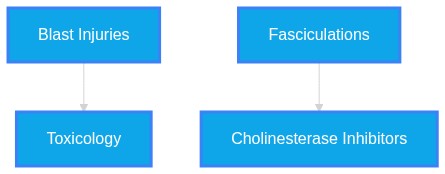
Context:A patient is brought into a remote aid station after an explosion inside a covert manufacturing facility. They have a known concussive blast injury, moderate skin irritation, and potential unknown chemical inhalation.Patient Clinical Presentation:Physical Trauma: Grade 2 concussion (confusion, mild disorientation, reactive pupils).Dermatological: Superficial skin burning and blistering across the forearms. The skin smells faintly of burnt almonds or cut grass.Respiratory/Systemic: Shortness of breath, mild tachypnea, and sudden, severe muscle twitching (fasciculations) that began 10 minutes post-exposure.Operational Constraint:Standard advanced diagnostics are unavailable. The primary treatment kit contains standard trauma items, atropine/pralidoxime (2-PAM) autoinjectors, sodium thiosulfate, hydroxycobalamin, and basic field-expedient wellness supplies.Scan Instructions:Run a single scan over the medical and toxicological corpus to map this multi-system presentation. Provide the following outputs using Veridical Enforcement:Differential Toxin Ranking: Based on the combination of blast concussion, skin burning, and the specific onset of muscle twitching vs. scent clues, identify and rank the top two most likely overlapping chemical exposure pathways.The Dynamic Counter-Response (The "If/Then" Fork): Map the exact treatment-response trap. If I suspect Toxin A and administer standard Countermeasure X (e.g., an anticholinergic like atropine), but the patient’s fasciculations instantly stop while their blood pressure dangerously spikes and pupils violently dilate, what secondary hidden pathway does this reaction reveal?Veridical Contraindications: Explicitly cite the exact physiological mechanisms and PubMed-grounded parameters where standard concussion management (e.g., specific fluid resuscitation volumes or sedatives) directly exacerbates the cellular hypoxia or neurotoxicity caused by the suspected chemical inhalants. Do not hallucinate or approximate citations.
Plausibility Verdicts
You are likely managing a patient with a combination of nerve agent poisoning and irritant gas exposure. Prioritize airway management and cholinergic control while monitoring for cardiac instability from the atropine itself.
Dataset Summary
Novel & Overlooked Insights
- Intraosseous administration provides bioavailability similar to intravenous routes, which is critical when IV access is difficult in mass casualty, contaminated, or field-expedient settings.
- The "intermediate syndrome" is a documented complication following organophosphate poisoning, characterized by muscle weakness and respiratory distress, which may be predicted by the GLU/K ratio.
- Standard diagnostic scoring for chemical injury, such as the PGI score, can substitute for serum cholinesterase levels when laboratory access is unavailable.
- Phosgene-induced pulmonary edema is non-cardiogenic and manifests with a latent phase, differing fundamentally from the immediate cholinergic crisis of nerve agents.
- Atropine is frequently used to manage bradycardia in poisoning cases, yet its administration does not always equate to a complete resolution of systemic toxicosis.
- The use of midazolam is increasingly favored over diazepam for terminating nerve agent-induced status epilepticus, though both demonstrate limited efficacy in preventing long-term neurodegeneration.
- Chemical agents like sulfur mustard or phosgene have no specific "antidote," making supportive care and specialized interventions like CPAP or early protective antioxidants the primary therapeutic focus.
Extracted Discoveries
- Assess the efficacy of inhaled BML-111 in combination with atropine for mixed phosgene/organophosphate injuries.
- Evaluate the utility of the GLU/K ratio in mixed exposure cohorts for early prediction of intermediate syndrome.
- Retrospective review of casualties from documented chemical manufacturing explosions to categorize symptom clusters.
- Discovered Hypothesis (A to C): Inhibition of Src Tyrosine Kinase could mitigate the secondary, chronic neuroinflammatory damage observed after phosgene-induced lung injury, despite phosgene and nerve agents typically being viewed as separate toxicological domains. - Literature A (Origin): Phosgene-induced lung injury pathophysiology and treatment strategy (Source ID: 35983054) - Literature C (Target): Mitigating soman (GD)-induced long-term neurotoxicity via Src tyrosine kinase inhibitor Saracatinib (Source ID: 40764938) - The Intersecting Bridge B: Src Family Kinase-mediated inflammation/signaling. - Biological Rationale: Both toxicants involve reactive inflammatory pathways (e.g., NF-kB, reactive oxygen species) and potential long-term glial activation; Src inhibitors are known to cross the blood-brain barrier and modulate these shared pro-inflammatory pathways in similar neural tissue contexts.
- There is conflicting evidence regarding the utility of BAL protein as a biomarker for phosgene injury; while some studies (ID: 30668997) suggest lung weight is superior, others emphasize BAL protein as a standard surrogate endpoint.
- The use of intraosseous administration (ID: 22738685) for atropine and pralidoxime, usually considered for nerve agents, could be repurposed for the rapid delivery of any standard antidotes in a mass-casualty setting where IV access is delayed.
PathMap is funded by sales of datasets and coversheets to researchers of any kind who wish to discover the most viable routes and paths to accelerate cures. We do not make theoretical molecules, we expose the truth in current PubMed literature. Commission a trace today.
PathMap Scores
How are these metrics evaluated?
Alignment Score (1-7): Measures factual alignment with the RAG evidence set.
[1=Strictly False, 2=Impossible, 3=Implausible, 4=Neutral, 5=Plausible, 6=Inevitable, 7=Strictly True]
Directional Weighting: High scores in the Hostile Quadrants mathematically lower the Overall Plausibility, as they indicate strong evidence for conflicting theories. Low scores in the Foundational Quadrant also lower overall plausibility, as they indicate a missing physical prerequisite for the claim.
Veridicality Audit Report
All Extracted Datapoints
Evaluated Perspectives & Quadrants
Verbatim Quote Audit Console
Mapped Reference Directory (APA)
Abstract Repository (Raw Full-Texts) Show Database
Investigator Profile