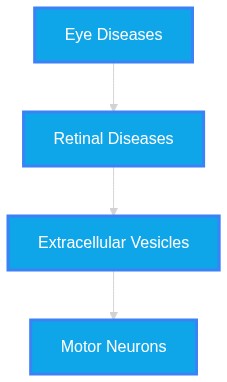
A Top-Down Mechanism for Sporadic ALS Initiated by Ocular Metal Dyshomeostasis and Retrograde Exosomal Transport along the Subcortical Visual Axis
Plausibility Verdicts
The 'top-down' hypothesis is biologically plausible due to shared neuro-developmental origins and transport mechanisms, but current evidence primarily supports the retina as a diagnostic biomarker rather than the initiator of systemic ALS.
Dataset Summary
Novel & Overlooked Insights
- RNFL thinning is a reproducible biomarker for ALS, suggesting the retina may be an "accessible window" to systemic neurodegeneration.
- Retinal thinning in ALS occurs even in the absence of significant motor symptoms, potentially pre-dating symptomatic onset.
- Metal dyshomeostasis is a central, multifaceted driver in ALS, where free copper and iron imbalances initiate protein aggregation (e.g., SOD1).
- EVs released from muscle, glial, and neuronal cells act as "messengers" that spread pathogenic proteins and miRNAs, potentially reinforcing a feedback loop of systemic dysfunction.
- The retina and visual pathways exhibit structural damage such as demyelination and thinning of RGCs, which shares neuroimmune features with cerebral pathology.
- Copper and iron levels in the spinal cord are disrupted in sporadic ALS, parallel to findings in familial cases, suggesting a shared metabolic end-point.
- The use of OCT and OCT-A allows for the non-invasive mapping of vascular and structural neurodegeneration that may eventually function as a clinical diagnostic tool.
Extracted Discoveries
- Longitudinal tracking of fluorescently labeled SOD1 or TDP-43 EVs from the retina to spinal cord neurons in transgenic models.
- Assessment of retrograde transport blockade using specific motor protein inhibitors on ALS-associated EV spread from retinal ganglion cells.
- Multi-center longitudinal ocular imaging study in early-stage sporadic ALS to establish the temporal link between retinal structural change and motor symptom onset.
- Proteomic analysis of CSF-derived EVs comparing retinal-specific vs CNS-specific protein signatures in patients.
- Ocular ciliary dysfunction acts as a primary trigger for systemic SOD1 aggregation by altering the shedding rate of toxic microvesicles that reach motor circuits via the CNS glymphatic pathway.
- Ciliary primary neuron EV shedding in SOD1-deficient C. elegans models (ID: 41672113).
- Systemic SOD1-associated motor neuron toxicity and muscle atrophy in Tg(SOD1G93A) mice (ID: 40795306).
- Superoxide dismutase 1 (SOD1) deficiency-driven regulation of primary ciliary EV biogenesis.
- SOD1 deficiency in primary cilia regulates the rate of EV shedding; if this mechanism is evolutionary conserved in ocular or retinal neurons, the shift in ciliary shedding under oxidative stress could provide a consistent supply of toxic, SOD1-laden EVs to the CNS circulation.
- Meta-analyses of retinal OCT parameters in ALS report significant RNFL thinning in some cohorts, while other longitudinal studies (ID: 41517507) report no significant thickness changes over short follow-up periods, suggesting high variability in ocular phenotype manifestation.
- The use of copper chaperones (CuATSM/Ebselen) and mitochondrial stabilizers (Mdivi-1) could be repurposed for local ocular application to prevent retinal neurodegeneration before it progresses to systemic involvement, as ocular neurons share protective metabolic mechanisms with motor neurons.
PathMap is funded by sales of datasets and coversheets to researchers of any kind who wish to discover the most viable routes and paths to accelerate cures. We do not make theoretical molecules, we expose the truth in current PubMed literature. Commission a trace today.
PathMap Scores
How are these metrics evaluated?
Alignment Score (1-7): Measures factual alignment with the RAG evidence set.
[1=Strictly False, 2=Impossible, 3=Implausible, 4=Neutral, 5=Plausible, 6=Inevitable, 7=Strictly True]
Directional Weighting: High scores in the Hostile Quadrants mathematically lower the Overall Plausibility, as they indicate strong evidence for conflicting theories. Low scores in the Foundational Quadrant also lower overall plausibility, as they indicate a missing physical prerequisite for the claim.
Veridicality Audit Report
All Extracted Datapoints
Evaluated Perspectives & Quadrants
Verbatim Quote Audit Console
Mapped Reference Directory (APA)
Abstract Repository (Raw Full-Texts) Show Database
Investigator Profile