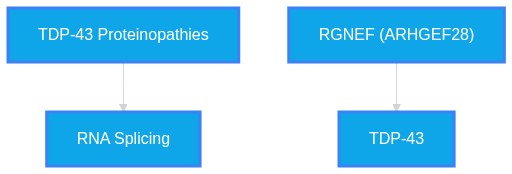
A 3x3 Evaluation Matrix of Biological Interactions of ARHGAP32, RGNEF (ARHGEF28), and TDP-43 in Neurodegenerative Disease found in PubMed Literature as of August 5, 2026
Dataset Summary
Novel & Overlooked Insights
- RGNEF and TDP-43 interact within micronuclei, a novel mechanism for cytoplasmic aggregate formation in ALS.
- ARHGAP32, while a GAP protein, is itself a target of the very splicing dysregulation caused by nuclear TDP-43 depletion.
- RGNEF (ARHGEF28) has been identified as a candidate risk allele in population-based studies using item response theory.
- The C-terminal domain of KIF5A, often linked to ALS, also displays a basic isoelectric point, mirroring issues seen with certain mutated RGNEF variants.
- YAP serves as a potential modulator of TDP-43 condensates, showing that non-transcriptional pathways can alleviate proteinopathy.
- Lipid bilayers containing phosphatidylserine and cardiolipin can specifically accelerate TDP-43 CTD aggregation.
- TDP-43 is essential for skeletal muscle maintenance, translocating to mitochondria during maturation.
- Cryptic splicing events in genes like ARHGAP32 occur selectively in neurons already showing signs of TDP-43 pathology.
Extracted Discoveries
- Investigate if ARHGAP32 splicing inhibition via ASOs rescues the mitochondrial bioenergetic defects observed in TDP-43 depleted models.
- Perform mass spectrometry to map the interaction interface between RGNEF and the RRM1/2 domains of TDP-43.
- Longitudinal analysis of ARHGAP32 isoforms in iPSC-derived neurons during TDP-43 cytoplasmic mislocalization.
- Comparative study of RGNEF/ARHGEF28 variants across different ALS clinical subtypes to determine correlate pathology.
- Inhibition of the Rho GTPase regulator EPS8 may prevent the cryptic splicing of ARHGAP32 that occurs downstream of TDP-43 cytoplasmic mislocalization.
- EPS8/RAC signaling hyperactivation promotes aggregation of TDP-43 (ID 40903652).
- ARHGAP32 is a major target of aberrant cryptic splicing in TDP-43 proteinopathy (ID 40478310).
- Rho GTPase signaling pathway homeostasis.
- Since EPS8 hyperactivation drives TDP-43 pathology and nuclear depletion is the prerequisite for ARHGAP32 cryptic splicing, normalizing the Rho signaling cascade via EPS8 inhibition should theoretically maintain TDP-43 nuclear localization, thereby preventing the downstream aberrant splicing of ARHGAP32.
- Evidence regarding the protective vs. pathogenic role of FUS/TDP-43 aggregates is conflicting; while most sources describe them as causative of neurotoxicity (ID 41542389), yeast models suggest they may act as a sequestration reservoir that promotes longevity (ID 41614607).
- Carboplatin, traditionally an anti-cancer agent, is repurposed to inhibit NF-κB in astrocytes, thereby mitigating TDP-43-induced neurotoxicity (ID 42134762). NU-9 is repurposed to stabilize the endolysosomal system, preventing accumulation of both SOD1 and TDP-43 aggregates (ID 40030015).
PathMap is funded by sales of datasets and coversheets to researchers of any kind who wish to discover the most viable routes and paths to accelerate cures. We do not make theoretical molecules, we expose the truth in current PubMed literature. Commission a trace today.
PathMap Scores
How are these metrics evaluated?
Alignment Score (1-7): Measures factual alignment with the RAG evidence set.
[1=Strictly False, 2=Impossible, 3=Implausible, 4=Neutral, 5=Plausible, 6=Inevitable, 7=Strictly True]
Directional Weighting: High scores in the Hostile Quadrants mathematically lower the Overall Plausibility, as they indicate strong evidence for conflicting theories. Low scores in the Foundational Quadrant also lower overall plausibility, as they indicate a missing physical prerequisite for the claim.
Veridicality Audit Report
All Extracted Datapoints
Evaluated Perspectives & Quadrants
Verbatim Quote Audit Console
Mapped Reference Directory (APA)
Abstract Repository (Raw Full-Texts) Show Database
Investigator Profile