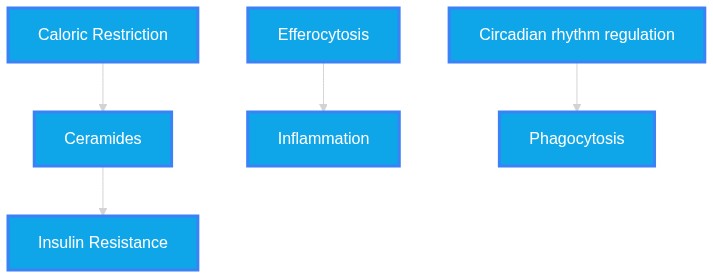
Clinically prescribed periodic "fasting" (caloric restriction), combined with dietary modification to include Omega-3 polyunsaturated fatty acids from fish and monounsaturated fats from olive oil, dietary fibers, and polyphenols from rich plant compounds may lower or balance toxic accumulated ceramides (like C16:0) via inhibition and metabolic processing in order to reduce organ aging and improve Circadian Efferocytosis Oscillation.
Plausibility Verdicts
The claim is plausible based on evidence supporting CR, diet quality, and efferocytosis as critical regulators of ceramide metabolism and aging, though specific clinical trials validating the totality of the intervention are currently limited.
Dataset Summary
Novel & Overlooked Insights
- Caloric restriction acts as a direct inhibitor of ceramide accumulation, specifically targeting species linked to insulin resistance.
- The gut microbiota serves as a primary hub for transforming dietary fiber into short-chain fatty acids (SCFAs) that regulate efferocytosis.
- There is a distinct circadian control over peroxisomal import in cortex glia, which oscillates and modulates lipid metabolism.
- Efferocytosis itself activates DNA repair mechanisms (base excision repair) to facilitate macrophage proliferation and tissue resolution.
- Omega-3 polyunsaturated fatty acids (such as DHA) protect against palmitic acid-induced lipotoxicity in Schwann cells.
- CGRP signaling acts as a neuro-immune regulator that drives macrophage polarization toward a pro-reparative phenotype in wounds.
- The "gut-muscle axis" allows polysaccharides to regulate lipid metabolism and antioxidant defense, influencing physical tissue quality.
- Metabolic rhythmicity, mediated by clock genes, synchronizes hepatic lipid transport and yolk precursor formation in avian models.
- Circadian disruption, such as that seen in night shiftwork, creates internal metabolite misalignment (e.g., uridine and bile acids) linked to cardiometabolic disease.
Extracted Discoveries
- Investigate the effects of time-restricted feeding (TRF) on the temporal rhythmicity of macrophage efferocytosis markers in aging mice.
- Assess whether dietary Omega-3 and polyphenol enrichment specifically reverses age-related decline in SLC25A34-mediated lipid cycling.
- A randomized controlled trial evaluating the effect of Mediterranean-style dietary timing (chrononutrition) on plasma C16:0 ceramide levels and efferocytic capacity in elderly populations.
- Longitudinal proteomics/lipidomics study mapping the cross-talk between circadian liver markers and macrophage efferocytic signaling in individuals with metabolic dysfunction.
- Omega-3 fatty acids enhance the clearance of senescent cells (efferocytosis) in the aging vascular endothelium by modulating the expression of Mertk and Gas6.
- Docosahexaenoic acid (DHA) protection of Schwann cells via lipid handling and autophagy (Source 42501159)
- Defective neutrophil efferocytosis as a driver of organ aging in elderly mice (Source 42462036)
- Gas6/Mertk signaling pathway
- Omega-3s enhance lipid droplet formation and membrane fluidity, which are critical for the efficient phagocytosis of senescent/apoptotic cells, a process known to be impaired in the aging neutrophils-macrophage interface.
- Conflicting evidence exists regarding the consistency of dietary fiber intervention on glycemia and lipid outcomes, as some studies report significant improvements while others show no impact, likely due to heterogeneity in fiber type, duration, and baseline participant status (ID 42451146).
- The use of 'reverse mechanical buffering' hydrogels (ID 42468599) could be adapted to modulate macrophage activity in metabolic disorders, specifically by providing a physical environment that restores normal efferocytosis in tissues where mechanical stress is elevated.
PathMap is funded by sales of datasets and coversheets to researchers of any kind who wish to discover the most viable routes and paths to accelerate cures. We do not make theoretical molecules, we expose the truth in current PubMed literature. Commission a trace today.
PathMap Scores
How are these metrics evaluated?
Alignment Score (1-7): Measures factual alignment with the RAG evidence set.
[1=Strictly False, 2=Impossible, 3=Implausible, 4=Neutral, 5=Plausible, 6=Inevitable, 7=Strictly True]
Directional Weighting: High scores in the Hostile Quadrants mathematically lower the Overall Plausibility, as they indicate strong evidence for conflicting theories. Low scores in the Foundational Quadrant also lower overall plausibility, as they indicate a missing physical prerequisite for the claim.
Veridicality Audit Report
All Extracted Datapoints
Evaluated Perspectives & Quadrants
Verbatim Quote Audit Console
Mapped Reference Directory (APA)
Abstract Repository (Raw Full-Texts) Show Database
Investigator Profile