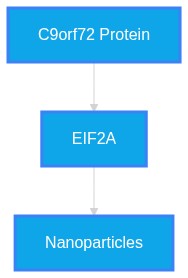
"MARK2-eIF2α signaling, activated by misfolded proteins including DPRs and TDP-43, is upregulated in C9-ALS patient tissues."
"Loss of MARK2 significantly suppresses RAN translation in reporter cells, patient-derived neurons, and a mouse model and confers neuroprotection under proteotoxic conditions."
"Here we report the identification of a direct kinase of eIF2α, microtubule affinity-regulating kinase 2 (MARK2), which phosphorylates eIF2α in response to proteotoxic stress."
"C9RAN translation initiates through a cap- and eIF4A-dependent mechanism that utilizes a CUG start codon. C9RAN and CGG RAN are both selectively enhanced by integrated stress response (ISR) activation."
"Genetic inhibition of the ISR or knockdown of ATX2, the Drosophila orthologue of ATXN2, rescues motor deficits in these models."
"Targeting phosphorylated-PERK and the phosphorylated-eif2α complex reduces DPR levels revealing a potential therapeutic strategy to attenuate DPR-dependent disease pathogenesis in NRE-linked diseases."
"Together, eIF5 stimulates the CUG initiation of poly-GA RAN translation in cellular and Drosophila disease models of C9orf72 FTLD/ALS."
"Using reporter systems to quantitatively measure RAN translation provides a platform to examine candidate genes/pathways and screen for modifiers of this non-canonical pathway."
"Amyotrophic lateral sclerosis (ALS)-associated mutations in the RNA-binding protein fused in sarcoma (FUS), which suppress local translation, disrupt the compartment-specific RNA signatures, including components of the translation machinery."
"Spermine treatment limited infarct size, attenuated cardiac troponin I and creatinine kinase-MB release, improved cardiac function, and decreased ERS and apoptosis related protein expression."
"Finally, rapamycin as well as spermidine, carbamazepine, and tamoxifen could also rescue the motor dysfunction of 7-mo-old FTLD-U mice."
"Genetic testing identified a novel heterozygous missense variant, c.355 C > T (p.Arg119Cys), in the SQSTM1 gene."
"The presence of neck weakness in MND was predictive of time to respiratory function decline, for respiratory outcomes (forced vital capacity (FVC) <65%, FVC <50% and NIV use) as well as having an effect on time to death."
"Using US (≥ 2 regions with fasciculations/high-grade) as an ancillary criterion, 53.7% were diagnosed at first visit; median time to diagnosis was 5 months (range 3-8) in those otherwise missed."
"Findings showed increasing use of radiomics, circulating tumor DNA, rhythm monitoring, vascular imaging, inflammatory markers, biologics, cell therapy, psychological intervention, and lipid-lowering therapy."
"The studies collectively demonstrate the potential benefits and diverse range of assistive devices available to support upper extremity function."
"Stem cell therapy for ALS appears to be safe, with preliminary evidence suggesting potential therapeutic benefit in slowing disease progression in selected patients."
"We demonstrate that fractal dimensions are sufficient to obtain accurate models for glioblastoma diagnosis, despite still underperforming when compared to the traditional feature extraction method."
"Tofersen seems to be associated with slower functional decline and reduced NfL levels."
"This first nationwide study of MNDs in Latvia highlights diagnostic delays and possible under-recognition of adult SMA and SBMA."
"The frequency of pathogenic or likely pathogenic genetic variants was 15.7% (8/51)."
"By focusing on deficits associated with ALS, the MFI may improve the ability to identify individuals at elevated risk of the disease."
"The ability to evaluate treatment response on an individual level will help to determine the clinical relevance of VUS as new gene-targeted treatments for ALS become available."
"We identified four plasma proteins significantly associated with FTD, namely RGS7 and ASAP2 (increased risk), as well as TMCC3 and VPS29 (decreased risk)."
"Our results suggest that TnT and sNfL capture different dimensions of disease status within the D50 framework."
"Thus, antibody to ATCV-1 in ALS patients and the susceptibility of human M1 macrophages to ATCV-1 infection with boosted inflammatory cytokine and diminished anti-inflammatory cytokine production suggest that ATCV-1 may contribute to ALS motor neuron disease."
"Sexuality in MND is more associated with cognitive and mood factors than with motor disability."
"This case supports classification as a SYNE1-related motor neuron disease-like phenotype with mild distal contractures rather than an isolated arthrogryposis multiplex congenita type 3 (AMC3) phenotype."
"IVIg therapy was administered without meaningful clinical benefit, suggesting neurodegeneration as the primary phenotypic driver."
"This study demonstrates that MD is experienced by healthcare professionals working with MND across Europe."
"These findings suggest a potential role for pNfL as an adjunctive tool in neuromuscular diagnostic evaluation."
"MARK2-eIF2α signaling, activated by misfolded proteins including DPRs and TDP-43, is upregulated in C9-ALS patient tissues."
"Loss of MARK2 significantly suppresses RAN translation in reporter cells, patient-derived neurons, and a mouse model and confers neuroprotection under proteotoxic conditions."
"Here we report the identification of a direct kinase of eIF2α, microtubule affinity-regulating kinase 2 (MARK2), which phosphorylates eIF2α in response to proteotoxic stress."
"Amyotrophic lateral sclerosis (ALS)-associated mutations in the RNA-binding protein fused in sarcoma (FUS), which suppress local translation, disrupt the compartment-specific RNA signatures, including components of the translation machinery."
"Spermine treatment limited infarct size, attenuated cardiac troponin I and creatinine kinase-MB release, improved cardiac function, and decreased ERS and apoptosis related protein expression."
"Finally, rapamycin as well as spermidine, carbamazepine, and tamoxifen could also rescue the motor dysfunction of 7-mo-old FTLD-U mice."
"Treatment with these nanoparticles significantly reduced p53-mediated neuronal ferroptosis and improved synaptic function both in vitro and in vivo."
"Cardiac autonomic dysfunction is increasingly recognized as a significant contributor to disease burden in ALS, manifesting as abnormalities in heart rate variability, sympathetic overactivity, and corrected QT prolongation."
"TJ-68 treatment increased tryptophan and aconitate levels but reduced serotonin and acetylcarnitine levels."
"We engineered spermidine-modified ginseng-derived extracellular vesicles (S-GEVs) nanoparticles, termed S-GEVs@siRNA. These nanoparticles leveraged the targeting capabilities of spermidine for olfactory receptor-trace amine associated receptor (TAAR), enhancing siRNA delivery and therapeutic efficacy."
Validator Flag: Strict Misquote Detected! The exact character sequence "We engineered spermidine-modified g..." was NOT found in the provided text. Do NOT truncate, paraphrase, or edit quotes.
"These findings support a feedforward loop with initial repeat-mediated toxicity enhancing RAN translation and subsequent production of additional poly-dipeptides through ISR, thereby promoting progressive disease."
Validator Flag: Strict Misquote Detected! The exact character sequence "These findings support a feedforwar..." was NOT found in the provided text. Do NOT truncate, paraphrase, or edit quotes.
"The induction of SSAT and elevated polyamine catabolism in cells increases the phosphorylation of eukaryotic translation initiation factor 2α (eIF2α) and enhances the expression of binding immunoglobulin protein BiP/GRP78)."
Validator Flag: Strict Misquote Detected! The exact character sequence "The induction of SSAT and elevated ..." was NOT found in the provided text. Do NOT truncate, paraphrase, or edit quotes.
"The MND Together project aims to address these systemic gaps by (1) developing a national picture of care coordination in England and Wales."
Validator Flag: Strict Misquote Detected! The exact character sequence "The MND Together project aims to ad..." was NOT found in the provided text. Do NOT truncate, paraphrase, or edit quotes.
"This study delivers a provisional, ECAS-based classification for the neuropsychological sub-phenotyping of non-demented ALS patients."
Validator Flag: Strict Misquote Detected! The exact character sequence "This study delivers a provisional, ..." was NOT found in the provided text. Do NOT truncate, paraphrase, or edit quotes.
"Eight of nine cats exhibited clinical improvement following hIVIg administration, achieving ambulatory status (walking >5 steps) within a median of 4 days."
Validator Flag: Strict Misquote Detected! The exact character sequence "Eight of nine cats exhibited clinic..." was NOT found in the provided text. Do NOT truncate, paraphrase, or edit quotes.
"In this review, we focus on the differential role(s) of nuclear and cytoplasmic intron retaining transcripts (nIRTs and cIRTs, respectively)."
Validator Flag: Strict Misquote Detected! The exact character sequence "In this review, we focus on the dif..." was NOT found in the provided text. Do NOT truncate, paraphrase, or edit quotes.
"In this chapter, we summarize the available computational tools for predicting ubiquitylation in silico and the common approaches used to enrich ubiquitylation in samples."
Validator Flag: Strict Misquote Detected! The exact character sequence "In this chapter, we summarize the a..." was NOT found in the provided text. Do NOT truncate, paraphrase, or edit quotes.
"Cognitive and behavioral impairments are already detectable at the time of diagnosis in a substantial proportion of patients with PLS, including early PLS."
Validator Flag: Strict Misquote Detected! The exact character sequence "Cognitive and behavioral impairment..." was NOT found in the provided text. Do NOT truncate, paraphrase, or edit quotes.
"Here we identified 92 proteins with concentrations that changed before phenoconversion; characterized the longitudinal trajectory of these proteins."
Validator Flag: Strict Misquote Detected! The exact character sequence "Here we identified 92 proteins with..." was NOT found in the provided text. Do NOT truncate, paraphrase, or edit quotes.
"Reconceptualizing gait as a 'sixth vital sign' reframes mobility as a multidimensional biomarker of neural and systemic health."
Validator Flag: Strict Misquote Detected! The exact character sequence "Reconceptualizing gait as a 'sixth ..." was NOT found in the provided text. Do NOT truncate, paraphrase, or edit quotes.
"Findings of this narrative review underscore the need for methodologically rigorous longitudinal human studies on fluoride, aluminum and neurodegenerative disease risk."
Validator Flag: Strict Misquote Detected! The exact character sequence "Findings of this narrative review u..." was NOT found in the provided text. Do NOT truncate, paraphrase, or edit quotes.
"Our findings suggest that strenuous physical activity may be associated with a significantly younger age of ALS onset, replicated in both the post-mortem and MND Register cohorts."
Validator Flag: Strict Misquote Detected! The exact character sequence "Our findings suggest that strenuous..." was NOT found in the provided text. Do NOT truncate, paraphrase, or edit quotes.
"There are no recommended medicinal treatments, especially no specific etiological treatment for PPS."
Validator Flag: Strict Misquote Detected! The exact character sequence "There are no recommended medicinal ..." was NOT found in the provided text. Do NOT truncate, paraphrase, or edit quotes.
"Together, these experiments show that Gars ΔETAQ/+ mice display robust and selective peripheral nerve pathology that manifests in a general distal-to-proximal fashion."
Validator Flag: Strict Misquote Detected! The exact character sequence "Together, these experiments show th..." was NOT found in the provided text. Do NOT truncate, paraphrase, or edit quotes.
"Higher glutamine/glutamate, arginine, and leucine levels were associated with more severe muscle cramps. TJ-68 treatment increased tryptophan and aconitate levels."
Validator Flag: Strict Misquote Detected! The exact character sequence "Higher glutamine/glutamate, arginin..." was NOT found in the provided text. Do NOT truncate, paraphrase, or edit quotes.
"This report focusses on nursing interventions adopted in terms of respiratory management, nutritional management, psychological care and exercise."
Validator Flag: Strict Misquote Detected! The exact character sequence "This report focusses on nursing int..." was NOT found in the provided text. Do NOT truncate, paraphrase, or edit quotes.
"Biallelic mutations in VRK1 are associated with a recognizable form of motor neuron disease characterized by features of dHMN combined with upper motor neuron involvement."
Validator Flag: Strict Misquote Detected! The exact character sequence "Biallelic mutations in VRK1 are ass..." was NOT found in the provided text. Do NOT truncate, paraphrase, or edit quotes.
"Cardiac autonomic dysfunction is increasingly recognized as a significant contributor to disease burden in ALS, manifesting as abnormalities in heart rate variability."
Validator Flag: Strict Misquote Detected! The exact character sequence "Cardiac autonomic dysfunction is in..." was NOT found in the provided text. Do NOT truncate, paraphrase, or edit quotes.