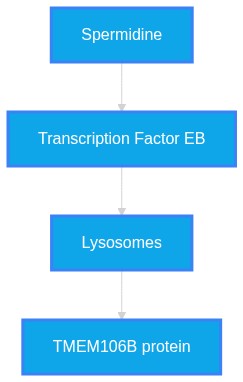
Discovery: Considering PubMed #37563705, #42012729, and #42541426, Spermidine is a known inducer of autophagy through EP300 inhibition and TFEB activation. Since TMEM106B amylofilaments induce lysosomal dysfunction, TFEB-driven restoration of lysosomal capacity would logically prevent the accumulation of these filaments.
Plausibility Verdicts
Yes, spermidine-induced TFEB activation is a proven mechanism for enhancing lysosomal function. While TMEM106B amyloid accumulation is associated with lysosomal dysfunction, the direct clearance of these specific filaments by spermidine-mediated TFEB activation has not been definitively demonstrated.
Dataset Summary
Novel & Overlooked Insights
- Spermidine supplementation acts as a downstream effector of the anti-aging effects induced by fasting and rapamycin.
- TMEM106B amyloid filaments demonstrate age-dependent formation in astrocytes and reside in endosomal/lysosomal compartments.
- TFEB phase separation is essential for its transcriptional activation and anti-inflammatory functions induced by nutrient stress.
- The TFEB-ATP6V0C axis is a critical determinant of microglial proteostasis and alpha-synuclein clearance.
- TMEM106B single nucleotide polymorphisms are associated with cognitive resilience in Alzheimer's disease cases, independent of amyloid plaque burden.
- Spermidine-induced autophagy via TFEB can rescue mitochondrial function in several cell types, including Sertoli cells and cardiomyocytes.
- The induction of ER-phagy via FAM134B is transcriptionally regulated by TFEB/TFE3, creating a secondary layer of proteostasis regulation.
Extracted Discoveries
- Determine if spermidine or TFEB overexpression accelerates the degradation rate of TMEM106B filaments in primary neuronal culture models.
- Assess whether TFEB knockdown increases TMEM106B amyloid burden in microglia during aging-induced stress.
- Longitudinal analysis of CSF TMEM106B levels in individuals undergoing long-term spermidine supplementation.
- Comparative proteomics of lysosomal contents in patients with high vs. low TMEM106B aggregate burden treated with autophagy-inducing agents.
- Spermidine-mediated TFEB activation may modulate the biophysical properties of the Biondi body variant of TMEM106B filaments to reduce amyloid burden.
- Spermidine/TFEB axis (Source #42588134, #42012729)
- TMEM106B amyloid filaments in Biondi bodies (Source #39503754, #38886865)
- Lysosomal degradative capacity and acidification (Source #42546981)
- TFEB is the master regulator of lysosomal biogenesis; since Biondi bodies are amyloid inclusions found within secondary lysosomes, enhancing lysosomal degradative capacity via TFEB activation provides a logical mechanism to influence their clearance.
- None identified in the provided text, though the 'double-edged' role of autophagy in tumor survival vs. suppression is noted.
- The use of TFEB activators, such as spermidine or the curcumin analog CM-C1, serves as a multipurpose strategy to restore autophagic flux in conditions ranging from neurodegeneration to inflammatory bowel disease.
PathMap is funded by sales of datasets and coversheets to researchers of any kind who wish to discover the most viable routes and paths to accelerate cures. We do not make theoretical molecules, we expose the truth in current PubMed literature. Commission a trace today.
PathMap Scores
How are these metrics evaluated?
Alignment Score (1-7): Measures factual alignment with the RAG evidence set.
[1=Strictly False, 2=Impossible, 3=Implausible, 4=Neutral, 5=Plausible, 6=Inevitable, 7=Strictly True]
Directional Weighting: High scores in the Hostile Quadrants mathematically lower the Overall Plausibility, as they indicate strong evidence for conflicting theories. Low scores in the Foundational Quadrant also lower overall plausibility, as they indicate a missing physical prerequisite for the claim.
Veridicality Audit Report
All Extracted Datapoints
Evaluated Perspectives & Quadrants
CLAIM EVALUATED AND ANSWER TO USER
"Discovery: Considering PubMed #37563705, #42012729, and #42541426, Spermidine is a known inducer of autophagy through EP300 inhibition and TFEB activation. Since TMEM106B amylofilaments induce lysosomal dysfunction, TFEB-driven restoration of lysosomal capacity would logically prevent the accumulation of these filaments."ABSTRACT & REWRITTEN CLAIM
Scientific literature identifies spermidine as a polyamine capable of modulating autophagy via EP300 inhibition and subsequent TFEB nuclear translocation. Concurrently, TMEM106B has been characterized as a transmembrane lysosomal protein that forms amyloid filaments in an age-dependent manner. This synthesis evaluates whether TFEB-mediated lysosomal restoration can mitigate the pathological accumulation of TMEM106B amyloids.INTRODUCTION & JUSTIFICATION
Spermidine, a naturally occurring polyamine, has emerged as a candidate modulator of brain aging because it regulates autophagy, mitochondrial function, oxidative balance, and neuroinflammatory signaling. The mechanism by which spermidine promotes longevity and cellular health is largely attributed to its ability to induce macroautophagy. Spermidine, a dietary polyamine from wheat germ and fermented foods, induces autophagy through EP300 inhibition and is associated with reduced all-cause mortality in prospective studies. This pathway involves the hypusination of EIF5A, which facilitates the translation of TFEB, a master regulator of lysosomal biogenesis and autophagic flux. Regarding lysosomal pathology, TMEM106B inclusions have been identified as amyloids in aging and neurodegeneration. By transmission immuno-electron microscopy, Biondi bodies of choroid plexuses were decorated by TMEM239 and were associated with structures that resembled residual bodies or secondary lysosomes. While the data suggests that TMEM106B filaments form in an age-dependent manner, the potential for TFEB-mediated clearance remains a hypothesized therapeutic intersection. Restoration or enhancement of lysosomal acidification through pharmacological modulation of lysosomal pH, activation of autophagy, or targeting of key regulatory pathways has been shown to re-establish microglial homeostasis, attenuate neuroinflammation, and confer neuroprotection in preclinical models. Therefore, the activation of TFEB through spermidine supplementation presents a plausible theoretical mechanism to support the degradation of aberrant lysosomal proteins, including TMEM106B aggregates.Novel & Overlooked
EVIDENCE, METHODOLOGY & CITATIONS
1. ID: 42588134 - Application: Spermidine mechanism - "Spermidine, a dietary polyamine from wheat germ and fermented foods, induces autophagy through EP300 inhibition and is associated with reduced all-cause mortality in prospective studies." 2. ID: 42222188 - Application: SPD function - "SPD acts as a key regulator of cellular quality control by inducing macroautophagy and preserving proteostasis, largely through modulation of histone and autophagy-related protein acetylation." 3. ID: 42012729 - Application: Spermidine and aging - "Spermidine, a naturally occurring polyamine, has emerged as a candidate modulator of brain aging because it regulates autophagy, mitochondrial function, oxidative balance, and neuroinflammatory signaling." 4. ID: 39212197 - Application: Fasting-induced surge - "Acute nutrient deprivation (fasting) causes an immediate increase in spermidine biosynthesis in yeast, flies, mice and humans, as corroborated in four independent clinical studies." 5. ID: 42224830 - Application: Autophagy decline - "Molecularly, dysregulation of nutrient-sensing pathways such as AMPK and mTOR, impaired transcriptional control by TFEB and FOXO, and reduced lysosomal competence contribute to the reduction of autophagy." 6. ID: 38886865 - Application: TMEM106B characterization - "We confirm that in the brain, inclusions were most abundant in astrocytes. No inclusions were detected in heart, liver, spleen or hilar lymph nodes. Based on their staining with luminescent conjugated oligothiophenes, we confirm that TMEM106B inclusions are amyloids." 7. ID: 39503754 - Application: Biondi bodies and lysosomes - "By transmission immuno-electron microscopy, Biondi bodies of choroid plexuses were decorated by TMEM239 and were associated with structures that resembled residual bodies or secondary lysosomes." 8. ID: 42546981 - Application: Lysosomal restoration potential - "Restoration or enhancement of lysosomal acidification through pharmacological modulation of lysosomal pH, activation of autophagy, or targeting of key regulatory pathways has been shown to re-establish microglial homeostasis, attenuate neuroinflammation, and confer neuroprotection in preclinical models." 9. ID: 41874700 - Application: eIF5A/TFEB translation - "Our review highlights that spermidine and one of its major cellular targets, translation initiation factor 5A (eIF5A), facilitate translation of transcription factor EB (TFEB) to induce autophagy during starvation." 10. ID: 39729151 - Application: TFEB phase separation - "More importantly, TFEB inhibitor with ability to suppress TFEB puncta formation abolished the IF-mediated amelioration of DSS colitis." 11. ID: 42239088 - Application: TFEB in PTX models - "The transcription factor EB (TFEB), a master regulator of lysosomal biogenesis, was also upregulated in the nucleus of cultured mouse DRG neurons treated with PTX." 12. ID: 42172896 - Application: PQLC2/TFEB interaction - "PQLC2-deficient cells exhibited enhanced nuclear translocation of transcription factor EB (TFEB), a key regulator of lysosome, accompanied by increased expression of TFEB-lysosomal and autophagy target genes." 13. ID: 42169618 - Application: TFEB targets - "Single-cell RNA-seq after treatment revealed increased expression of TFEB targets and autophagy-related genes in B cells, in line with elevated autophagic flux." 14. ID: 42424320 - Application: TFEB in neuropathy - "Transcriptomic analysis reveals dysregulation of autophagy-related transcription factors, notably TFEB, FOXO3, and NRF2." 15. ID: 42501331 - Application: GBP4 mechanism - "GBP4 facilitates Mtb containment by promoting lysosomal acidification and autophagy via type Ⅰ IFN-dependent TFEB and FOXO3a activation." 16. ID: 42299666 - Application: TFEB cardiac function - "Our findings demonstrate that TFEB antagonizes pathological hypertrophic cardiac remodeling through upregulation of lysosomal capacity, maintaining mitochondrial energetic function, and promoting AMPK signaling." 17. ID: 42251851 - Application: Mestranol/TFEB - "Transcriptomic profiling of flow‑sorted macrophage/microglia populations reveals coordinated down‑regulation of lysosomal-phagosomal and immune gene networks, including MIT/TFE family transcription factors (TFEB/TFEC) and immune master regulators such as SPI1, IRFs, BATF, MAFB, and RUNX3." 18. ID: 42217339 - Application: Spermidine/AMPK/Mitophagy - "Critically, in vitro dual-cell experiments verified that spermidine activated AMPK-mediated mitophagy to directly inhibit the hyperactivation of cGAS-STING inflammatory axis" 19. ID: 42117833 - Application: miR-214/TFEB - "Further analysis revealed that miR-214-3p directly reversed the lysosomal defects triggered by IMI treatment." 20. ID: 42086115 - Application: Spermidine resilience - "Increasing evidence identifies polyamines, particularly spermidine (Spd), as important modulators of autophagy and cellular resilience" 21. ID: 42061637 - Application: TPhP mechanism - "The results indicate that TPhP exerts hepatotoxicity through multi-target interactions derived from network analysis, primarily involving PPARG/PI3K/AKT1-driven metabolic dysregulation and STAT3/mTORC1-mediated inflammatory cascades associated with PTGS2." 22. ID: 42013738 - Application: SICM/SPD - "SPD markedly attenuated SICM in vivo and in vitro by improving both mitochondrial quantity and quality." 23. ID: 42508389 - Application: Sarcopenia framework - "Mitochondrial quality control, redox resilience, proteostasis, and gut-muscle communication are discussed as representative domains that facilitate cross-species interpretation." 24. ID: 42264187 - Application: CRM nanodelivery - "Consequently, CRMs such as metformin, spermidine, and curcumin have been widely used because of their ability to recapitulate key molecular effects of CR." 25. ID: 41825683 - Application: ALA-PDT autophagy - "ALA-PDT activates antibacterial autophagy via the ROS-EP300 pathway to eliminate intracellular M. abscessus" 26. ID: 41756429 - Application: SAT1/α-Syn - "SAT1 overexpression reduced α-Syn protein levels, altered its subcellular distribution within the brain, and mitigated α-Syn-induced lifespan shortening." 27. ID: 41695269 - Application: ALS/RCD - "Integrated bibliometric and bioinformatics evidence supports an immunometabolic convergence involving ferroptosis-inflammation-autophagy signaling" 28. ID: 41614028 - Application: DCM biomarkers - "These findings highlight their diagnostic potential for DCM with HF and lay a foundation for exploring targeted small-molecule therapies (e.g., QL-XII-47, tipifarnib-P2) to improve the disease's clinical management." 29. ID: 41497595 - Application: Lysosomal escape - "Transient lysosomal injury markedly enhanced neoaggregation and loss of function, likely by promoting fibril interactions with native TDP-43." 30. ID: 41463395 - Application: TANGO2 modifiers - "These findings highlight lipid metabolism as a key pathway in TANGO2 deficiency pathophysiology and suggest autophagy and mitophagy as additional modifier mechanisms influencing phenotypic variability." 31. ID: 41415834 - Application: Fructose/MASLD - "Fructose-SB uniquely accelerates MASLD progression in HFHC-fed mice through transcriptional reprogramming of metabolic and mitochondrial pathways." 32. ID: 41330616 - Application: PD-1/Spermidine - "Spermidine, a polyamine that declines with age, has the potential to modulate both mitochondrial function and proteostasis." 33. ID: 41315858 - Application: AD phagocytosis - "Most of the known genetic risk for AD can be linked to microglial phagocytosis, including ABCA1, ABI3, ACE, ADAM17, APOE, APP, BIN1, BLNK, CD2AP, CD33, CLU, CR1, CTSB, CTSH, EED, GRN, INPP5D, LILRB2, PICALM, PLCG2, PSEN1, PTK2B, SIGLEC11, SORL1, SPI1, TMEM106B and TREM2." 34. ID: 40760677 - Application: NORAD/ferroptosis - "NORAD is a promoter of oncogenesis and inhibited ferroptosis via miR-144-3p-mTOR-ferritinophagy in cancer cells." 35. ID: 40667544 - Application: SF3b4/CRC - "SF3b4 may promote CRC proliferation by enhancing cellular autophagy." 36. ID: 40096894 - Application: EP300/SIRT5 - "Activation of EP300 expression increased SIRT5 expression and significantly improved autophagy for inhibition of NPC senescence." 37. ID: 39873130 - Application: CCFE/sarcopenia - "CCFE enhanced autophagy by activating AMPK (80% increase, p < 0.01) and inhibiting Atg5 protein acetylation (65% decrease, p < 0.001), with contributions from ellagic acid and polyamines." 38. ID: 39480813 - Application: TMEM106B/SARS-CoV-2 - "SARS-CoV-2MA1 infection in HEK293T cells relies on heparan sulfate and endocytic pathways, with TMEM106B, a transmembrane lysosomal protein, the most significant contributor." 39. ID: 39262221 - Application: TMEM106B/CR - "TMEM106B variants may influence CR independent of AD pathology." 40. ID: 42429378 - Application: Ureaplasma pH adaptation - "The findings of this study suggest a multi-omics scheme for how organisms adapt to environmental changes and ensure survival without inducing new circuits or complex transcriptional regulation." 41. ID: 42374161 - Application: TFEB-ATP6V0C - "These findings establish the TFEB-ATP6V0C axis as a key determinant of microglial proteostasis, proposing targeted activation of this pathway as a promising strategy to mitigate PD progression." 42. ID: 42368585 - Application: GRg1/CKLF1 - "Mechanistically, GRg1 binds to CKLF1 and modulates the mTORC1/TFEB pathway, enhancing lysosomal function and thereby facilitating the clearance of dead/dying neurons." 43. ID: 42331842 - Application: Placental autophagy - "In trophoblast cells, spermidine induces autophagy via hypusination of eukaryotic translation initiation factor 5 A (EIF5A), reducing estrogen and prostaglandin production." 44. ID: 42165414 - Application: HFD/STAT3-TFEB - "HFD in vivo and PA in vitro disrupt lysosomal function and the intestinal barrier through the STAT3-TFEB axis, suggesting this signaling pathway as a promising avenue for intervention in diet-associated IBD." 45. ID: 42107477 - Application: Nano-Se/Cd - "This present study provides a foundation for preclinical research for its usefulness as a potential therapeutic for reproductive toxicity induced by environmental heavy metal pollutants." 46. ID: 42104568 - Application: PACS2/ER-phagy - "Our findings demonstrate that SIM is closely associated with disrupted MAM integrity." 47. ID: 42104376 - Application: VPS13B/lysosome - "Together, these findings identify VPS13B as a regulator of lysosomal homeostasis and provide insight into how VPS13B deficiency may contribute to Cohen syndrome pathology." 48. ID: 42479943 - Application: Aging kidneys/TFEB - "Overexpression of TFEB could partially restore autophagic activity in senescent renal tubular cells and protect them from LPS-induced damage." 49. ID: 42468217 - Application: Oocyte toxicity - "Spermidine supplementation effectively restored autophagic activity and rescued the associated cellular defects, thereby improving both nuclear and cytoplasmic maturation in oocytes." 50. ID: 42424320 - Application: Neuropathy mechanisms - "These findings provide new insights into the molecular mechanisms underlying diabetic neuropathy and highlight promising avenues for therapeutic intervention, potentially leading to improved management strategies for this challenging complication."Verbatim Quote Audit Console
Mapped Reference Directory (APA)
- [1] ID: 42588134 - Rzeski W, Rzeska W (2026). Natural Bioactive Compounds Targeting Key Hallmarks of Aging: Functional Food Potential of Spermidine, Fisetin, Berberine, and Urolithin A.. Nutrients. ID: 42588134.
- [2] ID: 42222188 - Numaguchi T, Nakamura M, Koshizawa T, Mohamad Ishak NS, Hashimoto K (2026). Dietary pyrroloquinoline quinone and spermidine in healthy longevity: targeting the hallmarks of aging.. Frontiers in aging. ID: 42222188.
- [3] ID: 42012729 - Pandolfi S, Björklund G, Ghezzi C, Paone FM, Chirumbolo S (2026). Spermidine in the aging brain: mechanisms, preclinical evidence, and clinical perspectives.. Molecular biology reports. ID: 42012729.
- [4] ID: 39212197 - Hofer SJ, Daskalaki I, Abdellatif M, Stelzl U, Sedej S et al. (2024). A surge in endogenous spermidine is essential for rapamycin-induced autophagy and longevity.. Autophagy. ID: 39212197.
- [5] ID: 42224830 - Goyal A, Kumari A, Agrawal N, Yadav HN (2026). Autophagy decline during ageing: Molecular regulation, tissue specificity, and therapeutic potential.. Pathology, research and practice. ID: 42224830.
- [6] ID: 38886865 - Bacioglu M, Schweighauser M, Gray D, Lövestam S, Katsinelos T et al. (2024). Cleaved TMEM106B forms amyloid aggregates in central and peripheral nervous systems.. Acta neuropathologica communications. ID: 38886865.
- [7] ID: 39503754 - Ghetti B, Schweighauser M, Jacobsen MH, Gray D, Bacioglu M et al. (2024). TMEM106B amyloid filaments in the Biondi bodies of ependymal cells.. Acta neuropathologica. ID: 39503754.
- [8] ID: 42546981 - Jaganathan R, Vijayakumar S, Chen Y, Ye J, Bakthavatchalam P et al. (2026). New insights on microglial lysosomal acidification: A therapeutic target of neurodegenerative diseases.. Neurobiology of disease. ID: 42546981.
- [9] ID: 41874700 - Karimi K, Roberts SC, Carter NS, Hofer SJ, Karimi R (2026). Adaptive crosstalk between polyamine metabolism, translation, and autophagy sustains energy homeostasis in mammals during starvation: a scoping review.. Amino acids. ID: 41874700.
- [10] ID: 39729151 - Zhao X, Xia M, Peng Z, Du Q, Liu Y et al. (2025). TFEB Phase Separation Mediates the Amelioration Effect of Intermittent Fasting on Inflammatory Colitis.. Inflammation. ID: 39729151.
- [11] ID: 42239088 - Domalogdog KC, Sankaranarayan I, Franco-Enzástiga Ú, Mwirigi JM, Nguyen SM et al. (2026). Live cell imaging reveals paclitaxel-induced lysosome motility and function disruption in DRG neurons.. bioRxiv : the preprint server for biology. ID: 42239088.
- [12] ID: 42172896 - Jeung YJ, Jang M, Ahn J, Kwon OS, Kim SH et al. (2026). PQ-loop repeat-containing 2 (PQLC2) regulates mTORC1 lysosomal localization and autophagic flux.. European journal of cell biology. ID: 42172896.
- [13] ID: 42169618 - Alsaleh G, Ali M, Kayvanjoo AH, Liu F, Moreau T et al. (2026). Spermidine Mitigates Immune Cell Senescence and Boosts Vaccine Responses in Healthy Older Adults-A Pilot Study.. Aging cell. ID: 42169618.
- [14] ID: 42424320 - Song L, Zhou L, Li W (2026). Molecular mechanisms of autophagy disorder in diabetic neuropathy: Focusing on signaling pathways and regulation of lipid metabolism.. PloS one. ID: 42424320.
- [15] ID: 42501331 - Guo Q, Bi J, Fu Y, Song L, Wu H et al. (2026). Human GBP4 promotes TRIM21-BIP-dependent autophagy to restrict M. tuberculosis infection by preventing SORT1-mediated progranulin degradation.. Cell reports. ID: 42501331.
- [16] ID: 42299666 - Daou D, Das Gupta S, Anand A, May HI, Jiang N et al. (2026). TFEB Antagonizes Cardiac Hypertrophy and Failure by Enhancing Lysosomal Capacity and Mitochondrial Function.. Circulation research. ID: 42299666.
- [17] ID: 42251851 - Zhu E, Hao X, Sun W, Chen X, Li F et al. (2026). Mestranol induces a reversible lysosomal storage-like state in zebrafish microglia.. Aquatic toxicology (Amsterdam, Netherlands). ID: 42251851.
- [18] ID: 42217339 - Xi X, Li J, Wang Y, Ni Y, Zhou J et al. (2026). Codonopsis pilosula as the sovereign herb in Shenling Baizhu formula ameliorates DSS-induced ulcerative colitis via spermidine-AMPK-mediated mitophagy to inhibit the cGAS-STING inflammatory axis.. International immunopharmacology. ID: 42217339.
- [19] ID: 42117833 - Wang H, Zhong R, Li W, Tao Y, Li Y (2026). The miR-214-3p/CTSD Axis Regulates Lysosomal Homeostasis in Porcine Intestinal Epithelial Cells: A Preliminary Study.. Biology. ID: 42117833.
- [20] ID: 42086115 - Attili L, Rossi MN, Di Santo R, Duranti G, Ceci R et al. (2026). Polyamines and autophagy as a dynamic regulatory network in skeletal muscle regeneration and aging.. Mechanisms of ageing and development. ID: 42086115.
- [21] ID: 42061637 - Fan K, Guo Y, Zhang Q, Zhang S, Ni X et al. (2026). Unraveling the molecular mechanisms of triphenyl phosphate-induced hepatotoxicity: Integrated insights from network toxicology, molecular docking, and transcriptomic evidence.. Food and chemical toxicology : an international journal published for the British Industrial Biological Research Association. ID: 42061637.
- [22] ID: 42013738 - Long S, Sun J, Wu Y, Yi J, Ren S et al. (2026). Spermidine alleviates sepsis-induced cardiomyopathy by improving mitochondrial quality and quantity via a Metallothionein 1-dependent antioxidant pathway.. Phytomedicine : international journal of phytotherapy and phytopharmacology. ID: 42013738.
- [23] ID: 42508389 - Cho Y, Seo HD, Jung CH, Ahn J, Hahm JH (2026). A C. elegans-to-Mouse Discovery Framework for Prioritizing Sarcopenia Interventions.. Aging and disease. ID: 42508389.
- [24] ID: 42264187 - Prabhu P, Pai V, Singh AK (2026). Nanodelivery strategies for caloric restriction mimetics in age-associated neurodegeneration.. Ageing research reviews. ID: 42264187.
- [25] ID: 41825683 - Wang X, Dai Y, Feng Y, Kou Z, Chang J et al. (2026). ALA-PDT activates macrophage autophagy via the ROS-EP300 pathway to kill intracellular Mycobacteroides abscessus.. Photodiagnosis and photodynamic therapy. ID: 41825683.
- [26] ID: 41756429 - Bangash ZR, Matsui H, Ranxhi B, Todi SV, LeWitt PA et al. (2026). Polyamine metabolic enzyme SAT1 remodels the neuronal transcriptome and rescues α-synuclein toxicity in Drosophila.. Research square. ID: 41756429.
- [27] ID: 41695269 - Zhang J, Zhao Z, Xiang T, Teng D, Wan H et al. (2026). From knowledge landscapes to network mechanisms: charting regulated cell death pathways in ALS.. Frontiers in aging neuroscience. ID: 41695269.
- [28] ID: 41614028 - Ren J, Li Z, Wang Y, Wang Y, Li J (2025). Bioinformatics analyses reveal the autophagy-related feature biomarkers in dilated cardiomyopathy with heart failure.. Frontiers in cardiovascular medicine. ID: 41614028.
- [29] ID: 41497595 - Zhong W, Scialò C, Gatta B, Häfliger M, Leu N et al. (2025). Lysosomal escape and TMEM106B fibrillar core determine TDP-43 seeding outcomes.. bioRxiv : the preprint server for biology. ID: 41497595.
- [30] ID: 41463395 - Airoldi M, Bondi H, Remori V, Carestiato S, Ferrero GB et al. (2025). Systems-Level Integration of Multi-Omics Identifies Genetic Modifiers of TANGO2 Deficiency Disorder.. Biomolecules. ID: 41463395.
- [31] ID: 41415834 - Li YQ, Huang C, Chen J, Yang S, Cheng J et al. (2025). Identification of the role of sugar-sweetened beverages in the progression of a murine metabolic dysfunction-associated steatotic liver disease model.. Frontiers in nutrition. ID: 41415834.
- [32] ID: 41330616 - Yaguchi T, Chamoto K, Honjo T (2025). Age-related immune states and PD-1 blockade: mechanisms and strategies for the elderly.. Journal for immunotherapy of cancer. ID: 41330616.
- [33] ID: 41315858 - Brown GC, St George-Hyslop P, Paolicelli RC, Lemke G (2026). Microglial phagocytosis in Alzheimer disease.. Nature reviews. Neurology. ID: 41315858.
- [34] ID: 40760677 - Zhang X, Zheng W, Li H, Zhang L, Zhao H et al. (2025). Long non-coding RNA NORAD serves as a promoter of oncogenesis and inhibits ferroptosis via miR-144-3p-mTOR-ferritinophagy axis in cancer.. European journal of medical research. ID: 40760677.
- [35] ID: 40667544 - Wu T, Xiao Z, Su B, Yan Z, Zhao Y et al. (2025). Splicing factor 3b subunit 4 (SF3b4) is mediated by EP300 and CREBBP to promote colorectal cancer (CRC) proliferation by enhancing autophagy.. American journal of cancer research. ID: 40667544.
- [36] ID: 40096894 - Liu XW, Huang SS, Xu P, Xu HW, Wang DK et al. (2025). Transcription factor EP300 targets SIRT5 to promote autophagy of nucleus pulposus cells and attenuate intervertebral disc degeneration.. Biochimica et biophysica acta. Molecular cell research. ID: 40096894.
- [37] ID: 39873130 - Park SH, Choi PG, Kim HS, Lee E, Lee DH et al. (2025). A Natural Autophagy Activator Castanea crenata Flower Alleviates Skeletal Muscle Ageing.. Journal of cachexia, sarcopenia and muscle. ID: 39873130.
- [38] ID: 39480813 - Yan K, Dumenil T, Stewart R, Bishop CR, Tang B et al. (2024). TMEM106B-mediated SARS-CoV-2 infection allows for robust ACE2-independent infection in vitro but not in vivo.. Cell reports. ID: 39480813.
- [39] ID: 39262221 - O'Neill N, Stein TD, Olayinka OA, Empawi JA, Hu J et al. (2024). Cognitive resilience to Alzheimer's disease characterized by cell-type abundance.. Alzheimer's & dementia : the journal of the Alzheimer's Association. ID: 39262221.
- [40] ID: 42429378 - Hase H, Nakura Y, Shimada Y, Nishino A, Kodama M et al. (2026). Integrated multi-omics analysis reveals a pH-driven metabolic and translational switch in Ureaplasma parvum.. Microbiology spectrum. ID: 42429378.
- [41] ID: 42374161 - Wang Y, Ma Z, Jin Z, Kou L, Xiong N et al. (2026). Dysregulation of the TFEB-ATP6V0C axis in microglia exacerbates α-synuclein pathology through impaired lysosomal acidification in Parkinson's disease.. Cell death and differentiation. ID: 42374161.
- [42] ID: 42368585 - Fan P, Ruan Y, Hu K, Wang H, Ye J et al. (2026). Ginsenoside Rg1 alleviates post-ischemic stroke neuroinflammation by inhibiting CKLF1-mediated suppression of dead/dying neuron clearance.. Acta pharmaceutica Sinica. B. ID: 42368585.
- [43] ID: 42331842 - Chen H, Long P, Wang Z, Du R, Zheng C et al. (2026). AOC1 regulates labor initiation through spermidine-induced autophagy of placental trophoblast cells via EIF5A hypusination.. Nature communications. ID: 42331842.
- [44] ID: 42165414 - He H, Guo X, Xu M, Tan Z, Tan C et al. (2026). High-fat diet exacerbates experimental colitis by inhibiting lysosomal function via the STAT3-TFEB Axis.. Autophagy. ID: 42165414.
- [45] ID: 42107477 - Liang YS, Du JY, Cai WN, Guo K, Meng WJ et al. (2026). Nano-selenium attenuates cadmium-induced ER-phagy through inhibition of TFEB nuclear translocation and FAM134B downregulation.. Free radical biology & medicine. ID: 42107477.
- [46] ID: 42104568 - Li X, Shi ZA, He F, Mu G, Wang F et al. (2026). PACS2 Alleviates Sepsis-Induced Myopathy by Activating ERK-MAPK Signalling Pathway to Suppress ER-Phagy.. Journal of cachexia, sarcopenia and muscle. ID: 42104568.
- [47] ID: 42104376 - Lee SK, Park S, Yeom MY, Lee JA (2026). VPS13B maintains lysosomal homeostasis through regulation of TFEB.. Molecular brain. ID: 42104376.
- [48] ID: 42479943 - Xiang Y, Fu Y, Liu Z, Han Y, Wu W et al. (2026). Down-Regulation of TFEB With Defective Autophagy in the Susceptibility of Aging Kidneys to Septic Acute Kidney Injury.. Aging cell. ID: 42479943.
- [49] ID: 42468217 - Zhang YR, Ding YW, Yin Y, Zhou LQ, Guo YX et al. (2026). Spermidine alleviates 2,2-dichloroacetamide/ 2,2-dibromoacetamide-exposed mouse oocyte toxicity by restoring autophagic homeostasis.. Ecotoxicology and environmental safety. ID: 42468217.
Abstract Repository (Raw Full-Texts) Show Database Collapse Database
ID: 38886865
Title: Cleaved TMEM106B forms amyloid aggregates in central and peripheral nervous systems.
Abstract: Filaments made of residues 120-254 of transmembrane protein 106B (TMEM106B) form in an age-dependent manner and can be extracted from the brains of neurologically normal individuals and those of subjects with a variety of neurodegenerative diseases. TMEM106B filament formation requires cleavage at residue 120 of the 274 amino acid protein; at present, it is not known if residues 255-274 form the fuzzy coat of TMEM106B filaments. Here we show that a second cleavage appears likely, based on staining with an antibody raised against residues 263-274 of TMEM106B. We also show that besides the brain TMEM106B inclusions form in dorsal root ganglia and spinal cord, where they were mostly found in non-neuronal cells. We confirm that in the brain, inclusions were most abundant in astrocytes. No inclusions were detected in heart, liver, spleen or hilar lymph nodes. Based on their staining with luminescent conjugated oligothiophenes, we confirm that TMEM106B inclusions are amyloids. By in situ immunoelectron microscopy, TMEM106B assemblies were often found in structures resembling endosomes and lysosomes.
View on PubMed
ID: 39212197
Title: A surge in endogenous spermidine is essential for rapamycin-induced autophagy and longevity.
Abstract: Acute nutrient deprivation (fasting) causes an immediate increase in spermidine biosynthesis in yeast, flies, mice and humans, as corroborated in four independent clinical studies. This fasting-induced surge in spermidine constitutes the critical first step of a phylogenetically conserved biochemical cascade that leads to spermidine-dependent hypusination of EIF5A (eukaryotic translation initiation factor 5A), which favors the translation of the pro-macroautophagic/autophagic TFEB (transcription factor EB), and hence an increase in autophagic flux. We observed that genetic or pharmacological inhibition of the spermidine increase by inhibition of ODC1 (ornithine decarboxylase 1) prevents the pro-autophagic and antiaging effects of fasting in yeast, nematodes, flies and mice. Moreover, knockout or knockdown of the enzymes required for EIF5A hypusination abolish fasting-mediated autophagy enhancement and longevity extension in these organisms. Of note, autophagy and longevity induced by rapamycin obey the same rule, meaning that they are tied to an increase in spermidine synthesis. These findings indicate that spermidine is not only a "caloric restriction mimetic" in the sense that its supplementation mimics the beneficial effects of nutrient deprivation on organismal health but that it is also an obligatory downstream effector of the antiaging effects of fasting and rapamycin.Abbreviation: EIF5A: eukaryotic translation initiation factor 5A; IGF1: insulin like growth factor 1; MTOR: mechanistic target of rapamycin kinase; ODC1: ornithine decarboxylase 1; TFEB: transcription factor EB.
View on PubMed
ID: 39262221
Title: Cognitive resilience to Alzheimer's disease characterized by cell-type abundance.
Abstract: The molecular basis of cognitive resilience (CR) among pathologically confirmed Alzheimer's disease (AD) cases is not well understood. Abundance of 13 cell types and neuronal subtypes in brain bulk RNA-seq data from the anterior caudate, dorsolateral prefrontal cortex (DLPFC), and posterior cingulate cortex (PCC) obtained from 434 AD cases, 318 cognitively resilient AD cases, and 188 controls in the Religious Orders Study and Rush Memory and Aging Project was estimated by deconvolution. PVALB+ neuron abundance was negatively associated with cognitive status and tau pathology in the DLPFC and PCC (Padj < 0.001) and the most reduced neuronal subtype in AD cases compared to controls in DLPFC (Padj = 8.4 × 10⁻⁷) and PCC (Padj = 0.0015). We identified genome-wide significant association of neuron abundance with TMEM106B single nucleotide polymorphism rs13237518 in PCC (p = 6.08 × 10⁻¹²). rs13237518 was also associated with amyloid beta (p = 0.0085) and tangles (p = 0.0073). High abundance of PVALB+ neurons may be a marker of CR. TMEM106B variants may influence CR independent of AD pathology. Neuron retention and a lack of astrocytosis are highly predictive of Alzheimer's disease (AD) resilience. PVALB+ GABAergic and RORB+ glutamatergic neurons are associated with cognitive status. A TMEM106B single nucleotide polymorphism is related to lower AD risk, higher neuron count, and increased AD pathology.
View on PubMed
ID: 39480813
Title: TMEM106B-mediated SARS-CoV-2 infection allows for robust ACE2-independent infection in vitro but not in vivo.
Abstract: Angiotensin-converting enzyme 2 (ACE2) is the primary entry receptor for severe acute respiratory syndrome coronavirus 2 (SARS-CoV-2), but ACE2-independent entry has been observed in vitro for strains with the spike-E484D substitution. Here, we conduct a whole-genome CRISPR-Cas9 knockout screen using SARS-CoV-2 mouse adapted 1 (SARS-CoV-2MA1), which carries spike-E484D, to identify the ACE2-independent entry mechanisms. SARS-CoV-2MA1 infection in HEK293T cells relies on heparan sulfate and endocytic pathways, with TMEM106B, a transmembrane lysosomal protein, the most significant contributor. While SARS-CoV-2MA1 productively infects human brain organoids and K18-hACE2 mouse brains, it does not infect C57BL/6J or Ifnar-/- mouse brains. This suggests that ACE2-independent entry via TMEM106B, which is predominantly expressed in the brain, does not overtly increase the risk of SARS-CoV-2 neuroinvasiveness in mice with endogenous Ace2 expression. Importantly, SARS-CoV-2MA1 does not replicate in the Ace2-/- mouse respiratory tract. Overall, this suggests that robust ACE2-independent infection by SARS-CoV-2MA1 is likely an in vitro phenomenon with no apparent implications for infection in vivo.
View on PubMed
ID: 39503754
Title: TMEM106B amyloid filaments in the Biondi bodies of ependymal cells.
Abstract: Biondi bodies are filamentous amyloid inclusions of unknown composition in ependymal cells of the choroid plexuses, ependymal cells lining cerebral ventricles and ependymal cells of the central canal of the spinal cord. Their formation is age-dependent and they are commonly associated with a variety of neurodegenerative conditions, including Alzheimer's disease and Lewy body disorders. Here, we show that Biondi bodies are strongly immunoreactive with TMEM239, an antibody specific for inclusions of transmembrane protein 106B (TMEM106B). Biondi bodies were labelled by both this antibody and the amyloid dye pFTAA. Many Biondi bodies were also labelled for TMEM106B and the lysosomal markers Hexosaminidase A and Cathepsin D. By transmission immuno-electron microscopy, Biondi bodies of choroid plexuses were decorated by TMEM239 and were associated with structures that resembled residual bodies or secondary lysosomes. By electron cryo-microscopy, TMEM106B filaments from Biondi bodies of choroid plexuses were similar (Biondi variant), but not identical, to the fold I that was previously identified in filaments from brain parenchyma.
View on PubMed
ID: 39729151
Title: TFEB Phase Separation Mediates the Amelioration Effect of Intermittent Fasting on Inflammatory Colitis.
Abstract: Intermittent fasting (IF) has been shown to ameliorate inflammation including DSS-induced colitis. It is well known that autophagy can limit inflammation and TFEB is a master transcriptional factor that regulates the processes of autophagy. However, whether TFEB is involved in the regulation of IF-mediated amelioration of inflammation and its mechanism remained unclear. In this study, we found that IF ameliorated DSS-induced colitis and induced TFEB. Nutrition deprivation induced TFEB puncta formation, which processes the characteristics of liquid-liquid phase separation (LLPS) showed by fluorescence recovery after photobleaching (FRAP) assay and 1,6-hexanediol treatment. We found the 24-33 amino acids of Coiled-Coil (CC) domain located in N terminus is essential for TFEB phase separation. Deletion of 24-33 amino acids within the CC domain inhibited TFEB-mediated target gene expression. In addition, we found transcription co-activators, EP300 and MED1, co-localized with TFEB condensate to formed a transcriptional hub that promotes the efficient expression of target genes. More importantly, TFEB inhibitor with ability to suppress TFEB puncta formation abolished the IF-mediated amelioration of DSS colitis. Together, these findings revealed a critical role of TFEB phase separation in the regulation of its transcriptional activity and anti-inflammatory functions induced by IF.
View on PubMed
ID: 39873130
Title: A Natural Autophagy Activator Castanea crenata Flower Alleviates Skeletal Muscle Ageing.
Abstract: Sarcopenia, characterized by a gradual decline in skeletal muscle mass and function with age, significantly impacts both quality of life and mortality. Autophagy plays a crucial role in maintaining muscle health. There is growing interest in leveraging autophagy to mitigate muscle ageing effects. The impact of natural autophagy activators on skeletal muscle ageing remains elusive. This study aims to identify natural autophagy activators and assess their effects on skeletal muscle ageing. To discover novel autophagy activators, we screened 493 natural products and identified Castanea crenata flower extract (CCFE) as a promising candidate. We investigated the effect of CCFE on cellular senescence in C2C12 cells induced by etoposide. In animal experiments, aged mice (18 months old) were fed a diet supplemented with 0.1% and 0.2% CCFE for 3 months. We assessed exercise capacity, mitochondrial function and autophagic flux to determine the impact of CCFE on skeletal muscle ageing. The components present in CCFE were analysed using LC-MS/MS, and their functional properties were examined. CCFE enhanced autophagic flux (LC3II 80% increase, p < 0.05) and reduced senescence-associated β-galactosidase activity (32.78% decrease, p < 0.001). In aged mice, a 3-month supplementation with CCFE improved muscle weight (18% increase, p < 0.05) and function (treadmill performance increased by 60%, p < 0.5; grip strength increased by 25%, p < 0.05). It alleviated mitochondrial dysfunction (basal oxygen consumption rate increased by 59%, p < 0.05) and restored autophagy. CCFE enhanced autophagy by activating AMPK (80% increase, p < 0.01) and inhibiting Atg5 protein acetylation (65% decrease, p < 0.001), with contributions from ellagic acid and polyamines. CCFE supplementation restored polyamine levels (serum spermidine increased from 0.98 ± 0.08 to 2.22 ± 0.05 μg/mL, p < 0.001) and increased urolithin levels (serum urolithin A increased from 0 to 18.79 ± 0.062 ng/mL, p < 0.001), metabolites produced by the gut microbiome from ellagic acid in aged mice. CCFE effectively suppressed skeletal muscle ageing by preventing mitochondrial dysfunction and restoring autophagic flux in aged mice. It achieved this by modulating AMPK and EP300 acetyltransferase activity, with contributions from its constituents, ellagic acid and polyamines. These findings highlight the potential of CCFE as a therapeutic agent for extending healthspan and mitigating sarcopenia, providing a basis for future clinical trials.
View on PubMed
ID: 40096894
Title: Transcription factor EP300 targets SIRT5 to promote autophagy of nucleus pulposus cells and attenuate intervertebral disc degeneration.
Abstract: Intervertebral disc degeneration (IVDD) is a prevalent spinal ailment and the leading cause of chronic low back pain. Understanding the exact pathogenesis of IVDD and developing targeted molecular drugs will be important in the future. Autophagy plays a key role in the metabolic processes and in the quality control of proteins in IVDD. However, the role of autophagy in the senescence of nucleus pulposus cell (NPC), the primary cells in the intervertebral disc responsible for maintaining the disc's structure and function, is not yet clear. Gene expression profiling data of human disc tissue were obtained from the Gene Expression Omnibus GSE15227, GSE23130, and GSE70362 datasets. Autophagy-related differentially expressed genes were identified from the Molecular Signatures Database (MSigDB) database. Weighted gene co-expression network analysis (WGCNA), receiver operating characteristic (ROC) curves, and least absolute shrinkage and selection operator (LASSO) regression identified an autophagy-related hub gene that encodes the E1A binding protein EP300 transcription factor in IVDD samples. Potential downstream target genes of EP300 were identified by bioinformatics analysis. The analysis identified sirtuin 5 (SIRT5) as a potential downstream target of EP300. Chromatin immunoprecipitation (ChIP)-qPCR, small interfering RNA (siRNA), and luciferase reporter gene assays were used to verify the interaction of EP300 and SIRT5 in vitro. For in vivo experiments, SIRT5 knockout mice and SIRT5-overexpressing adeno-associated virus serotype 5 (AAV5) were constructed to verify the effect of the EP300-SIRT5 signal axis on the progression of IVDD. EP300 expression was reduced in the IVDD samples compared with its expression in healthy disc tissue samples. The reduced EP300 expression inhibited the occurrence of autophagy, which promoted NPC senescence. ChIP-qPCR and luciferase reporter gene assays showed that EP300 promoted SIRT5 expression by direct binding to its promoter. Activation of EP300 expression increased SIRT5 expression and significantly improved autophagy for inhibition of NPC senescence. In vivo experiments confirmed that knockdown of EP300 promoted NPC senescence and led to an exacerbation of IVDD, which was reversed by SIRT5 overexpression. Our results provide the first evidence for the importance of EP300 and SIRT5 interactions in promoting IVDD development by inhibiting autophagy during IVDD. The EP300-SIRT5 signaling axis was identified as a promising target for therapy of IVDD based on autophagy genes.
View on PubMed
ID: 40667544
Title: Splicing factor 3b subunit 4 (SF3b4) is mediated by EP300 and CREBBP to promote colorectal cancer (CRC) proliferation by enhancing autophagy.
Abstract: Splicing factor 3b subunit 4 (SF3b4) is closely associated with cancer development. As a core subunit of the SF3b complex, SF3b4 participates in regulating alternative splicing, and its abnormal expression is linked to the onset of malignant tumors. However, the role of SF3b4 in colorectal cancer (CRC) remains undefined. This study demonstrates that in CRC, E1A binding protein p300 (EP300) and CREB binding protein (CREBBP) regulate SF3b4 expression by activating Histone H3 lysine 27 acetylation (H3K27ac) on the SF3b4 promoter. Additionally, enhanced autophagy counteracts the proliferation-inhibitory effect of SF3b4 knockdown in CRC cells. Implications Statement: SF3b4 may promote CRC proliferation by enhancing cellular autophagy. SF3b4 acts as a potential oncogene in CRC tumorigenesis and progression. SF3b4 serves as a promising prognostic biomarker for CRC.
View on PubMed
ID: 40760677
Title: Long non-coding RNA NORAD serves as a promoter of oncogenesis and inhibits ferroptosis via miR-144-3p-mTOR-ferritinophagy axis in cancer.
Abstract: Non-coding RNA activated by DNA damage (NORAD) has been found to enhance proliferation and metastasis of cancer cells. Ferroptosis is characterized by excess lipid peroxidation and has been confirmed to eliminate cancer cells. However, the specific role of NORAD in cancer and ferroptosis is not clear. In this study, data from public databases were downloaded to investigate role of NORAD in cancer. NORAD expression was higher in cancer tissues than in normal and was positively related with worse survival of patients. NORAD was negatively related with effect of multiple anti-cancer agents. Epigenetic factors, including lower DNA methylation and EP300-induced higher histone acetylation resulted in enhanced expression of NORAD. GO and KEGG analysis showed that NORAD participated in lipid peroxidation and ROS metabolism, indicating that NORAD may serve as a role in ferroptosis. Indeed, in-vitro and in-vivo assays showed that expression of NORAD is negatively related with ferroptosis in cancer cells. Mechanically, NORAD competitively bound with miR-144-3p and resulted in up-regulation of mTOR which served as an inhibitor of ferritinophagy. Decreased ferritinophagy led to lower free iron ions and the following reduced ferroptosis. Inhibited ferroptosis by NORAD was expanded by autophagy inhibitor 3-MA and reversed by autophagy inducer EBSS. Lastly, application of anti-cancer treatment cisplatin, radiation, doxorubicin and PTX exhibited synergetic anti-cancer effect with NORAD knock-down, and NORAD over-expression attenuated anti-cancer effect of drugs. In total, NORAD is a promoter of oncogenesis and inhibited ferroptosis via miR-144-3p-mTOR-ferritinophagy in cancer cells.
View on PubMed
ID: 41315858
Title: Microglial phagocytosis in Alzheimer disease.
Abstract: Accumulating evidence indicates that Alzheimer disease (AD) is caused by dysregulated microglial phagocytosis. The main risk factor for AD is age, and ageing reduces microglial phagocytosis of amyloid-β (Aβ) plaques, while increasing microglial phagocytosis of synapses and neurons. Most of the known genetic risk for AD can be linked to microglial phagocytosis, including ABCA1, ABI3, ACE, ADAM17, APOE, APP, BIN1, BLNK, CD2AP, CD33, CLU, CR1, CTSB, CTSH, EED, GRN, INPP5D, LILRB2, PICALM, PLCG2, PSEN1, PTK2B, SIGLEC11, SORL1, SPI1, TMEM106B and TREM2. Moreover, the only disease-modifying treatments for AD - anti-Aβ antibodies - work by increasing microglial phagocytosis of Aβ aggregates. Microglial phagocytosis of Aβ via TREM2, LRP1, CD33, TAM receptors and anti-Aβ antibodies appears to reduce AD pathology by pruning and compacting plaques, restricting subsequent tau pathology, whereas microglial phagocytosis of synapses and neurons seems detrimental in the later stages of AD, via complement, P2Y6 receptor and TREM2. However, the roles of microglial phagocytosis in AD are complex and multifaceted, and improved treatments are likely to require a deeper understanding of these roles.
View on PubMed
ID: 41330616
Title: Age-related immune states and PD-1 blockade: mechanisms and strategies for the elderly.
Abstract: Aging impairs antitumor immunity and may reduce the efficacy of immune checkpoint inhibitors (ICIs). However, the underlying mechanisms remain unclear. Building on our recent findings, we review three key mechanisms of CD8+ T-cell aging: elevated T-cell receptor (TCR) activation thresholds, mitochondrial dysfunction, and disruption of proteostasis. Studies in aged mice have revealed that aged naïve T cells exhibit defective priming due to increased CD45 expression, which raises the TCR activation threshold and restricts effector differentiation. Aging also impairs mitochondrial metabolism, particularly fatty acid oxidation. Furthermore, we highlight the role of proteostasis collapse, including defective autophagy and increased endoplasmic reticulum stress, as a contributor to T-cell dysfunction. Spermidine, a polyamine that declines with age, has the potential to modulate both mitochondrial function and proteostasis. Its supplementation has been shown to improve programmed cell death-1 blockade responsiveness in aged mice. Although clinical studies in humans have yielded inconsistent results regarding the effect of chronological age on ICI efficacy, identifying patients with "age-related" immune microenvironments may enable stratified therapeutic approaches based on insights from preclinical aging models.
View on PubMed
ID: 41415834
Title: Identification of the role of sugar-sweetened beverages in the progression of a murine metabolic dysfunction-associated steatotic liver disease model.
Abstract: Rising metabolic dysfunction-associated steatotic liver disease (MASLD) prevalence parallels increased sugar-sweetened beverage (SSB) consumption. Clinical studies suggest differential metabolic effects of fructose, glucose, and sucrose, yet their distinct roles in MASLD pathogenesis remain uncharacterized in preclinical models. This study aimed to establish a murine model to dissect the specific contributions of fructose, glucose, and sucrose to MASLD progression. This study establishes a murine model to dissect SSB-specific contributions to MASLD progression. Eight-week-old male C57BL/6N mice were fed a high-fat high-cholesterol (HFHC) diet with/without fructose-, glucose-, or sucrose-sweetened beverages for 10 weeks. Hepatic transcriptomic profiles were analyzed via microarray, followed by functional enrichment. Protein-protein interaction (PPI) network and single-cell analysis identify pathway perturbations and hub genes. Fructose-SB supplementation, unlike glucose or sucrose, exacerbated HFHC-induced MASLD phenotypes, including elevated body weight, hepatic steatosis, glucose intolerance, and hepatocellular injury. Transcriptomics identified 2,195 fructose-specific differentially expressed genes (DEGs: 1,978 upregulated, 224 downregulated). Upregulated DEGs were enriched in thyroid hormone signaling, lysosomal activity, and autophagy, while downregulated DEGs implicated oxidative phosphorylation suppression. PPI analysis revealed key hub genes (Akt1, Stat3, Ctnnb1, Ep300) and mitochondrial components (mt-Nd4, mt-Cytb, Uqcrq) as central regulators of fructose-driven pathology. Fructose-SB uniquely accelerates MASLD progression in HFHC-fed mice through transcriptional reprogramming of metabolic and mitochondrial pathways. In mice fed a high-fructose diet, expression of key hub genes was elevated, particularly in Kupffer and endothelial cells, which were also enriched in proportion. These findings highlight fructose-specific mechanisms in MASLD pathogenesis and identify potential therapeutic targets for SSB-associated metabolic disorders.
View on PubMed
ID: 41463395
Title: Systems-Level Integration of Multi-Omics Identifies Genetic Modifiers of TANGO2 Deficiency Disorder.
Abstract: TANGO2 deficiency disorder is a rare autosomal recessive disease (~100 cases reported worldwide). Despite being caused by loss-of-function variants in the TANGO2 gene, patients exhibit marked phenotypic variability, including intrafamilial differences among individuals carrying identical variants. To uncover potential modifier mechanisms influencing disease severity, we developed an integrative Systems biology framework, combining exome sequencing, transcriptomics, variant effect prediction, and Human Phenotype Ontology mapping. This approach was applied to two siblings carrying identical compound heterozygous TANGO2 variants but opposite clinical outcomes: one severely affected and one asymptomatic. Personalized protein-protein interaction networks and combined univariate and multivariate analyses were employed to maximize specificity in this single-family comparison. In the affected sibling, a cumulative burden of common APOB variants, together with altered VLDLR, NTN1, and LDHA expression, implicated disrupted lipid metabolism and neurodevelopmental pathways. The asymptomatic sibling harbored a potentially protective 3'-UTR variant in EP300 and no APOB variant burden, supporting enhanced post-transcriptional regulation within developmental biology networks. These findings highlight lipid metabolism as a key pathway in TANGO2 deficiency pathophysiology and suggest autophagy and mitophagy as additional modifier mechanisms influencing phenotypic variability. Our integrative multi-omics framework provides a valuable strategy for elucidating genotype-phenotype relationships in rare diseases and supports personalized therapeutic approaches.
View on PubMed
ID: 41497595
Title: Lysosomal escape and TMEM106B fibrillar core determine TDP-43 seeding outcomes.
Abstract: Frontotemporal lobar degeneration with TDP-43 inclusions (FTLD-TDP) shows striking clinical and neuropathological heterogeneity, yet a systematic analysis of subtype-specific features and inter-patient variability was missing. We treated human neurons and neuron-like cells with 30 postmortem brain samples and quantified neoaggregate formation, loss of function and changes in the TDP-43 interactome to define determinants of seeding outcomes. Potent FTLD-TDP-A seeds drove a progressive collapse of physiological TDP-43 interactions accompanied by functional loss. Beyond the burden of pathological TDP-43, we identified the fibrillar core of the lysosomal protein TMEM106B as a critical pro-seeding factor. Transient lysosomal injury markedly enhanced neoaggregation and loss of function, likely by promoting fibril interactions with native TDP-43. Our work establishes a mechanistic link between TMEM106B and TDP-43 aggregation, identifies lysosomal escape as a key driver of pathology and introduces the strongest model yet for seeded TDP-43 aggregation and loss of function, to enable discovery of disease modifiers.
View on PubMed
ID: 41614028
Title: Bioinformatics analyses reveal the autophagy-related feature biomarkers in dilated cardiomyopathy with heart failure.
Abstract: Dilated cardiomyopathy (DCM) is a major cause of heart failure (HF). In this study, we aimed to explore potential autophagy-related biomarkers associated with DCM with HF. The GSE17800 dataset was downloaded from GEO, and differentially expressed genes (DEGs) were identified. Autophagy-related DEGs (AR-DEGs) were obtained by merging DEGs with autophagy-related genes (ARGs) from HADb and HAMdb databases. Gene function enrichment analysis was performed using GO and KEGG. Hub genes were identified via protein-protein interaction (PPI) network analysis, with their expression and diagnostic values validated using the GSE21610 dataset. A doxorubicin (DOX)-induced cardiomyocyte injury model was established to evaluate hub gene expression in vitro and in vivo studies. Potential therapeutic small molecules targeting hub genes were screened via L1000FWD, and their binding affinity to targets was assessed by molecular docking. In the GSE17800 dataset, a total of 45 AR-DEGs were identified by intersecting with ARGs from HADb and HAMdb. Through PPI network analysis, 7 hub genes were extracted: CDKN1A, CTSD, DDIT3, EP300, FN1, PKM, and SOD2. Further validation using the GSE21610 dataset showed that receiver operating characteristic (ROC) curve analysis confirmed CTSD and SOD2 had high diagnostic value for DCM with HF. Moreover, in both in vitro and in vivo DOX-induced cardiomyocyte injury models, DOX treatment resulted in upregulated CTSD expression and downregulated SOD2 expression. Additionally, small molecules targeting CTSD and SOD2 (e.g., QL-XII-47 and tipifarnib-P2) were identified as potential therapeutic candidates for DCM with HF. This study provides novel evidence that CTSD and SOD2 potently contribute to autophagy regulation in DCM with HF. These findings highlight their diagnostic potential for DCM with HF and lay a foundation for exploring targeted small-molecule therapies (e.g., QL-XII-47, tipifarnib-P2) to improve the disease's clinical management.
View on PubMed
ID: 41695269
Title: From knowledge landscapes to network mechanisms: charting regulated cell death pathways in ALS.
Abstract: To map the research landscape linking amyotrophic lateral sclerosis (ALS) with regulated cell death (RCD) and to integrate bibliometric trends with bioinformatics evidence to identify convergent mechanisms and actionable targets. Web of Science Core Collection, PubMed, and Scopus were searched for 2005-2024 (English; Article/Review). After merging and de-duplication, 6,272 records were analyzed using CiteSpace, VOSviewer, and bibliometrix to evaluate publication trends, collaboration, co-citation structure, and keyword evolution. In parallel, ALS-related genes were intersected with apoptosis-, ferroptosis-, and pyroptosis-associated gene sets. Shared targets were used to construct PPI networks, identify core modules and hub genes, and perform GO/KEGG enrichment analyses. Publications and citations increased steadily with a clear rise after 2015. The field is anchored by the USA and shows rapidly growing contributions from Asia and Europe. Keyword evolution indicates a shift from "oxidative stress/apoptosis" toward multi-pathway RCD, with prominent recent bursts in ferroptosis, pyroptosis, necroptosis, and autophagy/mitophagy, alongside persistent themes in motor-neuron degeneration, mitochondria, and neuro-inflammation. Bio-informatics results showed substantial genetic overlap between ALS and RCD modalities. Hub-gene analysis highlighted TP53, AKT1, STAT3, MYC, RELA, EP300, CREBBP, JUN, HSP90AA1, and MAPK3 as central nodes. Enrichment analyses implicated FoxO, HIF-1, and lipid-related pathways, and GO terms related to chemical/oxidative stress responses and autophagy regulation. ALS-cell death research is consolidating around interconnected RCD programs. Integrated bibliometric and bioinformatics evidence supports an immunometabolic convergence involving ferroptosis-inflammation-autophagy signaling, providing a focused set of candidate pathways and hub targets for mechanistic validation and translation.
View on PubMed
ID: 41756429
Title: Polyamine metabolic enzyme SAT1 remodels the neuronal transcriptome and rescues α-synuclein toxicity in Drosophila.
Abstract: Polyamine homeostasis is tightly regulated by interconversion and catabolic pathways and has been increasingly implicated in neurodegenerative disorders, including Parkinson's disease (PD), where accumulation of α-synuclein (α-Syn) perturbs neuronal homeostasis. Spermidine/spermine N1-acetyltransferase 1 (SAT1) occupies a central position in polyamine interconversion, and alterations in SAT1 activity have been linked to α-Syn toxicity and PD-related neuropathology. To investigate how SAT1 activity influences α-Syn-associated neurodegeneration, we employed a Drosophila model of neuronal α-Syn expression. SAT1 overexpression reduced α-Syn protein levels, altered its subcellular distribution within the brain, and mitigated α-Syn-induced lifespan shortening. Transcriptomic analyses showed that SAT1 modulates stress-associated gene expression in the α-Syn background, including attenuation of chaperone and ubiquitin-related responses and coordinated changes in pathways linked to mitochondrial function and amino acid metabolism. SAT1 co-expression attenuated α-Syn-associated alterations in genes involved in mitochondrial quality control, including USP30, Uch-L5R, RNF185, and the mitochondrial ornithine carrier SLC25A15. At the protein level, SAT1 increased mitochondrial-associated signal, enhanced LC3 association with mitochondrial compartments, restored LC3-II/LC3-I ratios in mitochondrial fractions and reduced mitochondrial accumulation of α-Syn. Our findings indicate that SAT1 activity is associated with reduced α-Syn toxicity and altered mitochondrial-associated proteostasis during α-Syn expression.
View on PubMed
ID: 41825683
Title: ALA-PDT activates macrophage autophagy via the ROS-EP300 pathway to kill intracellular Mycobacteroides abscessus.
Abstract: Mycobacteroides abscessus is a common rapidly growing non-tuberculosis mycobacteria (NTM) that exhibits resistance to most antibiotics and is associated with low cure rates, highlighting an urgent need for new therapeutic strategies. Our previous clinical study has found that ALA-PDT may represent a novel and promising approach for treating M.abscessus infection, although its precise mechanism of action remains to be elucidated. To investigate the mechanism by which ALA-PDT kills intracellular M. abscessus, we established an intracellular infection model using THP-1 to evaluate its bactericidal effect. Subsequently, RNA-sequencing analysis and targeted in vitro experiments were performed to explore the underlying mechanisms. ALA-PDT significantly reduced the intracellular survival of M. abscessus in THP-1. RNA-sequencing revealed that ALA-PDT modulates multiple cellular pathways, notably inducing the upregulation of autophagy-related genes. Consistently, ALA-PDT increased autophagosome formation and LC3 expression in both infected and uninfected macrophages. The bactericidal effect of ALA-PDT against intracellular M.abscessus was markedly attenuated by an autophagy inhibitor, confirming the functional role of autophagy. In addition, ALA-PDT promoted the generation of reactive oxygen species (ROS), while a ROS inhibitor suppressed the ALA-PDT induced increase in LC3 expression and the decrease in intracellular bacterial survival. Transcriptomic analysis suggested that EP300 may play a key regulatory role in this process. In vitro experiments confirmed that ALA-PDT downregulated EP300 expression, and an EP300 activator significantly reversed the ALA-PDT-mediated increase in LC3 expression and reduction in intracellular bacteria. Finally, it was found that ALA-PDT can alter the overall acetylation levels in macrophages, pointing to a potential epigenetic mechanism. These findings demonstrate that ALA-PDT activates antibacterial autophagy via the ROS-EP300 pathway to eliminate intracellular M. abscessus, uncovering a potential epigenetic immune mechanism. This work provides a theoretical foundation for the clinical application of ALA-PDT in treating M. abscessus infections.
View on PubMed
ID: 41874700
Title: Adaptive crosstalk between polyamine metabolism, translation, and autophagy sustains energy homeostasis in mammals during starvation: a scoping review.
Abstract: Mammalian cells tightly regulate the shift between catabolism and anabolism to maintain energy homeostasis during starvation. Among other adaptations, cells adapt to nutrient restriction by downregulating translation, the most energy consuming cellular process, and inducing autophagy. Polyamines are ubiquitous small polycationic endogenous metabolites indispensable for cellular growth and viability. They regulate both autophagy and translation processes, coordinating an intriguing metabolic hub during cellular adaptation to starvation. Recent studies have highlighted a complex role for polyamines during starvation and a growing body of evidence underscores various nutrients and nutrient-sensing pathways that modulate autophagy through their influence on the mammalian target of rapamycin complex 1 (mTORC1) signaling. mTORC1 is a master regulator of cellular anabolism, including translation. Less explored is how these coordinated systems adapt and respond to starvation. This scoping review explores how changes in polyamine metabolism and related molecules orchestrate the adaptive crosstalk between autophagy, mTORC1, and translation to ensure that the mammalian cell conserves energy to maintain essential cellular functions during starvation. Our review highlights that spermidine and one of its major cellular targets, translation initiation factor 5A (eIF5A), facilitate translation of transcription factor EB (TFEB) to induce autophagy during starvation. Starvation suppresses mTORC1 activity, leading to reduced ribosome biogenesis and translation while promoting autophagy to meet cellular energy demands. We discuss the adaptive mechanisms by which reduced levels of acetyl-CoA, amino acids, EP300, glucose, insulin, and S-adenosylmethionine inhibit mTORC1 and simultaneously induce autophagy. Additionally, we describe the adaptive role that glucagon, Sestrin2, and urea play to inhibit mTORC1 and how eIF5A, glucagon, spermidine, and TFEB induce autophagy.
View on PubMed
ID: 42012729
Title: Spermidine in the aging brain: mechanisms, preclinical evidence, and clinical perspectives.
Abstract: Spermidine, a naturally occurring polyamine, has emerged as a candidate modulator of brain aging because it regulates autophagy, mitochondrial function, oxidative balance, and neuroinflammatory signaling. This review summarizes current knowledge on spermidine biology, including its synthesis, catabolism, transport, and cell-specific handling in neurons and glia, with emphasis on ATP13A2/ATP13A4-dependent trafficking and EP300-linked autophagy. Preclinical studies consistently show that spermidine enhances proteostasis, reduces soluble amyloid-beta, improves microglial phagocytic activity, preserves mitochondrial fitness, and attenuates inflammatory responses in models of aging and neurodegeneration. Human evidence is encouraging but still limited: observational studies associate higher dietary spermidine intake with better cognitive outcomes, whereas interventional trials suggest possible benefits in subjective cognitive decline and mild dementia, with variable dose-dependent effects. Overall, spermidine is a biologically plausible nutraceutical for healthy brain aging, but larger, well-designed clinical trials are needed to define efficacy, bioavailability, safety, and optimal therapeutic use across prodromal, early-stage, and disease-specific patient populations.
View on PubMed
ID: 42013738
Title: Spermidine alleviates sepsis-induced cardiomyopathy by improving mitochondrial quality and quantity via a Metallothionein 1-dependent antioxidant pathway.
Abstract: Sepsis-induced cardiomyopathy (SICM) is characterized by mitochondrial dysfunction, impaired mitophagic flux, and overwhelming oxidative stress. Spermidine (SPD), a natural polyamine known to enhance autophagy and preserve cardiac function in aging and metabolic disorders, has not been systematically evaluated in the context of septic cardiomyopathy. To determine the therapeutic potential and mechanistic basis of SPD in septic cardiac dysfunction. Network pharmacology, RNA sequencing, a cecal ligation and puncture (CLP) mouse model, and multiple cellular assays were integrated to assess the protective actions of SPD. Mitochondrial function, mitophagy flux, and oxidative stress were evaluated using transmission electron microscopy (TEM), immunohistochemistry (IHC), Western blotting, structured illumination microscopy (SIM), mitochondrial membrane potential assays, oxygen consumption rate (OCR) analysis, and mitochondrial DNA (mtDNA) quantification. Transcriptomic clustering and pathway enrichment identified molecular targets, which were validated through siRNA-mediated gene silencing. SPD markedly attenuated SICM in vivo and in vitro by improving both mitochondrial quantity and quality. It restored sepsis-impaired mitophagy by upregulating LC3B and ATG7, promoting autophagosome maturation, and enhancing cellular ubiquitination. Transcriptomic profiling highlighted metallothionein-1 (MT1) as a key node in metal-ion response pathways. SPD activated the NRF2-MT1-SOD2 antioxidant axis, reduced mitochondrial reactive oxygen species (mtROS) under lipopolysaccharide (LPS) stimulation, and reversed sepsis-induced suppression of SOD2. MT1 knockdown abolished SPD-mediated SOD2 stabilization and mtROS clearance, confirming its essential role in SPD's cardioprotective effects. SPD mitigates SICM by orchestrating the restoration of mitochondrial quality control, normalization of mitophagic flux, and stabilization of cellular redox homeostasis. These findings support SPD as a promising therapeutic candidate for septic cardiomyopathy.
View on PubMed
ID: 42061637
Title: Unraveling the molecular mechanisms of triphenyl phosphate-induced hepatotoxicity: Integrated insights from network toxicology, molecular docking, and transcriptomic evidence.
Abstract: Triphenyl phosphate (TPhP), a prevalent organophosphate flame retardant (OPFR), exhibits environmental persistence, bioaccumulation, and biotoxicity. Although emerging evidence suggests its hepatotoxicity, the precise molecular mechanisms remain incompletely defined. This study employed an integrative strategy to study the mechanisms. Network analysis identified hepatotoxicity targets by intersecting TPhP-associated targets with liver disease targets. Subsequently, protein-protein interaction networks prioritized seven hub genes (SRC, PPARG, AKT1, EP300, EGFR, PTGS2, and GAPDH) using topological algorithms. For structural validation, molecular docking and dynamics simulations were employed to evaluate the binding stability between TPhP and these targets. Functional enrichment analyses implicated phospholipid biosynthesis and xenobiotic metabolism, with inflammatory response exacerbating metabolic dysregulation. Quantitative analysis of HepG2 cells treated with TPhP for 24 h demonstrated significant upregulation of PPARG, PTGS2, and EGFR. Microarray analysis in rodent models confirmed 71% concordance (5/7 hub genes) between network-predicted hub genes and rodent transcriptomic data. The results indicate that TPhP exerts hepatotoxicity through multi-target interactions derived from network analysis, primarily involving PPARG/PI3K/AKT1-driven metabolic dysregulation and STAT3/mTORC1-mediated inflammatory cascades associated with PTGS2. Collectively, this integrative study provides evidence that TPhP may compromise lipid raft integrity and autophagy-lysosomal function through PPARG-centered networks, offering novel insights for environmental risk assessment and therapeutic target identification.
View on PubMed
ID: 42086115
Title: Polyamines and autophagy as a dynamic regulatory network in skeletal muscle regeneration and aging.
Abstract: Autophagy is a core cellular mechanism that preserves tissue homeostasis by removing damaged proteins and organelles. In skeletal muscle, proper regulation of autophagic flux is essential for maintaining metabolic and structural integrity, whereas its disruption contributes to muscle atrophy, metabolic dysfunction, and age-related functional decline. Increasing evidence identifies polyamines, particularly spermidine (Spd), as important modulators of autophagy and cellular resilience, with beneficial effects on stress responses, metabolic regulation, and lifespan extension. Physical exercise likewise acts as a physiological inducer of autophagy, promoting muscle remodelling, mitochondrial quality control, and adaptive responses to stress. Within this framework, spermine oxidase (SMOX) has emerged as a relevant regulator of muscle homeostasis. SMOX expression is maintained in healthy muscle but declines in atrophic conditions. By converting spermine into spermidine, SMOX may help sustain autophagy-related pathways and support muscle mass under physiological conditions. This review explores the interplay between exercise, spermidine, and SMOX, highlighting autophagy as a unifying regulatory axis. We summarize current evidence on their individual and combined roles in preserving muscle function and discuss their potential relevance for promoting healthy muscle aging and counteracting sarcopenia.
View on PubMed
ID: 42104376
Title: VPS13B maintains lysosomal homeostasis through regulation of TFEB.
Abstract: Cohen syndrome (CS) is a rare autosomal recessive neurodevelopmental disorder characterized by intellectual disability, microcephaly, retinal dystrophy, and neutropenia. We previously demonstrated that VPS13B mediates phosphatidylinositol 4-phosphate (PI4P) transport to promote mitochondrial fission. Here, we identify VPS13B as a regulator of lysosomal homeostasis. VPS13B knockout (KO) HeLa cells exhibited aberrant lysosomal distribution and reduction in LAMP1-positive lysosomes. Bulk RNA sequencing revealed coordinated downregulation of lysosome-related genes, including genes required for acidification and lysosome biogenesis, which was confirmed by quantitative RT-PCR. Consistent with these transcriptional changes, VPS13B KO significantly reduced the abundance of LysoTracker-positive acidic compartments. Induced neurons derived from CS patient iPSCs recapitulated the loss of acidic lysosomal compartments, supporting disease relevance. Mechanistically, VPS13B KO altered TFEB mRNA levels and modestly increased the basal nuclear-to-cytoplasmic (N/C) ratio of endogenous TFEB, but blunted its further increase upon Torin1 treatment. Together, these findings identify VPS13B as a regulator of lysosomal homeostasis and provide insight into how VPS13B deficiency may contribute to Cohen syndrome pathology.
View on PubMed
ID: 42104568
Title: PACS2 Alleviates Sepsis-Induced Myopathy by Activating ERK-MAPK Signalling Pathway to Suppress ER-Phagy.
Abstract: Sepsis-induced myopathy (SIM) is a common and life-threatening complication, but its underlying mechanisms remain poorly understood. PACS2, a key resident protein at mitochondria-associated endoplasmic reticulum membranes (MAMs), regulates ER homeostasis under various pathological conditions. However, whether sepsis disrupts PACS2-dependent MAM integrity, thereby triggering ER dysfunction and muscle wasting, remains unexplored. We established a sepsis mouse model via cecal ligation and puncture (CLP) and assessed muscle function using compound muscle action potential (CMAP) recording and grip strength measurements. Muscle atrophy was evaluated by H&E staining and Western blotting. PACS2 expression was determined by Western blotting, immunohistochemistry and qRT-PCR. MAM integrity was assessed by immunofluorescence co-localization of IP3R and VDAC1, and ER-phagy (reticulophagy) activation was evaluated by transmission electron microscopy, Western blotting and fluorescence microscopy. To investigate the functional role of PACS2, adeno-associated virus (AAV)-mediated PACS2 overexpression was performed in mouse tibialis anterior muscle and gastrocnemius muscles, followed by RNA-sequencing analysis. The MAPK pathway proteins p-ERK, p-P38 and p-JNK levels were assessed by Western blotting, and the involvement of ERK-MAPK signalling was tested pharmacologically via intraperitoneal injection of the ERK inhibitor SCH772984. Septic mice developed progressive skeletal muscle atrophy (p < 0.001) and dysfunction (p < 0.01), accompanied by 56% reduction in PACS2 expression at 96 h post-CLP (p < 0.01), 25% decrease in MAM integrity (p < 0.05) and subsequent activation of FAM134B-mediated ER-phagy (p < 0.01). AAV-mediated PACS2 overexpression significantly alleviated muscle atrophy by restoring MAM integrity by 28% (p < 0.01), reducing FAM134B expression by 43% (p < 0.01) and attenuating ER-phagy (p < 0.01). Co-immunoprecipitation revealed no detectable direct protein-protein interaction between PACS2 and FAM134B. Transcriptome sequencing and Western blotting analysis demonstrated that PACS2 overexpression specifically activated the ERK-MAPK signalling pathway (55% increase in p-ERK, p < 0.01) without affecting p-P38 or p-JNK levels (p>0.05), which suppressed FAM134B-mediated ER-phagy (p < 0.05) and ameliorated muscle atrophy (p < 0.05) by inhibiting nuclear translocation of TFEB (p < 0.01). Pharmacological ERK inhibition with SCH772984 abolished the protective effects of PACS2 by promoting TFEB nuclear translocation (p < 0.001) and TFEB-mediated FAM134B expression (p < 0.001). Our findings demonstrate that SIM is closely associated with disrupted MAM integrity. PACS2 plays a critical role in maintaining MAM structural integrity and regulating FAM134B-mediated ER-phagy through the ERK-MAPK-TFEB signalling axis, thereby providing novel mechanistic insights and potential therapeutic targets for SIM.
View on PubMed
ID: 42107477
Title: Nano-selenium attenuates cadmium-induced ER-phagy through inhibition of TFEB nuclear translocation and FAM134B downregulation.
Abstract: Cadmium (Cd) is a well-documented environmental pollutant associated with male reproductive disorders, necessitating the urgent development of effective therapeutic agents. Nano-selenium (Nano-Se) represents an advanced selenium supplement with robust antioxidant properties, which can mitigate various forms of heavy metal toxicity. However, the role of Nano-Se in alleviating Cd-induced testis damage remains unclear. Family with sequence similarity 134 member B (FAM134B) is the first identified Endoplasmic reticulophagy (ER-phagy) receptor, and the ER-phagy it mediates plays a crucial role in the reproductive system. In this study, Hy-line White roosters were randomly divided into four groups and subjected to a 90-day observation period. Serum samples and testicular tissue samples from roosters were collected for subsequent detection. Hematoxylin-eosin (H&E) staining, periodic acid-Schiff (PAS) staining, ELISA kit detection, Western blotting (WB), immunofluorescence (IF), cellular thermal shift assay (CETSA) and molecular docking techniques were employed to explore the effects of Cd on the reproductive system and the alleviating effect of Nano-Se. In vivo assays revealed that Nano-Se efficiently mitigated testicular atrophy and histological damage triggered by Cd exposure. Nano-Se reversed the Cd-mediated inhibition of steroidogenesis-related proteins, and elevated the expression of Leydig cell markers including 3β-HSD and INSL3, thereby ameliorating Cd-evoked Leydig cell dysfunction. Consistent with in vivo outcomes, in vitro tests using primary rooster Leydig cells demonstrated that Nano-Se notably restrained Cd-activated ER-phagy and excessive lysosomal acidification. Mechanistically, such protective effects were achieved by blocking TFEB nuclear translocation and preventing the downregulation of FAM134B. This present study provides a foundation for preclinical research for its usefulness as a potential therapeutic for reproductive toxicity induced by environmental heavy metal pollutants.
View on PubMed
ID: 42117833
Title: The miR-214-3p/CTSD Axis Regulates Lysosomal Homeostasis in Porcine Intestinal Epithelial Cells: A Preliminary Study.
Abstract: Lysosomes are crucial for the function of fetal vacuolated enterocytes in neonatal piglets, yet how they are regulated by miRNAs remains poorly defined. Therefore, this study aimed to elucidate how miRNAs govern lysosomal homeostasis in the developing intestine. Using a neonatal piglet model of lysosomal dysfunction induced by imipramine (IMI), we identified ssc-miR-214-3p as a key down-regulated miRNA implicated in lysosomal pathways. In IPEC-J2 enterocytes, the miR-214-3p mimic ameliorated IMI cytotoxicity by restoring cell viability and migration while suppressing apoptosis. Further analysis revealed that miR-214-3p directly reversed the lysosomal defects triggered by IMI treatment. Specifically, it alleviated lysosomal alkalinization and markedly restored acid phosphatase (ACP) activity, indicating a recovery of the acidic hydrolytic environment. This restoration was also accompanied by the preservation of lysosomal membrane integrity and a consequent reduction in the nuclear translocation of transcription factor EB (TFEB). Furthermore, cathepsin D (CTSD) was validated as a direct target of miR-214-3p by luciferase assay, and its overexpression reversed the protective effects of the mimic on lysosomal acidification and lysosome-associated membrane protein 1 (LAMP1) levels. Collectively, our findings reveal a novel miR-214-3p/CTSD axis that regulates lysosomal homeostasis during neonatal intestinal maturation, providing a potential therapeutic target for porcine intestinal disorders.
View on PubMed
ID: 42165414
Title: High-fat diet exacerbates experimental colitis by inhibiting lysosomal function via the STAT3-TFEB Axis.
Abstract: An elevated risk for inflammatory bowel disease (IBD) has been linked to the intake of high-fat diet (HFD), yet the underlying molecular mechanisms remain unclear. The lysosome and the macroautophagy/autophagy-lysosome pathway (ALP) are critical for maintaining the intestinal epithelial barrier. By employing both an in vivo model of dextran sulfate sodium (DSS)-induced colitis in mice and an in vitro model using lipopolysaccharide (LPS)-treated NCM460 cells, we established that HFD in vivo and palmitic acid (PA) in vitro profoundly impair epithelial barrier function and amplify inflammation, which was linked to the suppression of lysosomal function and the ALP. Mechanistically, HFD in vivo and PA in vitro activated STAT3 (p-STAT3[Y705]) under DSS- and LPS-associated inflammatory stress, respectively. This led to a dual suppression of TFEB: on the one hand, activated STAT3 directly bound to the TFEB promoter to inhibit its transcription; on the other hand, it facilitated the lysosomal recruitment of MTOR and activated MTORC1, which promoted TFEB phosphorylation (p-TFEB[S211]) and hindered its nuclear translocation. This cascade resulted in lysosomal membrane permeabilization (LMP), loss of acidification, and impaired degradative function. Intestinal epithelial-specific knockout of Stat3 or pharmacological activation of TFEB restored lysosomal function, repaired the epithelial barrier, and ameliorated colitis. Conversely, rectal administration of AAV9-shTfeb reversed the protective effects conferred by stat3 knockout. Our study reveals that HFD in vivo and PA in vitro disrupt lysosomal function and the intestinal barrier through the STAT3-TFEB axis, suggesting this signaling pathway as a promising avenue for intervention in diet-associated IBD.Abbreviations: AB-PAS: Alcian blue-periodic acid-Schiff; ALP: autophagy-lysosome pathway; CD: Crohn disease; ChIP: chromatin immunoprecipitation; CLEAR: coordinated lysosomal expression and regulation; DSS: dextran sulfate sodium; HFD: high-fat diet; IBD: inflammatory bowel disease; IF: immunofluorescence; IHC: immunohistochemistry; LAMP: lysosome associated membrane protein; LGALS3/Gal3: galectin 3; LMP: lysosomal membrane permeabilization; LPS: lipopolysaccharide; MAP1LC3/LC3: microtubule associated protein 1 light chain 3; MTOR: mechanistic target of rapamycin kinase; MTORC1: mechanistic target of rapamycin kinase complex 1; PA: palmitic acid; RRAG: Ras-related GTP binding; RRAG-CA: constitutively active RRAG GTPase; RT-qPCR: reverse transcription quantitative PCR; SQSTM1/p62: sequestosome 1; STAT3: signal transducer and activator of transcription 3; TA1: TFEB activator 1; TEM: transmission electron microscopy; TFEB: transcription factor EB; TJ: tight junction; TUNEL: terminal deoxynucleotidyl transferase dUTP nick-end labeling; UC: ulcerative colitis; WB: western blot; WT: wild-type.
View on PubMed
ID: 42169618
Title: Spermidine Mitigates Immune Cell Senescence and Boosts Vaccine Responses in Healthy Older Adults-A Pilot Study.
Abstract: Older adults are highly vulnerable to infectious diseases, and vaccines are often less effective in this population because of diminished B and T cell memory responses driven by impaired autophagy, immunosenescence, and chronic low-grade inflammation. Spermidine has been shown to counteract immunosenescence and induce autophagy in preclinical models, and its levels decline with age in humans. We conducted a double-blind, randomised, placebo-controlled pilot study in 40 adults over 65 years of age following their third SARS-CoV-2 vaccine dose to assess the safety of Spermidine and its effects on vaccine-induced immunity. Daily oral supplementation (6 mg, 13 weeks) was well-tolerated. Vaccine non-responsiveness was common, and non-responders exhibited a distinct immune-senescence signature marked by elevated p16, mTOR signalling, and γ-H2AX+ DNA damage in lymphocytes. Spermidine reversed these features and significantly enhanced spike-specific IgG secretion, memory B cell recall responses and neutralising antibody activity, specifically in non-responders. Single-cell RNA-seq after treatment revealed increased expression of TFEB targets and autophagy-related genes in B cells, in line with elevated autophagic flux. These findings suggest that targeting immune cell senescence with Spermidine may improve vaccine responsiveness in older adults and highlight immune-senescence markers as potential predictors of vaccine failure in ageing populations.
View on PubMed
ID: 42172896
Title: PQ-loop repeat-containing 2 (PQLC2) regulates mTORC1 lysosomal localization and autophagic flux.
Abstract: PQ-loop repeat-containing 2 (PQLC2) is a lysosomal transporter for cationic amino acid that plays a critical role in regulating intracellular amino acid levels. However, its role in lysosomal biogenesis and autophagy remains poorly understood. Here, we investigate the impact of PQLC2 loss on lysosomal function and autophagic flux using PQLC2 knockdown and knockout cell models. PQLC2-deficient cells exhibited enhanced nuclear translocation of transcription factor EB (TFEB), a key regulator of lysosome, accompanied by increased expression of TFEB-lysosomal and autophagy target genes. In addition, genes related to mechanistic target of rapamycin complex 1 (mTORC1), a negative regulator of TFEB, were destabilized, leading to reduced lysosomal recruitment and impaired mTORC1 signaling. Loss of PQLC2 also resulted in lysosomal dysfunction, including defective lysosomal acidification, decreased cathepsin activity, and lysosomal enlargement. Furthermore, autophagosome maturation and autophagic flux were disrupted in PQLC2-deficient cells, as evidenced by p62 accumulation and decreased LC3-II levels. Collectively, our results highlight that PQLC2 is essential for regulating mTORC1-dependent lysosomal function and autophagy, underscoring its potential role in maintaining cellular homeostasis.
View on PubMed
ID: 42217339
Title: Codonopsis pilosula as the sovereign herb in Shenling Baizhu formula ameliorates DSS-induced ulcerative colitis via spermidine-AMPK-mediated mitophagy to inhibit the cGAS-STING inflammatory axis.
Abstract: Dextran sulfate sodium-induced ulcerative colitis is featured by excessive intestinal inflammation and disrupted mucosal immune homeostasis. Codonopsis pilosula is the sovereign herb in Shenling Baizhu Formula for ulcerative colitis therapy, and Codonopsis pilosula polysaccharides are its key active components, while their immunomodulatory effects and molecular mechanisms in Shenling Baizhu Formula against ulcerative colitis remain elusive. This study explored the critical role of Codonopsis pilosula polysaccharides and the spermidine-AMPK-mediated mitophagy-cGAS-STING inflammatory axis in regulating intestinal inflammation and ameliorating ulcerative colitis. A dextran sulfate sodium-induced ulcerative colitis mouse model was established to evaluate the indispensable role of Codonopsis pilosula polysaccharides in Shenling Baizhu Formula. Ultra-high performance liquid chromatography metabolomics and 16S ribosomal RNA sequencing were performed to identify key metabolites and gut microbiota. In vitro dextran sulfate sodium-induced ulcerative colitis cellular models (human colorectal adenocarcinoma Caco-2 and human normal colonic epithelial NCM460 cells) were constructed to validate the regulatory mechanism of spermidine on AMPK-mediated mitophagy, inflammatory balance and intestinal epithelial injury. Codonopsis pilosula polysaccharides were essential for the anti-ulcerative colitis efficacy of Shenling Baizhu Formula: removal of Codonopsis pilosula significantly aggravated colonic pathological lesions, intestinal inflammatory responses and oxidative stress in ulcerative colitis mice, whereas Codonopsis pilosula polysaccharides supplementation reversed these abnormal phenotypes (P < 0.05). Metabolomics and microbiomics confirmed that Codonopsis pilosula polysaccharides exerted therapeutic effects via spermidine (a key metabolite in glutamate metabolism pathway) and Muribaculaceae. Critically, in vitro dual-cell experiments verified that spermidine activated AMPK-mediated mitophagy to directly inhibit the hyperactivation of cGAS-STING inflammatory axis, thereby restoring intestinal inflammatory homeostasis and alleviating epithelial cell injury in ulcerative colitis. Codonopsis pilosula polysaccharides extracted from the sovereign herb Codonopsis pilosula in Shenling Baizhu Formula ameliorate dextran sulfate sodium-induced ulcerative colitis, and the core mechanism depends on spermidine-triggered AMPK-mediated mitophagy to suppress the cGAS-STING inflammatory signaling axis, which plays a pivotal role in regulating intestinal immunity and repairing mucosal epithelial damage.
View on PubMed
ID: 42222188
Title: Dietary pyrroloquinoline quinone and spermidine in healthy longevity: targeting the hallmarks of aging.
Abstract: Aging is a multifaceted biological process driven by interconnected cellular and molecular hallmarks. As geroscience increasingly prioritizes healthspan over lifespan, nutritional interventions targeting multiple aging mechanisms have gained attention as accessible strategies to mitigate age-related functional decline. This mini review synthesizes recent evidence on how the bioactivities of two food-derived geroprotective compounds, pyrroloquinoline quinone (PQQ) and spermidine (SPD), intersect with the hallmarks of aging and their distinct and overlapping roles in maintaining cellular homeostasis. PQQ primarily functions as a mitochondrial and redox regulator, enhancing mitochondrial biogenesis and bioenergetic capacity through the AMP-activated protein kinase (AMPK) and sirtuin1 (SIRT1)/peroxisome proliferator-activated receptor gamma coactivator 1-alpha pathways. In contrast, SPD acts as a key regulator of cellular quality control by inducing macroautophagy and preserving proteostasis, largely through modulation of histone and autophagy-related protein acetylation. These complementary mechanisms converge on several key hallmarks of aging, including genomic instability, deregulated nutrient sensing, mitochondrial dysfunction, and chronic inflammation. The anti-aging mechanisms of PQQ and SPD originate from distinct upstream biochemical processes but converge on shared signaling hubs, including the AMPK/SIRT1 axis and autophagy-related networks. This convergence suggests a coordinated network-level complementarity that may offer a more robust intervention against age-related decline than targeting independent pathways alone.
View on PubMed
ID: 42224830
Title: Autophagy decline during ageing: Molecular regulation, tissue specificity, and therapeutic potential.
Abstract: During ageing, cell regulation has declined, as indicated by the buildup of damaged organelles and macromolecules and impaired proteostasis. Autophagy is a lysosome-based cell self-digestion mechanism that removes "cellular waste," which includes damaged organelles and abnormally altered proteins or protein aggregates. Thus, autophagy is a mechanism that is effective in maintaining normal cellular functioning via regulating the quality of proteins and organelles. However, ageing tissues and several age-related disorders have been demonstrated to have dysfunctional autophagy, resulting in the pathogenesis of cardiovascular, neurodegenerative, metabolic, muscular, and ocular disorders. Molecularly, dysregulation of nutrient-sensing pathways such as AMPK and mTOR, impaired transcriptional control by TFEB and FOXO, and reduced lysosomal competence contribute to the reduction of autophagy. Moreover, in several preclinical studies, pharmacological agents restore autophagic flux via inhibition of mTOR, activation of AMPK, and polyphenols, caloric restriction, and exercise (lifestyle interventions), show an effective role in the treatment of several disorders related to ageing. Furthermore, substantial pre-clinical data indicate the current knowledge about the molecular regulation of autophagy, its tissue-specific decline during ageing, and therapeutic strategies to restore autophagy to treat age-related disorders. Additionally, there is no clinical data available in order to confirm the safety and efficacy of their treatment, so a deeper study of autophagic modulation could serve as a basis for therapeutic interventions that encourage healthy ageing and delay age-related disorders in clinical models as well. Conclusively, according to several preclinical data, therapeutic measures show an effective role in treating several age-related disorders via targeting the autophagy pathway.
View on PubMed
ID: 42239088
Title: Live cell imaging reveals paclitaxel-induced lysosome motility and function disruption in DRG neurons.
Abstract: Lysosomal trafficking and homeostasis are biological functions that are pivotal for DRG neurons, given their metabolic demands and extremely long axons. Previous studies indicate that lysosomal signaling is altered in a mouse model of chemotherapy-induced peripheral neuropathy (CIPN) and that blocking mitogen activated protein kinase-associated kinase (MNK1/2) signaling can alleviate pain behaviors in CIPN. Here, we investigated lysosome dynamics and lysosome-associated signaling in a mouse model of CIPN induced by paclitaxel (PTX), a chemotherapeutic agent used for various types of cancer. Using spinning disk super-resolution microscope (SPINSR), we demonstrate that PTX treatment in vivo causes reduced lysosome motility observed in vitro. PTX likewise drives the accumulation of Sequestosome 1 (SQSTM1), also known as P62, in cultured mouse DRG neurons, indicating lysosomal dysfunction in DRG neurons. The transcription factor EB (TFEB), a master regulator of lysosomal biogenesis, was also upregulated in the nucleus of cultured mouse DRG neurons treated with PTX. In line with this, increased lysosomal-associated membrane protein 1 (LAMP1) expression was observed in PTX-treated mice. Given that our previous work demonstrated PTX treatment increases MNK1/2-eIF4E signaling in DRG neurons, we examined whether MNK1/2 inhibition could rescue lysosomal dysfunction. Treatment with Tomivosertib (eFT508), a potent MNK1/2 inhibitor, restored P62 levels in DRG neurons of PTX-treated mice and reduced TFEB in DRG treated in vitro. To establish translation relevance, we further show that PTX elevates phosphorylated eiF4E (p-eIF4E) in human DRG neurons, and concurrent eFT508 administration attenuates this effect. Collectively, these findings indicated that PTX disrupts lysosome trafficking and biogenesis, and that MNK inhibition with eFT508 restores lysosomal signaling and can serve as a neuroprotective strategy for CIPN.
View on PubMed
ID: 42251851
Title: Mestranol induces a reversible lysosomal storage-like state in zebrafish microglia.
Abstract: Environmental estrogenic compounds are increasingly recognized as neurotoxicants, yet their effects on microglia intracellular homeostasis in vivo remain poorly understood. Using zebrafish larvae as a live imaging model, we identify the synthetic estrogen mestranol as a potent inducer of a reversible lysosomal storage-like state in microglia. Mestranol exposure causes pronounced microglia hypertrophy and reduces neutral red staining, without affecting microglia number or neuronal apoptosis. Functional analyses show that mestranol-treated microglia retain phagocytic capacity toward apoptotic neurons and bacterial particles but fail to efficiently digest internalized cargo, leading to intracellular accumulation. Although acidic vesicles and protease‑associated compartments expand and disperse throughout the cytoplasm, lysosomal degradative efficiency is markedly impaired, suggesting that cargo digestion is compromised despite the formation of acidic phagolysosomal compartments. Transcriptomic profiling of flow‑sorted macrophage/microglia populations reveals coordinated down‑regulation of lysosomal-phagosomal and immune gene networks, including MIT/TFE family transcription factors (TFEB/TFEC) and immune master regulators such as SPI1, IRFs, BATF, MAFB, and RUNX3. Overexpression of TFEC partially rescues both estradiol and mestranol-induced microglia hypertrophy and neutral red loss, although the rescue is only partial, indicating a more complex mechanism involving additional TFEC-independent pathways. Notably, microglia lysosomal dysfunction and hypertrophy are reversible upon drug withdrawal. Together, our findings demonstrate that mestranol induces an acquired and regulatable lysosomal stress state in microglia, characterized by immune transcriptional suppression and impaired intracellular digestion. This work establishes a live, reversible in vivo model for studying estrogen‑associated neuroimmunotoxicity and microglia vulnerability to lysosomal stress.
View on PubMed
ID: 42264187
Title: Nanodelivery strategies for caloric restriction mimetics in age-associated neurodegeneration.
Abstract: Brain aging is associated mainly with a decline in cognitive function and is a major risk factor for various neurodegenerative disorders (NDDs). Major hallmarks of aging include oxidative stress, chronic neuroinflammation, mitochondrial dysfunction, and impaired proteostasis. Although caloric restriction (CR) has consistently demonstrated neuroprotective effects, its long-term effects in humans remain challenging. Consequently, CRMs such as metformin, spermidine, and curcumin have been widely used because of their ability to recapitulate key molecular effects of CR. Despite their therapeutic effects, the clinical translation of CRMs is significantly limited by their poor bioavailability, rapid metabolism, low aqueous solubility, and inefficient penetration across the blood-brain barrier (BBB). A nanoparticle-based drug delivery system provides a promising approach to address these limitations. Polymeric, liposomal, and lipid-based nanocarriers can be engineered to increase BBB transport via receptor-mediated transcytosis and to enable targeted and sustained drug release. Encapsulation of CRMs within nanoparticles has improved their pharmacokinetic and pharmacodynamic profiles by increasing their stability and bioavailability and reducing systemic degradation. However, targeted delivery of CRMs has been shown to modulate aging-associated pathways, which are necessary for the maintenance of neuronal integrity and synaptic function. This review highlights the potential of CRM-loaded nanocarriers as emerging therapeutic systems to delay brain aging and age-associated disorders. Furthermore, the current challenges and future perspectives on optimizing brain-targeted delivery to enable successful clinical translation in age-related NDDs are discussed.
View on PubMed
ID: 42299666
Title: TFEB Antagonizes Cardiac Hypertrophy and Failure by Enhancing Lysosomal Capacity and Mitochondrial Function.
Abstract: Pathological cardiac remodeling and afterload-induced increases in energy demand contribute to heart failure (HF). Lysosome-assisted processes, such as autophagy, coupled with alterations in mitochondrial oxidative capacity, are critical regulators of this response. Furthermore, the lysosome is a hub for multiple signaling pathways governing hypertrophic growth. TFEB (transcription factor EB) has emerged as a key regulator of lysosomal genes and mitochondrial function in multiple tissues, especially in response to external stress. Leveraging a cardiomyocyte-specific TFEB knockout mouse (CTKO), pressure overload was induced by transverse aortic constriction (TAC) to elucidate the role of TFEB under hypertrophic stress conditions. Echocardiography was employed to assess cardiac function, and hearts were subsequently harvested for transcriptomic, proteomic, and metabolomic analyses. To glean further insight into the molecular mechanisms involved, we studied neonatal rat ventricular myocytes exposed to phenylephrine, an in vitro model of cardiomyocyte hypertrophy. We report that TFEB is rapidly activated and translocates to the nucleus in cardiomyocytes exposed to hypertrophic stress conditions, triggering a lysosomal gene program independent of autophagy gene changes. At baseline, contractile function measured by echocardiography appeared normal in these mice compared with their Cre-negative littermates. However, in pressure-overload stress induced by TAC, CTKO mice manifested an amplified hypertrophic response, leading rapidly to HF. Unlike WT hearts, CTKO hearts failed to increase lysosomal capacity after TAC. They manifested an increase in the steady-state levels of autophagosome-associated proteins, such as LC3II and p62, as well as accumulation of ubiquitinated proteins, suggesting a defect in protein turnover. Interestingly, CTKO mice harbored altered mitochondrial structure, reduced oxidative capacity, and reduced abundance of peroxisome PGC-1α-b (proliferator-activated receptor-1 alpha-b). Furthermore, CTKO hearts manifested reduced expression of key enzymes within metabolic pathways essential for normal myocardial metabolism, including fatty acid metabolism, carbon metabolism, and branched-chain amino acid metabolism. Surprisingly, AMPK (AMP-activated protein kinase) signaling, while normal at baseline, was significantly decreased in CTKO hearts after TAC. This reliance on TFEB for growth trigger-induced AMPK signaling was also observed in vitro in cells exposed to phenylephrine, as were the antihypertrophic effects of TFEB activation, supporting a direct role of TFEB in this process. Finally, we report that exogenous activation of AMPK in the absence of TFEB can completely rescue the exacerbated hypertrophic response both in vitro and in vivo, independent of lysosomal function. Notably, blunting of the hypertrophic response did not impact the decreased contractile function observed in TAC-treated CTKO mice, highlighting the importance of TFEB in regulating mitochondrial function in response to stress. Our findings demonstrate that TFEB antagonizes pathological hypertrophic cardiac remodeling through upregulation of lysosomal capacity, maintaining mitochondrial energetic function, and promoting AMPK signaling.
View on PubMed
ID: 42331842
Title: AOC1 regulates labor initiation through spermidine-induced autophagy of placental trophoblast cells via EIF5A hypusination.
Abstract: Parturition depends on precise communication between the mother and fetus. While fetal lung signals are known to help initiate labor, the role of the placenta has remained unclear. Here we show that in steroid receptor coactivator (Src)-1 and -2 double-knockout mice, reduced placental amine oxidase, copper-containing 1 (Aoc1) leads to increased spermidine levels. In trophoblast cells, spermidine induces autophagy via hypusination of eukaryotic translation initiation factor 5 A (EIF5A), reducing estrogen and prostaglandin production. Estrogen reciprocally increases Aoc1 expression via estrogen receptor-α (ERα) in concert with SRC-1/2, forming a feedback loop maintaining placental autophagy homeostasis. AOC1 levels are elevated in preterm labor placentas from both mice and humans. Placenta-specific Aoc1 knockout dramatically delays labor by increasing trophoblast autophagy. Importantly, spermidine supplementation rescues inflammation-induced preterm labor in mice. Our findings reveal that placental AOC1-spermidine-EIF5A-autophagy axis is essential for parturition timing and offer a potential therapeutic strategy for preterm birth.
View on PubMed
ID: 42368585
Title: Ginsenoside Rg1 alleviates post-ischemic stroke neuroinflammation by inhibiting CKLF1-mediated suppression of dead/dying neuron clearance.
Abstract: The reduction of dead/dying neurons represents a critical mechanism for the anti-acute ischemic stroke (AIS) effect of Panax notoginseng, however, its molecular basis remains unclear. Recent findings implicate chemokine-like factor 1 (CKLF1) as a key contributor to the impaired clearance of dying neurons. Here, we established an integrated high-throughput screening strategy combining biolayer interferometry (BLI), liquid chromatography-tandem mass spectrometry (LC-MS/MS), and NanoBRET technologies to identify CKLF1 inhibitors among Panax notoginseng saponins (PNS). Of note, ginsenoside Rg1 (GRg1) exhibits the highest affinity for CKLF1 and the most potent inhibitory efficacy against the CKLF1-CCR4 interaction, effectively suppressing CKLF1-C27 peptide-induced calcium influx and cytokine production. In experimental AIS models, GRg1 confers neuroprotective properties by mitigating ischemic brain damage and promoting neuronal functional recovery. Mechanistically, GRg1 binds to CKLF1 and modulates the mTORC1/TFEB pathway, enhancing lysosomal function and thereby facilitating the clearance of dead/dying neurons. This study presents an efficient approach for the discovery of natural CKLF1 inhibitors and highlights GRg1 as a promising therapeutic candidate for enhancing the clearance of dead/dying neurons in AIS.
View on PubMed
ID: 42374161
Title: Dysregulation of the TFEB-ATP6V0C axis in microglia exacerbates α-synuclein pathology through impaired lysosomal acidification in Parkinson's disease.
Abstract: Emerging evidence suggests that microglia exhibit dual regulatory roles in the pathogenesis of Parkinson's disease (PD); however, their precise function in α-synuclein clearance remains incompletely understood. Here, we provide compelling evidence that α-synuclein preformed fibrils (α-syn PFF) impair lysosomal acidification in microglia, leading to defective autophagic flux and disrupted α-syn degradation. This dysfunction further promotes the secretion of microglial extracellular vesicles (EVs), exacerbating disease pathology. Mechanistic investigations uncover that α-syn PFF directly interacts with ATP6V0C, a pivotal V0 subunit of V-ATPase. This interaction sterically hinders V0-V1 domain assembly, disrupting proton pump complex formation and reducing ATP6V0C expression. Functionally, ATP6V0C overexpression rescues lysosomal acidification deficits and facilitates α-syn degradation in vitro, while in vivo, ATP6V0C overexpression alleviates neurotoxicity and reduces phosphorylated α-syn aggregation in α-syn PFF mouse models. Further investigation identifies the PI3K-AKT-mTOR-TFEB pathway as a key regulatory axis of ATP6V0C-mediated lysosomal acidification in microglia. Notably, both TFEB activation and mTOR inhibition restore lysosomal acidity and upregulate ATP6V0C expression, thereby enhancing α-syn clearance. These findings establish the TFEB-ATP6V0C axis as a key determinant of microglial proteostasis, proposing targeted activation of this pathway as a promising strategy to mitigate PD progression.
View on PubMed
ID: 42424320
Title: Molecular mechanisms of autophagy disorder in diabetic neuropathy: Focusing on signaling pathways and regulation of lipid metabolism.
Abstract: Diabetic neuropathy, a prevalent and debilitating complication of diabetes mellitus, is characterized by progressive neuronal dysfunction. This study investigates the role of autophagy dysregulation in the pathogenesis of diabetic neuropathy and explores potential therapeutic interventions. Using a combination of in vitro and in vivo models, we demonstrate that chronic hyperglycemia leads to impaired autophagic flux in neurons, evidenced by decreased LC3I/II ratio and increased p62 accumulation. This autophagy dysfunction is associated with alterations in key signaling pathways, including mTOR activation and AMPK inhibition. Transcriptomic analysis reveals dysregulation of autophagy-related transcription factors, notably TFEB, FOXO3, and NRF2. We identify a novel bidirectional relationship between autophagy impairment and lipid metabolism dysregulation, suggesting a potential vicious cycle contributing to neuronal dysfunction. These findings provide new insights into the molecular mechanisms underlying diabetic neuropathy and highlight promising avenues for therapeutic intervention, potentially leading to improved management strategies for this challenging complication.
View on PubMed
ID: 42429378
Title: Integrated multi-omics analysis reveals a pH-driven metabolic and translational switch in Ureaplasma parvum.
Abstract: Human ureaplasmas are minimal-genome bacteria and pathobionts of the urogenital tract. They must adapt to fluctuating pH conditions despite the absence of canonical transcriptional regulatory systems. However, the mechanisms underlying these responses remain unclear. This study aimed to construct a system-level model of pH adaptation in this minimal pathogen. We used an integrated multi-omics platform combining proteomics, metabolomics, and RNA modification profiling to construct a system-level model of pH adaptation. The results revealed a bifurcated strategy governed by the differential activation of preexisting, co-regulated functional modules. Under neutral pH conditions (pH 7), Ureaplasma parvum activated energy metabolism and upregulated ATP synthesis while forming a stress-counteracting proteostasis pathway. This may suggest a biological energy state under high stress conditions. Conversely, under acidic stress (pH 5), it activated biosynthesis/translation, showing significant upregulation of ribosomal proteins and accumulation of translation precursors and the polyamine spermidine. This may represent a state of expanded translational capacity. This adaptive switch is accompanied by dynamic reorganization of the epitranscriptome, highlighting the importance of post-transcriptional regulation. This study suggests mechanisms by which minimal organisms achieve adaptive plasticity through sophisticated post-transcriptional and metabolic control, providing a new framework for understanding Ureaplasma physiology and the biology of genome-reduced organisms.IMPORTANCEMinimal bacteria challenge canonical views of cellular regulation. In organisms with radically reduced genomes and sparse transcription factors, how adaptive plasticity is achieved remains a core question. Our study proposes a model in which a simple physicochemical cue-extracellular pH-selects among prewired cellular programs, while post-transcriptional and epitranscriptomic layers fine-tune execution. The findings of this study suggest a multi-omics scheme for how organisms adapt to environmental changes and ensure survival without inducing new circuits or complex transcriptional regulation. Conceptually, it proposes regulation via RNA modifications in processes, such as metabolism, proteostasis, and translation. This framework may be generalizable to other genome-reduced microorganisms. Beyond microbiology, it provides design principles for synthetic biology and offers a mechanistic interpretation of phenotypic tolerance to stress factors. It may encourage the use of pH-linked epitranscriptome signals as measurable indicators of cellular state.
View on PubMed
ID: 42468217
Title: Spermidine alleviates 2,2-dichloroacetamide/ 2,2-dibromoacetamide-exposed mouse oocyte toxicity by restoring autophagic homeostasis.
Abstract: Environmental toxicants pose a major threat to human health, yet the reproductive toxicity of haloacetamide disinfection byproducts remains largely unclear. Here, we examined the effects of two haloacetamides, 2,2-dichloroacetamide (DCAcAm) and 2,2-dibromoacetamide (DBAcAm), on mouse oocyte maturation and identified the underlying mechanisms of toxicity. Both compounds markedly impaired meiotic spindle assembly and compromised the function of multiple organelles, including mitochondria, the endoplasmic reticulum, and the Golgi apparatus, primarily through autophagy dysregulation at specific exposure concentrations, as evidenced by the observation that more than half of the oocytes failed to progress beyond the MII stage. Spermidine supplementation effectively restored autophagic activity and rescued the associated cellular defects, thereby improving both nuclear and cytoplasmic maturation in oocytes. Collectively, these findings demonstrate that spermidine alleviates toxicant-induced deterioration of oocyte quality by regulating autophagy and highlight its potential therapeutic value for reproductive protection and clinical application.
View on PubMed
ID: 42479943
Title: Down-Regulation of TFEB With Defective Autophagy in the Susceptibility of Aging Kidneys to Septic Acute Kidney Injury.
Abstract: Sepsis-associated acute kidney injury (SA-AKI) is a common and devastating disease that has a significantly higher incidence and greater severity in elderly patients, but the molecular basis underlying SA-AKI in the elderly is largely unknown. Recent studies have proved autophagy as an intrinsic protective mechanism against AKI; however, the role and regulation of autophagy in aging kidneys remain unclear. Here we demonstrate that defective autophagy activation in aging kidneys is a key to their susceptibility to SA-AKI. In our experiments, the ability of autophagy activation was impaired in aging kidneys in response to SA-AKI in mice. In vitro, activation of autophagy with TAT-Beclin-1 peptide mitigated lipopolysaccharide (LPS)-induced apoptosis and inflammation in senescent renal proximal tubular cells. Single-cell sequencing revealed significant age-related alterations in autophagy-associated genes in septic AKI, including TFEB. Overexpression of TFEB could partially restore autophagic activity in senescent renal tubular cells and protect them from LPS-induced damage. Moreover, in vivo treatment with the curcumin analog C1 (a TFEB activator) enhanced autophagic function in aging kidneys and reduced LPS-induced AKI. These results demonstrate the defective autophagy activation in aging kidneys, which contributes to the SA-AKI sensitivity and susceptibility in the elderly, suggesting a therapeutic strategy by enhancing autophagy.
View on PubMed
ID: 42501331
Title: Human GBP4 promotes TRIM21-BIP-dependent autophagy to restrict M. tuberculosis infection by preventing SORT1-mediated progranulin degradation.
Abstract: Interferons (IFNs) are potent antimicrobial cytokines. However, effector mechanisms mediating their function in humans are poorly understood, partly because IFNs can induce numerous effector molecules. While guanylate-binding proteins (GBPs) are IFN-inducible, their role in cell-autonomous resistance to intracellular pathogens is incompletely understood. We demonstrate that human GBP1-5 significantly inhibits intracellular Mycobacterium tuberculosis (Mtb) survival, but only GBP4 mediates autophagy. GBP4 facilitates Mtb containment by promoting lysosomal acidification and autophagy via type Ⅰ IFN-dependent TFEB and FOXO3a activation. Mechanistically, GBP4 binds progranulin (GRN), reducing SORT1-mediated GRN lysosomal degradation. Moreover, GBP4 facilitates the GBP4-GRN-BIP-AKT complex assembly while inhibiting the GBP4-BIP-TRIM21 complex formation, thereby enhancing GRN-mediated BIP accumulation and AKT degradation. This leads to AKT inhibition, and concomitant TFEB and FOXO3a activation. GRN, BIP, AKT, and TRIM21 are essential for GBP4-mediated mycobactericidal activity. Our study uncovers a key role for GBP4 in regulating cell-autonomous resistance in human macrophages and may facilitate the development of host-directed therapies against tuberculosis (TB).
View on PubMed
ID: 42508389
Title: A C. elegans-to-Mouse Discovery Framework for Prioritizing Sarcopenia Interventions.
Abstract: Sarcopenia is a manifestation of musculoskeletal aging, yet no approved therapy is available. A major challenge is not the lack of potential interventions, but the difficulty of efficiently identifying which candidates should advance to aged-mammal validation. Sarcopenia is driven by multiple biological processes, including mitochondrial dysfunction, impaired proteostasis, redox dysregulation, inflammaging, and altered nutrient sensing. Consequently, candidate interventions encompass not only conventional drug candidates but also natural products, dietary compounds, food-derived metabolites, and multi-component formulations. This diversity creates a candidate space that is difficult to systematically evaluate using aged-mouse models alone. Here, we propose a C. elegans-to-mouse discovery framework for sarcopenia intervention development. C. elegans enables rapid organism-level assessment of locomotor function, muscle integrity, toxicity, genetic dependency, and conserved aging mechanisms within a single in vivo system. These features allow large candidate pools, including diverse compounds, doses, and combinations, to be screened and prioritized before resource-intensive mammalian studies. Within this framework, preservation of age-related function serves as the primary selection criterion, whereas conserved biological mechanisms provide additional support for candidate advancement. Mitochondrial quality control, redox resilience, proteostasis, and gut-muscle communication are discussed as representative domains that facilitate cross-species interpretation. Examples including urolithin A, norharmane, and spermidine illustrate how worm-based functional screening can be integrated with mechanistic evidence and aged-mouse validation. Collectively, this review proposes a practical framework that integrates function-centered screening with conserved mechanistic interpretation to improve early-stage prioritization of sarcopenia interventions. This framework provides a conceptual strategy for accelerating the discovery of function-preserving therapeutics for skeletal muscle aging.
View on PubMed
ID: 42546981
Title: New insights on microglial lysosomal acidification: A therapeutic target of neurodegenerative diseases.
Abstract: Microglia, the resident immune cells of the central nervous system (CNS), maintain brain homeostasis and respond to pathological insults. Microglial dysfunction has been implicated in the pathogenesis of several neurodegenerative diseases, including Alzheimer's disease, Parkinson's disease, and multiple sclerosis. Impaired lysosomal function, particularly defective lysosomal acidification, leads to the accumulation of undegraded material, thereby promoting neuroinflammation and neuronal damage. This review examines the mechanisms governing lysosomal acidification in microglia and evaluates its potential as both a therapeutic target and a prognostic biomarker in neurodegenerative diseases. The literature on microglial lysosomal acidification, lysosomal pH regulation, autophagy, and neurodegeneration was searched in PubMed, Scopus, and Web of Science. Relevant mechanistic, preclinical, and translational studies were critically appraised and synthesized. Lysosomal acidification is increasingly recognized as a key regulator of microglial function and homeostasis. Defective acidification, driven by dysregulation of the vacuolar H+-ATPase (V-ATPase) proton pump, TFEB/TFE3 signaling pathways, and lysosomal ion channels such as TRPML1 and TMEM175, impairs autophagic flux and substrate degradation, facilitating the accumulation of neurotoxic aggregates including amyloid-β and α-synuclein. Emerging evidence suggests that the degree of microglial lysosomal acidification may serve as a prognostic biomarker for disease progression and therapeutic response. Restoration or enhancement of lysosomal acidification through pharmacological modulation of lysosomal pH, activation of autophagy, or targeting of key regulatory pathways has been shown to re-establish microglial homeostasis, attenuate neuroinflammation, and confer neuroprotection in preclinical models. Restoration of microglial lysosomal acidification represents a promising therapeutic strategy for neurodegenerative diseases. A deeper understanding of the molecular mechanisms regulating lysosomal acidification in microglia may facilitate the identification of novel biomarkers and therapeutic targets, ultimately contributing to the development of innovative interventions for neurodegenerative disorders.
View on PubMed
ID: 42588134
Title: Natural Bioactive Compounds Targeting Key Hallmarks of Aging: Functional Food Potential of Spermidine, Fisetin, Berberine, and Urolithin A.
Abstract: Naturally derived bioactive compounds that modulate aging-associated mechanisms have attracted growing research interest, yet few reviews examine how such compounds might act together. This narrative review examines four mechanistically distinct compounds, namely spermidine, fisetin, berberine, and urolithin A, as emerging functional food ingredients with scientifically supported effects on key hallmarks of human aging. Spermidine, a dietary polyamine from wheat germ and fermented foods, induces autophagy through EP300 inhibition and is associated with reduced all-cause mortality in prospective studies. Fisetin, a flavonoid from strawberries and apples, exerts senolytic activity by selectively eliminating senescent cells via PI3K/AKT and Bcl-2/Bcl-xL inhibition, with emerging clinical evidence. Berberine, an isoquinoline alkaloid from Berberis species, modulates metabolic dysfunction via AMP-activated protein kinase (AMPK) activation and reshapes gut microbiota composition through direct high intraluminal exposure, with the most extensive clinical dataset of the four compounds. Urolithin A, a gut microbiome-derived postbiotic from ellagitannins in pomegranates and nuts, induces mitophagy via PINK1/Parkin and has been evaluated in a growing number of registered human clinical trials. Together, the four compounds primarily target distinct but complementary aging-associated pathways (autophagy, senolysis, metabolic regulation, mitophagy), suggesting rational potential for combined functional food formulations. Limited direct evidence for their combined use and the need for dedicated co-administration studies are discussed, alongside bioavailability, safety, and regulatory considerations.
View on PubMed
Investigator Profile