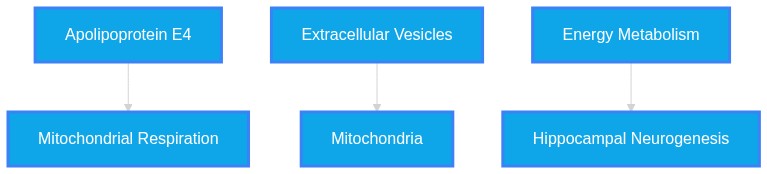
ApoE-mediated lipsignaling and EV-delivered bioenergetic substrates both converge on the stabilization of mitochondrial respiratory complexes, which is the requisite physiological precursor for renewed neurogenesis in the hippocampus.
Dataset Summary
Novel & Overlooked Insights
- ApoE4 is not merely a transport protein but a metabolic stressor that impairs mitochondrial membrane potential and glycolysis in astrocytes.
- EVs possess a 30-fold higher ganglioside content than the parent cells, suggesting unique signaling capabilities in mediating neuroplasticity.
- The entorhinal cortex exhibits region-specific bioenergetic regulation, contrasting with the cortex and hippocampus, indicating differential susceptibility to ApoE4.
- "Neurogenesis without division" in cortical immature neurons (cINs) offers a paradigm shift in how we view brain structural plasticity.
- Pharmacological inhibition of the lysosomal channel TMEM175 can alleviate mitochondrial dysfunction under oxidative stress through AMPK activation.
- SORD-related neuropathies demonstrate that muscle tissue itself is an active site of mitochondrial complex I and metabolic regulation, complicating systemic disease models.
Extracted Discoveries
- Determine if EV-derived mitochondrial cargo can rescue hippocampal neurogenesis in ApoE4-TR mice under stress conditions.
- Evaluate the impact of UQCRC1/COX4I1 overexpression on the neurogenic potential of hippocampal neural stem cells in ApoE4-expressing models.
- Longitudinal analysis of ganglioside content in circulating EVs as a proxy for hippocampal metabolic integrity in aging.
- Discovered Hypothesis (A to C): Extracellular vesicles (EVs) derived from muscle tissue can stabilize mitochondrial complexes in hippocampal neurons, promoting neurogenesis via metabolic substrate delivery. - Literature A (Origin): SORD deficiency study (ID: 42616755), detailing mitochondrial stress and metabolic dysfunction in skeletal muscle. - Literature C (Target): Studies on hippocampal neurogenesis (ID: 42602088), linking metabolic stabilization to memory circuits. - The Intersecting Bridge B: Mitochondrial respiratory chain complex proteins (e.g., UQCRC1/COX4I1) and metabolic regulatory signals (e.g., ATP-related metabolites). - Biological Rationale: Muscle-derived EVs carry metabolic cargo that, if distributed to the CNS, could provide the bioenergetic precursors necessary for hippocampal neurons to overcome the metabolic shifts associated with hippocampal sclerosis or aging.
- There is a tension between the protective potential of EGFR activation (promoting neurogenesis) and its potential for promoting neurotoxicity/gliosis if chronic (ID 42591826).
- Use of EV-based decoy receptors (glycoengineered with Gb3, ID 42615512) to sequester toxic circulating factors that impair neuronal bioenergetics.
PathMap is funded by sales of datasets and coversheets to researchers of any kind who wish to discover the most viable routes and paths to accelerate cures. We do not make theoretical molecules, we expose the truth in current PubMed literature. Commission a trace today.
PathMap Scores
How are these metrics evaluated?
Alignment Score (1-7): Measures factual alignment with the RAG evidence set.
[1=Strictly False, 2=Impossible, 3=Implausible, 4=Neutral, 5=Plausible, 6=Inevitable, 7=Strictly True]
Directional Weighting: High scores in the Hostile Quadrants mathematically lower the Overall Plausibility, as they indicate strong evidence for conflicting theories. Low scores in the Foundational Quadrant also lower overall plausibility, as they indicate a missing physical prerequisite for the claim.
Veridicality Audit Report
All Extracted Datapoints
Evaluated Perspectives & Quadrants
Verbatim Quote Audit Console
Mapped Reference Directory (APA)
Abstract Repository (Raw Full-Texts) Show Database
Investigator Profile