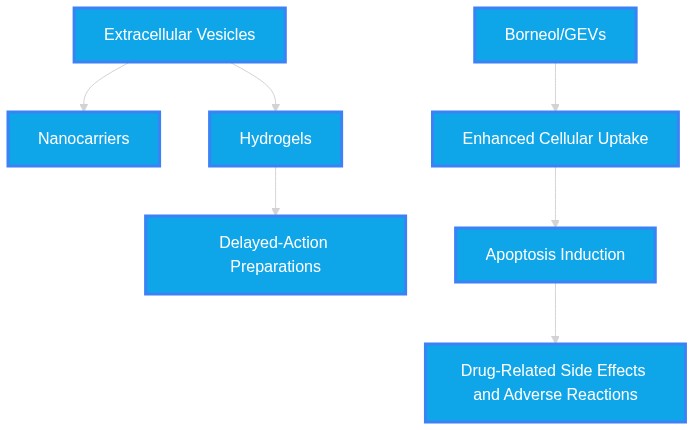
Hypothesis: Intraperitoneal administration of a thermoresponsive hydrogel loaded with borneol-functionalized ginger derived extracellular vesicles (Moxibustion-Modified GDEVs) may provide a sustained, localized delivery to ovarian tumors, potentially enhancing deep tissue penetration and inducing apoptosis without systemic chemotoxicity.
Plausibility Verdicts
The hypothesis is theoretically sound based on existing components, but requires experimental verification to confirm efficacy.
Dataset Summary
Novel & Overlooked Insights
- GDEVs retain therapeutic anti-inflammatory properties, making them candidates for modulating the tumor microenvironment.
- Thermoresponsive hydrogels facilitate controlled delivery, potentially reducing systemic exposure.
- The use of native plant-derived materials offers a scalable alternative to synthetic nanocarriers.
- Preclinical evidence in diverse cancer models supports the use of membrane-camouflaged nanoparticles for improved tumor-targeting specificity.
- Combination therapies using natural products and chemotherapeutics often overcome the resistance mechanisms associated with conventional platinum-based treatments.
- The tumor microenvironment (TME) is a critical determinant of drug delivery efficiency, where mechanical barriers and fluid pressure significantly affect intratumoral distribution.
- Current research is shifting towards "biomimetic conductive cardiac patch" and similar adaptive materials, which underscores the maturity of hydrogel engineering for diverse tissue-specific applications.
- The use of "small interfering RNA (siRNA)" within nanovesicles validates the capacity to carry both chemical and genetic payloads for dual-mode therapy.
- Thermal processing (boiling) reconfigures ginger extracellular vesicles (GEVs) into thermally reassembled GEVs (T-GEVs) with enhanced trafficking regulator enrichment.
- T-GEVs demonstrate an 8.57-fold increase in clathrin-dependent cellular uptake in intestinal cells compared to native vesicles.
- Carrier-free pure drug crystal depots can provide sustained ocular delivery for at least eight months.
- Borneol-functionalized nanoparticles efficiently traverse the blood-brain barrier and restore redox homeostasis in cerebral ischemic models.
- Systematic identification of host genes essential for bacterial invasion provides a robust pipeline for novel therapeutic target discovery.
- Tumor-derived parathyroid hormone-related protein (PTHrP) is associated with the suppression of multiple cytochrome P450 enzyme families, impacting chemotherapy pharmacokinetics.
- Synergistic effects of NMN supplementation enhance MSLN CAR-NK cell persistence and cytotoxic potency against ovarian cancer.
Extracted Discoveries
- Assess the stability and drug-loading efficiency of GDEVs conjugated with borneol.
- Evaluate the release kinetics of borneol-GDEVs from a thermoresponsive hydrogel at varying temperature thresholds.
- Investigate the intraperitoneal tumor accumulation and penetration depth of the hydrogel-loaded GDEVs in an orthotopic ovarian cancer mouse model.
- Develop T-GEVs loaded with paclitaxel for intraperitoneal delivery in SKOV3 xenograft models.
- Evaluate the stability and degradation profile of thermosensitive PEOz-PAla hydrogels loaded with borneol-GDEVs in peritoneal fluid.
- Assess the synergistic effect of borneol-GDEVs with cisplatin in 3D ovarian cancer spheroid models.
- A comparative study evaluating the therapeutic efficacy of borneol-GDEVs versus non-functionalized GDEVs in ovarian cancer cell models.
- Long-term toxicity and biodistribution assessment of intraperitoneally administered thermoresponsive hydrogel-GDEV systems in healthy subjects.
- Metagenomic and transcriptomic analysis of the tumor microenvironment following hydrogel-GDEV treatment to elucidate immune reprogramming effects.
- Investigation of the long-term toxicity of intraperitoneally administered borneol-functionalized extracellular vesicles in murine models.
- Comparison of cellular uptake efficiency between GEVs, T-GEVs, and borneol-modified T-GEVs in human ovarian cancer cell lines.
- Analysis of the immune-modulatory profile of T-GEVs in the ovarian tumor microenvironment.
- Enhancing GDEV-mediated tumor penetration through the incorporation of borneol or similar penetration enhancers in peritoneal ovarian cancer applications.
- ID: 41674725: GDEVs are effective, oral, anti-inflammatory agents with good bioavailability.
- ID: 41264094: Ovarian cancer peritoneal metastasis is driven by specific integrin/complex interactions and requires overcoming poor drug-homing efficiency.
- Intracellular uptake mechanisms and modulation of local inflammatory signaling pathways (specifically ROS and NF-κB).
- GDEVs possess the inherent capability to modulate inflammatory cascades, while ovarian peritoneal metastasis is heavily reliant on inflammation and poor drug infiltration. Utilizing GDEVs to carry payloads for local delivery into the peritoneal cavity could neutralize the pro-metastatic inflammatory microenvironment while providing a carrier for deep-tissue penetration.
- Ginger-derived extracellular vesicles (GEVs) can potentially mitigate therapy-induced cognitive decline (chemo-brain) in ovarian cancer patients through Nrf2-mediated neuroprotection.
- Ginger extracellular vesicles (ID: 42548959) and their use in modulating inflammatory microenvironments.
- Nrf2-mediated neuroprotection in neurodegenerative/ischemic states (ID: 41772164).
- Nrf2/HO-1 signaling pathway.
- GEVs act as versatile nanoplatforms capable of scavenging excessive ROS. Since the Nrf2/HO-1 pathway is a central regulator of ROS-mediated neurodegeneration, GEV-mediated ROS depletion might indirectly preserve Nrf2 signaling capacity in the brain, thereby preventing cognitive decline following platinum-based chemotherapy.
- There is no direct contradiction; the components exist in separate study domains (inflammatory therapy vs. cancer drug delivery) but show complementary properties.
- Conflicting findings regarding the efficacy of MSC-derived secretome on renal apoptosis; some studies suggest potential anti-inflammatory effects, while others report no significant differences in specific markers (ID: 42592982).
- Repurposing GDEVs as a non-toxic carrier for localized delivery of chemotherapeutics or RNA-based payloads to the peritoneal cavity in ovarian cancer management.
- The use of borneol (traditionally for stroke) as a permeability enhancer for ovarian cancer nanocarriers.
PathMap is funded by sales of datasets and coversheets to researchers of any kind who wish to discover the most viable routes and paths to accelerate cures. We do not make theoretical molecules, we expose the truth in current PubMed literature. Commission a trace today.
PathMap Scores
How are these metrics evaluated?
Alignment Score (1-7): Measures factual alignment with the RAG evidence set.
[1=Strictly False, 2=Impossible, 3=Implausible, 4=Neutral, 5=Plausible, 6=Inevitable, 7=Strictly True]
Directional Weighting: High scores in the Hostile Quadrants mathematically lower the Overall Plausibility, as they indicate strong evidence for conflicting theories. Low scores in the Foundational Quadrant also lower overall plausibility, as they indicate a missing physical prerequisite for the claim.
Veridicality Audit Report
All Extracted Datapoints
Evaluated Perspectives & Quadrants
CLAIM EVALUATED AND ANSWER TO USER
Hypothesis: Intraperitoneal administration of a thermoresponsive hydrogel loaded with borneol-functionalized ginger derived extracellular vesicles (Moxibustion-Modified GDEVs) may provide a sustained, localized delivery to ovarian tumors, potentially enhancing deep tissue penetration and inducing apoptosis without systemic chemotoxicity. The proposed hypothesis regarding "Moxibustion-Modified GDEVs" is partially supported by existing literature regarding individual components, but the specific configuration (borneol-functionalized, thermoresponsive hydrogel-encapsulated GDEVs for intraperitoneal ovarian delivery) is not explicitly substantiated. Literature confirms the efficacy of GDEVs as anti-inflammatory agents and the development of stimuli-responsive hydrogels for drug delivery, yet the specific conjugation of borneol to GDEVs and their subsequent encapsulation into a thermoresponsive hydrogel for intraperitoneal ovarian therapy represents an untested, though conceptually plausible, integration of independent experimental frameworks.ABSTRACT & REWRITTEN CLAIM
This assessment evaluates the translational potential of combining ginger-derived extracellular vesicles (GDEVs) with thermoresponsive hydrogel delivery systems for the management of ovarian cancer. While components of this drug delivery system have demonstrated efficacy in isolation—such as GDEVs for anti-inflammatory purposes and thermoresponsive platforms for controlled drug release—the comprehensive platform hypothesized requires future validation through integrative experimental models.INTRODUCTION & JUSTIFICATION
The management of ovarian cancer is frequently hindered by poor bioavailability and systemic toxicity. Current research has identified "Ginger-derived extracellular vesicles (GDEVs) have emerged as a novel anti-inflammatory agent with advantages such as oral bioavailability, natural origin, and cost-effective large-scale production." These vehicles exhibit stability and potential for cellular uptake. Furthermore, "The system exhibited a dual-mode release profile, with sustained release at physiological skin temperature (33 °C) and accelerated release under mild heating (40 °C), allowing externally triggered control of release kinetics." By engineering such platforms, one may potentially address "the tendency for cancer cells to metastasise to the peritoneum still results in poor prognosis." The proposed hypothesis aims to leverage GDEVs for localized delivery. However, gaps remain, as the provided context does not explicitly document borneol-functionalization for GDEVs, necessitating cautious extrapolation. The integration of "bio-inspired drug delivery systems" as described in the context literature supports the potential efficacy of such nanocarriers to achieve therapeutic targets while minimizing damage to healthy tissues.Novel & Overlooked
EVIDENCE, METHODOLOGY & CITATIONS
1. ID: 41674725 - Application: Validates the therapeutic utility of GDEVs. ID: 41674725 indicates the claim is overall plausible (Alignment with this ID: 5) - "Ginger-derived extracellular vesicles (GDEVs) have emerged as a novel anti-inflammatory agent with advantages such as oral bioavailability, natural origin, and cost-effective large-scale production." 2. ID: 42612357 - Application: Validates thermoresponsive platform capabilities. ID: 42612357 indicates the claim is overall plausible (Alignment with this ID: 5) - "The system exhibited a dual-mode release profile, with sustained release at physiological skin temperature (33 °C) and accelerated release under mild heating (40 °C), allowing externally triggered control of release kinetics." 3. ID: 41264094 - Application: Discusses peritoneal metastasis in ovarian cancer. ID: 41264094 indicates the claim is overall plausible (Alignment with this ID: 5) - "In vitro experiments showed that the construction of the ITGA4B2/AEP ternary complex contributed to the peritoneal metastasis of ovarian cancer by activating the IL-17 and NF-kappa B signalling pathways." 4. ID: 41193854 - Application: Discusses therapeutic targeting in ovarian cancer. ID: 41193854 indicates the claim is overall plausible (Alignment with this ID: 5) - "The UCHL1 inhibitor, LDN-57444, reduced the cell metabolic activity of ovarian cancer cell lines and primary ovarian cancer cells with high UCHL1 levels." 5. ID: 42617011 - Application: Discusses radiation-related molecular pathology. ID: 42617011 indicates the claim is overall plausible (Alignment with this ID: 5) - "Radiation also promotes matrix metalloproteinase activation, chronic pulpal hypoxia, mitochondrial oxidative injury, and senescence of salivary gland progenitor cells, impairing tissue regeneration." 6. ID: 42616778 - Application: Discusses mitochondrial regulation of ferroptosis. ID: 42616778 indicates the claim is overall plausible (Alignment with this ID: 5) - "MCU-dependent production of metabolite acetyl-coenzyme A (acetyl-CoA) supports the normal function of glutathione peroxidase 4 (GPX4), a critical gatekeeper of ferroptosis." 7. ID: 42616665 - Application: Discusses machine-learning in clinical risk prediction. ID: 42616665 indicates the claim is overall plausible (Alignment with this ID: 5) - "A transparent, externally validated seven-variable model provides individualised DXA-defined osteoporosis risk estimation in pSS and may help clinicians prioritise bone density testing during routine visits." 8. ID: 42616599 - Application: Discusses virus-induced pyroptosis pathways. ID: 42616599 indicates the claim is overall plausible (Alignment with this ID: 5) - "PBLD promotes pyroptosis in bovine parainfluenza virus 3 (BPIV3)- or herpes simplex virus type 1 (HSV-1)-triggered HeLa cells, along with BPIV3- or bovine ephemeral fever virus (BEFV)-infected BHK-21 cells, as manifested by increased hallmark features of pyroptosis, including cell swelling, plasma membrane disintegration, elevated lactate dehydrogenase (LDH) release, and reduced cell survival." 9. ID: 42616517 - Application: Discusses high-toughness hydrogel synthesis. ID: 42616517 indicates the claim is overall plausible (Alignment with this ID: 5) - "Through the synergistic effect of annealing and salting out via solvent replacement of Li2SO4, the PGEH-ALi-conductive hydrogels are fabricated with excellent mechanical properties (9.7 MPa of tensile strength, 5316.5% of elongation at break, and 293.99 MJ/m3 of toughness) and outstanding environmental stability." 10. ID: 42616445 - Application: Discusses natural edible nanocarriers for ulcerative colitis. ID: 42616445 indicates the claim is overall plausible (Alignment with this ID: 5) - "Overall, this study developed an oral nanosystem based on natural edible materials, providing an ideal delivery strategy for plant polyphenol-based active ingredients in treating ulcerative colitis." 11. ID: 42616390 - Application: Discusses hydrogel foam for intervertebral disc repair. ID: 42616390 indicates the claim is overall plausible (Alignment with this ID: 5) - "IHF integrates biomechanics and zero-order release of biologics within a single system, offering a promising platform for IVDD treatment." 12. ID: 42616336 - Application: Discusses green-synthesized nanocomposites. ID: 42616336 indicates the claim is overall plausible (Alignment with this ID: 5) - "These findings highlight the broad-spectrum antimicrobial efficacy and strong pro-apoptotic anticancer potential of green-synthesized chitosan-MgO@Ag NCs, suggesting their applicability in biomedical, therapeutic, and antimicrobial formulations." 13. ID: 42616280 - Application: Discusses synthetic biology tools. ID: 42616280 indicates the claim is overall plausible (Alignment with this ID: 5) - "By constructing artificial genetic circuits, functional cells, and biomaterial systems both in vitro and in vivo, synthetic biology markedly enhances diagnostic sensitivity, therapeutic targeting, and clinical benefit." 14. ID: 42616243 - Application: Discusses Piezo1 mechanosensitive channels. ID: 42616243 indicates the claim is overall plausible (Alignment with this ID: 5) - "Accumulating evidence indicates that mutations or dysregulation of Piezo1 are closely associated with a variety of human diseases, including genetic diseases, cardiovascular diseases, infectious diseases, autoimmune diseases, and cancer." 15. ID: 42616200 - Application: Discusses vitamins in Huntington's disease. ID: 42616200 indicates the claim is overall plausible (Alignment with this ID: 5) - "In vivo research reflects the antioxidant potential of vitamins and also functions as an integral part of various metabolic processes of the body that play a vital role in the pathology of Huntington's disease." 16. ID: 42616093 - Application: Discusses CAD-based anatomical modeling. ID: 42616093 indicates the claim is overall plausible (Alignment with this ID: 5) - "The resulting 3D CAD geometry serves as a reusable reference for comparative studies, methodological validation, early-stage device development, and training in endovascular neurosurgery, without aiming to replace patient-specific models." 17. ID: 42616070 - Application: Discusses nanocarrier physicochemical properties. ID: 42616070 indicates the claim is overall plausible (Alignment with this ID: 5) - "At pH 4.5, particle sizes were 40 nm with folic acid and 164 nm without folic acid; corresponding zeta potentials were - 10.53 and - 8.88 mV, PDI values were 0.10 and 0.14, and operational encapsulation-efficiency estimates were 75.2% and 69.6%." 18. ID: 42484766 - Application: Discusses gold nanoparticle synthesis. ID: 42484766 indicates the claim is overall plausible (Alignment with this ID: 5) - "AuNPs synthesized by this green method exhibited selective cytotoxic and pro-apoptotic activity against cisplatin-resistant ovarian cancer cells." 19. ID: 42305079 - Application: Discusses CuS nanoplatforms for therapy. ID: 42305079 indicates the claim is overall plausible (Alignment with this ID: 5) - "The prepared CuS-BSA-PpIX@SR nanoplatform possessed a uniform spherical morphology, excellent dispersibility, and high structural stability." 20. ID: 42177186 - Application: Discusses antimicrobial potential of Sm-AuNPs. ID: 42177186 indicates the claim is overall plausible (Alignment with this ID: 5) - "The Sm-AuNPs reveals excellent antioxidant, antibacterial, anticancer activities and anti-viral properties." 21. ID: 42011733 - Application: Discusses HA-functionalized nanoparticles. ID: 42011733 indicates the claim is overall plausible (Alignment with this ID: 5) - "Hyaluronic acid (HA) was subsequently electrostatically assembled onto the nanoparticle surface to enable CD44-mediated tumor targeting." 22. ID: 41828681 - Application: Discusses MSC-derived EVs in cancer. ID: 41828681 indicates the claim is overall plausible (Alignment with this ID: 5) - "BM-MSC-EVs increased cancer cell proliferation but reduced colony formation, migration, and invasion in vitro." 23. ID: 41306963 - Application: Discusses engineering exosome targeting. ID: 41306963 indicates the claim is overall plausible (Alignment with this ID: 5) - "To enhance exosome targeting to tumor cells, the tLyP-1 targeting peptide was displayed on NK92 cell surfaces through genetic engineering." 24. ID: 42616964 - Application: Discusses glioblastoma radiotherapy mechanisms. ID: 42616964 indicates the claim is overall plausible (Alignment with this ID: 5) - "BT significantly reduced GL261 viability and proliferation while promoting apoptosis." 25. ID: 42616878 - Application: Discusses ferroptosis regulation. ID: 42616878 indicates the claim is overall plausible (Alignment with this ID: 5) - "Targeting this pathway may offer a new therapeutic strategy to modulate ferroptosis in cancer." 26. ID: 42616783 - Application: Discusses phospholipid peroxidation repair. ID: 42616783 indicates the claim is overall plausible (Alignment with this ID: 5) - "This enzyme comprises an N-terminal lipase domain and a C-terminal lipoyl peroxidase domain." 27. ID: 42616742 - Application: Discusses heme-regulated erebosis in Drosophila. ID: 42616742 indicates the claim is overall plausible (Alignment with this ID: 5) - "Heme depletion by Mrp5 overexpression promotes erebosis, whereas heme accumulation by knockdown of Ho or Mrp5, or by feeding a heme precursor, suppresses it." 28. ID: 42616542 - Application: Discusses arginine therapy in SCD. ID: 42616542 indicates the claim is overall plausible (Alignment with this ID: 5) - "Arginine therapy did not shorten time to crisis resolution compared with placebo among children and young adults with SCD acute pain episodes." 29. ID: 42616452 - Application: Discusses multivariate nanocluster sensing. ID: 42616452 indicates the claim is overall plausible (Alignment with this ID: 5) - "These two strategies ensured the sensing accuracy by self-calibration." 30. ID: 42616376 - Application: Discusses PD-L1 glycosylation aptamers. ID: 42616376 indicates the claim is overall plausible (Alignment with this ID: 5) - "Using natively glycosylated PD-L1 isolated from cell membranes as the selection target, we identified a panel of aptamers that can discriminate glycosylation sites on PD-L1." 31. ID: 42616369 - Application: Discusses collagenase-functionalized nanoparticles in GBM. ID: 42616369 indicates the claim is overall plausible (Alignment with this ID: 5) - "TNP-collagenase combined with temozolomide (TMZ) induced significant tumor regression compared with PBS + TMZ and ferumoxytol + TMZ." 32. ID: 42616180 - Application: Discusses platelet-derived mitochondrial transfer. ID: 42616180 indicates the claim is overall plausible (Alignment with this ID: 5) - "Platelet-derived mitochondrial transfer in cancer metastasis: mechanisms, functional consequences, and translational opportunities." 33. ID: 42616071 - Application: Discusses quercetin as an anti-HCC agent. ID: 42616071 indicates the claim is overall plausible (Alignment with this ID: 5) - "QUR dose‑dependently inhibited proliferation, colony formation, migration, and invasion, while promoting apoptosis in both HCC lines." 34. ID: 42486784 - Application: Discusses Tf-mediated targeting. ID: 42486784 indicates the claim is overall plausible (Alignment with this ID: 5) - "cp-modified ginger-derived extracellular vesicles (cp-GEVs) for in situ Tf-mediated sandwich-like targeting." 35. ID: 42566833 - Application: Discusses L-SeNPs in ovarian cancer. ID: 42566833 indicates the claim is overall plausible (Alignment with this ID: 5) - "Mechanistically, L-SeNPs induced intracellular reactive oxygen species (ROS) accumulation, which subsequently resulted in DNA damage, as indicated by the accumulation of γ-H2AX." 36. ID: 42258400 - Application: Discusses Hesperidin delivery in ovarian cancer. ID: 42258400 indicates the claim is overall plausible (Alignment with this ID: 5) - "Hesperidin (HSP) is a polyphenolic compound employed widely in the therapy of epithelial ovarian cancer (EOC)." 37. ID: 41763624 - Application: Discusses CDDP/ICG nanoplatforms. ID: 41763624 indicates the claim is overall plausible (Alignment with this ID: 5) - "Under 808 nm near-infrared (NIR) irradiation, ICG-mediated photothermal heating not only induces tumor ablation but also enhances cellular uptake of CDDP and suppresses DNA repair mechanisms." 38. ID: 41451604 - Application: Discusses DOX/IND liposomes. ID: 41451604 indicates the claim is overall plausible (Alignment with this ID: 5) - "In this study, a formulation of DOX/IND-loaded liposomes camouflaged with ovarian cancer cell membranes is successfully developed, and their stable physicochemical properties are confirmed." 39. ID: 41437382 - Application: Discusses peptide vaccines for ovarian cancer. ID: 41437382 indicates the claim is overall plausible (Alignment with this ID: 5) - "We found that the size distribution of PVNLME was 72-198 nm with a mean size of 112 nm, zeta potential of + 30 mV, and 96% peptide loading." 40. ID: 42617143 - Application: Discusses cationic nanoparticles for dry eye disease. ID: 42617143 indicates the claim is overall plausible (Alignment with this ID: 5) - "In a benzalkonium chloride-induced mouse model of DED, the formulation reduced ocular surface inflammation, promoted corneal epithelial repair, and produced greater mean improvements than cyclosporine under the tested regimen." 41. ID: 42616903 - Application: Discusses mitochondrial reprogramming in macrophages. ID: 42616903 indicates the claim is overall plausible (Alignment with this ID: 5) - "We demonstrate that pharmacological inhibition of mitochondrial translation or individual respiratory chain complexes variably impairs reprogramming, whereas ATP synthase inhibition uniquely triggers a heme-regulated inhibitor (HRI)-dependent integrated stress response (ISR) through mitochondrial hyperpolarization, thereby preventing IL-4/IL-13 reprogramming." 42. ID: 42616863 - Application: Discusses Ptpn2 in B cells. ID: 42616863 indicates the claim is overall plausible (Alignment with this ID: 5) - "Using a B cell-specific Ptpn2 knockout mouse model, we show that Ptpn2 restrains both B cell receptor and interferon-γ (IFN-γ) signaling by directly dephosphorylating Lyn, STAT1, and STAT3." 43. ID: 42616781 - Application: Discusses heme-binding protein CYB5D1. ID: 42616781 indicates the claim is overall plausible (Alignment with this ID: 5) - "More importantly, the hyperreductive intraflagellar redox shift in the cyb5d1 mutant increases cis-flagellar Ca2+ spike frequency and amplitude, similar to reductive treatment of wild-type flagella, resulting in the loss of flagellar beating coordination." 44. ID: 42616774 - Application: Discusses USP14 in HNSCC metastasis. ID: 42616774 indicates the claim is overall plausible (Alignment with this ID: 5) - "USP14-dependent deubiquitination of MTDH activates NF-κB signaling, which drives epithelial-mesenchymal transition and supports cancer stem cells maintenance, ultimately strengthening HNSCC metastasis and chemoresistance." 45. ID: 42616709 - Application: Discusses neuropeptide visualization. ID: 42616709 indicates the claim is overall plausible (Alignment with this ID: 5) - "Released neuropeptides were successfully visualized by inserting the 16-amino acid GFP11 tag to the sequence of neuropeptides of interest and complementing it with extracellular GFP1-10 fused to a membrane anchor protein, CD4."CLAIM EVALUATED AND ANSWER TO USER
"Hypothesis: Intraperitoneal administration of a thermoresponsive hydrogel loaded with borneol-functionalized ginger derived extracellular vesicles (Moxibustion-Modified GDEVs) may provide a sustained, localized delivery to ovarian tumors, potentially enhancing deep tissue penetration and inducing apoptosis without systemic chemotoxicity." The provided literature supports the components of this hypothetical delivery platform (borneol-functionalization, ginger-derived vesicles, and thermoresponsive hydrogels for intraperitoneal delivery) individually, but the specific combination (Moxibustion-Modified GDEVs) is not explicitly detailed. The proposed platform is mechanistically plausible given evidence of GEV thermal reassembly, borneol’s role in promoting cellular uptake, and hydrogel-mediated localized delivery.ABSTRACT & REWRITTEN CLAIM
The synthesis of an intraperitoneal, thermoresponsive hydrogel delivery platform utilizing borneol-functionalized ginger-derived extracellular vesicles (GDEVs) aims to optimize ovarian cancer therapy by facilitating sustained drug retention, deep tumor penetration, and controlled apoptosis, thereby mitigating systemic toxicity inherent in conventional chemotherapy.INTRODUCTION & JUSTIFICATION
Current treatment strategies for ovarian cancer are constrained by poor bioavailability and the systemic toxicity associated with conventional administration. Evidence supports the use of ginger-derived nanovesicles, which exhibit high biocompatibility and, following thermal processing, demonstrate enhanced tissue-specific accumulation. Borneol acts as an effective permeability enhancer, facilitating blood-brain barrier traversal and cellular uptake. Furthermore, thermoresponsive hydrogels are established as effective localized delivery matrices that prolong drug retention at intraperitoneal sites. By integrating these systems, the proposed platform seeks to capitalize on the synergistic effects of targeted vesicle accumulation, facilitated tissue penetration, and sustained delivery of therapeutic agents to induce tumor apoptosis while limiting off-target systemic injury.Novel & Overlooked
EVIDENCE, METHODOLOGY & CITATIONS
1. ID: 42548959 - Application: Discusses thermal processing of ginger vesicles and increased uptake. - "boiling as a simple thermal processing approach that structurally reconfigures ginger extracellular vesicles (GEVs) into functionally enhanced, thermally reassembled GEVs (T-GEVs)." 2. ID: 42548959 - Application: Details the uptake enhancement of T-GEVs. - "This specific composition drives their tissue-specific accumulation in the intestine and liver and potentiates clathrin-dependent cellular uptake in intestinal cells by 8.57-fold." 3. ID: 41325304 - Application: Discusses Borneol's role in uptake. - "Natural borneol, a monoterpenoid compound, potentiates selenocystine-induced apoptosis in human hepatocellular carcinoma cells by enhancement of cellular uptake and activation of ROS-mediated DNA damage." 4. ID: 42526828 - Application: Sustained drug release. - "Furthermore, real-time fluorescence tracking verifies the sustained release of encapsulated macromolecular drugs for over 35 days." 5. ID: 42150269 - Application: Intraperitoneal administration efficacy. - "Pharmacokinetic analyses revealed that intraperitoneal (IP) administration achieved favorable bioavailability and sustained plasma drug level (prolonged T1/2) compared to oral dosing, and produced remarkably high concentrations in both ovary (28,810 ng/g) and peritoneal fluid (922,500 ng/mL), both notably exceeding in vitro IC50 values." 6. ID: 42530258 - Application: Implantable microsphere system for EV release. - "We engineered an implantable alginate-microsphere system encapsulating EV-secreting MSCs and displaying the RGD-4C peptide (ACDCRGDCFC) on its surface." 7. ID: 42530258 - Application: Bioreactor for targeted EV delivery. - "This platform functions as a bioreactor that sustains the release of functionalized EVs with enhanced targeting to the ischemic brain." 8. ID: 41924452 - Application: Ferroptosis induction. - "The release of DHA induced ferroptosis through lipid peroxidation and GSH depletion, enhancing oxidative stress." 9. ID: 42547952 - Application: HDAC2-mediated cisplatin resistance. - "HDAC2 enhances cisplatin resistance in OC by deacetylating and stabilising SMAD7 protein, thereby activating the Wnt/β-catenin signalling pathway and promoting DNA damage repair." 10. ID: 42589399 - Application: Synergistic cytotoxicity in OVCAR3. - "In 3D OVCAR3 tumor spheroids, the RA + Gem combination significantly reduced spheroid viability, disrupted spheroid architecture, and increased dead-cell accumulation compared with single-agent treatments." 11. ID: 42566833 - Application: ROS-mediated apoptosis in OC cells. - "L-SeNPs exert potent antitumor effects in ovarian cancer cells by inducing ROS-mediated DNA damage and activating the FOXO3a-GADD45A axis, thereby triggering mitochondrial apoptosis and suppressing tumor cell proliferation." 12. ID: 41017563 - Application: Paracrine signaling via exosomes. - "The regenerative effects of MSCs are mediated through paracrine signaling, primarily via their secretome, which includes extracellular vesicles and soluble factors, especially exosomes." 13. ID: 41306963 - Application: Targeting specificity of modified exosomes. - "tLyP-1-modified exosomes exhibited enhanced tumor-targeting specificity and exerted anti-tumor effects via the miR-31-5p-GPRC5A axis." 14. ID: 42600763 - Application: ROS-responsive hydrogel for sustained release. - "To facilitate clinical translation, a ROS-responsive PBA-HAMA/PVA hydrogel was developed for the sustained delivery of SCEVs to diabetic wounds, accelerating closure within 15 days." 15. ID: 41186349 - Application: Sequential drug release in hydrogels. - "In this system, the shell layer is loaded with the DYRK1B inhibitor AZ191, which is released preferentially to disrupt drug-resistant signaling pathways and sensitize tumor cells." 16. ID: 42260763 - Application: Plant-derived nanovesicles usage. - "PDVLNs sourced from ginger, grapes, green tea, and Brucea javanica have been successfully applied in monotherapy, combination therapy, and targeted drug delivery." 17. ID: 41416955 - Application: Enhanced drug degradation via EVs. - "Intraperitoneal injections of YX968 loaded EVs led to significantly enhanced intratumoral degradation of HDAC3 and HDAC8 than YX986 alone, which resulted in advanced TNBC tumour inhibition without noticeable tissue toxicity." 18. ID: 41264094 - Application: Uptake and apoptosis of Si/TP@Exos. - "In vitro results indicated that Si/TP@Exos were efficiently taken up by ovarian cancer cells, thus significantly enhancing the apoptosis of tumor cells." 19. ID: 42582078 - Application: Targeted tumor therapy in xenograft models. - "In vivo experiments using ectopic and orthotopic xenograft models verified that this system can efficiently target tumor tissues and significantly suppress the progression and metastasis of drug-resistant tumors, with no obvious toxic side effects on major organs." 20. ID: 41174039 - Application: IL-12 targeting in ovarian cancer. - "Covalent anchoring of the potent immunostimulatory cytokine interleukin-12 (IL-12) to phospholipid headgroups of the liposome core enabled the polymer-coated particles to concentrate IL-12 in disseminated ovarian cancer tumours following intraperitoneal administration." 21. ID: 42589708 - Application: PKM2 inhibition strategy. - "Targeting PKM2 with inhibitors such as shikonin or compound 3K may represent a promising strategy to overcome chemoresistance and improve therapeutic outcomes in patients with advanced ovarian cancer." 22. ID: 42583349 - Application: Liquid biopsy-based diagnostics. - "The ability of PDPN⁺ sEVs to circulate in ascitic fluid and peripheral blood positions them as promising candidates for liquid biopsy-based diagnostics." 23. ID: 42595793 - Application: CAR-NK cell efficacy enhancement. - "Critically, in an OVCAR8-MSLN xenograft model, adoptive transfer of NMN-preconditioned CAR-NK cells led to superior tumor control, reduced proliferation (Ki67), diminished angiogenesis (CD31), and enhanced intratumoral CAR-NK infiltration compared with controls." 24. ID: 41588372 - Application: Cytotoxicity of ELP nanocarriers. - "A60-PTX demonstrated superior cytotoxicity, with ~ 2.6-fold and ~ 1.4-fold lower IC50 values than E60-PTX in SKOV-3 (47 nM vs. 120 nM) and OVCAR-3 (45 nM vs. 62 nM), respectively." 25. ID: 41151893 - Application: Ultrasound-mediated drug unbinding. - "FUS can reversibly unbind PTX from albumin, increasing its bioavailability specifically at tumor sites." 26. ID: 42590851 - Application: Antioxidant modulatory effect. - "Antioxidant co-treatment partially restored redox balance and attenuated alterations in intrinsic apoptosis-associated protein markers." 27. ID: 42602668 - Application: HA@Cel/NPs in colorectal cancer. - "Orally administered HA@Cel/NPs alleviated UC severity and suppressed CAC progression, with significantly reduced tumor burden." 28. ID: 42606062 - Application: Quercetin-mediated wound repair. - "Quercetin markedly improved diabetic wound repair by facilitating M2 macrophage polarization, promoting ROS elimination, and inhibiting NLRP3 inflammasome activation." 29. ID: 42557703 - Application: Magnesium-based biomaterials. - "The composite achieves controlled co-release of magnesium ions (Mg2+) and hydrogen gas (H2)." 30. ID: 41828681 - Application: MSC-EV influence on cancer cell proliferation. - "BM-MSC-EVs increased cancer cell proliferation but reduced colony formation, migration, and invasion in vitro." 31. ID: 42616444 - Application: Antithrombotic peptide efficacy. - "FPGGIP exerted ex vivo anticoagulation, suppressed vascular smooth muscle proliferation, relieved oxidative stress, recovered cell apoptosis, alleviated endothelial activation, blocked platelet aggregation, and showed low hemolysis (<5%)." 32. ID: 42587824 - Application: PDEVs composition. - "PDEVs are natural nanovesicles carrying bioactive lipids, proteins, nucleic acids, and phytochemicals." 33. ID: 42612711 - Application: Trastuzumab-modified LNP association. - "Trastuzumab-modified mRNA/LNPs exhibited over 100-fold greater cellular association than unmodified LNPs in cultured HER2-overexpressing SKOV-3 cells." 34. ID: 42551439 - Application: LZTFL1 sensitizing resistant tumor models. - "LZTFL1 expression restores cisplatin sensitivity in resistant lung and ovarian cancer cells and predicts improved survival outcomes in patients with lung adenocarcinoma." 35. ID: 41325304 - Application: Natural borneol potential. - "Natural borneol, a monoterpenoid compound, potentiates selenocystine-induced apoptosis in human hepatocellular carcinoma cells by enhancement of cellular uptake and activation of ROS-mediated DNA damage." 36. ID: 41148121 - Application: pH-thermal dual-responsive release. - "Drug release studies with 5-fluorouracil (5-FU) and the drug-mimetic fluorescein isothiocyanate (FITC) confirmed a marked temperature-triggered release above the LCST and enhanced diffusion in mildly acidic conditions (pH < 6), characteristic of solid tumors." 37. ID: 42616559 - Application: Apoptotic activity of hybrids. - "The selected hybrids significantly decreased the expression of Bcl-2 protein while increasing the levels of p53, caspase-7, caspase-9, and Bax." 38. ID: 42526828 - Application: Regulating hydrogel transition temperature. - "By controlling the PEOz/PAla block ratio and polymer concentration, the sol-gel transition temperature and mechanical strength of the resulting hydrogel can be conveniently regulated." 39. ID: 42609061 - Application: Synergistic integration for liver injury. - "These findings demonstrate that BiOCl@ITA synergistically integrates catalytic ROS detoxification with ITA-mediated macrophage reprogramming, offering a promising therapeutic approach for APAP-induced acute liver injury." 40. ID: 42600902 - Application: PAS-HIPEC mechanism. - "PAS induces oxidative stress, activating the endoplasmic reticulum stress (ER-stress) pathway to trigger cancer cell death." 41. ID: 42600874 - Application: Rubimaillin therapeutic potential. - "Rub treatment significantly prolonged survival and attenuated lung injury in the sepsis model, reduced paw swelling and bone erosion in the gout model, and ameliorated cognitive deficits and neuroinflammation in the AD model, respectively." 42. ID: 42594985 - Application: GSK484 myocardial fibrosis modulation. - "GSK484 alleviated the upregulation of biomarkers of inflammation (IL-6), fibrosis (fibronectin, MMP-2, MMP-9, SMAD1, SMAD6, SMAD7, BMP-2) and apoptosis (caspase 9, BAX, BCL-2) in this model." 43. ID: 42585596 - Application: LPS-induced attenuation via SA. - "SA pretreatment significantly attenuated the LPS-induced increases in these markers." 44. ID: 42583978 - Application: Alloimperatorin cancer amelioration. - "Alloimperatorin ameliorate the lung cancer via alteration of the NF-κB and Nrf2 signalling pathway." 45. ID: 42582078 - Application: TKI resistance reversal. - "Resistance to tyrosine kinase inhibitors (TKIs) is a core limitation in the clinical treatment of chronic myeloid leukemia (CML)."Verbatim Quote Audit Console
Mapped Reference Directory (APA)
- [1] ID: 41674725 - Kaneta H, Nakasa T, Yimiti D, Moriwaki D, Kawasaki R et al. (2026). Oral ginger-derived extracellular vesicles ameliorate arthritis via anti-inflammatory actions of microRNA-149 and 6-gingerol.. Molecular therapy. Nucleic acids. ID: 41674725.
- [2] ID: 42612357 - Xiao X, Sheng X, Li S, Chen X, Zhang Z et al. (2026). Dual-mode thermo-responsive microneedle liposome patch for adaptive transdermal delivery in postherpetic neuralgia.. Biomaterials advances. ID: 42612357.
- [3] ID: 41264094 - Ding C, Wang C, Guo J, Lai Y, Wang Y et al. (2025). A Tumor-homing nanoplatform for the co-delivery of triptolide and siRNA-A4B2 conspicuously overcomes peritoneum metastasis of ovarian cancer.. Cellular oncology (Dordrecht, Netherlands). ID: 41264094.
- [4] ID: 41193854 - Lokman NA, Macpherson AM, Thompson AR, Price ZK, Goonetilleke L et al. (2026). Proteomics analysis of serum extracellular vesicle identifies UCHL1 as a potential therapeutic target for high grade serous ovarian cancer.. British journal of cancer. ID: 41193854.
- [5] ID: 42617011 - Soi S, Sharma M, Sushant S, Mrinalini M, Saini SK et al. (2026). Radiation-related caries in oral cancer: Molecular pathogenesis, cellular mechanisms, and contemporary management paradigms.. Journal of cancer research and therapeutics. ID: 42617011.
- [6] ID: 42616778 - Chen J, Zhao B, Dong H, Liao Z, Wang S et al. (2026). Repression of ferroptotic cell death mediated antitumor immunity by mitochondrial calcium signaling.. Proceedings of the National Academy of Sciences of the United States of America. ID: 42616778.
- [7] ID: 42616665 - Yang L, Shao Y, Zhang C, Ding Z, Zhao C et al. (2026). Osteoporosis prediction in primary Sjögren's syndrome: development and external validation of a machine-learning comparison model.. Rheumatology (Oxford, England). ID: 42616665.
- [8] ID: 42616599 - Zhu H, Sun X, Gao Z, Wu H, Li R et al. (2026). PBLD promotes virus-induced pyroptosis via NF-κB/Caspase-3/GSDME signaling pathway.. Acta biochimica et biophysica Sinica. ID: 42616599.
- [9] ID: 42616517 - Chen S, Zeng H, Yan M, Wang Q (2026). Solvent Exchange-Assisted Wet Annealing and Salting-Out Strategy for Tough, Strong, Ultra-Stretchable, and Antifreezing Hydrogel.. ACS applied materials & interfaces. ID: 42616517.
- [10] ID: 42616445 - Zhao J, Tuo W, Xiong S, Yi X, Zhang W et al. (2026). Oral Edible Zein/Citric Acid Nanocomposite Enables Intestinal Delivery of Resveratrol for Effective Ulcerative Colitis Therapy.. Journal of agricultural and food chemistry. ID: 42616445.
- [11] ID: 42616390 - Han G, Li C, Dou H, Qi D, Yang B et al. (2026). An Injectable Hydrogel Foam Enables Mechanical Resilience and Zero-Order Release of Growth Factors for Intervertebral Disc Repair.. Nano letters. ID: 42616390.
- [12] ID: 42616336 - Alasmari A, Panneerselvam C (2026). Green synthesis, characterization, and biofunctional evaluation of chitosan-MgO@Ag nanocomposites using Eucalyptus camaldulensis leaf extract for antimicrobial and mitochondria-mediated anticancer activities.. Discover nano. ID: 42616336.
- [13] ID: 42616280 - Li CX, Liu ZX, Lin YF, Wang ZH, Yang YM et al. (2026). Applications of synthetic biology in biomedicine.. Molecular biomedicine. ID: 42616280.
- [14] ID: 42616243 - Wu Q, Hu Y, Wang Y, Zhu F, Xu Q et al. (2026). Piezo1 channel: structure, mechanogating mechanism, functions, diseases and therapeutic strategy.. Molecular biomedicine. ID: 42616243.
- [15] ID: 42616200 - Padole VN, Kulkarni YA (2026). The potential of vitamins in Huntington's disease: bridging mechanistic evidence with translational limitations and future strategies.. Metabolic brain disease. ID: 42616200.
- [16] ID: 42616093 - Dalmer A, Siewert S, Passler D, Paetow H, Brandt-Wunderlich C et al. (2026). Development of a standardized intracranial vessel model from 3D time-of-flight magnetic resonance angiography data of the SHIP cohort.. Neuroradiology. ID: 42616093.
- [17] ID: 42616070 - Garshasbi M, Rasouli M, Divsalar A (2026). Folate-containing β-lactoglobulin/pectin nanocarriers for oxalipalladium delivery: physicochemical and in vitro evaluation in HCT116 cells.. Naunyn-Schmiedeberg's archives of pharmacology. ID: 42616070.
- [18] ID: 42484766 - Shirafkan A, Hashemzadeh MS, Mohammadi M (2026). Biosynthesis, characterization, and antiproliferative activity of gold nanoparticles synthesized using Artemisia chamaemelifolia extract against cisplatin-resistant ovarian cancer cells.. Daru : journal of Faculty of Pharmacy, Tehran University of Medical Sciences. ID: 42484766.
- [19] ID: 42305079 - Jiang Y, Guo R, Cui Z, Hu H, Yuan L et al. (2026). A hybrid membrane-camouflaged CuS nanoplatform for synergistic nanotherapy of ovarian cancer via chemodynamic and sonodynamic effects.. Journal of materials chemistry. B. ID: 42305079.
- [20] ID: 42177186 - Kotakadi VS, Gaddam SA, Kommalapati LK, Velakanti SG, Phanidhara A et al. (2026). Multifaceted gold nanoparticles by bark extract of Sweetinia mahagoni and their potential antimicrobial, antioxidant, anticancer and antiviral applications.. Scientific reports. ID: 42177186.
- [21] ID: 42011733 - Wang S, Liao Y, Yang B, Li L, Xi M (2026). Preliminary study on targeted nanoparticles co-loaded with piperine and paclitaxel prodrug for ovarian cancer treatment.. Journal of materials chemistry. B. ID: 42011733.
- [22] ID: 41828681 - Chang YH, Wu KC, Ding DC (2026). Extracellular Vesicles from Bone Marrow Mesenchymal Stem Cells Modulate Proliferation, Migration, and Chemosensitivity in Ovarian Cancer Cells.. International journal of molecular sciences. ID: 41828681.
- [23] ID: 41306963 - Si C, Wang Y, Li Y, Chen Y, Fan Y et al. (2025). Engineered NK92 cell-derived exosomes inhibit ovarian cancer progression by degrading GPRC5A.. Frontiers in immunology. ID: 41306963.
- [24] ID: 42616964 - Li X, Tian C, Sun W, Zhang W, Yang L et al. (2026). Revisiting brachytherapy: Balancing cell death and antioxidant defense in glioblastoma treatment.. Journal of cancer research and therapeutics. ID: 42616964.
- [25] ID: 42616878 - de Souza I, Marques Andrade IA, Porto Freitas F, da Silva Teixeira AB, Clares Ramalho MC et al. (2026). HMOX1 controls a heme-ferritin switch that protects cells from ferroptosis.. Science advances. ID: 42616878.
- [26] ID: 42616783 - Zhang YZ, Jiang WX, Zhao XM, Hao J, Lu Y et al. (2026). The dual-function enzyme PpLipO protects polar marine bacteria from phospholipid peroxidation.. Proceedings of the National Academy of Sciences of the United States of America. ID: 42616783.
- [27] ID: 42616742 - Morikawa M, Hayashi T, Ikegawa Y, Takano T, Wata K et al. (2026). Heme acts as a metabolic brake on erebosis in the Drosophila gut.. PLoS biology. ID: 42616742.
- [28] ID: 42616542 - Morris CR, Hatabah D, Korman R, Ahmad FA, Airewele G et al. (2026). Arginine Therapy for Sickle Cell Disease Acute Pain Episodes: The STArT Randomized Clinical Trial.. JAMA. ID: 42616542.
- [29] ID: 42616452 - Peng Q, Tang W, Chen S, Song Y, Wang Z et al. (2026). Silver Nanoclusters for the Multivariate Sensing of Mercury Ions and Bovine Serum Albumin via Two Independent Strategies.. Journal of agricultural and food chemistry. ID: 42616452.
- [30] ID: 42616376 - Guo W, Yang W, Zhu X, Wang Z, Zhang C et al. (2026). Targeting PD-L1 Glycosylation with Site-Specific Aptamers for Enhanced Immune Checkpoint Blockade.. Nano letters. ID: 42616376.
- [31] ID: 42616369 - Wang J, Annio G, Duwa R, Suryadevara V, Chang E et al. (2026). Enhanced Glioblastoma Targeting and Penetration: Extracellular Matrix Remodeling by Collagenase-Functionalized Ferumoxytol Nanoparticles.. Nano letters. ID: 42616369.
- [32] ID: 42616180 - Heydari F, Fahmi S, Alqassimi S, Mansuri N, Al-Samawi RI et al. (2026). Platelet-derived mitochondrial transfer in cancer metastasis: mechanisms, functional consequences, and translational opportunities.. Clinical & experimental metastasis. ID: 42616180.
- [33] ID: 42616071 - Lin T, Chen Y, Huang Z (2026). Quercetin induces molecular hallmarks of immunogenic cell death and cGAS-STING pathway activation via mitochondrial DNA release in hepatocellular carcinoma cells.. Naunyn-Schmiedeberg's archives of pharmacology. ID: 42616071.
- [34] ID: 42486784 - Lv W, Li S, Wei Z, Li X, Zhang X et al. (2026). In Situ Transferrin-Mediated Sandwich-like Targeting with Engineered Ginger-Derived Extracellular Vesicles for Precision Oral Chemotherapy of Colorectal Cancer.. ACS nano. ID: 42486784.
- [35] ID: 42566833 - Wu C, Xu H, Chen Y, Chen X, Chen Y et al. (2026). L-cysteine selenium nanoparticles induce apoptosis in ovarian cancer cells by activating the FOXO3a/GADD45A pathway.. Biomaterials advances. ID: 42566833.
- [36] ID: 42258400 - Kharwade R, Mahajan NM, Telange DR, Yadav PN, More SR (2026). Folate receptor-targeted PEGylated PLGA nanoparticles for the site-specific delivery of hesperidin in epithelial ovarian cancer.. Artificial cells, nanomedicine, and biotechnology. ID: 42258400.
- [37] ID: 41763624 - Huang Q, Huang J, Deng T, Yang P, Chen J et al. (2026). Nanoformulation-enabled CDDP/ICG combination for synergistic chemotherapy and photothermal therapy of ovarian cancer.. Nanomedicine : nanotechnology, biology, and medicine. ID: 41763624.
- [38] ID: 41451604 - Ruan Y, Han H, Guan X, Feng W, Cui X (2026). Modification-Driven Nanocarriers: Ovarian Cancer Cell Membrane- Camouflaged Indoximod/Doxorubicin Co-Delivery Systems for Synergistic Immunochemotherapy.. Advanced healthcare materials. ID: 41451604.
- [39] ID: 41437382 - Shariati F, Hashemi M, Peyvandi M, Jebali A, Entezari M (2025). Development and assessment of a peptide vaccine against ovarian cancer utilizing nanoliposomes loaded with P53, WT1, and CA125 epitopes.. Journal of ovarian research. ID: 41437382.
- [40] ID: 42617143 - Liu Z, Zhang Z, Chen H, He X, Xu C et al. (2026). Dual-Action Cationic Nanoparticle Eye Drops Synergistically Disrupt the Pathological Cycle of Dry Eye Disease via ROS-Scavenging and Inflammation Inhibition.. ACS applied materials & interfaces. ID: 42617143.
- [41] ID: 42616903 - Blanco-Fernandez J, Lisci M, Foged MM, Chapuis C, Pflästerer T et al. (2026). Mitochondrial profiling across macrophage states reveals inhibition of IL-4/IL-13 reprogramming by the integrated stress response.. Science advances. ID: 42616903.
- [42] ID: 42616863 - Hincapie AM, Poirier A, Aubry I, Aumont P, Bhagrath A et al. (2026). Ptpn2 limits plasma cell fate and antiviral immunity by integrating B cell receptor and IFN-γ signals in B cells.. Science advances. ID: 42616863.
- [43] ID: 42616781 - Lin Y, Zhao L, Liu G, Deng X, King SM et al. (2026). Heme-binding protein CYB5D1 couples intraflagellar redox to calcium signaling for coordinated flagellar beating.. Proceedings of the National Academy of Sciences of the United States of America. ID: 42616781.
- [44] ID: 42548959 - Hou L, Cao J, Gao S, Wang X, Zhang Z et al. (2026). Thermally Induced Reassembly of Ginger Extracellular Vesicles for Oral Therapy of Intestinal Inflammation.. Research (Washington, D.C.). ID: 42548959.
- [45] ID: 41325304 - Anonymous (2025). Expression of Concern: Natural borneol, a monoterpenoid compound, potentiates selenocystine-induced apoptosis in human hepatocellular carcinoma cells by enhancement of cellular uptake and activation of ROS-mediated DNA damage.. PloS one. ID: 41325304.
- [46] ID: 42526828 - Wang Z, Wang X, Chen Z, Zhang L, Song X et al. (2026). Injectable and thermosensitive poly(2-ethyl-2-oxazoline)-poly(L-alanine) hydrogel with enhanced mechanical performance and extended in vivo persistence.. Acta biomaterialia. ID: 42526828.
- [47] ID: 42150269 - Wong CL, Au TYK, Chan CS (2026). Efficient gram-scale synthesis and preclinical evaluation of an escin-derived therapeutic for ovarian cancer.. Bioorganic & medicinal chemistry. ID: 42150269.
- [48] ID: 42530258 - Wang Y, Lei X, Liang X, Huang Y, Zhang X et al. (2026). Implantable Microsphere-Mediated Targeted Delivery of Mesenchymal Stem Cell-Derived Extracellular Vesicles Attenuates Neuroinflammation and Promotes Recovery After Cerebral Ischemia.. Frontiers in bioscience (Landmark edition). ID: 42530258.
- [49] ID: 41924452 - Chen D, Zheng X, Gao Q, Chen B, Sun Y (2026). Manganese Biomineralized Ferritin Nanoplatforms with Shielding and Stimuli-Responsive Release for Potentiated Ferroptosis and Multimodal Ovarian Cancer Therapy.. International journal of nanomedicine. ID: 41924452.
- [50] ID: 42547952 - He Y, Wu M, Xu X, Zheng K, Zhou K (2026). HDAC2-Mediated SMAD7 Stabilisation Activates Wnt/β-Catenin Signalling to Drive DNA Damage Repair and Cisplatin Resistance in Ovarian Cancer.. Journal of cellular and molecular medicine. ID: 42547952.
- [51] ID: 42589399 - Orhaner C, Tuncer MC, Özdemir İ (2026). Rosmarinic Acid Sensitizes Ovarian Cancer Cells to Gemcitabine Through Oxidative Stress-Associated Apoptotic and Antiproliferative Responses.. International journal of molecular sciences. ID: 42589399.
- [52] ID: 41017563 - Kakade D, Date S, Patole V, Ingavle G, Satpute SK et al. (2025). Stem cell-derived exosomes in wound healing: mechanistic insights and delivery strategies.. Regenerative medicine. ID: 41017563.
- [53] ID: 42600763 - Wang H, Liu Y, Zhang J, Wang J (2026). Reversing Antibiotic Resistance and Reprogramming Macrophage Polarization by Extracellular Vesicles from Fresh Schisandra chinensis: A Dual Pharmacological Strategy for Drug-Resistant Wound Infection and Sepsis.. Pharmacological research. ID: 42600763.
- [54] ID: 41186349 - Yin P, Brozovic A, Zhang W, Wu C (2026). Core-shell hydrogel microspheres with sequential drug release and magnetothermal synergy for drug-resistant ovarian cancer.. Biomaterials science. ID: 41186349.
- [55] ID: 42260763 - Liu W, Fan B, Qian Y, Shi H, Zhang H et al. (2026). Green nanomedicine for cancer therapy.. Chinese medical journal. ID: 42260763.
- [56] ID: 41416955 - Erwin N, De U, Xiao Y, Wang L, Maharjan CK et al. (2025). Proteolysis Targeting Chimera Loaded Extracellular Vesicles for Developing Triple Negative Breast Cancer Treatment.. Journal of extracellular vesicles. ID: 41416955.
- [57] ID: 42582078 - Feng Z, Ma Y, Hu J, Wang Y, Wang K et al. (2026). Targeted nanoparticle-mediated Co-delivery of IFITM3 KO and ponatinib reverses TKI resistance in chronic myeloid leukemia.. Frontiers in pharmacology. ID: 42582078.
- [58] ID: 41174039 - Pires IS, Covarrubias G, Gomerdinger VF, Backlund C, Nombera Bueno E et al. (2026). IL-12-releasing nanoparticles for effective immunotherapy of metastatic ovarian cancer.. Nature materials. ID: 41174039.
- [59] ID: 42589708 - Park HE, Lee H, Kim JR, Lee E, Park JH et al. (2026). PKM2 Inhibitors Induce Autophagic Cell Death Through Suppression of PKM2-Mediated Glycolysis in Cisplatin-Resistant Ovarian Cancer Cells.. International journal of molecular sciences. ID: 42589708.
- [60] ID: 42583349 - Beniwal SS, Tali R, Munshi SS, Patel YK, Zainab et al. (2026). Podoplanin-positive extracellular vesicles in ovarian cancer: linking thrombosis, platelet crosstalk, and cancer stemness - a narrative review.. Annals of medicine and surgery (2012). ID: 42583349.
- [61] ID: 42595793 - Ouyang X, Deng X, Wang Q, Chu M, Wei X et al. (2026). Nicotinamide mononucleotide potentiates the anti-tumor efficacy of CAR-NK cell therapy targeting MSLN in ovarian cancer.. Cancer gene therapy. ID: 42595793.
- [62] ID: 41588372 - Goel R, Alvi S, Ali R, Sharma P, Bhattacharyya J et al. (2026). Targeted paclitaxel delivery in ovarian cancer via AP1-functionalized elastin-like polypeptide nanocarriers: development and characterization.. BMC cancer. ID: 41588372.
- [63] ID: 41151893 - Yoo SS, Banish K, Fahmi A, Glasener C, Yoon K et al. (2025). Focused Ultrasound-mediated Disruption of Plasma Protein Binding Enhances Chemotherapeutic Effects of Paclitaxel on Xenografted Ovarian Cancer in Mice.. Anticancer research. ID: 41151893.
- [64] ID: 42590851 - Korkmaz O (2026). Methotrexate Alters Nrf2/HO-1 Protein Expression and Intrinsic Apoptosis-Associated Protein Responses in OVCAR-3 Ovarian Cancer Cells: Differential Modulation by Antioxidant Compounds.. Journal of biochemical and molecular toxicology. ID: 42590851.
- [65] ID: 42602668 - Shi J, Zhang X, Yang L, Wang W, Liu L et al. (2026). Enzyme/Reactive Oxygen Species-Dually Activated Hyaluronic Acid Nanocarriers Enable Celastrol Delivery for Site-Specific Therapy of Inflammatory Bowel Diseases and Colorectal Cancer.. International journal of nanomedicine. ID: 42602668.
- [66] ID: 42606062 - Ni T, Zhang Q, Wang Y, Yi M, Tu L et al. (2026). Sustained-Release GelMA-Quercetin Hydrogel Accelerates Diabetic Foot Ulcer Healing via Foxo3-Mediated Macrophage Autophagy and M2 Polarization.. ACS applied bio materials. ID: 42606062.
- [67] ID: 42557703 - Huang R, Yang Z, Wang M, Su Y, Xu Y et al. (2026). Bioinspired Integrated MgH2 Hydrogel Synergistically Modulates the Osteo-Immune Microenvironment for Enhanced Bone Repair.. Journal of biomedical materials research. Part A. ID: 42557703.
- [68] ID: 42616444 - Xing H, Dong H, Guo C, Zou Y, Wang Z et al. (2026). From In Silico De Novo Generation to In Vitro Functional Validation: Discovery of Multifunctional Antithrombotic Peptides from Food-Derived Proteins via a Hybrid LSTM-GCN and Molecular Simulation Pipeline.. Journal of agricultural and food chemistry. ID: 42616444.
- [69] ID: 42587824 - Tie S, Kuang H, Xu H, Guo Q, Li J et al. (2026). Mechanisms and Translational Potential of Plant-Derived Extracellular Vesicles in Cardiovascular Disease.. Cells. ID: 42587824.
- [70] ID: 42612711 - Matsumoto M, Takayama R, Matsuguchi C, Shimada H, Izumi T et al. (2026). FcBP-HFQ lipid-mediated trastuzumab modification of mRNA-loaded lipid nanoparticles enhances delivery to HER2-expressing cancer cells.. European journal of pharmaceutical sciences : official journal of the European Federation for Pharmaceutical Sciences. ID: 42612711.
- [71] ID: 42551439 - Xue X, Zhang X, Zhou Q, Ma L, Yang Y et al. (2026). LZTFL1 rewires NADPH-glutathione metabolism to amplify ferroptosis.. Molecular cell. ID: 42551439.
- [72] ID: 41148121 - Nunziata G, Limiti E, Aramini D, Nava M, Moretti L et al. (2025). pH-Thermo Dual-Responsive Polymeric Nanoparticles for Women's Health: Dual Action Against Cervical and Ovarian Cancer Cells.. ACS applied materials & interfaces. ID: 41148121.
- [73] ID: 42616559 - Mourad MAE, Hofni A, Mourad AAE (2026). Thiadiazolo-Triazolo-Pyrimidine Hybrids as Dual Aurora A/ERK Inhibitors: Design, Synthesis, and Apoptotic Activity.. Drug development research. ID: 42616559.
- [74] ID: 42609061 - Huang J, Huang H, Huang K, Fang B, Bi X et al. (2026). Rapidly Liver-Accumulating BiOCl@ITA Nanozyme for Synergistic ROS Scavenging and Macrophage Reprogramming in APAP-Induced Liver Injury.. ACS applied materials & interfaces. ID: 42609061.
- [75] ID: 42600902 - Sun T, Ma Y, Peng Y, Ren K, Min T et al. (2026). Plasma-activated solutions potentiate the antitumor effects of HIPEC via endoplasmic reticulum stress mediated apoptosis.. Free radical biology & medicine. ID: 42600902.
- [76] ID: 42600874 - Xiao J, Lan Z, Zhang R, Zhang J, Hu Z et al. (2026). Novel natural inhibitor Rubimaillin targets NLRP3 R167/Y381 to ameliorate inflammatory and neurodegenerative diseases.. Journal of ethnopharmacology. ID: 42600874.
- [77] ID: 42594985 - Al-U'datt DGF, Tashtush A, Al-U'datt M, Tranchant CC, Al-Masaed S et al. (2026). PAD4 inhibitor GSK484 alleviates doxorubicin-induced myocardial fibrosis by modulating profibrotic, inflammatory and apoptotic signaling pathways in mice.. European journal of pharmacology. ID: 42594985.
- [78] ID: 42585596 - Doğan S, Okuyan HM, Coşkun A, Ayçiçek Özen ŞÖ, Doğan M et al. (2026). Sinapic Acid Attenuates LPS-Induced Acute Kidney Injury in Rats: Changes in Autophagy-Related, Apoptotic, Inflammatory, and Oxidative Stress Markers.. Journal of biochemical and molecular toxicology. ID: 42585596.
- [79] ID: 42583978 - Xiao G, Liu Z, Xie X, Zeng Q, Chen L (2026). Alloimperatorin attenuates lung tumor progression by targeting oxidative stress and nuclear kappa B factor/Nrf2 pathway dysregulation.. Indian journal of pharmacology. ID: 42583978.
Abstract Repository (Raw Full-Texts) Show Database Collapse Database
ID: 41017563
Title: Stem cell-derived exosomes in wound healing: mechanistic insights and delivery strategies.
Abstract: Mesenchymal stem cells (MSCs) contribute significantly to wound healing due to their ability to self-renew, modulate immune responses, and differentiate into various cell types. However, challenges such as unpredictable growth, limited vascular transport efficiency, stringent storage and maintenance requirements that limit the widespread clinical use of MSC-based therapy, highlighting the need for developing effective cell-free alternatives. The regenerative effects of MSCs are mediated through paracrine signaling, primarily via their secretome, which includes extracellular vesicles and soluble factors, especially exosomes. Compared to MSC therapy, exosomes provide superior benefits in terms of storage, safety, and efficiency in targeting the wound sites due to their enhanced tissue penetration capabilities. However, a specific aspect that remains underexplored in exosome-based therapy for wound healing is the development of optimized delivery systems, to ensure controlled, sustained release and precise localization of the exosomes at the wound sites. This review uniquely focuses on this critical and emerging area, providing a detailed overview of the current advancements and limitations in exosomes-based wound healing therapies, with a focus on their delivery strategies. The insights presented in this review are expected to accelerate the development of innovative, effective treatments, revolutionizing wound care management and advancing regenerative medicine in clinical practice.
View on PubMed
ID: 41148121
Title: pH-Thermo Dual-Responsive Polymeric Nanoparticles for Women's Health: Dual Action Against Cervical and Ovarian Cancer Cells.
Abstract: The development of smart nanocarriers capable of responding to tumor-specific stimuli represents a promising strategy for improving therapeutic selectivity in oncology. In this work, we present a class of dual-responsive polymeric nanoparticles (NPs) engineered for precision drug delivery in gynecological cancers. Amphiphilic block copolymers of the type P(MAA)-b-P(EG2MA-co-NIPAM) integrating pH-responsive methacrylic acid (MAA) and thermoresponsive diethylene glycol methyl ether methacrylate (EG2MA) and N-isopropylacrylamide (NIPAM) units were synthesized via reversible addition-fragmentation chain transfer (RAFT) polymerization. Fine-tuning of the lower critical solution temperature (LCST) was achieved by modulating the ratio between NIPAM and EG2MA, yielding copolymers with cloud points within the physiologically relevant range of 30-40 °C. The resulting NPs exhibited sharp and reversible swelling/shrinking behavior in response to pH and temperature stimuli, with sizes below 182 nm and narrow polydispersity indexes. The core-shell architecture was stabilized by a dodecyl-functionalized chain transfer agent, ensuring efficient self-assembly and robust encapsulation of both hydrophilic and hydrophobic drugs. Drug release studies with 5-fluorouracil (5-FU) and the drug-mimetic fluorescein isothiocyanate (FITC) confirmed a marked temperature-triggered release above the LCST and enhanced diffusion in mildly acidic conditions (pH < 6), characteristic of solid tumors. Cellular studies on HeLa and ovarian adenocarcinoma OVCA433 lines revealed rapid internalization, high biocompatibility, and a significant increase in therapeutic efficacy of 5-FU when delivered via NPs, compared to the free drug. These findings highlight the potential of the dual-responsive nanoplatform for targeted and controlled delivery in the treatment of cervical and ovarian cancers.
View on PubMed
ID: 41151893
Title: Focused Ultrasound-mediated Disruption of Plasma Protein Binding Enhances Chemotherapeutic Effects of Paclitaxel on Xenografted Ovarian Cancer in Mice.
Abstract: Paclitaxel (PTX), a widely-used chemotherapeutic agent, exhibits a high rate of plasma protein binding, which severely limits its bioavailability and reduces therapeutic efficacy. This study explored a novel strategy using low-intensity, non-thermal focused ultrasound (FUS) to locally disrupt PTX-albumin binding, thereby enhancing drug delivery and tumoricidal efficacy at tumor sites without increasing systemic toxicity. We applied sonication (600 kHz) with varying pulse durations and duty cycles to OVCAR3 cell constructs in vitro and identified the parameters that maximally enhanced PTX uptake and induced tumor cell death. Intracellular PTX concentrations and cell viability were quantified across the conditions. The optimized FUS parameters were then applied to a mouse xenograft model of ovarian cancer using athymic nu/nu mice. Luciferase-expressing OVCAR3 tumor growth was longitudinally monitored using bioluminescence imaging. The sonication parameters (70% duty cycle and 100 ms pulse duration), applied using 3 W/cm2 spatial peak temporal average intensity, optimally enhanced intracellular PTX uptake and increased cell death, independent of thermal or flow-related effects. In vivo, a single FUS treatment nearly doubled intratumoral PTX levels, without altering serum concentration. Repeated FUS sessions combined with PTX treatments over two weeks significantly suppressed tumor growth, compared to no treatment, PTX alone, or FUS alone. Histological analysis in PTX-treated groups showed that FUS did not cause additional damage to the liver, kidney, or surrounding tissues, nor did it affect peripheral blood markers of liver and kidney function. FUS can reversibly unbind PTX from albumin, increasing its bioavailability specifically at tumor sites. This targeted approach enhances chemotherapeutic effectiveness without elevating systemic toxicity or causing off-target damage, highlighting FUS as a promising adjuvant strategy for improving anticancer drug delivery in solid tumors.
View on PubMed
ID: 41174039
Title: IL-12-releasing nanoparticles for effective immunotherapy of metastatic ovarian cancer.
Abstract: Immunotherapies such as immune checkpoint inhibitors are effective in treating several advanced cancers, but these treatments have had limited success in metastatic ovarian cancer. Here we engineered liposomal nanoparticles carrying a poly-ʟ-arginine/poly-ʟ-glutamate coating that promotes their binding and retention on the surface of ovarian cancer cells. Covalent anchoring of the potent immunostimulatory cytokine interleukin-12 (IL-12) to phospholipid headgroups of the liposome core enabled the polymer-coated particles to concentrate IL-12 in disseminated ovarian cancer tumours following intraperitoneal administration. Shedding of the layer-by-layer coating and serum-protein-mediated extraction of IL-12-conjugated lipids from the liposomal core over time enabled IL-12 to disseminate in the tumour bed following rapid nanoparticle localization in tumour nodules. Optimized IL-12-polymer-coated nanoparticles promoted robust T cell accumulation in ascites and tumours in mouse models, extending survival compared with free IL-12 and sensitizing tumours to immune checkpoint inhibitors, eliciting strong immune responses and immune memory. Overall, these findings support the potential of these polymer-coated nanoparticles for the sustained delivery of IL-12 to disseminated metastatic ovarian cancer.
View on PubMed
ID: 41186349
Title: Core-shell hydrogel microspheres with sequential drug release and magnetothermal synergy for drug-resistant ovarian cancer.
Abstract: Ovarian cancer (OC) is one of the most fatal malignant tumors of the female reproductive system, and its high recurrence rate in advanced stages and drug resistance severely limit the efficacy of current treatment methods. The molecular mechanisms of drug resistance are complex and remain incompletely understood. Previous studies have attempted to enhance treatment sensitivity by co-delivering antitumor drugs with inhibitors of drug resistance-associated factors. However, these approaches often suffer from inadequate therapeutic efficacy and poor precision due to the inability to precisely control the sequential release of the two agents. To address this, this study designed and constructed a core-shell hydrogel microsphere (MSs) system with both sequential release and magnetothermal synergy functions to effectively intervene in drug-resistant OC. In this system, the shell layer is loaded with the DYRK1B inhibitor AZ191, which is released preferentially to disrupt drug-resistant signaling pathways and sensitize tumor cells. Subsequently, the core layer releases cisplatin to achieve sustained killing of tumor cells. In addition, magnetic nanoparticles embedded in the core can be heated to 42-46 °C under an alternating magnetic field, inducing thermosensitive apoptosis and enhancing cisplatin efficacy. This approach holds promise as a non-invasive alternative to traditional hyperthermic intraperitoneal chemotherapy (HIPEC). In vitro drug release experiments demonstrated that AZ191 exhibited rapid release within the first three hours with a cumulative release of approximately 26%, whereas cisplatin showed minimal early release (∼5%) followed by a markedly accelerated release. In vitro antitumor studies confirmed that the combined chemo-hyperthermia treatment using the core-shell MSs produced the most effective inhibitory effect on drug-resistant OC cells, reducing cell viability to 21% after 48 h, significantly outperforming either chemotherapy or hyperthermia alone. This strategy enables a "resistance-reversal first, precision-killing later" treatment model, offering a novel and effective solution for the treatment of drug-resistant OC.
View on PubMed
ID: 41193854
Title: Proteomics analysis of serum extracellular vesicle identifies UCHL1 as a potential therapeutic target for high grade serous ovarian cancer.
Abstract: This study characterised the proteins from EVs in the serum from high-grade serous ovarian cancer (HGSOC) compared to healthy controls. Serum EVs were isolated, followed by label-free liquid chromatography-tandem mass spectrometry (LC-MS/MS) to identify differentially expressed proteins. We validated the expression of 4 EV proteins increased in cancer serum (KRT4, MARCKS, SPP1/OPN, and UCHL1) in HGSOC tissues and normal ovarian tissues using online databases and independent HGSOC patient tissue cohorts. We additionally investigated the effects of the UCHL1 inhibitor, LDN-57444, on HGSOC cell metabolic activity, motility, invasion, and apoptosis in HGSOC tissues using patient-derived explant assays. Proteomics analysis identified 28 EV proteins that were upregulated in HGSOC compared to healthy controls. We confirmed that UCHL1 protein levels were increased in HGSOC tissues compared to normal (OSE and FT) and benign epithelium. High stromal UCHL1 levels were associated with reduced progression-free survival in HGSOC. The UCHL1 inhibitor, LDN-57444, reduced the cell metabolic activity of ovarian cancer cell lines and primary ovarian cancer cells with high UCHL1 levels. LDN-57444 blocked the motility and invasion of OVCAR3 cells and promoted apoptosis in the HGSOC patient explant tissue assay. UCHL1 has the potential to be used as a novel prognostic and therapeutic target for HGSOC.
View on PubMed
ID: 41264094
Title: A Tumor-homing nanoplatform for the co-delivery of triptolide and siRNA-A4B2 conspicuously overcomes peritoneum metastasis of ovarian cancer.
Abstract: Despite advances in ovarian cancer treatment, the tendency for cancer cells to metastasise to the peritoneum still results in poor prognosis. Studies have demonstrated that the integrin family plays a role in this metastasis; however, the underlying mechanism remains unclear. Triptolide (TP) has been confirmed to have a strong cytotoxic effect against ovarian cancer. However, its clinical application is limited by its severe systemic toxicity and low water solubility. This study investigated the integrins involved in peritoneal metastasis and their associated mechanisms. Furthermore, Si/TP@Exos were constructed to counteract the metastatic potential of ovarian cancer cells. In vitro experiments showed that the construction of the ITGA4B2/AEP ternary complex contributed to the peritoneal metastasis of ovarian cancer by activating the IL-17 and NF-kappa B signalling pathways. Thus, whether the combined application of siRNA targeting ITGA4B2 and TP could further overcome peritoneal metastasis in ovarian cancer was investigated. In vitro results indicated that Si/TP@Exos were efficiently taken up by ovarian cancer cells, thus significantly enhancing the apoptosis of tumor cells. Similarly, Si/TP@Exos were effectively enriched in the tumor areas and exerted anti-tumor activity obviously in vivo. Together, these findings present a novel strategy to overcome the peritoneal metastasis tendency of ovarian cancer and offer a potential therapeutic solution for clinical treatment of ovarian cancer. The combination of traditional Chinese medicine nano drug delivery platforms provides a new perspective for cancer treatment.
View on PubMed
ID: 41306963
Title: Engineered NK92 cell-derived exosomes inhibit ovarian cancer progression by degrading GPRC5A.
Abstract: Natural killer (NK) 92 (NK92) cells are critical immune-effectors with established roles in treating metastatic and hematological malignancies. Owing to the substantial adverse effects, including cytokine release syndrome, associated with NK92 cell therapy, research interest has pivoted toward the safer and potentially more efficient exosome-based approaches. However, the composition, properties, and functions of NK92 cell-derived exosomes remain largely unknown. In this study, NK92 cell-derived exosomes were isolated via ultracentrifugation. Small RNA sequencing and proteomic sequencing were performed on both the cells and their exosomes. To enhance exosome targeting to tumor cells, the tLyP-1 targeting peptide was displayed on NK92 cell surfaces through genetic engineering. The mechanism underlying tumor therapy mediated by NK92 cell-derived exosomes was investigated through in vitro and in vivo experiments. Additionally, we designed a cholesterol-modified ABCB1 siRNA that adsorbs onto exosome surfaces and enters recipient cells to silence target genes. First, small RNA sequencing and proteomic analysis of NK92 cells and NK92 cell-derived exosomes revealed that the exosomes retained the anti-tumor activity of parental NK cells, inhibiting tumor progression by modulating apoptosis, proliferation, and metastasis. Second, tLyP-1-modified exosomes exhibited enhanced tumor-targeting specificity and exerted anti-tumor effects via the miR-31-5p-GPRC5A axis. Furthermore, NK92 cell-derived exosomes effectively delivered ABCB1 siRNA into recipient cells, mediating efficient gene silencing to sensitize chemoresistant ovarian cancer cells to therapeutic agents. Overall, this study provides a novel strategy to treat ovarian cancer through the preparation of genetically modified NK92 cell-derived exosomes loaded with RNA interference.
View on PubMed
ID: 41325304
Title: Expression of Concern: Natural borneol, a monoterpenoid compound, potentiates selenocystine-induced apoptosis in human hepatocellular carcinoma cells by enhancement of cellular uptake and activation of ROS-mediated DNA damage.
Abstract:
View on PubMed
ID: 41416955
Title: Proteolysis Targeting Chimera Loaded Extracellular Vesicles for Developing Triple Negative Breast Cancer Treatment.
Abstract: Proteolysis targeting chimeras (PROTACs) represent an emerging targeted cancer therapy approach. However, their poor cell penetration and instability in vivo pose daunting challenges for wide-spread clinical usage. To enhance the in vivo therapeutic efficacy of PROTACs, we introduced extracellular vesicles (EVs) for in vivo PROTAC delivery, which is leveraged by a novel microfluidic droplet-based EV electro-transfection system (μDES). We previously developed YX968 PROTAC, which can selectively degrade both HDAC3 and HDAC8 in triple negative breast cancer (TNBC) cells and effectively suppress the tumour cell growth without provoking global hyperacetylation. In this manuscript, we demonstrated that YX968 loaded EVs via the μDES system can retain the optimal integrity of drug loaded EVs with improved loading efficiency compared to other transfection approaches, which, in turn, significantly enhances the therapeutic function of PROTAC in vivo in TNBC mouse models. Intraperitoneal injections of YX968 loaded EVs led to significantly enhanced intratumoral degradation of HDAC3 and HDAC8 than YX986 alone, which resulted in advanced TNBC tumour inhibition without noticeable tissue toxicity. Such EV-based delivery strategy, with a scalable EV loading approach, enhanced the in vivo PROTAC drug stability and bioavailability and improved tissue penetration and targeting, filling an important gap in the clinical translation of PROTAC-based cancer therapy.
View on PubMed
ID: 41437382
Title: Development and assessment of a peptide vaccine against ovarian cancer utilizing nanoliposomes loaded with P53, WT1, and CA125 epitopes.
Abstract: This study aimed to design, synthesize, and evaluate a peptide vaccine based on nanoliposomes loading multi-epitopes (PVNLME) of P53, WT1, and CA125. We selected the best epitope for each targeted protein and then, PVNLME was synthesized and characterized. Subsequently, BALB/c mice were randomly divided into two groups receiving 10 mg/ml or 100 mg/ml of PVNLME. Then, 100 µl of the vaccine were injected into each mouse every seven days for three consecutive weeks. In the fourth week, blood samples were taken, and both antibody titer and the serum level of different cytokines were measured. To further investigate, each mouse's serum sample was exposed to the OVCAR3 cell line. Subsequently, BAX to BCL2 gene expression ratio, cell viability, and apoptosis were evaluated. Finally, the efficacy of the peptide vaccine was analyzed in humanized PDX model mice. Based on Bioinformatics analysis, a merged peptide EENLRKKGEPHHELPPKKKKCKTCQRKFSRSDHLKTKKKDTTPSMTTSHGAESSS was selected as a multi-epitope peptide. We found that the size distribution of PVNLME was 72-198 nm with a mean size of 112 nm, zeta potential of + 30 mV, and 96% peptide loading. The level of cytokines and the titer of antibodies increased with increasing doses of PVNLME. Furthermore, we showed that this vaccine can increase the ratio expression of BAX /BCL2, which promotes apoptosis. Also, there was a decrease in cell viability and an increase in apoptosis rate in both doses and exposure times. Following the administration of this multi-epitope vaccine in PDX humanized mice, a notable reduction in the tumor volume was observed.
View on PubMed
ID: 41451604
Title: Modification-Driven Nanocarriers: Ovarian Cancer Cell Membrane- Camouflaged Indoximod/Doxorubicin Co-Delivery Systems for Synergistic Immunochemotherapy.
Abstract: Among the three primary gynecological malignancies, ovarian cancer has the highest mortality rate, and its onset is often insidious. Despite standard treatments, relapse and drug resistance remain major challenges. Doxorubicin (DOX) is known to induce immunogenic cell death (ICD); however, some patients still experience tumor resistance and recurrence owing to tumor-driven immunosuppression. Indoleamine 2,3-dioxygenase (IDO), which is highly expressed in tumor tissues, impairs T-cell function and differentiation, thereby promoting immunosuppression. Consequently, combining the IDO inhibitor indoximod (IND) with DOX may reverse immunosuppression and enhance both T-cell-mediated and ICD-driven anticancer effects. However, both drugs are limited by high systemic toxicity and poor tumor targeting, necessitating the use of nanocarriers to improve delivery efficiency and minimize toxicity. This study aims to develop novel cell membrane-camouflaged liposomes capable of co-delivering IND and DOX (DOX/IND@cmLPs) for ovarian cancer therapy and to evaluate its anticancer effects in vitro and in vivo. The particle size of DOX/IND@cmLPs is measured as 111.7 ± 2.7 nm using a Malvern Zetasizer Pro, with a zeta potential of -22.4 ± 4.00 mV. Entrapment efficiency (EE) is assessed using ultra-high performance liquid chromatography and ultraviolet spectrophotometry, yielding EE values of 85.1% ± 3.4% for DOX and 23.9% ± 1.3% for IND. At both pH 7.4 and pH 5.5, DOX release from DOX/IND@cmLPs is rapid during the first 24 hours, followed by a slower, more sustained release. Coomassie Brilliant Blue staining and Western Blot analysis confirmed successful encapsulation of the cell membrane in the liposomes. The potent antitumor effect of DOX/IND@cmLPs is demonstrated via CellTiter-Glo assays in vitro. Flow cytometry and immunofluorescence staining revealed an increased ratio of CD8+ T cells to Treg cells in tumor tissues, suggesting that DOX/IND@cmLPs may partially reverse local tumor-induced immunosuppression. Reduced Ki-67 expression and increased TdT-mediated dUTP nick-end labeling positive cell ratios in tumor sections indicated that DOX/IND@cmLPs treatment suppressed tumor proliferation and promoted apoptosis. Immunohistochemistry showed alterations in mammalian target of rapamycin (mTOR)-related pathway proteins in tumors. Furthermore, DOX/IND@cmLPs could induce an abscopal effect and provide long-lasting tumor suppression in a subcutaneous mouse model. In this study, a formulation of DOX/IND-loaded liposomes camouflaged with ovarian cancer cell membranes is successfully developed, and their stable physicochemical properties are confirmed. As an effective nanodrug delivery system, DOX/IND@cmLPs exhibited enhanced tumor-targeting and immune-mediated anticancer activity both in vitro and in vivo, indicating their potential as a platform for future combined chemotherapy and immunotherapy.
View on PubMed
ID: 41588372
Title: Targeted paclitaxel delivery in ovarian cancer via AP1-functionalized elastin-like polypeptide nanocarriers: development and characterization.
Abstract: Paclitaxel has been a cornerstone of ovarian cancer chemotherapy for over two decades. However, its clinical application is constrained by poor solubility and non-specific delivery, resulting in systemic toxicity and inconsistent therapeutic outcomes. Nanotechnology-based drug delivery systems have emerged as a promising strategy to address these limitations. In this study, we employed elastin-like polypeptide (ELP) nanocarriers, precisely modified with the tumor-targeting AP1 peptide, to deliver paclitaxel in ovarian cancer. ELPs are biologically inspired, genetically engineered polymers that can form nano-sized structures with controlled physicochemical properties, facilitating passive tumor targeting. The integration of the AP1 peptide, which specifically binds to the IL-4 receptor overexpressed in numerous cancers, enables active targeting of these nanocarriers, complementing the passive delivery approach. This investigation focused on the synthesis and characterization of paclitaxel delivery vehicles based on modified (A60) and unmodified (E60) ELPs. Paclitaxel (PTX) was conjugated to ELPs via a thiol-maleimide Michael-addition strategy. Both ELP-PTX formulations formed stable, monodisperse micelles, with A60-PTX nanoparticles measuring 28 ± 2.8 nm and E60-PTX nanoparticles measuring 46.8 ± 6.6 nm, as determined by TEM. DLS analysis further confirmed the narrow size distribution, evidenced by a single, narrow peak in the size distribution profile, indicating near homogeneity of the micellar population. In vitro binding analysis in SKOV-3 and OVCAR-3 ovarian cancer cells demonstrated significantly enhanced targeting capability with A60, exhibiting ~ 8.6-fold and ~ 2.7-fold higher cell binding than E60, respectively. Consistently, A60-PTX demonstrated superior cytotoxicity, with ~ 2.6-fold and ~ 1.4-fold lower IC50 values than E60-PTX in SKOV-3 (47 nM vs. 120 nM) and OVCAR-3 (45 nM vs. 62 nM), respectively. The relevance of the active targeting was further validated in agarose-based 3D spheroid models of the two cell lines with A60-PTX demonstrating approximately ~ 3-fold (SKOV-3) and ~ 2.5-fold (OVCAR-3) higher cytotoxicity compared to E60-PTX. Overall, this study highlights the potential of AP1-functionalized ELP nanocarriers to enhance the precision and therapeutic efficacy of paclitaxel delivery, offering a promising strategy for targeted ovarian cancer therapy.
View on PubMed
ID: 41674725
Title: Oral ginger-derived extracellular vesicles ameliorate arthritis via anti-inflammatory actions of microRNA-149 and 6-gingerol.
Abstract: Ginger-derived extracellular vesicles (GDEVs) have emerged as a novel anti-inflammatory agent with advantages such as oral bioavailability, natural origin, and cost-effective large-scale production. This study evaluated the therapeutic potential of GDEVs in rheumatoid arthritis (RA), a chronic autoimmune disease characterized by synovial inflammation and joint destruction. We conducted both in vitro and in vivo experiments using synovial fibroblasts derived from RA patients and a collagen antibody-induced arthritis (CAIA) mouse model. In vitro, GDEVs significantly suppressed the expression of pro-inflammatory cytokines tumor necrosis factor-α (TNF-α) and interleukin (IL)-1β and downstream mediators IL-6, Cox-2, and matrix metalloproteinase 3 (MMP3) and inhibited the proliferation and migration of RA synovial fibroblasts. In vivo, oral administration of GDEVs to CAIA mice reduced arthritis severity, attenuated synovitis, preserved cartilage integrity, and suppressed osteoclast activation. GDEVs were stable against gastric digestion and were efficiently taken up by intestinal cells, supporting their oral availability. Microarray and RNA sequencing identified miR-149 as a key regulatory molecule in GDEVs, associated with the suppression of inflammation-related signaling pathways, including Ras signaling and mitogen-activated protein kinase (MAPK) cascades. These findings highlight the potential of GDEVs as an anti-inflammatory therapy for RA. Given their stability and bioavailability, the oral administration of GDEVs could be a promising non-invasive treatment for future clinical applications.
View on PubMed
ID: 41763624
Title: Nanoformulation-enabled CDDP/ICG combination for synergistic chemotherapy and photothermal therapy of ovarian cancer.
Abstract: Ovarian cancer (OC) remains a highly lethal gynecologic malignancy, with platinum (Pt)-based chemotherapy facing challenges from drug resistance and systemic toxicity. In this study, we developed a silica-based nanoparticle system, termed SiO₂@PEG-ICG&CDDP, to co-deliver cisplatin (CDDP) and indocyanine green (ICG) for synergistic chemotherapy and photothermal therapy (PTT) against OC. The nanoplatform encapsulates cisplatin (CDDP) and indocyanine green (ICG), leveraging the enhanced permeability and retention (EPR) effect for tumor accumulation. Under 808 nm near-infrared (NIR) irradiation, ICG-mediated photothermal heating not only induces tumor ablation but also enhances cellular uptake of CDDP and suppresses DNA repair mechanisms. Concurrently, CDDP promotes apoptosis via the formation of platinum-DNA adducts, disrupting DNA replication and transcription. In vitro and in vivo evaluations demonstrated that this combinatory approach effectively reverses CDDP resistance and significantly suppresses tumor growth, while minimizing systemic side effects. Collectively, SiO₂@PEG-ICG&CDDP represents a promising nanotherapeutic strategy to augment the efficacy of platinum-based chemotherapy in ovarian cancer through PTT-chemotherapy synergy.
View on PubMed
ID: 41828681
Title: Extracellular Vesicles from Bone Marrow Mesenchymal Stem Cells Modulate Proliferation, Migration, and Chemosensitivity in Ovarian Cancer Cells.
Abstract: Ovarian cancer is the most lethal gynecologic malignancy, with chemoresistance and recurrence driven by cancer stem cells (CSCs). Mesenchymal stem cell-derived extracellular vesicles (MSC-EVs) mediate tumor-stroma communication, but their role in ovarian cancer progression and therapy remains unclear. Here, we investigated bone marrow (BM)-MSC-EVs, their effects on ovarian cancer cells, and the underlying molecular mechanisms. BM-MSCs were isolated, confirmed using flow cytometry and trilineage differentiation, and their EVs characterized using nanoparticle tracking analysis, transmission electron microscopy, and Western blotting. Kuramochi cells were treated with BM-MSC-EVs and assessed for proliferation, colony formation, migration, invasion, apoptosis, and chemosensitivity. Aldehyde dehydrogenase (ALDH+) Kuramochi cells, with or without EV exposure, were transplanted into non-obese diabetic severe combined immunodeficiency mice for xenograft studies, followed by histology, immunohistochemistry, Western blotting, and EV miRNA profiling. BM-MSC-EVs increased cancer cell proliferation but reduced colony formation, migration, and invasion in vitro. They sensitized ALDH+ CSC-like cells to carboplatin, while paclitaxel response remained unchanged. In vivo, EVs accelerated tumor growth and activated prosurvival (p-AKT, BCL-2), angiogenic (VEGFA, CD31), and epithelial-mesenchymal transition-associated (vimentin) pathways. EVs were found to be enriched in hsa-miR-100-5p, hsa-miR-122-5p, and hsa-let-7i-5p based on miRNA array analysis, and these findings were further validated by qRT-PCR. These findings reveal the dual roles of BM-MSC-EVs: enhancing carboplatin sensitivity while promoting tumor progression and angiogenesis.
View on PubMed
ID: 41924452
Title: Manganese Biomineralized Ferritin Nanoplatforms with Shielding and Stimuli-Responsive Release for Potentiated Ferroptosis and Multimodal Ovarian Cancer Therapy.
Abstract: Natural ferritin Fn) is a cage-like protein with a central cavity, making it a promising vehicle for drug delivery. However, its non-specific accumulation in iron-metabolizing organs impairs targeting precision and therapeutic efficacy. To overcome this challenge, we aimed to develop a novel biomimetic nanoplatform based on manganese-mineralized ferritin loaded with dihydroartemisinin (DHA@MFn) for precise ovarian cancer treatment, enabling controlled drug release and amplified therapeutic effects within the tumor microenvironment. We constructed a manganese-mineralized ferritin nanocage encapsulating DHA, resulting in DHA@MFn with favorable physicochemical properties, including a particle size of 12.2 nm and a zeta potential of -13.54 mV. The stability, stimuli-responsiveness, and in vitro release behavior of DHA@MFn were evaluated under weakly acidic conditions. We assessed its ability to catalyze Fenton-like reactions releasing Mn2 +, induce ferroptosis via lipid peroxidation and GSH depletion, and enable controlled drug release. In vivo biodistribution, tumor accumulation, and therapeutic efficacy were investigated using SKOV3 tumor-bearing mice, alone and in combination with irradiation. DHA@MFn remained stable and demonstrated excellent responsiveness to the tumor microenvironment, releasing Mn2 + ions that catalyzed Fenton-like reactions for hydroxyl radical production. The nanoplatform facilitated targeted tumor accumulation and retention, significantly reducing off-target organ distribution, particularly in the liver. The release of DHA induced ferroptosis through lipid peroxidation and GSH depletion, enhancing oxidative stress. Combined with irradiation, DHA@MFn achieved superior tumor ablation through synergistic ferroptosis, photothermal effects, and minimal systemic toxicity compared to free DHA, MFn alone, or their combinations with irradiation. This multifunctional biomimetic nanoplatform presents a promising strategy for precise, multimodal ovarian cancer therapy. By integrating controlled drug delivery, catalytic Fenton-like reactions, and synergistic radiotherapy, DHA@MFn demonstrates significant potential for clinical translation in targeted cancer treatment.
View on PubMed
ID: 42011733
Title: Preliminary study on targeted nanoparticles co-loaded with piperine and paclitaxel prodrug for ovarian cancer treatment.
Abstract: Combination chemotherapy incorporating natural products has emerged as an effective strategy to enhance anticancer efficacy while reducing systemic toxicity. Based on this, our study report a targeted, stimuli-responsive nanoparticle system for the co-delivery of paclitaxel (PTX) and piperine (PIP) to achieve synergistic ovarian cancer therapy. PTX was chemically conjugated to polyamidoamine (PAMAM) dendrimers via a glutathione (GSH)-sensitive disulfide linkage, while PIP was physically encapsulated within the hydrophobic core of PAMAM. Hyaluronic acid (HA) was subsequently electrostatically assembled onto the nanoparticle surface to enable CD44-mediated tumor targeting. The resulting nanoparticles exhibited a uniform spherical morphology with an average diameter of approximately 145 nm and demonstrated dual responsiveness to elevated GSH and acidic pH conditions characteristic of the tumor microenvironments. In vitro and in vivo antitumor studies revealed that the co-delivery system significantly enhanced cytotoxicity and apoptosis through synergistic PTX/PIP activity compared with monotherapy. In addition, HA modification markedly improved cellular uptake and tumor accumulation, leading to effective tumor growth inhibition in vivo with reduced systemic toxicity. In conclusion, this study highlights a rationally engineered nanocarrier integrating active targeting and stimuli-responsive release, offering a promising materials-based strategy for synergistic ovarian cancer therapy.
View on PubMed
ID: 42150269
Title: Efficient gram-scale synthesis and preclinical evaluation of an escin-derived therapeutic for ovarian cancer.
Abstract: Ovarian cancer is the most lethal gynecologic malignancy, characterized by a poor five-year survival rate for patients with advanced-stage disease. EV-S008, an escin derivative, exhibits potent anti-ovarian cancer activity; however, its preclinical development has been hindered by inefficient synthetic methodologies. In this study, we report a rational, seven-step synthetic route for EV-S008 that achieves a 40-fold increase in yield and produces material with 99.3% purity on a gram scale. EV-S008 demonstrated broad cytotoxicity across multiple human ovarian cancer cell lines, with IC50 values ranging from 1.2 to 11 μM. Pharmacokinetic analyses revealed that intraperitoneal (IP) administration achieved favorable bioavailability and sustained plasma drug level (prolonged T1/2) compared to oral dosing, and produced remarkably high concentrations in both ovary (28,810 ng/g) and peritoneal fluid (922,500 ng/mL), both notably exceeding in vitro IC50 values. In an ES-2-Luc xenograft nude mouse model, dose-dependent efficacy was observed, with IP administration of 10 mg/kg EV-S008 achieving 78% tumor growth inhibition (TGI) and significantly prolonged survival (p = 0.005). Altogether, these findings establish EV-S008 as a promising therapeutic candidate for ovarian cancer treatment via intraperitoneal delivery.
View on PubMed
ID: 42177186
Title: Multifaceted gold nanoparticles by bark extract of Sweetinia mahagoni and their potential antimicrobial, antioxidant, anticancer and antiviral applications.
Abstract: The current study of the biosynthesized Sm-AuNPs reveals a SPR peak at 554 nm indicating reduction of gold chloride to gold nanoparticles (Sm-AuNPs). Fourier Infrared Spectroscopy revealed that different bioactive compounds of bark extract were involved in reduction and stabilization of Sm-AuNPs. Transmission Electron Microscopy and EDX analysis of Sm-AuNPs reveals that the nanoparticles spherical in shape. The Sm-AuNPs are poly-dispersed in nature, with a poly-disperse index about 0.310 and high negative zeta potential value of -62.5 mV. The Sm-AuNPs reveals excellent antioxidant, antibacterial, anticancer activities and anti-viral properties. The results revealed that the Sm-AuNPs have an excellent antibacterial activity when compared with standard antibiotics while they also reveal a significant antioxidant activity. The anticancer studies on SKOV ovarian cancer cell line by Sm-AuNPs was carried by MTT assay, reveals that IC50 value was 64.19 µg/ml and the apoptotic cells were detected by Dual fluorescence assay. Apart from the above studies, the antiviral efficacy of Sm-AuNPs on New Castle Disease (NDV) was carried out in embryonated chicken eggs, reveals that the Sm-AuNPs have very good and considerable antiviral properties. The green synthesized Sm-AuNPs can useful as future therapeutic agents to control cancer and NDV effectively.
View on PubMed
ID: 42258400
Title: Folate receptor-targeted PEGylated PLGA nanoparticles for the site-specific delivery of hesperidin in epithelial ovarian cancer.
Abstract: Hesperidin (HSP) is a polyphenolic compound employed widely in the therapy of epithelial ovarian cancer (EOC). However, the low bioavailability, attributed to first-pass metabolism, low dissolution and poor tumour specificity, hampered its clinical effectiveness. Therefore, HSP-loaded folic acid-PEGylated poly(lactic-co-glycolic acid) (PLGA) nanoparticles (HSP-PEGylated PLGA FA NPs) were synthesized to improve dissolution and target specificity of HSP for the management of EOC. The NPs were synthesized by nanoprecipitation and assessed for entrapment efficiency, particle size, scanning electron microscopy (SEM), differential scanning calorimetry (DSC), powder X-ray diffractometry (PXRD) and in vitro dissolution. Additionally, antioxidant assay, cytotoxicity, cellular uptake and flow cytometric were performed on folate receptor overexpressing SKOV3 cell line. Physico-chemical characterization supported the formation of HSP-PEGylated PLGA FA NPs with entrapment efficiency ∼89.34%, particle size ∼205 nm, and a zeta potential of ∼ -25 mV, demonstrating their physical stability. The NPs enhanced HSP release at pH 5.5 compared to pH 7.4. The NPs showed greater cytotoxicity at an IC50 value of ∼29 µM/mL and enhanced early apoptosis ∼44% as compared to HSP-PEGylated PLGA NPs ∼32% towards the FA receptor overexpressed EOC cell line. The developed formulation shows promising potential as a targeted NP system for the management of EOC.
View on PubMed
ID: 42260763
Title: Green nanomedicine for cancer therapy.
Abstract: Nanoparticles derived from various sources have been widely investigated as biological therapeutic agents and drug carriers for cancer treatment. Among them, plant-derived vesicle-like nanoparticles (PDVLNs) have attracted considerable interest because of their wide availability, high yield, and ease of preparation. PDVLNs are primarily produced via active secretory mechanisms in plant cells in response to specific physiological and environmental stimuli. They can cross biological barriers while retaining the bioactive components of their parent plants, thereby exhibiting the dual capabilities of drug delivery and biological regulation. Currently, in the field of cancer treatment, PDVLNs sourced from ginger, grapes, green tea, and Brucea javanica have been successfully applied in monotherapy, combination therapy, and targeted drug delivery. This review systematically summarizes recent advances and the underlying molecular mechanisms of PDVLNs in cancer treatment, with an emphasis on engineering strategies designed to improve their performance as drug delivery systems, including drug loading techniques, surface modification approaches, and membrane fusion methods. Furthermore, the potential applications of PDVLNs in precision medicine and clinical translation are explored. By synthesizing current research progress and outlining future directions, this review provides a systematic theoretical foundation and practical insights to support the development of safe, effective, and clinically feasible antitumor nanotherapeutic platforms.
View on PubMed
ID: 42305079
Title: A hybrid membrane-camouflaged CuS nanoplatform for synergistic nanotherapy of ovarian cancer via chemodynamic and sonodynamic effects.
Abstract: Cell membrane camouflage technology has been widely used as a key strategy to overcome the limitations of traditional synthetic nanoparticles in terms of blood circulation, immune clearance, and tumor accumulation. In this study, a hybrid membrane-coated CuS nanoplatform (CuS-BSA-PpIX@SR) modified with red blood cell membranes (RBCMs) and SKOV3 cancer cell membranes (CCMs) was constructed for targeted chemodynamic and sonodynamic synergistic therapy of ovarian cancer. The prepared CuS-BSA-PpIX@SR nanoplatform possessed a uniform spherical morphology, excellent dispersibility, and high structural stability. Moreover, the nanoplatform generated abundant ROS under ultrasound irradiation, effectively inducing oxidative stress and apoptosis in SKOV3 cells with enhanced sonodynamic activation efficiency. Furthermore, this nanosystem exhibits excellent tumor accumulation capacity, a longer circulating half-life, and significant tumor-suppressing effects in vivo, with its efficacy attributed to the synergistic effect of chemodynamics and sonodynamics. The CuS-BSA-PpIX@SR nanoplatform integrates multiple functions, including biomimetic membrane-mediated targeted delivery, effective activation of sonosensitizers, and enhancement of oxidative stress responses, achieving highly efficient, precise, and low-toxicity sonodynamic therapy (SDT) in an ovarian cancer model. This strategy not only provides innovative design ideas and technical support for sonodynamic therapy of deep tumors but also opens a new path for the translation of multifunctional biomimetic nanosystems into clinical precision oncology treatment.
View on PubMed
ID: 42484766
Title: Biosynthesis, characterization, and antiproliferative activity of gold nanoparticles synthesized using Artemisia chamaemelifolia extract against cisplatin-resistant ovarian cancer cells.
Abstract: Ovarian cancer remains a major clinical challenge, largely because many patients eventually develop resistance to cisplatin. In this study, gold nanoparticles (AuNPs) were synthesized using Artemisia chamaemelifolia extract through a green chemistry approach, and their antiproliferative activity was evaluated in cisplatin-resistant A2780cp ovarian cancer cells. The aqueous extract of the plant was used as both the reducing and stabilizing agent during nanoparticle formation. The synthesized AuNPs were characterized using UV-Vis spectroscopy, FTIR, FESEM, TEM, and DLS. Cytotoxic effects were assessed using the MTT assay, while apoptosis was evaluated by Annexin V/PI flow cytometry. Changes in the expression of BAX, BCL-2, TP53, and CCND1 were assessed by RT-qPCR. HEK293 cells were included as a comparator cell line for cytotoxicity. UV-Vis spectroscopy showed a surface plasmon resonance peak near 530 nm, confirming nanoparticle formation. FESEM and TEM analyses revealed well-dispersed nanoparticles with predominantly spherical to slightly cubic morphology, an average size of 15.13 nm, and a relatively narrow size distribution. The MTT assay demonstrated dose-dependent cytotoxicity, with an IC₅₀ of 38.83 µg/mL(95% CI: 31.85 to 47.28) in A2780cp cells and no IC₅₀ reached within the tested concentration range for HEK293 cells (n = 3). Accordingly, the selectivity index (SI) was estimated to be > 5.15, suggesting preferential cytotoxicity toward A2780cp cells. In contrast, cisplatin showed a lower SI of 1.24. Flow cytometry indicated an increase in early apoptotic cells from 16.1 ± 1.2% to 69.2 ± 3.4% (n = 3), accompanied by a reduction in overall viability. RT-qPCR results were consistent with these findings, showing upregulation of BAX and TP53 and downregulation of BCL-2 and CCND1. AuNPs synthesized by this green method exhibited selective cytotoxic and pro-apoptotic activity against cisplatin-resistant ovarian cancer cells. These findings suggest their potential as a biocompatible candidate in strategies aimed at addressing chemoresistance in ovarian cancer.
View on PubMed
ID: 42486784
Title: In Situ Transferrin-Mediated Sandwich-like Targeting with Engineered Ginger-Derived Extracellular Vesicles for Precision Oral Chemotherapy of Colorectal Cancer.
Abstract: Oral chemotherapy for colorectal cancer (CRC) is limited by poor tumor selectivity and microenvironment-driven resistance. Addressing these limitations demands materials that integrate tumor-selective targeting with immune microenvironment modulation. Here, clinical analysis of CRC specimens revealed pronounced transferrin (Tf) enrichment in CRC-associated intestinal regions. Guided by this finding, we engineered a gastrointestinal-stable cyclic Tf-binding peptide (cp) with high Tf affinity and constructed cp-modified ginger-derived extracellular vesicles (cp-GEVs) for in situ Tf-mediated sandwich-like targeting. By recruiting endogenous Tf, cp-GEVs established a Tf-mediated bridging interface that selectively engages Tf receptor-overexpressing intestinal epithelium and tumor cells, enabling efficient epithelial transcytosis, tumor-selective accumulation, and deep intratumoral penetration after oral administration. When loaded with irinotecan (CPT-11), CPT@cp-GEVs significantly enhanced intracellular drug delivery and reprogrammed immunosuppressive M2-like tumor-associated macrophages toward a pro-inflammatory phenotype, thereby disrupting cancer stem cell-enriched drug-resistant niches. In AOM/DSS-induced primary CRC models and patient-derived ex vivo systems, CPT@cp-GEVs significantly improved chemotherapeutic efficacy while attenuating resistance. Collectively, this work establishes a Tf-mediated sandwich-like targeting framework for oral cancer therapy, offering a conceptually distinct materials design paradigm that integrates endogenous ligand recruitment with immune microenvironment reprogramming.
View on PubMed
ID: 42526828
Title: Injectable and thermosensitive poly(2-ethyl-2-oxazoline)-poly(L-alanine) hydrogel with enhanced mechanical performance and extended in vivo persistence.
Abstract: Thermosensitive hydrogels derived from thermogelling polymers have garnered growing interest as injectable biomaterials. However, conventional thermosensitive hydrogels often suffer from inadequate mechanical robustness and limited in vivo persistence. To address these issues, a series of amphiphilic poly(2-ethyl-2-oxazoline)-poly(L-alanine) (PEOz-PAla) copolymers are synthesized, and an injectable thermosensitive hydrogel based on thermogelling PEOz-PAla polymers is developed. By controlling the PEOz/PAla block ratio and polymer concentration, the sol-gel transition temperature and mechanical strength of the resulting hydrogel can be conveniently regulated. Multi-technique analyses indicate that the gelation mechanism involves thermally induced micelle aggregation, while the PAla domains possess pre-existing β-sheet-rich structures that substantially boost the hydrogel's mechanical performance. UV irradiation effectively sterilizes the PEOz-PAla powder, and pre-filled hydrogels display good storage stability at ambient temperature for more than three months. Non-invasive fluorescence imaging combined with traditional anatomical observation reveals that the PEOz-PAla hydrogel degrades stably and gradually at the subcutaneous injection site over 100 days, with biocompatibility confirmed by in vitro cytocompatibility and in vivo histological assessments. Furthermore, real-time fluorescence tracking verifies the sustained release of encapsulated macromolecular drugs for over 35 days. These results establish the PEOz-PAla hydrogel as a promising platform for sustained drug delivery and tissue engineering applications. STATEMENT OF SIGNIFICANCE: In this study, we developed a new thermosensitive and injectable hydrogel using rationally engineered poly(2-ethyl-2-oxazoline)-poly(L-alanine) (PEOz-PAla) copolymers. Compared with previously reported thermosensitive hydrogels, this hydrogel system simultaneously achieves enhanced mechanical properties and prolonged in vivo retention (> 100 days). Meanwhile, by systematically tuning the block lengths of PEOz and PAla, as well as the polymer concentration, a structure-property relationship is also established for thermogelling PEOz-PAla copolymers. Overall, this study introduces a design strategy for the development of new thermogelling polymers.
View on PubMed
ID: 42530258
Title: Implantable Microsphere-Mediated Targeted Delivery of Mesenchymal Stem Cell-Derived Extracellular Vesicles Attenuates Neuroinflammation and Promotes Recovery After Cerebral Ischemia.
Abstract: Ischemic stroke is a major cause of death and disability, in which neuroinflammation exacerbates injury. Mesenchymal stem cell (MSC)-derived extracellular vesicles (EVs) offer therapeutic potential but face translational hurdles in scalable production, rapid systemic clearance, and inefficient targeted delivery. We engineered an implantable alginate-microsphere system encapsulating EV-secreting MSCs and displaying the RGD-4C peptide (ACDCRGDCFC) on its surface. This platform functions as a bioreactor that sustains the release of functionalized EVs with enhanced targeting to the ischemic brain. Proteomics analyses compared EVs derived from 3D-microsphere cultures and conventional 2D cultures. Efficacy was evaluated in a mouse stroke model with intraperitoneal microsphere implantation, assessing biodistribution, neuroinflammation, microglial polarization, and recovery. The system sustained the release of targeted EVs, demonstrating proteomic enrichment of anti-inflammatory cargo. In vivo, the platform enhanced EV accumulation in the ischemic brain, reduced neuroinflammation, shifted microglia toward a reparative phenotype, and significantly improved neuronal survival and functional recovery. This integrated platform represents a promising preclinical strategy for treating ischemic stroke and has potential applications in other neuroinflammatory diseases. This system circumvents the need for EV extraction and storage while eliminating the peak-and-trough kinetics of bolus injections, and suggests potential for future translation pending further validation.
View on PubMed
ID: 42547952
Title: HDAC2-Mediated SMAD7 Stabilisation Activates Wnt/β-Catenin Signalling to Drive DNA Damage Repair and Cisplatin Resistance in Ovarian Cancer.
Abstract: To investigate the role of histone deacetylase 2 (HDAC2) in cisplatin resistance in ovarian cancer (OC). Cisplatin-resistant OC cell lines were employed to construct HDAC2 overexpression and knockdown models, and their effects on cell proliferation and apoptosis were examined. Chromatin immunoprecipitation, immunoprecipitation, and dual-luciferase reporter assays were performed to investigate the regulation of SMAD7 protein stability and promoter activity by HDAC2. Expression of DNA damage repair-related genes was detected by qRT-PCR. A xenograft mouse model was established for in vivo validation. HDAC2 was highly expressed in cisplatin-resistant OC cells. Overexpression of HDAC2 enhanced drug resistance and inhibited apoptosis and DNA damage, whereas knockdown of HDAC2 exhibited the opposite effects. Mechanistically, HDAC2 directly deacetylated the SMAD7 protein to prevent its degradation rather than suppressing its transcription via H3K27 deacetylation. The HDAC2/SMAD7 axis promoted drug resistance by activating the Wnt/β-catenin signalling pathway and modulating DNA damage repair-related genes. In vivo experiments confirmed that HDAC2 knockdown significantly inhibited tumour growth and enhanced the sensitivity. HDAC2 enhances cisplatin resistance in OC by deacetylating and stabilising SMAD7 protein, thereby activating the Wnt/β-catenin signalling pathway and promoting DNA damage repair.
View on PubMed
ID: 42548959
Title: Thermally Induced Reassembly of Ginger Extracellular Vesicles for Oral Therapy of Intestinal Inflammation.
Abstract: Plant-derived extracellular vesicles are promising candidates for oral drug delivery, yet their clinical translation is hindered by limited targeting precision and inconsistent systemic absorption. While surface engineering can enhance tissue accumulation, strategies that preserve biocompatibility and enable scalable production remain limited. Here, we introduce boiling as a simple thermal processing approach that structurally reconfigures ginger extracellular vesicles (GEVs) into functionally enhanced, thermally reassembled GEVs (T-GEVs). The surface architecture of T-GEVs is enriched with key vesicle trafficking regulators, including V-type proton adenosine triphosphatase subunit G, ARF1, and β-adaptin-like protein. This specific composition drives their tissue-specific accumulation in the intestine and liver and potentiates clathrin-dependent cellular uptake in intestinal cells by 8.57-fold. Beyond superior intrinsic anti-inflammatory activity through NLRP3 inflammasome suppression, T-GEVs function as an efficient oral delivery platform. When loaded with tumor necrosis factor-α (TNF-α) small interfering RNA, they enable a synergistic therapy that combines innate anti-inflammatory activity with targeted gene silencing of TNF-α, showing potent efficacy in colitis. Our findings position boiling as a natural strategy for enhancing the bioactivity and targeted oral delivery potential of GEVs.
View on PubMed
ID: 42551439
Title: LZTFL1 rewires NADPH-glutathione metabolism to amplify ferroptosis.
Abstract: Ferroptosis, a form of oxidative cell death, represents a therapeutic vulnerability for treating apoptosis-resistant cancers. Here, we identify leucine zipper transcription factor-like 1 (LZTFL1) as a key regulator of ferroptosis that rewires glutathione (GSH) metabolism. Mechanistically, LZTFL1 promotes oxidation of glucose-6-phosphate dehydrogenase (G6PD), thereby limiting NADPH production and impairing GSH regeneration. GSH depletion in turn enhances LZTFL1 translation via an AKT-mammalian target of rapamycin (mTOR)-eukaryotic initiation factor 4E (eIF4E) pathway, establishing a feedforward loop that amplifies ferroptosis. In vivo, the LZTFL1-formin homology 2 domain-containing 1 (FHOD1)-G6PD axis sensitizes multiple tumor models, including patient-derived xenografts, to ferroptosis, leading to enhanced lipid peroxidation, reduced GSH levels, suppressed tumor growth, and prolonged survival. LZTFL1 expression restores cisplatin sensitivity in resistant lung and ovarian cancer cells and predicts improved survival outcomes in patients with lung adenocarcinoma. Moreover, FDA-approved agents upregulate LZTFL1 and re-sensitize resistant tumors to cisplatin. These findings highlight LZTFL1 as a potential biomarker and a therapeutic target for enhancing ferroptosis-based cancer therapy.
View on PubMed
ID: 42557703
Title: Bioinspired Integrated MgH2 Hydrogel Synergistically Modulates the Osteo-Immune Microenvironment for Enhanced Bone Repair.
Abstract: Magnesium-based biomaterials show great potential in bone regeneration due to their inherent biocompatibility, osteogenic activity, and ability to modulate the immune microenvironment. However, their rapid degradation rate remains a critical barrier to clinical translation. To address these challenges, we developed a magnesium hydride-gelatin methacryloyl (MgH2-GelMA) composite with sustained release of hydrogen gas and magnesium ions, featuring a bone-mimetic organic-inorganic hybrid network. First, magnesium hydride microcrystals were coated with an inorganic silica layer to mitigate degradation; subsequently, the coated particles were embedded within an organic GelMA hydrogel matrix. The composite achieves controlled co-release of magnesium ions (Mg2+) and hydrogen gas (H2). The released Mg2+ directly stimulates the differentiation of bone marrow mesenchymal stem cells (BMSCs) into osteoblasts, accelerating osteogenesis. Concurrently, Mg2+ and H2 synergistically induce polarization of bone marrow-derived macrophages (BMDMs) toward an anti-inflammatory phenotype. During the active inflammatory phase, this polarization modulates the immune microenvironment and establishes a pro-regenerative local niche. This study not only elucidates a novel ion-gas synergistic mechanism but also provides innovative insights and theoretical foundations for advancing artificial bone materials from passive biomimetic replacement to active regenerative modulation.
View on PubMed
ID: 42566833
Title: L-cysteine selenium nanoparticles induce apoptosis in ovarian cancer cells by activating the FOXO3a/GADD45A pathway.
Abstract: Selenium nanoparticles (SeNPs) have emerged as promising anticancer agents due to their selective cytotoxicity and ability to modulate oncogenic signaling pathways. In this study, we developed a novel L-cysteine-modified selenium nanoparticles (L-SeNPs) system and investigated its antitumor effects and underlying molecular mechanisms in ovarian cancer cells. Our results demonstrated that L-SeNPs significantly inhibited cell proliferation and clonogenic potential in a dose- and time-dependent manner in A2780 and SKOV3 ovarian cancer cells. Mechanistically, L-SeNPs induced intracellular reactive oxygen species (ROS) accumulation, which subsequently resulted in DNA damage, as indicated by the accumulation of γ-H2AX. Treatment with the ROS scavenger N-acetyl-L-cysteine (NAC) markedly attenuated L-SeNPs-induced DNA damage, indicating that ROS generation serves as an upstream event in this process. L-SeNPs further triggered mitochondrial apoptosis characterized by activation of Bax, Bak, and cleaved PARP-1, along with downregulation of Bcl-2. Transcriptomic profiling revealed significant enrichment of the FOXO signaling pathway following L-SeNPs treatment, with GADD45A identified as a key upregulated downstream effector. Further mechanistic studies demonstrated that ROS-mediated DNA damage promoted FOXO3a nuclear translocation, leading to transcriptional activation of GADD45A. Functional experiments confirmed that both FOXO3a and GADD45A are essential for L-SeNPs-induced apoptosis, and restoration of GADD45A partially rescued apoptotic activity in FOXO3a-silenced cells, indicating that GADD45A acts downstream of FOXO3a. In conclusion, L-SeNPs exert potent antitumor effects in ovarian cancer cells by inducing ROS-mediated DNA damage and activating the FOXO3a-GADD45A axis, thereby triggering mitochondrial apoptosis and suppressing tumor cell proliferation. These findings provide new mechanistic insights into selenium-based nanomaterials and suggest the FOXO3a-GADD45A pathway as a potential therapeutic target for ovarian cancer treatment.
View on PubMed
ID: 42582078
Title: Targeted nanoparticle-mediated Co-delivery of IFITM3 KO and ponatinib reverses TKI resistance in chronic myeloid leukemia.
Abstract: Resistance to tyrosine kinase inhibitors (TKIs) is a core limitation in the clinical treatment of chronic myeloid leukemia (CML). Although ponatinib can cover the T315I mutation, its clinical application is limited by severe adverse reactions at high doses. On the basis of the USP28-BCR-ABL-IFITM3 resistance signaling axis first identified in our previous study, a ginger-derived lipid carrier-mediated targeted nanodelivery system (IP@GLPs@εF) was constructed, which codelivers CRISPR/Cas9-mediated IFITM3 knockout (IFITM3 KO) plasmid and ponatinib, establishing a new synergistic intervention mode of gene editing and targeted chemotherapy. When modified with ε-polylysine and fucoidan via layer-by-layer self-assembly technology, the carrier has an average particle size of 226.1 nm, a drug encapsulation efficiency of 84.2%, and excellent biocompatibility. In vitro experiments confirmed that the optimal ratio (2.5 μg IFITM3-sg3 + 5 μM ponatinib) significantly reversed the drug resistance of K562R cells, promoted apoptosis and inhibited proliferation. In vivo experiments using ectopic and orthotopic xenograft models verified that this system can efficiently target tumor tissues and significantly suppress the progression and metastasis of drug-resistant tumors, with no obvious toxic side effects on major organs. Mechanistically, this study revealed that IFITM3 mediates CML resistance by interacting with HSPA9 to activate the MET/AKT/BCL2 pathway and that IFITM3 KO can block this pathway and exert a synergistic antiresistance effect with ponatinib. This research provides a novel IFITM3-targeted synergistic therapeutic strategy and technical support for the clinical treatment of CML resistance.
View on PubMed
ID: 42583349
Title: Podoplanin-positive extracellular vesicles in ovarian cancer: linking thrombosis, platelet crosstalk, and cancer stemness - a narrative review.
Abstract: Ovarian cancer remains a leading cause of gynecologic cancer death worldwide, largely due to late diagnosis, frequent recurrence, and metastatic tendencies. Thrombosis is a common and life-threatening complication in these patients, contributing to poor prognosis and therapy resistance. Emerging evidence highlights a mechanistic link between tumor-derived extracellular vesicles and thrombotic events - particularly podoplanin-positive small extracellular vesicles (PDPN⁺ sEVs). Secreted by PDPN-expressing ovarian tumor cells, these vesicles act as biologically active messengers that circulate systemically. A central mechanism involves the binding of PDPN⁺ sEVs to C-type lectin-like receptor 2 (CLEC-2) on platelets, inducing platelet activation, aggregation, and the release of pro-inflammatory mediators. This interaction creates a hypercoagulable and pro-inflammatory microenvironment. Beyond coagulation, PDPN⁺ sEVs promote cancer aggressiveness by enhancing cancer stem cell plasticity, driving epithelial-to-mesenchymal transition, and facilitating immune evasion - hallmarks of metastasis and chemoresistance. This dual activity establishes a thromboinflammatory tumor niche that accelerates disease progression while undermining treatment efficacy. The ability of PDPN⁺ sEVs to circulate in ascitic fluid and peripheral blood positions them as promising candidates for liquid biopsy-based diagnostics. Furthermore, targeting the PDPN-CLEC‑2 axis or disrupting sEV biogenesis offers a novel therapeutic strategy to curb both thrombosis and metastatic spread. In conclusion, PDPN⁺ sEVs represent a critical molecular link between coagulation and cancer progression, offering valuable diagnostic, prognostic, and therapeutic potential for improving outcomes in ovarian cancer.
View on PubMed
ID: 42583978
Title: Alloimperatorin attenuates lung tumor progression by targeting oxidative stress and nuclear kappa B factor/Nrf2 pathway dysregulation.
Abstract: Diethylnitrosamine (DEN) is a potent environmental carcinogen commonly found in cigarette smoke and polluted air, which is strongly associated with the initiation and progression of lung cancer through oxidative stress, inflammation, and dysregulated cell signaling. Alloimperatorin, a bioactive furanocoumarin compound isolated from Angelica dahurica, has demonstrated anti-inflammatory, antioxidant, and anticancer potential. The current study was designed to explore the chemoprotective effect of alloimperatorin against DEN-induced lung cancer in rats and explore the underlying signaling pathways. Lung carcinogenesis was induced in male Wistar rats via intraperitoneal administration of DEN, and rats received the oral administration of alloimperatorin for 8 weeks. The lung function, body weight, tumor markers, phase I, phase II, polyamine, inflammatory parameters, inflammatory cytokines, and antioxidant enzymes were assessed. Quantitative histopathological analysis and histopathological observation were done in the lung tissue. Alloimperatorin significantly ameliorated the tumor burden, tumor number, mean tumor size, and improved histological architecture. Alloimperatorin ameliorate the level of tumor markers (5'-nucleotidase, aryl hydrocarbon hydroxylase, adenosine deaminase, lactate dehydrogenase, Hexosamine, Hexose), hematological parameters (total leucocytes, lymphocytes, total white blood cells count, neutrophils, monocytes, red blood cells counts), pro-inflammatory cytokines (tumor necrosis factor-alpha, L-1β, interleukin 4 [IL-4], IL-6, IL-10, IL-18), inflammatory parameters (cyclooxygenase-2, PGE2, vascular endothelial growth factor, nuclear kappa B factor [NF-κB]), apoptosis (Bax, Bcl-2, caspase-3) while restoring antioxidant enzyme (superoxide dismutase, catalase, glutathione (GSH) peroxidase, GSH, malonaldehyde) activities. In addition, it enhanced the level of HO-1 and Nrf2. Alloimperatorin ameliorate the lung cancer via alteration of the NF-κB and Nrf2 signalling pathway.
View on PubMed
ID: 42585596
Title: Sinapic Acid Attenuates LPS-Induced Acute Kidney Injury in Rats: Changes in Autophagy-Related, Apoptotic, Inflammatory, and Oxidative Stress Markers.
Abstract: Lipopolysaccharide (LPS)-induced acute kidney injury (AKI) is associated with high morbidity and mortality. The molecular mechanisms underlying sepsis-associated renal injury remain incompletely understood. Sinapic acid (SA), a bioactive phenolic compound, exhibits antioxidant, anti-inflammatory, and cytoprotective properties, but its nephroprotective role in LPS-induced AKI has not been clarified. We evaluated the protective effects of SA in an LPS-induced AKI rat model and examined its associations with autophagy-related, apoptotic, inflammatory, and oxidative stress markers. AKI was induced by a single intraperitoneal injection of LPS (5 mg/kg) following 7 days of oral SA pretreatment (40 mg/kg/day). LPS administration caused marked renal tubular injury and significantly increased serum BUN, CREA, and UA levels. SA pretreatment significantly attenuated these alterations. Moreover, LPS increased renal BECN1 immunoreactivity and circulating SQSTM1/p62 levels, indicating alterations in autophagy-related markers, together with increased renal TNF-α and Caspase-3 immunoreactivity. SA pretreatment significantly attenuated the LPS-induced increases in these markers. LPS also increased renal MDA levels and serum total oxidant status. SA pretreatment significantly reduced renal MDA without significantly altering SOD, GPx, or total antioxidant status, indicating attenuation of lipid peroxidation rather than a generalized enhancement of antioxidant defenses. Furthermore, SA attenuated the LPS-induced reductions in serum albumin and total protein and the increase in LDH. Collectively, these findings suggest that SA pretreatment attenuates LPS-induced AKI and that this protective effect is accompanied by changes in autophagy-related markers, reduced renal TNF-α and Caspase-3 immunoreactivity, and decreased renal lipid peroxidation.
View on PubMed
ID: 42587824
Title: Mechanisms and Translational Potential of Plant-Derived Extracellular Vesicles in Cardiovascular Disease.
Abstract: Cardiovascular diseases remain a major global health burden. Plant-derived extracellular vesicles (PDEVs) are increasingly being investigated as potential therapeutic and drug-delivery platforms for cardiovascular disease. PDEVs are natural nanovesicles carrying bioactive lipids, proteins, nucleic acids, and phytochemicals. Preclinical studies suggest that selected PDEV preparations may exert protective effects in cardiovascular disease-related models by modulating inflammation, oxidative stress, lipid metabolism, and endothelial repair. In experimental models, selected PDEVs have shown preliminary improvements in cargo stability, lesion accumulation, controlled release, and local retention through drug loading, surface ligand modification, responsive design, and integration with biomaterials. This review summarises the biogenesis, isolation, characterisation, and cardiovascular actions of PDEVs, with emphasis on their engineering and targeted delivery applications in atherosclerosis, myocardial infarction, ischaemia-reperfusion injury, vascular calcification, restenosis, and cardiotoxicity. Current challenges, including insufficient standardization, uncertain regulatory classification, unclear mechanisms, and limited pharmacokinetic and long-term safety data, are also discussed. Addressing these issues is essential for reliably evaluating the clinical translation potential of PDEVs.
View on PubMed
ID: 42589399
Title: Rosmarinic Acid Sensitizes Ovarian Cancer Cells to Gemcitabine Through Oxidative Stress-Associated Apoptotic and Antiproliferative Responses.
Abstract: Rosmarinic acid (RA), a naturally occurring polyphenolic compound, has attracted increasing attention because of its potential anticancer activity and capacity to modulate oxidative stress-associated signaling pathways. In the present study, the cytotoxic, apoptotic, and antiproliferative effects of RA, alone or in combination with gemcitabine (Gem), were investigated in OVCAR3 ovarian cancer cells and HaCaT keratinocytes using integrated two-dimensional and three-dimensional (3D) experimental models. Cell viability assays demonstrated dose- and time-dependent growth inhibition following RA and Gem treatment, while combination index (CI) analysis revealed synergistic cytotoxic activity in OVCAR3 cells. Flow cytometric analyses showed that combined treatment markedly increased apoptotic cell populations and altered cell cycle progression through enhanced S-phase and G2/M accumulation. Intracellular reactive oxygen species (ROS) levels were significantly elevated following combination treatment, and N-acetyl-L-cysteine (NAC) pretreatment partially attenuated both ROS accumulation and cytotoxicity, indicating a functional contribution of oxidative stress to the observed antitumor response. RT-qPCR analyses demonstrated increased expression of proapoptotic genes (BAX, CASP3, and CASP9) together with suppression of BCL2, MKI67, and CDK4 expression, while immunocytochemical analyses supported enhanced caspase-3 activation at the protein level. In 3D OVCAR3 tumor spheroids, the RA + Gem combination significantly reduced spheroid viability, disrupted spheroid architecture, and increased dead-cell accumulation compared with single-agent treatments. Collectively, these findings suggest that RA may enhance the anticancer activity of Gem in ovarian cancer cells through mechanisms associated with oxidative stress, apoptosis, and proliferation-related signaling pathways under both monolayer and 3D culture conditions.
View on PubMed
ID: 42589708
Title: PKM2 Inhibitors Induce Autophagic Cell Death Through Suppression of PKM2-Mediated Glycolysis in Cisplatin-Resistant Ovarian Cancer Cells.
Abstract: Ovarian cancer is among the most lethal gynecological malignancies due to its poor prognosis and lack of early symptoms. Cisplatin remains the primary chemotherapeutic agent; however, resistance to cisplatin in advanced ovarian cancer is a major cause of treatment failure. Pyruvate kinase M2 (PKM2) is markedly upregulated in ovarian cancer tissues and contributes to cisplatin resistance, though its therapeutic relevance has not been fully defined. This study investigated whether shikonin and compound 3K, both PKM2 inhibitors, could enhance anticancer effects in cisplatin-resistant SKOV-3 cells by modulating autophagic pathways. Cytotoxicity assays revealed that treatment with shikonin or compound 3K significantly reduced PKM2 expression. Combination therapy with high-dose PKM2 inhibitors and cisplatin increased apoptosis compared to controls, although the modest induction suggests apoptosis is only partially responsible for the observed effects. Additionally, Shikonin and compound 3K treatment suppressed PKM2-mediated glycolysis and induced autophagic cell death in cisplatin-resistant ovarian cancer cells, as evidenced by increased LC3-II expression, autophagosome formation, and reduced cell viability. These findings indicate that PKM2 overexpression plays a central role in cisplatin resistance in ovarian cancer. Targeting PKM2 with inhibitors such as shikonin or compound 3K may represent a promising strategy to overcome chemoresistance and improve therapeutic outcomes in patients with advanced ovarian cancer. These findings strongly suggest that PKM2 overexpression plays a key role in cisplatin resistance in ovarian cancer. Thus, PKM2 inhibitors use may be a highly effective strategy for overcoming chemoresistance and improving outcomes in patients with advanced ovarian cancer.
View on PubMed
ID: 42590851
Title: Methotrexate Alters Nrf2/HO-1 Protein Expression and Intrinsic Apoptosis-Associated Protein Responses in OVCAR-3 Ovarian Cancer Cells: Differential Modulation by Antioxidant Compounds.
Abstract: Methotrexate (MTX) exerts cytotoxic effects primarily through folate pathway inhibition; however, increasing evidence suggests that MTX-induced oxidative stress and mitochondrial apoptosis significantly contribute to cellular injury. The present study aimed to investigate MTX-induced redox imbalance and intrinsic apoptotic activation in OVCAR-3 ovarian cancer cells and to evaluate whether sodium selenite, fucoidan, caffeic acid, and resveratrol differentially modulate redox and mitochondrial signaling pathways. OVCAR-3 cells were exposed for 24 h to MTX (10 µM) alone or in combination with sodium selenite (SS), fucoidan (FUC), caffeic acid (CA), or resveratrol (RSV). Oxidative stress parameters, including total antioxidant capacity (TAC), total oxidant capacity (TOC), oxidative stress index (OSI), and malondialdehyde (MDA) were measured. Redox signaling proteins (Nrf2 and HO-1) and intrinsic apoptotic markers (Bax, Bcl-2, cytochrome-c, cleaved caspase-9, and cleaved caspase-3) were quantified by ELISA. MTX significantly decreased TAC while increasing TOC, OSI, and MDA levels, indicating marked oxidative imbalance. Concurrently, Nrf2 and HO-1 protein expression levels were significantly reduced. MTX also increased the Bax/Bcl-2 ratio, increased cytochrome-c protein levels, and elevated cleaved caspase-9 and caspase-3 levels, consistent with activation of intrinsic mitochondrial apoptotic signaling. Antioxidant co-treatment partially restored redox balance and attenuated alterations in intrinsic apoptosis-associated protein markers. Among the concentrations examined, resveratrol produced the largest modulatory effect. MTX induces redox-dependent coordinated alterations in intrinsic apoptosis-associated proteins in OVCAR-3 cells. Integrated evaluation of Nrf2 and HO-1 protein expression together with cytochrome-c-caspase signaling provides supportive evidence regarding MTX-induced cellular stress responses. Selected antioxidants partially modulate this pathway, suggesting a regulatory role in redox-associated chemotherapeutic stress.
View on PubMed
ID: 42594985
Title: PAD4 inhibitor GSK484 alleviates doxorubicin-induced myocardial fibrosis by modulating profibrotic, inflammatory and apoptotic signaling pathways in mice.
Abstract: The therapeutic potential of selective PAD4 inhibitors such as GSK484 in mitigating adverse cardiac remodeling remains to be established. This study tested the hypothesis that PAD4 inhibition by GSK484 alleviates doxorubicin (DOX)-induced myocardial fibrosis in mice by modulating the expression of fibrosis-related biomarkers. Male BALB/c mice were injected intraperitoneally with DOX (6 mg/kg/day) or saline (control) for three days, followed by intraperitoneal injection of GSK484 (0.5 mg/kg/day) for seven days. Blood analytes were determined. Left ventricular tissues were analyzed for PAD4 protein expression, fibrotic content by Masson's staining, as well as mRNA expression of inflammatory, fibrotic, proliferation and apoptosis biomarkers by quantitative PCR. Significant elevation of fibrotic content and PAD4 protein expression was evidenced in the heart of DOX-induced cardiomyopathic mice relative to controls, together with significantly lower serum high-density lipoprotein. These alterations were prevented in DOX-induced cardiomyopathic mice treated with GSK484. Likewise, GSK484 alleviated the upregulation of biomarkers of inflammation (IL-6), fibrosis (fibronectin, MMP-2, MMP-9, SMAD1, SMAD6, SMAD7, BMP-2) and apoptosis (caspase 9, BAX, BCL-2) in this model. Moreover, GSK484 modified the significance and direction of the correlations between PAD4 transcription levels and several other biomarkers. Findings show that PAD4 inhibition by GSK484 is associated with reduced fibrosis in DOX-induced cardiomyopathy, accompanied by changes in key inflammatory and profibrotic signaling markers. While the underlying mechanisms remain unclear, findings support further investigation of PAD4 inhibition as a potential therapeutic strategy for fibrotic cardiac diseases.
View on PubMed
ID: 42595793
Title: Nicotinamide mononucleotide potentiates the anti-tumor efficacy of CAR-NK cell therapy targeting MSLN in ovarian cancer.
Abstract: Chimeric antigen receptor-engineered NK cells targeting mesothelin (MSLN CAR-NK) have emerged as promising off-the-shelf immunotherapeutics for multiple malignancies. However, their clinical translation remains constrained by inefficient cytotoxic potency and limited persistence. This study investigated the therapeutic potential of nicotinamide mononucleotide (NMN), a metabolic modulator known to enhance immune cell functionality, in augmenting MSLN CAR-NK cell efficacy against ovarian cancer (OC). Through systematic evaluation, we found that NMN supplementation significantly enhanced CAR-NK cell activation marker expression (CD69, NKG2D), degranulation capacity (CD107a+ increased by 21.7 ± 1.1%), and cytokine production (IFN-γ elevated 1.3-fold). In addition, NMN treatment potentiated MSLN CAR-NK cell-mediated cytotoxicity against MSLN+ target cells, achieving 32.8 ± 1.4% specific lysis at an effector-to-target ratio of 25:1, while concurrently reducing cellular apoptosis compared with controls. Mechanistic interrogation via transcriptomic profiling revealed NMN-mediated modulation of PLC-γ phosphorylation cascades and mitochondrial redox homeostasis. Notably, NMN effectively counteracted tumor microenvironment-induced mitochondrial ROS accumulation (reduced by 25.1 ± 0.8% in OC-conditioned medium). Critically, in an OVCAR8-MSLN xenograft model, adoptive transfer of NMN-preconditioned CAR-NK cells led to superior tumor control, reduced proliferation (Ki67), diminished angiogenesis (CD31), and enhanced intratumoral CAR-NK infiltration compared with controls. These findings establish NMN as a clinically relevant adjuvant that augments CAR-NK cell efficacy through dual mechanisms: metabolic enhancement of effector functions and protection against microenvironmental oxidative suppression, thereby offering a translatable strategy to improve CAR-NK therapy for ovarian cancer.
View on PubMed
ID: 42600763
Title: Reversing Antibiotic Resistance and Reprogramming Macrophage Polarization by Extracellular Vesicles from Fresh Schisandra chinensis: A Dual Pharmacological Strategy for Drug-Resistant Wound Infection and Sepsis.
Abstract: The rapid global escalation of multi-drug resistant (MDR) infections, ranging from localized chronic MRSA-infected wounds to systemic CRE-induced sepsis, has necessitated the urgent development of innovative antimicrobial potentiators. Herein, we identify Schisandra chinensis-derived extracellular vesicles (SCEVs) as a versatile, biogenic nanoplatform capable of simultaneously reversing bacterial resistance and resolving pathological inflammation. SCEVs exhibit intrinsic, broad-spectrum antibacterial activity and function as potent antibiotic sensitizers. At a low dose, SCEVs reduced the MICs of clinical MDR strains by up to 20-fold, achieving a fractional inhibitory concentration index (FICI) of 0.215. Leveraging this synergy, we engineered meropenem-loaded SCEVs (Mero@SCEVs) to achieve targeted intracellular delivery with an encapsulation efficiency of 20%. Integrated proteomic analyses unveiled that SCEVs exert their multifaceted efficacy through a dual-action mechanism whereby chitinase and Histone H4 disrupt bacterial membrane integrity, while ATP synthase targets F-type ATPase to deplete intracellular energy levels in pathogens. Simultaneously, SCEVs exert profound immunomodulatory effects by scavenging 71.4% of excessive ROS and driving macrophage polarization from a pro-inflammatory M1 phenotype to a pro-healing M2 phenotype. To facilitate clinical translation, a ROS-responsive PBA-HAMA/PVA hydrogel was developed for the sustained delivery of SCEVs to diabetic wounds, accelerating closure within 15 days. Beyond topical therapy, intraperitoneal injection of SCEVs rescued 60% of mice from lethal CRE-induced sepsis by suppressing cytokine storms and alleviating multi-organ damage. Collectively, this work establishes SCEVs as a novel antibiotic adjuvant strategy with dual antimicrobial and immunomodulatory pharmacology for managing the drug-resistant bacterial infectious continuum from localized wounds to systemic sepsis.
View on PubMed
ID: 42600874
Title: Novel natural inhibitor Rubimaillin targets NLRP3 R167/Y381 to ameliorate inflammatory and neurodegenerative diseases.
Abstract: Rubia cordifolia L. is traditionally used in Chinese medicine for treating arthritic and inflammatory conditions by cooling blood and activating circulation. Gouty arthritis, one of the disease models investigated in this study, falls within this traditional anti-arthritic application. This study investigates whether rubimaillin (Rub), a naphthoquinone from Rubia cordifolia, selectively inhibits NLRP3 inflammasome activation and exerts therapeutic effects in relevant disease models. The NLR family pyrin domain-containing 3 (NLRP3) inflammasome is a key driver of various inflammatory, metabolic, and neurodegenerative disorders; yet, no clinically approved inhibitor is currently available. Rubia cordifolia L. is a traditional medicinal herb, and Rubimaillin (Rub), a naphthoquinone isolated from this herb, has potential anti-inflammatory properties, but its role and mechanism in regulating NLRP3 activation remain unclear. This study aimed to determine whether Rubimaillin (Rub), a naphthoquinone isolated from Rubia cordifolia L., can selectively inhibit NLRP3 inflammasome activation and yield therapeutic effects in relevant NLRP3-driven disease models. Mouse primary microglia, bone marrow-derived macrophages (BMDMs), and the human macrophage cell line THP-1 were primed with lipopolysaccharide (LPS) for 3 h, then stimulated with Nigericin or ATP to induce NLRP3 inflammasome assembly and pyroptosis. Caspase-1 activation, apoptosis-associated speck-like protein containing a CARD (ASC) speck formation, interleukin-1β (IL-1β) release, and lactate dehydrogenase (LDH) secretion were quantified. Mutagenesis studies were conducted to identify critical residues required for Rub's binding to NLRP3. The in vivo therapeutic potential of Rub was assessed in three murine models of NLRP3-driven inflammation: LPS-induced sepsis, monosodium urate crystal (MSU)-induced gouty arthritis, and the APP/PS1 double-transgenic Alzheimer's disease (AD) mouse model. Mice received intraperitoneal Rub or vehicle, and disease severity was evaluated by histopathology, cytokine profiling, and behavioral tests. Rub significantly reduced pyroptosis and IL-1β release in mouse primary microglia, BMDMs, and THP-1 cells in a dose-dependent manner, without affecting Absent in melanoma 2(AIM2) or NLR family CARD domain containing 4 (NLRC4) pathways. Mechanistically, Rub directly bound to NLRP3, thereby blocking the oligomerization of both NLRP3 and ASC, as well as preventing caspase-1 activation and gasdermin D (GSDMD) cleavage. Furthermore, mutagenesis studies identified arginine 167 and tyrosine 381 as critical residues for Rub's binding to NLRP3. In vivo, Rub treatment significantly prolonged survival and attenuated lung injury in the sepsis model, reduced paw swelling and bone erosion in the gout model, and ameliorated cognitive deficits and neuroinflammation in the AD model, respectively. Collectively, these findings demonstrate that Rub selectively targets the NLRP3 inflammasome and exerts therapeutic effects on NLRP3-driven diseases including sepsis, gout, and AD. This study provides a molecular basis for the traditional application of Rubia cordifolia L. and highlights Rub as a promising natural lead compound for the treatment of NLRP3-driven disorders.
View on PubMed
ID: 42600902
Title: Plasma-activated solutions potentiate the antitumor effects of HIPEC via endoplasmic reticulum stress mediated apoptosis.
Abstract: Hyperthermic intraperitoneal chemotherapy (HIPEC) is a promising therapy for peritoneal metastasis, yet variable efficacy and complications necessitate improvement. This study investigates plasma-activated solutions (PAS) as an enhancer of HIPEC against colorectal cancer-derived peritoneal metastasis. Using murine models and human colorectal cancer cell lines, PAS combined with HIPEC significantly suppresses tumor growth, reduces malignant ascites, and improves survival. Mechanistically, PAS induces oxidative stress, activating the endoplasmic reticulum stress (ER-stress) pathway to trigger cancer cell death. Reactive oxygen species (ROS) are critical mediators, as their neutralization abolishes antitumor effects. Furthermore, integrating PAS-HIPEC with anti-PD-L1 immunotherapy yields synergistic tumor control and survival benefits superior to monotherapies. These findings establish PAS-enhanced HIPEC as a promising strategy that leverages ROS-mediated cell death to potentiate chemotherapy and sensitize tumors to immunotherapy, offering a novel approach for this challenging disease.
View on PubMed
ID: 42602668
Title: Enzyme/Reactive Oxygen Species-Dually Activated Hyaluronic Acid Nanocarriers Enable Celastrol Delivery for Site-Specific Therapy of Inflammatory Bowel Diseases and Colorectal Cancer.
Abstract: Conventional oral nanocarriers for intestinal diseases rely on single-responsive mechanisms and target a single pathological stage, failing to address the inflammation-carcinoma continuum. Celastrol (Cel)'s oral translation is limited by poor bioavailability and lack of lesion-specific targeting. To overcome these barriers, we constructed a hyaluronic acid (HA)-functionalized platform featuring dual enzyme/ROS-triggered release and CD44-mediated active targeting (HA@Cel/NPs) for treating ulcerative colitis (UC), colitis-associated colorectal cancer (CAC), and colon cancer. HA@Cel/NPs were fabricated using β-cyclodextrin and 4-(hydroxymethyl) phenylboronic acid as dual-responsive linkers. Physicochemical properties, drug release profiles, cellular uptake, anti-inflammatory activity, macrophage polarization, and anticancer activity were systematically evaluated in vitro. In vivo biodistribution and therapeutic efficacy were assessed in UC, CAC, and colon cancer mouse models, with anti-PD-L1 combination therapy in the colon cancer setting. HA@Cel/NPs exhibited uniform size (76.87 ± 2.65 nm, PDI 0.166 ± 0.012), stayed stable for 14 days, and achieved ~71% Cel release under high H2O2/α-amylase conditions within 8 h. The nanocarriers enhanced cellular uptake and promoted M1-to-M2 macrophage polarization in inflamed macrophages, while inducing potent CT26 cell apoptosis. Orally administered HA@Cel/NPs alleviated UC severity and suppressed CAC progression, with significantly reduced tumor burden. In colon cancer, intravenous HA@Cel/NPs combined with intraperitoneal anti-PD-L1 significantly boosted CD8⁺ and CD4⁺ T cell infiltration and effectively eradicated established tumors compared with HA@Cel/NPs monotherapy. HA@Cel/NPs offer a versatile, dual-route platform that bridges inflammation management and cancer immunotherapy, distinguishing itself from single-mechanism or single-disease nanocarriers.
View on PubMed
ID: 42606062
Title: Sustained-Release GelMA-Quercetin Hydrogel Accelerates Diabetic Foot Ulcer Healing via Foxo3-Mediated Macrophage Autophagy and M2 Polarization.
Abstract: Diabetic foot ulcers (DFUs) represent a prevalent complication of diabetes mellitus, featuring elevated incidence, high amputation risk, and heavy economic medical burdens. Current clinical treatments for DFUs primarily focus on comprehensive care with limited efficacy. Quercetin, a flavonoid compound with antioxidant properties, has shown potential therapeutic effects in inflammatory-related diseases. investigate the role of quercetin in activating Foxo3-induced macrophage autophagy and promoting M2 polarization in DFUs, and to evaluate the therapeutic efficacy of a quercetin co-crosslinked hydrogel for sustained drug delivery. Animal models of DFUs were established to validate quercetin's ability to accelerate epithelialization and angiogenesis. RNA-seq screening revealed enhanced macrophage autophagy and upregulated Foxo3 expression under quercetin treatment. To optimize clinical applicability, a GelMA-Quercetin co-cross-linked hydrogel was developed for localized and sustained drug release. The in vivo therapeutic efficacy was evaluated by measuring wound closure, performing histological assessment, and analyzing macrophage polarization-related markers. Quercetin markedly improved diabetic wound repair by facilitating M2 macrophage polarization, promoting ROS elimination, and inhibiting NLRP3 inflammasome activation. The GelMA-Quercetin hydrogel demonstrated sustained drug release, achieving 80% cumulative release within 48 h, and markedly improved wound closure compared to saline and GelMA-only controls. Hydrogel-treated wounds exhibited reduced inflammation, increased angiogenesis, and accelerated epithelial regeneration. This study demonstrates that quercetin activates the Foxo3-autophagy axis to drive M2 macrophage polarization, thereby resolving chronic inflammation in DFUs. The GelMA-Quercetin hydrogel provides a clinically translatable strategy for localized therapy, combining sustained drug delivery with enhanced wound healing. These findings highlight quercetin's dual role as a molecular regulator and hydrogel-based therapeutic agent for DFUs.
View on PubMed
ID: 42609061
Title: Rapidly Liver-Accumulating BiOCl@ITA Nanozyme for Synergistic ROS Scavenging and Macrophage Reprogramming in APAP-Induced Liver Injury.
Abstract: Acetaminophen (APAP) overdose is the leading cause of acute liver failure worldwide, yet existing therapy relies solely on N-acetylcysteine (NAC), whose efficacy diminishes markedly beyond an 8-10 h therapeutic window. The underlying pathology involves a self-amplifying cycle of reactive oxygen species (ROS) overproduction and macrophage-mediated inflammation, and strategies that concurrently scavenge ROS, reprogram macrophage polarization, and attenuate hepatocyte apoptosis remain lacking. Itaconate (ITA), an endogenous anti-inflammatory metabolite, suffers from poor membrane permeability and lacks intrinsic ROS-scavenging capacity. Herein, we constructed BiOCl@ITA by integrating defect-engineered bismuth oxychloride (BiOCl) with surface-loaded ITA. Oxygen vacancy engineering confers intrinsic superoxide dismutase (SOD)- and catalase (CAT)-mimicking activities under stimulus-free conditions. BiOCl@ITA showed rapid accumulation in the liver within 0.5 h after intraperitoneal administration and was efficiently internalized by both hepatocytes and macrophages in vitro. Moreover, BiOCl@ITA virtually eliminated intracellular ROS and attenuated APAP-induced hepatocyte injury, while also reprogramming LPS-stimulated macrophages from M1 toward an M2 phenotype, consistently outperforming free ITA across all endpoints. In a murine APAP-induced ALI model, BiOCl@ITA-treated mice showed near-complete thermal recovery by 24 h, accompanied by substantially reduced serum hepatic injury markers and attenuated histopathological damage. Hepatic molecular and tissue-level analyses further demonstrated restoration of antioxidant defenses, favorable regulation of BAX/BCL-2 expression, and sustained M1-to-M2 macrophage polarization in vivo. These findings demonstrate that BiOCl@ITA synergistically integrates catalytic ROS detoxification with ITA-mediated macrophage reprogramming, offering a promising therapeutic approach for APAP-induced acute liver injury.
View on PubMed
ID: 42612357
Title: Dual-mode thermo-responsive microneedle liposome patch for adaptive transdermal delivery in postherpetic neuralgia.
Abstract: Postherpetic neuralgia (PHN) presents as persistent background pain accompanied by unpredictable breakthrough episodes. Current topical therapies are poorly suited to this fluctuating pain pattern because they provide limited transdermal penetration and static drug release. Here, we developed a thermo-responsive microneedle platform integrating sustained local lidocaine delivery with externally triggered accelerated release and evaluated its material characteristics, temperature-dependent release behavior, transdermal delivery performance, and in vivo pharmacokinetic behavior. The system consists of a gelatin and poly (ethylene glycol) diacrylate microneedle matrix, lidocaine-loaded liposomes, and a flexible pullulan backing layer. The patch demonstrated adequate mechanical strength for skin insertion, exceeding 0.1 N per needle, achieved an insertion efficiency above 93%, and delivered cargo to a depth of approximately 75 μm near the epidermal-dermal interface. Compared with a conventional topical patch, the microneedle liposome configuration enhanced transdermal permeation and prolonged drug retention in the skin for up to 48 h, enabling both rapid initial delivery and sustained local availability. The system exhibited a dual-mode release profile, with sustained release at physiological skin temperature (33 °C) and accelerated release under mild heating (40 °C), allowing externally triggered control of release kinetics. The flexible backing maintained conformal adhesion under dynamic deformation, and skin evaluation indicated minimal barrier disruption with only mild, transient erythema in human subjects. These findings demonstrate the feasibility of the system as a controlled local delivery platform and support further evaluation of the system in disease-relevant PHN models.
View on PubMed
ID: 42612711
Title: FcBP-HFQ lipid-mediated trastuzumab modification of mRNA-loaded lipid nanoparticles enhances delivery to HER2-expressing cancer cells.
Abstract: Lipid nanoparticles (LNPs) have emerged as a key delivery platform for mRNA therapeutics, as demonstrated by the clinical success of mRNA vaccines against SARS-CoV-2. LNPs are now being investigated for various applications, such as cancer immunotherapy and the treatment of genetic disorders. However, LNPs tend to accumulate predominantly in the liver and lack intrinsic cell-type specificity. Modifying LNPs with antibodies is a promising strategy for enhancing cell-specific delivery. We have previously developed orientation-controlled anti-transferrin receptor and anti-PD-L1 antibody modifications for the targeted delivery of nucleic acids, including mRNA and siRNA. In this study, we newly applied this platform to trastuzumab, a clinically established high-affinity anti-HER2 therapeutic antibody, to develop orientation-controlled trastuzumab-modified mRNA/LNPs for HER2-selective delivery. we evaluated trastuzumab-modified mRNA/LNPs in HER2-overexpressing SKOV-3 ovarian cancer cells and HER2-low MDA-MB-231 breast cancer cells. Trastuzumab-modified mRNA/LNPs exhibited over 100-fold greater cellular association than unmodified LNPs in cultured HER2-overexpressing SKOV-3 cells. Furthermore, after intratumoral administration in a mouse model bearing subcutaneous SKOV-3 tumors, the trastuzumab-modified group showed significantly higher luciferase expression than the unmodified and isotype-controlled antibody-modified groups. These findings support FcBP-HFQ lipid-mediated trastuzumab modification of LNPs as a useful approach for efficient cell-selective mRNA delivery.
View on PubMed
ID: 42616070
Title: Folate-containing β-lactoglobulin/pectin nanocarriers for oxalipalladium delivery: physicochemical and in vitro evaluation in HCT116 cells.
Abstract: This study characterized β-lactoglobulin/low-methoxyl-pectin formulations containing oxalipalladium, compared preparations with and without folic acid, and evaluated pH-buffer release and HCT116 cell responses. Formulations were assessed by dynamic light scattering, zeta-potential measurement, spectrophotometric encapsulation-efficiency estimation, scanning electron microscopy, and atomic-force microscopy. Dialysis-based release was assessed in buffers at pH 1.2, 4.5, 7.0, and 7.5. HCT116 responses were examined by MTT, Annexin V/propidium iodide flow cytometry, and RT-qPCR. At pH 4.5, particle sizes were 40 nm with folic acid and 164 nm without folic acid; corresponding zeta potentials were - 10.53 and - 8.88 mV, PDI values were 0.10 and 0.14, and operational encapsulation-efficiency estimates were 75.2% and 69.6%. Release was lower in acidic buffers and greater at pH 7.0-7.5. MTT analysis demonstrated concentration-dependent reductions in HCT116 viability. Annexin V-positive fractions were 40.2% for the folate-containing formulation, 11.85% for the folate-free formulation, and 4.5% for untreated cells. RT-qPCR showed directional changes in selected apoptosis-associated and topoisomerase transcripts. These findings support enhanced in vitro potency of the folate-containing formulation under the tested conditions, while receptor-mediated targeting, selective toxicity, and in vivo efficacy require separate validation.
View on PubMed
ID: 42616071
Title: Quercetin induces molecular hallmarks of immunogenic cell death and cGAS-STING pathway activation via mitochondrial DNA release in hepatocellular carcinoma cells.
Abstract: Immunotherapy for hepatocellular carcinoma (HCC) is constrained by the immunosuppressive tumor microenvironment. Inducing immunogenic cell death (ICD) and activating the cyclic GMP-AMP synthase (cGAS)-stimulator of interferon genes (STING) pathway are promising strategies to reinvigorate anticancer immunity. Quercetin (QUR) exerts extensive anti-HCC effects, yet whether it can provoke ICD and STING pathway activation remains unknown. Human HCC cell lines SMMC‑7721 and Huh‑7 were treated with various concentrations of QUR. Cell proliferation, colony formation, migration, invasion, and apoptosis were assessed by CCK‑8, EdU, wound‑healing, Transwell, and YO‑PRO‑1/PI assays. The release of damage-associated molecular patterns (DAMPs), which represent characteristic hallmarks of ICD, was systematically evaluated: immunofluorescence for cell surface calreticulin (CRT) exposure, ELISA for extracellular adenosine triphosphate (ATP) levels, quantitative real-time PCR (qPCR) for cytosolic mitochondrial DNA (mtDNA) release, and western blotting for the protein expression of heat shock protein 70 (HSP70), HSP90, and high mobility group box 1 (HMGB1). cGAS-STING signaling activation was assessed by measuring the protein levels of cGAS and STING, along with the phosphorylation of TANK-binding kinase 1 (TBK1), interferon regulatory factor 3 (IRF3), and p65. QUR dose‑dependently inhibited proliferation, colony formation, migration, and invasion, while promoting apoptosis in both HCC lines. QUR triggered the release of DAMPs, as shown by increased cell surface CRT exposure, extracellular ATP release, cytosolic mtDNA leakage, and upregulation of HSP70, HSP90, and HMGB1. Concurrently, QUR activated the cGAS‑STING pathway, evidenced by elevated expression of cGAS and STING, along with enhanced phosphorylation of TBK1, IRF3, and p65. Our findings suggest that QUR concurrently elicits molecular hallmarks of ICD and activates the cGAS‑STING pathway through mtDNA release in HCC cells, which provides a preliminary mechanistic basis for exploring QUR as an immunomodulatory agent for HCC.
View on PubMed
ID: 42616093
Title: Development of a standardized intracranial vessel model from 3D time-of-flight magnetic resonance angiography data of the SHIP cohort.
Abstract: A standardized, population-based three-dimensional (3D) computer-aided design (CAD) model of the intracranial arterial system was developed from time-of-flight magnetic resonance angiography (TOF-MRA) data of the Study of Health in Pomerania (SHIP) cohort, tailored for realistic simulation and experimental neurovascular applications. An averaged intracranial TOF-MRA dataset generated from 4308 individual whole-body MRI examinations of the SHIP cohort was used as the anatomical basis. Intracranial arteries were segmented using 3D Slicer with Frangi-based vessel enhancement, semi-automatic region-growing, and manual refinement to obtain continuous vascular masks. Centerlines were extracted with VMTK (Vascular Modelling Toolkit), and vessel radii were computed via distance mapping. The resulting centerline and radius data were imported into a CAD environment (Creo Parametric) to reconstruct smooth vessel centerlines, generate circular cross-sections, and create a lofted three-dimensional lumen model, which was converted into a hollow geometry with a uniform wall thickness and exported as an STL file for 3D printing. The proposed workflow yielded a geometrically consistent, hollow 3D model of the central intracranial arteries, representing a population-averaged arterial anatomy with smooth vessel courses, gradual diameter transitions, and a closed, continuous wall. The CAD model could be successfully manufactured as a physical 3D-printed phantom and provides a stable, reproducible test environment for digital and in vitro investigations of neurovascular interventions under standardized anatomical conditions. Population-based TOF-MRA data can be transformed into a technically robust and anatomically meaningful intracranial reference model suitable for CAD-based simulation and additive manufacturing. The resulting 3D CAD geometry serves as a reusable reference for comparative studies, methodological validation, early-stage device development, and training in endovascular neurosurgery, without aiming to replace patient-specific models.
View on PubMed
ID: 42616180
Title: Platelet-derived mitochondrial transfer in cancer metastasis: mechanisms, functional consequences, and translational opportunities.
Abstract: Cancer metastasis is a multistep and highly inefficient process that depends on reciprocal interactions between tumor cells and the host microenvironment. Among the most important host contributors, platelets have emerged as active facilitators of metastatic dissemination, supporting the survival of circulating tumor cells, immune evasion, endothelial arrest, extravasation, and early colonization. More recently, platelet-derived mitochondrial transfer has been recognized as a novel mechanism by which platelets may enhance tumor aggressiveness through metabolic reprogramming. This review critically synthesizes the current literature on platelet-mediated mitochondrial transfer in cancer, with emphasis on its biological mechanisms, functional consequences, and translational implications. Emerging evidence in selected osteosarcoma and triple-negative breast cancer models indicates that activated platelets can donate functional mitochondria to cancer cells through direct contact and microparticle-mediated pathways, potentially increasing oxidative phosphorylation, ATP production, redox adaptability, proliferative capacity, and migratory behavior. Mechanistically, platelet mitochondrial transfer may involve pathways linked to mitochondrial quality control and trafficking, including PINK1/Parkin-MFN2 signaling, while also intersecting with broader platelet-tumor crosstalk that promotes epithelial-mesenchymal transition, anoikis resistance, and immune escape. In parallel, platelet-derived mitochondrial cargo and related extracellular vesicle signatures may offer new opportunities for liquid biopsy-based biomarker development. However, major challenges remain, including the need for rigorous in vivo validation, discrimination of intact mitochondria from fragmented mitochondrial material, and clarification of context-dependent effects across tumor types. Collectively, platelet-derived mitochondrial transfer represents an emerging layer of intercellular communication that may link thrombosis, metabolism, and metastasis, and it offers promising avenues for both biomarker discovery and therapeutic intervention.
View on PubMed
ID: 42616200
Title: The potential of vitamins in Huntington's disease: bridging mechanistic evidence with translational limitations and future strategies.
Abstract: Neurodegenerative diseases are characterized by impairment of neuronal functions and neuronal loss. Huntington's disease is one of the neurodegenerative diseases caused by the formation of mutant Huntingtin protein aggregates in the brain. The other pathological reasons behind this disease are oxidative stress, mitochondrial dysfunction, and excitotoxicity, which lead to impairment of motor, cognitive, and psychiatric functions. The vitamins are considered an essential part of a healthy diet, as they tend to increase the nutritional value of the diet. Insufficient intake of macro- and micronutrients can deteriorate human health, which may lead to malnutrition. Nowadays, these vitamins are also considered molecules to manage neurodegenerative disease with the intention of a dual response, along with nourishment. In vivo research reflects the antioxidant potential of vitamins and also functions as an integral part of various metabolic processes of the body that play a vital role in the pathology of Huntington's disease. Despite several neuroprotective properties, current research on vitamins remains limited. The review focuses on evidences exploring the functional significance of vitamins in maintaining neuronal and brain health and their possible impact on the symptoms and pathogenesis of Huntington's disease. It also highlights how the vitamins' potential is at stake to reach the clinical perspective, along with different strategies to overcome their limitations using novel drug delivery and biomarker-based approaches.
View on PubMed
ID: 42616243
Title: Piezo1 channel: structure, mechanogating mechanism, functions, diseases and therapeutic strategy.
Abstract: The Piezo1 channel is a mechanosensitive, non-selective cation channel that converts mechanical forces into electrochemical signals, playing pivotal roles in vertebrate physiology. Structurally, Piezo1 features a distinctive trimeric propeller structure that undergoes conformational changes in response to membrane tension, enabling mechanogating. Accordingly, Piezo1 is involved in a broad spectrum of physiological processes, including vascular development and homeostasis, bone and cartilage formation, skeletal muscle growth, neural development, sensory perception, immune regulation, and cellular volume regulation. Accumulating evidence indicates that mutations or dysregulation of Piezo1 are closely associated with a variety of human diseases, including genetic diseases, cardiovascular diseases, infectious diseases, autoimmune diseases, and cancer. Therefore, Piezo1 has emerged as a potential therapeutic target. Currently, the exploration of pharmacological modulators targeting Piezo1, as well as emerging approaches such as gene therapy, artificial intelligence (AI)-driven drug discovery, and advanced drug delivery systems, offer potential avenues for the development of Piezo1-targeted therapeutic strategies. However, these approaches still face significant challenges regarding specificity, in vivo targeting, and context-dependent effects. This review systematically summarizes the structure, mechanogating mechanisms, physiological and cellular functions of Piezo1, as well as its associations with human diseases. Based on this, the limitations of current Piezo1-targeted therapeutic strategies and their future developmental directions are highlighted, while the therapeutic potential of targeting Piezo1 is emphasized.
View on PubMed
ID: 42616280
Title: Applications of synthetic biology in biomedicine.
Abstract: Based on the principles of engineering reconstruction and programmable design, synthetic biology is driving a paradigm shift in biomedical diagnosis and therapy from conventional models toward intelligent and precision medicine. By constructing artificial genetic circuits, functional cells, and biomaterial systems both in vitro and in vivo, synthetic biology markedly enhances diagnostic sensitivity, therapeutic targeting, and clinical benefit. In recent years, with the maturation of key technologies such as DNA synthesis and assembly, computational modeling, gene editing, RNA regulation, and protein engineering, synthetic biology has spawned numerous applications with potential for clinical translation in fields such as early screening for pathogens and tumors, programmable cellular immunotherapies, intelligent life-based therapies, and the manufacture of medical biomaterials. Nevertheless, current synthetic biology systems still face critical bottlenecks such as insufficient targeting and editing precision in vivo, poor functional stability of gene circuits, pronounced immunogenicity risks, high manufacturing costs, and lagging ethical and regulatory frameworks. This review systematically summarizes progress in foundational tools and key supporting technologies of synthetic biology, highlights innovative strategies and clinical value in biosensors, cell therapy, living therapeutics, and smart biomaterials, and provides an in‑depth comparison of different chassis cells, delivery vectors, and regulatory circuits in terms of disease suitability, safety, and translational efficiency. The artificial intelligence (AI)-enabled component design, closed-loop intelligent regulation, off‑the‑shelf universal cells, and multimodal theranostic platforms are also discussed. This review offers a systematic framework from technical principles to clinical translation and provides theoretical support and technical guidance for developing next-generation synthetic biology-based diagnostic and therapeutic strategies.
View on PubMed
ID: 42616336
Title: Green synthesis, characterization, and biofunctional evaluation of chitosan-MgO@Ag nanocomposites using Eucalyptus camaldulensis leaf extract for antimicrobial and mitochondria-mediated anticancer activities.
Abstract: The study describes the eco-friendly fabrication of chitosan-MgO@Ag nanocomposites (chitosan-MgO@Ag NCs) using an aqueous leaf extract of Eucalyptus camaldulensis, which serves as a natural reducing and stabilizing agent during synthesis. Fresh, disease-free leaves were processed to obtain a phytochemical-rich extract, which facilitated the phytoreduction of Ag+ ions and stabilized the composite matrix. Chitosan, MgO nanoparticles, and biosynthesized Ag nanoparticles were successfully integrated to form a stable NC system, which was comprehensively characterized using UV-visible spectroscopy, FTIR, XRD, DLS, zeta potential, SEM, TEM, SAED, and EDX analyses. UV-Vis analysis showed characteristic peaks at 244.81 and 418.32 nm confirming Ag nanocluster formation, while FTIR verified functional group interactions among chitosan, MgO, Ag, and E. camaldulensis biomolecules; XRD revealed distinct crystalline phases of MgO and Ag, DLS indicated a uniform hydrodynamic diameter of 242.3 nm with a zeta potential of - 25.3 mV, and SEM/TEM along with EDX confirmed well-dispersed spherical nanoparticles and homogeneous elemental distribution. Biological activity assessment demonstrated potent and dose-dependent antimicrobial effects against bacterial and fungal organisms, with S. typhi, C. perfringens, and K. pneumoniae showing high susceptibility. The NCs also exhibited significant anticancer activity against colon cancer cells (HCT-116), with IC50 values of 25 µg/mL (24 h) and 12 µg/mL (48 h). Increased intracellular ROS production, disruption of mitochondrial membrane potential, AO/EtBr-assisted apoptosis, and modulation of apoptotic gene expression (downregulation of Bcl2; upregulation of cytochrome c, caspase-3, Bax) collectively confirmed mitochondria-mediated apoptotic cell death. These findings highlight the broad-spectrum antimicrobial efficacy and strong pro-apoptotic anticancer potential of green-synthesized chitosan-MgO@Ag NCs, suggesting their applicability in biomedical, therapeutic, and antimicrobial formulations.
View on PubMed
ID: 42616369
Title: Enhanced Glioblastoma Targeting and Penetration: Extracellular Matrix Remodeling by Collagenase-Functionalized Ferumoxytol Nanoparticles.
Abstract: Glioblastoma (GBM) contains a dense collagen-IV-rich extracellular matrix (ECM) that restricts intratumoral transport of therapeutic agents. To overcome this barrier, we engineered protease-responsive, collagenase-functionalized theranostic nanoparticles (TNP-collagenase) by conjugating collagenase-IV to the FDA-approved iron oxide nanoparticle ferumoxytol through a cathepsin B-cleavable linker, enabling tumor-specific enzyme activation. TNP-collagenase retained high MRI relaxivity and exhibited minimal cytotoxicity. In 3D tumor spheroids, TNP-collagenase significantly enhanced nanoparticle penetration compared with ferumoxytol alone. In an orthotopic U87MG mouse model, MRI demonstrated greater tumor accumulation of TNP-collagenase, reflected by significantly reduced tumor T2 relaxation times. TNP-collagenase combined with temozolomide (TMZ) induced significant tumor regression compared with PBS + TMZ and ferumoxytol + TMZ. Histological analyses confirmed degradation of perivascular collagen-IV and improved intratumoral distribution of therapeutics. These results establish enzyme-activated ECM remodeling as a nanomedicine strategy to enhance drug delivery and therapeutic efficacy in GBM while enabling noninvasive imaging of treatment response.
View on PubMed
ID: 42616376
Title: Targeting PD-L1 Glycosylation with Site-Specific Aptamers for Enhanced Immune Checkpoint Blockade.
Abstract: Programmed death-ligand 1 (PD-L1) critically relies on extensive N-glycosylation at four conserved sites to regulate its immune-checkpoint function. However, the distinct roles of individual glycans remain poorly understood because of a lack of site-specific tools, which also limits the efficacy of current PD-1/PD-L1 blockade therapies. Here, we developed a glycoprotein-targeted Systematic Evolution of Ligands by EXponential enrichment platform (Glyco-SELEX) using an indole-incorporated DNA library to screen aptamers against epitope-specific glycans. Using natively glycosylated PD-L1 isolated from cell membranes as the selection target, we identified a panel of aptamers that can discriminate glycosylation sites on PD-L1. Our results demonstrated that aptamers targeting glycans at the N35 or N192 site effectively disrupt the PD-1/PD-L1 interaction. Moreover, by engineering a bivalent aptamer directed against both sites, the antitumor activity of CAR-T cells was significantly enhanced. This work not only resolves the functional ambiguity of PD-L1 glycosylation but also establishes a versatile platform for developing therapeutics against epitope-specific glycans.
View on PubMed
ID: 42616390
Title: An Injectable Hydrogel Foam Enables Mechanical Resilience and Zero-Order Release of Growth Factors for Intervertebral Disc Repair.
Abstract: Intervertebral disc degeneration (IVDD) is a global challenge to cure effectively. Although current hydrogel-based therapies are promising, they often have difficulty of completely reversing IVDD progression. Herein, we report an injectable and growth factor-laden hydrogel foam (IHFs@GFs) for the treatment of IVDD. IHF is prepared from methylphenyltetrazine-modified hyaluronic acid (HA-MTZ), norbornene-modified gelatin (Gelatin-NB), and norbornene-modified cellulose nanofibers (CNF-NB). MTZ reacts with NB to release N2, spontaneously generating numerous closed and spherical N2 bubbles in hydrogels. These N2 bubbles endow IHF with good mechanical resilience and pressure buffering. Moreover, IHF shows zero-order release of transforming growth factor-β3 and insulin-like growth factor-1. Notably, after 8 weeks of treatment with IHFs@GFs, the disc height and hydration in degenerated IVD are significantly restored to over 90%, thereby enabling effective treatment of IVDD. The IHF integrates biomechanics and zero-order release of biologics within a single system, offering a promising platform for IVDD treatment.
View on PubMed
ID: 42616444
Title: From In Silico De Novo Generation to In Vitro Functional Validation: Discovery of Multifunctional Antithrombotic Peptides from Food-Derived Proteins via a Hybrid LSTM-GCN and Molecular Simulation Pipeline.
Abstract: Cardiovascular thromboses bring heavy global health burdens, while traditional screening of food-derived antithrombotic peptides is inefficient. This work built an integrated pipeline integrating de novo peptide generation, hybrid LSTM-GCN deep learning, and molecular simulations, screening 15,000 sequences to obtain lead peptide FPGGIP. It had a binding affinity of -6.4 kcal/mol and a stable thrombin complex (RMSD = 1.42 Å), acting as a competitive thrombin inhibitor (IC50 = 14.3 μM). FPGGIP exerted ex vivo anticoagulation, suppressed vascular smooth muscle proliferation, relieved oxidative stress, recovered cell apoptosis, alleviated endothelial activation, blocked platelet aggregation, and showed low hemolysis (<5%). As a multifunctional safe peptide, it serves as a promising candidate for cardiovascular nutraceuticals, and the pipeline enables efficient peptide mining.
View on PubMed
ID: 42616445
Title: Oral Edible Zein/Citric Acid Nanocomposite Enables Intestinal Delivery of Resveratrol for Effective Ulcerative Colitis Therapy.
Abstract: Resveratrol (Res) is a plant polyphenol with diverse bioactivities, yet its application is limited by poor water solubility and low bioavailability. Therefore, an edible nanodelivery system composed of a zein/citric acid complex was developed to encapsulate Res@ZC-NPs showed high encapsulation efficiency, average particle size of 66.16 ± 1.19 nm and PDI of 0.176. In vitro, ZC-NPs inhibited oxidative stress-induced reactive oxygen species production and promoted cellular uptake. In vivo, the nanoparticles effectively delivered res to the colon, prolonged its retention, alleviate dextran sulfate sodium (DSS)-induced colitis in mice, preserve colonic tissue integrity, restore intestinal barrier function, and partially reshape gut microbiota composition. Overall, this study developed an oral nanosystem based on natural edible materials, providing an ideal delivery strategy for plant polyphenol-based active ingredients in treating ulcerative colitis.
View on PubMed
ID: 42616452
Title: Silver Nanoclusters for the Multivariate Sensing of Mercury Ions and Bovine Serum Albumin via Two Independent Strategies.
Abstract: Herein, silver nanoclusters (FO-Ag NCs) were synthesized using folic acid and O-phenylenediamine as ligands, with an emission at 578 nm when excited at 410 nm. The FO-Ag NCs achieved multivariate determination for Hg2+ and bovine serum albumin (BSA) via two strategies. Initially, Hg2+ quenched the emission, while BSA enhanced it with a blue shift (578 to 558 nm), with detection limits (LOD) of 96 nM and 0.60 μM, respectively. Another strategy, cascade detection based on BSA recovering the Hg2+ quenched emission, was accomplished with an LOD of 1.26 μM for BSA. These two strategies ensured the sensing accuracy by self-calibration. The smartphone supporting portable sensing enabled rapid on-site analysis in food and water with satisfied recoveries (94.22-106.09% for Hg2+ and 97.31-112.51% for BSA), and the reliability was confirmed by ICP-MS and ELISA. The multivariate sensing protocol demonstrated potential applications for environmental monitoring and food safety.
View on PubMed
ID: 42616517
Title: Solvent Exchange-Assisted Wet Annealing and Salting-Out Strategy for Tough, Strong, Ultra-Stretchable, and Antifreezing Hydrogel.
Abstract: Hydrogels are widely used in biomedicine, human-computer interaction, wearable electronics, etc. However, the development of conductive hydrogels that simultaneously possess high strength, high toughness, excellent stretchability, and antifreezing to meet diverse application scenarios remains a significant challenge. Herein, a new solvent exchange-assisted wet annealing-salting out strategy is proposed to prepare high-toughness poly (vinyl alcohol)-gelatin hydrogels by modification of the internal hydrogen bond network, structural densification, and adjustment of the crystallinity. Through the synergistic effect of annealing and salting out via solvent replacement of Li2SO4, the PGEH-ALi-conductive hydrogels are fabricated with excellent mechanical properties (9.7 MPa of tensile strength, 5316.5% of elongation at break, and 293.99 MJ/m3 of toughness) and outstanding environmental stability. These outstanding mechanical properties are superior to those of other elastomers. This work provides a new and effective strategy to fabricate tough, strong, stretchable, and antifreezing hydrogels with potential applications in numerous fields.
View on PubMed
ID: 42616542
Title: Arginine Therapy for Sickle Cell Disease Acute Pain Episodes: The STArT Randomized Clinical Trial.
Abstract: Acute pain episodes are the leading cause of emergency department visits and hospitalizations for patients with sickle cell disease (SCD), yet US Food and Drug Administration-approved drugs for acute pain episodes are lacking. During acute pain episodes, patients develop acute arginine deficiency associated with longer time to crisis resolution and greater total parenteral opioid use. Multiple single-center, phase 2 randomized clinical trials have shown that arginine is safe, is opioid sparing, improves cardiopulmonary function, and reduces length of hospital stay. To determine the efficacy and safety of intravenous arginine for SCD acute pain episodes. Prospective, phase 3, double-blind randomized clinical trial conducted between June 21, 2021, and June 13, 2024, in 10 US children's hospitals enrolling patients aged 3 to 21 years presenting to the emergency department with SCD acute pain episodes requiring parenteral opioids. Patients were randomized to receive intravenous arginine (200 mg/kg followed by 100 mg/kg every 8 hours until discharge; n = 129) or saline placebo (n = 142). The primary outcome was time to crisis resolution, defined as hours from initial study drug delivery to last intravenous opioid dose. Secondary outcomes included total parenteral opioid use (intravenous morphine equivalents in milligrams per kilogram from first study drug dose to last intravenous opioid dose), pain scores, and patient-reported outcomes. Of 274 randomized participants, 271 received study drug; the mean age was 14.3 years (SD, 4.3 years), 51% were male, and 92% were Black. The trial was halted early for futility, as time to crisis resolution was similar in those receiving arginine vs placebo (median, 60.8 hours [IQR, 34.8-109.0 hours] vs 65.8 hours [IQR, 31.1-111.1 hours], respectively; absolute difference, 7.2 hours; 95% CI, -21.6 to 35.9 hours). No significant differences were seen in total parenteral opioid use, pain scores, patient-reported outcomes, or safety events. Arginine therapy did not shorten time to crisis resolution compared with placebo among children and young adults with SCD acute pain episodes. ClinicalTrials.gov Identifier: NCT04839354.
View on PubMed
ID: 42616559
Title: Thiadiazolo-Triazolo-Pyrimidine Hybrids as Dual Aurora A/ERK Inhibitors: Design, Synthesis, and Apoptotic Activity.
Abstract: Aberrant activation of Aurora A kinase causes mitotic spindle assembly, chromosome segregation, and cell cycle progression, leading to genomic instability as well as disruption of several tumor suppressors. Furthermore, ERK has largely emerged as a survival signaling pathway controlling cell proliferation, differentiation, and metastasis. Unfortunately, this pathway is overexpressed in most of the human malignancies. In efforts to develop innovative inhibitors targeting Aurora A/ERK signaling pathway, a novel series of thiadiazolo-, triazolo-pyrimidine hybrids have been designed, synthesized, and assessed for their ability to block Aurora A/ERK and induce apoptosis. Cytotoxicity of the synthesized hybrids was examined against MCF-7, HCT-116 and A549 cell lines. Among the synthesized hybrids, 9a, 9c, and 14b demonstrated higher cytotoxic action than alisertib and GDC-0994 against the MCF-7 and A549 cancer cell lines. IC50 values for these hybrids were 2.59 ± 0.13, 4.63 ± 0.25, and 5.77 ± 0.38, respectively, against MCF-7 cell line and were 3.61 ± 0.19, 3.85 ± 0.21, and 4.23 ± 0.15, respectively, against A549. The selected hybrids significantly suppressed p-Aurora A kinase level as well as p-ERK1/2 level and its upstream regulators p-SRC, p-c-RAF, p-MEK1/2; meanwhile, ERK downstream effectors FOXO3a level was upregulated, and c-Myc was downregulated, in a dose-dependent manner. The selected hybrids significantly decreased the expression of Bcl-2 protein while increasing the levels of p53, caspase-7, caspase-9, and Bax. They effectively induced pre-G1 phase, G0/G1 phase apoptosis, and G2/M phase arrest. The synthesized hybrids possessed favorable binding interactions in the molecular docking investigations as well as appropriate drug-like characteristics.
View on PubMed
ID: 42616599
Title: PBLD promotes virus-induced pyroptosis via NF-κB/Caspase-3/GSDME signaling pathway.
Abstract: Phenazine biosynthesis-like domain-containing protein (PBLD) has been proven to be a critical regulator of tumor suppression and antiviral innate immunity; however, its role in pyroptosis remains unexplored. Our current investigation shows that PBLD promotes pyroptosis in bovine parainfluenza virus 3 (BPIV3)- or herpes simplex virus type 1 (HSV-1)-triggered HeLa cells, along with BPIV3- or bovine ephemeral fever virus (BEFV)-infected BHK-21 cells, as manifested by increased hallmark features of pyroptosis, including cell swelling, plasma membrane disintegration, elevated lactate dehydrogenase (LDH) release, and reduced cell survival. Further studies reveal that PBLD facilitates virus-induced pyroptosis mediated by GSDME N-terminal cleavage but independent of GSDMD cleavage. Using caspase-specific inhibitors and knockout cell lines, we identify Caspase-3, but not Caspase-8, as essential for virus-induced GSDME-dependent pyroptosis. Mechanistically, PBLD enhances Caspase-3 activation by upregulating PUMA mRNA levels via the NF-κB signaling pathway. Furthermore, silencing of NF-κB abolishes PBLD-induced PUMA upregulation and Caspase-3 and GSDME cleavage. In summary, these findings reveal that PBLD potentiates virus-triggered pyroptosis through the NF-κB/PUMA/Caspase-3/GSDME signaling pathway. This investigation provides unprecedented understanding of the molecular mechanisms by which PBLD regulates cell death and highlights its promise as a pharmacological target for viral infections and inflammatory diseases.
View on PubMed
ID: 42616665
Title: Osteoporosis prediction in primary Sjögren's syndrome: development and external validation of a machine-learning comparison model.
Abstract: Osteoporosis and fragility fractures are clinically important complications of primary Sjögren's syndrome (pSS) that may accelerate functional decline and excess mortality. In practice, osteoporosis risk is often assessed using general-population tools that do not incorporate disease activity, glucocorticoid exposure or inflammation-related bone remodelling. We aimed to develop and externally validate a prediction model for DXA-defined osteoporosis in pSS using routinely available clinical and laboratory indicators. This retrospective cohort study included 1,000 patients with pSS from Longhua Hospital, randomly split into training and internal validation sets (7:3), and an independent external validation cohort of 266 patients from Shanghai Seventh People's Hospital. Candidate predictors were screened by univariable analysis, multivariable logistic regression and LASSO. Logistic regression was compared with seven supervised machine-learning algorithms. Performance was evaluated by area under the receiver operating characteristic curve (AUC), calibration and decision curve analysis. The final logistic regression model retained seven predictors: sex, age, current glucocorticoid use, EULAR Sjögren's Syndrome Disease Activity Index score, 25-hydroxyvitamin D, procollagen type 1 N-terminal propeptide and β-C-terminal telopeptide of type I collagen. AUCs were 0.820, 0.807 and 0.787 in the training, internal validation and external validation cohorts, respectively, with good calibration. Machine-learning models achieved higher training AUCs but showed poorer transportability. A freely accessible web-based calculator was developed for point-of-care use. A transparent, externally validated seven-variable model provides individualised DXA-defined osteoporosis risk estimation in pSS and may help clinicians prioritise bone density testing during routine visits.
View on PubMed
ID: 42616742
Title: Heme acts as a metabolic brake on erebosis in the Drosophila gut.
Abstract: Tissue homeostasis relies on the balance between proliferation of stem cells and death of differentiated cells. In Drosophila gut enterocytes, we recently identified a novel form of cell death, termed erebosis. Erebosis is a nonapoptotic, nonautophagic, and nonnecrotic process, in which affected cells accumulate Ance (angiotensin-converting enzyme) and lose many other proteins, ultimately leading to the loss of organelles and the nucleus. The underlying molecular mechanism of erebosis has remained unclear. Here, through single-cell RNA sequencing and genetic approaches, we found that the small metabolite heme regulates erebosis. Cells undergoing erebosis up-regulate the heme-degrading enzyme Heme oxygenase (Ho) and the heme exporter Mrp5, and decrease intracellular amounts of heme. Heme depletion by Mrp5 overexpression promotes erebosis, whereas heme accumulation by knockdown of Ho or Mrp5, or by feeding a heme precursor, suppresses it. Downstream of heme, Dpp signaling suppresses erebosis. Inhibition of erebosis reduces intestinal stem cell proliferation, indicating a cross-talk mechanism between enterocyte death and stem cell division. Our results demonstrate that reduction of cytoplasmic heme is a critical step in initiating enterocyte erebosis and coordinating stem cell proliferation, thereby maintaining gut tissue homeostasis. This work provides the first insight into the molecular mechanism regulating erebosis.
View on PubMed
ID: 42616778
Title: Repression of ferroptotic cell death mediated antitumor immunity by mitochondrial calcium signaling.
Abstract: Ferroptosis is a unique type of programmed cell death caused by excessive lipid peroxidation and represents a vulnerability in certain types of cancer. However, the signaling mechanisms that modulate ferroptosis and its functional consequence on the tumor microenvironment are poorly understood. Here, we demonstrate an inhibitory effect of mitochondrial calcium uniporter (MCU) on ferroptosis during embryogenesis and tumor development. MCU-dependent production of metabolite acetyl-coenzyme A (acetyl-CoA) supports the normal function of glutathione peroxidase 4 (GPX4), a critical gatekeeper of ferroptosis. Mechanistically, acetylation of GPX4 on lysine 90 (K90) prevents the formation of a detrimental salt bridge between K90 and aspartate 23, therefore protecting GPX4 enzymatic activity and avoiding ferroptosis. Deletion of MCU in cancer cells caused a robust antitumor T cell response and significantly blunted tumor growth. Thus, our findings indicate MCU-mediated acetyl-CoA metabolism as a critical anti-ferroptosis mechanism, which can be investigated as potential therapeutic candidate for tumor treatment.
View on PubMed
ID: 42616781
Title: Heme-binding protein CYB5D1 couples intraflagellar redox to calcium signaling for coordinated flagellar beating.
Abstract: Coordinated ciliary/flagellar beating requires precise spatiotemporal regulation of molecular motors such as dyneins, yet the molecular mechanisms governing ciliary synchrony remain poorly understood. Here, we demonstrate that a heme-binding axonemal protein CYB5D1 functions as a redox-sensitive switch that controls flagellar beating coordination by regulating Ca2+ dynamics. Both the D58G point mutation, which abolishes heme-binding activity, and the complete loss of CYB5D1 lead to a reduction in the flagellar redox potential. More importantly, the hyperreductive intraflagellar redox shift in the cyb5d1 mutant increases cis-flagellar Ca2+ spike frequency and amplitude, similar to reductive treatment of wild-type flagella, resulting in the loss of flagellar beating coordination. Interestingly, oxidative treatments induced synchronized Ca2+ spikes across both cis- and trans-flagella of cyb5d1 and increased flagellar beating coordination. In addition, loss of CYB5D1 raised the intraflagellar Ca2+ pool. These results indicate that CYB5D1 links redox sensing to Ca2+ signaling in ciliary coordination and reveal how the two flagella of the same cell achieve synchronized beating through redox-gated Ca2+ dynamics. Furthermore, CYB5D1 loss impairs gliding motility by dysregulating Ca2+ spiking specifically in the leading flagellum, extending the redox-Ca2+ regulatory axis to surface-associated flagellar behaviors. Given the evolutionary conservation of both CYB5D1 and the redox-Ca2+ signaling axis, this mechanism likely regulates ciliary function across eukaryotes, with implications for understanding ciliopathies and respiratory diseases.
View on PubMed
ID: 42616783
Title: The dual-function enzyme PpLipO protects polar marine bacteria from phospholipid peroxidation.
Abstract: Membrane phospholipid peroxidation is a deleterious process in which reactive oxygen species (ROS) attack unsaturated fatty acids embedded in cell membranes, generating phospholipid hydroperoxides and triggering structural damage that can ultimately lead to cell death. While mammalian strategies to mitigate peroxidation, primarily through the combined activities of phospholipase A2 (PLA2) and subsequent reduction of resultant fatty acid hydroperoxides with glutathione peroxidases/peroxiredoxins have been well characterized for more than two decades, mechanisms by which prokaryotes contend with this oxidative challenge remain poorly understood. Here, we report a phospholipid hydroperoxide elimination strategy mediated by the bifunctional enzyme PpLipO from the Antarctic sea-ice bacterium Pseudoalteromonas prydzensis. This enzyme comprises an N-terminal lipase domain and a C-terminal lipoyl peroxidase domain. Through synergistic action of these domains, PpLipO first hydrolyzes ROS-induced phospholipid hydroperoxides into fatty acid hydroperoxides via its lipase domain, then catalyzes their reduction to hydroxy fatty acids via the peroxidase domain. Comprehensive phylogenetic and structural analyses of the C-terminal peroxidase domain revealed its unique position within a distinct clade of the Ohr/OsmC family, known for their roles in organic hydroperoxide detoxification. Functional studies of PpLipO homologs in other marine bacteria, combined with metagenomic surveys, suggest that this strategy is widespread in global oceans, particular among polar marine bacteria. Altogether, our findings identify a prokaryotic phospholipid peroxidation repair mechanism that parallels the mammalian PLA2 - peroxidase system, expanding our understanding of oxidative stress response across domains of life.
View on PubMed
ID: 42616863
Title: Ptpn2 limits plasma cell fate and antiviral immunity by integrating B cell receptor and IFN-γ signals in B cells.
Abstract: Antigen-specific humoral responses are critical for long-term protection against infectious diseases, yet the mechanisms that regulate B cell differentiation and antibody production remain incompletely defined. Here, we identify the Protein Tyrosine Phosphatase Nonreceptor Type 2 (Ptpn2) as a B cell-intrinsic regulator of plasma cell fate and isotype switching. Using a B cell-specific Ptpn2 knockout mouse model, we show that Ptpn2 restrains both B cell receptor and interferon-γ (IFN-γ) signaling by directly dephosphorylating Lyn, STAT1, and STAT3. Loss of Ptpn2 leads to hyperactivation of these two signaling pathways, resulting in transcriptional reprogramming that promotes plasma cell differentiation and increased IFN-γ-driven antibody production. Functionally, Ptpn2-deficient mice generated enhanced primary antiviral antibody responses following influenza infection and elevated virus-specific and neutralizing titers upon recall without compromising affinity. These findings identify Ptpn2 as a key intracellular checkpoint that integrates antigenic and inflammatory cues to regulate humoral immunity, with potential implications for enhancing vaccine-induced protective immunity.
View on PubMed
ID: 42616878
Title: HMOX1 controls a heme-ferritin switch that protects cells from ferroptosis.
Abstract: Modulating the intracellular labile iron pool (LIP) has emerged as a promising strategy to induce ferroptosis in cancer cells, offering a way to overcome resistance to apoptosis-based therapies. One of the main contributors to LIP is heme catabolism mediated by heme oxygenase-1 (HMOX1), which promotes ferroptosis sensitivity by releasing free iron. Beyond its role as an iron donor, heme can influence diverse proteins and signaling pathways that drive tumor progression, but how heme regulates ferroptosis remains poorly understood. Here, we uncover a paradoxical, protective function of heme in the absence of HMOX1 activity. When HMOX1 is inactive, heme becomes stabilized, leading to ferritin up-regulation, suppression of ferroptosis, and rescue of cell death induced by both pharmacological and genetic inhibition of GPX4. Our findings reveal an unrecognized heme-HMOX1-ferritin axis that controls ferroptosis sensitivity. Targeting this pathway may offer a new therapeutic strategy to modulate ferroptosis in cancer.
View on PubMed
ID: 42616903
Title: Mitochondrial profiling across macrophage states reveals inhibition of IL-4/IL-13 reprogramming by the integrated stress response.
Abstract: Mitochondria drive cellular reprogramming by integrating metabolism and signaling. In macrophages, mitochondria are central to immunometabolic responses to external cues, but the extent to which they are remodeled and participate in macrophage reprogramming remains unclear. Here, we integrate transcriptomics with whole-cell and purified mitochondrial proteomics to profile lipopolysaccharide (LPS)/interferon-γ (IFN-γ)- and interleukin-4 (IL-4)/IL-13-stimulated macrophages. We reveal a notable disconnect between mitochondrial transcript and protein levels following either stimulus and a signal transducer and activator of transcription 6 (STAT6)-dependent increase in mitochondrial DNA (mtDNA) expression and intramitochondrial translation in IL-4/IL-13 macrophages. We demonstrate that pharmacological inhibition of mitochondrial translation or individual respiratory chain complexes variably impairs reprogramming, whereas ATP synthase inhibition uniquely triggers a heme-regulated inhibitor (HRI)-dependent integrated stress response (ISR) through mitochondrial hyperpolarization, thereby preventing IL-4/IL-13 reprogramming. Mechanistically, we show that restoring mitochondrial membrane potential or inhibiting the ISR rescues IL-4/IL-13-mediated reprogramming. Together, we identify mtDNA expression, intramitochondrial translation, and mitochondrial membrane potential as critical, drug-sensitive determinants of the IL-4/IL-13 response.
View on PubMed
ID: 42616964
Title: Revisiting brachytherapy: Balancing cell death and antioxidant defense in glioblastoma treatment.
Abstract: Brachytherapy (BT) is favored over external beam radiation therapy (EBRT) for certain tumors with modest ionizing damage. However, the biological effect of BT in glioblastoma remains uncertain. Thus, this study aimed to compare BT and EBRT in glioblastoma treatment. BT cell culture templates ensured equal in vitro doses between BT and EBRT. The effects of EBRT and BT on GL261 glioblastoma cells were detected by CCK8 assay, colony formation assay, and flow cytometry. In addition, cellular reactive oxygen species (ROS) levels and mitochondrial membrane potential were measured. Western blotting was used to verify the mechanisms underlying regulated cell death, including apoptosis and ferroptosis. A GL261 xenograft model was also constructed for in vivo validation. BT significantly reduced GL261 viability and proliferation while promoting apoptosis. It also significantly increased ROS levels and altered MMP. Moreover, BT upregulated the level of γ-H2AX (DNA damage), GPX4, SLC7A11 (antioxidant defense), and PTGS2 (ferroptosis marker), indicating BT-induced ferroptosis and an adaptive cellular antioxidant response. In xenografts, BT significantly inhibited tumor growth, decreased CD31 expression levels indicating impaired angiogenesis, and increased HIF-1α levels reflecting exacerbated tumor hypoxia. BT effectively induces oxidative stress, DNA damage, and ferroptosis in glioblastoma. It also triggers a robust antioxidant defense response while influencing angiogenesis and the hypoxic tumor microenvironment.
View on PubMed
ID: 42617011
Title: Radiation-related caries in oral cancer: Molecular pathogenesis, cellular mechanisms, and contemporary management paradigms.
Abstract: Radiation-related caries (RRC) is a rapidly progressive and distinctive complication of radiotherapy in patients with oral cancer. Unlike conventional dental caries, it demonstrates atypical clinical patterns, accelerated destruction, and multifactorial pathogenesis involving salivary dysfunction, direct hard tissue injury, and ecological microbial shifts. To critically review the molecular mechanisms, cellular pathways, clinical manifestations, diagnostic advances, and contemporary prevention and management strategies related to RRC. A narrative review of published literature was conducted focusing on salivary gland dysfunction, radiogenic injury to enamel and dentin, matrix metalloproteinase activation, pulpal and microvascular changes, mitochondrial dysfunction, stem cell senescence, oral microbiome dysbiosis, diagnostic tools, and emerging preventive and therapeutic approaches. Radiation reduces salivary flow, buffering capacity, and mineral content, predisposing teeth to demineralization. Simultaneously, reactive oxygen species induce enamel and dentin damage, collagen degradation, dentino-enamel junction instability, and increased fracture susceptibility. Radiation also promotes matrix metalloproteinase activation, chronic pulpal hypoxia, mitochondrial oxidative injury, and senescence of salivary gland progenitor cells, impairing tissue regeneration. Microbiome alterations favor cariogenic species such as Streptococcus mutans with enhanced virulence and biofilm formation. Clinically, RRC commonly affects cervical margins, cusp tips, and incisal edges, progressing rapidly toward crown destruction. Preventive strategies include salivary-sparing radiotherapy, gland transfer procedures, sialogogues, topical fluoride, CPP-ACP formulations, silver diamine fluoride, and structured surveillance. Novel approaches such as AI-assisted diagnosis, antimicrobial peptides, matrix metalloproteinase inhibitors, hydrogels, and nanocarrier-based delivery systems show translational promise. RRC is a complex radiation-induced oral disease driven by convergent structural, biological, and microbial mechanisms rather than xerostomia alone. Optimal management requires early risk assessment, integrated prevention, timely restorative care, and mechanism-targeted therapies to preserve oral health and quality of life in oral cancer survivors.
View on PubMed
ID: 42617143
Title: Dual-Action Cationic Nanoparticle Eye Drops Synergistically Disrupt the Pathological Cycle of Dry Eye Disease via ROS-Scavenging and Inflammation Inhibition.
Abstract: Dry eye disease (DED) is an increasingly prevalent ocular surface disorder that causes discomfort and, in severe cases, visual impairment. A central feature of DED is a self-perpetuating oxidative stress-inflammation cycle, in which excessive reactive oxygen species (ROS) production initiates and sustains inflammatory injury. Treatments directed only at inflammation may therefore provide incomplete control. Here, we developed self-assembled PGED-TEMPO-2/fibronectin (FN) nanoparticle eye drops comprising a ROS-scavenging cationic polymer and an extracellular matrix protein with reported immunomodulatory activity. The cationic surface may favor interaction with negatively charged corneal mucins, thereby contributing to prolonged ocular surface retention. In vitro and in vivo, PGED-TEMPO-2/FN reduced ROS accumulation, preserved mitochondrial membrane potential, lowered pro-inflammatory cytokine expression, modulated macrophage polarization, and decreased apoptosis. In a benzalkonium chloride-induced mouse model of DED, the formulation reduced ocular surface inflammation, promoted corneal epithelial repair, and produced greater mean improvements than cyclosporine under the tested regimen. Thus, PGED-TEMPO-2/FN integrates antioxidant activity, protein delivery, and ocular retention in a single topical platform for DED treatment.
View on PubMed
Investigator Profile