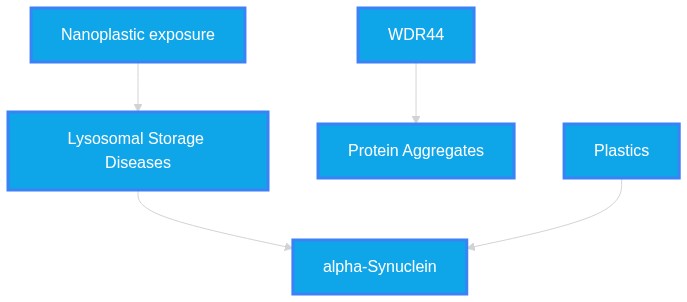
Polystyrene nanoplastics (PS-NPs) may act as a scaffold for the recruitment and accumulation of WDR44 at the lysosomal membrane, thereby accelerating the de novo aggregation of alpha-synuclein in the early stages of PD.
Plausibility Verdicts
The claim is a novel hypothesis that is biologically plausible but currently unsupported by direct experimental evidence in the provided literature.
Dataset Summary
Novel & Overlooked Insights
- Lysosomal membrane permeabilization (LMP) is a central nexus in both neurodegeneration and nanoplastic-induced cellular toxicity.
- WDR44 knockdown is documented to markedly reduce α-SYN aggregation, whereas its overexpression accelerates pathology, identifying it as a primary target for therapeutic intervention.
- Nanoplastics can induce lysosomal iron efflux, facilitating pathways such as ferroptosis, which overlaps with the lysosomal-mitochondrial crosstalk seen in PD.
- Cellular mechanisms for lysosome repair, such as ESCRT recruitment and TFG-mediated repair, are hindered by the proteinopathies that nanoplastics potentially amplify.
- The "body-first" hypothesis of PD is supported by studies on the enteric nervous system, where nanoplastics induce α-SYN aggregation similar to pesticides.
- In addition to proteinopathies, nanoplastics influence epigenetic reprogramming and cytoskeletal remodeling, adding layers of complexity beyond pure protein-folding models.
- Lysosomal acidification is a major bottleneck; multiple compounds, including acidic nanoparticles and ginsenoside Rg1, show potential for restoring degradative function in PD models.
- Small GTPases and their activation, such as those analyzed by the SAIYAN system, provide potential monitoring tools for the spatiotemporal activation of pathways impacted by both PD and plastic exposure.
Extracted Discoveries
- Perform co-immunoprecipitation (Co-IP) or proximity ligation assays (PLA) to determine if internalized polystyrene nanoplastics physically interact with WDR44 at the lysosomal membrane.
- Evaluate WDR44 localization via super-resolution microscopy in cells exposed to fluorescently labeled polystyrene nanoplastics.
- Use CRISPR-mediated WDR44 depletion in nanoplastic-exposed models to quantify the reduction in α-synuclein pathology relative to controls.
- Comparative analysis of WDR44-alpha-synuclein co-localization patterns in sporadic PD patient-derived cells vs. nanoplastic-stressed healthy cells.
- Temporal tracking study of lysosomal WDR44 enrichment post-nanoplastic internalisation.
- Nanoplastic-induced lysosomal membrane remodeling may sequester WDR44, creating a 'hotspot' for α-synuclein aggregation initiation.
- Polystyrene nanoplastics cause lysosomal membrane permeabilization and lipid composition shifts (ID: 41643617; 41812834).
- WDR44 initiates α-synuclein aggregation specifically at the lysosomal membrane (ID: 41993512).
- Lysosomal surface remodeling/membrane composition changes induced by hydrophobic particles.
- Nanoplastic accumulation alters lysosomal membrane lipids (phosphatidylethanolamines/cardiolipins), which may provide an aberrant surface or structural anchor that recruits WDR44, effectively lowering the threshold for its interaction with α-synuclein.
- None directly contradictory, but studies emphasize distinct mechanisms (e.g., STING vs. WDR44 vs. mitochondrial-lysosome coupling) as the primary initiator, suggesting multi-factorial drivers of aggregation.
- The use of lysosome-acidifying nanoparticles (AcNPs) or ginsenoside Rg1 to restore lysosomal homeostasis could theoretically mitigate the recruitment of WDR44 by alleviating membrane tension and pH imbalances.
PathMap is funded by sales of datasets and coversheets to researchers of any kind who wish to discover the most viable routes and paths to accelerate cures. We do not make theoretical molecules, we expose the truth in current PubMed literature. Commission a trace today.
PathMap Scores
How are these metrics evaluated?
Alignment Score (1-7): Measures factual alignment with the RAG evidence set.
[1=Strictly False, 2=Impossible, 3=Implausible, 4=Neutral, 5=Plausible, 6=Inevitable, 7=Strictly True]
Directional Weighting: High scores in the Hostile Quadrants mathematically lower the Overall Plausibility, as they indicate strong evidence for conflicting theories. Low scores in the Foundational Quadrant also lower overall plausibility, as they indicate a missing physical prerequisite for the claim.
Veridicality Audit Report
All Extracted Datapoints
Evaluated Perspectives & Quadrants
Verbatim Quote Audit Console
Mapped Reference Directory (APA)
Abstract Repository (Raw Full-Texts) Show Database
Investigator Profile