PathMap
☰
Curation Policy
FAQ
About
Contact
Legal
GitHub
PathMap Literature Based Discovery Engine
Share your Discovery:
Guaranteed to find unpublished literature based discoveries.
Clear Search
Experiment #00000139
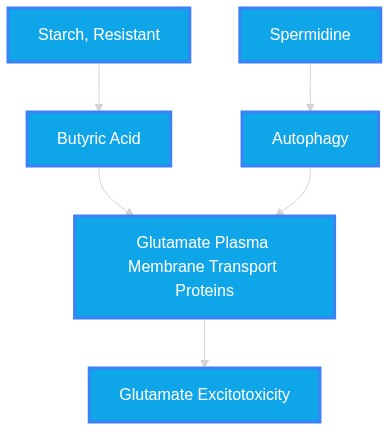
Foundational Dietary Theory: The dietary synergy between Hi-Maize and 6x Spermidine Yeast creates a potential cellular supply-and-clearance loop within the brain's astrocytes. Circulating spermidine metabolites utilize documented astrocytic polyamine uptake systems to access the central nervous system. Once inside, this exogenous spermidine drives FAM134B-mediated ER-phagy, clearing the endoplasmic reticulum matrix. This clearance removes the ER-stress bottleneck, allowing newly transcribed astrocytic EAAT2—upregulated by gut-derived butyrate from Hi-Maize fermentation—to successfully traffic to the plasma membrane and mitigate synaptic glutamate excitotoxicity.
Starch, Resistant
_gates_from_starch__resistant
Butyric Acid
_gates_to_butyric_acid
_gates_from_butyric_acid
Glutamate Plasma Membrane Transport Proteins
_gates_to_glutamate_plasma_membrane_transport_proteins
Spermidine
_gates_from_spermidine
Autophagy
_gates_to_autophagy
_gates_from_autophagy
_gates_from_glutamate_plasma_membrane_transport_proteins
Glutamate Excitotoxicity
_gates_to_glutamate_excitotoxicity
+5 more
View Results
Experiment #00000138
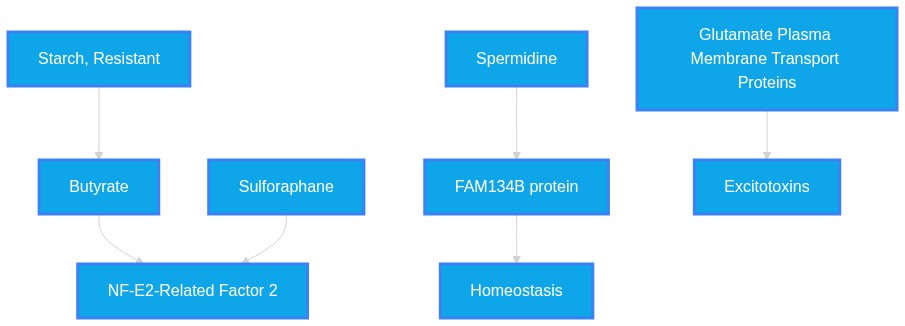
Dietary butyrate from resistant starch may synergize with sulforaphane-driven Nrf2 activation and spermidine-mediated FAM134B ER-phagy in order to restore astrocytic EAAT2 membrane trafficking and potentially clear synaptic glutamate excitotoxicity in neurodegeneration. (Literature Based Discovery)
Starch, Resistant
_gates_from_starch__resistant
Butyrate
_gates_to_butyrate
_gates_from_butyrate
NF-E2-Related Factor 2
_gates_to_nf_e2_related_factor_2
Sulforaphane
_gates_from_sulforaphane
Spermidine
_gates_from_spermidine
FAM134B protein
_gates_to_fam134b_protein
_gates_from_fam134b_protein
Homeostasis
_gates_to_homeostasis
Glutamate Plasma Membrane Transport Proteins
_gates_from_glutamate_plasma_membrane_transport_proteins
Excitotoxins
_gates_to_excitotoxins
+10 more
View Results
Experiment #00000016
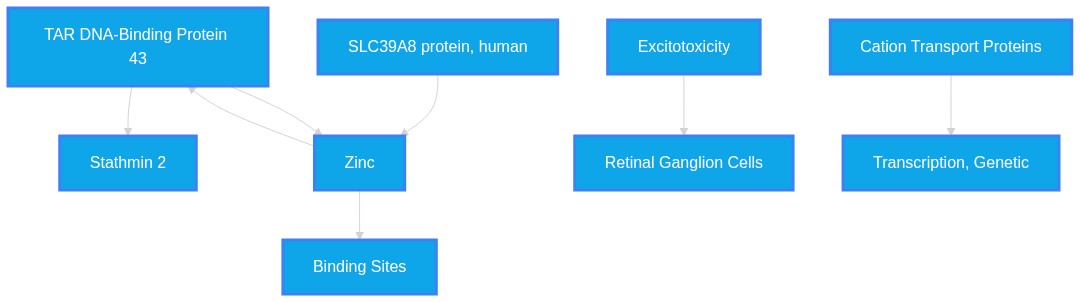
Analyze the potential for zinc-binding competition between synaptic transporters (e.g., SLC39A8, ZnT3) and ALS-associated proteins (RGNEF, TDP-43) in the RGC-thalamic axis. Can this competition explain the coexistence of RGC excitotoxicity and STMN2 depletion in clinical samples?
TAR DNA-Binding Protein 43
_gates_from_tar_dna_binding_protein_43
Stathmin 2
_gates_to_stathmin_2
SLC39A8 protein, human
_gates_from_slc39a8_protein__human
Zinc
_gates_to_zinc
Excitotoxicity
_gates_from_excitotoxicity
Retinal Ganglion Cells
_gates_to_retinal_ganglion_cells
Cation Transport Proteins
_gates_from_cation_transport_proteins
Transcription, Genetic
_gates_to_transcription__genetic
_gates_from_zinc
Binding Sites
_gates_to_binding_sites
_gates_to_tar_dna_binding_protein_43
+10 more
View Results
Experiment #00000012
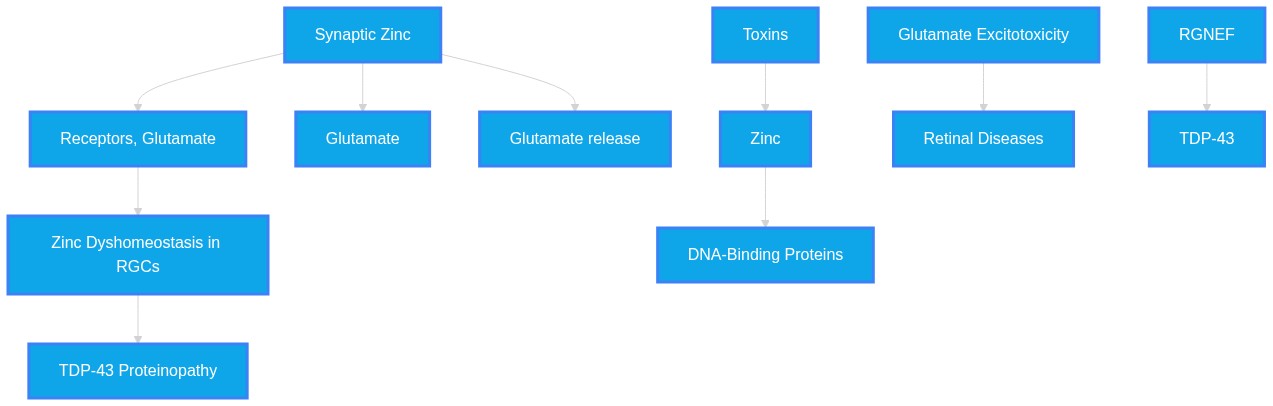
If a toxin with a thermodynamic affinity for Zinc GREATER THAN that of Glutamate AND LESS THAN that of RGNEF, under certain conditions a pathway exists wherein the toxin could shuttle synaptic retinal zinc to RGNEF, thus potentially ultimately resulting in the retinal TDP-43 proteinopathy seen in the retina post mortem in Sporadic Amyotrophic Lateral Sclerosis
Synaptic Zinc
_gates_from_synaptic_zinc
Receptors, Glutamate
_gates_to_receptors__glutamate
_gates_from_receptors__glutamate
Zinc Dyshomeostasis in RGCs
_gates_to_zinc_dyshomeostasis_in_rgcs
_gates_from_zinc_dyshomeostasis_in_rgcs
TDP-43 Proteinopathy
_gates_to_tdp_43_proteinopathy
Glutamate
_gates_to_glutamate
Zinc
_gates_from_zinc
DNA-Binding Proteins
_gates_to_dna_binding_proteins
Glutamate release
_gates_to_glutamate_release
Glutamate Excitotoxicity
_gates_from_glutamate_excitotoxicity
Retinal Diseases
_gates_to_retinal_diseases
RGNEF
_gates_from_rgnef
TDP-43
_gates_to_tdp_43
Toxins
_gates_from_toxins
_gates_to_zinc
+19 more
View Results
Reference Abstract
Loading...
Source: PubMed
View on PubMed